Daniel Foster carried other people’s important letters for twenty-seven years before he discovered that the most important pieces of mail in his own house had been disappearing.
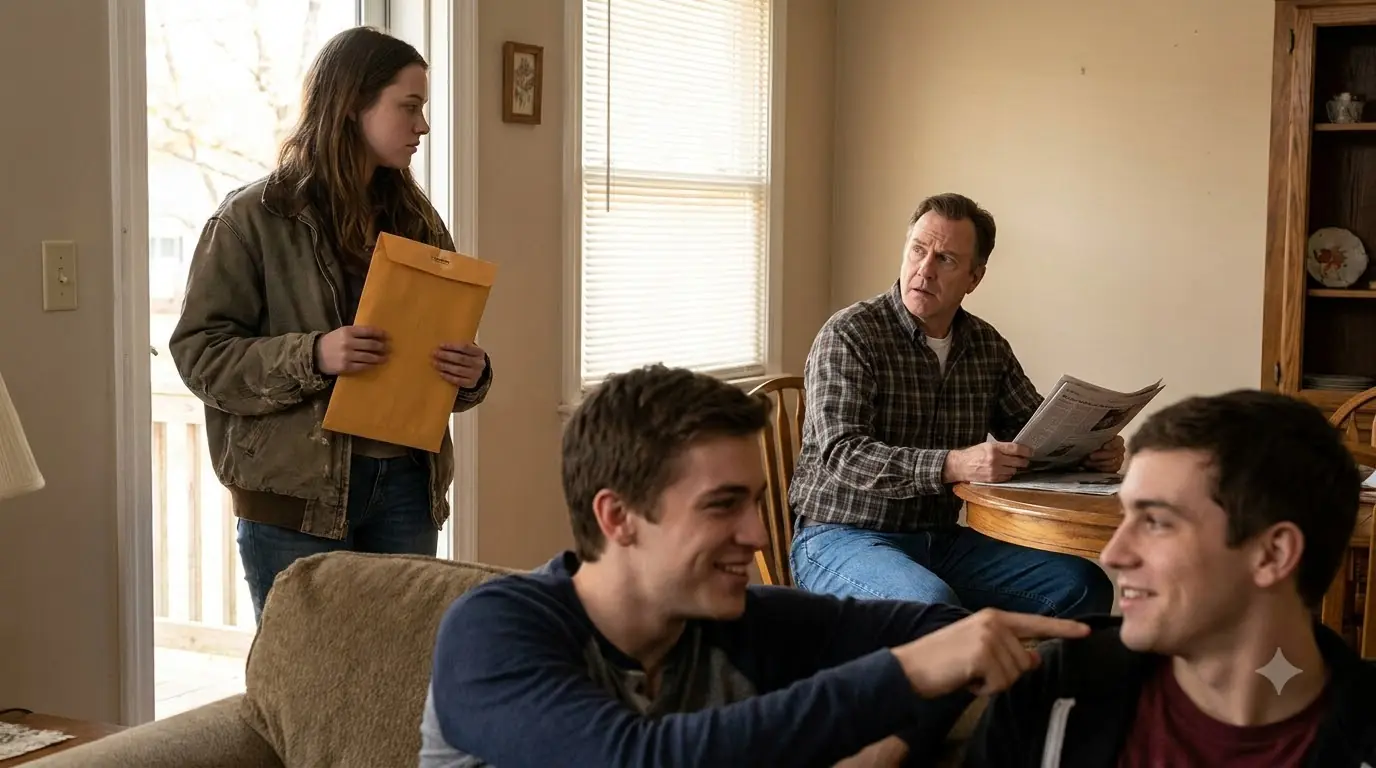
He came through the kitchen door at 4:37 on a warm September afternoon still wearing his blue postal-service polo, gray work pants, and the tired expression that usually disappeared the moment he saw his family. His route had been heavier than usual, his right knee hurt, and the Arizona heat had followed him inside even though the air conditioner was running. He wiped his forehead with one forearm and stopped beside the kitchen island.
Sixteen-year-old Noah Foster sat on one stool, grinning so broadly Daniel almost laughed before knowing why.
Fourteen-year-old Caleb sat beside him with curly red hair falling over his glasses. Around the boys were shopping bags from the outlet center, a cardboard shoebox, folded shirts, a new backpack, and the black duffel Daniel and his wife Laura had bought Noah for junior-year baseball.
Laura stood at the other end of the island sorting receipts.
“You're early,” she said.
“Truck temperature light came on.”
Daniel placed his lunch cooler down.
“Supervisor switched my last block.”
Noah leaned forward.
“So?”
Daniel looked at him.
“So what?”
The teenager glanced meaningfully at Daniel’s pocket.
Daniel tried not to smile.
“Subtle.”
“You said today.”
“I said maybe today.”
“You bought it?”
Caleb immediately looked up.
“Wait. Seriously?”
Laura smiled despite herself.
Daniel reached into his pocket.
A key ring appeared in his hand.
One silver key.
One black remote.
One small red tag from Mesa Valley Auto Sales.
Noah stood so fast the stool scraped the tile.
“No way.”
Daniel placed the keys on the island.
The boy stared.
“Is that—”
“2008 Honda Civic.”
“You actually got it?”
“No.”
Daniel nodded toward the keys.
“I stole somebody else’s car and thought we'd all learn together.”
Noah laughed.
Caleb reached for the remote.
Noah slapped his hand away.
“Mine.”
“Not yet,” Daniel said.
Noah looked at him.
Daniel leaned against the counter.
“Insurance starts Monday.”
“You finish defensive-driving Saturday.”
“Your mother and I keep a spare.”
“No passengers for the first month except Caleb if we approve it.”
Noah groaned.
“Dad.”
Daniel raised an eyebrow.
“Would you prefer walking?”
“No.”
“Excellent negotiation.”
Noah picked up the keys.
For one second the teenager looked eight years old again.
That was why Daniel had bought the car.
Not because Noah needed one desperately.
He could ride with friends, take the school bus, borrow Laura’s SUV occasionally.
Daniel bought it because Noah had worked all summer at a grocery store, saved nearly two thousand dollars, maintained good grades, helped coach little-league baseball, and repeatedly proven himself responsible.
Or at least Daniel believed he had.
“You like it?” Daniel asked.
Noah looked toward him.
“Are you kidding?”
He stepped around the island and hugged his father.
Daniel laughed.
“You haven't even seen it.”
“Where is it?”
“Driveway.”
Noah almost ran toward the window.
Caleb followed.
“It’s silver!”
“I can see that.”
“Looks old.”
“You can walk.”
“I didn't say bad.”
Noah laughed.
Laura shook her head.
For a few minutes, the Foster kitchen looked exactly like the kind of family scene Daniel had spent years trying to build.
That mattered to him more than anyone in the room understood.
Daniel’s first wife, Rebecca, had died when Noah was nine and Caleb was seven.
An aneurysm.
No warning.
No long illness.
One morning Rebecca complained about the worst headache of her life. By that evening, Daniel was sitting in an intensive-care waiting room while a neurosurgeon explained words he could hear but not understand.
Two days later, his sons no longer had a mother.
Daniel spent the next three years trying to make sure they never lost anything else.
Too much pizza.
Too few rules.
Sleeping in Daniel’s bed whenever they wanted.
Cancelled trips because Caleb became anxious.
New baseball equipment because Noah said his teammates had better gear.
Daniel knew he had overcompensated.
He told himself grieving children deserved excess softness.
Then he met Laura Mitchell.