Rain silvered the glass walls of Aurelia Grand while three hundred guests lifted crystal flutes beneath a ceiling Elena Hartwell Vale had designed herself. She had spent nine years turning a neglected lakeside property into the flagship of a resort network that now stretched across North America and Europe. Every line of the lobby, every hidden service corridor, every garden terrace and staff residence had begun as a drawing beneath her hand. Yet when Julian Vale stepped onto the stage that night, he spoke as though the entire world around him had risen from his will alone.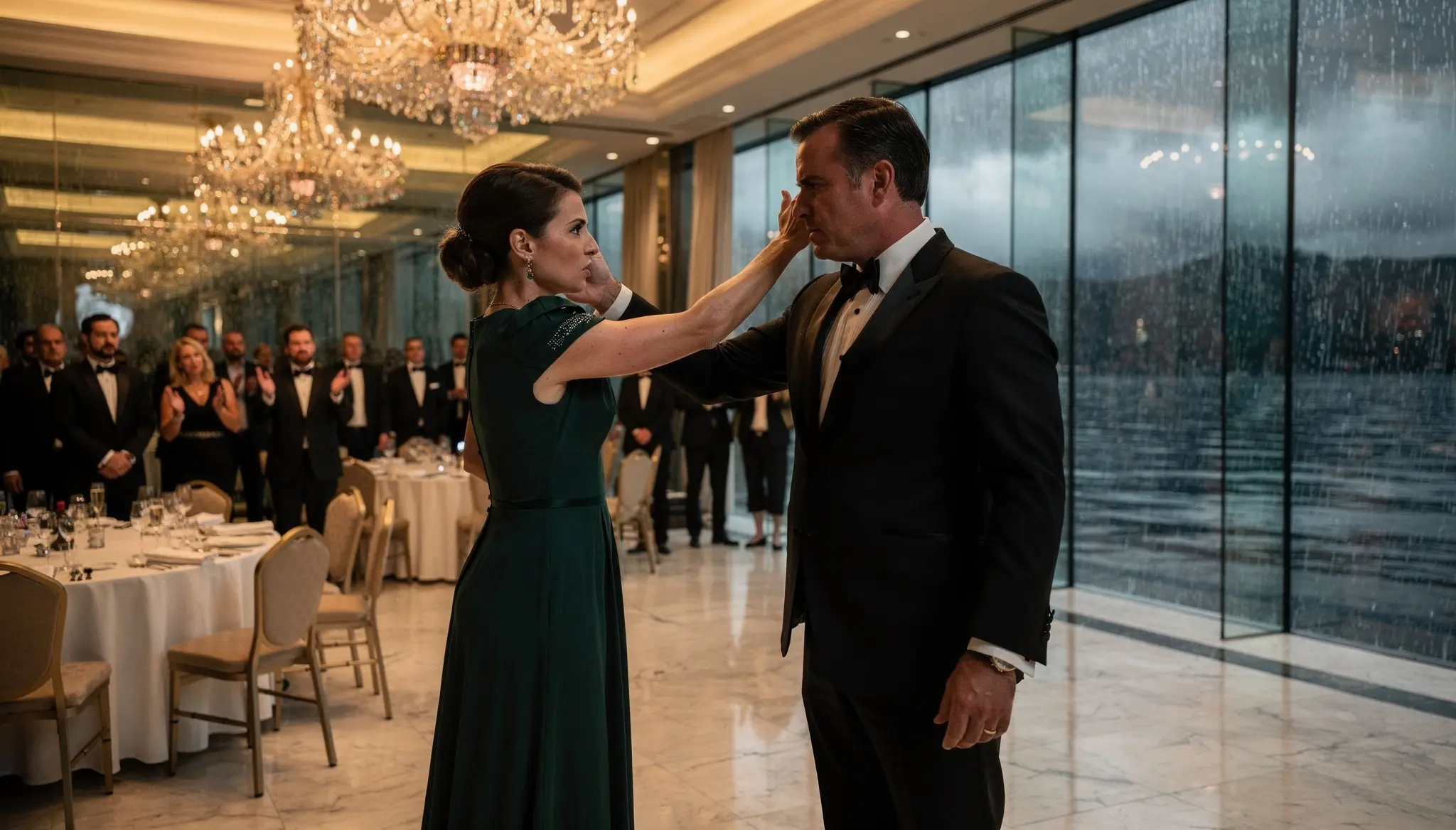
“My resort,” he said, smiling toward the investors seated closest to the stage. “My company, my vision, and soon, the largest privately controlled hospitality group on the continent.”
Elena stood near the back of the ballroom, one hand resting around an untouched glass of water. She watched several directors exchange uneasy glances, but none interrupted him. Julian had become the public face of Aurelia because she had once believed visibility and ownership were separate things. She had preferred plans, contracts, design reviews, labor meetings, and the quiet work of building something durable. He had preferred cameras, interviews, magazine covers, and rooms in which people applauded before they understood what had been said.
Then Celeste Ward entered wearing Elena’s pale cashmere coat.
The emerald pendant at Celeste’s throat struck Elena harder than the coat. It had belonged to her grandmother, then to her mother Isabel, and finally to Elena. She had kept it in a locked drawer in the penthouse because the tiny scratches near the clasp reminded her of childhood evenings when Isabel had let her hold it beneath a lamp. Celeste touched the stone as she crossed the ballroom, and Julian’s expression softened in a way he had not allowed Elena to see in months.
Elena walked toward the stage. “Take off my coat,” she told Celeste quietly. “And give me the pendant.”
Celeste’s lips curved. “Julian said it was part of the resort collection.”
“It is not.”
Julian descended from the stage before Elena could reach them. “You are embarrassing yourself,” he said, loud enough for the nearest tables to hear. “This is a business event, not another one of your scenes.”
Elena stared at him. “You invited your mistress into my home wearing my mother’s necklace, and you think I am the one creating a scene?”
The room fell silent. Julian’s face hardened, not with shame but with the fury of a man whose control had been questioned in public. He signaled Marcus Hale, Aurelia’s head of security. Marcus did not move. Julian signaled again, this time toward two guards stationed beside the ballroom doors.
“Remove her,” Julian ordered. “She is no longer authorized to remain on the property.”
A murmur spread across the room. Elena heard one investor whisper that she was Julian’s wife. Another answered that perhaps the divorce papers had already been filed. The guards approached with visible reluctance, but Julian repeated the order and warned them that refusal would end their careers. Elena did not resist when they guided her through the lobby she had designed and out beneath the front canopy.
The rain had become heavy. It soaked through her silk sleeves before the doors closed behind her. Through the glass, she saw Julian turn back toward the ballroom as though a minor inconvenience had been removed. Celeste remained beside him, still wearing the emerald pendant.
Elena took out her phone and called her father.
Adrian Hartwell answered on the first ring. “Elena?”
She watched rainwater run down the engraved brass threshold of Aurelia Grand. “Nightfall.”
There was a pause, not of confusion but recognition. “Are you in immediate danger?”
“I have been removed from the property by Julian’s order. Celeste has Mother’s pendant. Julian has declared Aurelia his.”
“Stay where cameras can see you,” Adrian said. “Nightfall is active.”
Inside the resort, Julian’s access card failed before he reached the private elevator. He tried it twice, then shoved it into the reader with enough force to bend the edge. The elevator remained locked. On the ballroom level, the doors to the executive operations room sealed automatically. Computer sessions connected to Julian’s credentials ended, his authority over payroll transfers was suspended, and every master key assigned to him reverted to ordinary guest status.
Phones began ringing across the ballroom. Directors received emergency notices from Hartwell Land Trust, Aurelia Infrastructure Holdings, and the three entities that owned the trademarks, access roads, marina rights, water systems, and energy agreements serving the resorts. Within forty seconds, Julian’s title had been suspended pending a fiduciary review. Within ninety seconds, Elena had been appointed interim executive chair.
Julian stormed back toward the front entrance, but the outer doors would not respond to his badge. A staff member had to open them manually from the desk. He stepped beneath the canopy and found Elena standing in the rain with her phone still in her hand.
“What did you do?” he demanded.
Elena looked at the man who had just thrown her from a building she had created. “I used one word.”
“You locked me out of my own company.”
Julian laughed sharply. “You think your father can steal Aurelia from me because you are angry?”
“Aurelia was never yours to steal.”
The truth reached the investors before the rain stopped. Julian owned roughly twelve percent of Aurelia Operations, the company responsible for day-to-day management. He owned none of the land beneath Aurelia Grand. He did not own the buildings, the brand, the road from the county highway, the marina, the water treatment system, the private power line, or the data centers supporting reservations. Those assets belonged to trusts and holding companies created by the Hartwell family long before Julian appeared on magazine covers.
The structure had never been designed to humiliate him. Isabel Hartwell had built it after watching developers destroy entire communities by leveraging land they did not truly understand. She believed operations could take risks, but land and public access should not be placed at the mercy of one executive. Julian had been given broad authority to manage the resorts, but not the power to sell their foundations.
By midnight, the board had moved its emergency session to a conference room in a hotel across the street. Elena arrived in borrowed clothes and sat beside Priya Nair, Aurelia’s director of audit. Marcus stood near the door, his expression unreadable. Julian entered with two lawyers, demanding reinstatement and accusing Elena of staging a marital coup.
Priya placed a thick file on the table. “Before the board considers any reinstatement, we need to discuss a four-hundred-eighty-million-dollar obligation to Sloane Meridian.”
Elena turned toward her. “What obligation?”
Priya slid a document across the table. It carried Elena’s signature, her biometric authentication, and an encrypted approval that appeared to have come from her personal signing tablet. The loan was secured not only by Aurelia Operations but by conversion rights. If the company missed a payment or breached specific financial conditions, Sloane Meridian could convert the debt into voting control before dawn.
Julian stared at the contract as though seeing it for the first time. “That financing was necessary.”
“You knew about it?” Elena asked.
“I knew Victor Sloane had offered bridge capital. I did not know the final structure.”
“Yet your authorization appears on the supporting schedules,” Priya said.
Julian looked at Elena instead of answering. “You signed the guarantee.”
“I did not.”
His lawyer leaned forward. “The biometric record says otherwise.”
Elena studied the pages. The signature resembled hers perfectly, but the pressure pattern was wrong. She signed slowly at the beginning of her surname and lifted slightly before the final letters. The forged signature moved in one continuous stroke. Someone had copied the image but not the habit behind it.
Naomi Pierce, Elena’s attorney and longtime friend, examined the authentication record. “The approval required four elements,” she said. “Elena’s tablet, her biometric sample, a legal authentication ring, and a security officer’s rotating code.”
Marcus stiffened. Naomi looked down at her right hand and found the slim silver ring she used for high-value document authentication was missing.
“My ring was in my hotel safe in Geneva last month,” she said.
Priya opened a second file. Security footage from Geneva showed Celeste entering a private meeting room with Elena’s tablet tucked beneath a folder. Dane Kessler walked beside her. Kessler was known publicly as an asset recovery consultant. Privately, he had spent two decades acquiring distressed properties for Victor Sloane, often by making survival impossible for the owners before offering rescue.
Another clip showed Marcus entering the room hours earlier to review conference security. A third showed Julian authorizing Celeste to attend as his representative. No single person appeared to possess every element required for the fraudulent loan, but together their actions formed a complete authorization chain.
“It was assembled from pieces,” Elena said. “My device, Naomi’s ring, Marcus’s code, Julian’s access, and Celeste’s hand.”
Priya nodded. “A mosaic attack. Each participant could tell themselves they were only responsible for one harmless fragment.”
Julian pushed back from the table. “Celeste would not forge a half-billion-dollar loan without telling me.”
Elena thought of the emerald pendant. “Then perhaps you knew less about the woman beside you than you believed.”
Before the meeting ended, Priya presented a second discovery. Over three years, Julian had approved payments to consulting companies connected to Sloane Meridian and Kessler. Some were labeled transport optimization. Others were described as utility resilience, waterfront access studies, or regional vendor consolidation. In reality, the companies had purchased docks, road easements, transmission routes, freight contracts, and maintenance firms surrounding Aurelia properties.
Victor Sloane did not need to own the resorts. He only needed to own every road, cable, harbor, and service through which they survived.
The emerald pendant became the first physical clue linking the present attack to the death of Elena’s mother. Naomi recovered an old appraisal showing that Isabel had modified the pendant shortly before the fire at Aurelia Cove twenty-two years earlier. Beneath the emerald was a hollow chamber containing a micro-key unlike any commercial key design. The report did not explain what it opened.
Elena had been nine when the fire started in the east wing of Aurelia Cove during renovation. She remembered smoke, heat, and Adrian carrying her through a corridor while someone screamed behind them. Isabel died inside. The official report blamed a solvent accident and faulty temporary wiring. Kessler’s name did not appear in the report, yet a newly recovered photograph placed him near the service entrance that night.
Thomas Vale, Julian’s father, had also been there. According to family history, Thomas rescued Elena and later died while traveling overseas. But Adrian possessed a letter Thomas had sent shortly before his reported death. Naomi read it aloud to the board in a closed session.
“Isabel was right about Sloane’s private ledger,” Thomas had written. “I took the child out, but Julian saw more than he has admitted. Protect Elena, and do not trust what Julian says after Victor speaks to him.”
Julian’s face drained of color. “My father never wrote that.”
Adrian, appearing by secure video, answered calmly. “He wrote it to me.”
“You told me he died.”
“I told you what was necessary to keep you alive when you were sixteen.”
“Or necessary to keep me obedient,” Julian replied.
The board recessed before dawn, but no one left with certainty about who had betrayed whom. Elena returned to Hartwell House with Adrian, Naomi, Priya, Marcus, and a reduced security team. The house had belonged to Isabel, and its oldest rooms still contained narrow service passages from the nineteenth century. Elena had played inside them as a child. She had forgotten how easily a person could move unseen behind the walls.
Celeste arrived just after sunrise.
She came without the cashmere coat and placed the emerald pendant on the table between them. Her hands shook, though her voice remained controlled. “I copied your signature,” she told Elena. “I used your tablet in Geneva. I took Naomi’s ring from the hotel safe, and I gave Kessler the data he needed to construct the biometric authorization.”
Julian stepped toward her. “Why?”
Celeste looked at him with something colder than affection. “Because Victor promised to tell me where my mother’s evidence was hidden. Because he said Marina Ward did not die a thief. And because I believed you when you said Elena and Adrian had stolen the life that should have been yours.”
“You were with me to gain access,” Julian said.
“At first.” Celeste’s eyes flickered. “Then I began believing parts of the lie because they were easier than admitting what I had become.”
Elena picked up the pendant but did not put it on. “Why are you here now?”
“Victor is removing everyone who knows enough to connect the loan, the fire, and the land purchases. He has a list. Adrian, Naomi, Marcus, Priya, me.” Celeste looked at Julian. “And you, if he decides you are no longer useful.”
Julian’s jaw tightened. “He needs me.”
“He needed your name, your access, and your resentment. Those are not the same as needing you alive.”
The first shots struck the windows before anyone answered. Glass burst inward from the eastern gallery. Marcus dragged Elena behind a stone column while Thomas Reed’s old security shutters began closing across the lower floors. Armed men entered through the garden doors using copied Hartwell credentials. Kessler’s voice came through the house intercom, telling Adrian to surrender the pendant and Isabel’s records.
Adrian led the others through a concealed panel behind the library shelves. The passage descended between the walls and split beneath the central staircase. Celeste knew one route from old architectural plans, but Elena remembered another, narrower turn that led toward Isabel’s private workroom. Dust covered the door. The lock accepted the micro-key from the pendant.
Inside were metal film canisters, photographs, and a projector built into a cabinet. Elena inserted the key a second time, and the projector came alive. Isabel appeared on the wall, younger than Elena now was, her hair pinned back and soot visible along one cheek.
“If you are watching this,” Isabel said, “the ledger has survived longer than I expected, and so have the lies around it.”
The film jumped. Isabel’s voice changed slightly, as though a section had been cut away.
“Adrian is one of them,” she appeared to say. “The other will be the child Elena trusts most when she is grown.”
Elena felt the room contract around her. Adrian stood several feet away, staring at the image of his dead wife. Julian looked from the screen to Elena with a terrible, almost vindicated expression.
“I told you,” he whispered. “Your father built all of this on secrets.”
Priya moved closer to the projector. “The splice is recent.”
Kessler’s men struck the outer door. Marcus fired once through the passage, forcing them back. Naomi removed the reel and held it toward the light. A narrow segment had been cut and rejoined with modern adhesive.
“Someone edited your mother’s last testimony,” she said. “They wanted you to hear an accusation, not the truth.”
The group escaped through a tunnel that opened beyond the greenhouse. Hartwell House burned in two rooms before emergency crews contained the attack, but Isabel’s film and the pendant survived. By afternoon, federal agents arrived with a warrant for Adrian based on leaked records suggesting he had financed Sloane companies after the Aurelia Cove fire.
Elena watched officers place her father in a transport vehicle. Adrian did not resist. “Do not trust the route,” he told her. “Victor buys systems by buying the people who believe they are too small to matter.”
Twenty minutes later, the convoy changed direction without authorization. The vehicle carrying Adrian disappeared.
Elena did not wait for official reassurance. The escort company blamed a routing error, the local police claimed the federal agents had taken custody, and the federal agents denied authorizing the transfer. Marcus traced one of the convoy vehicles to the eastern edge of Aurelia Cove, where the oldest sections of the resort had remained sealed since the fire. Elena, Marcus, and Celeste entered through a maintenance gate before the authorities could stop them.
The east wing stood like a dark wound above the lake. New construction surrounded it, but Adrian had refused to demolish the original stone shell. Inside, smoke stains still marked the upper arches, and warped iron beams crossed rooms where Isabel’s plans had once hung. Elena heard movement in the lower service corridor and found Julian kneeling beside an old drainpipe with a flashlight between his teeth.
He spun toward them. “You should not be here.”
“My father vanished,” Elena said. “You came directly to the place where my mother died. Explain why.”
Julian pulled a folded fragment from his coat. It was part of a letter written in Isabel’s hand. The visible lines described an agreement Adrian had signed with Victor after Hartwell money entered a network of fraudulent investments. Isabel called the signature a betrayal, but the next page was missing. Julian claimed the letter proved Adrian had not been an innocent defender of the family.
“I remembered something after seeing the film,” Julian said. “The night of the fire, I hid a ledger page in a drainage tube. I was terrified Victor would find it.”
Celeste stepped closer. “You told Victor you never touched the ledger.”
“I was sixteen.”
“You were forty when you repeated the lie to me.”
Julian ignored her and reached deeper into the pipe. His fingers closed around a rusted metal cylinder. Inside was a page filled with account numbers, dates, company names, and handwritten initials. Taped beneath it was a small cassette labeled for Elena.
Elena carried an old recorder in her emergency case because Isabel’s archives included several formats. She inserted the tape. Her mother’s voice filled the ruined room.
“Ellie, there are moments when the people who love you will ask for time instead of truth. Sometimes they are buying time to protect you. Sometimes they are buying silence to protect themselves. You must learn the difference.”
A sound echoed in the corridor. Marcus pushed Elena behind a stone support as gunfire struck the wall. Kessler and two armed men advanced from the western entrance. Julian grabbed the cylinder and ran toward the service stairs. Celeste followed, shouting that the page belonged to her mother as much as to Isabel.
The corridor filled with dust and smoke from a charge placed against an old door. Elena lost sight of Celeste. When Marcus reached the stairs, he found blood on the railing and Celeste’s scarf caught beneath a broken hinge, but no body. Julian had escaped with the cylinder. Kessler vanished through a route connected to the lake tunnels.
By evening, Aurelia faced a crisis larger than any single property. Julian released an edited video showing Elena discussing the hidden ownership structure with Adrian. The audio had been rearranged to make her appear to admit that Hartwell entities had deceived banks and minority investors. Sloane Meridian sent default notices to every major lender, while four freight companies controlled by Victor suspended deliveries to Aurelia resorts.
Elena joined an emergency staff broadcast from Aurelia Grand. Behind her, reservation systems flickered and managers took notes by hand. She explained the ownership structure, admitted that it had been too complex and too secretive, and promised independent review. Then she canceled Julian’s order terminating four hundred employees, an order he had signed hours before the gala to create cash reserves for the Sloane payment.
“We will not save a company by discarding the people who built it,” Elena said. “No one should confuse secrecy with stability again, including me.”
Employees in kitchens, maintenance rooms, front desks, marinas, and shuttle depots kept the resorts operating. Some drove personal vehicles to deliver food when Sloane-controlled transport companies refused service. Others opened manual reservation books, checked guests in with paper forms, and moved payroll data through independent channels Priya verified. The crisis revealed weaknesses, but it also revealed that Aurelia’s real strength had never been Julian’s image.
Forensic specialists proved the video against Elena had been assembled from separate recordings. The breathing patterns did not match the sentences, room reflections changed between words, and the background clock moved backward twice. The evidence bought time, but not enough. Unless the four-hundred-eighty-million-dollar conversion was stopped, Victor could still claim voting control.
Priya found another structure buried beneath the financial records. Adrian had created a one-hundred-twenty-million-dollar Legal Protection Fund listing himself, Victor, Julian, and Celeste as beneficiaries. At first glance, it looked like a shared escape account. Julian’s lawyers called it proof that Adrian had participated in the conspiracy from the beginning.
Adrian could not answer because he was still missing. Naomi examined the trust language and discovered that none of the named beneficiaries could receive money personally. Funds could be released only after verified confessions activated claims for victims, employees, pension holders, and communities harmed by the Sloane network. The apparent protection fund was a trap designed to turn self-interest into restitution.
A message arrived from Victor directing Elena to an abandoned ferry terminal outside the city. Celeste appeared on the screen tied to a chair beneath a rusted loading platform. Victor promised to exchange both Celeste and Adrian for the emerald pendant, the ledger page, and Elena’s authorization to release the loan conversion.
Elena went with Julian, Marcus, and a federal tactical team positioned beyond the terminal. Victor had chosen a building filled with old fuel lines and ventilation shafts. When Elena entered, doors sealed behind her and a pale gas began pouring through floor vents. Celeste coughed against the tape over her mouth while a projector illuminated the wall.
The footage showed a sixteen-year-old Julian at Aurelia Cove carrying a metal can through a service passage. Kessler walked beside him. Victor’s voice came through hidden speakers.
“Your husband has spent twenty-two years pretending he was only a witness.”
Julian stared at the image. “He told me it was cleaning solvent.”
On the screen, young Julian set the can beside a stairwell door. Kessler took it, unscrewed the cap, and disappeared toward the renovation wing. Minutes later, smoke filled the corridor.
“I knew it was wrong,” Julian said, his face gray. “I knew Kessler should not have been there. But I did not know Isabel was trapped inside.”
Victor’s voice returned. “You knew enough to stay silent.”
“And you taught me that silence was survival.”
Elena crawled toward Celeste while Marcus searched for the gas shutoff. Julian found an emergency wheel behind a corroded panel and forced it closed. Marcus shattered an upper window, and tactical officers entered as the gas began thinning. Victor and Kessler had never been inside the terminal. They had controlled the scene remotely.
Celeste tore the tape from her mouth. “The film is incomplete. Charles changed the testimony. He has done it for years.”
Charles Redding had served as Julian’s mentor since Thomas’s reported death. He had advised Julian through school, his first investments, and his marriage to Elena. Priya compared his consulting payments with the recovered ledger page and found transfers before and after the Aurelia Cove fire. Charles had been paid to manage witnesses, rewrite statements, and guide a frightened boy toward the version of events Victor needed.
Audio specialists recovered a damaged recording from the terminal system. Isabel’s voice could be heard arguing with Charles. “The boy does not know what is in that can,” she said. “You are using him because Victor believes fear lasts longer when it begins young.”
The words did not absolve Julian. As an adult, he had repeatedly chosen concealment, fraud, and cruelty. But they established that Victor, Kessler, and Charles had created the first cage around him when he was sixteen, then taught him to decorate the cage and call it power.
A telephone number hidden in Thomas Vale’s letter led Elena to a remote mountain lodge. Eleanor Hartwell, Elena’s grandmother, answered when Naomi called. Eleanor admitted that Thomas had never died. A courier carrying his passport had been murdered during an attack meant for him, and Eleanor used the confusion to hide the surviving witness.
“Elena must hear Isabel’s complete testimony before Thomas intervenes,” Eleanor said. “Otherwise every emergency action becomes another family secret replacing law.”
Elena traveled to the lodge with Naomi and Priya. Thomas opened the door. He was thinner than the photographs Elena remembered, with white hair and a scar running from his jaw into his collar. Behind him stood Adrian, exhausted but alive.
Elena crossed the room and held her father without speaking. Adrian apologized for the deception, the agreements, and the years of partial truths. He explained that Isabel had asked him to sign a temporary arrangement with Victor so she could continue tracing the stolen money. After her death, Adrian preserved the arrangement longer than necessary because exposing it would also reveal that he had protected Julian’s changed testimony.
“You thought secrecy could contain danger,” Elena said.
“I thought I could choose which truths reached you and when.” Adrian lowered his eyes. “That became its own form of control.”
Thomas possessed a legal authority capable of stopping the false loan conversion. Years earlier, Isabel had named him a conditional witness trustee. He could activate the authority only after Elena listened to Isabel’s unedited testimony and publicly affirmed the real purpose of the Hartwell land trust.
“The land was never meant to make your family untouchable,” Thomas told her. “It was meant to keep one person from treating workers, guests, communities, and history as private property.”
The original film was not at the lodge. Four months earlier, Celeste and Charles had arrived using Eleanor’s credentials. Celeste took the reel, believing it contained proof about Marina Ward, her mother. Charles allowed her to leave with it because he expected her to bring the evidence to Victor.
Thomas explained that Marina had worked with Isabel. On the night of the fire, Marina carried the Sloane ledger out through a service tunnel and divided its pages among several people. She was later killed and publicly blamed for theft. Celeste had grown up hearing that her mother betrayed the Hartwells. Her work for Victor had begun as an attempt to locate records that could restore Marina’s name.
Back in Chicago, Julian appeared before the emergency court. He admitted concealing Sloane-related transactions and allowing Victor access to Aurelia systems. He denied personally forging Elena’s signature, but acknowledged that he continued cooperating after Victor convinced him Adrian intended to strip him of all authority.
“I believed I had earned ownership because I was the person the public recognized,” Julian said. “When Elena questioned me, I treated her knowledge as a threat instead of the foundation of the company.”
Judge Helen Park extended the freeze on the loan conversion for seventy-two hours. “Your confession buys the court time,” she told Julian. “It does not purchase forgiveness, immunity, or ownership.”
The trail to the original film ended at a weathered inn in Vermont once used by Hartwell survey teams. Elena found Celeste in an upstairs room with the reel, Marina’s letters, and the cashmere coat folded in a suitcase. Celeste said she had kept the coat because wearing Elena’s life had become part of the role Victor expected her to perform.
Charles arrived before they could leave. He carried a pistol and spoke without the gentle patience he had used around Julian for decades. He admitted directing witness statements, financial fraud, and identity theft across multiple Hartwell and Sloane disputes. Marina, Isabel, Thomas, and Adrian had all believed they were collecting separate pieces of evidence. Charles had spent his life making sure those pieces never formed a complete picture.
Julian entered through the rear stairwell. He had followed Charles after recognizing an old tracking code in his mentor’s vehicle. Charles ordered him to stand aside.
“You exist because I taught you how to survive,” Charles said.
“You taught me how to call fear ambition.” Julian moved between Charles and Elena. “That is not the same thing.”
Charles fired. The bullet struck Julian below the shoulder. Celeste dragged him behind the bed while Elena knocked the lamp into Charles’s path. Charles escaped through the window with several ledger pages, but the original film remained in Elena’s hands.
At the hospital, while Julian underwent surgery, Elena watched Isabel’s complete testimony. The missing words transformed the message.
“Adrian is not one of them,” Isabel said. “Your father is not the man you must fear. The child Elena will trust most is not a person at all. It is the child inside her who believes love can repair someone who refuses responsibility.”
Isabel then explained that Adrian signed Victor’s agreement at her request. The signature was intended to distract the Sloane network while she copied records and moved the land into protective trusts. She warned that secrecy, even when begun for protection, would eventually become dangerous if the next generation treated it as inherited authority.
Marina’s statement identified a sealed evidence vault beneath the seawall at Aurelia Cove. The vault required two human admissions rather than ordinary keys. Elena had to affirm the public purpose of the trust. Julian had to identify himself as the first surviving witness to the violation that led to Isabel’s death.
Elena returned to the Cove with Thomas, Adrian, Naomi, Priya, Marcus, Celeste, and a wounded Julian who refused to remain in the hospital. Beneath the seawall, they found a bronze door engraved with the Hartwell compass. A recording system asked Elena to state whom the land existed to protect.
“The land is not the private shield of my family,” Elena said. “It exists to protect workers, guests, communities, lawful access, and the truth from any individual who would convert them into personal property.”
The system turned to Julian. He faced the microphone for nearly a minute before speaking.
“I was sixteen when Kessler gave me the can. I carried it knowing something was wrong. I saw him attack Isabel and later lied about what I saw after Victor threatened me. As an adult, I used that fear as permission to commit new wrongs. I concealed transactions, betrayed Elena, abused security authority, and tried to humiliate her so I could seize control. I am a witness, and I am also responsible.”
The bronze locks released.
Inside were ledgers, insurance records, land maps, recordings, and duplicate corporate documents preserved in waterproof containers. The evidence connected Sloane Meridian to officials, security contractors, distressed-property acquisitions, and witness intimidation across three decades. Marina’s original statement lay beside Isabel’s, proving the two women had worked together until the night of the fire.
The attack began before the first container could be removed. Charges exploded along the upper tunnel. Victor, Kessler, and Charles entered from the harbor side with armed men. Charles fired toward Elena. Julian crossed the narrow space and took the impact against a protective vest Marcus had forced him to wear.
Victor seized the black ledger and escaped through the water gate. He reached a waiting boat and headed toward the Aurora Crown, Aurelia’s largest private yacht. By the time coast authorities located the vessel, Victor had taken control of it with approximately two hundred guests and employees aboard.
Victor transmitted his demands from the upper deck of the Aurora Crown. He wanted safe passage beyond United States waters, release of the Sloane accounts, and Elena’s authorization allowing the fraudulent loan to convert into voting control. If she refused, he promised to begin killing hostages one deck at a time.
The Aurora Crown had been designed as a floating extension of the Aurelia brand. Elena knew its systems because she had approved the interior divisions, emergency bulkheads, crew routes, and guest communications. She boarded from a Coast Guard launch carrying what appeared to be the authorization device Victor wanted. Beneath her sleeve, Naomi had secured a transmitter connected to the vessel’s maintenance network.
Victor met her in the central salon. Kessler stood near the windows, and armed men controlled the staircases. Guests sat on the floor with their hands visible. Crew members had been separated from the engineers who understood the ship.
“You could have avoided this,” Victor said. “All you had to do was let Julian believe he owned what he managed.”
“You did not take this ship because Julian stopped believing,” Elena replied. “You took it because the records survived.”
She placed the device on the table. While Victor examined it, Elena pressed her thumb against the hidden transmitter. The Aurora Crown’s emergency zoning system came online. Fire doors dropped between decks, trapping several gunmen in service corridors. Cabin screens displayed instructions directing guests to lock themselves inside and remain below the window line.
Kessler grabbed Elena before she could reach the navigation panel. He forced her against the table and demanded the pendant. Celeste appeared from a pantry passage wearing a crew jacket. She struck Kessler with a fire extinguisher, then pulled Elena toward the bridge. Kessler recovered and drove a knife into Celeste’s side before Marcus and Coast Guard officers breached the salon.
Elena reached the bridge and entered the pendant key into an emergency port Isabel had commissioned years earlier. The engines reduced to idle, steering transferred to a secured console, and the exterior doors locked against Victor’s escape. Victor ran for a tender boat but found its release mechanism disabled.
Kessler was arrested beside the lower galley. Victor surrendered only after officers recovered the black ledger from beneath his coat. Celeste survived surgery, though the wound required months of rehabilitation. The loan collapsed when forensic analysts found files describing the voice-synthesis system used to create Elena’s verbal guarantee. The biometric chain, signature, and recorded approval had all been manufactured.
The immediate victory exposed a new problem. Eleanor Hartwell’s trust contained a succession clause. If Elena failed to complete the public purpose she had affirmed at the seawall vault, Julian could become the next land steward. Eleanor had written the clause as a test, not a reward. Julian could assume authority only after admitting every major wrongdoing and voluntarily abandoning all personal claims to the assets.
Charles emerged through attorneys with a separate appendix. He argued that Elena had violated the trust by attempting to restructure Aurelia during an active threat. If the court accepted his interpretation, her authority would terminate and the succession process would begin.
Judge Park convened an emergency hearing. Julian appeared in a sling, pale from blood loss but conscious. The trust transferred temporary stewardship to him after the court confirmed his confession met the threshold. Charles smiled from the observers’ section, believing Julian would use the position to reclaim the empire he had always wanted.
Julian signed the acceptance page. Then he signed a second document renouncing the position.
“I give up every personal claim to the land, buildings, roads, marinas, brands, and infrastructure held by the Hartwell trusts,” he said. “I transfer stewardship to the Isabel Hartwell Public Stewardship Foundation. No member of my family, Elena’s family, Celeste’s family, or Victor’s family should possess unilateral control.”
The courtroom remained silent. Elena did not mistake the act for redemption. Julian was surrendering power only after years spent trying to seize it. Still, the choice prevented Charles from using the succession clause and transformed the trust’s direction.
The interim board elected Elena executive chair for one year, giving her responsibility for the transition. Land stewardship would move to a council with an elected employee representative, an independent land-use expert, and Judge Park. Operational leadership would remain separate.
A burned page recovered from Charles’s files revealed another secret. Thomas Vale was not Julian’s biological father. Court-supervised testing confirmed Victor Sloane was.
Marianne Vale had worked for Victor when she was young. Thomas testified that Victor coerced her, then tried to claim the child after Julian’s birth. Thomas married Marianne and raised Julian as his own. Victor did not seek connection out of love. He saw a child who could be shaped, positioned near Hartwell assets, and taught to equate control with safety.
Julian received the result without visible surprise. “He called me his investment long before I understood what he meant.”
Thomas sat beside him. “Biology explains what Victor tried to do. It does not decide who you are, and it does not excuse what you chose.”
Victor’s arrest triggered a contingency Charles had built into Aurelia’s network. An account labeled FOUNDER began attacking twenty-seven resorts at once. Reservation systems failed, payroll files locked, electronic room keys stopped updating, and automated building controls issued contradictory commands.
Priya ordered every property to return to manual procedures. Employees opened mechanical key cabinets, checked paper fire maps, walked floor by floor, and set up handwritten payroll verification. Kitchens tracked supplies on clipboards. Engineers isolated elevators and operated essential systems locally. The company remained open because thousands of workers knew how to function without the polished technology executives had mistaken for the organization itself.
The FOUNDER program demanded a password tied to the Aurelia Cove fire. Official reports listed 214 occupied rooms that night. Thomas insisted the number was wrong. One room had been counted twice after a family moved during construction noise.
“Two hundred thirteen,” Elena said.
Priya entered 213. The attack paused, then exposed its command directory. Investigators traced the system to Charles’s hidden infrastructure and disconnected the resorts before permanent damage occurred. The number proved that even Charles’s most modern crimes remained built around manipulated details from the fire.
Before the network closed, Charles transferred nine hundred million dollars in illicit funds into the new Isabel Foundation. If the foundation accepted the deposit, prosecutors could argue that Aurelia’s public reform had been financed by criminal money. Banks would freeze the foundation, communities would lose confidence, and the transition could collapse.
Eleanor had named Celeste alternate founding officer because Marina Ward had helped preserve the original ledger. Celeste alone possessed the authority to reject the incoming transfer before settlement. From her hospital bed, she reviewed the instruction with Naomi.
“If I reject it, the money returns to Sloane accounts already under seizure,” Celeste said. “I receive nothing, and I lose the founder position.”
“That is correct,” Naomi answered.
Celeste looked at Elena through the video screen. “I wore your coat because I wanted to stand where you stood. I took the pendant because I thought access to your history would give me control over mine. Returning this money does not undo that.”
“No,” Elena said. “It does not.”
Celeste pressed the rejection command. The transfer reversed. She then resigned every role in the foundation and agreed to cooperate with prosecutors.
The new stewardship council formed without a Hartwell, Vale, Ward, or Sloane majority. Samuel Ortiz, a maintenance supervisor who had worked at Aurelia for twenty years, became the employee representative. Dr. Lila Chen, an independent land-use and environmental specialist, accepted the second seat. Judge Park led the council and required public minutes for all emergency decisions.
Charles remained missing. Priya found evidence that he had used a service credential inside Aurelia Grand after the yacht rescue. The access log ended beneath the brass compass set into the center of the lobby floor. Original blueprints showed a basement archive below it, sealed during renovation and absent from modern plans.
Elena entered the archive with Priya, Marcus, and Thomas. The room contained Hartwell ownership charters, Isabel’s letters, original land grants, and duplicate films. Charles sat behind a table with a pistol in one hand and a pressure switch in the other. Wires ran from the switch to incendiary charges placed among the shelves.
“If the first charter burns,” Charles said, “every transfer afterward becomes vulnerable. Victor may be in custody, but uncertainty can still destroy what you think you saved.”
Elena stopped several yards away. “You spent decades changing records because you knew the originals had more power than your stories.”
“I spent decades proving that people believe the first convincing explanation.”
“You removed one word from my mother’s testimony.”
“And for several days, you doubted your father. That was enough.”
Priya moved along the wall while Elena kept Charles talking. She found the firing circuit beneath a cabinet and began separating the control wires. Charles noticed Marcus shifting position and raised the pistol.
Thomas overturned the heavy archive table. Marcus fired once, striking Charles in the shoulder. The pressure switch fell from his hand. Priya cut the final wire half a second before the signal reached the charges.
Nothing burned.
Charles lay against the stone floor while officers entered. The original charter remained open beneath a protective sheet, its first provision stating that Hartwell property could never be used to deny lawful access to workers or communities dependent upon it. The document Charles intended to destroy contained the same principle Elena had spoken at the seawall.
Inside a locked drawer, Naomi later found Eleanor’s final letter to Julian. Eleanor wrote that surrendering ownership was only his first honest act, not redemption. Elena had no duty to reopen any door for him. If Julian meant to change, he would have to accept responsibility without asking the woman he harmed to watch, encourage, or reward him.
Julian read the letter in a federal interview room. That afternoon, he signed a comprehensive plea agreement covering financial fraud, conspiracy, obstruction, misuse of security personnel, and his role in Elena’s removal from Aurelia Grand. His cooperation activated another contingency hidden by Victor.
Explosives buried beneath the seawall were programmed to destroy the evidence vault and kill the investigators working inside. Adrian, Naomi, and a federal evidence team were cataloging records when the warning appeared. They had forty-seven minutes.
No complete demolition plan existed. The system combined hardwired timers with a radio trigger positioned offshore. Eleanor had discovered the explosives years earlier but had not removed them. Instead, she connected the primary timer to the land trust’s approval mechanism, believing a future generation should be forced to declare publicly what the land protected before the archive could be secured.
Elena was furious. “She left people standing over explosives to make a governance point.”
Judge Park did not defend Eleanor. “Then we will not repeat the same coercion by signing whatever you place before us.”
With less than half an hour remaining, the stewardship council debated the emergency charter. Samuel demanded enforceable protections for employees during future crises, including pay continuity and elected representation. Dr. Chen required environmental review and a prohibition against using emergency powers to bypass shoreline protections. Judge Park required every emergency authority to expire automatically unless reviewed in open proceedings.
Adrian’s voice came through the vault connection. “Elena, there may not be enough time.”
“There is enough time to do this without turning danger into obedience,” she answered.
Elena accepted every amendment. The council approved the charter with thirteen minutes and fifty-two seconds remaining. The primary timer stopped.
Then a second countdown appeared.
The offshore radio trigger was embedded in the spine of the recovered black ledger. Julian remembered Victor tapping the cover three times whenever he discussed the Cove. Priya examined the embossed number 213 and realized it concealed a mechanical release rather than a digital password.
Adrian pressed the figures in sequence. A compartment opened inside the ledger spine, revealing a compact transmitter. Marcus removed the casing while Priya identified the battery connection. He pulled the power source with forty-one seconds remaining.
The seawall held. The archive survived, along with the records of people who had risked their lives to preserve it.
During the evidence review, prosecutors found six payments from a Sloane security company to Marcus. Marcus explained that he had accepted the money as part of an unauthorized counterintelligence effort. He used Victor’s funds to identify compromised guards and prevented two attacks on Aurelia properties. Records supported that claim.
They also showed that Marcus knew Julian had increased security before the gala and suspected Elena was being drawn into a public confrontation. He had not warned her because he believed exposing the operation too early would prevent him from identifying the full network.
Elena listened without interrupting. “You saved lives,” she said. “And you decided that the danger to me was information I did not need.”
“I thought I could control the risk.”
“My father thought that. Thomas thought that. Julian thought that. Every secret in this story began with someone believing they alone could decide what another person was allowed to know.”
She thanked Marcus for the attacks he prevented, then removed him as security chief. He accepted the decision and later cooperated with an independent review.
Elena returned to the penthouse for the first time since the gala. Celeste’s cashmere coat had been preserved as evidence. The rooms were full of photographs showing a marriage whose public elegance had hidden an uneven distribution of truth. Elena took Isabel’s letters, her original lobby drawings, and a small wooden key Julian had carved for her during their first year together.
She left the photographs behind.
Naomi filed the divorce petition that afternoon.
Victor attempted one final bargain before trial. Through his attorney, he offered Elena a still photograph from the night of the Aurelia Cove fire. It showed Adrian gripping a metal lever beside the east-wing exit while flames reflected across the glass. Victor claimed the image proved Adrian had locked Isabel inside.
Years earlier, Elena might have reacted to the picture before asking where it came from. Now she requested the original film, the camera model, the chain of custody, and every frame recorded before and after the image. Prosecutors obtained the full reel from a Sloane storage unit.
The complete sequence showed Adrian carrying an unconscious nine-year-old Elena beneath one arm while pulling the lever with his free hand. The door mechanism had been reversed during construction. Pulling the lever should have released the exterior latch, but Kessler had altered the linkage so the action appeared to secure the door. Adrian was trying to open it.
Through the small glass panel, Isabel appeared behind falling debris. She placed one hand against the window and pointed toward Elena. Then she waved Adrian away moments before part of the ceiling collapsed between them. Victor and Charles had frozen a single frame from an attempted rescue and preserved it as a future murder accusation.
Adrian was cleared of responsibility for Isabel’s death. He did not use that finding to present himself as innocent in every respect. He had signed agreements, concealed evidence, protected Julian’s changed testimony, and allowed a secret ownership system to continue without sufficient public accountability. He agreed to cooperate fully and accepted a limited plea for obstruction.
Victor, Charles, and Kessler were charged with fraud, kidnapping, conspiracy, extortion, witness interference, attempted murder, and offenses connected to the forged loan and yacht hostage crisis. Celeste pleaded guilty to identity theft, fraud, conspiracy, and theft of the pendant. Marcus faced no criminal charge after the independent inquiry confirmed his counterintelligence claims, but he resigned from Aurelia.
Julian’s plea covered financial fraud, obstruction, conspiracy, misuse of security systems, and his role in ordering Elena’s removal. The two guards who escorted her outside were not charged. Both had objected to the order, documented their objections, and ensured cameras recorded that Elena was not physically harmed during the removal. They later testified about Julian’s threat to fire them.
Aurelia began restructuring while the criminal cases moved forward. Priya became chief integrity officer with authority independent of operations and the board chair. Samuel Ortiz became the first employee-elected director. Judge Park led the land stewardship council and published every lease, related-party transaction, beneficial ownership record, and emergency authorization.
Some investors left, arguing that the new disclosure requirements made Aurelia less flexible. The company’s value fell during the first year. Yet lenders gradually returned because risks previously hidden in family agreements could finally be measured. Employees stayed, guests returned, and local communities gained enforceable rights in decisions involving roads, shorelines, and seasonal housing.
Eleven months after the gala, Victor and Charles went to trial. Their attorneys tried to turn the Hartwell family’s secrecy into a defense. They argued that Adrian’s concealed structures, Thomas’s false death, Eleanor’s hidden conditions, and Isabel’s private evidence system showed that everyone involved had manipulated records.
Elena admitted those facts from the witness stand. “My family concealed ownership structures. My father made agreements he should have disclosed. I allowed Julian to be presented as the owner because I believed public credit did not matter as long as the work remained protected. Those choices created shadows. They did not give Victor Sloane permission to forge my signature, kidnap my father, seize a ship, threaten two hundred people, or attempt to burn evidence.”
The jury convicted Victor and Charles on every major count. Kessler later accepted a plea after prosecutors connected him to the assault on Isabel, the fire, the forged loan authentication, and the attack on the seawall vault.
Before the divorce became final, Elena visited Julian in federal custody. A glass partition separated them. He looked older without tailored suits, staff members, or rooms arranged to respond to his presence.
“I transferred the mountain house to the Isabel Foundation,” he said. “Not to you.”
Elena waited.
“I almost gave it to you directly,” he continued. “Then I understood that deciding what you should want would be another way of reaching into your life.”
“That is true.”
“I am not asking you to write the court, visit again, or forgive me.”
She studied him. For years, every apology had contained a hidden request for reassurance. This one did not. It remained far smaller than the damage, but for the first time Julian allowed responsibility to exist without demanding that Elena soften it.
The divorce was completed on a quiet morning with no reporters outside the courthouse. Elena left with Naomi and walked three blocks before either woman spoke. There was no dramatic release, only the unfamiliar calm of a legal bond ending after the emotional truth had ended much earlier.
Six months after the gala, Julian had written a letter that was found later among Charles’s files. Naomi discovered it while preparing an integrity award ceremony honoring Isabel Hartwell and Marina Ward. The letter proved Julian knew Celeste was using him to reach protected records, knew Victor’s loan threatened Aurelia, and knew someone had copied Elena’s signature.
Julian had intended to expose Victor eventually. First, however, he planned to use the crisis to force Adrian to transfer the real ownership structure to him. He believed he could let the conspiracy advance far enough to weaken Elena’s family, then emerge as the man who saved the company.
The letter increased Julian’s criminal exposure. Concealing it would have been easy. It could have protected the man Elena had once loved and shortened a sentence he had already begun to accept. It would also have repeated the exact pattern that allowed every previous crime to grow.
Elena authenticated the handwriting and submitted an affidavit to prosecutors. Julian did not challenge the evidence. Taking his cooperation into account, the court sentenced him to fourteen years in federal prison.
Victor received a sentence that ensured he would spend the remainder of his life in custody. Charles received thirty-eight years. Kessler received twenty-five. Celeste received six years after the court considered her cooperation, the yacht rescue, her rejection of the illicit transfer, and the injuries she sustained, while emphasizing that none of those actions erased her crimes.
Recovered Sloane assets repaid employee pensions, community relief programs, defrauded investors, and families displaced by aggressive property acquisitions. Adrian received probation, a substantial fine, and community service for his limited obstruction plea. He left the family office and joined the independent compensation program, where every decision he made could be reviewed by people outside the Hartwell family.
Thomas moved into the small mountain house now owned by the Isabel Foundation. He visited Julian once a month. Julian never referred to Victor as his father, despite the genetic result. Victor explained the origin of a strategy used against him, but Thomas was the man who had chosen to raise him, protect him, confront him, and continue showing up after the truth became difficult.
Eighteen months after the gala, Aurelia completed its transition. Employees owned fifteen percent of the operating company. No family member could serve simultaneously as board chair, chief executive, and land steward. Emergency authority expired automatically unless reviewed in a public session.
Nightfall was retired.
The code had saved Elena because it allowed one secret structure to defend itself against another. But it depended on hidden ownership, inherited authority, and decisions made beyond the view of the people affected. In its place, Aurelia adopted a system called Daybreak. Every protective action generated an immediate public record, independent review, employee notification, and a fixed expiration time.
Priya became chief executive after a global search. Samuel Ortiz became vice chair of the operating board. Judge Park remained head of the stewardship council. Elena completed her promised year as executive chair, then stepped away from daily operations.
She returned to architecture. Her new projects included affordable housing for resort workers, a legal support center near Aurelia Grand, and schools serving children of seasonal employees. She discovered that designing without defending a marriage or a dynasty felt different. Buildings became places for people again, not symbols in a contest over who could claim them.
The burned east wing of Aurelia Cove became a memorial and research center. Isabel’s original testimony and the edited version were displayed side by side. Visitors could hear how the removal of a single word changed a warning into an accusation. The exhibit explained editing methods, evidence custody, financial coercion, and the danger of allowing one archive to become the sole guardian of truth.
Copies of the ledger went to universities, regulators, labor organizations, and community trusts. No single person or institution retained exclusive control. The choice honored both Isabel and Marina, who had divided the evidence because they understood that centralized truth could be destroyed or purchased.
The emerald pendant was displayed between their photographs. Elena did not keep it as an heirloom. Too many people had used it to unlock doors in other lives. In the museum, it became a reminder that a key should open evidence, not turn its holder into property.
Three years after the gala, Elena visited Julian once more. He had joined therapy programs, studied ethics and compliance, and helped investigators understand how persuasive executives justified hidden control to themselves. His work proved useful in several corporate coercion cases.
“I do not expect this to change what you decide about me,” he said.
“It does not erase what happened,” Elena replied. “But useful work is still useful.”
They did not discuss reconciliation. Elena could believe Julian had changed without returning to the role of his wife. Forgiveness, if it ever existed, did not require access.
After the visit, she drove to the mountain resort. Adrian and Thomas waited on a terrace overlooking the valley. The three of them watched sunlight move across forests and employee housing Elena had recently completed.
For years, Aurelia had been described as Julian’s empire, Adrian’s inheritance, Isabel’s design, or Elena’s achievement. The truth was larger and less flattering to individual pride. Aurelia was land held under obligation, work performed by thousands of people, communities connected to its roads and water, and evidence preserved by witnesses who finally agreed to speak.
Elena no longer needed a secret word, a board vote, or a key card to prove she belonged. The land belonged to a public trust. The company’s future belonged partly to the people building it. Her mother’s truth belonged to everyone willing to examine it honestly.
Her own life belonged entirely to her.