Mara Ellison knew exactly three things about Derek Vaughn before she walked into Warehouse Four.
He was good at his job.
He knew he was good at his job.
And too many people around him had learned that disagreeing with him was expensive.
The fourth thing she discovered for herself.
Derek enjoyed an audience.
Warehouse Four occupied the eastern end of the Iron Ridge Training Complex, a sprawling state emergency-response facility outside Colorado Springs where public-safety teams, industrial rescue crews, tactical medical units, and specialized security personnel rotated through advanced certification courses.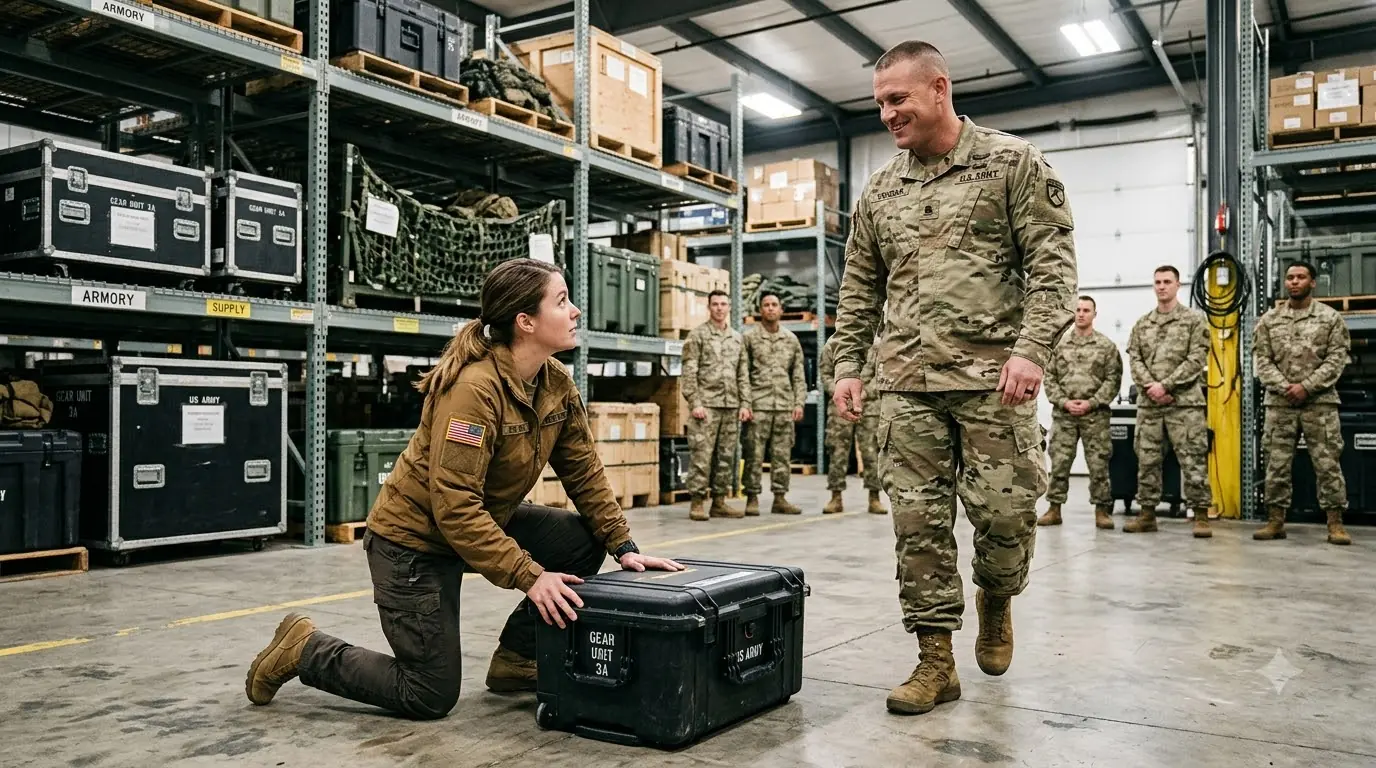
It looked nothing like the polished training centers pictured in recruiting brochures.
The building smelled of rubber mats, hydraulic fluid, old canvas, and dust.
Steel shelving rose nearly to the ceiling.
Black equipment cases sat stacked in disciplined rows.
Training mannequins occupied one corner.
Protective helmets and harnesses hung from hooks.
Orange tape marked lanes across the concrete floor.
The fluorescent lights overhead were brutally honest.
Nothing looked glamorous beneath them.
That was one reason Mara liked the place.
Training should not be glamorous.
It should expose weaknesses before reality did.
She arrived at 7:06 on a Monday morning wearing a brown field jacket, dark work trousers, tan boots, and no visible rank or evaluator insignia.
That was intentional.
Her credentials remained zipped inside the inner pocket of her jacket.
The official clipboard was with Daniel Cross, director of advanced certification, who would join her later.
For the first three hours, Mara wanted nobody adjusting their behavior because an evaluator was standing nearby.
Iron Ridge had received too many complaints.
Not formal misconduct complaints.
Not yet.
Concerns.
Trainees reporting that instructors rewarded aggression over judgment.
Junior staff afraid to correct senior trainers.
Scenario scores changing after verbal disputes.
Safety calls dismissed as weakness.
One trainee had withdrawn from certification entirely after being mocked publicly for stopping a drill when another participant appeared disoriented.
Another claimed his score dropped fifteen points after he questioned an instructor's restraint technique.
None of those stories proved anything.
Mara knew that.
People interpreted conflict differently.
Hard training was uncomfortable by design.
Instructors could not be expected to make every participant feel validated.
Certification existed to test competence, not confidence.
Still, patterns mattered.
Three names appeared repeatedly.
Derek Vaughn was one of them.
He stood near the center mat when Mara entered.
Thirty-eight years old.
White American.
Six feet two.
Muscular without being bulky.
Buzz cut.
Square jaw.
Tan camouflage training uniform.
Boots polished enough to suggest he cared who noticed.
He was demonstrating balance disruption to fourteen trainees while another instructor, Luis Ortega, watched from the equipment racks.
Mara stopped near the wall.
Nobody acknowledged her immediately.
Good.
Derek spoke loudly.
“Most people think control starts with strength.”
He caught a trainee's wrist.
Turned.
Shifted his weight.
The trainee stumbled.
Derek released him.
“It doesn't.”
He looked around the circle.
“It starts with timing.”
That part was correct.
Mara wrote nothing.
No clipboard.
No visible note-taking.
She watched.
Derek demonstrated again.
Clean.
Controlled.
Technically sound.
Then he chose a smaller trainee.
A twenty-four-year-old woman named Keisha Bell.
Keisha stepped onto the mat.
Derek said:
“Don't help me.”
Keisha nodded.
He applied the movement.
Keisha anticipated.
Adjusted.
Stayed upright longer than expected.
Several trainees murmured approval.
Derek smiled.
Not warmly.
Again.
This time faster.
Keisha nearly fell but recovered.
Derek's smile disappeared.
“Stop trying to win the demonstration.”
Keisha looked confused.
“I thought you said resist naturally.”
“I said don't help me.”
“I wasn't.”
A few trainees looked down.
Mara noticed.
That reaction mattered more than the disagreement.
People knew what was coming.
Derek stepped closer.
“You think because you stayed up once, you've figured something out?”
Keisha said:
“No.”
“Then quit performing.”
Keisha's face flushed.
Derek turned toward the group.
“This is what ego looks like.”
Mara's jaw tightened.
The trainee had not shown ego.
She had responded to instruction.
Derek continued:
“When students decide they know more than the instructor, they stop learning.”
Keisha said nothing.
Luis Ortega looked uncomfortable.
But he did not intervene.
Mara stored that.
Not on paper.
Memory.
Derek reset the drill.
Keisha obeyed more passively.
She fell immediately.
Derek smiled.
“Better.”
That word bothered Mara.
Better meant what?
Better training?
Better compliance?
Better demonstration for the instructor?
She waited.
The morning continued.
Derek was undeniably skilled.
His footwork excellent.
His explanations concise.
His awareness of spacing strong.
He spotted errors quickly.
He corrected unsafe hand position twice.
Stopped one trainee before an awkward fall.
Praised another for keeping distance.
Mara did not want a villain.
Real people were harder.
Derek had strengths.
That made the concerns more important, not less.
Poor instructors were easy to remove.
Talented ones could reshape culture.
At 8:40, Luis finally approached Mara.
“You here for logistics?”
Mara looked at him.
“Observation.”
“Cross send you?”
“Yes.”
Luis glanced toward Derek.
“Does he know?”
“No.”
Luis looked surprised.
Then slightly amused.
“Good luck.”
Mara raised an eyebrow.
“With?”
“You'll see.”
He walked away.
That answer told her more than he intended.
At 9:15, Derek noticed her.
Not because she announced herself.
Because he noticed everything eventually.
He finished a drill.
Looked toward the wall.
“You.”
Mara looked behind herself deliberately.
A couple trainees smiled.
Derek did not.
“You standing there.”
“Yes?”
“You participating or decorating the concrete?”
Mara walked forward.
“Observing.”
He looked at her jacket.
No insignia.
No visible evaluator badge.
“Observing what?”
“The course.”
“Who are you?”
“Mara Ellison.”
He waited.
She did not add title.
Derek looked toward Luis.
Luis suddenly became fascinated by a harness buckle.
Derek turned back.
“New transfer?”
“Something like that.”
That was not technically a lie.
Mara had transferred into the regional evaluation office six months earlier.
Derek interpreted it differently.
“You trained in combatives before?”
“Yes.”
“How much?”
“Enough.”
The trainees noticed the answer.
Derek smiled.
There it was again.
Audience.
“Enough.”
He repeated it as if she had made a joke.
Mara remained still.
Derek gestured toward the mat.
“Come show us enough.”
Luis looked up.
Mara saw concern.
She could refuse.
She had no obligation to participate physically.
Her job was evaluation.
But participation could reveal things observation could not.
She stepped onto the mat.
Derek said:
“Jacket off.”
Mara removed it.
Plain tan long-sleeve training shirt underneath.
No visible credential.
She folded the jacket and set it on an equipment case.
Derek looked her over.
Not sexually.
Professionally dismissive.
“You know the drill?”
“Balance recovery.”
“You sure?”
“Yes.”
He nodded toward her stance.
“That's your stance?”
Mara looked down.
“Yes.”
“You always stand that narrow?”
“When I want mobility.”
Derek laughed.
Several trainees laughed because he did.
Not because anything was funny.
Mara noticed that too.
He stepped closer.
“Okay, transfer.”
“Show me mobility.”
He initiated slowly.
Mara shifted.
Recovered.
His eyebrows changed.
Again.
Faster.
She adjusted.
Stayed upright.
Derek's expression sharpened.
Third time.
He added a shoulder feint.
Mara moved with it.
Did not fall.
The room became quieter.
Derek smiled.
But the smile no longer reached his eyes.
“Not bad.”
“Thank you.”
“Again.”
This time he increased force.
Mara felt it immediately.
Training demonstrations had levels.
This one changed.
Not dangerous yet.
Not light either.
She pivoted.
Recovered.
Derek's jaw tightened.
He whispered low enough that only she heard: