"Do you mind? Some of us are trying to win a war here."
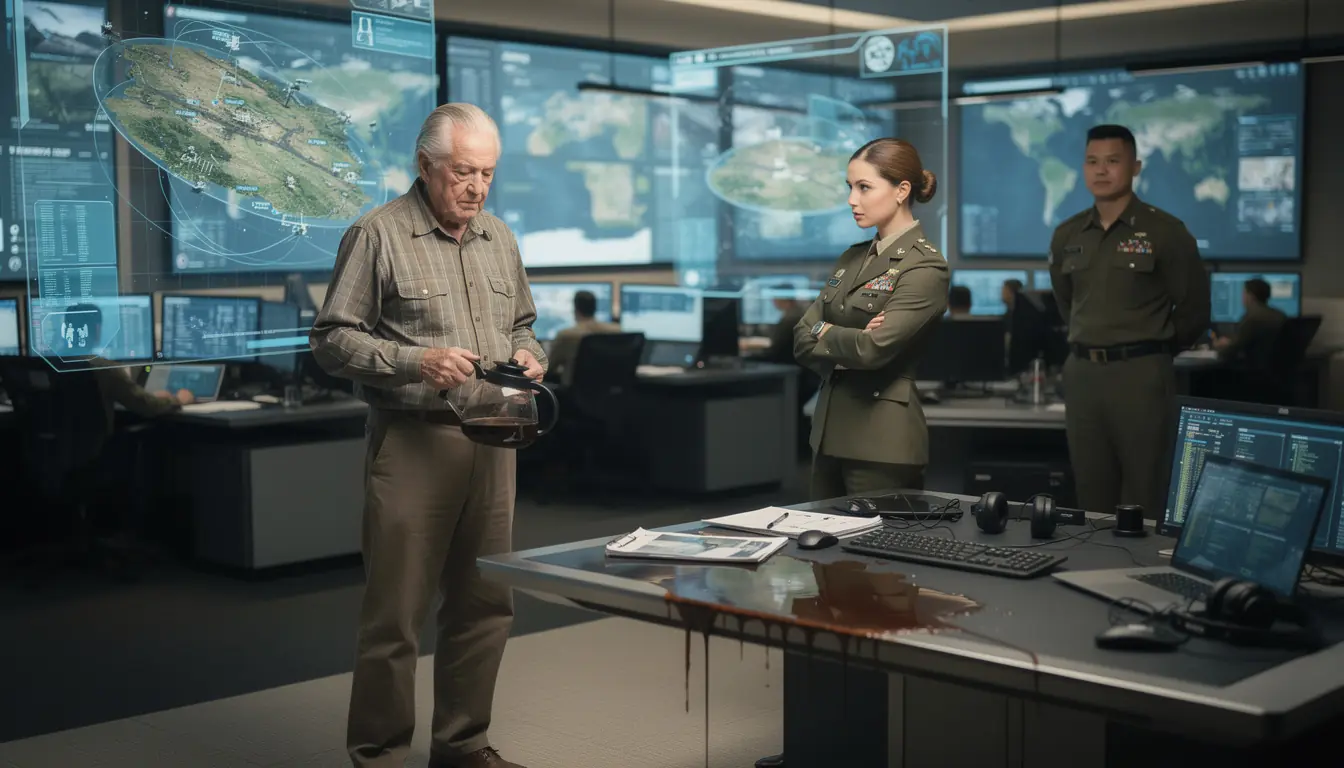 Captain Eva Rostova's voice was as sharp and sterile as the room around her. It was a place of cool blues and muted grays: a cavern of glowing screens where data streams flowed like digital rivers. In the center, a holographic map of some remote, contested mountain range pulsed with tactical overlays.The only warmth in the entire strategic operations center came from the thermal carafe in Thomas Whitfield's hand.At 78, Thomas moved with a quiet economy that the young, caffeinated minds in the room mistook for slowness. He was a ghost in their machine: a civilian contractor hired to perform the simple, analog task of keeping the coffee fresh and the mugs full. He was part of the background, as unnoticeable as the low hum of the servers or the filtered, recycled air.He said nothing in response to Captain Rostova's barb. He simply moved to her station, his reflection a stooped, blurry figure in the dark glass of her monitor. He reached for her empty mug."Just leave the pot," she said, not looking up from her screen. "We'll serve ourselves. It's faster."Lieutenant Mark Chen, a prodigy fresh from MIT, smirked from the adjacent console, his algorithms running a new predictive model on enemy movements. "Captain, we can't afford a latency of, what, two minutes for a coffee run."The two of them shared a brief, knowing glance. It was a joke at his expense, but Thomas felt no sting. He had heard variations of it for the past three years he'd worked here: he was the old man, the relic, the human equivalent of a dial-up modem in a fiber-optic world. To them, he was just the coffee guy.He placed the steaming carafe on a heat-resistant coaster beside Rostova's keyboard and began his slow, deliberate retreat. His shoes, soft-soled and worn, made no sound on the polished concrete floor.He moved along the periphery of the room, his gaze sweeping over the controlled chaos. He saw the intricate dance of information: the flickering icons representing battalions, drone surveillance feeds, and encrypted communications. He understood more than they could ever imagine.The room was a symphony of controlled tension. At the head of the immense tactical table stood General Marcus Thorne, a man carved from granite and resolve. He was in his late 50s, his Army green service uniform immaculate, his presence a gravitational force that held the entire operation together. He hadn't spoken in ten minutes, his eyes fixed on the holographic terrain, processing a thousand variables at once.Thomas continued his circuit. He refilled the mug of a young sergeant who nodded his thanks, his eyes never leaving his screen. He passed another analyst who was rubbing his temples, the stress of the operation a visible aura around him. Thomas knew that look: he had worn it himself for more years than these young officers had been alive.