Her father sold her on a Tuesday in the gravel courtyard of Ashby Hall before the dust of the Duke’s carriage had settled. He did not call it a sale. He called it a generous match. He called it providence. He called it many things in the polished voice he used for visiting clergymen. But Beatrice Ashby, watching from the window of her sick room on the second floor, knew the shape of a sale when she saw one.
She had been keeping her father’s ledgers in secret for two years. She knew how he spoke when money was owed and how he spoke when money was being moved. And she knew the difference between the words a man chose for a daughter and the words he chose for a debt. “Bring her down,” her father said. Beatrice’s maid, Mary, set down the hairbrush and would not meet her eyes. “He has not even come inside,” Beatrice said. “Your father wants you on the gravel, miss.” “On the gravel?” “In the chair, miss. He says the Duke must see the chair from the window of the carriage. He says it must be the first thing.”
She let her hands rest on the arms of the chair. The wood was cold under her palms. Her right leg, from the knee down, was still strapped in the brace her cousin’s physician had ordered the morning after the riding accident two Octobers ago. The brace she had stopped needing eleven months past, which her father had insisted she continue to wear in company. There were two truths about Beatrice Ashby, and only one of them belonged to her family. The truth they used was that she could not walk. The truth she kept was that she could, slowly, with care, on level ground, for short distances. And that she had been measuring her steps in the locked passage between her sick room and the linen press for nearly a year while no one was looking.
“Mary,” she said. “Miss?” “Has he made you swear anything today?” “Only what I swear every day, miss, that you cannot stand.” “Thank you for not making it a longer list.” The wheelchair was carried down the staircase by two footmen. She held her hands folded in her lap and did not look at the portraits as they passed. Her mother had been removed from the long gallery the year after the accident. A small act, easily explained, but Beatrice had noticed. She noticed many things she was not meant to notice. And she had learned to keep that fact off her face.
Her amber silk shawl, the one her mother had left her, slid against the braces as the chair tipped on the landing. She caught it. The footmen apologized. She told them not to be concerned. She had learned to apologize to servants for the inconvenience of being carried. It embarrassed everyone less. The autumn air struck her like a thrown sheet of water. Colder than she had expected, sharper, brighter. Wood smoke from the kitchen chimney, crushed apples from the cider press, the smell of horses that had been driven hard and not yet rubbed down. She breathed it in and felt, for the first time in two years, the precise sensation of being outside her own house.
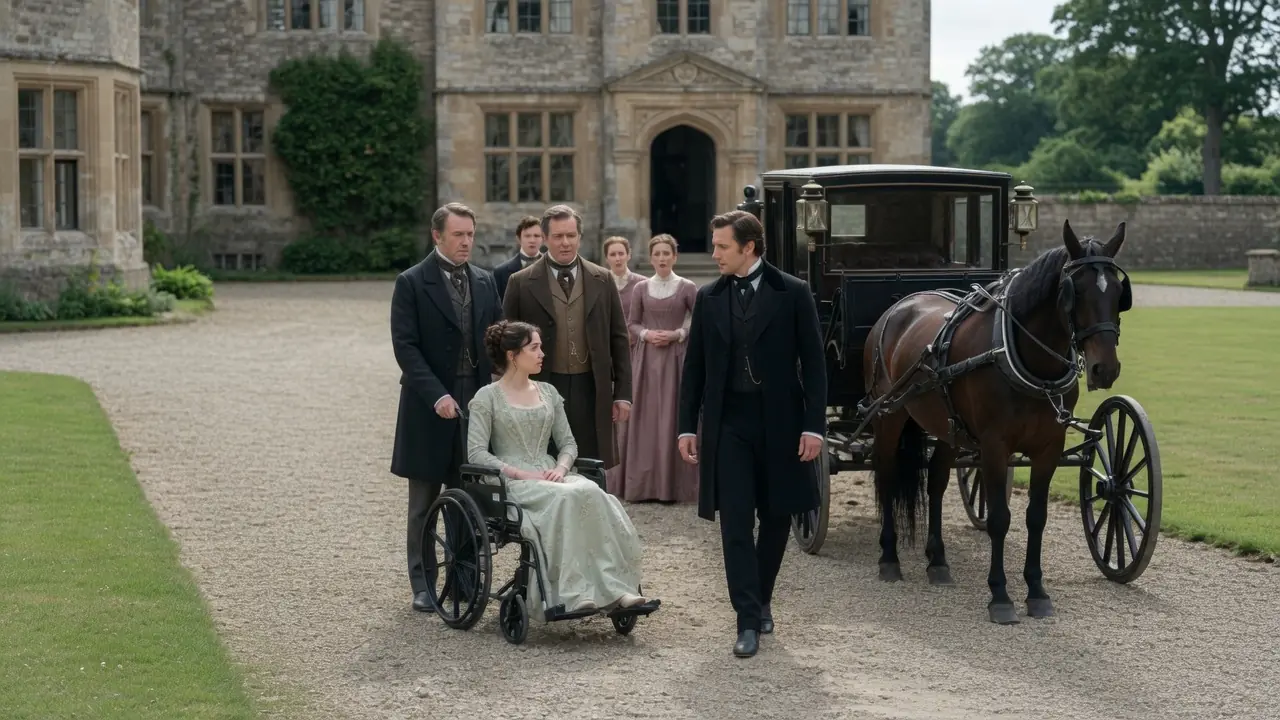
She closed her eyes for a half second, only that, before she remembered who would be watching and opened them again. The Duke had not yet stepped down from his carriage. The carriage itself was a thing of restraint, black lacquered, plain at the doors, the Ravenmuir crest small enough to be missed from across a yard. A carriage that did not announce itself. Two grays in matched harness, sweat dark on their necks, a coachman in dark blue, a single outrider holding the leads, not speaking, not looking at the house. They had come fast. They had come fast and they had not stopped to make themselves presentable, which told her something about the man inside that her father had not understood when choosing him.
Her father had positioned himself in the center of the courtyard, his hat in his hand, his smile composed. Her uncle Lionel, the architect, she suspected, of every line of the contract she had not been permitted to read, stood at her father’s right shoulder, two steps behind. Her cousin Charlotte stood at the door of the house in a peach-colored morning gown that did not suit the weather, watching the carriage door with the expression of a woman who has been promised a play she very much wishes to see. The footman wheeled the chair into position. Beatrice felt the small jar of stones beneath the wheels, the way the chair settled an inch lower at her left side because the gravel had been raked unevenly in haste. She did not adjust herself. She kept her hands folded.
“He must come down,” her father said under his breath to no one. “He must come down and look at her and see.” The carriage door opened. The Duke of Ravenmuir stepped out with the unhurried movement of a man who did not borrow his height from his title. He was tall, broader through the shoulders than the cut of his traveling coat could disguise, and he had the careful, level stride of a man who had spent more hours of his life on his feet than seated. Dark hair, cut shorter than fashion, a face that had been weathered by something other than ballrooms. Twenty-eight, perhaps. Beatrice was twenty-six and had stopped being able to estimate ages with confidence after her own had stopped showing on her. And she thought, with a small, foolish flicker of vanity she had not felt in months, that she would have liked to meet him in the year before the accident, when she had still been a girl who walked into rooms.
He did not bow at the carriage. He did not bow toward her father. He looked first at the horses, ran a hand once along the nearer gray’s neck, said something quiet to the coachman that Beatrice could not hear, but that ended with the man nodding and beginning to unbuckle a cheek strap with relief in his hands. Then, and only then, the Duke turned to the courtyard and took in what had been arranged for him. His eyes did not move first to her father. They moved to her. Beatrice held her face composed. It was a face she had practiced in the mirror of her sickroom. A face that said, “I am a piece of furniture. Please conduct your business above me.” A face she had perfected for visiting solicitors, for the family physician, for the curate. It was the only armor she had, and it had served her well for two years. She put it on now, smoothly, and looked back at him over the gravel.
The Duke’s expression did not change, but something in the way he held his shoulders did. He had been a man arriving at an obligation. He became, in the space of one breath, a man assessing an injury. Not hers. The arrangements. He had seen what she had seen, the chair on the gravel, the window angle, the staging of it. And he had understood, in less time than it would have taken her father to clear his throat, what kind of household he had driven into. “Your Grace,” her father said, stepping forward. “Welcome to Ashby Hall.” The Duke walked past him. Beatrice’s father, mid-bow, blinked at the patch of air the Duke had occupied a moment before, and then lifted his head and watched, as everyone in the courtyard watched, the Duke of Ravenmuir cross the gravel in seven long strides and stop directly in front of his bride.
He did not speak first. He looked at her, not at the chair, not at the brace, not at the angle of her foot, at her face, full on. The way a man looks at a person to see whether they are still inside the place they have been put. Beatrice felt the look land. It traveled the length of the practiced furniture-faced composure she had assembled and went somewhere underneath it that she had not built any defenses for. He spoke her name into the quiet courtyard, and she answered him with his title. Both voices pitched low enough that only the front rank of footmen could pretend not to hear. “I’m late,” he said. “I apologize. I would have come yesterday.” “It is a long road from Ravenmuir.” “Not as long as it has been for you, I suspect.”
She said nothing to that. There was nothing she could say. He did not appear to need an answer. He looked briefly past her at the two footmen who had wheeled her down and were now waiting to wheel her back. He looked at her uncle Lionel. He looked at her father. He looked at the window of her cousin Charlotte’s room. Then he looked at the chair. “This is your chair,” he said. “It is.” “Has it been with you long?” “Two years.” “Your father wrote that you cannot walk.” “That is what my father wrote.”
Her father’s mouth opened. Her uncle Lionel cleared his throat. “Your Grace,” Lionel said, “if we may invite you inside—” “The contracts are signed,” the Duke said without looking at him. “I signed them in London on Saturday. Your courier delivered the papers Sunday morning. You have my word, your money, and my name upon the document. The thing remaining in this courtyard is not a contract. It is a woman in a chair on cold gravel in October without a coat.” He shrugged out of his traveling coat as he spoke. He did it without ceremony, without the flourish a man would have made of it had he been attempting a gesture. He simply removed it because it was no longer his and was now something that needed to be on her shoulders.
He stepped behind the chair, draped the coat carefully over her, settling the collar so that it did not press the brace against her skin, and then came back to stand in front of her. The coat smelled of leather and cold horses and something resinous. Not pomade, not cologne, the kind of smell a man acquires when he spends long days outdoors and brings the weather home in his clothes. It weighed on her shoulders. She had not been warm out of doors in two Octobers. She did not allow her eyes to close again. He gave her her name again and she gave him his title and the formal exchange was the only fragment of ceremony that the courtyard would receive that morning.
“With your permission, I will lift you from this chair and set you in my carriage. We can discuss arrangements on the road.” “Your Grace,” she said carefully, “I have men who can—” “I do not doubt that you have men who can. I’m asking your permission to do it myself.” There was a small, terrible silence in the courtyard. Her father’s mouth was still open. Her uncle Lionel was, for the first time since she had met him, not certain what to do with his hands. Charlotte had stepped onto the gravel and stopped, having clearly intended to be helpful in some performance of her own, and discovering, mid-stride, that the script she had imagined was no longer being staged.
Beatrice looked up at the man she had married three days ago, in a document she had not been allowed to read. “You have it,” she said. He bent. He did not bend in the apologetic way men bent over invalids, the half stoop that signaled both effort and condescension. He bent the way a man bends to lift a thing he respects. One knee on the gravel, no flinch, eyes level with hers. His hand slid under her knees, and the other behind her shoulders. He did not jostle the brace. He did not press the bruise along her left ribs that no one in this courtyard knew about except for Mary. He stood easily, as if she weighed nothing he had not lifted before, and turned, with her in his arms, in front of her father, her uncle, her cousin, the two footmen, the coachman, the outrider, the kitchen boy peering from the area steps, and the maid at the linen press window, whom Beatrice could see only because she was being held high enough to see.
He carried her across the gravel. She felt the precise distance between his chest and hers. She felt the careful hold beneath her knees that did not allow the hem of her gown to ride up. She felt the steadiness of his stride, which did not adjust to the gravel because his legs were strong enough that the gravel did not need to be adjusted to. She felt, against her cheek through the fabric of his shirt, the rapid, steady thump of his heartbeat, faster than his face had let her think it was, slower than her own. She kept her eyes on the open carriage door. He spoke her name once he had her settled, and she answered him in the same low tone. And only then did he allow himself the small surprise of remarking on her weight. “You are lighter than I expected.” “I have not been outdoors in some time.” “That,” he said, “is going to change.”
He set her down on the velvet seat as if she were something he had been carrying carefully through weather. He arranged the coat around her again. He took her cane from the footman who came forward with it, and laid it across her lap where she could reach it. Then, only then, he turned to her father in the doorway of the carriage. He addressed her father by name, and her father answered with the title in the wary half bow of a man who had already lost the morning. “You will send her belongings to Ravenmuir by the afternoon coach. Her maid will travel with us. Her physician’s notes, all of them, including the originals from two years ago, will be in the parcel. If they are not, I will return for them myself. We are clear?” “Your Grace, the—the celebration.” “There will be no celebration today. My wife had prepared—” “Your wife may keep her preparations. My wife and I are leaving.”
He stepped up into the carriage, took the seat opposite hers, and pulled the door shut himself. The coachman was already on the box. The horses were already turning. Through the small window of the carriage, as they rolled out of the gravel courtyard of Ashby Hall, Beatrice saw her father, her uncle, her cousin, all standing on the gravel exactly where the chair had been, in the precise positions in which the Duke had left them, as if a stage manager had walked off mid-rehearsal and taken the only candle. She closed her eyes for the half second she was permitted, and opened them again. The Duke was watching her. He gave her her name across the carriage, and she gave him his title. And the small ritual seemed to be the way he needed to begin every honest sentence to her.
“I owe you an apology already.” “Already?” “I was meant to come yesterday. I drove through the night. I did not stop in the village. I came directly because I had a feeling I ought to come directly. And I find that I was correct. And I find that being correct was not a comfort. Will you forgive the abruptness?” She studied him in the dimness of the carriage. The light from the window cut across his cheekbone and caught the tired skin under his eye. He had been driving since some hour the previous night. He had not stopped to bathe. She could smell the cold of the road on him. He had crossed half a county to be here today instead of tomorrow, and he had done it because he had not trusted what he would find. And he had been right not to trust it. “There is nothing to forgive,” she said. “There is a great deal to forgive. Some of it is mine and some of it is theirs. I will sort which is which on the road.”
“Your Grace.” “Theodore.” “Your Grace, my name is Theodore. Theo when I am tired. Which I am. Which I will likely be for some time. I would prefer that you used it from this afternoon. I do not propose to be a Your Grace to the woman whose chair I have just lifted from a courtyard.” She felt the cane in her lap, the warmth of his coat on her shoulders, the carriage rocking gently as the wheels found the harder road beyond the gates. She felt also, beneath all of this, the beginning of a thing she had spent two years learning how not to feel. The dangerous, specific clarity of being seen. “Theodore,” she said. “Beatrice, I will need to tell you several things on this road.” “I expected as much.” “They will not all be pleasant.” “I did not expect that they would.”
She drew his coat more closely around her and looked out of the window at the autumn fields she had not seen since the morning of her riding accident and felt the brace against her right knee and felt also, with the precision of a woman who had been practicing the calculation in secret for nearly a year, exactly where her foot would land if she chose, on some quieter day than this one, to set it down on a road of her own. “We will start,” she said, “with the contract.” Ravenmuir was three hours by carriage if the roads were dry. They were not in places. The ruts north of the river were soft from a week of rain, but the Duke’s coachman knew the line of the dry middle and held it. And Beatrice watched the country come at her through the small carriage window with the disorienting, half-painful pleasure of a person relearning what landscape was.
She had known she would have to speak. She had not expected that he would let her speak in her own time. He had, for the first quarter of an hour, asked her practical questions. How she preferred the lap robe, whether the rocking of the carriage hurt the brace, whether she was warm enough in his coat, whether she would prefer the curtain drawn. She had answered each briefly, accurately. He had taken each answer at face value, made the adjustment, and waited. He had not asked her about the contract. He had not asked her about her father. He had not asked her, as she had braced to be asked, about the accident. He simply sat across from her with his arms folded in a way that suggested he was waiting the way a man waits at a station for a train known to be running late and watched the fields go past over her shoulder.
It was, she realized after the third quarter hour, a kind of negotiation she had not encountered before. He was offering her silence. He was offering her the choice of when to break it. “My uncle drafted the contract,” she said. He did not move. “Lionel?” “Yes.” “How long ago?” “He began the draft after the accident. I cannot be certain of the date he completed it. I would estimate sixteen months ago. He has been holding it since. He needed only to find the correct purchaser.” “He used that word?” “Not aloud. The word he used aloud when speaking of you was arrangement.” “What was the price?”
“£12,000, of which seven was styled as a settlement on me, three as a release of an old family debt, and two as a finder’s fee in everything but name. The release of the debt is a fiction.” He looked at her then. Not surprised, not delighted, very still. “Go on.” “There is no debt. Your late father did not borrow from mine. Your late father did not, so far as my private examination of three years of receipts can determine, ever conduct any business with my father at all. The release of debt clause is the instrument by which my uncle Lionel intends to collect the £3,000 that, by the contract’s structure, would be paid to the estate of Ashby Hall. The estate of Ashby Hall is, in practice, my uncle Lionel.” “Your father is the estate of Ashby Hall.” “My father is the named owner of the estate of Ashby Hall. The estate’s affairs have been managed by my uncle Lionel since the year my mother was lost. I was eighteen. I have observed my uncle’s management since I was nineteen. I have kept ledgers of his management in cipher since I was twenty-two. I am twenty-six.”
She watched the Duke’s face for the response she had braced for. The disbelief, the indulgent smile, the careful adjustment of expression as a man recalibrated who he had married. None of those came. He let his head tip slightly to one side. He looked briefly at the window. “Twenty-two,” he said. “Yes.” “Two years before the accident.” “Yes.” “You began keeping ledgers on your uncle two years before any reason existed to.” “I had reason. He did not know I had reason.” “What was it?” She measured him a moment longer. He was waiting again. He was, she was beginning to understand, very practiced at waiting. “A maid,” she said. “Sarah Pell. She had served my mother. After my mother passed, my uncle dismissed her without a character. She came to my window the night before she left. Thirteen, Your Grace, she was thirteen, and told me where to look in his desk if I ever wanted to know what she had seen.”
“Did you look?” “I looked. The receipts she described existed. I copied them. I returned the originals before he noticed. I did this every Wednesday afternoon for four years while he believed I was reading novels in the morning room. I am very good at reading novels. I am better at copying receipts.” “Did Sarah Pell—” “She is a housekeeper now in Lincolnshire. I’ve written her a letter every quarter for six years. She does not know that I send the letters. They’re signed with my mother’s name. I send them through Mary’s cousin, who works in a coaching inn near her village. I have never spoken her name aloud before this carriage. I would prefer, please, that I had never had to.”
The Duke did not speak for a long moment. Outside the window, the road climbed a low ridge, and a thin line of late sun broke over the brown of the fields, and a flight of rooks lifted from the hedgerow and turned together against the gray of the sky. He spoke her name, eventually, into the quiet of the carriage. She gave him his. “Why did you tell me this in the first hour of our marriage?” “Because the first hour of our marriage is the hour in which I will be most believed. By the third hour, you will have begun to wonder whether I am a clever woman who has taken advantage of you. By the third week, my uncle Lionel will have written to you with the polite and reasonable air for which he is famous in our county, to suggest that I am subject to nervous fancies on account of the accident. By the third month, he will have visited Ravenmuir himself with my father and told you, sadly, in the careful voice of a man who loves his niece, that I am not always to be relied upon in matters of money. He will offer to manage my settlement on my behalf. You will, by then, half believe him. I would prefer to spend this hour on this road telling you the truth about him before he’s had the chance to tell you the truth about me.”
The Duke’s eyes had not left her face since she had begun. “That is,” he said slowly, “the most efficient strategic operation I have heard executed on the seat of a carriage.” “Thank you. I had not anticipated being grateful today for marrying a strategist. I had not anticipated today having the use of a husband.” He looked at her. Really looked at her. Not at the brace, not at the chair he had lifted her from. And a small, dry, surprised smile touched the corner of his mouth. And it not become a laugh. Because he was, as he had said, tired. He gave her her title. She returned it. He corrected, gently, to his name. And she repeated it back as a thing one practices by saying. “What else?” “There is the matter of my walking,” she said. And let the sentence hang while he gave her the smallest nod.
“I can.” He was quiet for the space of a turn of the wheels. “How much?” “Short distances, with care. I’ve not walked in front of a member of my family since the August before last. They do not know.” He waited a beat. Then asked the question that mattered most. “Your physician?” “My physician is paid, and has been paid for some time, to confirm the brace. He has not examined me in fourteen months. The last examination, when he found the bone had healed, occurred without my uncle present. I asked him not to write a report. He did not. He is a kind man, and an old one. And he is afraid of my uncle.” “Why have you not walked in front of them?” “Because the moment they know, my uncle will marry me to the next available creditor before I can manage it. The brace was a fiction. The fiction was protection. I needed the fiction to last until I could engineer a marriage that placed me beyond his reach, in a household large enough that he could not reach me through a back door. I have been managing the engineering for fourteen months. He was managing his own arrangement at the same time. He believed his arrangement was the one that would conclude. I believed mine was. I did not, until I saw your carriage in the courtyard, know which of us was correct.” “Mine was the one that concluded.” She inclined her head. The smallest possible acknowledgement. Careful as a chess piece set down without a sound.
“Were you aware that I was the engineering you had managed?” “No. I knew the shape of the man I needed. I did not know the name. I knew there was a duke in the north whose late father had endowed three village schools and one hospital. Small things, badly publicized, easily missed in the gossip columns. I knew that any son who had not unwound those endowments after his father’s death was either negligent or deliberate. I read the records of the endowments in the parish reports my father took. I made some inquiries through Mary’s cousin. I formed the impression that you were deliberate.” “That is a great deal of inquiry for a woman whose physician was not allowed to examine her.” “I had a great deal of time.”
He was silent for a moment, and then he laughed. A short, low, genuinely surprised laugh that filled the dim carriage and was gone again. It was the first he had laughed all day. Perhaps the first he had laughed in some longer time. And he looked after, briefly embarrassed at himself. He looked back at her with the embarrassment subsiding into something steadier. The careful, level attention of a man who had decided he was going to spend the next quarter hour being told the rest of it. “I have been deliberately negligent of nothing in my life. I would like that to remain the case. I would like, therefore, to know what you intend to do.”
She thought about it. She had thought about it for fourteen months. But she had thought about it as a woman alone in a sickroom thinks about a thing she will execute alone. She had not thought about it as a woman speaking with a husband in a carriage on a road. The latter was an unfamiliar register. She found that the calculations simplified rather than complicated. “I intend to take Ashby Hall away from my uncle,” she said, “without taking it from my father. I intend to walk the length of your library before Christmas, and then the length of your gallery by Easter, and then, if it can be arranged, the length of a quiet road in the spring. I intend to give you a household worthy of the name your father did not unwind, and to be myself worthy of being, at some unhurried point in our acquaintance, your wife, in fact, as well as in document. I intend to do all of this without becoming a burden to you in any of the ways my father has trained me to expect to be a burden. I intend, finally, to stop wearing this brace in a place where no one will use the wearing or the not wearing as currency.”
He sat very still. “That,” he said, “is more than I’d been told to expect from a wife.” “I am sorry.” “Do not be. I will not be.” He let the silence hold for a moment longer, then he reached across the carriage slowly, and laid his hand, palm up, on the seat between them. He did not speak immediately. He simply waited with the open hand on the velvet, the way one waits for a hesitant horse to come to a held bridle. “This is a road. You are tired. I am tired. We have a great deal more to discuss. I do not propose that we discuss it now. I propose, instead, that you put your hand here, not as a gesture, as a fact, so that when you fall asleep in the next half hour, and you will, you have not been outside in two years and your color is changing, I can know precisely where your hand is and not jolt it. We can resume the strategic operation when you wake.”
She looked at the hand. It was a large, square hand, the back of it crossed with a faint scar running from the base of the first knuckle to the wrist, a working hand, a hand that had, two hours earlier, lifted her from a chair on cold gravel without disturbing a brace. She put her hand into it. He closed his fingers around hers, not tight, not possessive, the closure of a man latching a gate against a wind, and rested their joined hands on the seat. He did not speak again. He looked out of the window and let her not speak.
She did not, in fact, fall asleep in the next half hour. She fell asleep within four minutes. When she woke, with the carriage stopped in the courtyard of Ravenmuir and the autumn light gone almost orange in the western sky, his hand was still around hers, and he was sitting forward to spare her the angle of the cushion, and the brace had not, in three hours of road, pressed once against her bruised knee.
Ravenmuir was not what she had been told to expect. She had been told by her uncle to expect a great, cold cathedral of a house, the seat of a man too proud to remarry after his first wife’s death, kept by a skeleton staff, run on a strict bell. She’d been told this by a man who’d never been to Ravenmuir and had no source for the information beyond his desire to deliver his niece into an austerity that would render her grateful. What she saw when the Duke opened the carriage door and the courtyard came into view, was a long, low, warm-stoned manor with three rows of mullioned windows lit from within against the early dusk. Smoke from four chimneys, two dogs of an unimpressive but enthusiastic breed coming around the corner at speed, a housekeeper on the steps with her apron still on from the kitchen, a steward standing one step behind, and a small congregation of staff who were attempting, badly, not to crane their necks at the carriage door.
“Mrs. Heaver,” the Duke said before he stepped down. “This is my wife, Lady Beatrice. Her maid will arrive on the afternoon coach with her belongings. Until then, she will need everything. Hot water, a fire in the rose room, not the green, the rose. Soup, not a meal. Send for Dr. Wycombe in the morning, not this evening. She is not to be examined tonight. I will carry her in.” The housekeeper, round-faced, perhaps fifty, eyes sharp under the practiced calm of a woman who had managed a great house for thirty years, said only, “Your Grace.” And turned, before he had finished speaking, to set the orders moving.
The Duke stepped down. He did not, this time, ask Beatrice’s permission. He stood at the open carriage door and held out his arms in the precise, quiet way of a man whose request had already been made. She allowed herself, on this second lifting, to look up at him. The light from the lanterns over the door fell across his face. He was tireder than he had been in the courtyard at Ashby Hall. He had not slept since some hour she could not place. He had carried her three hours in his attention, as well as in his arms. She said his name, quietly enough that only he could hear, and he answered with hers and waited. “You may put me down inside. Not in the carriage. Not in the courtyard. Inside.”
He nodded once. He lifted her a second time in the courtyard of Ravenmuir in front of two dogs and a small congregation of staff and carried her up the three shallow steps and through the broad oak door and into a hall that smelled of beeswax and applewood and the particular gentle dust of a house that has been lived in continuously for two hundred years. He set her, as she had asked, just inside the threshold on a settle by the door. Not in the chair the housekeeper had had brought. Not in the wheeled thing the steward had appeared with. On a settle with cushions. “You arranged the cushions.” He took her cane and laid it across the settle within reach. “Mrs. Heaver will take you to the rose room,” he said. “She will not require you to climb stairs. There is a sedan in the back passage that has not been used since my mother had her ankle in plaster the year before we lost her. It is in good condition. Mrs. Heaver has arranged it.”
She began to protest, half formed, the rest of an evening she had assumed he would expect. “I am going to wash, eat something that is not ham from a saddlebag, and write three letters before I sleep. The first will be to your father restating what I said in the courtyard in writing. The second will be to your uncle requesting from him in the politest possible terms every paper he holds related to the alleged release of debt. The third will be to my own steward in London who will receive his instructions for the next month before midnight. You will be asleep, I hope, before I have finished the second letter.” “You cannot—” “I can, Beatrice. I’ve done it before, less interestingly.” He looked at her for a beat longer than he needed to. Then he straightened, gave her the dry, brief, surprised half-smile that he had given her in the carriage, and turned to the housekeeper, who was waiting at the precise distance of a woman who had heard every word, and would not betray a single one with a flicker.
He turned to the housekeeper. “My wife is to have anything she asks for. She is also to have several things she will not ask for. Use your judgment.” Mrs. Heaver bowed her head fractionally, the closest thing to a vow Beatrice had ever seen a housekeeper deliver in a hallway. He left. In the rose room an hour later, washed, fed broth and bread, propped against three pillows of the wrong size that Mrs. Heaver was already replacing, Beatrice lay in a vast, unfamiliar bed under a vast, unfamiliar canopy, and stared at the painted ceiling beam where a flight of small wooden swallows had been carved by a craftsman who had clearly been showing off. She listened to the unfamiliar house. She listened to the murmur, somewhere through two walls and a passage, of a man’s voice dictating letters in a measured tone.
She thought, “He has not been a husband to me. He has not in any of the ways a husband would have been within his rights to be. He has, in the matter of a marriage I did not choose, accidentally chosen extremely well.” She thought, “I will sleep until morning, and I will begin tomorrow by walking, slowly, with care, on level ground, for short distances, across the floor of the Rose Room, to the window, where I will see whatever weather the morning brings. I will choose what he sees of that, and when. I will choose. I have not chosen in the matter of my own legs for two years.”
She closed her eyes. She slept. She did not wake until ten o’clock the following morning, which was longer than she had slept at one stretch in eighteen months. And the first thing she saw when she opened her eyes was a small bowl of late autumn roses on the windowsill, yellow at their cores, edged with a faint, tired pink. And beneath them, on a folded slip of cream paper, in a strong, square hand, the word “Walk when you are ready. Tea.”
She walked. She walked from the bed to the window, six steps, with the cane, slowly. The carpet was thicker than she had grown used to at Ashby Hall, and the cane sank into it more than she had expected. But she made the six steps without letting the brace take her weight. The brace was loose this morning. She had loosened it herself before sleeping, and Mary, arriving from Ashby Hall on the evening coach as the Duke had stipulated, had not been told to tighten it again. And she stood when she reached the window, with her free hand braced against the stone of the sill, and her breath coming a little too fast, and looked out at Ravenmuir’s second morning of being hers.
A garden, frostbitten, walled, a long, low orchard behind it, the last of the apples not yet picked, a drive curving out under elms, a pond she had not seen the night before, a man in an undyed shirt, sleeves rolled to the elbow despite the cold, splitting wood on a stump by the orchard wall, splitting it badly, she noted, with the precise attention she gave to all things she was not supposed to be observing. He had a steward’s posture, but a steward would not be splitting his own wood. He had a Duke’s height. He had a Duke’s shoulders. The Duke had, apparently, decided to start his second day at home in his own wood yard, which told her a thing she filed away in the same drawer with the smallness of the Ravenmuir crest and the carriage door.
He looked up. He saw her in the window. He set the axe down, carefully, into the splitting block, head buried, and lifted his hand once in acknowledgement, the way a man acknowledges a sail at the horizon. Not a wave, an acknowledgement. She lifted her hand against the cold stone of the sill in return. He bent to the axe again. She watched him for two full minutes, long enough to confirm that the wood splitting was, indeed, terrible, that he was learning a thing he had never had reason to learn, that the steward, observing from the corner of the orchard wall, was twice trying not to laugh. And then she walked six steps back to the bed, sat on its edge, and rang for Mary.
“Miss,” Mary said before Beatrice could speak. “I am not to call you miss anymore. Mrs. Heaver has made it very clear.” “Your Grace, then.” “Yes, Your Grace.” “It will take me a week.” “Take a week?” “Mary, I have a great deal of letters to write today.” “Yes, Your Grace.” “Bring my desk, please, such as it is. There must be something in this room. I want pens, ink, and the paper that does not have my uncle’s crest on the watermark. I do not propose to write a letter on my uncle’s paper for the rest of my life.” “Yes, Your Grace.” She addressed Mary once more by name as the maid reached the door. And Mary turned with the same quiet acknowledgement. “Your cousin at the coaching inn, Mary. The letters to Lincolnshire had been going out under my mother’s name. I will write the next one this morning in my own hand, signed plainly. Will he carry it without asking the question I think he will wish to ask?” “He will carry it, Your Grace. He has been carrying them for six years without asking. He will not begin now.” “Did you know what was in them?” “I had a feeling, Your Grace. I asked my cousin nothing. He told me less. Yes, Your Grace.” Mary bobbed. Mary went.
Beatrice sat in the morning light and watched the Duke two stories below pretend, for the second time in her acquaintance with him, that he was not a Duke. The first week at Ravenmuir settled around her in increments she had not, in two years of sickroom calculation, learned to anticipate. Her sickroom at Ashby Hall had been a room of subtractions, what she could not do, what she could not be seen attempting, what she must not be observed reading. The rose room at Ravenmuir added back, by quiet daily increments, the small permissions a person required in order to remember that she was a person.
Mrs. Heaver brought her hot water at six o’clock before the household stirred because Beatrice had mentioned, only once, that mornings had been the hour at which she had felt most like herself. And Mrs. Heaver, who had taken in this fact at the same instant she had taken in the question of which fire to lay first, had adjusted the schedule of three under-housemaids to ensure that hot water arrived at the rose room door at six o’clock precisely. Mary, who had at first been startled by the early summons, was within four mornings rising at half past five from genuine inclination, and within seven was the principal beneficiary of a kitchen maid named Annie who had with the swift instinct of staff for staff decided that a ladies’ maid traveling alone from a sick room required of all things the tea poured first.
The walls of the rose room were papered, Beatrice discovered, in a faded yellow rosebud pattern the exact shade of a thing slightly forgotten. The ceiling was beamed with the small wooden swallows. There was a fire grate of black-veined marble, a writing desk with one drawer that did not close perfectly. Two armchairs upholstered in a brown velvet that had been new perhaps thirty years before and had been maintained by Mrs. Heaver with the careful unsentimental craft of a housekeeper who did not believe in replacing what could be brushed. There was a window seat with cushions that had been slept on by at minimum six dogs across two generations. A writing slope of inlaid walnut, a small bookshelf of indifferent novels that someone had clearly assembled at random for the comfort of a guest who might want a novel without thinking too hard about which one. There were no portraits. There was a single mirror, oval, mounted at the height of a standing woman, set into the wall opposite the bed in such a position that anyone seated in the bed would not by accident look up and find herself there. Beatrice noted the mirror’s placement with the particular attention she reserved for kindnesses that had been thought through.
The garden at Ravenmuir fell terrace by walled terrace from the south side of the house down toward the orchard and the long meadow and the river beyond. There was a kitchen garden of brick, frostbitten and ordered with the neat ruined rows of late kale, leeks, and the crowns of asparagus tied in for winter. There was a rose garden, austere in October, a tracery of black canes and the brown sheaves of the last hips against the wall. There was a small white marble basin fed by a lead pipe in which a single water strider had been spending a thoughtful late autumn. There was a low gate of black iron in the orchard wall through which, Beatrice understood by the second day, the Duke disappeared at unpredictable hours to do unpredictable things in his own wood yard with his own axe, and the patient, indulgent amusement of his groom.
Beatrice walked, at first, only inside. She walked from the bed to the window of the rose room, six paces, then back. Then, on the third afternoon, from the bed to the door, eleven paces. On the fourth, from the door of the rose room to the door of a small dressing room across the corridor that Mrs. Heaver, with the same uninflected efficiency, had had cleared for her use. Then, by the seventh day, the corridor itself, from the rose room door to the head of the back stairs, a distance of forty-two paces, which she walked twice before sitting down on the upper step and laughing very quietly into her own sleeve, because she had not in two years walked forty-two consecutive paces and had now walked eighty-four. Mary, who watched all of this from the doorway of the rose room with her arms folded into her apron and her face very carefully held, did not cry. She had been ordered by Beatrice on the morning of the second day not to cry. She did not cry. She did, however, on three separate occasions in the first week, vanish into the linen press for a quarter of an hour with a piece of mending she did not, in fact, need to attend to, and emerge with her eyes very bright and her chin very firm. And Beatrice did not, with the courtesy due to a maid who had kept a great many secrets for many years, ever ask her where she had been.
The household at Ravenmuir had a rhythm that did not require Beatrice’s instruction in order to assemble itself around her. This was, she understood by the end of the first week, a household that had been managed for a long time by a woman who knew how to manage it without consulting a master. Because the master, having installed Mrs. Heaver in her position twelve years previously, had then had the sense to leave her to her work. The kitchens ran to the hour. The fires were laid by an under-footman named Edwin, who, at fourteen, was already so silent that Beatrice did not at first realize a fire had been laid until she saw the new flames. The horses were exercised by the head groom, a thin Yorkshireman called Plum, in the long meadow at seven and at four. The dogs, two unimpressive lurchers named, with the Duke’s particular brand of unceremonious accuracy, Mr. and Sir, circulated through the house and the yards and the orchards in long optimistic patrols, and were so consistently gently rebuffed at the door of the rose room by Mary, that they took, by the fifth day, to lying outside it in the corridor as a matter of established right.
Beatrice’s belongings arrived from Ashby Hall on the afternoon coach, as the Duke had stipulated, and then continued to arrive in small parcels for the next several days in a steady trickle that Beatrice eventually understood to be the result of Mary’s cousin, the coaching innkeeper, having taken it upon himself to send on, with each subsequent coach, anything he believed Beatrice had been unjustly deprived of. There was, in this manner, a small green leather book she had not opened in three years, a glove that did not match anything else, two combs of horn she had been certain her uncle had thrown away the morning after the accident, and one slim cloth-bound volume of a poet she had read aloud to her mother on the last summer of her mother’s life, which arrived on the seventh day with no note, and which Beatrice held against her chest in the rose room for one long uninterrupted minute before placing it deliberately on the small bookshelf at her bedside between an indifferent novel and another.
The Duke, throughout the first week, conducted himself with the careful attention of a man who had decided that his presence in a room was a question to be answered by the room’s occupant and not by him. He breakfasted alone at eight o’clock at the long table in the great breakfast room until the morning of the fourth day, when Beatrice walked on her own legs with the cane slowly down the back stairs and presented herself at the door of the small breakfast room. She had not asked permission. She had not informed Mrs. Heaver. She had decided in the rose room at half past seven that the small breakfast room was where her place would now be set and walked to it. Mrs. Heaver, who had been waiting in the corridor outside the great breakfast room with the expressionless competence of a woman who had foreseen every eventuality, redirected the morning’s coffee in the time it took Beatrice to lower herself into the window seat chair.
The Duke, when he came in at eight o’clock as usual, stopped for the precise space of one breath at the door of the great breakfast room, registered the empty table, glanced down the corridor, registered the new arrangement, and walked, without comment, into the small breakfast room, where he sat opposite his wife at the window seat and asked, very calmly, whether she preferred her toast pale or dark. She preferred it dark. He had it dark. He drank his coffee. She drank hers. They did not, in the first morning of breakfast together, discuss anything of consequence. They discussed the color of the water strider in the marble basin, which the Duke had also noticed. They discussed the swallows in the ceiling beams of the rose room, which he had not seen since boyhood. They discussed, with the careful attention of two people who had agreed without speaking, to begin with the easiest possible weather. The difference between Yorkshire bread and Hampshire bread, on which the Duke had unexpectedly firm opinions.
They did not, that morning, discuss the contracts, the uncle, the brace, the chair, the courtyard, the lifting, or the question that had been laid three days earlier in the dim carriage between them in the form of a hand on a velvet seat. After breakfast on the fourth day, and on every day after, the Duke took his correspondence to a chair he had drawn into the long passage outside the rose room, where he could sit with his pencil and his envelopes within hearing distance of any sound she might make, and yet not, by his presence, oblige her to acknowledge him. Beatrice, who had not been protected by anyone since her mother had been alive, and who had therefore not, in eight years, been able to distinguish protection from supervision, took two full days to recognize that what was happening in the long passage was protection.
On the third day, she wrote, on a small piece of cream paper from the writing desk, in her own clean hand, the words “I have observed, and I am grateful.” And slid the paper, folded once, beneath the door. He did not, at any point, refer to it. He did, two mornings later, draw the chair closer to the door of the rose room, and shift his pencil work by half an hour later, and bring with him a second cup of coffee that he set on the floor by the door, where Beatrice, having walked to the door in the manner that had become her secret morning practice, discovered it, still warm. She drank the coffee. She put the cup back on the floor. She heard from the chair on the other side of the door a single, small, dry exhalation that was, in its way, the closest thing to a laugh she had so far heard from the man she had married.
She slept that night with the small green leather book beside her on the pillow. And in the morning, she walked to the small breakfast room without the cane. By the end of the second week, she was reading the Ravenmuir ledgers. She had not asked. The Duke had not, in any morning conversation, suggested that she should. But on the eighth day, when Mrs. Heaver passed through the small breakfast room with a folded letter from London for the Duke’s attention, Beatrice glanced, with the trained, unhurried economy of a woman who had been reading her father’s correspondence over his shoulder for seven years, at the seal, and observed, in the half second before Mrs. Heaver set the letter down, a discrepancy in the handwriting of the address. The London steward had written the direction. A second hand had written the second line. The second hand was an unfamiliar one. The second hand was, in three small details, the hook of the letter G, the pressure on the downstroke of the first letter, the specific ink, the precise hand of a Mr. Gristwood, whose seventeen letters of correspondence with her uncle Lionel were, at that moment, copied and folded into the small green leather book beside the indifferent novels in the rose room.
She did not, at the breakfast table, allow her face to register what she had seen. She finished her toast. She finished her coffee. She thanked Mrs. Heaver for the cake. She returned, on her own legs, with the cane, to the rose room. And she sat in the writing desk chair and wrote two paragraphs in her own clean hand that she did not show to her husband for another six days, in which she set down for the first time in language that was not cipher, the precise outline of what she now knew about the relationship between her uncle’s London man of business and the people her husband paid to do work in London on his behalf. She locked the paragraphs in the writing desk drawer that did not close perfectly. And she set the small green leather book on top of them. And she walked, slowly, with the cane, down to the small library on the ground floor, where the Duke had said, on the second morning, that she was welcome at any hour to read whatever she found.
She found, in the small library, a great deal more than novels. She found, on the long shelf above the fireplace, three identical leather-bound ledger volumes marked in gilt with the years of the past three accounting periods of the Ravenmuir estate. She found, on the lower shelf beneath, a fourth volume marked with the current year, half completed in a careful clerical hand. She found, in the desk drawer of the small library, a sheaf of unopened letters that had clearly been set aside by the Duke on the evening of his return from Ashby Hall and not, in the hurry of the past week, returned to. She found, on a side table, a copy of The Improvement of the Estate, in which the Duke had marked passages in pencil with a precise, intelligent hand. She found, on the windowsill, a small carved wooden horse with one ear missing, which had clearly been set down there by a child a long time before, and which had clearly not, in any of the years since, been moved.
She did not ask, that afternoon, to take the ledgers up to the rose room. She asked the housekeeper instead, on her way back through the corridor, whether there was a small writing desk that could be brought down to the small library for the use of a guest, and Mrs. Heaver, who was by now beginning to read Beatrice’s questions with a degree of accuracy that Beatrice found gratifying, said only that there was a serviceable rosewood desk in the upstairs sewing room, and that it would be in the small library by the afternoon. It was. By the afternoon, Beatrice had moved the small green leather book and a fresh quire of paper to the desk by the window, had pulled down the current year’s Ravenmuir ledger, and had begun, in pencil, on the right-hand sheet of the quire, the precise side-by-side comparison that she had been preparing in her head in the locked passage of her sick room at Ashby Hall for the better part of a month.
The Duke, coming in from the wood yard at four o’clock with sawdust on his sleeves, looked once into the small library, registered the desk, registered the book, registered the wife, did not enter, and did not comment. He went up to his dressing room, washed, came down for tea, and asked Beatrice, over the bread and butter at the window seat of the small breakfast room, whether she would object to him reading by the fire of the small library that evening from seven until half past nine, because he had been postponing for two weeks the matter of his own correspondence and could no longer reasonably postpone it. She did not object. He read by the fire of the small library that evening from seven until half past nine. She worked at the rosewood desk by the window. Neither of them, at any point, looked across the room at the other, and neither of them, at any point, was unaware for a single minute of the precise position of the other in the room.
In the second week, she began to walk after dark. Mrs. Heaver, who had observed the morning practice with the same uninflected attention she gave to fire laying, had had a small lamp set in the long passage on a side table that burned at a low wick from sundown until midnight. Beatrice, who had been used at Ashby Hall to walking the locked passage between the sickroom and the linen press only when the household was certainly asleep, found that Ravenmuir’s late lamp permitted her between half past nine and eleven the long quiet practice she had not in two years had room for. She walked from the rose room to the head of the back stairs and back. She walked on the eleventh night from the rose room to the small library door, a hundred and four paces. She walked on the twelfth night the same hundred and four paces and then, very carefully, opened the small library door and walked the further fourteen paces to the rosewood desk by the window and sat down in the dark in her own working chair and laid her cane across her lap and listened to the absolute particular silence of a country library after the fire has gone out.
She heard at exactly eleven a single soft step in the corridor outside and a small exhalation she had heard once before through a door and the unhurried sound of a man who had decided on the evidence of an empty rose room to confirm by his own hearing that his wife had walked to the small library and not by accident fallen on the back stairs. She did not call out. He did not enter. The step retreated. The corridor lamp burned on. She sat for another quarter of an hour at the rosewood desk in the dark and then walked on her own legs with the cane the hundred and eighteen paces back to the rose room where she discovered a fresh shawl folded on the bed that had not been there at sundown.
By the end of the second week she had completed in her own clean hand a thirteen-page parallel of the Ravenmuir ledgers with the seventeen letters from her uncle’s man of business and she had identified with the precision of a woman who had been waiting for fourteen months to identify it the exact accounting clause that connected the two. She did not that night show the parallel to her husband. She locked it with the small green leather book in the drawer of the rosewood desk that did not close perfectly and she sat on the surface of the desk where Mrs. Heaver’s morning lamp would light it for the housemaid who came at six, the small carved wooden horse with one ear missing which he had taken down from the windowsill of the small library and brought up in her short pocket for reasons she did not at half past eleven attempt to articulate even to herself. She slept very well.
The third week of her marriage on a Wednesday her uncle Lionel wrote. The letter arrived on the salver in the breakfast room at twelve minutes past nine. Beatrice was already at the table. She had by then walked unaided from the rose room to the small breakfast room every morning for nine days with the cane and a little more confidence each morning and Mrs. Heaver had taken to setting her place at the window seat where the sun came in over the orchard at exactly that hour and the Duke who never breakfasted later than eight had taken to breakfasting at nine instead because he had found that he preferred his coffee in the company of his wife. He saw the letter on the salver. He looked at the seal. He named the sender across the toast and she repeated the word back to him with the smallest possessive shift claiming the man and the letter alike. “Would you prefer that I open it?” “I would prefer that I open it in your hearing after the toast.” “Mrs. Heaver,” the Duke said, “toast please, not in haste.”
The toast came, unhurried. It was buttered slowly. Beatrice took her time over it. The Duke took his of the coffee. Neither of them looked at the letter on the salver, which lay between them with the small gold weight of a stone dropped into a pond they had been allowing to settle for nine days. When the toast was finished, Beatrice picked up the letter, broke the seal, and read it twice. Once at the speed at which she would have read it the day she met her husband, and once at the speed she had developed since. She passed it across the table. The Duke read it once. “He says you have been seen walking. He says he has been informed by a person he trusts that I’ve been seen walking unaided in the gardens of Ravenmuir on three separate occasions. He suggests, with a great show of concern, that this is most surprising. He suggests that, in light of my long history of nervous fantasies after the accident, he would consider it a kindness if he might be permitted to send our family physician to examine me at his earliest convenience. He suggests that, should the examination confirm what he has been told, the matter of my settlement and the release of debt clause might benefit from a small renegotiation conducted in a friendly spirit between the families.”
“He is asking to revise the contract. He is asking to extort. The friendly spirit is a courtesy. The extortion is the intention.” “Who informed him?” “It is irrelevant. He has eyes in every house in this county that has ever taken my father’s port. He will have a footman at Ravenmuir by Christmas if I do not act before.” The Duke set the letter on the table, smoothed it once with the side of his hand. A careful, considering smoothing, not an angry one. And lifted his eyes to her over his coffee cup. He spoke her given name into the morning quiet of the breakfast room, and she answered him with his. And the small private exchange settled between them like a turned page. “What is your move?”
She sat back in the window seat and looked out at the garden. The frost had finally cleared from the lawn. A robin was at the rosemary by the wall. The orchard beyond was bare except for a few late apples on the high branches, beyond the reach of the ladders. “I will write to him,” she said, “and invite him to dinner. He waited. “At Ravenmuir,” she said, “on the date of my choosing, with my father, with Charlotte, with the Hartleys, the Penroses, and Mr. Bramwell, the magistrate. Six persons besides ourselves. A small county dinner, wholly proper, wholly public. I will provide him with the opportunity to ask me, in front of company he respects, what he has asked you in private. I will provide him with the opportunity, also, to refuse to ask. He will refuse to ask. I will then, in the course of the evening, walk slowly, with the cane, with care, from the drawing room to the dining room, and from the dining room back, across the length of two rooms my staff will have arranged for the precise distance I can manage. I will then, after the ladies have withdrawn, return, alone, with Mr. Bramwell as our witness, to the small library where, in advance of the dinner, you would have caused my private ledgers, copied in cipher, kept since I was twenty-two, transcribed in clear during the past three weeks at Ravenmuir, to be laid out on the long table. Mr. Bramwell will be invited to read. I will be invited to translate. My uncle will be invited to explain. He will not be able to. The Hartleys, the Penroses, and my father will be in the next room, and the doors will be open.”
“That,” said the Duke, “is a county dinner.” “I have had three weeks to plan it. You have had eighteen months.” “That is also true.” He looked at her. Really looked. In the way he had begun to look at her over coffee in the mornings. Which was a way she had not previously associated with men over breakfast. And lifted the cup carefully to his lips. He set the cup down again before he answered. With the kind of deliberation he gave to all small public commitments. “I will host this dinner. I had not doubted it. I will host this dinner on one condition.” “Which is?” “That you walk from the drawing room to the dining room on my arm. Not because you require the arm. Because I would like at some point in this engineering to be in the engineering. I have been for three weeks an admiring observer.” “You have been,” she said, “more than that.” “On your arm then?” “On your arm.” “Date?” “The Friday after next. Eleven days.” “I will need three days of rehearsal in the rooms. I will need Mary, Mrs. Heaver, and your steward. I will not need you in the rehearsal. Because if you are present in the rehearsal, you will become anxious. And if you are anxious on the night, you will hover. And if you hover, Mr. Bramwell will notice. And if Mr. Bramwell notices, his testimony is less useful.” “You have considered me.” “I have considered everyone.” “I am very pleased that I am marrying my wife.” “You married your wife three weeks ago.” “I am marrying her continuously, Beatrice. It is what one does evidently on receipt of evidence.”
She did not answer that. She did not look at him. She looked down at her toast which she had finished. And at her hands which were calmer than she had expected. She felt, distantly, as if she had been handed the weight of a small bird and asked to carry it across a courtyard without dropping it. She wrote the letter to her uncle that afternoon. She wrote it deliberately, in the soft and slightly anxious tone of the niece he had raised, the tone he expected, the tone he would not question, the tone that would arrive at his desk with the small fragrance of his own success around it. She thanked him for his concern. She acknowledged that she had been, since the accident, perhaps overprotected by her family. She said that she was now, with the help of her husband and his kind staff, attempting some small recovery of strength. She said that she would be very grateful if her uncle could come to Ravenmuir, bringing her father and Charlotte, of course, for a quiet country dinner on the Friday after next. She said that the Hartleys had very kindly accepted. That the Penroses had also. That Mr. Bramwell, an old friend of her husband’s family, would be present. And that she hoped, after dinner, to take her uncle into the small library in private, where there were certain ledger pages of her late mother’s that she felt she ought, at last, to share with him.
She used her late mother’s name in the closing. She signed it very carefully with her own. The Duke read the letter over her shoulder. “That,” he said, “is the most impolite letter I have ever read.” “Thank you.” “Your uncle will not see one rude word in it.” “He is not the reader for whom I wrote it.” “For whom did you write it?” “For Mr. Bramwell, who I will allow to read it on the night, after the ledgers, as the closing piece of evidence. He will recognize the courtesy. He will understand, when he reads it, that I knew in advance what I was inviting my uncle to.” He spoke her name, and she gave him his. And the brief exchange was, as it had become their habit, a request and an answer compressed into a single courteous beat. “I will help you to the post.” He did. He walked beside her slowly on the gravel path that ran from the front door to the post pillar, which she had practiced the day before. And she went on his arm for the precise practical reason that the gravel was uneven, and she wanted to be unseen when she stumbled. And not for the reason her mouth had given her, which was that she liked the feel of the wool of his coat under her fingers more than she had given herself permission in eighteen months to like the feel of anything.
She put the letter in the post pillar herself. She walked back without using the arm. He did not comment on the difference. The week before the dinner became at Ravenmuir a small and quiet operation conducted with the concentration of a campaign. Mrs. Heaver rehearsed the placement of every candelabrum. The steward measured the precise distance in steps from the drawing-room hearth to the dining-room sideboard, and reported back to Beatrice that the distance was thirty-one paces by his stride. Beatrice’s stride, she informed him with the dry precision she had perfected over toast, was three-quarters of his. She required, therefore, forty-one paces, a number she considered agreeable and would not permit anyone to alter. Mary practiced the unstrapping of the brace beneath the surface of the heavy tablecloth in the drawing-room, practiced, in fact, the unstrapping with one hand while pouring tea with the other, which Beatrice had insisted upon, and which Mary had laughed at for the first two attempts, and then performed flawlessly on the third. Cook practiced the courses, five only, simple, country, no display, with a particular attention to the soup, which would arrive, by Beatrice’s instruction, at the precise moment her uncle would be most expecting cleverness on a plate.
The Duke, throughout all this, did very little. He had, he announced on the first morning of the rehearsals, decided to take his correspondence to the wood yard. He read his letters at the splitting block on a stool that had been brought out for him by an indulgent groom. He answered them in pencil on the back of envelopes. He came in for dinner with sawdust on his cuffs, smelling of orchard and oil. And Beatrice, watching him from the doorway of the small library, noted on each occasion that the man learning to split wood was learning to split wood very poorly. And that he was learning it all the same with the patient attention of a man who had decided that whatever he was practicing in the wood yard was not, in fact, the splitting.
On the fourth morning of rehearsals, halfway between the drawing room and the dining room, on the long stretch of polished oak floor between, she stopped. Mrs. Heaver, with her count clicker, said, “Twenty-three paces, Your Grace.” “Yes.” “Are you well?” “Quite well, Mrs. Heaver.” “Should we resume from twenty-three?” “Mrs. Heaver, would you ask my husband to come into the long passage?” “Your Grace?” Mrs. Heaver went. Beatrice stood with the cane on the precise central plank of the long passage and watched the autumn light come through the high windows in long pale bars, and thought about the calculation she had been performing in private since the morning she had walked to the window of the rose room and decided, having performed it once more in the past minute, that it was correct.
He came. He had sawdust on his sleeve. He was wiping pencil from his palm with a handkerchief. She gave him her name and he gave her his and answered the unspoken summons with a single steady syllable. “I would like to walk back from twenty-three to one in your company without Mrs. Heaver without Mary without rehearsal.” He asked whether she meant on his arm. She answered no and when he asked more quietly whether she meant beside him she said yes. “Beside him.” “At what distance?” “At the distance,” she said, “of a wife.”
He did not speak. He set the handkerchief on the windowsill. He folded his hands behind his back to make sure she understood that he would not reach for her unless she asked and stepped exactly to her left at the distance indeed of a wife. She walked twenty-three paces slowly with the cane on the polished floor of the long passage in the autumn light. He kept beside her slightly slower than his natural pace, slightly faster than hers, matching neither, matching her. He did not speak. He did not breathe loudly. He did not adjust himself when she swayed briefly at the eighth pace. He simply continued at the precise distance he had taken until she steadied which she did with the cane in three breaths. At pace one by the drawing room threshold she stopped. She looked at him in the autumn light from the high window and gave him his name. He answered with hers and waited for whatever she was going to say.
“I would have managed it without you.” “I know.” “I preferred the managing of it with you.” “I know.” “I thought you should be told.” “I am very glad to have been told.” He did not move. She did not move. The autumn sun came through the high window. Mrs. Heaver, somewhere down the passage, was studiously busy with a candelabrum she did not need to be busy with. Mary, at the dining room door, had not turned to look. The whole house was conducting itself with the considered tact of a house that had been learning its mistress for three weeks, as if it had not seen anything at all. He raised his hand. He did not touch her face. He laid the back of his fingers against the inside of her wrist, where the cane sat in her grip, and let it rest there for the space of three beats. Three deliberate beats. The kind of touch a man uses when he has decided in advance the duration he will permit himself. Then he stepped away. “Tea,” he said, evenly. “In the drawing room. We resume from twenty-three after.” “Yes.”
He spoke her name once more on the threshold, and she gave him his, and the brief mutual address closed the small ceremony of the morning’s walk. “You are walking very well today.” “Thank you.” “I would like, on a quieter day than this one, to ask you a question.” “Ask it now.” “I will ask it on the quieter day.” “I will answer it on either day.” He did not respond to that. He went down the passage ahead of her to the drawing room, where Mrs. Heaver, miraculously, had tea ready. Beatrice walked the remaining twenty-three paces back alone at her own speed, and found, when she reached the drawing room threshold, that she was breathing harder than she had been breathing for any other reason in the past three weeks. She did not that night sleep until late. She lay in the rose room bed and counted in the dark the precise number of times the back of his fingers had touched the inside of her wrist and the precise number of beats they had stayed there and the precise number of inches he had stood from her on the polished floor of the long passage in the autumn light and discovered that for the first time in two years the inventory she was keeping was an inventory of a thing that had happened to her body that she wanted to remember.
The Friday of the dinner arrived in a thin late October fog that broke before noon into a quiet low autumn sun. Her uncle’s carriage came into the courtyard at six o’clock. Her father’s came directly behind it. Charlotte stepped down in a gown the color of cream chosen, Beatrice noted, for visibility against the dark wood of the hall and looked at the staff arranged with a small brittle smile of a woman who had been promised a different play. The Duke had arranged the staff himself. He was at the door not on the steps in his own coat, the dark green one well cut but not formal. The coat of a man who had decided not to dress to impress his guests. He had Beatrice on his arm. She was in her amber silk the shawl that had been her mother’s now made up into a gown by a London dressmaker the Duke had sent for in the second week and the brace beneath the gown was unstrapped. She had not strapped it that morning. She had walked at her own pace from the rose room to the hall six minutes earlier than was necessary on her own legs with the cane beside her husband.
“Mr. Ashby,” the Duke said. “Mr. Ashby.” “Miss Ashby.” Beatrice’s father said “Your Grace.” Her uncle Lionel said, “Your Grace, Lady Beatrice. We are—we are so glad.” “You are most welcome,” the Duke said. “Please come in. The Hartleys are already here. Mr. Bramwell is in the small library looking at something Lady Beatrice has wished to show him before the others arrive.” Her uncle’s smile faltered for a beat. He recovered. “In the library?” “Already?” “At my wife’s invitation. She and Mr. Bramwell have been corresponding quietly since the second week of our marriage.” “Have they?” “They have. He is, as you know, an old friend of my late father’s. He has been, at my wife’s request, conducting a small correspondence with her on certain old matters relating to the family.” Her uncle Lionel did then, in the doorway of Ravenmuir, the small thing that Beatrice had spent eighteen months waiting to see him do. He turned his face very slightly to Charlotte. And Charlotte, who had been instructed by him for two years to monitor every alteration in his expression, blinked once. The blink was the confirmation. “Lady Beatrice,” he said, “how very—how very strong you appear today.” “Thank you, uncle.” “You are walking?” “On occasion.” “A miracle of recovery—was it sudden?” “It has been, dear uncle, a slow and considered recovery conducted privately over a longer period than my family has perhaps been told. I did not wish to be congratulated on the steps before I had taken them. My husband and Mrs. Heaver have been very kind. The Ravenmuir staff, as you will see, have not asked me a single inappropriate question. I find that the recovery of a woman’s strength happens more readily in an environment where it is not, every morning, in question.” “That is—that is a wonderful sentiment.” “It is not a sentiment, uncle. It is an observation.” “Well—well, of course—we must celebrate.” “We will. Please, come in. The Hartleys are at the fire. Mr. Bramwell will join us before the soup.”
She walked at the Duke’s left side into her own house. Mr. Bramwell, the magistrate, joined them between the soup and the fish with a small dry apology for his lateness and a small dry compliment for the Duchess on the soup. He was, as the Duke had said, an old friend of the late Duke’s. A thin, alert, white-haired man with the manner of a country lawyer who had spent thirty years quietly disbelieving most of what he had been told. He sat at Beatrice’s right hand. He did not look at her uncle at all during the soup. He looked instead at her father with an expression of polite, intent, gentle attention that Beatrice recognized from the magistrate’s bench as the look he wore when listening to an account he had already been given a different version of. Her father drank his soup in silence. The fish came. The mutton came. Charlotte, deprived of an audience, attempted three different anecdotes and was politely, briefly interested in by Mrs. Hartley, who then turned her attention back to the soup tureen. The Penroses spoke of a parish boundary. The Duke, at the head of the table, spoke very little. He watched with the steady, level attention he had brought to her courtyard the entire arrangement of his table.
Her uncle Lionel twice attempted to draw the conversation toward the matter he had come to draw toward. Twice, Beatrice did not allow him. The first time he said, “Your Grace, if I may, the matter of the settlement. There are, we feel, some small clarifications that would benefit—” “Uncle.” Beatrice said, gently, “We have agreed not to discuss settlements at the table. Mr. Bramwell, will you have a little more of the mutton?” The second time he said, “Lady Beatrice, perhaps after dinner.” “Uncle, after dinner, I have asked Mr. Bramwell to join me in the small library. You are very welcome to join us. My father, also. Charlotte may wait with the ladies. We will be only a quarter hour. Mr. Bramwell, you are content?” “Entirely, Your Grace.” The mutton was finished. Charlotte, who had been instructed before leaving Ashby Hall to remain in any room her uncle remained in, glanced at Lionel for guidance. Lionel did not look back. The ladies withdrew. The Hartleys and the Penroses, who had been told in advance by the Duke exactly what was going to be conducted in the small library after dinner, withdrew also to the drawing room, where they would read and listen with the open doors in the considered manner of a county audience.
Mr. Bramwell, Beatrice’s father, her uncle Lionel, the Duke, and Beatrice walked the short corridor to the small library. Beatrice walked with the cane. The Duke walked beside her at the distance of a wife. Her father walked behind, slowly, as a man walks who has not, perhaps, slept the previous night. Her uncle walked very precisely, indeed, like a man who has discovered that the carriage he is riding in is not the carriage he expected and is calculating in real time the distance to the next station. The small library was warm. The long table had been laid by Mrs. Heaver in the morning with thirteen leather-bound ledgers, three loose bundles tied with green ribbon, four envelopes addressed in Beatrice’s mother’s hand, and one envelope addressed in Sarah Pell’s. Two candelabra, a decanter that no one had opened, three glasses he had not poured.
Mr. Bramwell, without ceremony, sat down at the head of the table and put on the spectacles he wore for ledgers. Beatrice, with the cane, took her position at the side. The Duke stood behind her, close enough that she could feel him, far enough that he did not crowd her elbow. Her father took the chair opposite. Her uncle, after a fractional hesitation in which he was clearly weighing an exit through the long window, took the remaining chair. Beatrice opened the first ledger. “Mr. Bramwell, these ledgers are mine. The earliest entry is dated June the third, 1818 when I was twenty-two. They are kept in a cipher of my own devising, which I will explain to you as we proceed. The cipher is not difficult. I devised it when I was a girl. I had time.” Mr. Bramwell nodded. “The originals from which I copied, the receipts, the correspondence, the rent rolls of Ashby Hall, were and are in my uncle’s desk in the library at Ashby Hall. I returned each original after copying. My uncle has not, to my knowledge, noticed that any of his papers have ever left their drawer.”
“Beatrice,” her uncle said very softly, “what is—” “Uncle, I’m speaking to Mr. Bramwell. You will have your turn.” Mr. Bramwell raised one hand without looking at Lionel. Lionel closed his mouth. “In particular, Mr. Bramwell, I would like to direct your attention to the entries relating to the Ravenmuir release of debt clause inserted into my marriage contract by my uncle in February of last year. The clause asserts a debt of £3,000 owed by the late Duke of Ravenmuir to my late grandfather, which my marriage to the present Duke is alleged to release. There is no such debt. There is no entry in any ledger of Ashby Hall kept by my uncle or by anyone else that records a single transaction with the late Duke of Ravenmuir in any year. There is, however,” she turned the page, “a remarkable correspondence beginning in March of last year between my uncle and a London man of business named Gristwood, in which the proposed £3,000 is, in fact, allocated in advance of any contract being signed to the discharge of my uncle’s personal debts to the firm of Vinda and Carmody. I have copies of seventeen letters of this correspondence. I have copies of the Vinda and Carmody receipts. I have, additionally, copies of the personal accounts of Mr. Gristwood obtained through a clerk at his firm whose conscience was greater than his loyalty. I have, in short, a complete record of the use to which my uncle had intended to put the £3,000 before the Duke had ever seen the contract. The clause is a fiction. It is also a forgery. And the forgery is in my uncle’s hand.”
She set the page down. “Mr. Bramwell, would you be so good as to read?” Mr. Bramwell read. He read in silence, without expression, for a quarter of an hour. He turned each page deliberately. He glanced twice at Lionel, not in accusation, in the patient, professional manner of a magistrate confirming, point by point, the precise location of the rope around a man’s ankle. Her uncle Lionel did not speak. He sat very still in his chair. His hands rested on his knees. His knuckles were white. His face, Beatrice noted dispassionately, was the precise gray of the sky over Ashby Hall on the morning of her riding accident. Her father—Beatrice did not look at her father immediately. When she did, she found him sitting forward, both hands pressed flat to the table, looking not at the ledgers, not at his brother, but at her. His mouth was not entirely steady. His eyes, very pale eyes that she had not looked into in two years, were on her face with the particular attention of a man looking at his own daughter for what he is realizing was the first time in a long while.
Mr. Bramwell finished. He removed his spectacles. He folded them. He laid them on the closed ledger. “Lady Beatrice.” “Mr. Bramwell.” “This is, in my long professional view, an unusually complete case.” “Thank you.” “I will require to take possession of these papers, with your permission, for the purposes of preparing the appropriate proceedings.” “You have my permission.” “Mr. Lionel Ashby.” Her uncle, with great care, lifted his face. “Mr. Bramwell.” “You have, sir, the right to consult counsel. I would advise you to consult competent counsel, and to consult them tonight. I would advise you, additionally, against attempting to leave the county before Tuesday.” Lionel stood. He stood slowly. He looked at Beatrice, at her face, full on, for the first time since she had been seventeen, perhaps, at her eyes, which were her mother’s, exactly, which he had not, perhaps, allowed himself to notice for as long as he had been managing her father’s affairs. “Beatrice.” “Uncle.” “How long,” he said, very quietly, “have you been planning this?” “Since you dismissed Sarah Pell, Uncle.” “Sarah Pell was a maid.” “She was thirteen.”
He held her eyes for another half second. He bowed. A precise drawing-room bow. The bow he had made to her every Sunday morning for sixteen years. And walked, without the cane he did not own, out of the library, through the corridor, past the door of the drawing room, where Mrs. Hartley, Mrs. Penrose, and Charlotte sat in a small, attentive silence, out of the front door, and into the courtyard, where his coachman, who had been forewarned by Mrs. Heaver of the unlikely possibility, was already turning the horses. Mr. Bramwell let him go. “He will not run,” Mr. Bramwell said evenly to the Duke. “He will go home, drink his way through three bottles, and present himself at my office on Tuesday morning at nine o’clock. I have known him since he was a boy. The bow was the surrender. He does not surrender twice.” “You are very certain, Mr. Bramwell.” “I am, Your Grace. It is one of the small advantages of having lived in this county longer than most.” He gathered the papers. He bowed to Beatrice. “Lady Beatrice.” “Mr. Bramwell.” “I will call upon you on Wednesday with a cup of tea. The proceedings will be uncontested. The release of debt clause will be struck. The three thousand pounds will, in due course, return to Ravenmuir. I will arrange the redirection of the seven thousand of your settlement with your permission into a trust solely under your name.” “You have my permission.” “I will leave you now to your father.” He went.
Her father had not stirred. He sat still with both hands on the table looking at her. The Duke at her shoulder said very quietly, “I will be in the corridor, Beatrice.” “Stay, please. In the corridor. If you call, I will come. I will not be in the room.” He set his hand briefly against the small of her back, the first deliberate touch he had given her in front of another person, and went out leaving the door open by an inch and in the corridor outside sat down on a chair he must have had the steward placed there and did not by any sound intrude.
Her father, after a very long silence, said, “Beatrice.” Her father said her name across the long table and she answered him with the title she’d given no one else at Ashby Hall in many months. “How much did you know?” “Everything, father. Since I was twenty-two. Some of it earlier, some of it after the accident.” “The accident in particular.” He looked then sharply at her. “The accident.” “Father.” “Beatrice.” “What?” “What about the accident?” “It does not matter now. Charlotte was a girl. She was envious. She was twenty. Uncle Lionel, who knew that the marriage of an unmarried niece would inconvenience his arrangements at Ashby, did not quite discourage what she planned. None of them quite discouraged it. You did not, father, know that they had not discouraged it. I have always known that you did not know. I have not, perhaps, given you in two years sufficient credit for not knowing.” Beatrice, I cannot—father give you that credit allowed at this table. Not tonight. Not, perhaps, this year. But you should know that I have always known in the quiet of my own ledgering the shape of what you were and were not aware of. You were, in the matter of the chair on the gravel, deceived as much as I was.”
Her father put his face in his hands. He sat that way for some time. Beatrice did not go to him. She did not, also, leave him. She sat at the long library table with the cane across her knees and watched her father grieve a thing he had failed to be in time to prevent. When, after some minutes, he lifted his face, she said, very calmly, “Father, Beatrice, you will live henceforth at Ashby Hall on a quarterly allowance from my settlement paid by my husband’s solicitor in London. The household will be managed by a steward of Mr. Bramwell’s choosing, with whom you will not interfere. Charlotte will be removed with a settlement to my mother’s family in Norfolk. You will not write to her without my permission. You will, twice a year, in the spring and at Michaelmas, dine at Ravenmuir. You will, on those evenings, behave as a father. We will, in the course of years, perhaps, return to something of what we were when my mother was alive. We may not. I am not, this evening, prepared to promise you that we will. I am prepared to promise that we will not, henceforth, be enemies.” Her father, very quietly, said, “Yes.”
“You will not, ever, sell another daughter.” “There are no other daughters, Beatrice.” “Then this conversation is closed.” He stood. He came slowly around the table. He stopped a polite distance from her chair, no closer than the Duke had taken in the long passage. And he looked again at her face. “Beatrice.” “Father.” “Your mother—would have been—” “I know, Father.” “Are you—well?” “I am very well.” “And the man, the Duke—he is—” “He is what he appeared to be in the courtyard, Father. There is no second face. He has been, in the matter of his own marriage, every single day since the courtyard the man who lifted me from the chair.” Her father did not answer that. He turned slowly and walked to the door of the small library and stopped there. He looked back at her once. “Good night, Beatrice.” “Good night, Father.” He went out, past the Duke in the corridor, who stood when he came. Past the open door of the drawing room, where the ladies, by some small miracle of Mrs. Heaver’s choreography, had begun discussing wallpaper. Out of the house. Beatrice heard, a moment later, the wheels of his carriage on the gravel.
The Duke came back into the small library. He closed the door behind him. He came to the chair her father had sat in, drew it out, sat down across from her at the long table and looked at her over the lamps. He spoke her name across the lamplight. She gave him his. And when he murmured “my wife” she answered him again with the only word she could give him in such a room. His own. “It is twenty-three minutes past ten.” “Yes.” “We have, technically, the rest of an evening with the Hartleys, the Penroses, and Mr. Bramwell, who has taken the ledgers and gone.” “Yes.” “I propose,” he said, “that we send Mrs. Heaver out with our most charming apologies, which she will deliver perfectly because she has, in fact, been waiting for the cue. And that I take you on my arm to the rose room. I will go no further than your door. I will sit in the corridor. If you call, I will come. I will not be in the room.”
“That is what you said in the corridor an hour ago.” “It remains correct.” She let his name fall soft between them. He gave her hers and waited. “Walk me to the rose room.” He stood. He came around the table. He held out his hand. She did not take his hand. She set the cane down carefully on the table beside the lamps. She stood slowly on her own legs. She walked with no cane and no arm across the four paces of the small library to where her husband stood with his hand still extended. She stopped exactly at the distance that had been, three weeks earlier, the distance of a wife. She gave him his name. He returned hers very quietly as if naming were itself the question being asked. “I would like to ask the question now. The question I said I would ask on the quieter day. That one.” “Beatrice. The day is not quieter. It is the quietest day there is going to be for some time. I would prefer to ask it in this one rather than wait for a quieter one that may not arrive.” He looked at her, at her face, at her hands, at her legs which were not, this evening, supported by any wood, and he did not speak immediately.
When he did, it was in the careful, level voice he’d used in the carriage on the road from Ashby Hall. He spoke her name first, the way a man speaks a word he has been holding in his mouth since the road. “I love you.” “I know.” “You have known for some time.” “Since the third morning.” “The yellow roses.” “That obvious?” “That careful.” He smiled, the small, dry, surprised smile she had now seen perhaps twenty times, each in a slightly different shape, and laid the back of his fingers very gently against the inside of her wrist where the cane had, twenty minutes earlier, sat in her grip. “I love you, Theodore.” “You do not have to. I’m not saying it because you said it.” “I’m saying it because since I have been rehearsing the dinner, I have not stopped. I have rehearsed the precise distance I would say it from. I have rehearsed the precise tone. I have rehearsed the precise hour. I have rehearsed it badly. I have, in fact, rehearsed it for the first time in my life, without privately accounting it as a thing I would later have to recover from. I am saying it now because the rehearsal is over.”
He did not, this time, smile. He did not need to. His face, the face that had been arriving at an obligation in her courtyard and had become, mid-stride, a man assessing an injury, became, in the small library at Ravenmuir, by the lamps, a man who has been told a thing he had not let himself plan for. He laid his other hand gently against the side of her face. He did not bring her toward him. He let her come on her own legs to him. She came. She kissed her husband slowly, carefully, with the cane on the table behind her, on her own feet, in front of no one but the lamps and a row of leather-bound ledgers, and did not, in the kiss, for a single half second, count anything.
He did not, after, lift her. He walked beside her at the distance of a wife, all the way along the corridor, all the way through the warm hall, all the way up the shallow stairs of Ravenmuir, slowly, with care, on level ground, for short distances, to the door of the rose room, where he kissed her again, briefly, on the temple. And then, exactly as he had said he would, sat down in a chair in the corridor. He stayed in the corridor. She slept very well.
Six months after the dinner, on a morning in late April, when the orchard at Ravenmuir was full of the small white blossom of the apple trees, and the dogs were chasing one another in long ridiculous loops between the rosemary and the wall, Beatrice walked the length of the orchard wall on her own legs, without the cane, and, at the far end, where the gate opened onto the long meadow that ran down to the river, found her husband splitting wood at a stump that was beginning, after a winter’s practice, to be split in something approaching the proper manner. He set the axe into the block when he saw her coming. He spoke her name in a voice careful with the thing he was registering. She gave him his. “You are at the orchard wall.” “I am.” “Without the cane.” “For the orchard wall today, I have it in the rose room. I will have it back this afternoon if I am tired. I am not yet tired.”
He looked at her, at her face, at her hands, at her legs, and the small, dry, surprised smile that he had given her in the carriage, in the long passage, in the small library by the lamps, came into his face. Unchanged in shape and changed entirely in meaning. The way a thing one has carried for a very long time changes when one finally sets it down. He looked back at her, at the cane she was not carrying, and used the address he had reserved since the small library for a small and particular use. “I would like to lift you. From the orchard wall to the steps. Not because you require the lifting. I would like the practice.” “You have not lost the practice.” “I would like all the same to be in the carrying. We have been lately conducting a great deal of our marriage on our own legs.” She laughed. A real laugh. The laugh she had not laughed in front of any member of her family in two years. The laugh she had been laughing for six months over coffee at the breakfast room window. And she set her hand lightly against his arm. “On my permission, Theodore.” “On your permission.” “You have it.”
He bent. He bent this time the way a man bends in his own garden in late April to a thing he respects. One knee briefly in the orchard grass. His hand under her knees, his other behind her shoulders. He stood easily and turned with her in his arms in the precise midmorning sun in front of two unimpressive dogs, an indulgent groom, a steward who was openly laughing this time, and the autumn courtyard staff, who had become by April the spring courtyard staff, and who were watching from every window in the orchard side of the house, without troubling today to pretend that they were not. He carried her back across the orchard to the house. He carried her up the three shallow steps and through the broad oak door. Exactly. Except that he was not wearing a traveling coat. And exactly. Except that she was not wearing a brace beneath her gown. And exactly. Except that the woman in his arms was the woman she had been told two Octobers earlier she could not become.
He set her down inside on the settle by the door. The same settle with the same cushions that Mrs. Heaver had arranged for her on the night she’d first come to Ravenmuir and laid her cane across the settle within reach. He set her down with the same care and met her eyes the way he had in the orchard. “Tea. In the breakfast room, the window seat. It will be drawn up for you.” “It will be drawn up by you, please. It is your wife you have just carried.” “Yes.” “On my arm to the breakfast room, Theodore.” “On your arm.” She rose. She set her hand lightly upon his arm. She walked with him slowly on her own legs, with the cane against her gown, across the warm hall into the breakfast room, where Mrs. Heaver, having seen of course from the far window, had already poured the coffee. And where the late April sun, coming in through the orchard window over the precise place at the table that had, for six months, been hers, fell on the back of her hand where it rested on her husband’s sleeve.
She sat. He sat. Mrs. Heaver, with the tact of a woman who had been Mrs. Heaver for thirty years, withdrew. The dogs, somewhere in the corridor, were attempting to come into the room and being intercepted with small, dry instruction by the steward. He spoke her name across the table as if to confirm that the breakfast room was, in fact, the breakfast room. “I will pour.” “Please.” He poured. The coffee steamed in the cup. He set the cup carefully in front of her. The way a man sets a thing he has been carrying through weather. And sat back with his own cup in his hands and did not, for a moment, drink. “You are watching me,” she said. “I am.” “To what end?” “To the end,” he said, “of remembering that this is what a Tuesday is.” “It is a Friday, Theodore.” “It is, in any case, the day on which my wife walked the length of the orchard wall on her own legs in late April without a cane and then permitted me to lift her and then drank her coffee in the window seat. And I would like, if you do not mind, to remember it, regardless of which day it is, technically.” She did not mind. She lifted her cup. She drank her coffee slowly, looking out at the orchard wall, which she had walked the length of on her own legs in late April without a cane, in front of her husband and his unimpressive dogs and his indulgent groom and his housekeeper of thirty years in the precise sunlight, in the precise spring, in the precise life she had calculated in the locked passage of her sickroom at Ashby Hall eighteen months before would, on a quieter day than this one, eventually arrive. It had arrived. She drank the coffee. It was, she discovered, very good coffee.