Thwack. That was the sound of a mud-caked, algae-covered, profoundly heavy clump of absolute garbage hitting my stainless steel garage workbench. Water, smelling strongly of duckweed and decades of suburban decay, puddled around it, dripping onto the concrete floor. Embedded within this dark, foul-smelling mass of sludge was a shopping cart caster wheel, the mangled frame of what used to be a pair of Ray-Bans, and a solid congealed block of pennies, nickels, dimes, and quarters. Oh, and right in the center, gleaming just slightly under the harsh fluorescent garage light, was the unmistakable stainless steel band of a waterlogged Rolex.
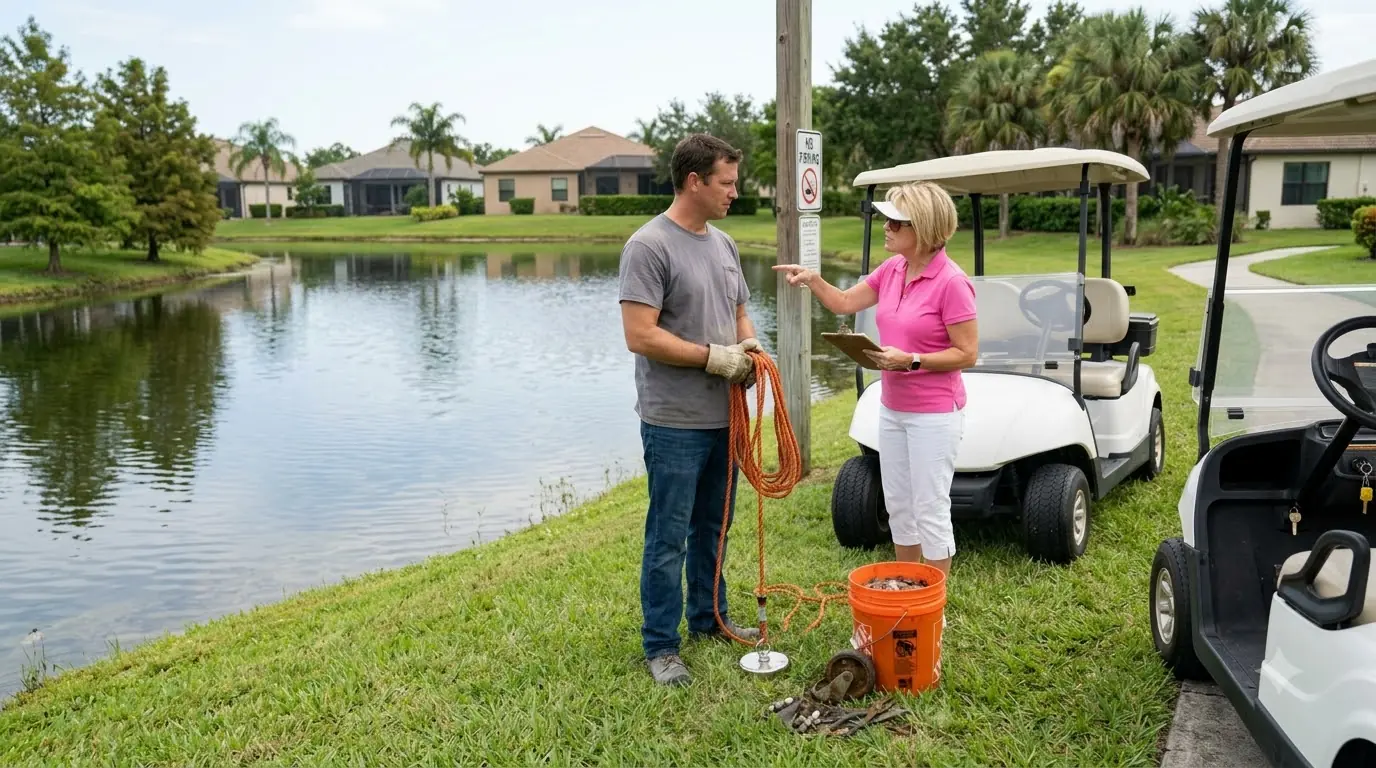
You're probably wondering how I ended up covered in Florida pond muck, staring at a pile of literal sunken treasure in my garage. To understand that, you need to understand the Pelican's Perch Homeowners Association in Naples, Florida. And to understand Pelican's Perch, you need to understand Ashley. Pelican's Perch is one of those cookie-cutter pastel painted neighborhoods where the grass isn't just green, it's heavily regulated. We have rules for the color of your mailbox flag.
We have rules for the maximum allowable height of a decorative garden gnome. 14 inches, in case you were wondering, and yes, they measure. It's a place where retirees with too much time and not enough hobbies go to exercise petty authoritarianism over their neighbors. And at the top of this beige stucco food chain was Ashley. Ashley was the HOA president.
She possessed a haircut that looked like it was actively asking to speak to a manager. A permanent scowl etched deep lines around her mouth, and she drove a custom lifted golf cart equipped with a flashing amber light, and I kid you not, a handheld radar gun. She patrolled the neighborhood like she was guarding a nuclear launch facility, issuing citations for weeds that dared to grow a millimeter above the sanctioned limit. The whole mess started on a humid Tuesday afternoon. My 10-year-old nephew, Tommy, was visiting for the week.
Tommy is a good kid, quiet, and entirely obsessed with the outdoors. I had bought him a cheap closed-face spinning reel combo from Walmart, and we walked down to the community pond. Now, this pond is a massive man-made retention lake sitting right in the middle of the development. Before the HOA annexed the surrounding property in the late '90s and threw a gate around the whole place, it actually used to be part of a public park. For 30 years, people have been walking around it, tossing coins into it, dropping their keys into it, and generally treating it like a giant stagnant wishing well.
We set up on the grassy bank. I baited Tommy's hook with a little piece of bread. We were just going for bluegill, nothing crazy. He cast his line out, the red and white plastic bobber settling onto the glass flat surface of the water. It was peaceful.
The sun was warm. The cicadas were buzzing. And for about exactly 4 minutes, life was good. Then I heard it. The high-pitched electric whine of Ashley's golf cart approaching at exactly 14.5 mph.
She swerved off the paved walking path and drove straight onto the grass. The aggressive tread of her golf cart tires tore up a small patch of St. Augustine turf. She slammed on the brakes, sending a flock of terrified mallards scattering into the water. "Excuse me."
Ashley barked, stepping out of the cart. She was wearing a visor that cast a harsh shadow over her eyes. She marched over to us, pointing a manicured acrylic fingernail at a wooden post about 20 yards away. I looked at the post. Stapled to it was a brand new, highly unlevel, poorly laminated piece of pink printer paper.
"No fishing." "Violators fined $150." "Can you read?" Ashley asked, her voice dripping with the kind of condescension usually reserved for disobedient toddlers. I sighed, putting a hand on Tommy's shoulder.
The kid looked terrified. "Ashley, it's Tuesday. The kid is 10. We're catching and releasing bluegill that are the size of my palm. We aren't exactly running a commercial trawling operation out here."
"The rules are the rules," she snapped, pulling a small leather-bound citation pad from her pocket. "The board voted on this last night. The fish are community aesthetic property. You are disturbing the aesthetic. Pack it up or I'm writing you up."
I looked at the pond. I looked at Tommy, whose bottom lip was starting to quiver. Then I looked at Ashley. My internal monologue was already running at full speed. Community aesthetic property?
Did the bluegill retain legal counsel? Do the frogs pay HOA dues? But I knew better than to argue with Ashley on the grass. She thrived on direct conflict. She wanted me to yell so she could call the Naples police and report a disturbance.
"Fine," I said, keeping my voice dangerously level. "We're leaving. Come on, Tommy. Reel it in." Tommy quietly reeled in his empty hook.
And we packed up the tackle box and walked back to my house in silence. I felt that familiar hot prickle of injustice at the back of my neck. I absolutely despise bullies, especially administrative bullies who hide behind pink laminated signs. That night, after Tommy was asleep, I sat at my kitchen island with my laptop open.
The glow of the screen illuminated my kitchen as I descended into the rabbit hole of Florida state law. There is a beautiful, dangerous thing about the law. It is incredibly specific. People like Ashley rely on the spirit of their poorly drafted HOA rules. But the letter of the law is where you find the cracks.