Sunrise came slow over Asheford County that morning, the kind of pale orange light that used to catch on the water running through the ditch behind our property. I stood at the edge of what had been our drainage canal for almost 70 years, and I watched 60 flat-graded home sites stretch out where the water used to run.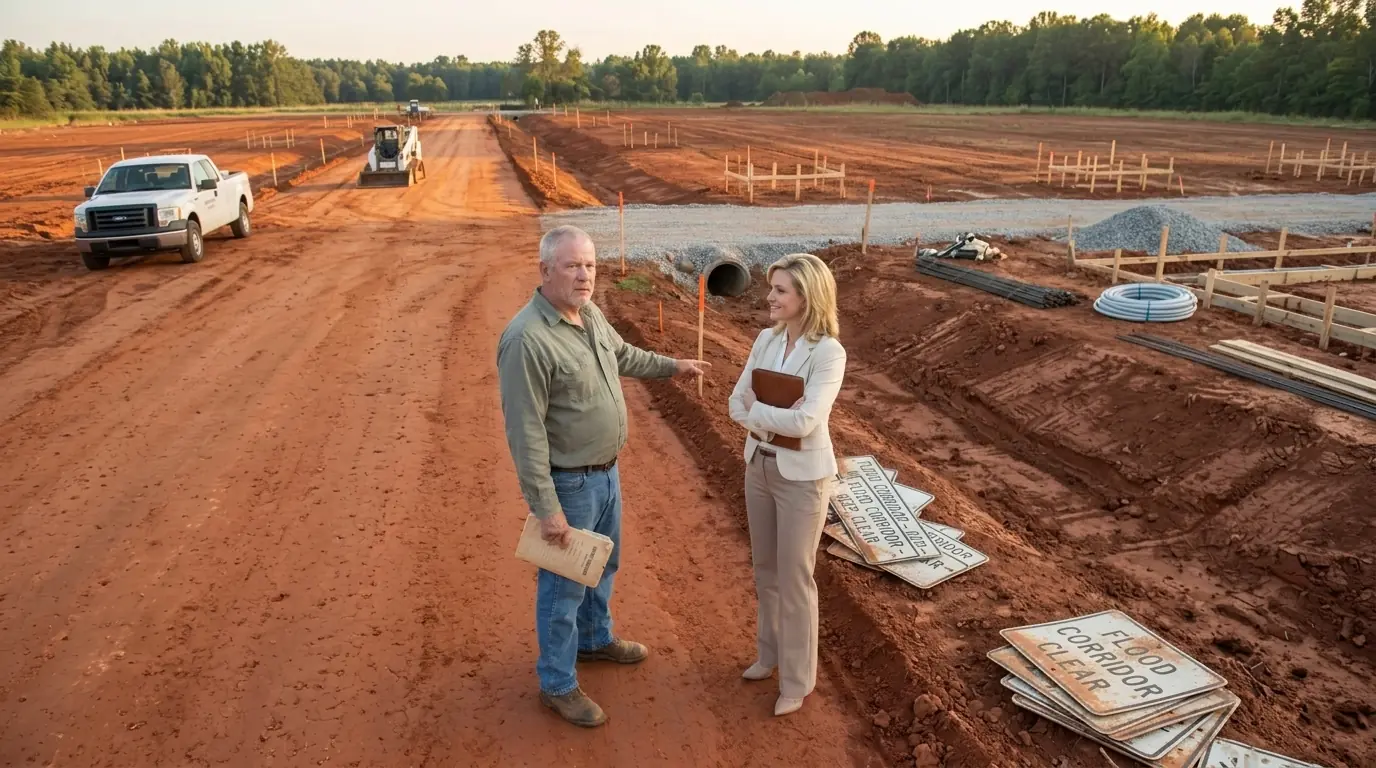
Dana Whitlock stood beside me in a blazer that cost more than my truck, smiling like she had already won something. She told me a muddy ditch could not stand in the way of progress, and she said it the way people say things they have never once had to prove.
I told her about the flood corridor easement, about the release gates 2 miles upstream, about the county seal stamped on paperwork older than her subdivision. She laughed, waved a hand toward the survey stakes, and walked back to her car.
3 days later, the emergency sirens went off before dawn, and the gates opened exactly the way I told her they would.
My name is Grant Ellison, and I have lived on this land since before I could walk. My father bought 34 acres along the eastern edge of what eventually became Brier Glenn back in 1968, long before anyone had poured a foundation for a subdivision anywhere near here.
Running along our boundary was a channel about four yards wide that the old-timers called the Ellison cut, though most people who moved into the new houses never gave it a second look. Most of the year it sat almost dry, choked with weeds and riverstone, carrying nothing more than a thin trickle that a child could step over without getting wet. It looked, to anyone who had not lived through a hard, rainy season, like nothing more than an ugly scar on an otherwise pretty piece of land.
It was not a simple irrigation ditch, whatever the newcomers assumed when they saw it from their back porches. A document filed with the county in 1957 granted Asheford County a permanent right to use that channel as an emergency flood release corridor from the Asheford reservoir upstream.
My father used to walk that ditch twice a year clearing brush and deadfall, keeping the bed open the way his own father had taught him. He told me once, standing right where I was standing that morning with Dana, that the canal could stay quiet for 20 years and never say a word. But the day it finally spoke, a man had better not be standing in front of it. I never forgot that.
I kept the brush cut back and the channel clear long after he passed, even when half of Brier Glenn assumed I was just an old-fashioned man tending a useless gutter. I had spent most of my working life as a maintenance supervisor for a local contractor, overseeing storm drains, culverts, and lift stations across three counties. So, I understood better than most what a channel like ours was actually built to do. I knew the difference between a decorative water feature and a working piece of flood infrastructure. And I knew that difference could be the line between a wet lawn and a washed-out foundation.
Every autumn I walked the length of the corridor with a machete and a pair of heavy gloves, cutting back the honeysuckle and clearing fallen limbs so nothing would dam the flow if the water ever came hard and fast. Neighbors who bought into Brier Glenn after the first phase went up would sometimes stop their cars along the road and watch me working, and more than a few asked why the county did not simply pave the whole thing over and be done with it. I always gave them the same answer: that some ground was never meant to be built on, no matter how flat and convenient it might look from the street.
Then one Tuesday morning in early spring, I walked the property line and found orange survey stakes driven straight down into the dry bed of the canal. Each one carried a printed tag that read "Phase 3 Brier Glenn expansion." I stood there for a long moment before I understood what I was actually looking at.
I drove into town that same afternoon and found a set of blueprints laid across the hood of a survey truck. And when I looked closely at the plan, I realized the new homes were not simply going up beside the canal. They were going up directly on top of it, foundation lines drawn straight across 70 years of documented water rights as if the corridor had never existed at all.