I was standing at the end of my own driveway when the patrol car turned onto the road, lights already spinning.
Karen was blocking my truck. Her husband was circling it with his phone out, snapping photos of my plates like he was building a case file.
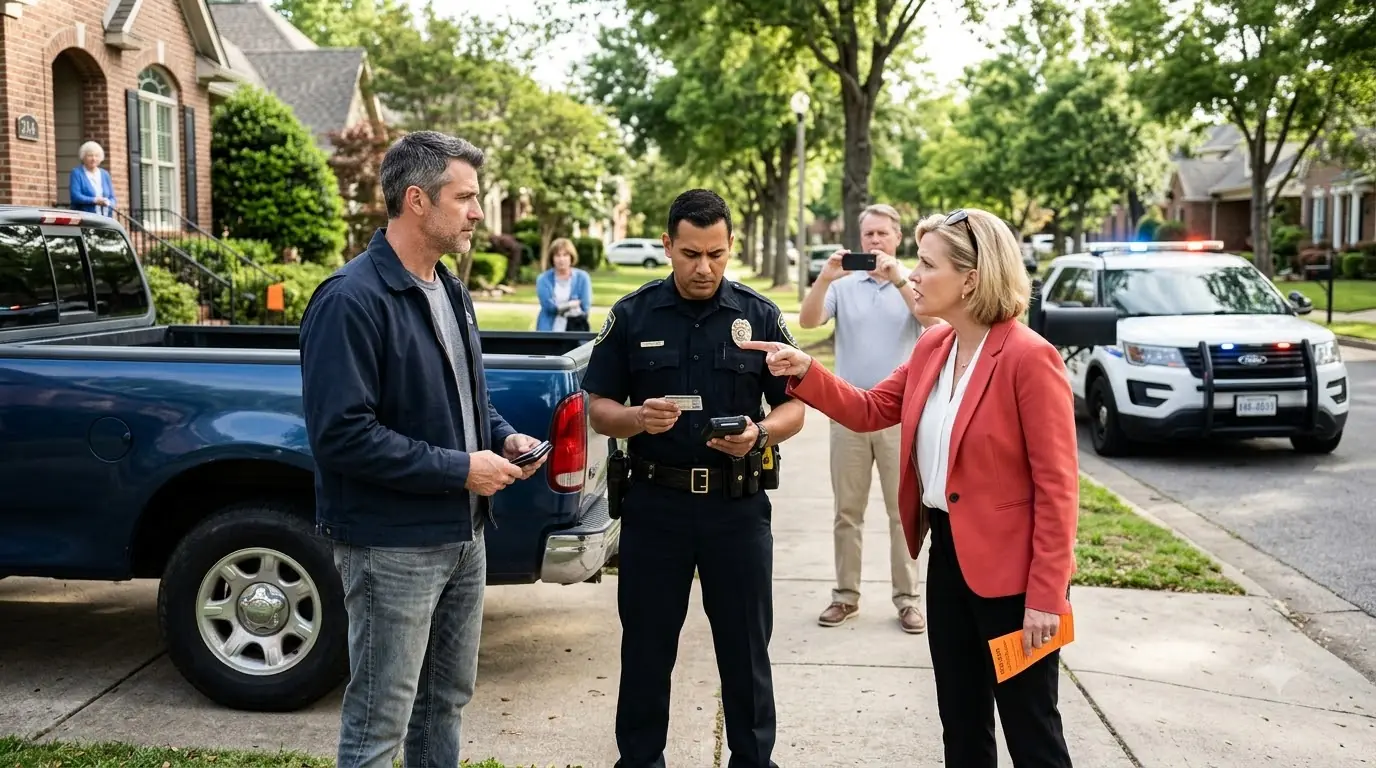
"This road is HOA property," Karen said, jabbing a finger toward my chest. "You don't get to park here. You don't get to be here." A violation notice was zip-tied to my gate behind her fluttering in the wind.
Orange, official-looking, useless. Her husband reached out and slapped his palm flat on my tailgate like he was tagging livestock. I hadn't given him permission to touch anything I owned. "Sir, step back from the vehicle," the officer called out, already walking up.
Karen got to him first. "He's trespassing," she said, loud enough for three houses to hear. "I want him removed now." I didn't move. I didn't raise my voice.
I just stood there watching a woman confidently explain the law to a man in uniform getting almost every part of it wrong. She had no idea she had just called 911 on the man who owned the ground that patrol car was parked on. "ID," the officer said to me, hand out, not unkind. Just doing his job on second-hand information.
I handed it over slowly. Karen crossed her arms like she'd already won. "This is what happens," she told the small crowd gathering by their mailboxes, "when people think they can just do whatever they want." Nobody said anything back to her. Nobody ever did.
The officer walked toward his car with my license, glanced down at it once, then again, longer the second time. Karen didn't notice. She was too busy narrating her victory to a woman in a bathrobe two driveways down. "We've had complaints," she said.
"Multiple complaints. This ends today." I watched the officer's radio crackle, watched him lean into his open door and read something off my ID into the mic slow and careful like he wanted to be sure before he said it twice. I already knew what he was about to find. I'd known it for months. I just hadn't decided yet whether today was the day I stopped letting her find out the easy way.
Karen turned back to me smiling the kind of smile people wear right before the floor disappears under them. "Any last words," she'd said, "before they walk you off my property?" I looked past her at the road, at the gate, at the notice still zip-tied there, snapping in the wind like it mattered. If she'd known whose name was actually on file for that road, she wouldn't have dialed 911. She would have run.
I moved into that subdivision in March in an unmarked work truck with three boxes of clothes and a filing cabinet I told the movers to handle carefully. Nobody asked what was in it. Nobody asked much of anything, actually. I liked it that way.
To the neighborhood, I was just the new guy. Quiet. Kept to himself. Drove an old truck instead of something that announced money.
I never corrected anyone who assumed I worked construction or maybe managed a hardware store somewhere. Let them assume. Assumptions were useful. Karen, on the other hand, made sure everyone knew exactly who she was within the first week.
She'd been HOA president for 6 years by then, and in that time, she'd rewritten the bylaws twice. Both times to give the board more teeth. Fines for mailbox color, fines for trash cans left out past 6:00 p.m., fines for a basketball hoop visible from the street, small things individually, but she'd turned small things into a system, and the system ran on fear. I heard about it before I felt it myself.
At the mailbox cluster, an older woman named Ruth told me, almost apologetically, that I should get a copy of the covenant book before Karen finds a reason to need one. She said it like she was warning me about weather. Ruth had lived in the neighborhood for 11 years. She was 73, widowed, and I'd learn later, already 3 months behind on an HOA fine she couldn't fully explain to me because the reason kept changing depending on who from the board she'd spoken to that week.
"She has fines on half the street," Ruth said. "Nobody fights her. Fighting her costs more than paying." I didn't say much back. I just filed it away the way I filed everything.
My first notice came 6 weeks after I moved in. Mailbox color. Apparently, mine was a shade outside approved specifications, according to a laminated card zip-tied to the post. I checked the covenant book Ruth had told me to get.
The approved range was listed as a Pantone code. My mailbox was by my own eye identical to four others on the street. I didn't fight it. I paid the $11 because $11 wasn't worth the conversation yet.
But I took a photo of the notice, time-stamped it, and put it in a folder I'd started keeping in that filing cabinet nobody had asked about. That folder didn't start out as a plan. It started out as a habit. I'd spent enough of my life around paperwork to know that people who abuse small authority always leave a paper trail because they don't think anyone's going to bother reading it back to them.
Karen never asked me a single personal question in those first months. Not my job, not where I'd come from, not what the quiet trucks working on the empty lot near the entrance road were there for. She had already decided who I was the moment she saw the truck and the work boots. To her, I wasn't a neighbor.