My HOA Karen destroyed my backyard beehives, so I made sure she’d get a very personal introduction to about 50,000 of my closest friends. I’m talking full-on horror movie chase scene, except instead of a masked killer, it was a swarm of very angry bees. And instead of a final girl, it was a middle-aged woman in a designer blazer screaming words I didn’t even know existed.
But here’s the thing. Was it really an accident when she showed up that day, or did I know exactly what would happen when I forgot to mention the relocated hives? Even I’m not sure if I’m the hero or the villain in this story.
So, here’s how this whole thing started.
I had three beautiful beehives in my backyard, right up against the fence line near my garden. And these weren’t just any bees. These were Italian honeybees, the gentle kind that basically ignore you unless you’re actively trying to mess with them. And I’d been keeping them for almost two years because I loved the fresh honey, and my garden had never looked better with all that pollination happening.
The hives were painted this nice sky-blue color, tucked behind some flowering bushes, completely out of sight from the street. Totally legal according to county regulations. And I’d even registered them with the local beekeeping association because I actually cared about doing things the right way.
Every weekend, I’d go out there in my bee suit, check on the girls, harvest a little honey, and just enjoy the peaceful hum of thousands of bees doing their thing. And my neighbors on both sides had zero problems with it because I’d talked to them first, even gave them free honey, and they thought it was actually pretty cool.
But then, one Saturday morning, I’m out there doing a routine hive inspection, and I hear this voice behind me that made my blood run cold, even through the bee suit. Karen from the HOA, standing in my backyard without permission, without knocking, just standing there with her arms crossed and this look on her face like she just discovered I was running an underground gambling ring.
She goes, “Those are beehives.” Not as a question, but as an accusation, like I was keeping tigers or something.
And I turned around slowly, bees crawling all over my veil and gloves, and I said, “Yeah, they’re beehives. I’m a beekeeper.”
And she immediately launched into this speech about how beehives are a nuisance and a danger to the community, and how she’d received multiple complaints from concerned residents, which was absolutely a lie. Because my only two neighbors love the bees, and everyone else couldn’t even see my backyard.
I tried explaining that bees are totally legal, that I’m licensed, that these specific bees are known for being docile, but she cut me off and said, “It doesn’t matter what I think is legal. The HOA has standards and regulations.” And she’d be filing a formal complaint with the board to have the hives removed immediately.
And before I could respond, she spun around and marched out of my backyard. And I just stood there covered in bees, thinking, here we go again, another battle with this woman who’d made it her personal mission to make my life miserable ever since I’d painted my front door a color she didn’t preapprove three years ago.
But here’s where things took a turn.
Two days later, I got the official letter from the HOA. And I’m not going to bore you with the legal language, but basically they were demanding I remove the beehives within seven days or face daily fines, starting at $50 and escalating from there.
And the letter specifically mentioned safety concerns, potential liability issues, maintaining property values, all this nonsense that had Karen’s fingerprints all over it because I knew for a fact that beehives weren’t mentioned anywhere in our HOA bylaws.
So, I did what any reasonable person would do. I called the county agricultural extension office, confirmed that my hives were completely legal under county law, which supersedes HOA rules, got everything in writing, and sent a polite but firm response to the HOA board explaining that they had no legal authority to make me remove legally permitted agricultural equipment from my private property.
I thought that would be the end of it, that Karen would back down once she realized she couldn’t win this one. But I forgot who I was dealing with. This was a woman who’d once spent six months trying to fine a neighbor for having the wrong shade of white on their mailbox post. A woman who measured everyone’s grass height with an actual ruler. A woman who drove through the neighborhood with binoculars looking for violations like some kind of suburban spy.
So, of course, she wasn’t going to just let this go.
Three days after I sent my response, I was at work when my neighbor texted me a photo that made my stomach drop. Karen’s car parked in my driveway, and she was in my backyard again, this time with two other people I didn’t recognize. And they were all standing near my beehives taking pictures and pointing. My neighbor said they’d been back there for almost 20 minutes.
And I immediately left work early and drove home as fast as legally possible because I knew something bad was about to happen. When I pulled into my driveway, Karen’s car was gone. But as I ran into my backyard, I saw something that made me actually gasp out loud.
Someone had spray-painted giant red X’s on all three of my hives.
And I don’t mean little X’s. I mean these huge marks that covered almost the entire front of each hive box. And the bees were going absolutely crazy, flying in confused patterns, clustering around the entrance, clearly agitated by the paint fumes and the disturbance.
And I knew immediately who’d done it because who else could it have been?
I checked my security camera that faced the backyard, and there it was, crystal-clear footage of Karen and her two buddies from the HOA board walking right up to my hives. Karen pulling out a can of red spray paint from her enormous designer purse and methodically marking each hive while the other two stood there watching like this was totally normal behavior. And you could even hear her on the audio saying something about marking them for removal and making sure he knows we’re serious.
And I sat there watching this footage, feeling this mix of rage and disbelief because she’d literally just committed vandalism and trespassing on camera.
The next morning, I went out to check on the hives, and two of them were completely dead. I mean, every single bee inside was just gone. Not dead on the ground, just vanished. And the third hive was struggling, the bees acting weird and lethargic. And I realized the spray paint must have had something in it that either killed them or drove them away.
And I just lost two entire colonies, representing months of work and hundreds of dollars in investment, not to mention the loss of the bees themselves, which I actually cared about.
I was beyond angry now. I was in that cold, calculated state where you stop yelling and start planning. And I knew I had to do something. But I also knew going through official channels would take forever and probably result in nothing because HOA boards protect their own, and Karen would just deny everything or claim she was acting on behalf of the community.
So I sat there in my backyard, looking at my destroyed hives, and I thought, you know what? Maybe it’s time Karen learned what it actually feels like to be on the wrong side of a few thousand bees.
So here’s what I did.
I called my beekeeping mentor, this old guy named Frank who’d been keeping bees for 40 years and knew everything about everything when it came to these insects, and also someone Karen had messed with before. He’d been one of her earlier victims, long before I moved in.
And I asked him about getting replacement colonies, and he said he actually had some extra hives he needed to relocate because he was downsizing. Strong colonies, very healthy, and he could give me a good deal.
But then I mentioned what happened with Karen, and Frank got this tone in his voice, this knowing chuckle, and he said, “You thinking what I think you’re thinking?”
And I said, “Maybe. What am I thinking?”
And he explained that he had this one particular hive that was, let’s say, less friendly than my Italian honeybees. They were a hybrid strain, technically legal to keep, but known for being extremely defensive of their territory. The kind of bees that would chase you for a quarter mile if they decided you were a threat.
And Frank said he’d been trying to requeen them to calm them down, but hadn’t gotten around to it yet. He asked if I wanted that colony. Said I could have it cheap since they were difficult to manage.
And I sat there thinking about Karen’s face covered in red spray paint, about my dead bees, about the years of harassment I’d endured from this woman. And I said, “Yes, I’ll take them.”
But I didn’t tell Frank what I was really planning.
A week later, I had four new hives set up. Three with normal, gentle bees and one with Frank’s spicy colony. And I positioned them in a very specific spot, not against the back fence where my old hives had been, but along the side yard, right next to the gate that led to my backyard, in a location that was still technically on my property but much more visible from the street.
And I made sure not to paint these hives, just left them as plain wood boxes. Nothing to indicate which hive was which, except for a small mark I’d made on the bottom of the defensive colony’s box, a mark only I would know to look for.
Now I just had to wait because I knew Karen. I knew her patterns. I knew she couldn’t resist checking up on me to see if I’d complied with her illegal demand to remove my bees.
And sure enough, four days later, I was watching my security camera feed on my phone while I was at the grocery store. And there she was, walking up my driveway like she owned the place. And I watched her look around to make sure no one was watching. And then she opened the side gate and walked right into my yard, heading straight for where she thought my hives would be.
So when Karen walked through that gate expecting to find my hives in their old spot against the back fence, she instead walked directly past the new hives positioned right next to the gate. And I mean directly past them, probably less than three feet away. And she was so focused on getting to the back of the yard that she didn’t even notice them.
I watched on my camera as she reached the back fence, saw nothing there, looked confused, and then started walking back toward the gate. And I knew what was about to happen. I knew it with every fiber of my being.
And part of me wondered if I should call her, warn her, tell her to freeze and back away slowly. But then I remembered my dead bees, remembered the red X’s, remembered every single time this woman had made my life hell for no reason except her own power trip.
And I just kept watching.
Karen was about five feet from the gate when she must have finally noticed the hives because she stopped walking. And I could see her lean in closer, probably trying to see if they were active. And that’s when she made her big mistake. She reached out and actually knocked on one of the hive boxes. Not a gentle tap, but a solid knock, like she was knocking on a door.
And I don’t know if she was trying to see if there were bees inside or if she was just being her usual aggressive self. But what she definitely didn’t know was that she just knocked on the one hive that absolutely should not be knocked on under any circumstances.
For about three seconds, nothing happened. And I could see Karen looking satisfied with herself, probably thinking the hives were empty or inactive. But then I saw the first bee emerge from the entrance, and then another. And then suddenly the entrance was just black with bees pouring out like water from a faucet.
And Karen’s body language changed instantly from confident to confused to, “Oh my God, what have I done?”
The bees didn’t just fly around randomly. They went straight for her. Dozens of them. Then hundreds. And I watched through my camera as Karen screamed. And I mean really screamed, this sound that was part terror and part disbelief. And she started running toward the gate, swatting at the air around her head.
And more bees kept coming, chasing her, because that’s what these particular bees do. They defend their territory aggressively. And defensive bees don’t just sting once and leave. They pursue the threat until it’s far away from their hive.
Karen made it through the gate, but the bees followed her. A cloud of angry insects surrounding her as she ran down my driveway. And she was spinning in circles, swatting at them with her hands. Then she took off her designer blazer and started using it like a weapon, whipping it through the air, hitting herself in the face with it half the time.
And the scene was so absurd, so perfectly chaotic, that I actually started laughing right there in the grocery store parking lot. This burst of laughter that I couldn’t control. Because here was this woman who’d terrorized me and countless others for years, now being terrorized herself by something she’d brought entirely upon herself.
She made it to her car, threw herself inside, but some bees had followed her in. And through my camera, I could see the car rocking back and forth as she presumably fought them inside the vehicle. And then the car started, and she peeled out of my driveway so fast she left tire marks on the street. And the remaining bees eventually gave up the chase and flew back to their hive like nothing had happened.
I sat in my car watching the footage replay, watching Karen run and scream and swat. And I felt this weird mixture of satisfaction and something else, something I couldn’t quite name. Was it guilt? Was it triumph? Was it justice? I honestly couldn’t tell.
And that’s when I realized this situation was more complicated than I’d thought because, yes, she’d trespassed again. Yes, she’d provoked the bees herself. Yes, she’d brought this entirely on herself. But I’d also known those bees were aggressive. I’d positioned them specifically where someone entering my yard would walk past them. I’d chosen not to warn her, even when I saw her on camera.
So, was this really just karma, or had I orchestrated something darker?
But before I could think too much about it, my phone rang, and it was my next-door neighbor. And his voice sounded worried, and he said, “Dude, I just saw Karen run out of your place covered in bees. She looked really messed up, and she was screaming something about calling the police and suing you and getting your bees destroyed. You might want to check your camera.”
And I said, “Thanks. I saw it. I’ll handle it.”
And I hung up, feeling this knot form in my stomach because I realized this wasn’t over. This was just the beginning. And Karen wasn’t the type to just accept what happened and move on. She was the type to escalate, to weaponize, to turn herself into the victim and me into the villain.
And suddenly, I wasn’t sure if my revenge had been worth whatever was coming next.
I drove home, and as I pulled into my driveway, I saw something that made my blood run ice cold. There was an ambulance parked two houses down, and a police car was parked in front of my house, and I could see Karen sitting on her tailgate with a paramedic examining her arms and neck. And even from my car, I could see the red welts covering her exposed skin. Dozens of them, maybe more.
And standing next to the police car was an animal control officer. And he was looking at my house with this expression that told me everything I needed to know about where this was heading.
I got out of my car slowly, trying to look confused and concerned rather than guilty. And the police officer approached me and asked if I was the homeowner, and I said yes. And he asked if I kept bees, and I said yes. And he nodded and said they’d received a complaint about aggressive bees attacking someone on my property, and he needed to ask me some questions.
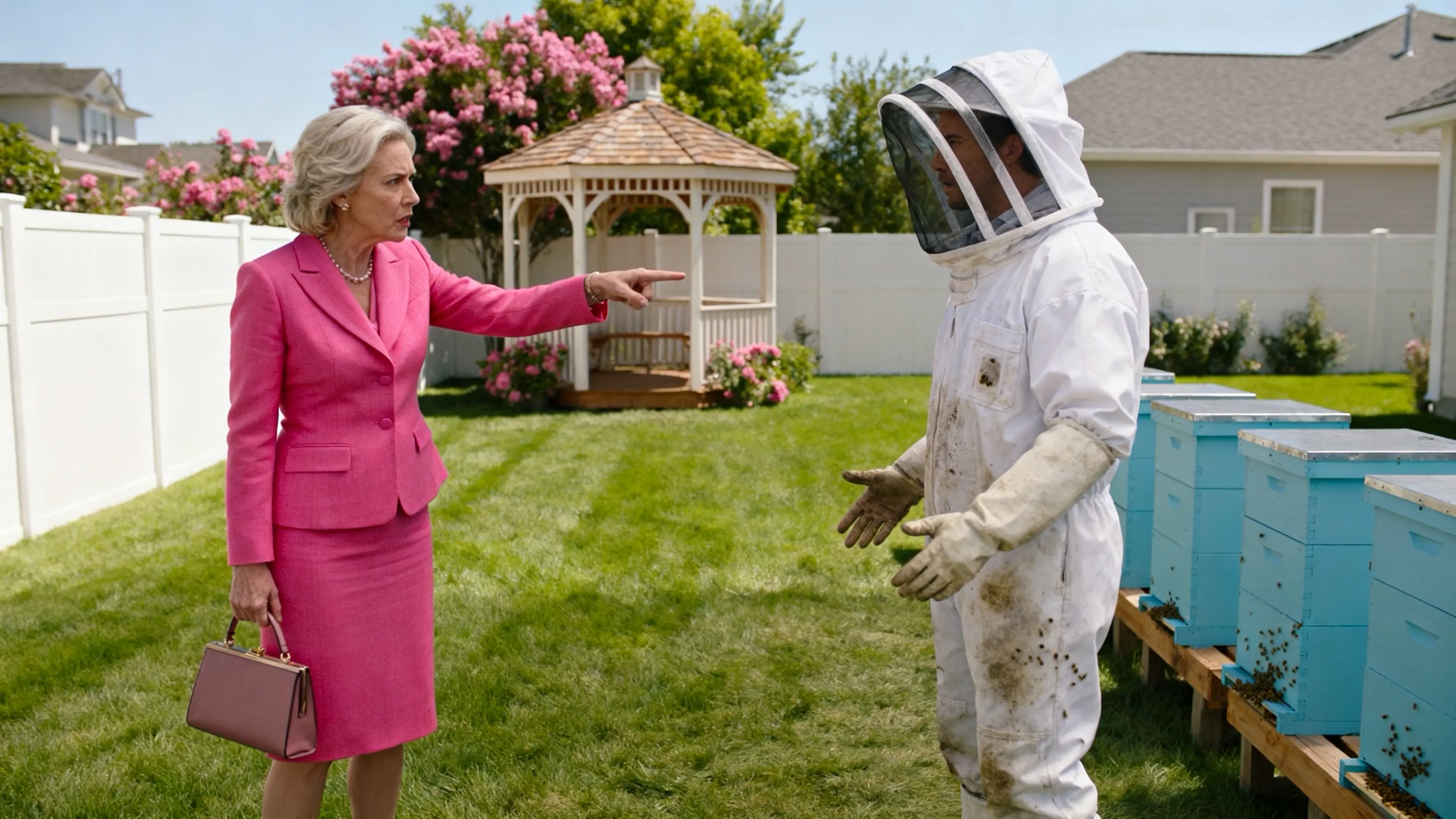
I explained that Karen had trespassed, that she’d been harassing me about my bees, that I had security footage of her vandalizing my previous hives. And the officer seemed interested in that, asked if he could see the footage, but then the animal control officer walked over and said he needed to inspect my hives immediately.
And I said, “Sure, no problem.” And I led them both to the side yard where the hives were positioned. And my heart was pounding because I knew the defensive colony was right there, clearly marked with their activity.
And the animal control officer took one look at the setup and said, “Which hive was active when the incident occurred?”
And I pointed to the one Frank had given me. And he made some notes and said, “These bees would need to be evaluated, possibly removed, possibly destroyed, depending on their aggression level.”
And that’s when I felt it, that sinking feeling that my revenge had just cost me everything. Because not only was I going to lose the bees again, but I might face actual legal consequences this time. Criminal charges, a lawsuit, everything I’d been trying to avoid by taking matters into my own hands.
But then, right as the animal control officer was about to say something else, my phone buzzed with a text message, and I glanced down at it without thinking, and it was from Frank, my beekeeping mentor. And all it said was, “Call me right now. Emergency. Don’t say anything to anyone until you talk to me.”
I looked up at the officers and said I needed to make a quick phone call. Is that okay? They said, “Sure. We need to talk to the other party anyway.” And they walked back toward Karen.
I immediately called Frank. And before I could even say hello, he said, “Listen to me very carefully. Those bees I gave you, there’s something you need to know about them.”
My stomach dropped even further because I thought he was about to tell me they were illegal or dangerous or something that would make this situation even worse.
But instead, he said something that changed everything. And I mean everything.
Suddenly, I realized this whole situation wasn’t what I thought it was at all, and neither was Karen’s involvement. And what I’d done might not have been revenge at all, but something completely different, something that made me question everything I thought I knew about what had been happening for the past three weeks.
And there I stood in my yard holding my phone, listening to Frank talk, watching the police officer interview Karen. And I thought, “Oh no. Oh God. What have I actually done?”
Frank’s voice on the phone was urgent, almost panicked. And he said, “Those bees I gave you, the defensive colony, I need you to listen very carefully because this is important. They’re not just defensive. They’re Africanized hybrids, technically legal in our county, but only with special permits and inspections. And I was supposed to have them requeened and certified before giving them to anyone, but I thought I had more time. And if animal control tests them and finds out their Africanized genetics, you’re looking at serious fines, possible criminal charges for keeping unregistered aggressive species, and they will absolutely destroy that colony immediately.”
And I felt my legs go weak because Africanized bees, even hybrids, were the kind of thing that made headlines, the kind of thing that could turn me from a victim of HOA harassment into a public menace.
And I looked over at the animal control officer, who was now taking photos of my hives, and I knew I had maybe five minutes before he asked to inspect them more closely and discovered exactly what Frank was telling me.
I asked Frank what I should do, and he said the only option was to remove that specific colony immediately before they tested it. But I couldn’t just walk over there and start dismantling a hive in front of police and animal control without looking incredibly suspicious.
And Frank said, “I know, I know. I’m trying to think.” And then he said, “Wait, did anyone actually get stung? Like, did the bees make contact?”
And I said, “Yes. Karen got stung multiple times. She’s covered in welts.”
And there was this long pause on the phone, this terrible silence. And then Frank said something that made my heart stop completely. He said, “Oh God, please tell me you know about Karen’s bee allergy. Please tell me someone told you she has a documented severe anaphylactic reaction to bee stings. She almost died from a single sting three years ago. It’s on file with the county emergency services. And if she got stung multiple times by Africanized hybrids, she should be in a hospital right now, not sitting on a tailgate. This is really bad. This is potentially manslaughter-level bad if something happens to her.”
I hung up the phone and just stood there watching Karen talking to the police officer, watching her point at her arms and neck, watching her gesticulate wildly like she always did when she was worked up.
And she looked fine. Uncomfortable and angry, but fine. Not like someone experiencing anaphylactic shock.
And I thought maybe Frank was wrong. Maybe her allergy wasn’t that severe. Maybe she’d built up tolerance. But then I remembered the animal control officer saying something about evaluating the bees. And I realized if they discovered the Africanized genetics and then found out about Karen’s allergy, it wouldn’t matter that she looked fine now. It would only matter that I’d knowingly kept aggressive bees and she’d been exposed to them.
And suddenly, my little revenge plan had transformed into something that could destroy my entire life, cost me everything, possibly land me in an actual prison. And I couldn’t even claim ignorance because I’d specifically asked Frank for aggressive bees. I’d positioned them where an intruder would encounter them. I’d watched Karen approach on my camera and done nothing to warn her.
And every single one of those decisions was about to come back and crush me.
The police officer walked over to me and said they’d need a full statement, asked if I had the security footage I’d mentioned, and I said, “Yes, it’s inside. Let me get it.”
And I walked into my house with my mind racing because I needed to figure out a plan, needed to think of some way to salvage this situation before it spiraled completely out of control.
But as I was pulling up the security footage on my laptop, I noticed something weird in the timestamp of Karen’s first trespassing incident, the one where she spray-painted my original hives. And I realized the date was exactly three days after I’d sent my legal response to the HOA about the bees being protected under county agricultural law, which meant she’d vandalized my property in direct retaliation for me asserting my legal rights.
And that was a crime, a documented crime on video.
And maybe, just maybe, that was enough leverage to shift this situation back in my favor.
I copied the footage to a thumb drive, both the spray-painting incident and today’s bee attack. And I walked back outside where the police officer was waiting, and I handed him the drive and explained what was on it. And I made sure to emphasize that Karen had trespassed twice, that she’d destroyed my property the first time, that she’d knocked on the hive today, which provoked the bees.
And the officer nodded and said he’d review it.
But then Karen saw me talking to him, and she marched over, her face red and swollen, her arms covered in welts that looked genuinely painful. And she pointed at me and screamed, “He tried to kill me. He set a trap. He knew I’d come check on those illegal bees. And he set those monsters to attack me. I want him arrested right now.”
And I started to respond, but she kept going, saying she had witnesses, saying she had documentation of my harassment, saying the HOA board would back up everything she claimed.
And I just stood there thinking, here we go. Here’s the Karen I know, the one who lies and manipulates and twists everything to make herself the victim. Except this time, she actually was kind of the victim. Or at least she’d been hurt. And I didn’t know how to feel about that, didn’t know if I should feel guilty or justified or some horrible mixture of both.
The police officer held up his hand and told Karen to calm down, said he’d review all the evidence and then make a determination about whether any charges were warranted.
And Karen said, “There better be charges. She could have died. She has a severe bee allergy. Everyone knows she has a bee allergy.”
And I felt my stomach drop again because if everyone knew, then I should have known. And if I should have known, then my actions looked even more malicious, even more intentional.
And I realized I was standing on the edge of something very dark, something that could consume my entire life if I wasn’t extremely careful about what I said next.
But then something happened that I didn’t expect.
My neighbor, the one who texted me about Karen, walked over from his yard and said to the police officer, “Excuse me, I think I need to add something here. I’ve been living next to this guy for five years and next to Karen’s house for eight years. And I’ve watched her harass him constantly. And I’ve got Ring camera footage of her trespassing on his property at least six other times in the past two months. And I’m pretty sure whatever happened today, she brought it on herself.”
And Karen’s face went from red to purple, and she started yelling at my neighbor, calling him a liar, saying he was in on it, saying everyone in the neighborhood was conspiring against her.
And the police officer’s expression changed, shifted from neutral investigation mode to this is a complicated neighborhood dispute mode. And he said he’d need to collect statements from everyone involved and review all available footage before making any decisions.
The animal control officer walked back over and said he’d need to take samples from the aggressive hive for testing. Standard procedure. And I felt my chest tighten because that test would reveal the Africanized genetics, would trigger a whole new level of problems.
But before I could figure out how to stall or distract or do anything, Karen interrupted and said, “I want all those hives destroyed. Every single one. They’re a menace. He’s keeping them illegally and I want them gone today.”
And the animal control officer said that wasn’t how it worked. He’d need to complete his evaluation first. And Karen said then she wanted them quarantined or whatever the procedure was.
And I could see her building up to another outburst, another scene. And I thought about all the times she’d done this before, all the times she’d escalated situations until she got her way through sheer force of persistence and loudness.
And something in me just snapped.
I looked at Karen and said, “You know what? Let’s talk about what you really came here for today. Let’s talk about why you’ve been trespassing on my property every few days for the past two months because it’s not about the bees, is it? It’s about something else, something you’ve been looking for.”
And Karen’s expression changed instantly. Went from angry to guarded.
And she said, “I don’t know what you’re talking about.”
And I said, “Really? Because my security cameras caught you not just spray-painting my hives, but also walking around my entire backyard, looking in my shed, checking behind my garden boxes like you were searching for something. And you’ve done it at least seven times according to the footage. Always when you thought I wasn’t home, always spending way more time than you’d need to just check on some bees.”
And I was bluffing. I hadn’t reviewed all my footage that carefully, but I’d seen enough to know she’d been doing more than just harassing me about the bees. And the way her face went pale told me I’d hit on something true, something she didn’t want discussed in front of the police.
She recovered quickly and said I was delusional, that she’d only been on my property twice, both times in her official capacity as HOA president to investigate violations.
And I said, “Okay, then you won’t mind if I show the police all the footage I have, including the timestamps showing you entering my yard at 10 at night two weeks ago and staying for almost 40 minutes because I’m very curious what HOA business requires a nighttime inspection that lasts 40 minutes.”
And Karen’s face went from pale to completely white. And she opened her mouth, but nothing came out.
And I knew, I absolutely knew, I just uncovered something big, something that changed the entire dynamic of this situation.
The police officer looked interested now, asked if I really had footage of nighttime trespassing, and I said, “Yes, multiple instances.” And he asked Karen if that was true. And she stammered something about needing to check on community safety concerns at various times.
And the officer said that didn’t really explain the duration or the late hours. And Karen got defensive and said she didn’t have to explain herself to anyone. She was the HOA president. She had authority to inspect properties when violations were reported.
And my neighbor laughed, actually laughed out loud, and said, “Karen, there’s no HOA authority to trespass on private property at 10 p.m. You know that. Everyone knows that. So, what were you really doing?”
And I watched her face cycle through emotions, anger, fear, calculation, more fear. And I realized whatever she’d been looking for in my yard was serious enough that getting attacked by bees was preferable to having it exposed.
And I made a decision right then that I was going to find out what it was, and I was going to use it to make sure she never bothered me or anyone else in this neighborhood again.
The police officer said he wanted to see all the footage I had, wanted me to come down to the station tomorrow to provide a complete statement. And he looked at Karen and said she should probably go to the hospital to get checked out properly, make sure there were no complications from the stings.
And Karen nodded, but she was staring at me now with this expression I’d never seen before. Not anger, not hatred, but something closer to fear.
And I stared back and thought, yeah, now you know how it feels. Now you know what it’s like to have someone threaten your security and peace and sense of control.
And I felt that satisfaction again, that dark satisfaction that probably made me a worse person than I wanted to admit.
After everyone left, after the police car drove away, and Karen sped off toward the hospital, my neighbor went back to his house. I stood in my backyard looking at my hives, looking at the defensive colony that Frank had warned me about. I knew I needed to do something about them before the animal control tests came back.
But I also knew I needed to figure out what Karen had been looking for in my yard because that was clearly the key to everything. The explanation for why she’d targeted me so aggressively, why she’d risk getting stung again even after the first incident, why she looked so terrified when I mentioned the nighttime footage.
I went inside and pulled up my security camera archives, started going through every instance of Karen in my yard.
And what I found was insane.
She wasn’t just walking around randomly. She had a pattern. She kept going to the same areas, specifically the back corner of my yard near the fence line I shared with the property behind mine. In one clip, I could see her actually using a small shovel to dig in that area, not deep, just a few inches, like she was checking for something. And in another clip, she had what looked like a metal detector, sweeping it over the ground in systematic rows.
And I sat there watching this footage, thinking, what the hell was she looking for? What could possibly be buried in my yard that she wanted so badly?
I called Frank back and told him I had a bigger problem than the Africanized bees. Told him about Karen’s repeated trespassing and searching behavior.
And Frank was quiet for a moment before asking, “Do you know who lived there before you?”
“Some older couple. They moved to Florida or something,” I replied.
Frank hesitated, then said, “Because I remember hearing something years ago about that property. Something involving the previous owners and the HOA. A big dispute. I can’t remember the details, but you should check the property records. See if anything unusual shows up.”
I thanked him, hung up, and immediately started digging through the county records.
What I found made everything suddenly make perfect sense.
The previous owners hadn’t just moved. They’d sold the house amid a legal battle with the HOA over embezzlement allegations. According to the court documents, the former HOA treasurer had been accused of stealing over $40,000 from the reserve fund. The money was never recovered. The treasurer claimed some documentation of the missing funds had been hidden and that the HOA president at the time had been involved. The case was eventually settled out of court, with the treasurer agreeing to leave the neighborhood. No charges were filed against the HOA president, but the documentation and the missing money were never found.
I looked at the dates and realized the legal battle had ended six months before I bought the house.
The HOA president at the time of the dispute, the one named in the documents, was Karen Wilson.
The same Karen Wilson who was now making my life hell. And the same Karen who had been secretly searching my yard for two months.
It clicked.
She wasn’t harassing me about bees. She was terrified that somewhere on this property, where she once had access, evidence could exist to prove her involvement in the embezzlement.
The bee complaint had been her attempt to justify a legal inspection. When that didn’t work fast enough, she had resorted to trespassing. And the reason she knocked on that hive today wasn’t anger. It was panic, desperation, and distraction.
I’d basically set a trap for someone already trapped by her own guilt.
Sitting there staring at the court documents, I felt that strange mix of emotions again. On one hand, Karen had brought this on herself. Crimes, theft, harassment. On the other, I had weaponized bees, put her in the hospital, and now held information that could ruin her completely. Could prove she was a thief, a fraud, could get her arrested, maybe even send her to prison.
I had to decide what kind of person I wanted to be.
Would I use this information or let it go? Was revenge worth becoming the type of person who ruins lives, even if those lives deserved it?
Before I could decide, my phone rang, a number I didn’t recognize.
“Is this the homeowner at 2847 Maple Drive?” a woman asked.
“Yes,” I said.
“This is County Animal Control. We need you to come to our office first thing tomorrow morning, and depending on your statements, we may need to involve law enforcement.”
My blood ran cold. The Africanized genetics had shown up. I was about to face the consequences Frank had warned me about. While I’d been uncovering Karen’s secrets, the universe had been preparing to expose mine.
Whatever happened next would determine whether I’d successfully gotten revenge or just destroyed my own life.
And honestly, I wasn’t sure which outcome I deserved.
I sat there staring at the court documents about Karen’s embezzlement and realized I had maybe 12 hours before animal control tested those bees.
But then something clicked. I had leverage now. Real leverage. And I could use Karen’s secrets to bury mine.
I called Frank and said, “Get that aggressive colony out of my yard tonight. Right now. I’ll pay double.”
And he said, “Okay,” he’d be there in 90 minutes.
I hung up and started planning exactly what I was going to do next. I spent the next hour copying every piece of footage of Karen trespassing, printed out all the court documents about the embezzlement, and then I did something crazy.
I went to my backyard with a shovel and started digging in the exact spot where Karen had been searching.
Two feet down, my shovel hit something solid, a metal lockbox wrapped in plastic. Inside were bank statements, transfer records, handwritten notes, all the proof of exactly how Karen had stolen $40,000 from the HOA, how she’d blamed the treasurer and ruined his life.
And this was what she’d been desperately searching for because she knew if anyone found it, she was finished.
Frank showed up, and we removed the aggressive colony in 45 minutes. Gone. Vanished.
I didn’t sleep that night. Just stared at that lockbox thinking about what to do with it.
And around 3:00 a.m., I decided I wasn’t going to blackmail Karen. I was going to give this evidence to the police and let actual justice happen because this wasn’t just about me anymore. It was about making sure she couldn’t do this to anyone else ever again.
Next morning, I showed up at animal control early, told them I’d relocated the aggressive colony to a licensed facility for safety reasons, gave them Frank’s information. The officer said that resolved their main concern, and I left before he could ask questions.
Then I drove straight to the police station, laid out everything, the lockbox, the documents, the embezzlement case from five years ago.
The detective’s expression went from bored to very interested.
Three hours later, I walked out knowing I’d just destroyed Karen’s entire life.
Two weeks later, Karen got arrested, escorted out of an HOA board meeting in handcuffs. The local news reported on the embezzlement charges. The HOA board voted unanimously to remove her as president and ban her permanently. Her house went up for sale as she scrambled to pay for lawyers, and everyone in the neighborhood finally understood why she’d been so controlling. She was protecting her secret, and now that secret had destroyed her completely.
Animal control did their follow-up inspection, found my new, properly documented hives. No violations, no problems.
The HOA sent me a formal apology letter and waived my dues for two years.
I read it feeling absolutely nothing. Just exhausted relief that it was finally over.
But the truth was, it wasn’t over.
Not really.
Karen Wilson being led out of that HOA board meeting in handcuffs should have felt like the ending. The perfect cinematic payoff. The villain exposed. The neighborhood freed. The apology letter in my mailbox like some official acknowledgment that I’d been right all along.
Instead, for the next three nights, I barely slept.
I’d lie in bed staring at the ceiling, replaying the same moment over and over again: Karen walking back toward the side gate, pausing, noticing the hives too late, reaching out, knocking on that box.
Then the first bee.
Then the second.
Then the black stream pouring out.
And always, the worst part wasn’t what she did.
It was what I didn’t do.
I could have called her. I could have yelled through the camera speaker I’d installed near the patio after the spray-paint incident. I could have warned her. I could have said, “Don’t touch the hive. Back away now.”
I didn’t.
Because part of me wanted her to learn.
And the ugliest truth was that part of me wanted it to hurt.
That fact sat in my chest like a stone, and no amount of HOA apologies or neighborhood validation could move it.
A week after Karen’s arrest, I was out in the backyard doing a quiet inspection on the three gentle colonies I’d kept when my next-door neighbor, Ben, leaned over the fence with a beer in one hand.
“You know,” he said, “most satisfying thing I’ve seen in ten years was watching that woman get dragged off in cuffs.”
I kept my eyes on the frame I was checking.
“Yeah?”
“Oh, come on,” he said. “Don’t act humble now. You finally beat her.”
I slid the frame back in carefully and closed the hive.
“Did I?”
Ben frowned.
“She terrorized everyone. She stole money. She trespassed into your yard over and over. She killed your bees. Now she’s gone. That’s a win.”
I pulled off my gloves and looked at him.
“She got stung because I knew what would happen if she crossed that gate and I chose not to stop it.”
Ben shifted, uncomfortable now.
“Yeah, but she chose to trespass.”
“She did.”
“She chose to hit the hive.”
“She did.”
“And she was literally searching your yard for evidence of her own crimes. You’re acting like you set a bear trap.”
I looked down at the wood grain of the hive lid.
“Maybe not a bear trap,” I said quietly. “But I definitely put something meaner than necessary in the path of someone I knew would come back.”
Ben was silent for a second.
Then he said, “You ever think maybe the problem is that decent people always have to feel guilty for fighting back?”
That line stayed with me after he went inside.
Because maybe he was right.
Or maybe that was exactly the kind of thing people tell themselves when revenge works a little too well.
Two days later, Detective Alvarez called.
He wanted me down at the station to review some follow-up questions about the lockbox and Karen’s repeated trespassing. My stomach clenched the second I heard his voice, because some part of me had been waiting for the other shoe to drop ever since I’d walked out of animal control uncharged.
The station smelled like coffee, toner, and old stress.
Alvarez was a compact man in his forties with tired eyes and the kind of face that never looked impressed by anything, which I actually appreciated. He didn’t offer coffee. Didn’t smile. Just opened the file and got to it.
“We found enough in that box to reopen the old embezzlement case completely,” he said. “Bank routing copies, internal transfer instructions, handwritten notes matching Karen Wilson’s samples, and documentation of the reserve siphoning.”
I nodded.
He tapped a page.
“Enough to charge her with fraud, theft, evidence tampering, and potentially conspiracy, depending on what we get from two former board members.”
“Okay.”
He looked up.
“But that’s not the only thing we need to discuss.”
There it was.
I felt my jaw tighten.
“The bee incident?” I asked.
He watched my face for a moment before answering.
“Yes.”
I didn’t say anything.
Alvarez folded his hands.
“Animal control confirmed the aggressive colony was relocated before testing, but they also confirmed from your mentor’s statement that you requested a defensive hive after your original colonies were vandalized.”
I held his gaze.
“Yes.”
“You positioned that hive near the side gate.”
“Yes.”
“You did not warn Ms. Wilson, despite seeing her enter your property on camera.”
My mouth had gone dry.
“No.”
Alvarez was quiet for a second.
Then he said, “Do you know why you’re not currently being charged with anything?”
I didn’t trust myself to answer.
“Because intent matters,” he said. “And right now, what we have is a homeowner with a documented history of being harassed, vandalized, and repeatedly trespassed against by the eventual victim. We have clear footage of her approaching the hive, knocking on it, and provoking the swarm. We have no audio or message where you lured her, instructed her, or directly set the event in motion.”
He leaned back slightly.
“That doesn’t make what you did smart.”
I let out a breath I didn’t realize I’d been holding.
“No,” I said. “It doesn’t.”
He nodded once.
“Frankly? If she hadn’t had prior criminal exposure and if you hadn’t brought us that lockbox voluntarily, this would feel a lot murkier.” He closed the file halfway. “As it stands, we’re documenting it as an injury resulting from unlawful entry and provocation of livestock or managed insects on private property.”
“Livestock?”
“Bees count in more legal categories than most people realize.”
That almost made me laugh, but I couldn’t get there.
Alvarez studied me for another beat.
“You feel bad?”
The question caught me off guard.
“Yes,” I said.
“Good.”
That surprised me.
He continued, “Not because she didn’t deserve consequences. She did. Maybe more than she’s even gotten so far. But because people who stop feeling the line between defense and vengeance are usually the ones I end up seeing again.”
I sat there with that.
Then asked, “So what happens now?”
Alvarez closed the file completely.
“You stay clean. You stay out of neighborhood politics for a while. You let the courts handle Karen Wilson. And if anyone asks whether you meant for that to happen, you tell the truth as far as you can live with it.”
“What does that mean?”
He stood, signaling the conversation was over.
“It means you can say you knew the hive was defensive. You can say you didn’t warn her. You can say you regret that. But don’t you dare turn this into some heroic legend in your own head. That’s how people drift.”
I drove home with those words sitting beside me like a passenger.
Don’t turn this into a heroic legend.
That night, I walked out into the backyard just after sunset. The air still held the last heat of the day, and the hives hummed softly in that low, steady way that had always calmed me. Bees coming and going. Workers returning heavy with pollen. Guards at the entrance checking who belonged.
Simple, orderly, honest.
Unlike people.
I sat in the old lawn chair near the garden and looked toward the patch of dirt where I had dug up the lockbox.
That little square of disturbed ground had held five years of corruption, paranoia, and fear. Karen hadn’t just been looking for evidence. She’d been trying to bury herself all over again before someone else found the truth.
And I had almost buried myself too.
The more I thought about it, the less satisfying her downfall felt.
Not because I pitied her exactly. She had earned every consequence headed her way. She had stolen from neighbors, framed someone else, terrorized the block, and tried to use my property rights dispute as cover for her own panic. But when I pictured her screaming in the driveway with bees in her hair and her blazer whipping through the air, what I felt now wasn’t triumph.
It was warning.
About myself.
About how quickly righteous anger can start tasting like permission.
The next Saturday, the neighborhood held its first HOA meeting without Karen.
I almost didn’t go.
But then Ben texted:
If you don’t show up, Dale from cul-de-sac lot 12 is absolutely going to nominate himself for something and we’ll all die.
So I went.
The meeting was in the community clubhouse, a low beige building that always smelled faintly of stale coffee and furniture polish. The turnout was bigger than I’d ever seen. People who hadn’t attended in years showed up, suddenly very interested in governance now that they knew $40,000 had disappeared under everyone’s noses.
There were whispered conversations everywhere.
About Karen.
About the lockbox.
About the former treasurer she’d scapegoated.
About how many of them had seen her snooping and never said anything because it seemed easier not to get involved.
That last part bothered me most.
Because that was the thing about neighborhood tyrants. They don’t stay powerful because they’re strong. They stay powerful because everybody decides it’s less exhausting to let them.
When the temporary board chair opened the floor for comments, people started with the usual stuff. Landscaping. Pool gate codes. Trash pickup confusion after holidays.
Then Mrs. Delaney from the corner lot stood up.
She had to be eighty if she was a day, and she looked like a retired school principal who still knew how to silence a room without raising her voice.
“I’d like to talk about fear,” she said.
The room quieted.
“For years, many of us allowed one woman to make this neighborhood smaller because speaking up seemed inconvenient. We watched her bully. We watched her pry. Some of us laughed about it. Some of us rolled our eyes privately. But very few of us actually did anything.”
Her eyes moved across the room.
“That includes me.”
No one interrupted.
Then she looked toward me.
“And if Mr. Harper had not pushed back when she targeted him, if she had not overreached in such a spectacularly foolish way, we might still be sitting here pretending none of it was our business.”
The attention shifted to me so suddenly I almost wanted to leave.
I stood reluctantly.
“Honestly,” I said, “I don’t think I’m the right person to give lessons on how to handle conflict.”
A few people looked confused.
I continued anyway.
“Karen Wilson absolutely needed to be stopped. But I’d be lying if I said I handled every part of this cleanly. I didn’t.” I paused. “What I will say is this: people like her count on everyone else staying tired, isolated, and politely uninvolved. So if this neighborhood changes at all after this, it shouldn’t be because one person finally fought back. It should be because the rest of us stop outsourcing courage.”
That landed harder than I expected.
No applause.
No drama.
Just a room full of people sitting with the truth.
At the end of the meeting, they voted in an interim board.
Ben, to his own visible horror.
Mrs. Delaney.
And, unexpectedly, me.
I said no.
Immediately.
Firmly.
But they asked anyway. More than once. Apparently nearly weaponizing bees against the old HOA president had made me, in some people’s minds, exactly the kind of person who could stand up to nonsense.
That was terrifying.
I still said no.
What I did agree to was serve on a temporary oversight committee reviewing HOA policies, access rules, and trespass protections. Mostly because I didn’t trust anyone else to rewrite the language around private property and inspections.
Three weeks later, Karen’s lawyer sent me a letter.
It was aggressive, self-important, and full of the kind of phrases people use when they want to sound inevitable. Negligence. Premeditated hazard. Emotional distress. Lasting trauma. Civil damages.
I read it twice, then handed it to the attorney Detective Alvarez had recommended.
Her name was Monica Price, and within ten minutes of reviewing the footage, the prior vandalism, the county rules, and Karen’s criminal timeline, she laughed out loud.
“Let her try,” she said.
“That’s good?”
“That’s excellent.” Monica tapped the letter. “A civil claim means discovery. Discovery means depositions. Depositions mean she either lies under oath or admits she was trespassing on your property repeatedly while searching for evidence of her own financial crimes.”
That made me feel a little better.
Not much.
But some.
Karen never filed.
I think her lawyer got the same sinking feeling mine had, just from the other side.
By early spring, the criminal case against her had grown uglier. The former treasurer, the man she’d blamed years ago, turned out to have kept his own records. Nothing definitive on their own. But enough to match what was in the lockbox. Enough to prove he had been telling the truth the whole time.
His name was Leonard Ruiz.
And one afternoon he knocked on my door.
He was in his sixties, thin, worn, and carried himself like someone who had spent years being looked at sideways in grocery stores because of a story he didn’t tell. He held a paper bag in one hand and seemed unsure whether he was actually welcome.
“Mr. Harper?”
“Yeah.”
He lifted the bag slightly.
“My wife made peach cobbler. She thought I shouldn’t come empty-handed.”
I stepped back and let him in.
We sat at my kitchen table while he told me what the last five years had looked like from his side. The board accusations. The whispers. The legal bills. His daughter delaying her wedding because they couldn’t afford both the case and the event. His wife’s blood pressure going through the roof. The eventual settlement that got him out of the neighborhood but never cleared his name.
“I knew I didn’t bury that box deep enough,” he said with a tired smile. “I just didn’t know if anyone would ever find it.”
“Why bury it at all?” I asked.
He looked down.
“Because I panicked. Because Karen had more allies. Because I figured if I could at least keep the proof somewhere safe, someday maybe…” He shrugged. “Someday maybe truth would outlive power.”
That sentence hit me harder than most things had in weeks.
Before he left, Leonard looked at me for a long moment.
“You know,” he said, “whatever else happened, you didn’t just expose her. You ended a lie that trapped a lot of people.”
I almost told him I’d done it half out of revenge and half by accident.
Instead I just said, “I’m glad it’s out.”
After he left, I stood at the sink looking out over the backyard.
The hives were healthy again. The girls moved in and out of the entrances with their usual purpose, carrying on as if none of our human dramas had anything to do with them. Which, honestly, was probably the healthiest perspective in the neighborhood.
By May, the new HOA policies were in place.
No board member could enter private property without documented consent except in immediate emergencies.
All inspection requests had to be written.
All complaints had to be logged and reviewable.
Financial statements were posted monthly.
Discretionary enforcement powers got slashed down to almost nothing.
And the section Karen had tried to abuse around “community nuisances” was rewritten so clearly that even the dumbest future tyrant would have trouble pretending bees, tomatoes, or an off-white mailbox post constituted a constitutional crisis.
At Ben’s suggestion, I also added a clause requiring mediation before fines on first-time non-safety violations.
“Because nobody needs another suburban dictator with a clipboard,” he said.
That part passed unanimously.
One evening, almost six months after Karen’s arrest, I got a letter from her.
No return address beyond the detention facility.
I stared at it for a long time before opening it.
Inside was a single page.
No apology.
No self-awareness miracle.
Just a strange, brittle kind of honesty.
She wrote that she hated me for exposing her. Hated me for what happened with the bees. Hated me for watching and not stopping it. But she also wrote something else.
That she had been searching my yard because she was sure the box was still there and because every day it remained unfound felt like a loaded gun pointed at her life.
She wrote that she hadn’t been sleeping. That every strange car in the neighborhood felt like law enforcement. That every board meeting felt like performance on a trapdoor. That when the bee complaint gave her an excuse to “inspect,” she took it because fear had made her stupid.
And then, in the last paragraph, she wrote:
I don’t forgive you for letting that happen. But I suppose I understand now what it feels like to live every day knowing something is coming for you.
I read the line three times.
Then folded the letter and put it away.
Not because I wanted to preserve her voice, but because that sentence told the whole story.
Fear had made her cruel.
Fear had made me calculating.
Fear had nearly made both of us monsters in different ways.
That summer, the neighborhood association held its annual block party for the first time in years without tension hanging over it like storm weather.
Kids ran through sprinklers.
Someone grilled too much corn.
Mrs. Delaney judged a pie contest with terrifying seriousness.
Ben brought a jar of my honey to the dessert table and labeled it:
NOT A MENACE TO THE COMMUNITY
That got laughs.
So did I.
Which surprised me.
Late in the evening, as the sun dropped and people began stringing patio lights across the clubhouse courtyard, Ben handed me a beer and stood beside me in companionable silence.
“You look less haunted,” he said.
“I feel less homicidal.”
“I’ll take it.”
We watched a group of kids chase each other near the fence line.
Then Ben asked, “So have you decided? Hero or villain?”
I thought about it.
About Karen’s welts.
About my dead colonies.
About the lockbox.
About Leonard Ruiz’s ruined years.
About Detective Alvarez warning me not to turn this into some heroic legend.
About the fact that justice and revenge had bled into each other until I still wasn’t sure where one ended and the other began.
Finally I said, “Neither.”
Ben looked over.
“Then what?”
I took a sip of beer and looked toward my backyard, where the hives sat quiet in the fading light.
“Just a guy who got tired of being pushed, pushed back too hard, and then had to decide what to do once the truth was in his hands.”
Ben nodded slowly.
“Yeah,” he said. “That sounds about right.”
And maybe that was the only honest ending this story was ever going to get.
Karen went to prison because she stole from people, lied to them, and let fear turn her into a parasite with a title. I didn’t send her there. I just stopped protecting the lie she’d built around herself.
As for me, I kept the bees.
The gentle ones.
I never asked Frank for another “spicy” colony again.
Not because I was suddenly soft, but because I had learned something important in that awful, ridiculous, morally muddy stretch of months.
Anger can wake you up.
It can even save you.
But if you hand it the steering wheel for too long, it starts choosing destinations you’ll regret even after you arrive.
These days, when I go out in the mornings to check the hives, I do it the way I used to before Karen, before the spray paint, before the swarm and the sirens and the lockbox and the handcuffs.
Just me.
The hum of the girls.
The smell of warm wood and clover.
The steady, honest work of creatures that do not scheme, do not posture, do not hold grudges.
They defend what matters.
They return to the hive.
They keep building.
I figure that’s lesson enough for one lifetime.