The rain poured down hard on the streets of Manhattan as Sarah Collins rushed through the heavy wooden doors of the Grand Sterling, one of the most expensive restaurants in the city. Her uniform was slightly damp, and she knew she was running late for her evening shift.
At 23 years old, Sarah had been working as a waitress at this upscale establishment for almost two years now, trying to make ends meet while supporting her younger brother through college.
The Grand Sterling was the kind of place where millionaires and celebrities dined regularly. Crystal chandeliers hung from the high ceilings, and every table was set with fine china and sterling silver cutlery. The carpet was so thick that footsteps made no sound, and classical music played softly in the background.
Sarah had grown used to serving wealthy clients who often looked right through her as if she were invisible.
Tonight was particularly busy. The restaurant was hosting a private event for some of the city’s wealthiest business people. Sarah tied her apron and quickly joined the other servers who were preparing for the evening rush.
Her manager, Mr. Peterson, gave her a stern look as she arrived, but said nothing. He knew Sarah was one of his most reliable workers, even if she occasionally ran a few minutes late.
As the guests began to arrive, Sarah moved smoothly between tables, taking orders and serving food with practiced efficiency. She had learned to smile politely, speak only when spoken to, and never make eye contact for too long. That was the unspoken rule when serving the ultra-rich. They didn’t want to be reminded that regular people like her existed in their world.
Among the guests that evening was Marcus Thornfield, a real estate tycoon worth hundreds of millions of dollars. He was a man in his early fifties with silver hair, an expensive suit, and an expression that suggested he owned everything and everyone around him.
Marcus had built his fortune by buying struggling properties, renovating them, and selling them for huge profits. He was known throughout the city as someone who got what he wanted, and who had little patience for people he considered beneath him.
Marcus sat at the center table with several business associates and their wives. They were celebrating the closing of a major deal that would make them all even richer. The champagne flowed freely, and their laughter grew louder as the evening progressed.
Sarah had been assigned to their section, which meant she would be dealing with their demands all night.
From the moment she approached their table, Marcus looked at her with barely concealed contempt. When she asked for their drink orders, he waved his hand dismissively and spoke to one of his companions rather than to her directly, as if she weren’t standing right there.
Sarah kept her composure and wrote down their requests without comment.
Throughout the meal, Marcus seemed to take pleasure in making things difficult. He sent his steak back twice, claiming it wasn’t cooked properly, even though other servers whispered to Sarah that it looked perfect. He complained that his wine glass had a smudge, though Sarah could see no mark on it. He snapped his fingers to get her attention rather than speaking to her like a human being.
Sarah endured it all with quiet dignity.
She needed this job desperately. Her brother’s tuition was due next month, and their mother’s medical bills from last year were still not fully paid off. She couldn’t afford to lose her temper with a customer, no matter how rude he was.
So she smiled, apologized for imaginary mistakes, and did everything she could to make Marcus and his party happy.
As dessert was being served, Sarah noticed that the restaurant’s manager had wheeled out the beautiful grand piano that sat in the corner of the main dining room. The Grand Sterling was known for having live piano music during special events, and tonight a professional pianist was scheduled to perform.
However, as Mr. Peterson approached the piano, Sarah could see the worry on his face.
The manager walked quickly to the kitchen area where Sarah was preparing a tray of coffee cups. He looked stressed and spoke in a low, urgent voice. The pianist who was supposed to perform tonight had called in sick at the last minute. There was no time to find a replacement, and the guests were expecting entertainment.
Mr. Peterson asked if any of the staff knew how to play piano, even just a little bit.
Sarah felt her heart skip a beat.
She knew how to play.
In fact, she had been playing piano since she was five years old. Her late father had been a music teacher, and he had taught her everything he knew about music before he passed away when she was sixteen.
Piano had been her passion, her escape, her dream.
She had even received a full scholarship to a prestigious music conservatory seven years ago, but Sarah had turned down that scholarship. When her father died, her family had fallen into financial trouble. Her mother got sick, and her younger brother was still in high school.
Someone had to work and keep the family together.
Sarah had set aside her dreams of becoming a professional pianist and took whatever jobs she could find to support her family.
The piano in her tiny apartment was covered with dust now. She barely had time to even look at it, let alone play.
She hesitated before speaking to Mr. Peterson.
A part of her wanted to volunteer, to feel the keys under her fingers again, to play the beautiful music that once defined who she was.
But another part of her was afraid.
Afraid of being vulnerable in front of all these people who already looked down on her.
Afraid of not being good enough anymore after years away from serious practice.
Afraid of what Marcus Thornfield and his cruel friends might say.
Before she could make up her mind, Marcus himself appeared near the kitchen entrance. He had apparently overheard the conversation between Sarah and the manager.
A nasty smile spread across his face as he looked at Sarah, and she could immediately tell that he was about to make the situation worse.
Marcus announced loudly enough for nearby guests to hear that he had just discovered their waitress could play piano. He said it with a mocking tone, as if the very idea was ridiculous.
He suggested to Mr. Peterson that they should have Sarah play for them since there was no other entertainment available.
The way he said it made it clear that he expected her to fail, that he wanted to humiliate her in front of everyone.
Mr. Peterson looked uncomfortable, but felt pressured by the situation.
The guests were watching now, curious about the commotion. Marcus Thornfield was too important a customer to refuse, and the restaurant needed the entertainment that had been promised.
With an apologetic look at Sarah, the manager quietly asked if she would be willing to play something for the guests.
She looked at Marcus, who was smirking at her with obvious satisfaction.
She looked at the other wealthy guests who were now staring in her direction, with expressions ranging from curiosity to barely concealed amusement.
She looked at the grand piano sitting in the corner, its polished surface reflecting the light from the chandeliers above.
This was the moment when Sarah had to make a choice.

She could refuse and walk away, protecting herself from potential embarrassment, but confirming what people like Marcus already believed about people like her.
Or she could walk to that piano, sit down, and show them who she really was beneath the waitress uniform.
Her heart pounded as she made her decision.
Sarah set down the coffee tray with hands that had stopped trembling.
Something had shifted inside her in that moment of decision.
She looked at Marcus Thornfield and gave him a small, quiet nod.
Yes, she would play.
The smirk on his face grew wider, and he turned to his companions with a look that said they were about to witness something entertaining at this poor waitress’s expense.
Mr. Peterson seemed relieved that she had agreed, though he also looked worried about what might happen next.
He gestured toward the piano and told the other servers to hold off on serving for a few minutes while Sarah performed.
The buzz of conversation in the restaurant began to quiet as people realized something unusual was happening.
Wealthy diners turned in their seats to see what was going on.
Sarah untied her apron and folded it neatly, setting it on an empty chair.
She walked across the dining room toward the grand piano, feeling dozens of eyes following her every step.
The walk seemed to take forever.
She could hear whispered comments from various tables. Some people sounded curious. Others sounded skeptical. A few were already chuckling, as if the idea of their waitress playing piano was some kind of joke.
When she reached the piano, Sarah stood beside it for a moment, looking down at the keys she hadn’t played in front of anyone for years.
The instrument was a magnificent Steinway grand piano, probably worth more than she would earn in five years of working at the restaurant.
She pulled out the bench and sat down, adjusting her position the way her father had taught her so long ago.
Marcus Thornfield had positioned himself at a nearby table where he could see her clearly. He leaned back in his chair with his arms crossed, that same cruel smile on his face.
He called out to her in a voice loud enough for everyone to hear, asking what she was going to play for them. He added a comment about hoping it would be something simple, maybe “Twinkle, Twinkle, Little Star,” and his friends laughed at the insult.
Sarah didn’t respond to his mockery.
Instead, she placed her fingers gently on the keys and closed her eyes for just a moment.
She thought about her father, about the countless hours they had spent together at their old upright piano in their small living room.
She remembered how he used to tell her that music wasn’t about showing off or impressing people.
Music was about truth, about expressing something real and deep that words couldn’t capture.
When Sarah opened her eyes and began to play, she chose Chopin’s Nocturne in E-flat major, Opus 9, No. 2.
It was one of the most beautiful and technically demanding pieces in the classical piano repertoire. Her father had helped her master it when she was seventeen, just a year before he died.
She hadn’t played it in a long time.
But as her fingers found their positions, muscle memory began to take over.
The first notes floated through the restaurant like a whisper.
They were so soft and delicate that people had to lean forward to hear them.
The usual background noise of the restaurant, the clinking of glasses and silverware, the murmur of conversation, all faded into silence.
Sarah’s playing had immediately commanded attention in a way that felt almost magical.
As the piece continued, her fingers moved across the keys with increasing confidence.
The years away from serious practice hadn’t stolen her gift.
If anything, all the hardship and sacrifice she had endured since giving up her scholarship had added something deeper to her playing.
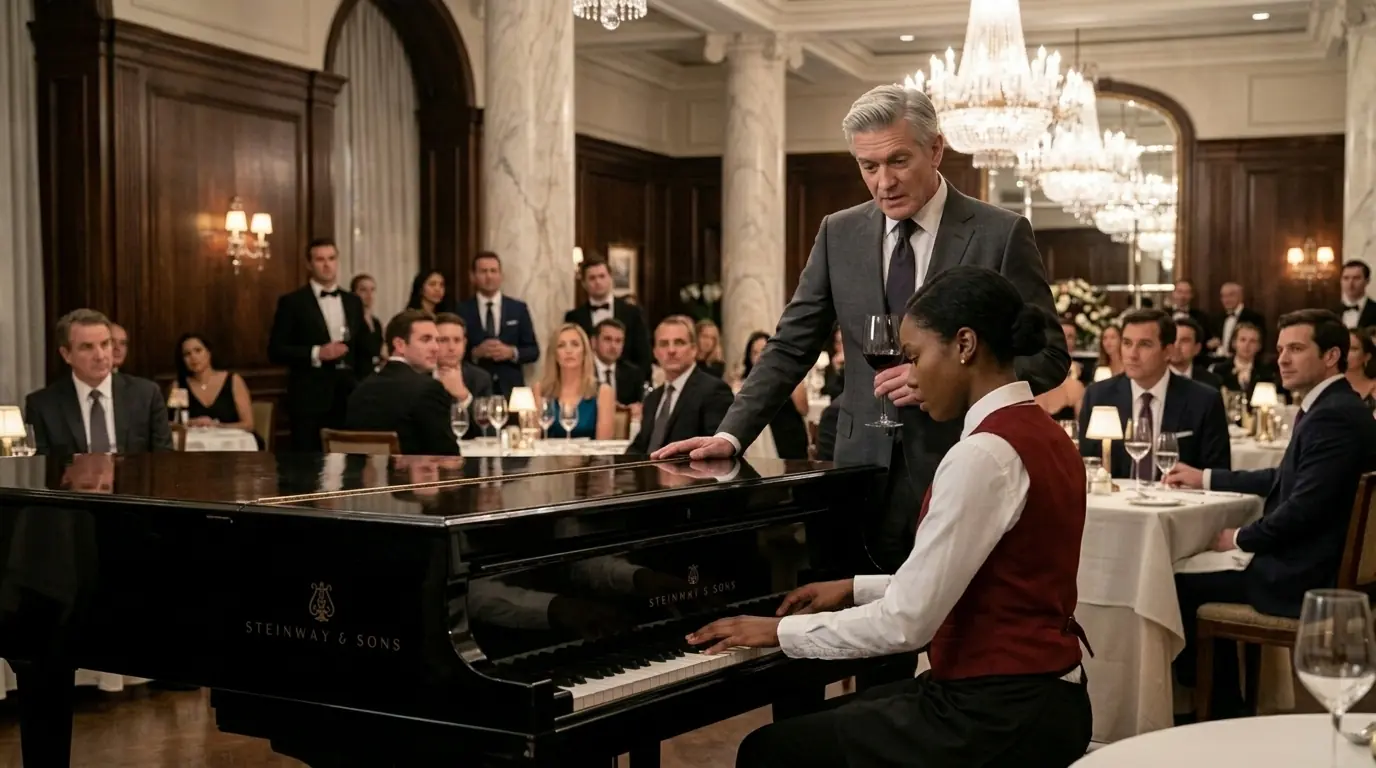
There was emotion in every note, a kind of longing and beauty that came from real life experience rather than just technical training.
The melody of the nocturne was achingly beautiful. It rose and fell like waves, with moments of tenderness followed by passages of greater intensity.
Sarah’s right hand carried the main melody while her left hand provided a steady, supportive foundation.
The way she used dynamics, playing some sections very softly and others with more power, showed a level of musical sophistication that stunned everyone listening.
Marcus Thornfield’s smirk had completely disappeared.
He sat forward in his chair now, his expression transformed from mockery to genuine shock.
His business associates were equally stunned.
One of the wives at his table had tears forming in her eyes, moved by the unexpected beauty of what she was hearing.
Around the restaurant, every single person had stopped what they were doing to listen.
The waiters and waitresses stood frozen in place, some of them with their mouths literally hanging open.
They had worked alongside Sarah for months or years, and none of them had any idea she possessed this incredible talent.
Mr. Peterson stood near the kitchen entrance with his hand over his mouth, hardly able to believe what he was witnessing.
Sarah was completely lost in the music now.
Her body swayed slightly as she played, and her face showed the intense concentration and emotion that comes from performing at the highest level.
This wasn’t just someone who had learned to play piano.
This was a true artist, someone with genuine gift and years of serious training.
The contrast between the humble waitress they had all ignored and the brilliant musician now commanding the entire room was almost impossible to process.
The middle section of the nocturne featured runs of notes that required incredible finger dexterity and control.
Sarah’s hands moved so quickly they seemed to blur.
Yet every single note was clear and perfectly placed.
Then the piece would slow down again, becoming tender and contemplative.
She was telling a story through the music, taking everyone in the restaurant on an emotional journey they hadn’t expected and would never forget.
As Sarah played, something remarkable began to happen.
People who had been looking at her with amusement or condescension just minutes earlier were now looking at her with respect and even awe.
The invisible barrier between the wealthy customers and the working-class waitress seemed to dissolve.
In that moment, everyone in the restaurant was simply human, connected by the universal language of beautiful music.
One elderly gentleman in the corner of the restaurant began to quietly cry.
The piece reminded him of his late wife, who used to play piano for him in their youth.
A young couple held hands as they listened, feeling the romance and tenderness in the music.
Even some of the kitchen staff had come out to the dining room to hear what was happening, standing quietly near the walls with expressions of pride that one of their own could create something so magnificent.
At the center table, Marcus Thornfield could no longer hide his reaction.
He had expected clumsy notes, a few embarrassing mistakes, something he and his friends could laugh about over brandy and dessert.
Instead, he was sitting in stunned silence, listening to a woman he had dismissed as invisible reveal a brilliance he could neither buy nor control.
That realization unsettled him more than the music itself.
For years, Marcus had built his life on a simple assumption: money separated people into categories. Those who commanded, and those who obeyed. Those who were admired, and those who served. Those who mattered, and those who existed to make life comfortable for the ones who did.
But as Sarah’s fingers moved across the keys with that impossible combination of discipline and feeling, Marcus felt something he rarely experienced.
Smallness.
Not because she was humiliating him directly.
Because she was doing something he could never do, and doing it with a grace that made his power look coarse by comparison.
The final section of the nocturne arrived like a confession.
Sarah softened her touch, allowing the melody to linger over the room in long, aching phrases. Every person in the restaurant seemed to be breathing with her now, suspended in the world she had created. The chandeliers above, the glittering glasses, the crisp white tablecloths, the expensive shoes and jewels and tailored suits—all of it had become secondary.
There was only the music.
And the woman who had carried it inside her all along while people snapped their fingers for more coffee.
When the last note faded, Sarah kept her hands on the keys for one brief second longer.
The silence that followed was so complete it felt sacred.
Then the room erupted.
Applause crashed through the restaurant like a wave breaking against stone. People rose from their seats almost instinctively, driven by something more than politeness. It became a standing ovation so sudden and overwhelming that one of the other servers, Denise, put both hands over her mouth and started crying.
Mr. Peterson was clapping harder than anyone.
Even the kitchen staff, still standing in the doorway, were cheering.
Sarah stood slowly from the piano bench, her face flushed, her breathing unsteady. For a moment she looked almost disoriented, as if she had only just remembered where she was.
The dining room that had been prepared for the celebration of wealthy dealmakers had become something else entirely.
It had become hers.
Marcus Thornfield remained seated for two seconds longer than everyone else.
Then, perhaps because every eye near his table had noticed, he stood too.
But his applause was different.
Measured.
Tight.
Controlled.
Because somewhere under the shock and admiration was another feeling he did not know what to do with.
Shame.
Sarah turned from the piano, expecting perhaps to quietly collect her apron and disappear back into the rhythms of service.
But before she could take more than two steps, a voice rose from the back of the room.
“My God.”
The speaker was an older man in a charcoal suit who had been dining alone near the windows. Silver-haired and elegant, with the bearing of someone long accustomed to concert halls and serious music, he stepped forward into the open space between the tables.
“I apologize,” he said, still looking at Sarah with open astonishment, “but I must ask… where did you train?”
The room quieted again, this time with curiosity.
Sarah hesitated, suddenly aware that her apron was still folded on the chair near the piano and that she was standing in the middle of one of Manhattan’s most expensive restaurants in a waitress uniform.
“I studied with my father,” she said softly. “And I was accepted to the New York Conservatory of Music years ago, but I never attended.”
A murmur moved through the room.
The older man’s eyes widened.
“You were accepted to the conservatory?”
“Yes, sir.”
“And turned it down?”
Sarah nodded once.
“Family circumstances.”
The man stared at her for a long moment, then introduced himself.
“My name is Edward Beaumont. I sit on the board of the conservatory.”
Mr. Peterson looked as though he might faint on the spot.
The other guests began whispering more intensely now. Some recognized the name at once. Edward Beaumont wasn’t just any wealthy diner. He was one of the most influential patrons of the arts in New York, a man whose support had launched careers and saved institutions.
Sarah’s face changed from embarrassment to disbelief.
Beaumont continued, still speaking with the stunned reverence of someone who had unexpectedly discovered a treasure in a junk drawer.
“Miss Collins, if what you just played is the result of interrupted training and memory alone, then what you’ve lost is a tragedy. And what you still possess…” He shook his head slightly. “What you still possess is extraordinary.”
Marcus Thornfield’s expression darkened.
The attention in the room, the admiration, the sudden shift in social gravity—it was all supposed to belong to him tonight. His table. His deal. His triumph.
Instead, the entire restaurant had been captured by a waitress he had tried to humiliate.
One of his associates, a hedge fund manager named Langston Pierce, leaned toward him and muttered under his breath, “You picked the wrong target.”
Marcus said nothing.
At the piano, Sarah looked overwhelmed.
“I appreciate your kindness,” she said to Beaumont, “but I’m not a performer anymore. I work here.”
That answer seemed to pain the old man.
“You may work here,” he said, “but that is not who you are.”
Those words hit Sarah harder than the applause.
Because for seven years, she had tried very hard to become practical. Useful. Invisible in the right ways. Reliable. The kind of person who paid bills and carried trays and put away impossible dreams because other people needed her to.
Who you are.
She felt the phrase like a hand pressing against a door she had locked from the inside.
Mr. Peterson approached then, wringing his hands.
“Sarah, I…” He looked genuinely emotional. “I had no idea.”
She managed a faint smile. “Neither did I, for a little while.”
A ripple of laughter moved through the room, gentle and warm.
Beaumont turned to the manager. “Would you mind terribly if I asked Miss Collins to join me for coffee after her shift? Strictly to discuss music.”
Mr. Peterson blinked.
“Of course. Of course not.”
Before Sarah could respond, Marcus Thornfield finally stood from his table and approached.
The room noticed immediately.
It was impossible not to.
He moved with the same controlled authority he brought into boardrooms and negotiations, but now that authority seemed thinner somehow. Less secure.
He stopped a few feet from Sarah.
For the first time that evening, he did not look through her.
He looked directly at her.
“You can really play,” he said.
It was not an apology.
Not yet.
Just a blunt acknowledgment of a fact too obvious to deny.
Sarah met his gaze calmly.
“Yes.”
Several people near the front tables exchanged glances. They had expected defiance from him, maybe a joke, maybe some attempt to diminish the moment. Instead, there was something brittle in his tone, a man trying to recover footing on ground that no longer felt stable.
Marcus glanced briefly toward Beaumont, who was watching with the cool patience of an older man who had seen many egos exposed by genuine talent.
Then Marcus looked back at Sarah.
“I may have misjudged you.”
Now there was a very noticeable stillness in the room.
Sarah could have let him have that. A clean line of retreat. A polished escape route. She could have nodded, smiled, and allowed him to preserve the little dignity he had left.
But she had spent too many years swallowing unfairness for the sake of survival.
And tonight something in her had woken up.
“You didn’t misjudge my piano playing, Mr. Thornfield,” she said quietly. “You misjudged my worth before you ever heard a note.”
Nobody moved.
Marcus’s face tightened.
It was not a cruel statement. It was worse for him than cruelty.
It was true.
One of the wives at his table looked down at her napkin. Another guest, an attorney known for his own polished arrogance, shifted his weight awkwardly. Sarah’s words had reached far beyond Marcus. They had landed on everyone in that room who had ever participated, even silently, in deciding who mattered by what they wore or how they served.
Marcus stared at her.
For perhaps the first time in his adult life, he seemed to understand that money could not purchase the right response to this moment.
Then, in a voice much lower than before, he said, “You’re right.”
It surprised everyone. Himself most of all.
He drew a breath.
“I behaved badly. Toward you. In your place of work. And I did it because I assumed…” He paused, unable to finish the sentence in a way that made him look decent.
Sarah finished it for him.
“Because you assumed I was less than you.”
Marcus gave the smallest nod.
“Yes.”
The admission stripped the room of its last illusions.
He was not performing now.
He was cornered by honesty.
And something in him, perhaps because there was nowhere left to hide, stopped fighting it.
“I’m sorry,” he said.
The words were plain. Unadorned. Hard-earned.
No one in the room seemed to breathe.
Sarah looked at him for a long second.
Then she said, “Thank you for saying it.”
Not forgiveness.
Not absolution.
Just acknowledgment.
And in some ways, that was more severe.
Marcus returned to his table without another word.
He sat down more slowly than before, no longer the center of the celebration but just another man in an expensive suit who had been made visible by his own pettiness.
Beaumont approached Sarah once more.
“After your shift,” he said gently. “No pressure. But I would very much like to talk.”
She nodded, still half stunned.
“All right.”
The rest of the evening passed in a haze.
Mr. Peterson insisted that Sarah not return to serving the central table. Denise and another server took over that section while Sarah helped quietly in the side station, pouring coffee with hands that still seemed to remember the shape of Chopin. Word of what had happened spread through the restaurant staff in under ten minutes. Dishwashers peeked through the kitchen doors. A line cook named Ramon grabbed her shoulders and said, “You had all those notes in you this whole time?”
Sarah laughed, cried once in the dry-storage room for exactly thirty seconds, then fixed her mascara and went back to work.
At 11:40 p.m., her shift ended.
She changed out of her stained white blouse into the only decent dress she kept in her locker for emergencies: a dark green knit thing she usually saved for funerals or church on Easter. She brushed out her hair, washed her hands twice, and met Edward Beaumont in the now nearly empty dining room.
He was seated near the piano with two cups of coffee waiting.
“Thank you for indulging an old man’s curiosity,” he said.
Sarah sat.
“I’m not sure curiosity is the word.”
He smiled. “Fair.”
For the next hour, he asked her questions no one had asked in years.
Who taught her phrasing?
How long had it been since she practiced seriously?
Why that nocturne?
Did she still read music fluently?
What repertoire did she love?
At first her answers came hesitantly, but the longer they talked, the more she felt old parts of herself returning from wherever she had buried them. She spoke about her father’s insistence on discipline. About Bach and Debussy and Rachmaninoff. About the conservatory letter she kept in a kitchen drawer for six years because throwing it away felt like admitting something final.
When she finished telling him why she had turned down the scholarship, Beaumont sat in silence for a moment.
Then he said, “You sacrificed something precious for the people you love. There is dignity in that. But sacrifice is not meant to become a permanent identity.”
She looked down into her coffee.
“What if it’s too late?”
“For what?”
“To become anything else.”
Beaumont’s answer came with the certainty of a man who had spent his life around art and knew exactly how often talent arrived bruised, delayed, and frightened.
“It is too late to become the girl who got the scholarship,” he said. “It is not too late to become the woman who still has the gift.”
The line struck so deep she couldn’t speak right away.
He reached into the inside pocket of his jacket and pulled out a cream-colored card.
“My office. My home number. And the number of Elena Marquez.”
Sarah frowned slightly. “The concert pianist?”
“The same. She owes me three favors and has a weakness for difficult students. If you are willing, I will arrange an audition. Private. No fanfare. No commitments. Just a room, a piano, and someone qualified to tell you the truth.”
Sarah stared at the card.
“Why would you do that?”
Beaumont smiled faintly.
“Because one does not stumble upon buried gold and walk away pretending not to have seen it.”
The next week changed her life.
She still worked at the Grand Sterling. She still paid bills. She still made sure her brother Ethan had enough for books and meal plans and the little emergencies college always produced. But now every morning, before sleeping after her late shifts, she practiced.
At first only forty minutes.
Then an hour.
Then two.
Her apartment neighbors banged on the walls twice before one elderly woman downstairs knocked on her door and said, “Please don’t stop. I haven’t heard Chopin through the pipes in years.”
The old upright piano in her apartment, once filmed in neglect, came back to life note by note. The dust disappeared. Her fingers grew sore. Old scales returned. So did fear.
What if the restaurant had been a fluke?
What if memory had carried her through one piece and nothing more?
What if Beaumont was simply romantic, the way rich patrons sometimes became when they discovered talent below stairs?
Then came the audition.
Elena Marquez received her in a private studio on the Upper West Side with no makeup, no patience for nonsense, and the unnerving eyes of someone who could hear dishonesty before the first measure ended.
“Play,” she said.
Sarah played.
A Bach prelude first. Then Debussy. Then Chopin again, because by then her hands had stopped belonging to panic.
When she finished, Elena remained silent for so long that Sarah felt her throat tighten.
Finally, the pianist stood, walked to the window, and said, “Your technique is wounded but not lost. Your control is inconsistent, your fourth finger is weak, your stamina is poor, and your life has interrupted your training in cruel ways.”
Sarah braced for the rest.
Elena turned back.
“But your musical instincts are so alive it is almost offensive.”
Beaumont, who had been sitting quietly in the back, burst out laughing.
Elena ignored him.
“You have one chance,” she told Sarah. “Not because talent expires by age, but because courage often does. If I take you, you work like someone trying to recover stolen time. Understood?”
Sarah’s eyes filled before she could stop them.
“Yes.”
“Good,” Elena said. “Then stop crying and come back Thursday.”
For six months, Sarah lived a double life.
By day, she trained.
By night, she served tables.
She did not tell most people.
Not because she was ashamed, but because hope still felt too fragile to expose. Denise knew. Mr. Peterson knew. Ethan knew, and when she told him, he sat on the edge of her couch and cried harder than she did.
“You gave up everything for me,” he said.
“No,” she corrected gently. “I postponed something.”
“You shouldn’t have had to.”
“Maybe not. But now we do what comes next.”
At the restaurant, Marcus Thornfield returned twice.
The first time, he requested Sarah’s section and looked uncomfortable the moment he sat down. He ordered politely. Used her name. Did not snap his fingers. When she brought his coffee, he said, “I heard Beaumont arranged an audition.”
Sarah nodded. “Yes.”
He looked down briefly, then said, “I hope you went.”
“I did.”
A small pause.
“And?”
“She said yes.”
For the first time, Marcus smiled without superiority.
“Good.”
It was a strange, awkward thing between them after that. Not friendship. Not exactly. But on his third visit, he left a note under the billfold.
I have a daughter your age. I realized, after that night, that if someone treated her the way I treated you, I would despise him. I have no excuse. Only gratitude that you answered me with honesty instead of humiliation.
— M.T.
Sarah folded the note and put it in her purse.
Years later, she would still keep it, not because his apology redeemed him, but because it reminded her that truth spoken calmly can alter even the most armored rooms.
Spring came slowly to Manhattan.
And with it came Sarah Collins’s first public performance in nearly eight years.
Not Carnegie Hall.
Not Lincoln Center.
A smaller venue. A donor recital room attached to the conservatory she had once refused.
Elena Marquez insisted on that particular location.
“You do not avoid the wound,” she told Sarah. “You return to it with better shoes.”
The recital room held only one hundred people. Beaumont filled half the seats with trustees, musicians, and patrons who understood enough about music to know when something rare was happening. Ethan sat in the front row in the one suit he owned. Denise came too, wearing borrowed heels and crying before the performance even began. Mr. Peterson sent flowers so enormous they looked like a diplomatic apology.
Sarah wore a simple black dress and walked to the piano with the same sense of disbelief that had followed her all winter.
Then she sat.
And played.
Not perfectly.
Better.
Because perfection was never the point.
She played as a woman who had known debt, grief, fluorescent kitchen lights, aching feet, closed doors, and the sharp humiliation of being looked through. She played as someone who had returned to herself piece by piece, with callused hands and stubborn hope.
When the final notes ended, the room rose.
Not in surprise the way the restaurant had.
In recognition.
Afterward, Elena approached her backstage and said the highest praise Sarah would ever receive from her.
“You no longer sound like someone remembering who she was. You sound like someone becoming who she is.”
That summer, Sarah reduced her shifts at the Grand Sterling.
By autumn, she left entirely.
Beaumont helped arrange a modest stipend. Elena found her accompanying work, then teaching work, then small performance opportunities that gradually became larger ones. Sarah did not become famous overnight. Her life did not transform into a fantasy. There were still bills. Still self-doubt. Still long subway rides carrying scores under one arm and groceries under the other.
But the axis of her life had changed.
The thing she loved most was no longer something she visited in secret between obligations. It had become part of her future again.
Two years later, when she made her formal debut in a chamber performance series at Lincoln Center’s smaller hall, a reviewer from The New York Times described her playing as “mature not in polish alone, but in moral force.”
Sarah cut out the review and mailed it to Ethan with no note. He framed it in his dorm room.
Five years after the night Marcus Thornfield tried to humiliate a waitress for sport, Sarah Collins returned to the Grand Sterling.
Not to work.
To perform.
The restaurant had renovated its dining room and launched a monthly music series under new ownership after Mr. Peterson finally retired. They invited former staff, regular patrons, critics, and business leaders. The grand piano still stood in the corner where everything had changed.
Marcus was there that night.
Older.
Quieter.
Accompanied by his daughter now, a poised young architect with kind eyes.
When Sarah entered in a midnight-blue gown, conversation softened. Not because she was the center of a spectacle, but because the room understood what it was witnessing.
A full circle.
Before the performance, Marcus approached her backstage.
“I almost didn’t come,” he admitted.
“Why?”
“Because I wasn’t sure I had any right to witness the result.”
Sarah studied him for a moment.
Then said, “You were part of the beginning. Not the reason. But part of it.”
He nodded, absorbing the distinction.
“My daughter insisted we come,” he said. “I told her the story.”
Sarah glanced at the young woman waiting respectfully a few feet away.
“That was brave.”
Marcus gave a rueful smile. “No. Brave was what you did. Mine was overdue.”
Then he stepped aside.
That night Sarah played Chopin’s Nocturne in E-flat major, the same piece that had silenced a room of people who thought they understood her value.
Only now, there was no mockery waiting at the end of it.
Only listening.
When she finished, applause filled the Grand Sterling once more, but it felt different this time. Warmer. Less surprised. More earned.
After the final encore, she stood near the piano while guests approached with flowers, congratulations, invitations, compliments.
Then she noticed a young waitress hovering near the side station, tray in hand, watching with the same combination of awe and caution Sarah once carried like a second uniform.
The girl couldn’t have been more than twenty.
Sarah walked over.
“Long night?” she asked.
The waitress jumped slightly. “A little.”
Sarah smiled.
“What’s your name?”
“Lena.”
“Do you play anything, Lena?”
The girl blinked. “Sing. Sort of.”
Sarah’s smile deepened.
“Sort of is how many important things begin.”
Lena looked stunned.
Then Sarah reached into her bag, took out a card, and handed it to her.
The young waitress stared at it.
“What is this?”
“My number,” Sarah said. “And the name of someone who can help if you’re serious.”
Lena looked as if she might cry.
“Why would you do that?”
Sarah glanced once at the piano, then back at the girl.
“Because someone opened a door for me when I was standing in the wrong uniform.”
And there it was again.
That echo.
That passing forward of grace.
Later that night, when the guests had gone and the chandeliers reflected softly off polished silver and emptied glasses, Sarah stood alone in the dining room for a final moment.
The room was quiet now.
Just as it had been before the first note, years ago.
She placed one hand lightly on the piano’s glossy edge and thought of her father, of Elena, of Ethan, of the apartment with the dusty upright, of Mr. Peterson near the kitchen door with his hand over his mouth, of Edward Beaumont asking where she had trained, and even of Marcus Thornfield, who had learned too late but not never.
A life, she had learned, is rarely changed by one moment alone.
It is changed by what someone does after that moment reveals who they are.
She turned off the bench lamp herself before leaving.
Outside, Manhattan hummed with taxis and light and ambition. Inside, the Grand Sterling settled back into stillness.
And Sarah Collins walked into the night no longer as a waitress who once carried music in secret, but as a woman who had reclaimed the part of herself the world almost convinced her to set aside forever.
Because talent can be buried.
Dignity can be ignored.
Dreams can be postponed until they nearly stop speaking.
But when truth finally finds its voice—
sometimes even the people who once looked down from the center table are forced to stand and listen.