"Cuff him and get him off my street!"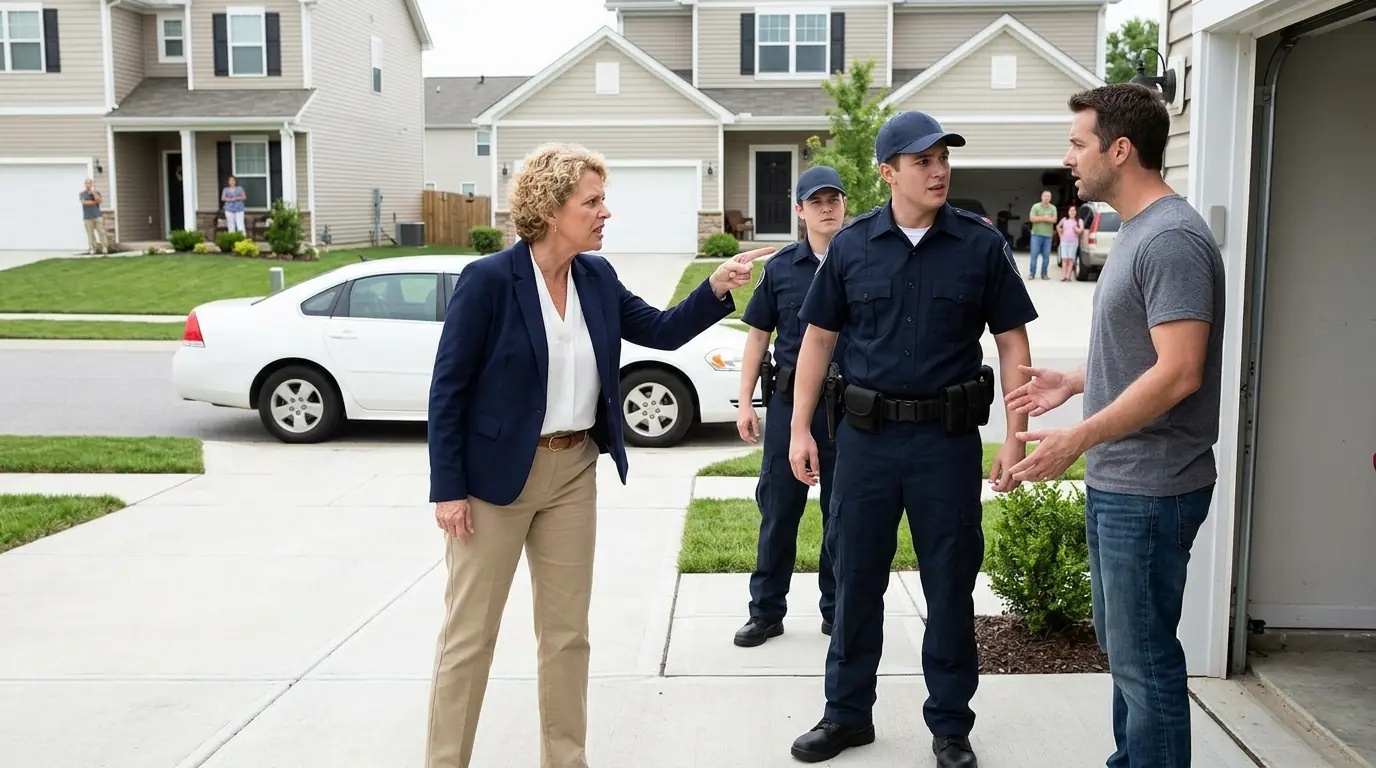
Brittany Vandercroft screamed that across the cul-de-sac at 2:47 on a Saturday afternoon, three seconds before her brother Dale walked up my driveway in a fake police uniform and clamped steel handcuffs on my wrists in front of my 14-year-old son.
The badge was bought on Amazon. The cruiser was a Tahoe with magnetic decals. The handcuffs, unfortunately for Dale, were real.
She was right about one thing: she did want me off her street. What she did not know—what she could not have known—was that I had been an FBI special agent for 16 years, and the federal indictment for her HOA board's $1.2 million embezzlement scheme was already sealed in a courthouse 21 miles away.
By the end of that Saturday, in front of every neighbor on Birch Hollow Lane, she was about to find out exactly who I was.
My name is Marcus Holloway. I'm a special agent with the FBI's Washington Field Office, assigned to the Public Corruption and White Collar Crime Squad. I have been working federal financial cases for 16 years. Before that, I did seven years in the Marine Corps, mostly in places I am still not allowed to talk about. I am 44 years old, 6'1", 210 lbs, and I bought a four-bedroom colonial in Stonewater Ridge, Loudoun County, Virginia, eight months before the day Britt Vandercroft sent two fake cops to arrest me on my own front porch.
I bought that house for two reasons.
The first reason was my son, Ethan. He's 14, quiet kid, smart as a whip, plays varsity lacrosse, reads more than he talks, and looks more like his mother every year. My wife, Allison, was killed by a drunk driver on the Beltway five years ago next September. Ethan and I have been a two-man household ever since. He needed a yard. He needed a school district. He needed a kitchen table where homework could happen without me bringing case files into it.
The second reason was Stonewater Ridge itself.
For two years, my unit had been quietly looking at the Stonewater Ridge Homeowners Association, specifically at a pattern of suspicious landscaping contracts, no-bid vendor relationships, and HOA dues that had quietly tripled over six years while community amenities slowly fell apart.
The treasurer was a woman named Brittany Vandercroft. She went by Britt. Her husband Trevor owned a contracting outfit called Bluewater Property Services. Bluewater had received over $600,000 from the Stonewater Ridge HOA in two years. The work Bluewater allegedly performed on the community pool, the clubhouse, and the gates had a strange habit of being invoiced but not done.
The case was in its preliminary stage. We had bank records, vendor invoices, and the cooperation of a former landscaper who had been stiffed by Bluewater. But to build the federal case, I needed to see the inside of that community. I needed to be a neighbor, not a stranger. I needed to know who knew what, who was scared, who was profiting, and who was just along for the ride.
So I bought the house.
I used my real name. I did not advertise my profession. I told the welcome committee I was a federal contracts analyst, which is technically true if you squint at my W-2. Ethan transferred to the local high school. We unpacked. We grilled hot dogs in the backyard. I joined the neighborhood Friday porch night twice. I shook every hand I could shake.
And quietly, very quietly, I began to listen.
I listened to Mrs. Penniman across the street, who had been typing complaints about Britt's behavior into her own personal Word document for two years. I listened to the Reyes family on Magnolia Court, who had paid a $4,000 special assessment in 2023 for drainage repair that never materialized. I listened to old man Foster, three doors down, a retired civil engineer who had personally measured the depth of the gravel resurfacing on the cul-de-sac and informed me—with the calm satisfaction of a man who had spent 40 years catching people lying with concrete—that Bluewater had been billing for two inches and pouring three-quarters of an inch.
That's a lot of listening for a man who was supposed to be invisible.
The trouble, and Britt's first mistake, was that Britt did not like men who listened. She liked men who nodded. She liked men who agreed. She especially liked men who paid their dues, signed their forms, and never asked to see the books—which was exactly what I was about to do.
The trouble started the morning I filed a written records request.
Under Virginia Code Section 55.1-1815, any member of a property owners association has the right to inspect the books and records of the association at the principal office during regular business hours on five business days' notice. I sent that notice on a Monday. I sent it certified mail. I sent it polite. I requested two years of bank statements, vendor invoices, contracts, and meeting minutes. I cited the statute. I signed my name.
Britt's response arrived on Wednesday. It was a single typed sheet on Stonewater Ridge HOA letterhead, signed in fountain pen, that said: "Your request has been denied. The board will consider future requests at its discretion."
That's it. That was the whole letter.
I read it twice, then I smiled.
Here's a thing every homeowner in America should know, and the law on this is settled: almost every state has a statute requiring HOAs to share their books with the homeowners they bill. The exact statute varies by state, but the principle is universal. An HOA is a private corporation funded by mandatory dues, and the people paying the dues have a legal right to see the books. If the HOA refuses, the homeowner can file in civil court and almost always win. And the HOA, if found in willful violation, can be ordered to pay legal fees plus statutory penalties. Refusal of a properly filed records request is the clearest red flag of HOA fraud you will ever see. If you ever get that letter, save it.
I saved Britt's letter in a manila folder. Then I filed my response: a short letter citing the statute, requesting reconsideration, and noting my intent to seek judicial relief if records were not provided within 30 days.
48 hours later, the harassment started.
Friday morning, Ethan opened the front door to walk to the bus stop and tripped on a violation notice taped to the door. The HOA had cited me for a mailbox violation. Specifically, my mailbox was painted a non-compliant shade of black. According to the cited bylaw, mailboxes in Stonewater Ridge must be Sherwin-Williams Iron Ore SW7069 or equivalent. My mailbox was Sherwin-Williams Tricorn Black SW6258. The notice carried a $100 fine.
By Monday, I had three more notices: garage door cleanliness, lawn edge alignment, and a lawn ornament Ethan had bought at a school fundraiser—a small wooden owl on a stake was apparently in violation of non-conforming yard art.
By Friday, I had eight notices. Total fines: $950.
I paid every single one in cash with a smile. Each receipt went into the manila folder. Ethan watched me write the eighth check at the kitchen table on Friday night and cocked his head.
"Dad," he said, "you're not annoyed."
"I'm not."
"Why not?"
I capped the pen. I slid the receipt into the folder. I patted the folder.
"Ethan, when somebody lies on paper, they leave a trail on paper. Eight notices means eight separate signatures, eight time-stamped acts of retaliation, and eight pieces of evidence I didn't have on Monday. Annoying me cost Britt nothing. Annoying a federal agent who's already building a public corruption case against her HOA, that costs her her freedom."
He thought about that for a second. He nodded. "Cool," he said. "Want me to get the chessboard?"
We played chess for an hour. He beat me twice. Allison would have been proud of him.