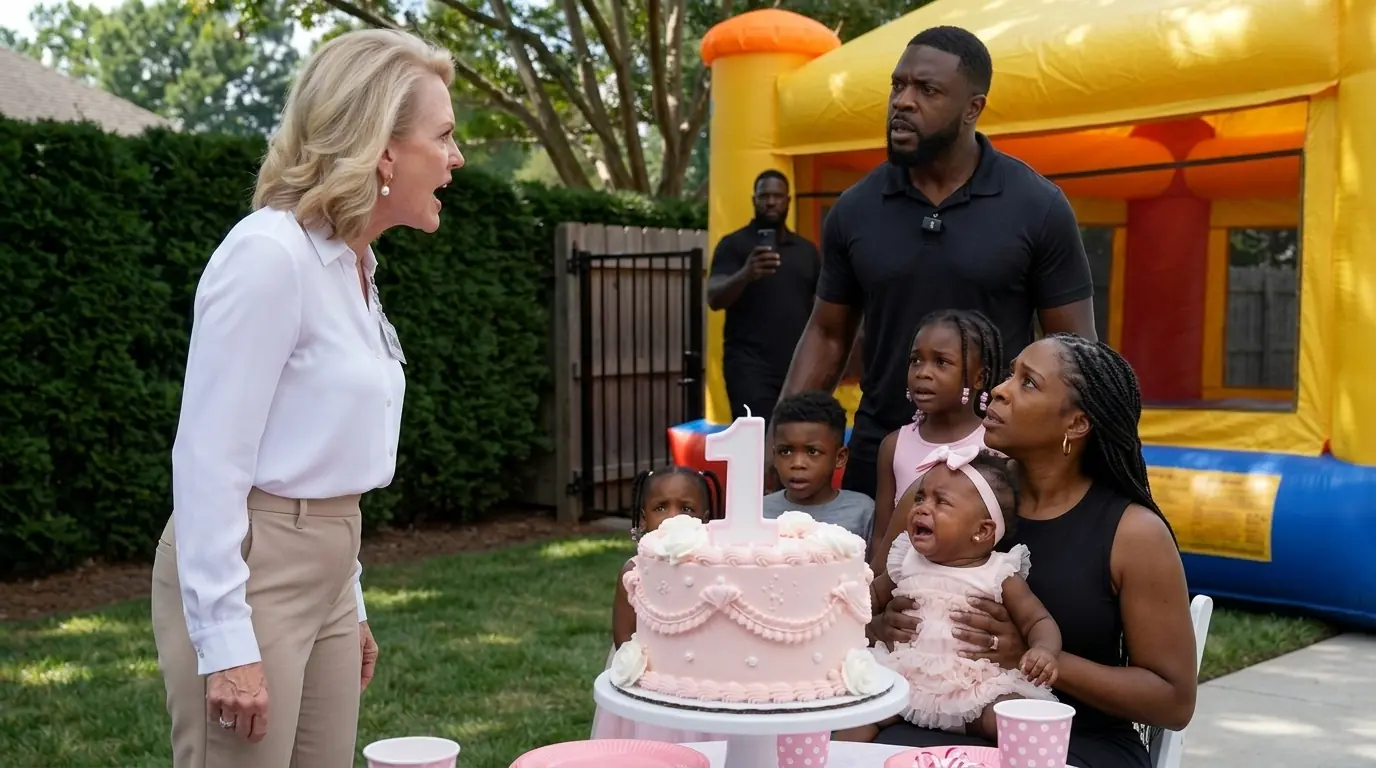
The first scream came from inside the inflatable castle.
Andre Holloway turned away from his daughter’s birthday cake just as the blue-and-pink roof began sagging toward the children inside. The blower had gone silent, the side walls were collapsing, and for three terrible seconds nobody understood why. Then Andre saw Marjorie Kellerman, president of the Stonegate Meadows Homeowners Association, standing beside the exterior outlet with the heavy orange power cord dangling from her hand.
“Get the kids out!” Andre shouted.
His younger brother Terrence dropped his plate and ran. Two parents pulled the entrance flap open while Andre reached inside and dragged his ten-year-old nephew toward daylight. Nobody was physically trapped for long, but six frightened children came crawling out at once, one crying, another yelling for his mother, while lemonade spilled across the patio and the photographer lowered her camera.
At the center of the yard, one-year-old Nia Holloway began crying in her decorated high chair.
Her mother, Keisha, scooped her up immediately.
Andre stood there looking at Marjorie.
She wore cream slacks, a pale blue blouse, oversized sunglasses, and a laminated Stonegate board credential clipped to her belt. Behind her stood a young private-security officer who looked like he wanted the grass to swallow him. Marjorie held up the unplugged cord as though she had just confiscated evidence.
“Now maybe you’ll listen,” she said.
Andre’s first instinct was to cross the yard quickly.
He did not.
He had spent forty-one years learning that being right and looking angry could become two completely different stories once someone else started describing what happened. So he walked instead, slowly enough that every relative holding a phone could see his hands hanging empty beside him.
He stopped six feet from Marjorie.
“Plug that back in.”
“No.”
“There were children inside.”
“I gave you notice that commercial inflatables require approval.”
Andre’s jaw tightened.
“You were told to leave my property.”
“I am conducting an HOA compliance inspection.”
“No, you’re not.”
Marjorie lowered her glasses.
“Excuse me?”
“You don’t have inspection authority here.”
“I am president of this association.”
“And I am the homeowner.”
“This home is located inside Stonegate Meadows.”
Andre looked toward his family.
“That argument has been going on for seven months.”
“And you continue pretending the rules don’t apply.”
“No.”
Andre pointed toward the side gate.
“I continue asking you to prove they do.”
Marjorie’s mouth tightened.
For almost a year, that question had driven her crazy.
Not shouting.
Not insults.
Not rebellion.
Just one question.
Show me the recorded document.
Keisha stepped forward with Nia against her chest.
“What exactly was so dangerous that you needed to shut down a bounce house with children inside?”
Marjorie looked around.
Thirty-one guests.
Most Black.
Three folding tables.
A canopy.
A birthday banner.
A grill.
Children running barefoot through the lawn.
“This gathering is excessive.”
Keisha stared.
“Excessive?”
“It violates neighborhood event standards.”
“Last weekend the Brenners had nearly fifty people for their son’s graduation.”
Marjorie’s expression flickered.
“That was different.”
“How?”
“It was properly recognized.”
Andre laughed once.
His daughter was turning one.
His mother stood by the cake.
Keisha’s parents had driven down from Macon.
Andre’s cousins had spent the morning hanging balloons.
Yet somehow a white family’s graduation counted as a recognized event while his baby’s birthday required enforcement.
Keisha’s voice became colder.
“Say what makes theirs different.”
Marjorie looked toward her clipboard.
“I don’t have to debate every comparison you manufacture.”
Terrence muttered from behind Andre.
“Convenient.”
Andre raised one hand without looking back.
His brother stopped.
Marjorie reached for her phone.
“I think law enforcement can explain this more clearly.”
Andre nodded.
“Please call them.”
She looked surprised.
“You want police here?”
“I want somebody here who might finally ask you for the document.”
That irritated her enough that she immediately dialed.
Nine minutes later, red and blue lights reflected across the balloon arch above Nia’s cake.
By then the bounce house had been reinflated.
Nobody put the children back inside.
They stood near their parents, watching adults talk in low voices while Nia’s crying settled into hiccups against Keisha’s shoulder.
Andre noticed his eleven-year-old son, Micah, standing near the kitchen door.
The boy’s face bothered him.
Not fear exactly.
Confusion.
The kind that appears when children realize grown-ups can act unfairly while still carrying clipboards, uniforms, titles, and confidence.
Micah finally asked:
“Dad, did we do something illegal?”
Andre looked at him.
“No.”
“Then why did she call police?”
Andre had no answer short enough for an eleven-year-old.
The real answer had started seven months earlier.
Andre and Keisha purchased 22 Fairmont Bend in the fall.
The neighborhood sat outside Atlanta in Cobb County, built around winding streets, two ponds, a clubhouse, and houses designed to look different enough that buyers forgot they had been constructed by three builders using mostly the same floor plans.
The Holloways liked the area immediately.
Keisha liked the kitchen.
Micah liked the basketball hoop beside the garage.
Andre liked the large backyard and old oak tree.
Nia, then five months old, slept through the showing.
The closing attorney noticed the problem.
Her name was Lillian Mercer, and she had spent twenty-eight years doing real-estate work long enough to distrust anything labeled “obvious.”
She flipped through the title package twice.
Then looked at Andre.
“Your listing says Stonegate Meadows HOA.”
Andre nodded.
“Eight hundred ninety dollars annually.”
Lillian tapped the legal description.
“Maybe.”
Keisha frowned.
“What does maybe mean?”
“It means I cannot find the recorded declaration that makes this parcel a mandatory member.”
Andre leaned closer.
“The house is literally surrounded by HOA houses.”
“That is geography.”
She tapped the deed again.
“I’m talking about title.”
Lillian explained the history.
Before Stonegate Meadows existed, the land belonged to three families.
Most sold everything to the original developer.
One family, the Barkers, sold nearly all their acreage but retained a narrow parcel containing their farmhouse and several acres around it.
When development eventually surrounded the property, the address changed.
The farmhouse was later demolished.
A modern home replaced it.
But the old Barker parcel remained legally separate unless somebody later recorded an annexation agreement.
Lillian could not find one.
“Could previous owners have joined voluntarily?”
Keisha asked.
“Yes.”
“Did they?”
“I’m still checking.”
Three days later, Lillian called.
No.
No supplemental covenant.
No annexation agreement.
No owner-consent document.
No deed restriction incorporating the parcel into Stonegate Meadows.
Its mailbox sat beside HOA mailboxes.
Its residents used the same roads.
Marketing websites described the property as being “in Stonegate Meadows.”
Legally, Lillian could not establish mandatory membership.
Andre thought that would simplify life.
Then the welcome packet arrived.
STONEGATE MEADOWS HOMEOWNERS ASSOCIATION — ANNUAL ASSESSMENT DUE: $890.
Andre emailed management.
He attached Lillian’s preliminary title letter.
The response came from Marjorie Kellerman.
All residences physically located within Stonegate Meadows are subject to neighborhood covenants and community standards.
Andre replied with one sentence.
Please send me the recorded instrument applying those covenants to 22 Fairmont Bend.
Marjorie sent the neighborhood handbook.
Andre asked again.
She sent a color-coded architectural guide.
Andre asked again.
She sent a map.
Andre asked again.
No deed document arrived.
Then came the violations.
Garbage bin visible from the driveway.
Portable basketball hoop too close to the sidewalk.
Garden hose stored on the side wall.
Outdoor chair cushion visible from the street.
Keisha began saving the envelopes in a kitchen drawer marked MARJORIE’S HOBBIES.
Andre did not find it as funny.
He paid property taxes.
Mortgage.
Insurance.
Utilities.
He did not intend to pay fines issued under authority nobody could establish.
Lillian sent a formal letter.
Please suspend enforcement unless and until the association identifies the recorded declaration or other legally binding instrument subjecting the Holloway parcel to Stonegate Meadows covenants.
Marjorie did not stop.
Instead, she became more creative.
A warning about lawn height arrived the morning after Andre’s landscaper cut it.
A parking notice appeared because Terrence’s pickup remained in the driveway overnight.
A “community appearance concern” cited Micah’s basketball hoop despite the fact that similar hoops sat outside at least twelve other houses.
Andre photographed everything.
Not because he was building a revenge plan.
Because Lillian told him something simple.
“People become much less confident once dates enter the conversation.”
The board eventually asked the association’s own lawyer to examine the issue.
Management told Marjorie to pause collection until counsel finished reviewing old subdivision records.
Andre heard nothing for six weeks.
Then came Nia’s birthday.
Keisha chose a Sweet One theme.
Pink balloons.
Gold lettering.
Strawberry decorations.