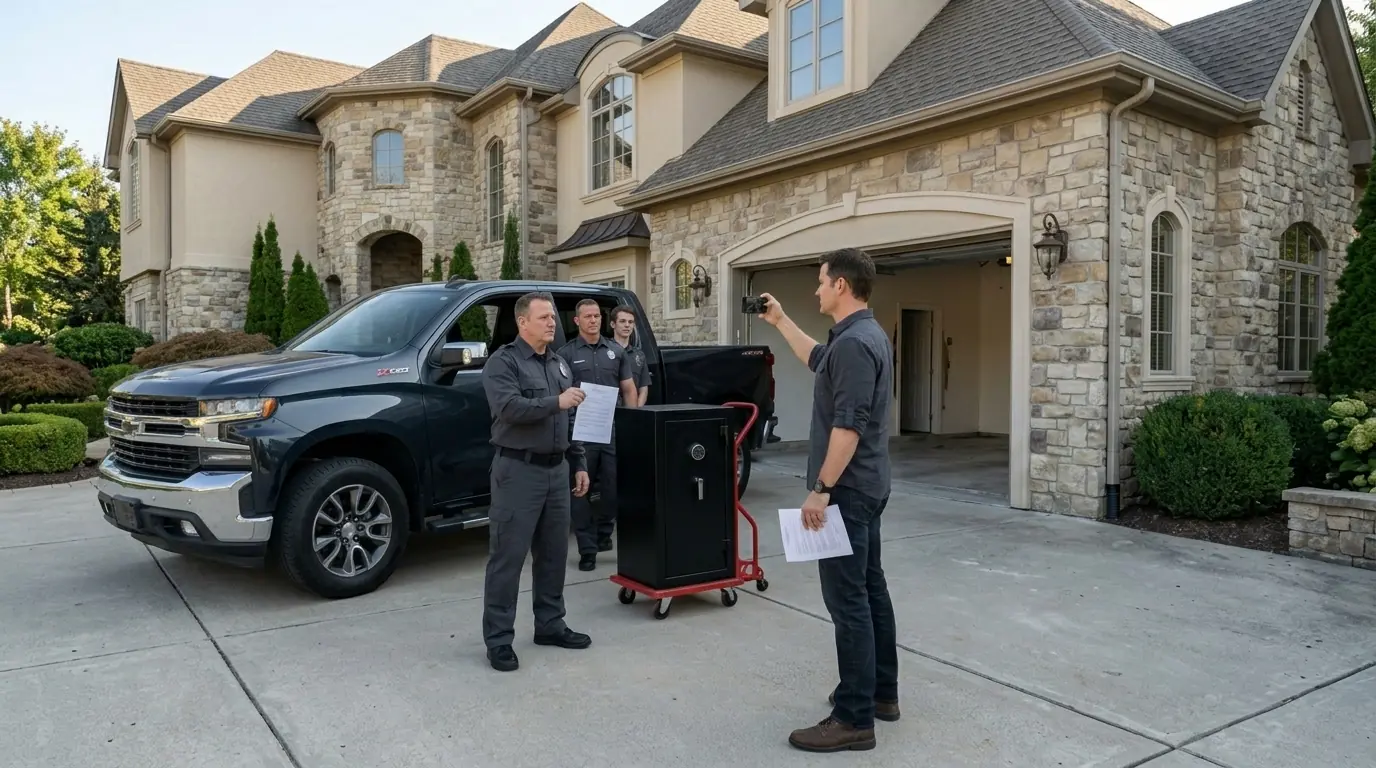
Detective Caleb Roark turned into his driveway just in time to see three HOA guards rolling his safe toward an unmarked truck. Their supervisor waved a fabricated seizure order and claimed the property belonged to the association. Caleb did not argue. He photographed every face, every plate, and every forged signature because he had seen that same document before.
For 6 months he had been investigating a burglary ring hiding stolen assets behind HOA enforcement actions. The guards thought they had chosen an empty house. They had walked into the home of the detective quietly building the case against them. Caleb Roark came home to Briar Hollow Estates earlier than planned that afternoon straight from a meeting with prosecutor Elliott Vance.
The moment he turned onto his street, he saw a gray unmarked truck parked outside his house, its rear doors open. The garage stood wide open. The side door showed fresh pry marks along the frame. Three men in matching uniforms from Whitcomb Community Security, the private firm the homeowners association had hired, were guiding an industrial dolly loaded with his nearly 300-lb safe out through the garage.
Caleb did not rush forward. Years as a detective had trained his instincts, and the first thing he did was raise his phone and start recording. He captured each man's face, the license plate on the truck, the dolly itself, the broken lock on the side door, the numbers stitched onto their uniforms, and the paper the lead guard was holding. That guard, a broad-shouldered man named Travis Boone, saw Caleb watching but showed no sign of alarm.
He announced almost bored that the association had seized the property to secure an unpaid debt. Caleb asked what debt. Travis held out a document titled “Emergency Property Recovery Authorization,” claiming Caleb owed the association $18,460 in fines, legal costs, and enforcement fees. Caleb knew instantly the paper was fraudulent.
Not only because he had never owed the association a single dollar, but because the notary stamp in the corner sat slightly crooked, tilted to the left in a way he had seen three times before stamped across three other documents currently sitting in his open case file. For half a year the major crimes unit had quietly investigated a string of strange incidents across several communities. Homeowners were suddenly accused of owing the association money. Valuable property was then seized under the banner of enforcement.
Watches, jewelry, legally owned firearms, cash, antiques, and electronics vanished from official records soon after. No one had yet proven these cases were connected. Standing in his own driveway, Caleb finally had that proof staring back at him. He kept his badge in his pocket for the moment and asked simply who had signed the order.
Travis pointed to the signature at the bottom. Mallory Whitcomb, President, Briar Hollow Homeowners Association. Caleb had met Mallory only twice before, both times at community events, where she carried herself with the polished warmth of someone who had learned exactly how to be liked in public. She remembered names.
She complimented lawns. She sent handwritten notes to new residents welcoming them to the neighborhood. Nothing about those brief encounters had suggested the woman capable of authorizing an armed crew to break into a house and haul away a safe. Caleb reminded himself that the calm, gracious face people saw at block parties rarely matched the one behind closed doors, and he had learned long ago never to judge the shape of a crime by the manners of the person who ordered it.
Caleb looked at his safe then back at the paper and told Travis to put it back inside the house. Travis smiled and said the detective no longer had the authority to decide that. Cole Harlan and the other guard stepped forward and tried to push Caleb back off his own driveway, a mistake he would come to regret. Caleb raised his badge and the atmosphere shifted instantly.
Derek Sloan, the youngest of the three, froze where he stood. Cole let go of Caleb's arm. But Travis only paused for a few seconds before saying that whether Caleb was a detective or not changed nothing about the association's order. What actually caught Caleb's attention was not Travis's attitude.
It was the next sentence out of his mouth. Travis said they had been given a specific instruction to retrieve the safe located in the downstairs office. Caleb had never told the homeowners association he owned a safe, let alone where it sat inside his house. That detail existed in exactly one place, an internal security report filed with the police department years earlier after an old break-in attempt at his previous residence.
Caleb looked hard at Travis. This was no longer a simple case of an association overstepping its authority. Someone inside the police department had handed his home address and the layout of his own house to the very people he was investigating. Caleb could have ordered an immediate arrest of all three guards right there in his driveway.
Instead, he made a decision that surprised even Travis. He stepped back from the driveway and told them to take it. It cost him something to say those words. The safe held nothing irreplaceable, but it was still his, still sitting inside the house he had bought with his own money after years of overtime and careful saving.
And watching strangers wheel it away without lifting a hand to stop them went against every instinct that had kept him alive on the job. He forced himself to remember that instinct and strategy were not always the same thing, and that the version of justice worth having was the kind built on proof, not on a single satisfying arrest in a driveway. Travis assumed the detective had simply given up. In truth, Caleb was already thinking three moves ahead, the way any good investigator learns to think under pressure.
If he arrested three low-level guards on the spot, all the department would have was trespassing, a broken lock, a forged document, and a conspiracy to seize property. But if he followed the safe to wherever it ended up, he might finally uncover the entire network behind these thefts. There was one more thing working in his favor. The safe held no case files.
Caleb never brought official evidence home. Inside sat only personal papers, an old wristwatch, some property records, and a small steel lockbox. Months earlier, after a break-in elsewhere in the neighborhood, Caleb had installed a discreet tracking device inside his own safe as a precaution. He quietly activated it now out of sight.