For nearly three months, my wife had been telling me that Thursday nights belonged to her and her friends. I believed her because after nine years of marriage, Natalie had never given me a serious reason not to believe her, and because “girls’ night” sounded too ordinary to examine closely. Then I started noticing the way she turned her phone facedown whenever I entered the kitchen, the messages that stopped the second I sat beside her, and the new password on the tablet we had shared for years. By the time I followed her car into downtown Tampa on a humid September night, I already knew I was doing something I would have judged another husband for doing.
My name is Aaron Whitfield, and I was thirty-nine when the life I understood began coming apart. I worked as a commercial insurance adjuster, which meant I spent most weeks inspecting fire damage, storm claims, collapsed roofs, and businesses where owners sometimes remembered facts differently after learning how much money was involved. Natalie was thirty-six, a pediatric speech therapist with an easy laugh and the ability to make frightened children trust her within minutes. We had been married nine years, together eleven, and until that summer I would have described our relationship as steady without realizing how much confidence was hidden inside that word.
We lived in a quiet neighborhood near Brandon, about twenty minutes east of Tampa when traffic was merciful. Our house was nothing spectacular, just a two-story place with pale stucco, a small screened porch, and a kitchen we had remodeled ourselves because hiring professionals offended my sense of financial responsibility. Natalie chose the cabinets, I installed the backsplash badly enough that one corner still bothered me every time sunlight hit it, and we argued for six weeks about whether the island needed pendant lights. Those stupid ordinary details mattered later because betrayal, or what you think is betrayal, has a way of making every shared decision feel suddenly archaeological.
The first thing that changed was Natalie's friendship with Brooke Mason. Brooke had known me almost as long as Natalie had and had served as maid of honor at our wedding, so I never considered her a threat to anything. Her father, Leonard Mason, had died that spring after a long illness, leaving Brooke responsible for clearing a warehouse-sized amount of paperwork from the old waterfront business he had owned in Clearwater. Sometime after that, Brooke and Natalie began spending more time together.
At first, there was nothing unusual about it. Brooke was grieving, Natalie loved her, and I understood why they might want dinners without husbands or partners hovering around trying to solve sadness. Then “dinner” became every Thursday, and every Thursday started ending later. Natalie came home smelling of restaurants I did not recognize and carrying explanations that sounded complete until I tried remembering them the next morning.
One Thursday she said they had gone to a wine bar in Hyde Park. Two weeks later, Brooke mentioned a restaurant in Ybor City and casually said she had not been to Hyde Park in months. I noticed the contradiction but said nothing because people mix up dates, friends split up during evenings, and suspicion can make ordinary errors look like evidence. Still, after that, I began remembering more carefully.
Natalie also started receiving messages from a number saved only as “E.C.” Whenever the notification appeared, she picked up the phone quickly, and twice I saw Brooke’s name appear seconds afterward. I asked who E.C. was, and Natalie told me it was someone helping Brooke sort out paperwork from her father’s estate. That answer made sense, which was exactly why I hated that it did not make me feel better.
The night I decided to follow her began with something almost embarrassingly small. Natalie stood in our bedroom fastening an earring while telling me Brooke wanted to try a new lounge downtown, and I noticed she had put on the dark green dress I had bought for our anniversary. It was not unusually revealing, and I was not bothered by the dress itself; what bothered me was that she had not worn it with me in almost a year. When I told her she looked beautiful, she smiled at the mirror instead of at me.
“You going somewhere fancy?” I asked, and Natalie answered, “Not really, Brooke just wants us to get out of the house.” I asked who else was going, and she named two women from Brooke’s yoga class whom I barely knew. Then she kissed my cheek, picked up her purse, and told me not to wait up. Five minutes after she left, I stood in our kitchen staring at the dark driveway and hated the man I was about to become.
I waited long enough that she would not notice my headlights behind her. Then I took my old pickup instead of the sedan she would recognize instantly and followed at a distance I told myself was respectful, which is a ridiculous word to apply to following your wife. Natalie drove past Hyde Park, passed the restaurants Brooke normally liked, and continued toward downtown. When she turned into a parking garage near a rooftop club called Meridian House, my stomach dropped before I had actually seen anything wrong.
I parked on a lower level and waited. Natalie crossed the street alone, then paused outside the club while checking her phone, and less than a minute later Brooke came around the corner. No yoga friends appeared. Instead, the two women hugged quickly and entered together.
I almost went home. There was still a version of the evening where Brooke had changed plans, the other women had canceled, and I was sitting in a truck inventing a crisis because my wife looked at her phone too often. I actually started the engine. Then my phone buzzed.
Natalie had texted, Brooke says hello. We're all here. Probably home around midnight. I stared at the word all longer than I should have. Then I turned the engine off.
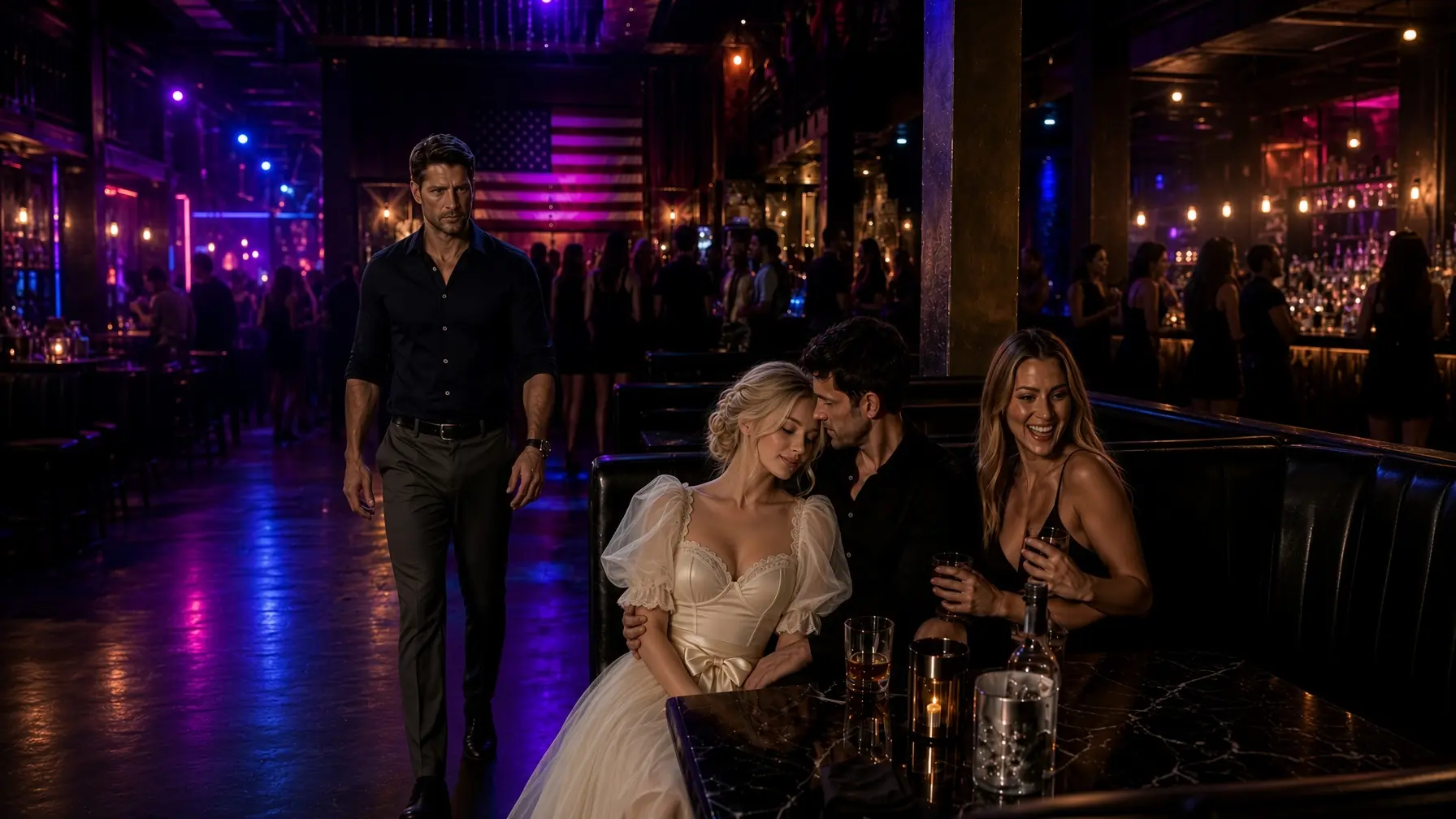
Meridian House was louder than I expected. Music rolled through the floor, blue light washed across the walls, and everyone inside seemed ten years younger than I felt. I stayed near the bar at first, partly because I did not want Natalie to see me and partly because I had no idea what I would do if I saw exactly what I feared. Then I found Brooke.
She was sitting in a curved booth near the back. Natalie sat beside her, and across from them was a man I had never seen before. He looked around my age, maybe a year younger, with dark hair, a charcoal jacket, and the kind of composed expression that immediately annoyed me because calm men are easy to dislike when you think they are sleeping with your wife.
At first, nothing looked intimate. They were talking seriously, and Brooke had several papers spread across the table between drinks. Then Natalie leaned toward the man so he could show her something on his phone, and his hand settled briefly against the back of her chair. She did not pull away.
My chest tightened. I watched another five minutes while telling myself I needed enough context not to destroy my marriage over a hand touching furniture. Then Natalie laughed at something he said and placed her fingers lightly against his wrist. That was all.
I walked toward the booth.
Brooke saw me first. Her face changed so dramatically that I knew instantly she had been hiding something, even if I still did not know what. Natalie followed Brooke’s stare, turned, and went completely pale. The man beside her stopped talking.
“Aaron,” Natalie said.
I looked at her. “Looks like girls’ night is going well.”
Brooke stood halfway. “Aaron, before you—”
“No.”
My voice came out calmer than I felt.
Natalie reached toward me, but I stepped back. “Don’t touch me until somebody explains why my wife has been lying to me for three months.” The strange man watched me without the defensive arrogance I expected, which somehow made me angrier. I asked him his name, and he said, “Evan Cross.”
E.C.
Of course.
I looked at Natalie. “That’s the estate guy?”
Her eyes filled. “Yes.”
“He looks very supportive.”
“Aaron, this is not what you think.”
I laughed once. Every betrayed spouse in every bad movie apparently hears the same sentence because sometimes clichés survive for a reason. “Then congratulations,” I said, “you have an opportunity to surprise me.”
Natalie looked toward Brooke.
That glance broke something.
“You need her permission?”
“No.”
“Then talk.”
She opened her mouth and stopped.
I reached for my wedding band.
Natalie stared at my hand. “Don’t.”
I slid the ring free anyway.
Nine years earlier, I had placed a different ring on her finger beneath a live oak tree outside my grandmother’s church. The ring had belonged to my grandmother Evelyn before Natalie, an antique gold band with a small oval diamond and tiny engraved branches around the setting. Evelyn had worn it for almost fifty years.
My grandmother gave it to me shortly before she died. She held my hand in her hospital room and said, “This belongs to the family before it belongs to any marriage.” At the time, I assumed she meant sentiment, lineage, and all the normal things grandmothers mean when they give young men old jewelry. Standing in Meridian House, I suddenly wanted it back.
“The ring,” I said.
Natalie looked at me.
“Aaron.”
“Please take it off.”
Brooke whispered my name, but I ignored her. Natalie slowly twisted the ring from her finger and placed it in my palm. The metal was warm.
I closed my hand.
Across the table, Evan Cross stopped breathing for a second.
It was subtle.
But I saw it.
His eyes fixed on my fist.
I turned toward him. “What?”
He said nothing.
“What are you looking at?”
“The ring.”
I opened my hand.
Evan leaned forward, and the irritation in his face disappeared. “Where did you get that?”
I stared at him. “From my grandmother.”
“What was her name?”
That question was so unexpected that my anger actually paused. “Why?”
“Please.”
“Evelyn Whitfield.”
Evan leaned back as though I had pushed him.
Brooke closed her eyes.
Natalie whispered, “This is why we needed more time.”
I looked between them. “More time for what?”
Nobody answered quickly enough.
I walked away.
Natalie followed me out of the club. Rain had started while I was inside, the warm heavy kind Florida produces without warning, and by the time I reached the parking garage entrance my shirt was already sticking to my back. I heard Natalie calling my name behind me and kept walking.
Then Evan caught the car door before I could close it.
I stood up immediately. “Move your hand.”
He did.
“I am not having an affair with your wife,” he said.
I stared at him.
“Good for you.”
“I’ve never kissed her.”
“Excellent.”
“I’ve never been alone with her except in my office.”
I looked toward Natalie approaching through the rain. “You all seem to think the physical details are the part I care about most.”
Natalie stopped several feet away. Brooke remained beneath the club awning. Evan wiped rain from his forehead and said, “Tonight was supposed to be the last meeting before we told you.”
I laughed. “That sentence is not improving anything.”
“I know.”
“Then explain.”
Evan looked at Natalie.
I felt rage rise again. “Stop asking my wife with your eyes whether I deserve an answer.”
He looked back at me.
“You’re right.”
Then Evan reached slowly inside his jacket. I tensed before realizing he was removing a long envelope. My full name was handwritten across the front.
AARON THOMAS WHITFIELD.
I did not take it.
“Who wrote that?”
Evan said, “The man your wife hired me to locate.”
“My wife hired you to locate someone?”
“Yes.”
“Who?”
Natalie answered.
“Your father.”
For several seconds I heard only rain.
My father had disappeared when I was ten years old. Thomas Whitfield left for work one Wednesday morning in 1997 and never returned. My mother told me he had emptied part of their savings, abandoned the family, and likely started over somewhere because he had always been restless.
There was no funeral. No confirmed death. No body.
Just absence.
By the time I was fifteen, my father had become less a person than a family warning. My mother, Diane, refused to say much about him beyond calling him selfish, while Grandma Evelyn was harsher. “Some men find leaving easier than facing what they’ve done,” she once told me.
I believed them.
Why wouldn’t I?
Children build history from whatever adults repeat most confidently.
“My father is dead,” I said.
Natalie shook her head.
“No.”
“You don’t know that.”
“I do now.”
I looked at Evan.
He held out the envelope again. “Thomas Whitfield is alive.”
My knees almost felt weak.
“No.”
“He lives near Dunedin.”
“That’s thirty minutes from us.”
“He moved there fourteen months ago.”
I laughed because reality had apparently become ridiculous enough to deserve it. “You’re telling me my father disappeared for twenty-eight years and now lives half an hour away?”
Evan nodded.
“Does he know I’m here?”
“Yes.”
That answer hurt worse than discovering he was alive.
“He knows where I live?”
“Yes.”
“And he stayed away.”
Nobody tried to soften it.
Good.
I looked at Natalie. “How long have you known?”
“About four months.”
I turned toward Brooke. “And you?”
“Almost five.”
Five months.
Every late dinner.
Every strange text.