"Cut every goddamn tree in that easement. Go wider before he gets out here."
Della Vosberg jabbed one French-tipped fingernail at the 80-year-old cottonwoods my grandfather had planted along the Powder River bottom.
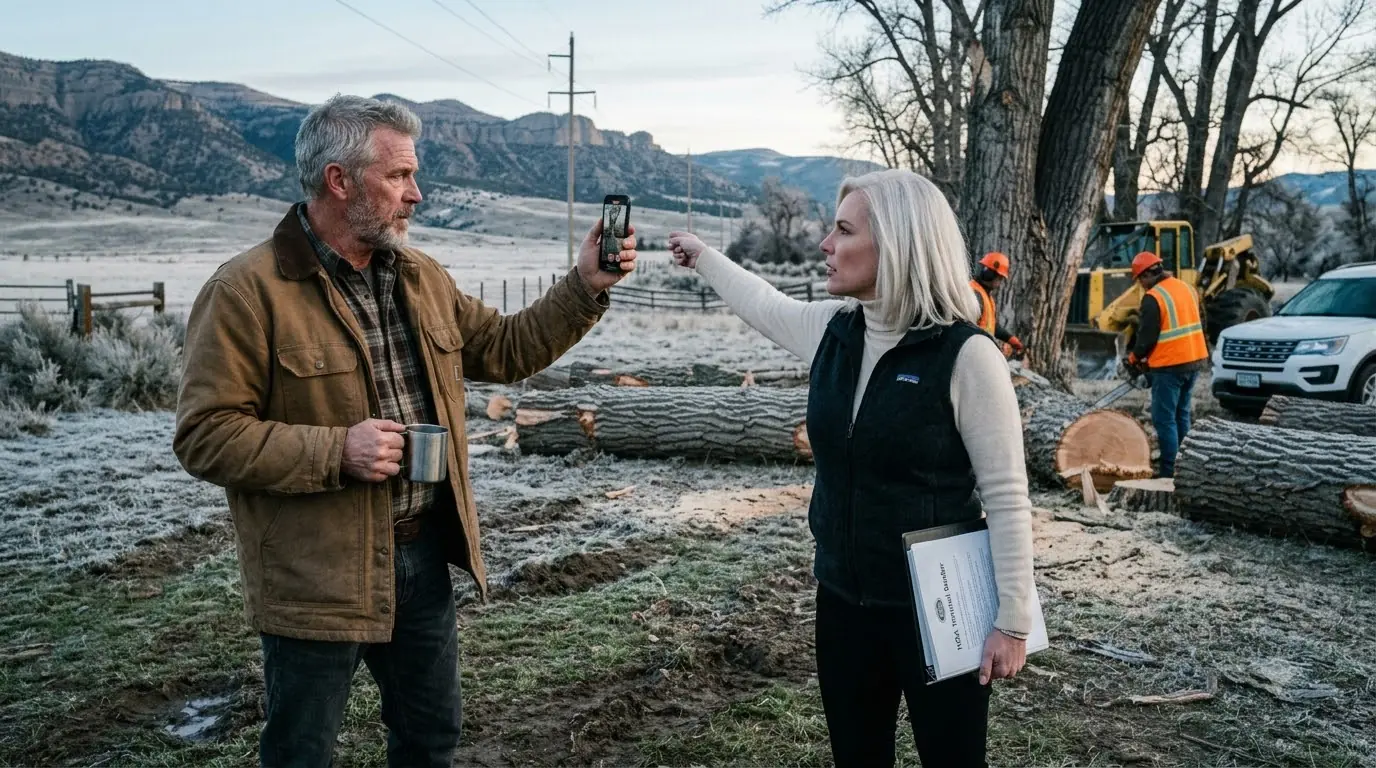
The chains roared. A row of old cottonwoods hit the ground at 6:15 on a cold morning the day after I had buried my uncle.
I came across the upper pasture in my late uncle's barn coat with my coffee in one hand and my phone recording in the other. Della turned, smoothed her Patagonia vest, and gave me a smile polished enough to close a corporate merger. "Mr. Ardmore," she said, "condolences. Sign the renewal and we'll stop." Behind her, the saws kept eating cottonwood.
Behind me, the Wyoming Public Service Commission was about to find out what she was burning. She didn't know the easement she was clearing on my land had a termination clause my grandfather had signed in 1958.
My name is Quinn Ardmore. I'm 56 years old and 3 months ago I retired from a 27-year career as a senior transmission engineer with the Western Area Power Administration designing high-voltage interconnects across the 11 Western states for what some folks call the federal grid and what most folks have never heard of in their lives.
I came home to Sheridan County, Wyoming in March because my uncle Garth Ardmore had died in his sleep in the same upstairs bedroom of the same farmhouse where my grandfather Hollister Ardmore had been born in 1924, where my mother Marjorie had grown up, and where my uncle had raised me after my parents died on a winter highway outside Buffalo, Wyoming in 1987.
My wife Linnea did not get to retire with me. She died of ALS in late 2021 after 14 months of the slow goodbye that disease forces you to learn. Our daughter Wren is 26.
She graduated from the University of Pittsburgh Dental School last May and is now an associate dentist in a small practice in Bozeman, Montana. She drives down on weekends when her schedule lets her. She has her mother's eyes, her mother's stubborn calm, and her mother's habit of correcting my grammar in the middle of dinner.
The ranch is 1,700 acres of East Slope Bighorn foothills, short grass prairie, cottonwood bottom along the Powder River fork, sagebrush bench above the lower pasture, and a single ridge of ponderosa where my grandfather had built the original homestead in 1947. Wyoming wind, Wyoming sky, Wyoming silence. The kind of country that makes a man understand why his grandfather had once written in a 1958 letter to my mother that this land would outlast everyone who ever tried to put their fence on it. Running across the upper third of the ranch in a north-south corridor, or about 40 ft wide on paper, is a power line easement. That easement is the spine of this story. So, let me tell you about it.
In 1958, my grandfather Hollister Ardmore signed a private easement deed granting four neighboring ranchers the right to run a 4,160-V distribution line across his land from the regional cooperative grid to the south to the small ranches to the north. He was a careful man. He wrote the deed himself. He limited the voltage.
He limited the width. He limited the duration to 99 years. He included an annual fee paid by the user, and he included a termination clause in plain English that said the easement could be terminated by the lineal heir of the grantor upon written notice to the user with 180 days grace in the event of unauthorized expansion of scope, voltage, or width. That clause, on a yellow piece of carbon paper, sat in a fireproof box in my Uncle Garth's office for 67 years.
I remember my Uncle Garth, the summer I turned 14, taking me up to that office one evening and showing me the box. He did not open it. He just tapped the lid with two fingers and said, "Quinn, the worst day of your life, this box opens. Until then, you leave it closed."
I did not understand him at the time. I had grown up on a ranch where the closed boxes were kept closed and the open boxes were kept open. And adults did not generally explain why. I left the office. I forgot about the box for 42 years.
In 2010, a developer named Theron Vosberg bought 800 acres of bench land just north of the ranch, hired a fast Cheyenne engineering firm, got himself a county zoning approval, and built 180 luxury homes on what had previously been four small cattle operations. The cooperative grid on the original 1958 easement had served those four ranches with a few thousand watts of barn lights and well pumps.
The new development needed far more capacity than the original four-ranch line had been built to carry. The developer's engineers, in an act of confidence I will charitably describe as careless, simply upgraded the line through my uncle's ranch from 4,160 volts to 24,900 volts, widened the cleared right-of-way from 40 ft to roughly 80, and never once filed a scope amendment with the Wyoming Public Service Commission, my uncle, or the Department of Agriculture.
He named the development Cloud Peak Estates. His wife, Adelaide Vosberg, who preferred to be called Della, became its first HOA board president. The first time she crossed our property line was the morning after my uncle's funeral. That was the day she made her first mistake. It would not be her last.
Della Vosberg stood in front of a yellow logging skidder with the 80-year-old cottonwood my grandfather had planted in 1947 lying in three pieces at her boots. Her Patagonia vest was zipped. Her boots were waterproof. Her hair was so blonde the cold morning sun bounced off it like off a snowfield.