"Your propane service is in violation of community infrastructure standards. You have 14 days to bring your installation into compliance, or the association will take corrective action at your expense."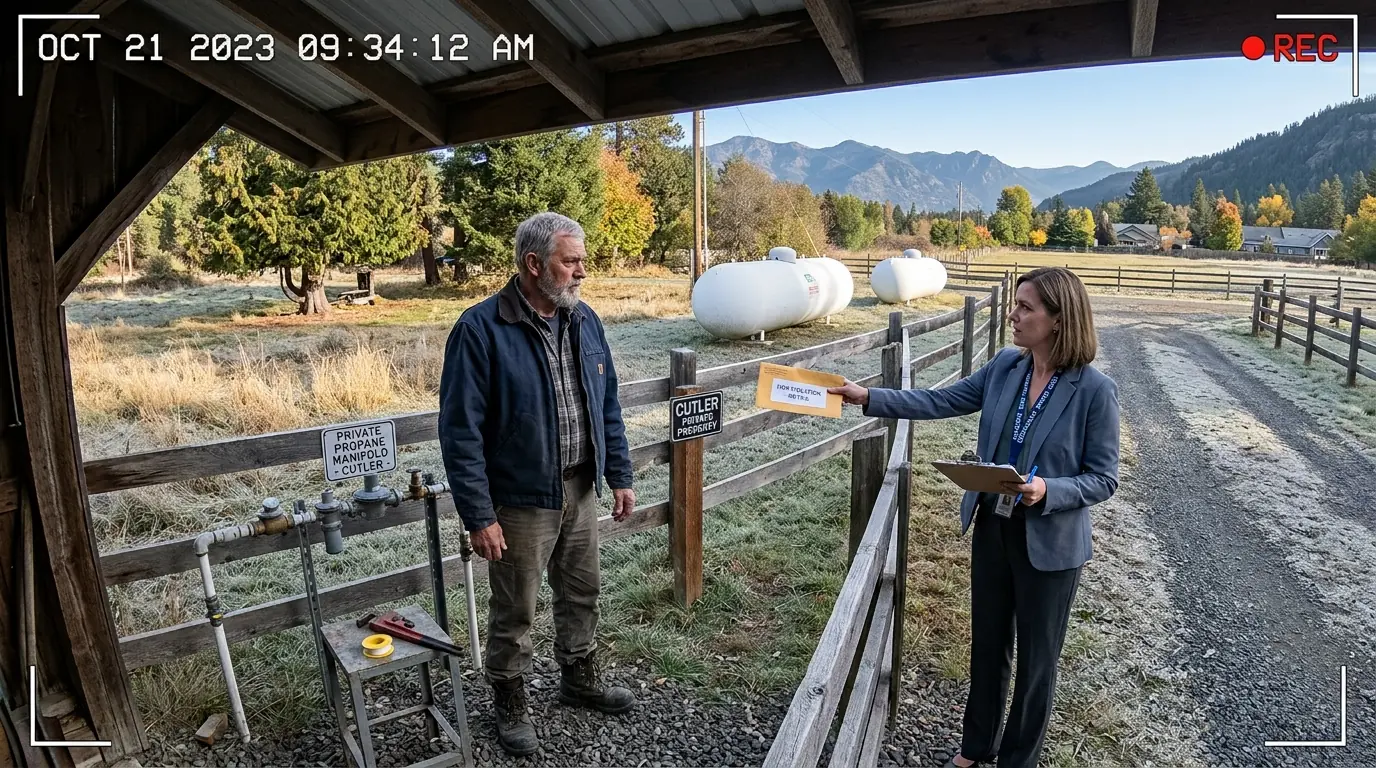
She said it the way people say things they have rehearsed in a car on the way over: clipped, certain, already impatient with any response I might offer.
Her name was Diane Coulter, and she was the infrastructure compliance chair for the Ridgeline Pines Homeowners Association—a title she wore the way some people wear a badge they paid for themselves. She stood at the edge of my gravel drive in a blazer the color of slate, a laminated lanyard around her neck, a clipboard pressed to her chest like a shield. Behind her, the October morning was cold and smelled of pine sap and the first real frost of the season, the kind that settles into the low ground and turns the grass silver before the sun clears the ridge.
I was not angry. I want to be clear about that. I was holding a pipe wrench and a roll of yellow thread seal tape, and I had been in the middle of a routine inspection of the main distribution manifold when she pulled up. I set the wrench on the top rail of the fence and listened to everything she had to say.
What Diane Coulter did not know, what she had no reason to suspect because no one had ever told her and she had never thought to look, was that the propane tank she was referencing—the one supplying heat and cooking gas to 61 homes in the Ridgeline Pines subdivision—sat on land I owned outright. The tank itself, the pad it rested on, the easement corridor, the supply lines running through all of it, every inch: my name was on the deed, and the deed was in a drawer in my kitchen, and it had been there for 31 years.
She handed me the envelope and walked back to her car without waiting for an answer.
I watched her drive out, and then I looked down at the manifold, and then I looked across the lower field toward the tank: a 30,000-gallon, commercial-grade vessel, white and slightly domed, sitting in the same place my grandfather had set the original installation back in 1962. The frost was melting off the grass in slow patches. A pair of crows moved through the treeline at the far edge of the property, and the whole valley was quiet except for the low, steady sound of the regulator doing its work.
I put the envelope in my jacket pocket and picked up the wrench again. There was still work to do.
Let me take you back to where this started—not to the morning Diane Coulter appeared in my driveway, but to the land itself, to what it was, how it came to be mine, and why any of this mattered.