The pistol shot echoed through the dusty Oklahoma City saloon on that sweltering August afternoon in 1883, but Clara Grace barely flinched as the drunken cowboy’s bullet lodged itself harmlessly into the ceiling beam above her head. She had learned long ago that fear was a luxury women like her could not afford, not when survival meant serving whiskey to men who saw her as little more than a piece of furniture with a pulse.
The shooter stumbled backward, laughing at his own recklessness while his companions slapped their knees and hollered. But Clara simply set down her tray and walked with measured steps toward the kitchen, her calico dress swishing against her worn boots.
“You all right, Clara?” Sally asked from behind the stove, her weathered face creased with concern.
“Same as always,” Clara replied, smoothing her auburn hair back into its practical bun.
At twenty-two years old, she had worked at the Red River Saloon for nearly three years, ever since her father died of fever and left her with nothing but debts and a reputation she never deserved. The town of Oklahoma City had grown rapidly since the railroad pushed through in 1882, bringing with it cattle drives, opportunists, and men with more money than manners.
Clara had hoped the expansion might bring opportunities for women beyond marriage or servitude, but those hopes had withered like prairie grass under the relentless summer sun. She returned to the main room with a forced smile, collecting empty glasses and dodging wandering hands with practiced efficiency.
The saloon owner, Marcus Webb, watched from behind the bar with calculating eyes, counting his profits while his employees navigated the daily indignities that came with the territory. Clara had long ago accepted this as her lot in life.
She was plain, poor, and unconnected. No respectable family would allow their son to court her, and the men who frequented the saloon wanted nothing from her that lasted beyond a night.
The door swung open, bringing with it a blast of hot Oklahoma wind and a stranger. Clara noticed him immediately, not because he was particularly handsome, though he was, but because of the way he moved. Most men who entered the saloon either swaggered with false bravado or slunk in with shame.
This man simply walked, his tall frame carrying itself with quiet confidence. He wore dust-covered traveling clothes, a wide-brimmed hat that shaded eyes the color of storm clouds, and a gun belt that sat low on his hips with the ease of long familiarity.
“What can I get you?” Clara asked, approaching his table near the window.
He looked up at her, and for a moment, Clara felt something shift in the air between them. His gaze was different from the leering stares she endured daily. He actually seemed to see her, not as an object or an obstacle, but as a person.
“Water first, if you have it,” he said, his voice low and rough like gravel under wagon wheels. “Then whatever whiskey you recommend.”
“The water is free and clean. The whiskey is expensive and questionable,” Clara replied, surprised by her own honesty.
The corner of his mouth lifted in something that might have been a smile. “Then I will trust your judgment on both counts.”
As Clara returned with his drinks, she caught Sally watching the exchange with raised eyebrows. The stranger paid for his whiskey without haggling, which immediately set him apart from most patrons, and nursed it slowly while watching the street through the dusty window.
Clara tried not to look his direction too often, but she found her eyes drawn to him throughout the evening. He did not join the card games or the raucous conversations. He simply sat, observed, and occasionally caught her looking at him.
When closing time approached and most of the customers had stumbled out into the night, the stranger finally stood and approached the bar where Clara was wiping down glasses.
“I am looking for work,” he said without preamble. “Heard there might be ranches hiring in the area.”
“The Morrison ranch north of town is always looking for hands,” Clara offered. “Though I hear the work is hard and the pay is poor.”
“I am not afraid of hard work,” he replied, then extended his hand. “Name is Lucas Morrison, but I go by Luke.”
Clara took his hand, noting the calluses that spoke of a lifetime of labor.
“Clara Grace, and that is unfortunate timing if the ranch you are seeking work at shares your name.”
Luke’s expression darkened slightly. “My older brother owns that spread. We have not spoken in five years, not since he married the woman I loved and made it clear there was no place for me on land that should have been half mine. But circumstances change, and pride is a poor companion on an empty stomach.”
There was a story there, Clara could tell, written in the lines of tension around his eyes and the set of his jaw. But she also recognized the look of someone who had traveled far on determination alone, and she respected the courage it took to return to a place where old wounds still festered.
“If you need a place to stay tonight, Mrs. Henderson runs a boarding house two streets over,” Clara said quietly. “Tell her I sent you. She will give you a fair rate.”
“I appreciate that,” Luke replied, holding her gaze for a moment longer than necessary.
Then he settled his hat back on his head and disappeared into the night.
Clara did not expect to see him again. Men drifted through Oklahoma City like tumbleweeds, there one day and gone the next, chasing opportunities or running from failures. But three days later, Luke walked back into the Red River Saloon during the quiet afternoon hours, this time wearing cleaner clothes and looking like he had actually slept.
“Your brother hired you then?” Clara asked, unable to contain her curiosity.
“After making it abundantly clear that he was doing me a favor and that I am expected to work twice as hard as any other hand for the privilege,” Luke replied. But there was no bitterness in his voice, only acceptance. “But yes, I start tomorrow.”
He ordered food this time, and Clara brought him a plate of stew and cornbread. The saloon was nearly empty, except for two old-timers playing checkers in the corner, so she found herself lingering at his table longer than propriety suggested.
“Why did you come back here?” she asked. “To Oklahoma City, I mean. Surely there are other places where work would come without old complications.”
Luke considered his answer carefully, spooning stew into his mouth while he thought.
“Because running only takes you so far before you realize you are just carrying your problems with you in a different location. I left five years ago thinking distance would heal things, but it just left them unresolved. My brother and I, we need to either fix what is broken between us or acknowledge that it cannot be fixed. Either way, I am tired of wondering.”
Clara understood that sentiment more than she cared to admit. She had spent years wondering if her life would ever amount to more than serving drinks and dodging advances, but she had been too afraid to risk what little stability she had in pursuit of something better.
“That is brave,” she said quietly.
“Or foolish,” Luke countered. “I have not yet determined which.”
And slowly, conversation by conversation, they began to build something that felt almost like friendship. Clara learned that Luke had spent the past five years working ranches across Texas and New Mexico Territory, learning everything he could about cattle and horses and the land itself.
He had saved almost nothing, spending his wages on necessities and sending what little remained back to their aging mother, who lived with Luke’s brother and his wife. The woman Luke had loved, Margaret, had chosen his brother Thomas, not out of malice, but because Thomas offered stability and inheritance while Luke offered only dreams and possibilities.
“You still love her?” Clara asked one evening when the whiskey had loosened his tongue just enough.
Luke was quiet for a long moment, staring into his glass as if it held answers.
“I loved who I thought she was, or maybe who I needed her to be at that time in my life. But I was twenty years old and thought love alone could build a future. Thomas understood that love needs a foundation, and he had one to offer. Can I fault her for choosing wisely?”
“You can be understanding and still hurt,” Clara observed.
“True enough,” Luke agreed, then shifted the conversation. “What about you? Surely you have left a trail of broken hearts across Oklahoma.”
Clara laughed, a sound without much humor.
“Men do not choose women like me for courting and marriage. They have already decided I am not good enough before they even know my name. I work in a saloon. My father died owing money to half the town, and I have no dowry or family connections to recommend me. I exist in the space between invisible and inconvenient.”
The words came out more bitterly than she intended, years of rejection and dismissal finally finding voice. She started to apologize, to take it back and put her armor back in place, but Luke stopped her with a hand on her wrist.
“Then every single one of them is a fool,” he said with such quiet intensity that Clara felt her breath catch. “And you deserve better than to be overlooked.”
Before Clara could respond, Marcus Webb called her name sharply from across the room, breaking the moment. She pulled her hand back and hurried to attend to a new group of customers who had just arrived, but she could feel Luke’s eyes on her for the rest of the evening.
That night, lying in her narrow bed in the tiny room she rented above the general store, Clara allowed herself to imagine what it might be like to be chosen. Not settled for, not accepted as a last resort, but actually chosen by someone who saw her worth.
The thought was so foreign, so dangerously hopeful, that she pushed it away and forced herself to sleep. The summer heat intensified as August gave way to September, turning Oklahoma City into a furnace where even the shade offered little relief.
Clara moved through her days in a haze of exhaustion, the saloon becoming unbearable as tempers grew short and violence erupted with increasing frequency. Luke still came by most evenings, but his face was drawn and his shoulders tight with tension that had nothing to do with the weather.
“Things are not going well at the ranch?” Clara asked one evening, setting a plate of food in front of him.
“Thomas does not trust me,” Luke said bluntly. “He watches everything I do, waiting for me to make mistakes or prove that I am the irresponsible younger brother he remembers. And Margaret walks on eggshells around both of us, trying to keep the peace while managing their two children and a household. I thought coming back would resolve things, but I am starting to think my presence just makes everything worse.”
“You cannot control how your brother sees you,” Clara said, sliding into the chair across from him without asking permission. The saloon was quiet, and Marcus was too busy flirting with one of the car dealers to notice.
“You can only control your own actions and hope that eventually he recognizes the truth. And if he never does, then you will have the satisfaction of knowing you tried and the freedom to leave without wondering what might have been.”
Luke studied her face, and Clara felt that strange electricity again, the sense that something significant was building between them, even though neither had named it aloud.
“You are wiser than your years suggest,” Luke said softly.
“I have had to be,” Clara replied. “Women do not get the luxury of learning lessons slowly.”
Their quiet conversation was interrupted by shouting from outside, followed by the sound of breaking glass. Luke was on his feet instantly, hand moving instinctively toward his gun before he caught himself.
Through the window, they could see a fight breaking out in the street between two groups of ranch hands. The kind of testosterone-fueled brawl that erupted regularly when men had more pride than sense. Marcus rushed to lock the saloon doors, not wanting the violence to spill inside and damage his property.
Clara watched as Luke’s jaw clenched, his whole body tensed with the need to act, but he forced himself to remain still. This was not his fight, and getting involved would only create more problems with his brother and the other ranchers in the area.
The fight ended as quickly as it began, with the town sheriff arriving to break things up and haul the worst offenders to jail for the night. But the incident left everyone on edge, a reminder of how quickly order could dissolve into chaos in a place where law was still a relatively new concept.
“I should walk you home,” Luke said when Clara finally finished her shift. “It is not safe tonight.”
“I have walked home alone for three years,” Clara pointed out, but she did not refuse when Luke fell into step beside her.
The streets were dark except for scattered lamplight spilling from windows. Oklahoma City quieted down at night, most honest folk already in bed, while those with darker intentions prowled the shadows. Clara knew the route by heart, but having Luke beside her changed the experience entirely.
She felt protected in a way that had nothing to do with his gun and everything to do with the solid, steady presence of someone who actually cared about her well-being.
“This is me,” Clara said when they reached the general store.
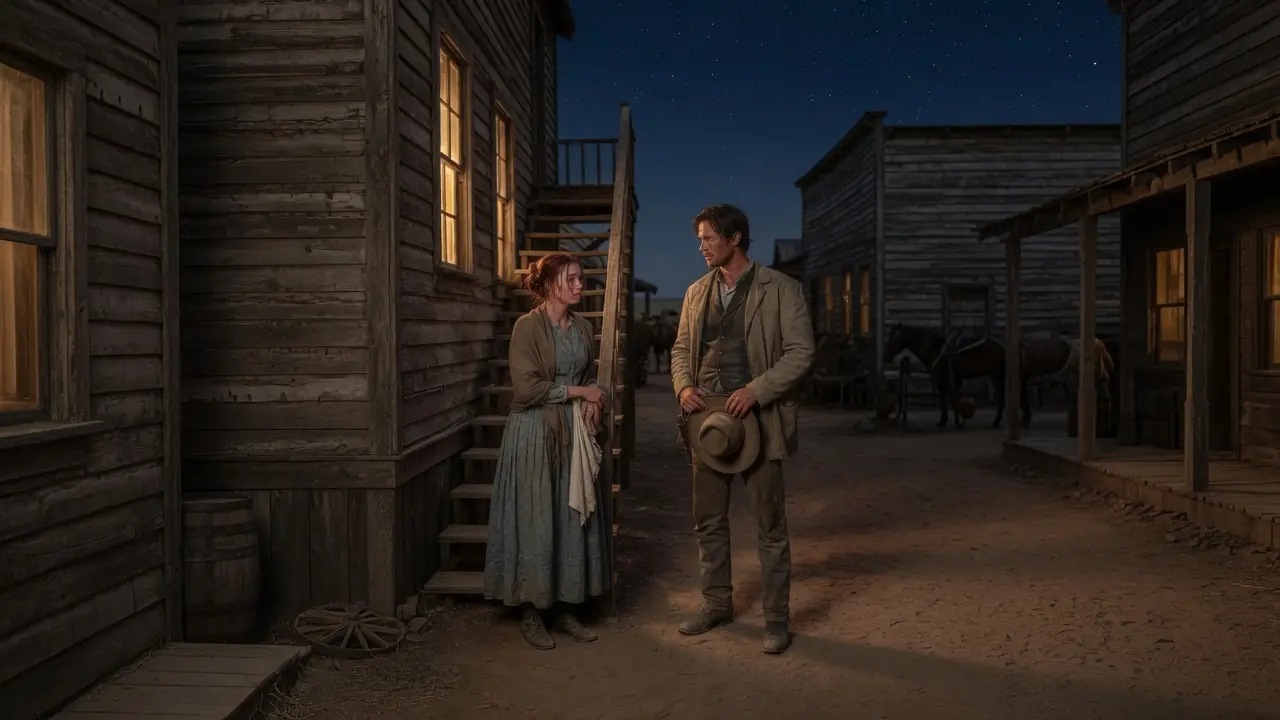
Stairs on the side of the building led up to her room, barely more than a closet with a bed and a washstand. She was suddenly acutely embarrassed by how little she had to show for twenty-two years of life.
Luke looked at the rickety stairs and the peeling paint with an expression Clara could not quite read.
“You deserve better than this, too,” he said quietly.
“We do not always get what we deserve,” Clara replied, trying to keep her voice light. “Sometimes we get what we earn, and sometimes we just get what is available.”
“What if I told you that I think you deserve everything?” Luke asked, and suddenly he was standing much closer, his hat in his hands, his storm-gray eyes locked on hers.
“What if I said that I have been coming to that saloon every night, not for the food or the whiskey, but because it is where you are?”
Clara’s heart hammered against her ribs.
“I would say that you should be careful making declarations you might regret in the morning.”
“I am not drunk, Clara. I am not confused or mistaken. I am just a man who has finally found something worth more than pride or past regrets. And I do not want to let it slip away because I was too afraid to speak honestly.”
“You barely know me,” Clara whispered, even as hope and fear warred inside her chest.
“I know that you are kind, even when the world has given you every reason to be bitter. I know that you are strong in ways that have nothing to do with physical strength. I know that you see people clearly, including yourself, and you do not hide behind false pretenses. I know that when you smile, really smile, it feels like the sun breaking through storm clouds. What else do I need to know?”
Clara felt tears burning behind her eyes.
“You need to know that I am afraid. I have watched women in this town get chosen last or not at all. I have seen them settle for men who treat them like property or burdens. I have never let myself believe that I could be someone’s first choice, their real choice, because hoping for that hurts too much when it does not come true.”
Luke set his hat down on the bottom step and took both of Clara’s hands in his. The gesture was achingly tender, and Clara had to fight not to pull away simply because she did not know how to accept tenderness without suspicion.
“I have never been chosen,” she whispered sadly, the words scraping out of her throat like broken glass. “Not by my mother, who died when I was born. Not by my father, who loved his whiskey more than his daughter. Not by this town, which has decided I am not worth their respect. Not by any man who looked right through me like I was invisible. I do not know how to believe that you are different, that this is real and not just another disappointment waiting to happen.”
Luke was quiet for a long moment, and Clara prepared herself for him to let go, to realize she was too damaged, too cynical, too much work. But instead, he lifted her hands to his lips and kissed her knuckles with such gentleness that she felt something crack open inside her chest.
“Then today, you are chosen by me,” Luke said firmly. “I choose you, Clara Grace, not because you are available or convenient or the only option. I choose you because you are exactly who I want. You are brave and honest and beautiful, and if the rest of this town is too blind to see that, then they are the ones missing out. I choose you, and I will keep choosing you every single day if you will let me.”
The tears Clara had been holding back spilled over, tracking down her dusty cheeks. She wanted to believe him so badly it physically hurt, wanted to trust that this was not just a pretty moment that would evaporate in the harsh light of reality.
But she also knew that some opportunities only came once, and refusing them out of fear was its own kind of tragedy.
“I do not know how to do this,” Clara admitted, her voice shaking. “I have never been courted properly. I do not know what I am supposed to say or do.”
“Say yes,” Luke replied simply. “Say yes, and we will figure out the rest together.”
Clara looked at him, really looked, and saw no deception in his face. He was not drunk or playing games or trying to manipulate her. He was just a man offering his heart with no guarantee she would not break it. And that vulnerability was perhaps the most convincing proof of his sincerity.
“Yes,” Clara whispered, and then louder, “Yes.”
Luke smiled, a real smile that transformed his whole face, and Clara felt herself smiling back. He did not try to kiss her, did not assume that her agreement gave him license to take liberties. He simply squeezed her hands once more and then stepped back.
“I will come by tomorrow evening,” he said, “and we will go for a proper walk where the whole town can see that I am courting you and that I am proud to be doing so.”
After he left, Clara climbed the stairs to her room and lay awake for hours, replaying every word of their conversation. Part of her still expected to wake up and discover it had all been a dream, another disappointment in a long line of disappointments.
But when morning came and the memory remained solid and real, Clara allowed herself the dangerous luxury of hope.
True to his word, Luke arrived at the saloon the next evening wearing his best shirt and carrying a small bouquet of wildflowers that he must have picked on his way into town. The gesture was simple but meaningful, and Clara felt her cheeks flush as she accepted them under the curious stares of the other saloon workers.
“I need to finish my shift,” Clara said, acutely aware of Marcus watching from behind the bar with narrowed eyes.
“I will wait,” Luke replied, settling into his usual table with the patience of a man who had learned not to rush important things.
The next few hours crawled by with agonizing slowness. Clara served drinks and food while hyperaware of Luke’s presence, of the promise his appearance represented.
When her shift finally ended, she changed out of her work dress into her only good dress, a simple blue calico that had seen better days but was clean and modest. She pinned her hair more carefully than usual, trying not to think too hard about why it suddenly mattered.
They walked through Oklahoma City as the evening settled in, the oppressive heat of the day giving way to slightly cooler temperatures. Luke kept a respectful distance, but offered his arm, which Clara took after only a moment’s hesitation.
She could feel people watching them, could practically hear the gossip starting to spread. Clara Grace, the saloon girl, walking with one of the Morrison boys like she was somebody worth noticing.
“Does it bother you?” Clara asked. “The staring and the talking?”
“Let them stare,” Luke said calmly. “Let them see that you have been claimed by someone who values you. Maybe it will make some of them reconsider their own prejudices.”
They walked to the edge of town where new buildings were still going up, evidence of Oklahoma City’s rapid expansion. Beyond the construction lay open prairie stretching toward the horizon, endless grass rippling in the evening breeze like an ocean of gold and green.
“Tell me about Texas,” Clara said, wanting to know more about the years Luke had spent away. “What was it like?”
Luke talked about dusty cattle drives and nights spent sleeping under stars so bright they seemed close enough to touch. He described the brutal heat of summer and the surprising cold of winter, the camaraderie among ranch hands, and the loneliness of always being a temporary fixture in other people’s lives.
He spoke about learning to read weather and land, about understanding cattle and horses, about becoming someone who could pull his weight and then some.
“It sounds hard,” Clara observed.
“It was,” Luke agreed. “But it was also simple in a way that life here is not. On the trail, you knew what was expected. You did your job. You earned your pay. You moved on. There were no complicated family dynamics or old wounds to navigate. I thought that simplicity was what I wanted. But I have realized that sometimes the complicated things are the ones worth fighting for.”
As twilight deepened, they turned back toward town. Luke walked Clara all the way to her stairs again, and this time when they said good night, he brushed a strand of hair back from her face with such tenderness that Clara felt her eyes sting with unshed tears.
“Same time tomorrow?” Luke asked.
“I would like that,” Clara replied.
Over the following weeks, a pattern emerged. Luke would arrive at the saloon each evening, wait patiently for Clara’s shift to end, and then they would walk together. Sometimes they talked for hours, sharing stories and dreams and fears.
Other times they simply walked in comfortable silence, finding peace in each other’s presence. Clara began to notice changes in how people treated her. Some of the townsfolk who had previously ignored her now nodded greetings when she passed.
A few of the married women stopped her to inquire about her intentions with Luke, their interest a mixture of genuine concern and nosiness. Even Marcus Webb seemed to view her differently, though whether that was respect or calculation, Clara could not tell.
But not everyone approved. Clara overheard whispered conversations suggesting she was not good enough for a Morrison, even if Luke was the younger brother with no inheritance. Some implied she was using him to improve her station, while others suggested Luke was only interested in her because she was available and easy.
The gossip stung, but Clara tried to remember Luke’s words about letting people talk while they built something real.
The real test came when Luke asked Clara to accompany him to Sunday services. Church attendance in Oklahoma City was spotty at best, but it remained the primary social gathering for respectable families. Clara owned nothing appropriate for church, but Sally helped her alter an old dress into something passable.
When Sunday arrived, Clara’s hands shook as she smoothed down her skirts. Luke met her outside the small wooden church, looking uncomfortable in a proper suit jacket that pulled slightly across his shoulders.
“You look beautiful,” he said quietly, offering his arm.
Walking into that church on Luke’s arm was one of the hardest things Clara had ever done. She could feel every eye turning toward them, could sense the judgment and curiosity rolling off the congregation in waves.
But Luke held his head high and led her to a pew near the front, sitting beside her like he had every right to be there, like she had every right to be there.
The service seemed to last forever. Clara barely heard the sermon, too focused on maintaining her composure under the weight of so many stares. But when they stood to sing hymns, Luke’s deep voice joined hers, and she felt some of her anxiety ease.
He was here beside her, publicly claiming their courtship, refusing to be ashamed or secretive about his choice.
After the service, as people filed out into the sunshine, Luke’s brother Thomas approached them. Clara had seen him before, but never up close. He looked like an older, harder version of Luke, with the same gray eyes, but a mouth set in permanent disapproval.
“Lucas,” Thomas said curtly, nodding but not offering his hand. “I did not expect to see you here.”
“I am trying to be a better man,” Luke replied evenly. “Church seemed like a good start.”
Thomas’s gaze shifted to Clara, and she felt herself being evaluated and found wanting.
“And you must be Miss Grace. I have heard talk about town regarding your association with my brother.”
“I hope you heard that he is a gentleman and that I am fortunate to know him,” Clara said, keeping her voice steady despite the urge to flee.
Something flickered in Thomas’s expression, surprise perhaps that she had spoken directly rather than deferring to the men. Before he could respond, a woman appeared at his elbow.
Margaret Morrison was pretty in a faded way, her face lined with exhaustion and her dress practical rather than fashionable. She looked between Luke and Thomas with obvious anxiety.
“It is good to see you, Luke,” Margaret said quietly. “You look well.”
“As do you,” Luke replied, and Clara heard no longing in his voice, only politeness.
An awkward silence stretched between the four of them until one of Thomas and Margaret’s children started crying from where he sat in the wagon. Margaret excused herself gratefully, and Thomas followed after a final measuring look at his brother.
“That went better than expected,” Luke said once they were alone.
“Did it?” Clara asked doubtfully.
“He did not order me off his property or forbid me from attending family occasions. For Thomas, that is practically a warm welcome.”
They walked away from the church, leaving the respectable families to their socializing. Clara waited until they were out of earshot before speaking again.
“Your brother does not approve of me.”
“My brother does not approve of much,” Luke replied. “But his approval is not required for us to be together. You are not courting him.”
“But his opinion matters to you,” Clara pressed. “And so does Margaret’s. They are your family, and I am the woman who is not good enough in their eyes or anyone else’s.”
Luke stopped walking and turned to face her fully, his hands gentle but firm on her shoulders.
“Listen to me, Clara. I spent five years running from my brother’s judgment and my own hurt pride. I am done with that. Thomas will either accept that I am building my own life with my own choices or he will not. Either way, it does not change how I feel about you or what I want our future to be.”
“What do you want our future to be?” Clara asked, hardly daring to hope.
“I want to marry you,” Luke said simply. “I want to build a home together, raise children if we are blessed with them, grow old watching sunsets from our own front porch. I want to wake up every morning knowing I chose the right person, and I want you to wake up knowing you were chosen in return. I cannot offer you wealth or social position, but I can offer you loyalty and love and a partnership built on respect.”
Clara felt tears spilling down her cheeks again, but this time they were not born of sadness or fear.
“I want that too,” she whispered. “I want it so much I am terrified it cannot be real.”
“It is real,” Luke promised. “And we will make it work one day at a time.”
As autumn arrived, painting the Oklahoma prairie in shades of gold and crimson, Luke and Clara’s courtship deepened. Luke spent his days working at the Morrison ranch, proving himself through sheer determination and skill. Thomas remained distant but grudgingly fair, paying Luke the same as other experienced hands and trusting him with increasing responsibility.
The tension between the brothers had not disappeared, but it had evolved into something more manageable, a truce built on mutual respect, if not affection.
Clara continued working at the Red River Saloon, but she began to dream of alternatives. She was a skilled seamstress, having learned from her mother’s sister before the woman passed away years ago. Perhaps she could take in mending and alterations, building a small business that would allow her to leave the saloon behind.
She mentioned this to Luke one evening, expecting him to dismiss it as impractical. Instead, he nodded thoughtfully.
“You would need supplies and somewhere to work. The room you rent now is too small, but if we married, we could find a larger place, something with space for you to set up properly.”
“You would not mind me working after we married?” Clara asked, surprised.
“Why would I mind you using your skills and earning money?” Luke replied. “We would both be working toward the same goal, building a life together. Your work has as much value as mine.”
It was such a radical departure from how most men viewed marriage that Clara had to sit down. She had assumed that marriage, if it ever came, would mean giving up any independence and becoming completely dependent on a husband’s goodwill.
But Luke was offering partnership, mutual support, a future where she retained her agency and identity.
“When?” Clara asked quietly. “When would we marry?”
“As soon as you are ready,” Luke said. “Tomorrow, next month, next year. I am not going anywhere.”
“I need to save money first,” Clara decided. “I will not come into marriage with nothing but debts and expectations. Give me until spring. By then, I will have enough saved to contribute to our household, and we can start as true partners.”
Luke agreed, though Clara could see the impatience in his eyes. Six months felt like an eternity when you had already found the person you wanted to spend your life with. But Clara needed that time to prove to herself that she was making a choice from a position of strength rather than desperation.
Winter came hard and fast that year, with storms sweeping down from the north and burying Oklahoma City under snow and ice. The saloon became a refuge from the bitter cold, packed with men seeking warmth and whiskey.
Clara worked double shifts, saving every penny while dodging advances from customers emboldened by alcohol and proximity. One particularly brutal evening in January, a fight broke out between two drunk ranch hands.
Clara tried to stay out of the way, but when one of them grabbed her arm to use as leverage while throwing a punch, she found herself caught in the middle of the brawl. She would have been seriously hurt if Luke had not appeared seemingly from nowhere, pulling her to safety and then stepping between her and the fighters with such authority that both men backed down immediately.
“You came?” Clara gasped, her arm throbbing where the man had grabbed her.
“Always,” Luke replied grimly. “Are you hurt?”
“Just bruised,” Clara assured him, though she was shaking from adrenaline.
Luke turned to Marcus Webb, who had finally emerged from his office.
“She is done working here,” Luke said flatly. “Tonight is her last night.”
“You do not get to make that decision,” Marcus shot back. “She works for me.”
“She works for herself,” Luke corrected. “And I will not stand by while she is put in danger for poverty wages and no protection. Clara, get your things. You are leaving with me.”
Part of Clara wanted to argue, to insist she could make her own decisions. But a larger part recognized that Luke was right. The saloon had always been dangerous, but tonight had shown her just how quickly things could turn deadly.
She retrieved her coat and the small bag where she kept her meager savings, and walked out of the Red River Saloon for the last time. Luke took her straight to Mrs. Henderson’s boarding house, the same place where he had been staying since arriving in Oklahoma City.
The elderly widow took one look at Clara’s pale face and bruised arm and immediately prepared a room without asking questions.
“What will I do now?” Clara asked once they were alone in the boarding house parlor. “I needed those wages to save for our wedding.”
“You will start your seamstress business now instead of waiting,” Luke said firmly. “I have been saving too, keeping back a portion of my wages each month. Between what you have and what I have, we have enough to get you started. We will find you workspace, buy supplies, and spread word that you are available for mending and alterations. It will work, Clara.”
“But the wedding,” Clara protested weakly.
“Will happen when we are ready, with or without savings,” Luke replied. “I would marry you tomorrow in borrowed clothes with no celebration if it meant you were safe and we were together. The money does not matter. You matter.”
Clara felt her remaining resistance crumble. She had been trying so hard to be strong and independent, to prove she was worthy of being chosen, that she had nearly forgotten what it felt like to accept help gracefully.
“Thank you,” she whispered.
“You do not need to thank me,” Luke said gently. “This is what partnership means. When one of us struggles, the other provides support. That is how we build something lasting.”
Over the next few weeks, Luke and Clara worked together to establish her seamstress business. They rented a small storefront on the main street, just two rooms, but with good light and enough space for Clara to work.
Luke built her a sturdy table and shelves while Clara cleaned and organized, gradually transforming the empty space into a proper shop. She used their combined savings to purchase fabric, thread, needles, and all the other supplies she would need.
Word spread quickly that Clara Grace was offering alterations and custom sewing. Her first customers were skeptical, but when they saw the quality of her work and the fairness of her prices, they told others. Within a month, Clara had a steady stream of business.
Women brought her dresses to alter. Men needed pants hemmed or shirts mended. A few bold souls even commissioned new garments from scratch.
The work was hard and the hours long, but Clara thrived. She loved the creativity of designing clothes, the precision of perfect stitches, the satisfaction of completing a project that made someone feel beautiful or confident.
And at the end of each day, Luke would arrive to walk her home, listening to her describe what she had accomplished and offering genuine interest and support.
As winter thawed into spring, Clara and Luke began seriously planning their wedding. They wanted something simple but meaningful, a ceremony that reflected who they actually were rather than trying to impress people who did not matter.
Clara sewed her own wedding dress, a practical cream-colored gown that she could wear again for Sunday services or special occasions. Luke purchased a new suit and arranged for the church minister to perform the ceremony.
The question of family remained complicated. Luke’s mother had passed away earlier that winter, her death peaceful but leaving Luke with complicated grief. She had never stopped hoping her sons would reconcile, and Luke felt he had failed her by not mending things with Thomas before her death.
But at the funeral, Thomas had approached Luke and extended a stiff but sincere invitation to Sunday dinner, acknowledging that their mother would have wanted them to try.
“You should go,” Clara encouraged when Luke told her about the invitation. “Even if it is uncomfortable, even if nothing gets resolved, you should try.”
“Come with me,” Luke requested. “If we are building a family together, that includes whatever relationship I have with my brother and his wife.”
The Sunday dinner at the Morrison ranch was tense but not hostile. Margaret proved to be warmer than Clara expected, asking genuine questions about the seamstress business and admiring Clara’s dress.
Thomas remained reserved, but he was not openly rude, and he even complimented Luke’s work at the ranch, acknowledging that his younger brother had proven himself to be reliable and skilled.
As they ate, Thomas’s two children, a boy of six and a girl of four, alternated between shy silence and boisterous energy. Clara watched Luke interact with them and saw a natural ease that suggested he would be a wonderful father someday.
The thought made her heart ache with longing for a future that felt tantalizingly close.
After dinner, Thomas and Luke stepped outside to look at some new equipment Thomas was considering purchasing. Left alone with Margaret and the children, Clara felt suddenly awkward, unsure what to say to this woman who represented so much of Luke’s past.
“He really cares for you,” Margaret said quietly, settling her daughter on her lap. “I can see it in how he looks at you. It is different from how he looked at me back when he thought he loved me.”
“I do not want to cause problems between Luke and your family,” Clara replied carefully.
“You are not causing problems,” Margaret assured her. “If anything, you are helping resolve them. Luke needed to come home, not to reclaim the past, but to make peace with it. And Thomas needed to see that his younger brother is not the irresponsible boy he remembers. You both are good for each other, and that is what matters.”
When Luke and Clara finally left the ranch as evening approached, Clara felt cautiously optimistic. The dinner had not magically fixed everything, but it had opened a door that had been closed for five years. With time and patience, perhaps the Morrison brothers could build a relationship based on who they were now rather than who they had been.
“Thank you for coming with me today,” Luke said as they rode back toward town in the wagon he had borrowed. “I know it was not easy for you.”
“Your family is important,” Clara replied simply. “And if we are going to be married, I need to be part of that, even when it is complicated.”
“We are going to be married,” Luke repeated as if testing the words. “Three more weeks.”
“Three more weeks,” Clara agreed, feeling excitement and nervousness flutter in her chest like trapped birds.
The weeks passed in a blur of final preparations. Clara finished her dress and Luke’s shirt. They finalized arrangements with the minister and sent word to the few friends they wanted present.
Clara even received an unexpected visit from Sally, her former coworker from the Red River Saloon, who apologized for not standing up for her more and offered to help with the wedding in any way she could.
The night before the wedding, Clara lay awake in her boarding house room, listening to rain drumming against the roof. Tomorrow she would stop being Clara Grace, orphan and former saloon worker, and become Clara Morrison, wife and business owner.
The transformation felt almost too enormous to comprehend. And yet, it also felt inevitable, like every difficult moment of her life had been leading her toward this one perfect choice.
She thought about Luke’s words that night months ago, when she had confessed she had never been chosen. He had looked at her with such certainty and said that today she was chosen by him.
And he had kept that promise every single day since, choosing her again and again through actions and words until Clara finally believed she was worthy of being chosen.
The wedding day dawned clear and bright, the storm having washed away the last remnants of winter and left everything sparkling and new. Clara dressed carefully, her hands steady as she pinned her hair and adjusted her dress.
Sally arrived to help with final preparations, bringing a simple bouquet of wildflowers and ribbons.
“You look beautiful,” Sally said sincerely. “Luke is a lucky man.”
“I am the lucky one,” Clara replied. “I get to spend my life with someone who sees me clearly and chooses me anyway.”
The church was half full when Clara arrived, a respectable showing considering how few connections either she or Luke had in Oklahoma City. Thomas and Margaret sat near the front with their children, and Mrs. Henderson dabbed at her eyes with a handkerchief.
But Clara only had eyes for Luke, standing at the front of the church in his new suit, his face lighting up when he saw her.
As Clara walked down the aisle, she felt the weight of every rejection and disappointment lift from her shoulders. She was not walking toward Luke as a last resort or a consolation prize.
She was walking toward the man who had chosen her first, who had seen her worth when she could not see it herself, who had offered her partnership and love without conditions or reservations.
The minister’s words washed over her in a blur. She heard Luke speaking his vows, his voice strong and clear, promising to love and honor and cherish her all the days of his life.
And then it was her turn, and she found her own voice steady as she promised the same, meaning every word with a depth that surprised her.
When the minister pronounced them husband and wife, Luke kissed her with such tenderness that Clara felt tears slip down her cheeks. This was real. This was happening. She was chosen, loved, valued, and she would spend the rest of her life choosing Luke in return.
The small celebration afterward at Mrs. Henderson’s boarding house was simple but joyful. There was food and music, laughter and dancing. Thomas even shook Luke’s hand and wished them well, a gesture that meant more than elaborate speeches.
And when the sun began to set, Luke and Clara slipped away to the small house they had rented on the edge of town, ready to begin their life together.
That first night as husband and wife was both awkward and wonderful, a fumbling exploration of intimacy that gradually transformed into something profound. Luke was patient and gentle, and Clara felt safe in a way she had never experienced before.
This was what it meant to be truly chosen, to be vulnerable and accepted, to give yourself to someone and trust they would treasure that gift.
The months that followed were not without challenges. Building a life together required compromise and communication, learning each other’s rhythms and habits.
Clara’s seamstress business continued to grow, but there were slow periods that tested their financial stability. Luke’s work at the Morrison ranch was steady but demanding, leaving him exhausted at the end of long days, and navigating the ongoing relationship with Thomas and Margaret required patience from both of them.
But through it all, they faced challenges as partners. When money was tight, they adjusted their spending together. When Luke came home frustrated with his brother, Clara listened and offered perspective.
When Clara struggled with self-doubt about her worthiness, Luke reminded her of her strength and capabilities. They built their life brick by brick, choice by choice, day by day.
The following spring brought news that changed everything. Clara had been feeling unwell for several weeks, tired and nauseated in ways that finally sent her to the doctor.
When he confirmed what she had begun to suspect, she walked home in a daze, one hand pressed to her still-flat stomach where a new life was growing.
Luke was in the yard when she arrived, repairing a fence that had been damaged in the previous night’s storm. He looked up at her approach, and whatever he saw in her face made him drop his hammer and rush over.
“What is wrong? What did the doctor say?”
“Nothing is wrong,” Clara said, her voice shaking. “Everything is perfect. Luke, I am pregnant. We are going to have a baby.”
For a moment, Luke simply stared at her, his expression unreadable. Then his face broke into the widest smile Clara had ever seen, and he picked her up and spun her around, laughing with pure joy.
“We are going to be parents,” he said wonderingly, setting her down carefully like she was made of glass. “You are going to be a mother.”
“And you are going to be a father,” Clara replied, tears streaming down her face. “Are you happy?”
“Happy does not begin to cover it,” Luke said, pulling her into his arms. “You have given me everything, Clara. A home, a purpose, a future, and now a child. How could I be anything but grateful?”
The pregnancy progressed smoothly, despite Clara’s initial concerns. She continued working at her seamstress shop, adjusting patterns to accommodate her growing belly and eventually specializing in alterations that could be done while sitting.
Luke became almost comically protective, insisting she not lift anything heavy and making sure she ate properly and rested enough.
As summer arrived and Clara’s due date approached, they prepared the small second bedroom in their house as a nursery. Luke built a cradle with his own hands, sanding the wood until it was smooth as silk.
Clara sewed tiny clothes and blankets, marveling at how something so small could contain so much hope and possibility. Thomas and Margaret visited more frequently as the pregnancy advanced, and Clara saw Thomas slowly warming to his younger brother.
The impending arrival of a new generation seemed to soften something in him, reminding him that family was about more than old grudges and hurt pride. Margaret brought hand-me-down baby clothes and offered advice about what to expect, her kindness genuine and deeply appreciated.
“You have done something I could not,” Margaret told Clara one afternoon while they sat on the porch shelling peas. “You helped Luke and Thomas find their way back to each other. That is a gift.”
“I just loved Luke honestly,” Clara replied. “The rest followed naturally.”
“That is exactly what I mean,” Margaret said with a smile.
Clara went into labor on a scorching July afternoon, three days before the date the doctor had predicted. The pain started slowly, manageable at first, but quickly intensified into something that made her grateful Luke had insisted she stop working a week earlier.
He rode for the doctor while Mrs. Henderson and Sally stayed with Clara, offering support and reassurance as the contractions grew closer together. Labor was long and exhausting, testing Clara’s strength in ways she had not anticipated.
But every time she wanted to give up, she remembered that she was bringing a child into a world where they would be chosen and loved from their first breath. That knowledge carried her through the worst of the pain, through the hours of effort, until finally, just as sunset painted the sky in shades of orange and pink, she heard the most beautiful sound in the world: her baby’s first cry.
“It is a boy,” the doctor announced, placing the tiny, squalling infant on Clara’s chest. “A healthy, strong boy.”
Clara looked down at her son, at his scrunched face and waving fists, and felt love so intense it was almost painful. This was her child, hers and Luke’s, a person who would never wonder if he was chosen or wanted.
He would grow up knowing he was treasured, that his existence was celebrated, that he belonged.
Luke entered the room moments later, his face pale with worry that transformed into wonder when he saw Clara holding their son. He approached slowly, reverently, as if afraid he might disturb something sacred.
“Can I hold him?” Luke asked quietly.
Clara carefully transferred the baby into Luke’s arms, watching as her husband looked at their son with an expression of pure awe.
“Hello, little one,” Luke whispered. “I am your father, and I promise to choose you every single day. You will always know you are loved.”
They named him James Lucas Morrison, after Luke’s father and Luke himself. Little James had his father’s gray eyes and his mother’s auburn hair, and from the beginning, he possessed a calm temperament that made him easy to love.
The first few weeks of parenthood were chaotic and exhausting, but Clara and Luke navigated them together, taking turns with nighttime feedings and diaper changes, marveling at every tiny milestone.
Thomas and Margaret came to meet their nephew, bringing their own children to meet their new cousin. Clara watched as Thomas held James with surprising gentleness, his gruff exterior cracking to reveal genuine affection.
“He looks like Father,” Thomas said quietly. “Same eyes.”
“He does,” Luke agreed.
And something passed between the brothers in that moment, an acknowledgment of shared history and renewed connection.
As James grew from an infant into a toddler, life found a rhythm that felt both ordinary and miraculous. Clara’s seamstress business continued to thrive, with women coming from miles around for her skilled work.
She cut back her hours to spend more time with James, but she never stopped working entirely. The independence she had fought so hard to achieve remained important, and Luke never questioned her right to maintain it.
Luke continued working at the Morrison ranch, but Thomas increasingly sought his advice on major decisions, trusting his younger brother’s judgment and experience. There was talk of Luke eventually buying into the ranch as a partner, making official what had become true in practice.
The Morrison brothers were equals, running the operation together despite their complicated history.
When James was two years old, Clara discovered she was pregnant again. This time, the news came with less shock and more quiet joy, a deepening of something that had already been wonderful.
Their daughter arrived the following spring, a tiny, fierce creature they named Caroline Grace Morrison, honoring Clara’s maiden name and ensuring her daughter would carry forward the strength Clara herself had embodied.
Caroline proved to be the opposite of her easygoing brother, demanding attention and refusing to be overlooked from her very first day. Clara saw something of herself in her daughter’s determination, that refusal to accept being invisible or dismissed.
She hoped Caroline would never know what it felt like to be unchosen, that she would grow up confident in her worth and deserving of respect.
The years passed in a blur of ordinary moments that added up to an extraordinary life. James grew tall and serious, inheriting his father’s quiet competence and his mother’s careful observation of the world.
Caroline remained spirited and bold, challenging expectations and pushing boundaries in ways that sometimes terrified her parents, but mostly filled them with pride. Luke and Clara added a third child eventually, another boy they named Thomas after Luke’s brother, a gesture that completed the healing between the Morrison brothers.
Oklahoma City continued to grow and change around them, transforming from a rough frontier town into an established city with schools and churches and businesses. The wild chaos of the early days gave way to something more settled, though the spirit of possibility that had drawn people west remained.
On their tenth wedding anniversary, Luke and Clara stood on the porch of the home they had built together, watching the sunset paint the Oklahoma sky in brilliant colors. Their children played in the yard, their laughter carrying on the evening breeze.
Inside, dinner waited on the stove, and tomorrow would bring work and responsibilities and the thousand small tasks that filled their days.
“You ever regret it?” Clara asked quietly. “Choosing me instead of someone more suitable, someone who would have been accepted immediately by your family and the town?”
Luke turned to look at her, his storm-gray eyes filled with the same certainty they had held that night years ago when he had first declared his choice.
“Not once,” he said firmly. “Not for a single moment. You are the best decision I ever made, Clara. You and the life we have built together.”
“I used to think I would never be enough,” Clara confessed. “That I would spend my whole life being overlooked and dismissed. I had accepted that was my fate.”
“And now?” Luke asked.
“Now I know that being chosen by the right person changes everything,” Clara replied. “Not because it makes me worthy, but because it helps me see the worth that was always there. You gave me that gift, Luke. You saw me when I was invisible, and you chose me when I thought I was impossible to choose.”
“You were never impossible,” Luke said, pulling her close. “You were just waiting for someone who deserved you.”
As stars began to appear in the darkening sky, Clara leaned into her husband’s embrace and felt complete. She thought about the frightened, cynical young woman she had been, serving whiskey in a saloon and believing she would never matter to anyone.
That woman felt like a stranger now, someone from another lifetime entirely. The journey from there to here had not been easy or simple. There had been struggles and setbacks, moments of doubt and fear.
But every challenge had been worth it for this, for the life she and Luke had created together. A life built on choice and respect and love, where neither of them had to pretend to be anything other than who they actually were.
Their children would grow up knowing they were wanted, that their existence was celebrated rather than merely tolerated. They would see in their parents a model of partnership where both people were valued, where decisions were made together, where love was demonstrated daily through actions as much as words.
And perhaps, if Clara and Luke were very lucky, their children would carry forward that legacy, choosing their own partners wisely and building their own lives with intention and care.
As the years continued to unfold, Clara and Luke grew older together, their faces acquiring lines and their hair turning gray. But the essential truth of their relationship remained unchanged.
They had chosen each other deliberately and joyfully, and they continued to make that choice every single day.
James eventually took over running the Morrison ranch alongside his uncle Thomas’s children, proving himself to be a capable manager with his father’s work ethic and his mother’s attention to detail. Caroline defied expectations by opening her own business, a general store that quickly became the heart of their growing community.
Young Thomas found his calling as a teacher, educating the next generation with patience and passion. Luke and Clara watched their children build their own lives with pride and occasional amazement.
How had two people who had been so certain they did not deserve happiness managed to create this? A family filled with love and possibility. But deep down, they knew the answer.
It was because they had been willing to take a chance on each other, to see beyond the surface to the potential underneath, to choose deliberately rather than settling for what was convenient or expected.
On their twenty-fifth wedding anniversary, Thomas and Margaret hosted a celebration at the ranch, bringing together friends and family from across the territory. As Clara looked around at the gathering, she saw the life she and Luke had built radiating outward, touching and changing everyone it reached.
Their love story had started with two damaged people taking a leap of faith, but it had grown into something that extended far beyond just the two of them.
Late in the evening, Luke found Clara standing alone by the pasture fence, watching horses graze in the moonlight. He came up beside her and took her hand, their fingers intertwining with the ease of long practice.
“What are you thinking about?” he asked.
“About how different things could have been,” Clara replied. “If you had not walked into that saloon that day, if you had not seen something in me worth choosing, if I had been too afraid to say yes when you offered me a chance at happiness.”
“But none of those things happened,” Luke reminded her gently. “Instead, we found each other at exactly the right moment, and we built something neither of us could have created alone.”
“I love you,” Clara said, the words as true now as they had been the first time she had spoken them. “Thank you for choosing me.”
“Thank you for letting yourself be chosen,” Luke replied, “and for choosing me in return every day, even when I did not deserve it.”
They stood together in comfortable silence, listening to the sounds of celebration drifting from the ranch house, feeling the weight of twenty-five years together and the promise of however many more they might be granted.
Clara thought about the girl she had been, standing in that saloon and believing she would never matter to anyone. She wished she could tell that girl that happiness was coming, that she just had to hold on a little longer and be brave enough to accept it when it arrived.
But maybe that girl had known on some level that her story was not finished yet. Maybe that was why she had kept going, kept surviving, kept hoping despite all evidence to the contrary, because somewhere deep inside, she had believed she deserved to be chosen even when the whole world told her otherwise.
As Clara and Luke returned to the celebration, surrounded by family and friends and the life they had built together, Clara felt profoundly grateful, not just for the happiness she had found, but for the journey that had led her there.
Every hardship, every rejection, every moment of doubt had shaped her into someone capable of accepting love when it finally arrived.
And Luke, for his part, was equally grateful. He had spent five years running from his past, believing that distance could heal wounds. But it was not distance that had saved him.
It was coming home, facing what he had been avoiding, and finding someone who understood that being broken did not mean being beyond repair. Clara had given him a second chance at family, at belonging, at building something meaningful.
She had chosen him just as deliberately as he had chosen her, and that mutual choice had been the foundation for everything good in his life.
The celebration continued late into the night, but eventually people began to depart, calling out goodbyes and promises to visit soon. James and his wife gathered their children. Caroline embraced her parents before leaving with her husband, and young Thomas helped clean up before heading home to his own small house in town.
Thomas and Margaret were the last to leave, with Thomas pausing to grip his brother’s shoulder in a gesture that conveyed everything words could not.
“Mother would be proud,” Thomas said quietly. “Of both of us, but especially of you. You built something real, Luke. Something lasting.”
“We all did,” Luke replied, glancing at Clara. “Together.”
After everyone had gone, Clara and Luke returned to their own home, walking slowly through the familiar streets of Oklahoma City. The town had changed so much since that day Luke had first arrived, dusty and uncertain, looking for work and a chance to make peace with his past.
Now it was truly home, the place where they had built their life and raised their children, the place where they had chosen each other and been chosen in return.
As they prepared for bed, moving through their nighttime routine with the ease of long practice, Clara caught sight of her reflection in the mirror. She was fifty years old now, her face lined by years of laughter and occasional tears, her hair more silver than auburn.
But when she looked at herself, she no longer saw someone who had never been chosen. She saw a woman who had been brave enough to accept love when it was offered, who had built a business and raised a family and created a life worth living.
“What are you smiling about?” Luke asked, coming up behind her and wrapping his arms around her waist.
“Just thinking about how lucky I am,” Clara replied. “How lucky we both are.”
“The luckiest,” Luke agreed, pressing a kiss to her temple.
They climbed into bed together, settling into their familiar positions, Luke’s arm around Clara’s waist and her head on his shoulder. Outside, Oklahoma City slept peacefully under the stars, the same stars that had watched over the territory when it was still wild and unsettled.
But inside their small house, Clara and Luke held each other close and felt nothing but contentment.
The story of how they had found each other would be told and retold over the years, passed down to their children and grandchildren as evidence that love could bloom even in the most unlikely circumstances.
It would become family legend, the tale of the saloon worker and the cowboy who had chosen each other when no one else would, who had built a life together through determination and faith, and the simple daily practice of choosing each other again and again.
But for Clara and Luke, it was not a story or a legend. It was simply their life, the result of one brave choice made on a summer evening years ago when Luke had seen past Clara’s circumstances to the woman underneath, and Clara had been brave enough to believe she deserved to be seen.
As sleep claimed them both, wrapped in each other’s arms in the home they had built together, one truth remained constant and unchanging.
They had been chosen, and they had chosen in return, and that had made all the difference.
The years continued to pass, with the steady rhythm of seasons turning and children growing. Clara’s seamstress shop eventually was taken over by a young woman from town whom Clara had trained, allowing Clara to finally retire and spend her days however she pleased.
Luke officially became a partner in the Morrison ranch, working alongside Thomas until his body told him it was time to slow down. They sold their share to James, who ran the operation with the same dedication his father and uncle had shown.
Grandchildren arrived, filling their lives with noise and laughter, and the special joy that comes from watching the next generation discover the world. Clara taught her granddaughters to sew, passing down not just skills, but the knowledge that women could build their own security and independence.
Luke taught his grandsons to ride and rope and work the land, but also to treat women with respect and to understand that strength came in many forms.
On their fortieth anniversary, their children surprised them with a small ceremony at the church where they had been married four decades earlier. The building had been expanded and improved over the years, but the bones were the same, and standing in that familiar space brought back a flood of memories.
“You remember what I was thinking during our wedding?” Clara asked Luke as they stood together after the ceremony ended.
“Tell me,” Luke invited.
“I was thinking that I could not believe it was real, that someone had actually chosen me. I kept waiting for you to change your mind, to realize you had made a mistake. Even as I was speaking my vows, part of me expected you to stop the ceremony and admit it was all a joke or a misunderstanding.”
“And now?” Luke asked gently.
“Now I know that you meant every word you said that day and every day since. You chose me, Luke Morrison, and you never wavered. That is the greatest gift anyone has ever given me, and I have spent forty years trying to be worthy of it.”
“You were always worthy,” Luke said firmly. “I just helped you see what was already true.”
As they left the church, surrounded by their children and grandchildren, Clara felt the weight of four decades of love and partnership settling around her shoulders like a warm blanket.
She had lived a life beyond anything she could have imagined that day in the saloon when a stranger walked in and changed everything. She had been loved and valued, had raised children who knew their worth, had built a legacy that would continue long after she was gone.
The evening ended with a celebration at James and his wife’s home, with food and music and stories told by people who had known Clara and Luke for years. As the sun set on another Oklahoma day, painting the sky in familiar shades of orange and pink, Clara found herself standing on the porch with Luke, watching their family through the windows.
“We did good,” Luke said quietly.
“We did,” Clara agreed. “We took two broken people and built something whole.”
“You were never broken,” Luke corrected gently. “You were just waiting to be seen.”
Clara turned to face her husband, this man who had walked into her life forty years ago and refused to leave, who had seen past her circumstances to the person underneath, who had chosen her when she thought she was impossible to choose.
“Thank you,” she said simply, “for everything.”
“Thank you for saying yes,” Luke replied. “For being brave enough to take a chance on us.”
They stood together as twilight deepened into night, two people who had found each other against all odds and built a life worth celebrating. Behind them, their family laughed and talked, carrying forward the legacy of love and choice that Clara and Luke had established.
And ahead of them, whatever time remained would be spent together, still choosing each other with every sunrise.
The story that had begun with words whispered sadly and answered with firm conviction had become a lifetime of choices made consciously and joyfully. Clara had learned that being chosen was not about being perfect or exceptional or better than anyone else.
It was simply about being seen clearly by someone who valued what they saw and choosing to value them in return.
And Luke had learned that the things we run from often contain the lessons we most need to learn. That home is not a place but a feeling created by people who choose to build something together. That love is not about grand gestures but about the steady accumulation of small choices made day after day.
As they finally went inside to rejoin their family, Clara glanced back once at the Oklahoma sky, now filled with stars. She thought about the girl she had been, frightened and convinced of her own worthlessness, and sent that girl a message across the years.
Hold on. Be brave. Say yes when the time comes. Because somewhere out there, someone is looking for exactly you, and when they find you, they will choose you so completely that you will finally understand your own worth.
That was the gift Luke had given Clara and the gift they had given each other. The knowledge that being chosen was not about luck or accident or settling. It was about two people recognizing something valuable in each other and deciding to build a life around that recognition.
It was about choosing and being chosen again and again until those choices became the very foundation of who you were.
And in the end, that was enough.
More than enough.
It was everything.