The kind of restaurant that makes regular people feel small doesn't advertise itself with neon signs or sidewalk boards. Aurelius sat tucked inside a glass tower in downtown Chicago. Its entrance marked by nothing more than brushed bronze lettering and a pair of doors that opened only when someone decided you were worth letting in. Inside, the ceiling stretched high enough to make conversation feel intimate and grand at the same time. Chandeliers hung like frozen waterfalls, catching light from every angle and scattering it across white tablecloths and polished silverware.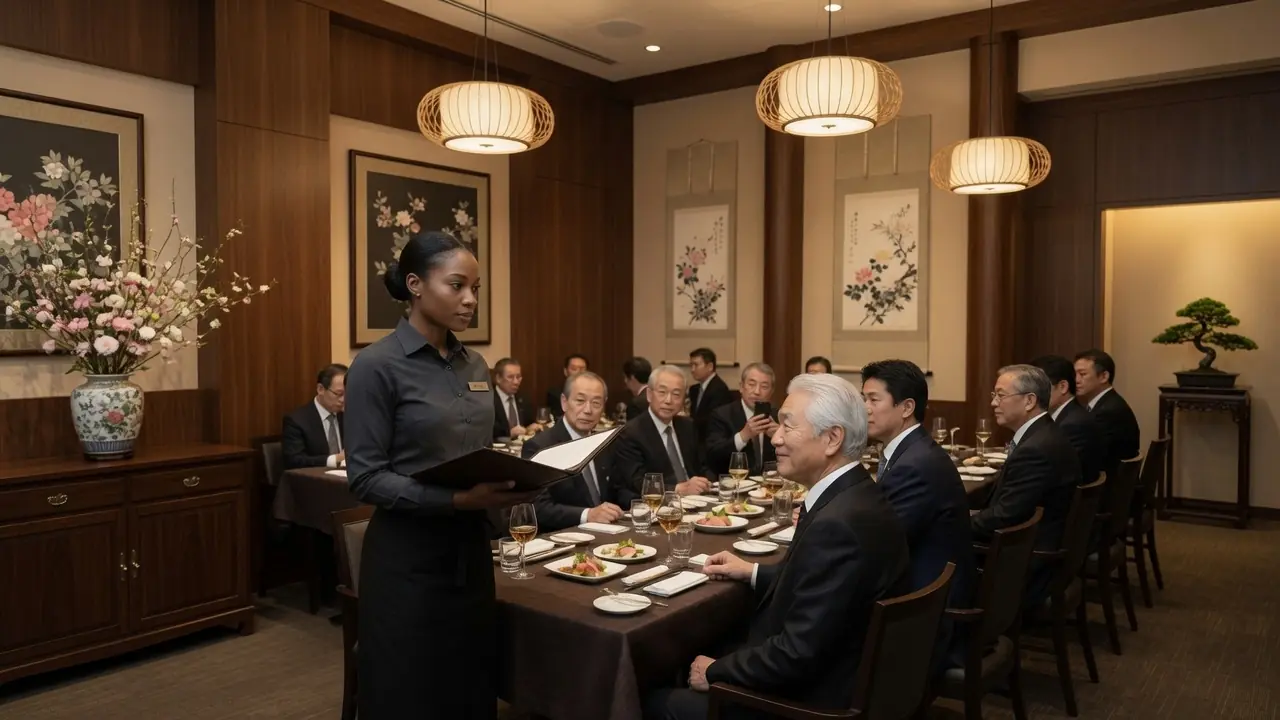
The guests who filled those tables wore the kind of calm that only came from never having to worry about a bill. It was the kind of place that hummed with money, not loudly but constantly, like a current running beneath everything. Moving through it all, quiet and unhurried, was Amara Cole. She was 26, slim and composed, with dark eyes that took in everything and gave away nothing. Her uniform was pressed and clean, the same as everyone else's.
But the way she wore it was different. There was no stiffness in her spine, no nervous energy in her steps. She moved like someone who had made peace with her surroundings, even if those surroundings had never fully made peace with her. Most of the guests didn't look at her twice. The ones who did look expected nothing much. A girl working a double shift, maybe saving up for something, maybe just getting by.
She had been at Aurelius for 14 months, longer than three of the four people who'd been promoted above her. Her coworkers were a mixed group. There was Danny, 23, fast-talking and anxious. There was Priya, who handled private dining and had a gift for flattery. And there was Gerald, a senior waiter in his late 40s who'd been at Aurelius for over a decade and had developed the particular brand of smugness that came from surviving long enough in one place to feel ownership over it.
A few minutes later, the kitchen doors swung open and Marco, the sous chef, caught Amara's eye. Table nine asked for the Kaiseki-style amuse-bouche, he said. The prep crew plated it the Western way again. Amara had already noticed it on the pass. She replated it correctly before taking it out. These were the small moments that made up Amara's evenings. Small corrections, quiet adjustments. Nobody announced them. Nobody thanked her for them.
At 7:45, the energy in the restaurant shifted. The manager, Robert Hale, gathered the full floor staff near the service corridor. We have a VIP reservation at 8:00, he said. His name is Kenji Takahashi. He's a CEO, the kind of visit that gets talked about in boardrooms. He has connections to a group of investors currently in discussion with the ownership of this restaurant chain. Tonight is a performance review for all of us. No mistakes.
Amara, I'm putting you on Takahashi's table, Robert said. You're the steadiest server I have. Just do what you always do. At 8:07, the front doors opened. Kenji Takahashi walked in with the quiet certainty of someone who had never needed to announce himself because rooms had always arranged themselves around him. He was in his mid-50s, lean, impeccably dressed in a charcoal suit. Behind him came his assistant Claire and two other executives.
Amara watched them settle from across the room. She picked up the menus and walked to the table. Good evening. Welcome to Aurelius. My name is Amara, and I'll be looking after your table tonight. Can I start everyone with still or sparkling water? Takahashi didn't look at her. He was reading the menu as if she hadn't spoken. Still water, Claire said. For everyone.
As Amara turned and walked toward the service station, Takahashi spoke in Japanese to one of the executives. She moves like someone who's been trained to look competent. Watch. She'll hover too long and won't know when to disappear. Amara's step didn't falter. When she returned to take their orders, Takahashi looked up at her with the pleasant, empty expression of a man fully in control. We'll need a moment, he said in English.
Takahashi turned back to Yamada and resumed speaking in Japanese about the menu. These places always hire for appearance. She probably doesn't speak anything beyond what they wrote on the specials board. When Amara returned, she walked through the specials cleanly. The halibut preparation, a dry-aged duck breast with a miso citrus reduction, a seasonal mushroom dish. No stumbling, no filler phrases.
Takahashi spoke again in Japanese. The miso reduction is a Western adaptation. The kitchen doesn't know what they're doing with it. Yamada asked her to describe how the kitchen prepares it. The base is a traditional shiro miso, white miso, lower salt, fermented shorter. They balance it with a yuzu reduction rather than standard lemon. It's finished with a cold butter mount, served immediately off the heat. The kitchen sourced the yuzu domestically.
There was a small silence. Takahashi resumed in Japanese. That was memorized. They brief these servers before VIP tables. Let's give her something she hasn't rehearsed. Takahashi began placing his order in Japanese, not translating, speaking rapidly as though Amara were a device he expected to malfunction. He ordered the duck, specified a particular sauce on the side, asked for a bread service with no butter, and requested a specific temperature for his water. Then, without changing his tone, he added that the duck should be prepared medium rare, bordering on rare.
Amara held her notepad. I want to make sure I have your order correctly, she said in English. For clarification, did you want to specify a preparation for the duck beyond what's listed? Takahashi smiled with satisfaction and said in English, I'm sorry. I thought I was clear. Then he turned to Yamada and said in Japanese, She didn't catch a word of it. The table chuckled softly.
From three tables away, Gerald glanced over. He read the body language clearly enough. Danny caught Amara's eye, his expression tight with anxiety. At the kitchen pass, Amara put in the order precisely, with a note for Marco on the duck preparation. She submitted the accurate Japanese version. The duck came out perfectly, medium rare bordering on rare, exactly as Takahashi had specified in Japanese.
During the pause between courses, Takahashi set his fork down and spoke in Japanese to Yamada. It's interesting, isn't it? You put someone in a uniform and they think they've risen above their station. You can always tell. It's in the way they hold themselves, that particular kind of reaching. People like that always end up back where they started. It's not cruelty, it's just gravity. Amara returned with a palate cleanser.
She set the dishes down one at a time. When she reached Takahashi's place, she straightened and looked directly at him. If you wanted proper service, you should have ordered correctly the first time, she said in Japanese. The room went still. She continued in natural, unforced Japanese. The order you placed in Japanese included a preparation specification for the duck that differed from what you repeated in English. The kitchen was given the accurate version.
I understood everything you said from the moment you sat down. She listed every item, every specification, every modification he had delivered in Japanese, reflecting his own register back to him. Would you like me to continue in Kyoto dialect or shall we return to English? Takahashi had not moved. His face showed a blankness more revealing than anger. Amara looked at him with the same calm she'd carried all evening.
Is there anything else I can bring you? she asked in English. Then she turned and walked back toward the service station. The restaurant noise resumed slowly. Takahashi reached for his wine glass. His hand was steady, but he looked at it before he lifted it. The rest of the meal passed in an altered quiet. Takahashi ate his duck and said nothing else in Japanese. When Amara came to the table, he watched her differently, the look of a man reorienting a map.
Near the exit, Takahashi paused. He turned and spoke in Japanese across the space. Where did you learn that? Amara crossed the distance without hurrying. From someone who respected the language, she said in Japanese. Then she held his gaze for a moment and turned back to her work. Takahashi stood at the entrance a few seconds longer than necessary.
In the back corridor, Gerald approached Amara. You trained in that language? I speak it, she said. I was wrong about you, he said stiffly. I don't know what I was wrong about exactly, but I was. Near the entrance, Claire broke away from the group. That was something most people wouldn't have done quietly, she said. Amara set down her tray. I wasn't doing it for most people.
Outside, a black luxury sedan waited at the service lane. The driver opened the rear door with deliberate posture. Amara walked toward it. Her posture shifted from the careful compression of service to something straighter, deeper. She got in. The driver closed the door. In a building across the city, Amara walked into a room where six people waited around a table. Welcome back, Ms. Cole, the man at the far end said. The board is waiting.
Amara sat at the head of the table. Then let's begin. They reviewed the status of investment positions and mapped Takahashi's next major deal. None of what they were doing was illegal. They operated through influence, through information, through careful placement. Daisuke Mori had taught her that. The meeting closed at 12:40. You did well tonight, Harold said simply. He called people like me decorative, Amara said. He said we move through spaces we haven't earned.
Daisuke used to say that the most dangerous thing you could be in a room full of powerful people was someone they had already decided didn't matter. You made him look at you tonight. The rest follows from that. Meanwhile, in a hotel suite on the 38th floor, Kenji Takahashi sat at the desk reviewing documents from his research team. The records on Amara Cole were too clean. Dig deeper, he told Claire. Use Mercer. And find out everything you can about Daisuke Mori's last known associates.
Nine years ago in Osaka, Amara had been 17, arriving with a scholarship and a second-hand dictionary. She had wandered into a room where Daisuke Mori was speaking. Over 14 months he became her most significant teacher. He taught her Japanese from context and literature. He taught her strategy and how power moved. Kenji Takahashi had visited twice during that time. Their relationship had changed. Takahashi had wanted to absorb Daisuke's network. Daisuke had refused.
Six months later, Daisuke's firm was rendered small through the quiet withdrawal of support. Amara had stayed in service work deliberately. It placed her in rooms where powerful people spoke freely. Harold Stent had found her three years ago. They had spent years positioning. The restaurant had not been random. Amara had waited. When the reservation appeared, she made sure she was assigned to the floor. She had known Takahashi would behave exactly as he did.
The following morning, Claire arrived at Takahashi's suite. There's a connection to a man named Harold Stent. Together they represent positions in three of the four companies involved in your Pacific Northwest deal. Takahashi looked at the documents. He thought about the phrase Amara had used. From someone who respected the language. Dig deeper, he said. He sat for a long time in the dark room. The game had changed. And he was no longer the only one playing it.