“Are you seriously writing a citation for a six-year-old?”
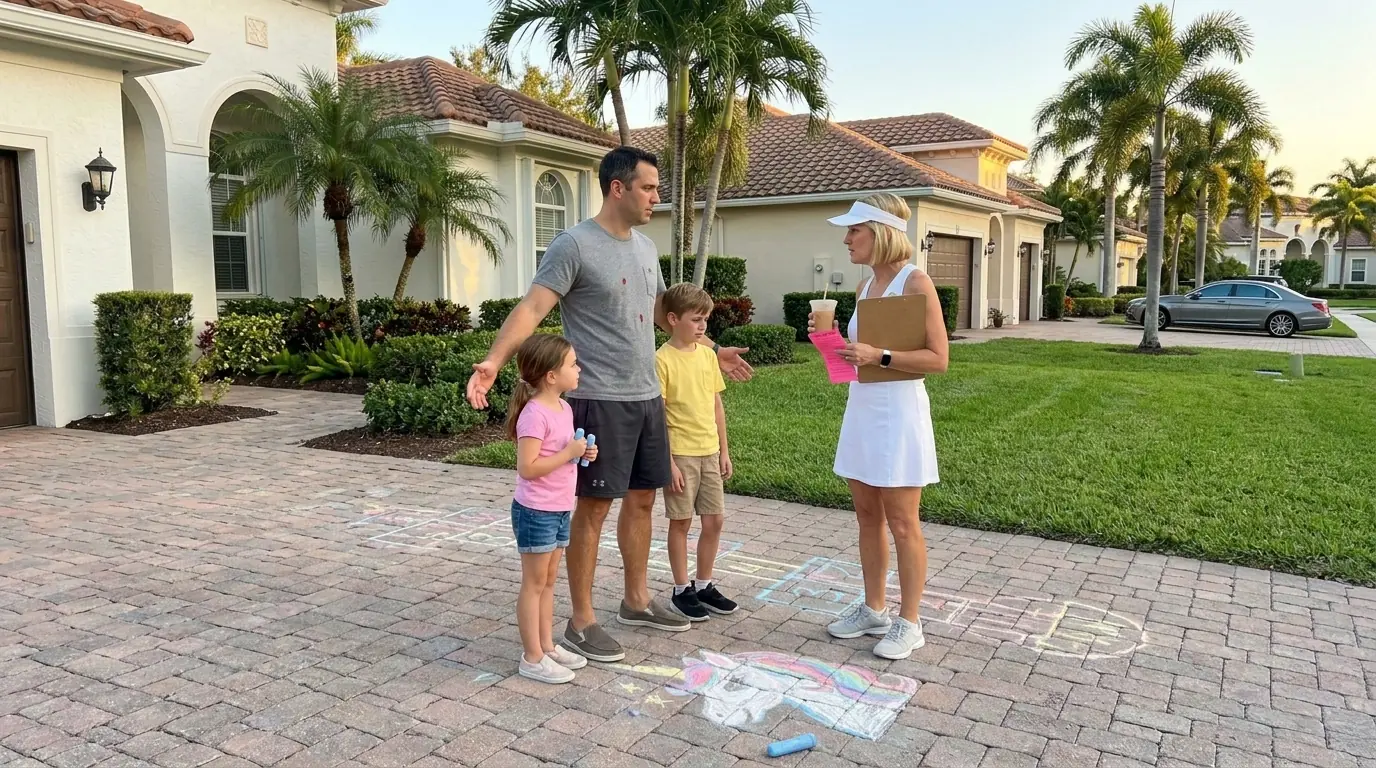
The red and blue lights of the Boca Raton police cruiser bounced off the pristine eggshell-white stucco of my house, casting chaotic shadows across the perfectly manicured lawn. It was seven o’clock on a Tuesday evening in late July, and the air was practically soup, the kind of thick Florida humidity that made your clothes stick to your skin the second you stepped outside. There I was, standing in my driveway in athletic shorts and a T-shirt covered in spaghetti sauce, staring down the barrel of the most absurd standoff in suburban America.
Down on the concrete near the edge of the street was the scene of the crime. It was a unicorn, or at least it was supposed to be one. My daughter Chloe was six, and her grasp of equine anatomy was, let’s say, abstract. The drawing was lopsided, neon pink and aggressively green, with a horn that looked more like a bent traffic cone. It was harmless, it was cute, and apparently it was also a threat to the very fabric of society.
Standing over the pastel masterpiece was Brenda, president of the Boca del Vista Homeowners Association, a title she wore like a four-star general’s uniform. That evening she had on her standard patrol gear: a crisp white tennis skirt, a visor against the setting sun, and a clipboard gripped so tightly in her manicured hand that her knuckles were white. In the other hand was her weapon of choice, an iced latte sweating profusely in the muggy air.
Then there was Officer Miller. Poor, exhausted Officer Miller leaned against the front quarter panel of his squad car like a man profoundly rethinking every life choice that had brought him to this driveway. His thumbs were hooked into his duty belt, his head tilted back slightly as if asking the heavens for a localized meteor strike.
“Ma’am,” Officer Miller said, his voice devoid of every emotion except profound weariness. “It is chalk. It is Crayola washable street chalk. The radar says we’re getting a thunderstorm at roughly four-fifteen tomorrow afternoon. Nature is going to handle this.”
Brenda scoffed, the sharp, practiced sound she normally reserved for people who left garbage cans at the curb an hour past the designated retrieval time. “Officer, I don’t think you understand the severity of the situation,” she snapped, gesturing wildly at the lopsided pink unicorn with her latte. “This is an unauthorized property alteration. It is a direct violation of Section 4, Article 2 of the Boca del Vista bylaws regarding temporary markings and graffiti.
If we let this slide, what’s next? People painting their mailboxes neon orange? Anarchy? It sets a precedent.”
I stepped in front of Chloe, who was hiding behind my leg and clutching a half-used stick of blue chalk like contraband. “Brenda, she is six years old,” I said, trying to keep my voice level. “She was drawing a magical horse. Are you going to dust her juice box for fingerprints next? Call the FBI? Demand a forensic analysis of the driveway?”
“Ignorance of the bylaws is not an excuse for breaking them,” Brenda shot back, her eyes narrowing beneath her visor. “When you bought a home in this community, you signed a legally binding contract to uphold the aesthetic cohesion of this neighborhood. That”—she pointed a trembling, manicured finger at the chalk—“is not cohesive. It is an eyesore. I demand that a report be filed.”
Officer Miller sighed. It was a long, rattling sigh that seemed to originate from the depths of his soul. He pushed himself off the cruiser and adjusted his vest.
“Listen to me very carefully, folks,” he said, shifting into the authoritative tone of a police officer entirely finished with the conversation. “I am not writing a police report for a chalk drawing. I am not citing a kindergartner for vandalism. There is no crime here.
This is a civil matter. It is an HOA matter. If you want to handle it, handle it through your board. But if either of you calls 911 again because a child is playing in her own driveway, I’m going to start handing out citations for misuse of the emergency dispatch system. Do we have an understanding?”
Brenda’s mouth dropped open. “But the property values—”
“Have a pleasant evening, ma’am,” Miller interrupted. He gave me a brief, sympathetic nod, climbed into his cruiser, and killed the flashing lights. As he drove away, the neighborhood suddenly felt very quiet except for the hum of central air-conditioning units and distant traffic on Palmetto Park Road.
I looked at Brenda. Brenda looked at me. The air between us practically vibrated with hostility.
“Well,” I said, offering a tight and entirely fake smile, “glad we got that sorted out. Come on, Chloe. Let’s go inside and wash your hands. It’s almost bath time.”
Brenda did not say a word. She stared at me with cold, calculating eyes, flipped a page on her clipboard, pulled out a pen, and started writing furiously. Then she marched up my walkway, slapped a piece of paper against my custom mahogany front door, and walked away, her tennis shoes squeaking against the concrete.
I waited until she was out of sight before pulling the paper from the door. It was a bright pink carbon-copy slip: Violation. Temporary markings and graffiti. Section 4, Article 2. Fine assessed: $500. Remediation required: immediate removal of unauthorized markings.
Five hundred dollars for a chalk unicorn.
I stood there in the humid night air, staring at the pink slip, and felt a slow heat begin to rise in my chest. It was not just anger. It was a deep, fundamental offense to my sense of logic.
I am an architect. I design commercial structures for a living, and I spend my days navigating building codes, zoning regulations, structural engineering requirements, and municipal bureaucracy on a massive scale. I read legal codes for fun. I understand why rules exist, but I also understand when rules are being weaponized by a petty tyrant with a god complex.
Brenda had messed with the wrong dad. She had not just fined me. She had challenged me. And in my world, when somebody throws a rule book at you, you do not simply dodge it. You pick it up and read every page more carefully than they did.
I ushered Chloe inside, helped her scrub the neon chalk dust from her hands, read her a bedtime story about a bear who loses his hat, and waited until she was asleep. Then I went downstairs to my study and closed the door.
My study was my sanctuary: floor-to-ceiling bookshelves, a heavy oak desk, and exactly zero pastel colors. I poured myself a glass of Lagavulin 16, sat at the desk, opened the bottom drawer, and pulled out the beast—the Boca del Vista Homeowners Association bylaws and covenants.
It was a massive, three-inch-thick black binder, roughly eight pounds and four hundred pages of restrictive, hyper-specific micromanagement. I cracked it open, took a sip of the scotch, and settled in. If Brenda wanted to play the technicality game, we were going to play.
I needed a loophole. I wanted a way to defeat the fine, strip away Brenda’s power over the situation, and do it inside the rules she had chosen to enforce. I did not just want to beat one citation. I wanted to build a position she could not easily attack.
I read past rules stating that garbage cans could be visible from the street only within a very narrow window around sanitation pickup. I read past a mandate governing the exact height of lawn grass and the approved palettes for exterior trim, which seemed to consist almost entirely of depression gray, institution beige, and surrender white. Around one in the morning, my eyes burning, I found the clause she had used against me.
Rule 42A, Temporary Markings: “Under no circumstances shall temporary markings, including but not limited to chalk, temporary paint, tape, or signage, be applied to driveways, walkways, or exterior walls visible from the street without prior written consent from the Architectural Review Board.”
Fair enough. But legal documents love exceptions, and the same binder had another section governing driveways.
Rule 18C, Driveway Maintenance and Alteration, allowed professional driveway resurfacing, sealing, and decorative concrete treatments, provided the base colors remained in grayscale tones—black, white, and gray—and a formal schematic was submitted and approved by the Architectural Review Board.