The laughter started at the hem of her gown. Lady Florence Hartwell stood at the top of the ballroom stairs of Wrentham House in a dress that had been turned twice, mended at the cuffs, and let down at the hem so many times that the original color could no longer be guessed at with any confidence. Below her, 300 of London's most fashionable people had gone suddenly, collectively silent, and then had begun, in the way that cruelty always finds its rhythm before it finds its courage, to laugh. She did not move.
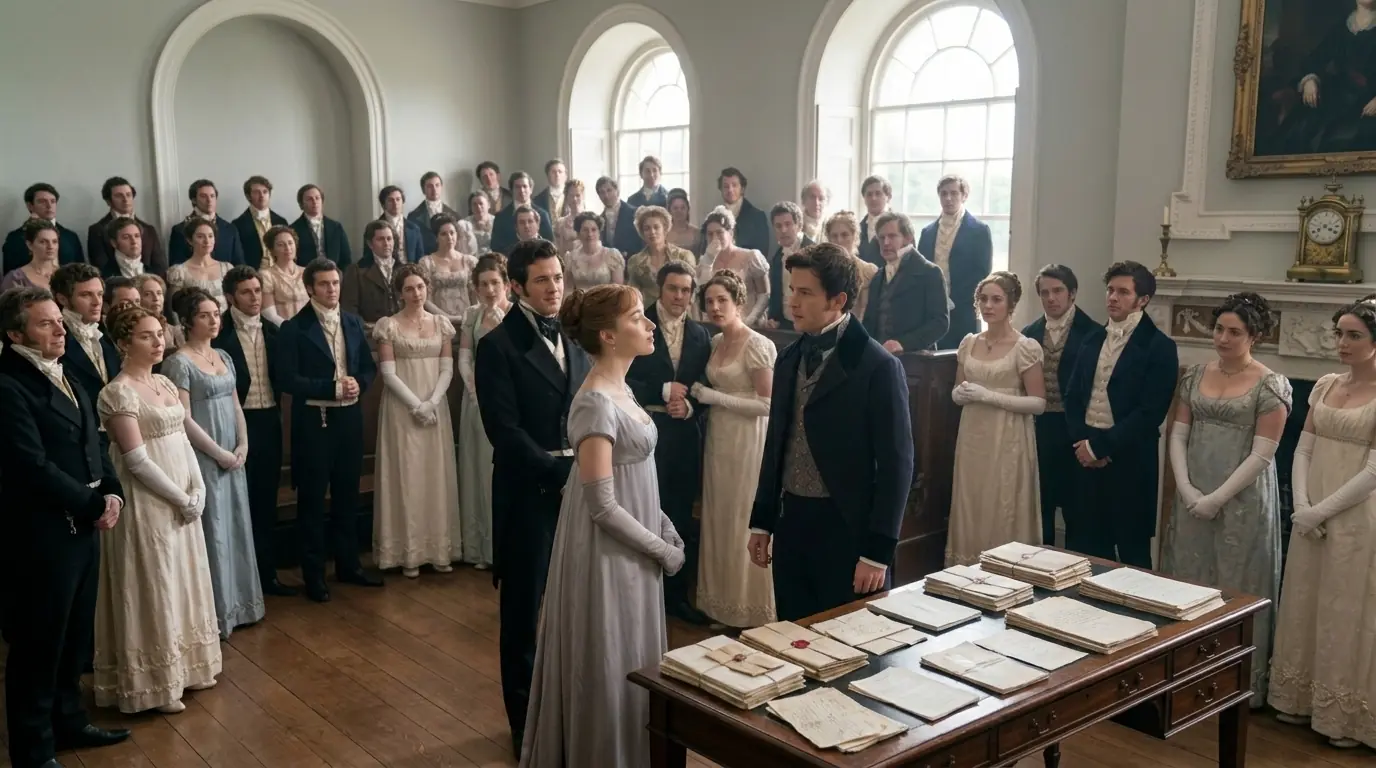
She stood at the top of the stairs with her chin at the exact angle her mother had taught her before her mother had died and left her with nothing else worth teaching, and she let them look. Somewhere below, a voice she did not trouble to identify remarked, quite audibly, that the Hartwell girl had come to a duke's ball dressed for a scullery. Another voice, closer, wondered aloud whether she had borrowed the gown from her own maid. Florence heard both remarks with perfect clarity and felt, to her own faint surprise, almost nothing at all.
She had buried her father four months past, and six weeks past had watched the last of her family's land, a modest country estate in Kent that had been in the Hartwell name for three generations, sold at auction for a fraction of its worth to settle the first and least dangerous of her father's creditors. She had learned in the space between the two losses that there is a point past which further grief stops registering as pain and begins, instead, to register merely as weather. It was into this silence, this particular held breath of a room deciding how far its unkindness might be permitted to travel, that the Duke of Rutherford turned from the window where he had been standing, entirely apart from the crowd, and looked at her. He was the reason 300 people had come.
He was the reason the candles had been ordered in such profusion that Wrentham House blazed like a second dawn against the November dark. He was thirty-two, unmarried, in possession of the largest private fortune south of Yorkshire, and famous, as famous as a man of his rank could be without vulgarity, for a coldness so total that mothers had stopped sending their daughters to stand near him on the grounds that it did nothing but waste the effort of a good gown. He looked at Florence Hartwell in her mended dress for the length of perhaps 4 seconds. He did not smile.
He did not offer the small mercy of a gallant remark that might have turned the room's laughter back on itself. He simply looked with an attention so complete that several onlookers would later swear he had been struck by something. Struck the way a man is struck who recognizes, across a crowded room, a thing he has been looking for without knowing its name. Then he turned back to the window and said nothing at all.
The laughter, deprived of its most interesting spectator, thinned and scattered, and Florence descended the stairs into a ballroom that had already begun to forget her, and took up a position near a pillar where she might stand unremarked until a decent hour permitted her to leave. She did not see the Duke of Rutherford cross to his hostess not 10 minutes later. She did not hear him ask, in the low, uninflected voice that made even simple sentences from his mouth sound like verdicts, who the girl in gray had been. She did not know that Lady Wrentham, delighted to have information a duke wanted, told him everything.
The dead father, the sold estate, the 4 months of genteel starvation Florence Hartwell had been enduring behind the drawn curtains of the last property she still possessed. A narrow London townhouse, mortgaged to the rafters, that she could no longer afford to heat. She did not know, either, the one thing Lady Wrentham did not tell him, because Lady Wrentham did not know it herself, the thing Florence had told no one, had confided to no aunt, no solicitor, no friend, and carried alone into that ballroom, the way she carried everything alone now, that the dress she wore had not been mended for want of a better one. It had been mended because every other gown she owned, every scrap of silk and lace her mother had left her, had already been sold, quietly, one piece at a time, to a woman in Cheapside who asked no questions, in order to keep a roof over her head for one more month.
She left Wrentham House a little after midnight without having danced a single dance, and did not know, as her hired carriage pulled away into the fog, that the Duke of Rutherford stood at the same window for a long while after her departure, looking down at the street below, turning over in his mind a decision he had not yet admitted to himself he had already made. The decision arrived at Florence's door three mornings later in the form of a note, delivered not by a footman in Rutherford livery, which would have caused talk on the street before noon, but by a plain, unmarked messenger who asked only that it be placed directly into Lady Florence Hartwell's hand and no one else's. She read it standing in the cold front hall of the house she could no longer afford to heat properly. Her breath was faintly visible even indoors, and she felt something in her chest tighten before she had gotten past the second line.
"Lady Florence, you do not know me beyond an evening's mortification, for which I offer no apology, as an apology from a stranger would only compound the insult. I write instead to ask a single question, which you may answer or ignore as you see fit. I understand your father's affairs were left in some disorder.
I am in a position to be useful. I ask nothing in return but the truth of your circumstances, plainly told. If you would rather I never mention this again, you need only fail to reply, and I will trouble you no further. Rutherford." Florence read it twice.
Then she folded it along its original creases, as though folding it smaller might make it less dangerous, and carried it to the small writing desk in what had once been her father's study, and was now simply a cold room with a desk in it. She did not reply that day. She did not reply the next day, either. It was not pride that stopped her, though pride would have been reason enough, it was arithmetic.
She had spent 4 months learning precisely how much a secret cost to keep, and the Duke of Rutherford's letter, however carefully worded, was still a hand extended by a stranger toward a wound she had told no living soul about. She was still turning the question over on the fourth morning when Mr. Josiah Renfrew came to call. Florence had met Renfrew twice in her life, both times at her father's side, both times with the particular unease of a woman who cannot say precisely what is wrong with a man, but knows, in the animal part of herself that predates reason, that something is.