The silver helicopter had been sitting dead inside the Mercer Aero Lux Hangar for four years, one month, and eighteen days gathering dust beneath cold white light like a $7.5 million piece of decorative sculpture. Celeste Mercer had spent more than $600,000 on specialists, diagnostic software, imported components, and engineering consultants from three continents, and not one of them had made those rotor blades turn a single revolution. When Colter Briggs, a single father in a faded work jacket with engine grease still on his knuckles, told the room he could fix it before sunrise, the entire hangar laughed. Celeste stepped forward, champagne in hand, and smiled the way people smile when they've already decided the punchline. "Make that dead helicopter fly," she said, loud enough for every investor in the room to hear, "and I'll marry you."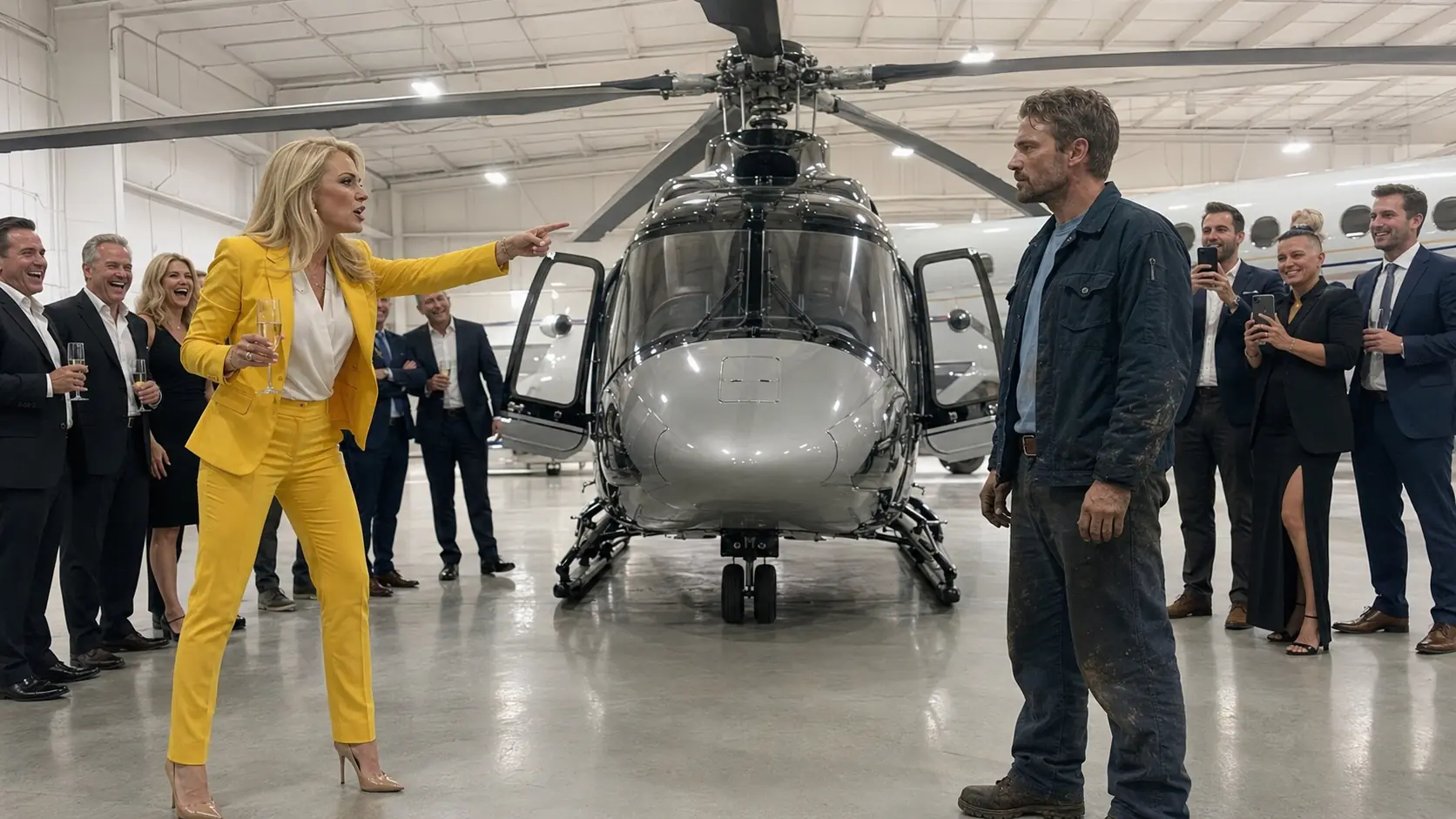
But the next morning, the sound of those turbines split the Texas dawn wide open. The Mercer Aero Lux private hangar on the western edge of Dallas was not the kind of place that smelled like grease and hydraulic fluid. It smelled like new leather and chilled sparkling wine, and the particular expense of nothing fills rooms where people with enormous amounts of money stand close to machines they will never fully understand. The floor was sealed concrete polished to a mirror finish. Track lighting ran in perfect parallel lines overhead, white and surgical, illuminating a row of private jets, two light helicopters, and at the far end, the silver and black centerpiece of the evening.
A luxury rotorcraft that had once been valued at $7.5 million and had not left the ground since the same year Von Mercer signed over his seat on the board of directors. The guests that evening wore tailored suits and quiet watches, the kind of crowd that evaluated aircraft the same way they evaluated real estate, by exclusivity, by what it cost to maintain, and by who else owned one. Celeste Mercer moved through them with the ease of someone who had rehearsed this room many times. Her dark blazer precise, her posture announcing before she spoke that she was the one who had built this and the one who intended to build it larger. She was pitching.
Mercer Aero Lux was positioning for a $120 million capital raise with plans to expand its VIP flight services into Miami, Los Angeles, and Las Vegas. She described the company as a symbol of speed, authority, and flawless execution. The language was polished, the deck was beautiful, and the champagne never ran out. But when one of the investors, a gray-haired man with the measured voice of someone who had already lost money once on a company with a beautiful deck, gestured toward the silver helicopter and asked why it was sitting still instead of impressing people by moving, Celeste's composure shifted by exactly 1°. It was small enough that most people in the room missed it.
Bryce Langston, her head of technical operations, stepped in smoothly, explaining that the aircraft was undergoing a scheduled systems review, that certain proprietary components required specialized calibration, and that it would be back in operational rotation shortly. It was a rehearsed answer to a question that had been asked in some version for 4 years, and it had the texture of something repeated so often it had stopped sounding like a lie and started sounding like policy. What Bryce did not say, what no one in that room said aloud, was that Mercer Aerolux had paid six separate engineering firms to diagnose the helicopter, had replaced three major subsystems, had flown in technicians from Germany and from California, and had quietly added the ongoing failure to a legal and insurance file that was now thick enough to be its own problem. The helicopter sat in that hangar the way a bad secret sits in a room, present, unavoidable, growing heavier with each passing year. Daphne Rhodes, the company's operations director, stood near the edge of the crowd with a glass she was not drinking and a phone she was trying to look like she was not checking.
She had been the one who kept the maintenance logs. She was the one who had started to believe, somewhere in the third year, that the helicopter's condition was not the result of mechanical failure the way the reports described it. She had no proof. She had no authority to question what the reports said, but she had been around aircraft long enough to know that some failures did not add up and this one never had. She slipped out through a side door and dialed a number she had been holding in her contacts for almost 6 months without calling.
The man who answered was at a kitchen table in a house outside of Abilene helping his 12-year-old daughter finish a geometry worksheet before the school week started. He listened to Daphne explain the situation in three sentences and then asked her one question about the helicopter's maintenance history that told her immediately she had called the right person. His name was Colter Briggs. He told her he could be in Dallas in under 2 hours. He arrived in a truck that was older than the helicopter, wearing a jacket with a frayed left cuff and a tool bag that had been patched at one corner with electrical tape.
He looked to everyone who saw him walk through the hangar door like someone who had taken a wrong turn looking for the loading dock. Bryce spotted Colter first and assumed he was a parts courier from a regional supplier or possibly a maintenance worker from the commercial terminal on the other side of the airfield. He walked over with the unhurried confidence of someone who had spent years deciding which people in rooms like this were worth his attention. He looked Colter over from the collar of his jacket to the worn steel toes of his boots and asked with a casual contempt that barely disguised itself as politeness whether he had come to the wrong entrance. Daphne stepped in before Colter had to answer and explained that she had asked him to come, that she wanted him to look at the helicopter.
The silence that followed was brief and instructive. Bryce's expression did not change, which meant it had already said everything it needed to. Celeste crossed the floor. She had been watching from across the room and the way she moved made it clear she did not intend to let whatever this was become a problem quietly. She asked Daphne in a voice calibrated for the surrounding investors to hear, what exactly she thought she was doing.
She followed it with the information that the helicopter had been examined by engineers from New York, from California, and from two firms in Europe, and none of them had been able to resolve the issue. One of the European teams had spent 11 days on site. She said this with the thin pleasure of someone stacking the weight of past failures on a person who was about to join them. Colter walked the perimeter of the helicopter slowly. He did not open a panel or unscrew anything.
He looked at the main rotor head, the transmission housing, the control linkages, the avionics bay access panel, the floor level sensor clusters, and the auxiliary power junction. He pressed two fingers briefly to the underside of the tail boom, the way a doctor presses a wrist before reaching for a stethoscope. Then he leaned into the cockpit and activated the auxiliary power unit, listening. A series of relay clicks moved through the airframe like a murmured sentence. Colter straightened up and stood still for a moment with his eyes slightly unfocused, which was what his mind looked like from the outside when it was working at full speed inside.
Bryce, who had been watching with his arms folded, announced to no one in particular that if a visual inspection were sufficient, the helicopter would have been flying 3 years ago. The remark got a small laugh. Celeste moved forward, and the room contracted slightly as it does when the most important person in the space decides to speak. She looked at Colter and delivered the line that would define the night. "Make that dead helicopter fly," she said clearly, with the smile of someone who already knew the answer, "and I'll marry you."
The laughter that followed was immediate and broad. Two or three guests raised their phones. A woman near the champagne table said something quiet to the man beside her that produced a further small laugh. The whole thing had the choreography of a social execution, casual and complete. Colter looked up.
He held Celeste's gaze for a moment without expression, then said, "I don't need you to marry me, but by morning, it will be in the air." The laughter faded about 2 seconds after it should have. Celeste held her smile, but something behind it had shifted. A small recalculation quickly covered. Celeste recovered fast.
She was, whatever else she was, someone who understood how rooms worked and how to use them. She announced that she was willing to formalize the claim, and she said it with the cheerful cruelty of someone who believes they cannot lose. She asked Colter to repeat his statement clearly for everyone present, and when he did, she proposed the terms with the precision of a person who had prepared for exactly this situation while believing it would never happen. If the helicopter did not lift off the ground under its own power before 7:00 in the morning, Colter would issue a written statement acknowledging that he had misrepresented his capabilities, apologize publicly to Mercer Aero Lux, and absorb any costs incurred during the evening. She named the figure those costs could reach.
It was not a small number for a man with a small operation in West Texas. Colter listened to all of it, and then said his condition was simpler. If the helicopter flew, Celeste would open the full maintenance records, insurance filings, and ownership history of the aircraft to the investment group before they committed any capital. He said it without emphasis, the way someone states a thing they have already decided is reasonable. The room did not laugh this time.
Several of the investors glanced at each other. Daphne, standing near the hangar wall, felt the temperature of the room change in a way she could not immediately name. Bryce looked at Colter with a different kind of attention than before. Celeste's pause was barely perceptible, but it was there, and Daphne noticed it. A short written agreement was drawn up by one of the investors' legal representatives, who happened to have a laptop and the professional habit of documenting things.
Celeste signed it with the confidence of someone completing a formality. Before Colter signed, he made a phone call. He stepped several feet away, spoke quietly for approximately 90 seconds, and returned. Celeste asked who he had called. He told her his attorney.
The phrase, "his attorney," landed in the room with a weight slightly disproportionate to its syllables. A man in a faded jacket with a patched tool bag did not typically have an attorney he could reach at 10:00 at night. Celeste filed the information somewhere and moved on. Colter signed and then made his final request before beginning. He asked for the hangar to be secured from non-essential personnel and for one independent technical observer to remain present for the duration.
Celeste agreed to both because agreeing to them cost her nothing if she was certain of the outcome. She was still certain. She had good reason to be. The helicopter had survived the attention of a great many experts. A single man with a patched bag was not going to change that between now and sunrise.
She said good night to the last few investors, refreshed her champagne, and excused herself to the upper office level where she could watch the hangar floor through the glass wall and wait for the moment she knew was coming. Colter set his bag on a work stool beside the helicopter and called Tessa before he started. The phone rang twice. His daughter answered with the alert voice of a child who had been awake longer than she admitted and asked whether he was coming home tonight. He told her he might be a little late in the morning, that he had to wake up a helicopter that had been asleep too long.
She asked if it was broken. He said it had been told it was broken, which was different. She told him to be careful, the way she always said it, not as a worry but as a custom between them, a small ritual they had built around his absences. He said he would and he meant it and he ended the call and put the phone in his pocket. His wife, Paige, had died when Tessa was five.
The years since had reorganized Colter around a different center of gravity, smaller, quieter, more deliberate. He had left the defense aviation contractor, where he had spent a decade building flight control systems, not all at once, but gradually, shedding the profile and the pace and the ambition of that life while retaining everything that mattered, which was the knowledge. He had known Von Mercer during that period. Von was one of the few people in executive aviation who actually understood the machines he sold, who could read a maintenance report rather than simply commission one, who treated the engineers in his company as colleagues rather than overhead. When Paige died, Von had been quietly useful in ways that did not require announcement.
He had directed maintenance contracts Colter's way during the years when Colter needed flexible hours more than he needed status. The relationship had never been formally acknowledged, which was how both of them preferred it. Four years ago, Von had been removed from Mercer Aero Lux board following allegations that he had approved the purchase of a defective aircraft, misclassified the resulting losses, and concealed documentation from auditors. The aircraft in question was the silver helicopter in the hangar. Celeste had led the internal review.
Von had left without contesting the findings publicly, which people who did not know him read as an admission. People who did know him read it differently. Before he disappeared from the company's public life, he had sent Colter a brief technical note, two pages handwritten, no return address, describing what he believed was true about the helicopter's condition. Colter had read it and understood it and filed it in a folder he kept in a locked drawer in his workshop. He could not act on it then.
The aircraft belonged to Mercer Aero Lux. He had no standing and no invitation. He had waited and done his work and watched the company from a considered distance. And tonight Daphne had given him exactly what he needed to walk through the door. By 10:43 in the evening, the hangar had emptied except for Colter, Daphne, Bryce, and two safety personnel stationed near the main doors.
Bryce dropped the full diagnostic file on the work table without ceremony. A three-ring binder that landed with the weight of four years of accumulated failure, more than 400 pages of logs, reports, component histories, and error codes. He told Colter everything worth knowing was in there and that everything in there pointed in the same direction. The aircraft systems had degraded across multiple critical domains simultaneously, rendering it uneconomical to repair. He said this without particular hostility, simply stating what he believed to be true.
Colter opened the binder, moved through it for about 12 minutes, then set it aside. He said the error pattern was too clean. He did not say this as an accusation, but as a technical observation, the kind of thing you notice when you have spent years mapping the way aircraft systems actually fail versus the way they are described as failing. Genuine degradation across multiple subsystems produces jagged, overlapping, contradictory error histories. The logs in front of him had an unusual coherence, as if each system had failed in exactly the way required to stop the aircraft while leaving each individual component superficially intact.
He said the question he wanted to answer was not what was wrong with the helicopter. It was who had told the helicopter it was wrong. He began with the power architecture, tracing the auxiliary bus through its junction boxes to the primary avionics rack. He tested sensor continuity on the rotor system without turning anything on, reading resistance values from memory against the tolerances he had written into similar systems a decade earlier. He checked the flight control computer's input channels one by one, not looking for damage but for interruption.
For the specific signature of a signal being blocked rather than absent. Daphne watched without speaking. Bryce stood a few feet back, arms still crossed, but the posture had changed. It was no longer dismissal, it was concentration. At 11:58, Colter found what he was looking for.
Tucked behind the avionics bay primary panel, in a cable run that was not documented in the aircraft's maintenance schematics, was a small secondary module the size of a hardback book. It was wired into the flight control validation loop, the system that confirmed, before every startup sequence, that all safety conditions were met. The module was broadcasting a continuous fault signal on that loop, not a real fault, a synthetic one. Manufactured. The helicopter's brain had been receiving, every single time anyone tried to start it, a message telling it that the rotor system had failed its safety check.
The rotor system itself was fine. The message was not. Bryce said nothing for a long moment. Then he said quietly that his team had never looked there because nothing in the documentation suggested there was anything there to find. Colter nodded without judgement and kept working.
At 1:32 in the morning, Celeste came down from the upper level. She had been watching the camera feed and had seen Colter's hands moving with the certainty of someone who had found something specific, and she could not stay in the office any longer. She crossed the hangar floor in the quiet of the late hour and asked what he had found. Her voice was even, but the question itself was an admission. She had not come down to check on progress.
She had come down because progress was happening. Colter described the module without editorializing. He said it was interfering with the flight control validation sequence, and that removing it was part of the repair. Celeste told him it might be a proprietary security device, and that she needed him to stop until legal counsel reviewed the component. Colter pulled the written agreement from his jacket pocket, unfolded it, and indicated the clause that granted him full access to any system affecting the aircraft's airworthiness.
He said if the device was preventing the helicopter from flying, it was within scope. Celeste shifted her approach. She told him she could make the evening worth his time in a way that went beyond whatever the bet was worth. She named a figure, $300,000, and framed it as a consulting fee for his work tonight, payable immediately upon his agreement that the helicopter was beyond economical repair. Colter said no.
She named a larger figure. He said no again, with the same absence of drama he had brought to every exchange that evening. Daphne, standing near the workbench, had spent years working for someone whose authority she had never questioned, and she felt something shift in herself as she watched Celeste offer money to someone who was not interested in it. Celeste lowered her voice and told Colter he did not understand what he was getting into. He looked at her steadily and said, "I know exactly what I'm getting into.
That helicopter isn't a dead machine. It's a witness." The word landed differently than she expected because it was the right word and she knew it. The calculation that moved across her face was not complicated. She was a precise person and she was counting the distance between where things were now and where they would be if he finished what he had started.
She walked back to the staircase without another word. Colter turned back to the aircraft and kept working. By 3:00 in the morning, the first layer of the module's access encryption had opened. The maintenance interface displayed a hidden access log, timestamps, user credentials, system commands. Buried in a partition that had not appeared in any of the diagnostic reports the previous engineering teams had generated because none of them had known to look for it.
The log covered a specific window of time, the 12 days immediately preceding Von Mercer's removal from the board. During that period, there had been six separate access events on the flight control validation system, all from a single administrative credential, all outside normal business hours, and all following the same pattern. Connecting to the validation loop, modifying the fault broadcast module, and logging out without creating a standard maintenance entry. Colter found the data partition next. It was a small encrypted drive attached to the module, 15 GB formatted as cold storage, not designed for regular access.
Inside it were copies of files that had been removed from the company's main servers. Maintenance records with Von's signature, insurance valuation documents, internal correspondence between Celeste and a third-party broker about the aircraft's declared condition, and a thread of email between Von and the company's former auditor discussing his concerns about a discrepancy between the helicopter's physical state and its official insurance classification. Von had been preparing to bring the matter before the board. The access log made clear that the module had been installed 2 days after that final email was sent. The picture assembled itself without requiring interpretation.
The helicopter had not been purchased broken. It had been made to appear broken. The fault signals were not the result of neglect or mechanical failure. They were instructions. The aircraft's own computers had been told, in the language of validated safety data, that it was not safe to fly, and they had believed it the way any system believes the inputs it receives.
Every diagnostic team that followed had seen the error reports and assumed the errors were real. None of them had asked whether the system reporting the errors had itself been compromised. Colter backed up the full partition contents and sent them to Preston Tate with a message that said, in its entirety, "The helicopter was locked, not broken. The data is attached." He then located the physical fault module, verified that removing it would restore the validation loop to its original configuration, and set it aside.
In its place, he seated a standard network bridge costing $89 that had been in his tool bag since that morning. He connected his laptop to the maintenance interface and began the process of clearing the false fault history from the flight control computer's active memory. Bryce had been working alongside him for the last hour without being asked. At some point, the posture of skepticism had simply dissolved, replaced by the focus of a technician watching a problem get solved correctly. He asked Colter once where he had learned to read a validation loop like that.
Colter said he had spent a long time building systems that were supposed to keep aircraft honest with themselves. He said sometimes the hardest problems were the ones where the system was working exactly as designed, just by the wrong instructions. From 4:30 onward, the hangar had the particular quality of pre-dawn industrial focus. Coffee from a thermos, low conversation, hands moving over equipment with the quiet economy of people who have stopped performing and started working. Colter and Bryce ran every system check in sequence.
Fuel state and contamination, oil pressure at operating temperature, main rotor head and blade track, tail rotor pitch control, hydraulic pressure across all three circuits, flight control surface response, pitot-static calibration, radio and transponder function, GPS signal acquisition, and engine performance at both idle and near-rated power, verified against the manufacturer's specification sheet that Colter had retrieved from a PDF on his phone. Nothing was skipped. Nothing was approximated. At 5:47, Celeste sent a message to Daphne saying the morning's demonstration was being postponed due to unresolved legal questions around the aircraft's airworthiness certification. Daphne read it and did not respond.
At 6:12, Preston Tate arrived at the hangar in a gray sedan carrying a document case and the measured unhurry of someone who had been up since 4 and considered that an entirely normal circumstance. He presented written confirmation of the bet agreement's terms and a separate letter establishing Colter's right to conduct the airworthiness test as specified. He told Celeste's representative who had come down to meet him that any attempt to unilaterally postpone the test would constitute a breach of the agreement and that the consequences of that breach were spelled out in the document he was welcome to read. The representative read it and went back upstairs. Daphne had called an independent aviation safety monitor at 5:00 in the morning, a licensed flight standards examiner named Roland Webb who lived 40 minutes from the airfield and owed Daphne a professional courtesy from 3 years prior.
Webb arrived at 6:28, reviewed the maintenance records Colter had generated overnight, walked the aircraft with the systematic attention of his profession, and said that pending a satisfactory engine run-up he saw no condition that would prevent a witnessed test flight. The investors Celeste had been trying to keep away from the hangar had, in the way of people who sense something important is happening, begun arriving on their own initiative. They stood in a loose cluster near the hangar entrance, hands in pockets, watching. At 6:41, Colter called a licensed test pilot he had worked with twice before, a woman named Sandra Hewitt based in Fort Worth, whom he had reached by phone at 5:00 in the morning and who had driven down without asking many questions because Colter's track record on unusual calls was reliable. Sandra did the cockpit familiarization, confirmed the instrument readings, spoke briefly with Webb, and strapped in.
Colter stood at the nose of the aircraft with a tablet displaying the real-time telemetry. He was not interested in flying the helicopter himself. What he wanted to demonstrate was not his courage. It was the aircraft's condition. Celeste stood outside on the flight apron, arms crossed, watching the hangar.
She had not slept. The joke she had made the previous evening, light, dismissive, designed to embarrass a man who wandered in from nowhere, had turned into something she could no longer control the shape of. She had built a story 4 years ago, and she had maintained it with careful attention, and now a single man with a tool bag and a $90 part was about to take it apart in front of the people whose money she needed. She thought about stopping it again and knew she could not. At 6:58 in the morning, the turbines began to spool.
The sound filled the hangar first and then spilled out across the apron. That rising metallic whine that is one of the most specific sounds in the world, the sound of a turbine engine waking from cold. The main rotor began to turn. It moved through its first slow revolution with the hesitancy of long disuse. The blades cutting through air that had not felt them in four years, one month, and eighteen days.
And then it accelerated, and the acceleration had the quality of something returning rather than starting. A system remembering what it already knew. People stopped talking. The investors stood with the stillness of people watching something they had not expected to witness. Bryce was near the maintenance bay door with his hands at his sides and his face carrying the expression of someone recalibrating a firmly held belief in real time.
Daphne stood near the tail of the aircraft and felt the rotor wash begin to move through her hair and the feeling was complicated in the way that relief and grief can arrive together. She had worked for this company for 9 years. She had known something was wrong for three of them. She had not had the standing to say so. The spinning rotor above her was not just a machine working.
It was a correction. Sandra brought the helicopter to a stable hover at 6 ft, held it there for 45 seconds while systems confirmed, then climbed smoothly to 150 ft and turned north. The aircraft moved across the early sky with the unhurried authority of something that had been waiting. The silver body caught the first direct light of the morning sun and held it. From the ground, it was a simple image, a helicopter flying, but its simplicity was what made it devastating because for 4 years the official position of everyone in authority had been that this was impossible.
The investors had seen Celeste's clip from the previous evening passed around on a phone screen. Her voice, her expression, her words, "Make that dead helicopter fly and I'll marry you." The helicopter completed its circuit in 11 minutes and 40 seconds and descended to a smooth landing on the painted H 12 ft from where Colter was standing. The rotors decelerated, the turbines wound down. The morning went quiet again except for the sound of cooling metal and distant highway traffic.
Colter walked to where Celeste was standing. He said, "You don't need to marry me, but you need to open the records." Preston Tate moved efficiently. The agreement required that the maintenance history, insurance documentation, and ownership chain of the aircraft be presented to the investment group, and he made clear that the presentation would begin within the hour, regardless of any additional requests for delay. The investors arranged themselves around the conference table in the hangar's upper office, and the files came up on a wall display.
The story they told was not complicated once you knew what to look for. The helicopter had been purchased in sound condition. Its first 2 years of operational life were normal. The maintenance records from that period, signed by Von Mercer's operations team, were clean and consistent. The anomaly began precisely 12 days before Von was removed from the board, the same window the access log identified.
The insurance valuation filed in the months following his removal had reclassified the aircraft from operational to non-operational status with a declared defect severity that did not match the physical evidence Colter had documented overnight. The broker correspondence found in the hidden partition described the strategic value of the reclassification in language that was, in context, unambiguous. Celeste said, "The administrative credential identified in the access log could have been used without her authorization." Preston produced the IP address logs showing every access event had originated from the same network subnet as her office terminals. She said the broker correspondence had been taken out of context.
Preston produced the complete thread without redaction and invited anyone present to read it in full. She said the insurance filing had been prepared by an external firm and signed under advisement. Daphne, who had been given a seat at the table by the independent monitor, said she had flagged inconsistencies in that filing at the time and been told to reclassify her concerns as outside her operational mandate. Von Mercer arrived at 7:46 in the morning. He had driven from San Antonio overnight after receiving a message from Colter the previous evening.
Not a long message, simply, "Come if you can." He walked into the upper office and looked for a moment through the window at the silver helicopter sitting on the apron below. He looked at it the way you look at something that was used against you and is no longer able to be used that way. He told the room that he had not purchased just a broken aircraft. He had purchased an aircraft that was in the process of being turned into evidence against him and he had been removed before he could stop it.
Bryce acknowledged that his technical team had spent four years chasing errors that were designed to be chased. He said this without excuse, with the plainness of someone accepting a professional humiliation. And then he said that if the team had known the error topology was artificial, they would have approached it differently and that the lesson he was taking was that the first question in any diagnostic was not what the system was reporting, but whether the reporting itself was trustworthy. It was then that Colter explained who he was. He had not offered the information unsolicited before now and he offered it without ceremony.
He told the room that before his time at the airfield in Abilene, he had spent 11 years as a systems engineer in defense aviation, and that a portion of the flight control validation architecture in the aircraft sitting on the apron below had been developed from a methodology he had patented a decade earlier. He told them he held an undisclosed equity position in a firm called Briggs Meridian Aviation, which held the primary maintenance and certification contract for the rotorcraft fleet that Mercer Aero Lux depended on for its VIP operations. He said he was not there to use that position as leverage. He was there because a man who had once been kind to him when kindness was not required had been accused of something he had not done, and the evidence to prove it had been sitting in a locked helicopter for four years. The investment group's lead partner said, in the measured tone of someone who had made large decisions in shorter time frames, that the capital raise would be suspended pending an independent audit.
He said this looking at Celeste, not unkindly, in the way that people deliver conclusions they believe are correct, but take no pleasure in delivering. Celeste did not leave the room dramatically. She did not make a speech. The version of herself she had maintained for the benefit of investors, of staff, of the industry she had built her identity inside. That version had simply stopped being available to her.
And what remained was a woman standing in a room where every document on the screen was saying something she could not answer. She tried once more, suggesting that the situation was operationally complex and that a full audit would vindicate the company's practices. Nobody in the room disagreed that an audit would take place. Nobody agreed it would say what she thought it would. The investors left in pairs and small groups, quietly, with the considered silence of people who have seen more than they expected and are already thinking about what comes next.
The board's emergency session was scheduled for 9:00. An outside advisory firm would be brought in to manage the interim period. Celeste would be asked to step back from operational authority while the review was ongoing. A request framed in the careful language of governance, which meant it was not a request. Von sat with Daphne at the corner of the conference table.
He had not spoken much since arriving, and he did not speak now. He looked like a man who had carried something heavy for a long time and had just been allowed to set it down. Daphne said she was sorry she had not found a way to say something sooner. He told her that she had said something in the end by making the call she made. Bryce found Colter near the staircase and said what he had been working up to for the last hour, that he had been wrong, that the dismissal had been unfair, and that he was sorry for it.
Colter said machines did not lie and that Bryce had spent four years trusting machines that had been given the wrong instructions, and that was not dishonesty, it was a diagnostic error, and diagnostic errors were correctable. He said it without condescension and without particular warmth, the way someone states a thing they mean entirely. Celeste walked past Colter near the hangar entrance. She stopped. She said she supposed he expected her to acknowledge the bet.
He said the bet had already been settled. She said she had been joking the previous night about the rest of it. He looked at her briefly and said, "I know. So did everyone else right up until the morning." He walked toward the main door.
She stood watching him go, and behind her the window looked out on the apron where the silver helicopter sat gleaming in the full morning light. Colter reached his truck, set his tool bag in the bed, and called Tessa. She answered on the first ring, which meant she had been awake and waiting. She asked if the helicopter had flown. He said it had.
She asked if it was hard to fix. He told her the fixing was the easy part. Finding the right question to ask the machine had taken most of the night, and once he knew the right question, the answer had come in about 40 minutes. She was quiet for a moment and then said, "That sounded like most things." He said she was not wrong about that.
He drove west on the empty morning highway. Behind him in the Mercer Aerolux Hangar, the silver helicopter sat on the apron in the full light of morning, its rotors still. Its systems live. Its record now open for anyone who needed to read it. Von Mercer was still inside, drinking coffee with a man he had not seen in four years, looking occasionally out the window at the aircraft that had once been the instrument of his removal, and was now the evidence of his restoration.
Daphne was on a call with the audit firm. Bryce was writing up a revised diagnostic protocol that started with a different question than the one he had been starting with for the last four years. Colter did not need to see any of that. He had come to fix a machine that everyone agreed was dead. He had asked a better question than the ones that came before, and the machine had told him the truth, and the truth had done what it tends to do when you finally give it room to move. Some things do not die from damage. They only go silent when someone with enough to lose decides silence is more useful than flight, but silence is a lock, not a grave, and locks, given the right hands and the right question and one long night, can always be opened.