“Listen carefully, boy,” Richard said, his tone sharpened by prejudice. “Your mother cleans this building, so perhaps fixing broken things runs in the family.” Richard Van Doran, a millionaire venture capitalist, towered over ten-year-old Finn Foster in the Apex Innovations parking lot.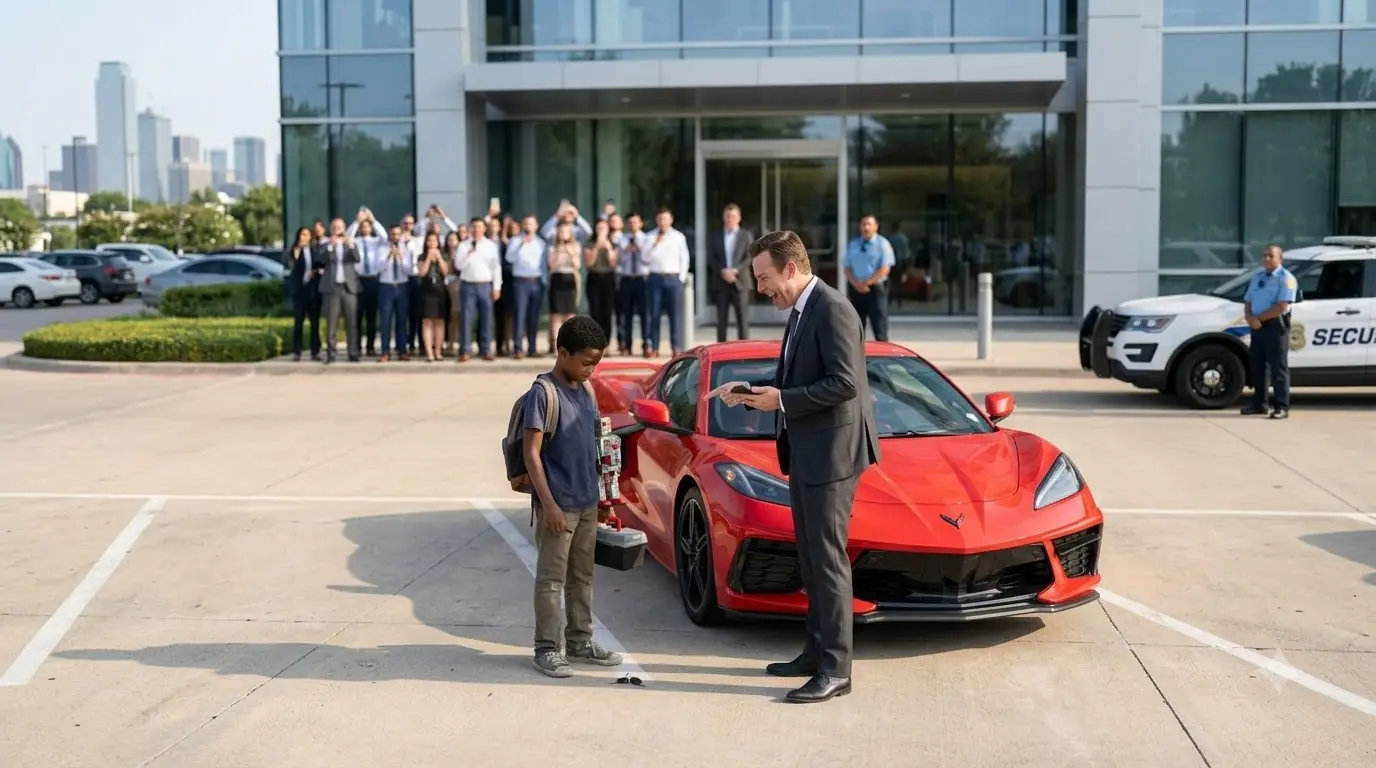
It was Friday morning in Austin, Texas. Richard's $320,000 Ferrari had just died at the executive entrance. He spotted Finn on the curb with a toolbox, waiting for his mother to finish cleaning inside. The boy wore secondhand clothes and held a robot built from junk. Richard threw his head back and laughed.
Loud, cruel, performative. The kind of laugh designed to humiliate. Then he yanked out his Ferrari keys and hurled them at Finn's feet as though tossing scraps to a dog. “Fix my Ferrari in thirty seconds, and I'll give it to you.” “Perhaps you can help your mother escape public housing.” His laughter echoed across the lot. Phones rose.
A crowd gathered. “When you fail, you both leave.” Finn stared at the keys in the dirt. Richard kept laughing. He did not know he had just challenged a genius who already solved this problem. Thirty seconds later, that laughter would die.
Thirty seconds later, his face would turn ghost white.
The keys hit the ground with a metallic clink that echoed across the parking lot. Finn Foster did not move. His eyes stayed locked on Richard Van Doran's face. It was the face of a man who had rarely heard the word no. Richard checked his Rolex, still chuckling to himself.
“The clock starts when you pick up those keys. Thirty seconds—not thirty-one, not twenty-nine and a half.” Another laugh. Sharp and ugly. The crowd had grown to perhaps fifteen people.
Employees were heading into Apex Innovations for the morning shift. A couple of executives who arrived with Richard. Miguel Rodriguez, the security guard, stood twenty feet away with his hand on his radio as though he wanted to intervene but did not know how. One of the executives, a man in his thirties named Brad Kellerman, laughed along with Richard and pulled out his phone. “Richard, come on.
He is just a child,” Brad said. “A child who is about to learn an important lesson about knowing his place,” Richard replied. Richard grinned, enjoying himself immensely. “Right?” Finn's jaw tightened.
His small hands curled into fists on top of the robot in his lap. A crude thing made from old circuit boards and salvaged motors that somehow moved and responded to simple commands. It was the kind of project that would impress a high school robotics teacher. For a 10-year-old working alone with scraps, it was extraordinary. But Richard doesn't see that.
Richard saw only junk held by a child he had decided did not belong there. “What's wrong?” Richard's voice dripped with mock concern. He laughed again. That same cruel sound. “Are thirty seconds too complicated?
Perhaps you need a tutorial first.” He turned to Brad. “See, this is what happens when HR forces diversity quotas on real companies,” he said. “We end up rewarding people who cannot even—” “I'll do it,” Finn interrupted. Finn's voice was small but clear.
He stood up, leaving the robot on the curb. His legs felt shaky, but he forced them steady. He was four feet eight inches tall in shoes that are half a size too small because they were on clearance, and his mother could not afford his actual size. Richard blinked, genuinely surprised. Then he started laughing again, harder this time.
“What?” “I'll fix your car.” Finn bent down and picked up the keys from the dirt. His fingers trembled, but not from fear anymore—from something else. Something had been building in his chest since his father died four years ago. The world had decided a Black child from the South Side didn't deserve a fair shot at anything. Richard's laughter grew louder, drawing more attention.
“Well, well, look at that, Brad. The boy has some courage.” He leaned down until he was at Finn's eye level. Close enough that Finn could smell coffee and expensive aftershave. “All right, here is the updated deal.
You fix my Ferrari in thirty seconds, and I will personally fund your education.” A full scholarship anywhere you want. Someone in the crowd murmured appreciation. Maybe Richard's not such a bad guy after all. Maybe this was simply his strange way of helping. But then Richard's voice dropped lower, meant only for Finn.
“But when you fail, and you will fail, you apologize to everyone here for wasting our time. And then you go inside, find your mother, and you both turn in her ID badge and leave. She is done here. Understood?” The crowd did not hear that part. The phones did not capture it.
For that moment, it was only Richard and Finn: millionaire and child, privilege and vulnerability, power and someone Richard assumed had none. Except Finn was not powerless. Not completely. Not yet. “When I fix it,” Finn said quietly, “you fund ten scholarships every year for ten years for children like me.” Richard's eyebrows shot up.
When, not if, when, this 10-year-old fixes a Ferrari 296 GTB that three certified technicians couldn't diagnose, I will fund ten full scholarships annually for a decade.” “That is my word.” He extended his hand for a handshake. Finn looked at it for a long moment before taking it. Richard's grip was crushing, meant to intimidate. Finn held on anyway. “Deal,” Richard said, grinning as if he had already won.
“Brad, start the timer when I say go.” Brad opened his phone's stopwatch app, thumb hovering over the screen. He was smiling too, enjoying the show. And that's when Miguel's radio crackled. A voice came through. “Miguel, is there a situation in Executive Lot B?
We are receiving reports of a crowd.” Miguel hesitated, then keyed his radio. “No situation. Just some people talking.” “Copy that. Keep an eye on it.” Miguel clipped the radio back to his belt and watches Finn with an expression that's hard to read.
He had seen this child before, five times in the past 2 weeks. Always sitting quietly by himself, never causing problems, always reading books way above his grade level or tinkering with electronics. Miguel's daughter was about the same age. He knew what a bright child looked like. He also knew what cruelty looked like.
And Richard Van Doran was demonstrating it with expert precision punctuated by that awful laugh. “Ready?” Richard asked, still grinning. Finn nodded. He walked toward the Ferrari, and as he did, his mind automatically cataloged what he was seeing. The car was a 296 GTB.
He knew this because 3 weeks ago, an identical model showed up at Sal's Auto Salvage where Finn spent his weekends. That one had been in a minor accident, totaled by insurance to avoid expensive repairs, and Finn had spent two full days exploring every inch of its hybrid V6 system. He knew this car, not this specific one, but the DNA of it, the architecture, the weak points, the crowded layout of its components. As Finn approached, someone whispered, “Is this real?” Another voice answered, “This is insane.” Richard laughed again and checked his watch. “Whenever you're ready.” “I should warn you, this car has been to Ferrari of Austin twice. $6,000 in diagnostic fees.
They found nothing. So unless you have some kind of magical solution—” “Go,” Finn said. Brad's thumb hit the screen. “Timer started.
Thirty seconds.” Richard crossed his arms, smirking, confident it would be over in seconds when the child broke down crying. And the parking lot fell completely silent, except for the ambient hum of traffic on the distant highway and the tick tick tick of the Ferrari's cooling engine. Finn did not go for the hood as everyone expected. Instead, he walked to the driver's-side door, opened it, and slid into the seat. His feet barely reached the pedals.
He inserted the key fob and turned it to ACC mode. Accessory, not full ignition. Richard snorted with amusement. “What is he doing?” The dashboard lit up. A Christmas tree of warning indicators.
43 error codes spanning fuel injection, hybrid battery management, transmission sync, and emissions control. But Finn was not looking at the dashboard. He was listening. He closed his eyes. Richard watched with a condescending smile, waiting for the inevitable tears.
And there it is. Beneath the normal electrical hum, beneath the cooling fans, there's a clicking sound, a rhythmic, inconsistent. Once every 2.3 seconds, coming from somewhere behind and below him. His eyes snapped open. “Fifteen seconds,” Brad called.
Finn exited the car and moved to the rear. The 296 GTB uses a mid-engine layout, which means the V6 and electric motor are behind the passenger compartment. Most people don't know that. Most people would be looking under the front hood. Finn opened the rear engine cover.
The hybrid powertrain gleams in the morning sun, a masterwork of engineering that costs more than most people's houses. “Ten seconds.” Brad's voice rose with anticipation. Richard laughs again louder. Brad, I think he's just looking at shiny parts back there. His hands move with practiced speed.
He pulled the small multimeter from his pocket, a gift from his father, and checked the coupling system where the gasoline engine and electric motor communicated. The reading fluctuated in the same rhythm as the clicking sound. Finn traced the fault to a heat-stressed sensor connection that was intermittently losing contact. He did not have the proper replacement part, so he made a careful temporary stabilization, then used the vehicle's approved service interface to recalibrate the actuator. The procedure was only meant to prove the diagnosis and make the car safe enough to move until a qualified technician replaced the damaged component.
Finn closed the rear engine cover and called, “Start it.” Brad's thumb hovered over the stop button. “Time.” “Thirty seconds exactly,” Brad said, voice filled with disbelief. Richard's laugh died in his throat. He's standing there with his arms crossed, face already starting to show concern because he can see in Finn's body language, the confidence, the certainty that something just happened.
Well, Richard's voice is sharp, the amusement gone. Start what? You didn't fix anything. You just played around back there. Finn walks to the driver's door, leans in, and turns the key.
The Ferrari roars to life. Not the stuttering, coughing start it's been doing for 6 weeks. A smooth, perfect, powerful ignition. The engine note is flawless. The distinctive V6 howl that makes Ferrari enthusiasts weep.
Every single warning light on the dashboard is dark. The parking lot goes dead silent except for that perfect engine purr. And then someone in the crowd whispers, "Oh my god, look at his face." Richard Van Doran stands frozen 10 feet from his car. His face, so smug and confident 30 seconds ago, twisted with cruel laughter, has completely drained of color. The expensive tan from weekend golf trips can't hide it.
He's gone pale as old paper, mouth hanging open, eyes wide with shock and dawning horror because he just lost a bet to a ten-year-old child in front of a dozen witnesses with their phones out. His face has gone from flushed with laughter to ghost white in the span of a heartbeat. The crowd sees it. The phones capture it. This exact moment, Richard's face turning the color of chalk, all arrogance evaporating, replaced by pure disbelief, will be screenshot and meme'med across the internet for months.
Brad stared at his phone as if the timer were lying. “He actually did it,” one of the other executives whispered. “Richard is pale as a ghost.” Miguel takes a step forward, hand dropping from his radio, eyes wide, watching Richard's face go from white to a sickly gray. Someone in the crowd starts to laugh. Not cruel like Richard's laugh, but amazed, delighted laughter. Someone else joins in, then another.
Richard's mouth opens, closes, opens again. No sound comes out. His face remained that awful pale color. And Finn Foster, 10 years old, Black son of a cleaning woman and a dead mechanic, wearing secondhand clothes and shoes that don't fit, stands next to a $320,000 Ferrari that's now running perfectly and says in a voice that doesn't shake anymore. “It's fixed, sir.” Richard did not respond.
He just stands there, face drained white. The laughter that filled the parking lot minutes ago, now a memory that will haunt him forever. To understand how a ten-year-old learned to do what three experienced technicians could not, the story had to return seven years to a salvage yard and a father who taught his son that engines never lied. The Ferrari's engine purr in the silence. Perfect.
Flawless. Impossible. Finn stands there with his hand still on the door. And for just a moment, time seems to slow. The crowd blurs.
Richard's pale face fades. The sound of the engine becomes something else. Another engine from another time in another place.
Seven years earlier, in the summer of 2018, Finn is three years old. His father, James Foster, lifts him onto his shoulders and carries him through rows of broken cars at Sal's Auto Salvage on the south side of Austin. The sun is brutal. The air smells like motor oil and rust and possibility. “Close your eyes, Finn,” his father said.
“Tell me what you hear.” Little Finn closes his eyes. At first, it's just noise, chaos, the clang of metal on metal, the hiss of welding torches, men shouting about parts and prices. But James is patient. “Listen deeper, past the noise.” “What is underneath it?” And slowly Finn starts to hear it.
The rhythm, the patterns, the language that machines speak when humans stop talking long enough to listen. James teaches him to distinguish sounds. A healthy engine purr versus a struggling knock. Smooth belt rotation versus squealing friction. Clean ignition versus misfiring cylinders.
This becomes their Saturday ritual. Every weekend, James brings Finn to the salvage yard and teaches him to listen, to understand, to diagnose by sound alone what most mechanics need computers to find. Engines don't lie, son. James tells him over and over. People lie.
Politicians lie. Computers can be wrong. But an engine tells you exactly what's broken if you just listen. Finn is 6 years old when he witnesses the moment that changes everything. March 2021, a Saturday morning.
A woman drives her BMW X5 into Sal's salvage yard. Tears streaming down her face. Every mechanic she's taken it to says the same thing. Engine blown. Needs full replacement. $18,000.
She's a single mother. She can't afford it. Without the car, she loses her job. Without her job, she loses everything. James spends 20 minutes just listening to the engine.
Finn stands beside him, small hand gripping his father's calloused fingers. "What do you hear, son?" James asks. Finn closes his eyes like he's been taught. It sounds scared, Daddy. Like it's trying to talk, but nobody's listening.
James smiles. Exactly right. The problem isn't a blown engine. It's a $40 oxygen sensor and a loose ground wire. Total fix. $60 and 45 minutes of labor.
The woman breaks down crying, but this time from relief, from gratitude, from the overwhelming grace of someone actually listening instead of just trying to make money off her desperation. After she drives away, James kneels down to Finn's eye level in the dust and oil of the salvage yard. You see what just happened? His voice is gentle but firm. That lady was going to lose everything because people stopped listening.
Rich folks can afford to replace whole engines. Poor folks need someone who actually listens to find the real problem. You understand? Finn nods, even though he's only six and doesn't fully grasp the weight of what his father is teaching him. Engines don't lie, son.
They tell you exactly what's wrong. But you got to listen. And when you find the truth, you speak it. Even if people don't want to hear it, especially then. James puts his hands on Finn's shoulders.
“Can you remember that?” “Yes, sir.” “Say it back to me.” “Listen first. Fix what is actually broken. Speak truth to power.” James hugs him tight, smelling like motor oil and sweat and safety.
Six months later, James Foster was dead.
In September 2021, an industrial accident at a factory where James took a second job for better insurance. A hydraulic press with a faulty pressure sensor. The sensor had been clicking for weeks. Workers reported it. Maintenance ignored it because the computer showed no error codes.
The sensor failed catastrophically. James was 29 years old. The bitter irony isn't lost on 6-year-old Finn, even through his grief. The exact thing his father taught him. Listen to what machines tell you, even when computers say everything's fine could have saved his father's life.
But nobody listened. One week after the funeral, Sal Martinez found Finn sitting alone inside an old car at the salvage yard holding his father's toolbox. "Hey, kiddo," S says gently. "You okay?" Finn doesn't cry. His voice is flat, empty.
Daddy said engines don't lie. People didn't listen. Now he's gone. Sal's heart breaks. Finn looks up with eyes too old for a six-year-old face.
I'm going to listen to every engine, every machine, so this doesn't happen to other kids' dads. From age 6 to 10, Finn becomes a fixture at the salvage yard. Sal lets him explore, learn, practice. The library becomes his second home. Mechanical engineering books way above his grade level.
YouTube becomes his teacher. Repair tutorials watched and rewatched until memorized. By age 10, Finn Foster can diagnose most common car problems by sound alone, faster and more accurately than mechanics with 20 years of experience. His motto, refined through grief and determination, remained simple: “Listen first. Fix what is actually broken.
Speak truth to power.” And on this Friday morning in an Apex Innovations parking lot, standing next to a perfectly running Ferrari, while a millionaire's face is still drained of color from shock, Finn is about to do exactly that. The Ferrari's engine idles perfectly. Richard Van Doran's face is still that awful pale color, like someone drained all the blood from his head. He blinks rapidly, trying to process what just happened. You.
Richard's voice cracked. He clears his throat. Some color slowly returning to his cheeks, but not much. “You were lucky. Reset some codes.
Watch it fail again in five minutes.” Finn turned to face him. “The electromagnetic coupling actuator sensor was fractured. It's a batch defect in 296 GTBs manufactured between March and June of last year. The broken sensor created cascade failure across four integrated systems.
I stabilized the failing connection and recalibrated the actuator through the approved service interface. It is running for now, but the damaged sensor connection still needs professional replacement before the car is driven normally.” The parking lot was so quiet that a pin could have been heard falling. Brad Kellerman's phone was still recording, and his jaw hung open.
“Did he just—how does a ten-year-old do that?” one of the other executives whispered. “There is no way. The dealerships had that car for days.” “The dealerships used Ferrari's diagnostic software,” Finn said, his voice steady and growing stronger with each word. “The software has a blind spot for intermittent coupling-sensor failures.”
It's not programmed to detect that specific failure pattern. Richard's face cycles through confusion, disbelief, embarrassment, and finally settles on anger. Red color flooding back into his previously pale cheeks. But it's rage now, not smuggness. The humiliation of having his face drain white in front of everyone, captured on a dozen phones, fuels his fury.
Okay, parking lot mechanic, you got lucky once, but real engineering requires more than YouTube tricks. He checks his Rolex, trying to regain control. 9:06 a.m. His board meeting starts at 10:00. An idea forms in Richard's mind. A way to regain control.
To put this child he had already judged back in the place Richard had assigned him. To make people forget that moment when his face went ghost white. “Here is what we are going to do,” Richard announced loudly enough for everyone to hear. Apex Innovations has a board meeting in 54 minutes. We're presenting our automotive AI division, robots that diagnose and repair vehicles autonomously.
If you're such a genius, come present to our board. Explain to a room full of PhDs and investors how a 10-year-old fixed what professional technicians couldn't. The trap is obvious to everyone except Finn. Richard knows a child can't possibly present to board-level executives. Even if Finn is smart, he'll be terrified.
He'll freeze. He'll fumble. And when he fails, Richard can dismiss the parking lot moment as beginner's luck. And restore his reputation. Make people forget his pale, shocked face.
Miguel takes a step forward. Richard, he's 10 years old and I was 10 once. Richard cuts him off. If he's smart enough to fix a Ferrari, he's smart enough to explain it to adults. Or was it just luck?
He looks directly at Finn, desperate to regain the upper hand. “What do you say?” You want those scholarships? Earn them. Come present to the board. Brad Kellerman grins, recovered from his shock.
Yeah, come on, kid. Show us your genius. Finn looks at the crowd. At Miguel, who's shaking his head slightly. Don't do it, kid.
At the phones, still recording. At Richard's face, no longer pale, but flushed with angry determination. Then Finn thinks about his mother inside the building, scrubbing toilets for minimum wage, working three jobs just to keep them fed. He thinks about his father's voice. "Speak truth to power." "I'll do it," Finn says.
Richard's smile widens. "Excellent. Conference room A. 9:45 sharp." He glances at Finn's worn clothes with barely concealed contempt. “The dress code is business-casual, but I suppose that shirt will have to do.” Cruel laughter from Brad.
Miguel moves quickly, pulling Finn aside as the crowd begins to disperse. “You do not have to do this,” Miguel said. “That man is setting you up to fail.” “I know,” Finn said quietly. “Then why do it?” “Because he made a bet—ten scholarships every year for ten years.
That is one hundred children who could get a chance. I cannot walk away from that.” Miguel looks at this 10-year-old boy with the weight of the world on his shoulders and makes a decision. “Come with me. You need the car's diagnostic data.” Finn nodded.
“I have a laptop in the security office.” Let's go.
9:10 a.m. Security office. Finn plugs his OBD2 scanner into Miguel's laptop and connects it to the Ferrari. He pulls the complete ECU diagnostic log. All 43 error codes, voltage fluctuation data, historical sensor readings going back six weeks. The door bursts open.
Sarah Foster stands there, face stricken with panic. “Baby, what is happening?” She's still wearing her cleaning uniform, yellow rubber gloves, hairet. Security called me, said you're presenting to executives. Finn explains quickly. The bet, the fix, the challenge.
Sarah's eyes fill with tears. Finn, these are powerful people. They're going to try to make you look stupid. “Mom, I know what I am doing.” Finn takes her hand. “This could change things for us.” Sarah looks at her son, her brilliant, brave, beautiful son who's had to grow up too fast, who's had to be the man of the house since he was six, who carries his father's dreams on his narrow shoulders.
She kneels down and cups his face in her hands. “Your father would be so proud of you right now.” She kisses his forehead. “Go show them what Foster courage looks like.” 9:20 a.m. Finn has 40 minutes to prepare a presentation for people who've spent decades in automotive engineering. He uses Miguel's laptop to create something simple.
Slide one. What was wrong? List of 43 error codes. Slide two. What everyone missed.
Diagram of coupling sensor. Slide three. The real problem. Illustration of fractured clip. Slide four.
The fix. Step-by-step explanation. Slide five. Why it matters. Batch defect implications.
His hands shook while he typed. He's never done anything like this. He was ten years old. He should be playing video games or riding bikes, not preparing to face down a boardroom of millionaires. Miguel watches him work and sees the fear in those young eyes.
“Hey,” Miguel said gently. “Look at me.” Finn looks up. “You already did the hard part,” Miguel said. “You repaired the car.
Now you only have to explain how. Tell them what you did.” Miguel puts a hand on Finn's shoulder. “You can do this.” Finn nods, not entirely convinced, and saves the presentation to a USB drive.
9:42 a.m. Miguel walks Finn through the gleaming hallways of Apex Innovations. They pass walls covered with photos of innovation leaders, all white or Asian men in expensive suits, all looking like they've never missed a meal or worried about rent. Finn has never felt more out of place in his life. They reach conference room A through the glass walls. Finn can see them.
12 people around a long table. Richard at the head looking supremely confident again. His momentary pallor forgotten. Or so he hopes. Brad in the corner with his laptop.
And at the far end, a woman Finn doesn't recognize. Dr. Rebecca Anderson, chief innovation officer, watching the door with sharp intelligent eyes. 9:44 a.m. Finn takes a deep breath, remembers his father's voice. Speak truth to power.
At exactly 9:45 a.m., Finn opened the door. Every head turns toward him. Richard's voice booms across the room. “Everyone, our special guest has arrived. Meet our special guest.
I am sorry—what is your name again?” “Finn Foster, sir.” His voice sounded small in this big room. “Finn Foster, everyone—ten years old, the son of one of our cleaning employees, and apparently a Ferrari repair expert. He is going to teach us about automotive engineering.” Richard's tone dripped with sarcasm. Muted chuckles moved around the table, and Brad smirked.
A couple of board members exchanged amused glances, but Dr. Rebecca Anderson did not laugh. She leaned forward in her chair and says in a voice that cuts through the condescension. “Mr. Van Doran, let us give Finn a chance to speak.” “Finn, please sit with us.” She gestured to an empty chair at the table. Not a kid's chair, not a chair against the wall, but a seat at the actual table. She treated him as an equal.
Finn walked to the chair on legs that feel like water. He inserted his USB drive into the presentation system with hands that would not stop shaking. Twelve pairs of eyes watched him. Most belonged to white executives, and only one belonged to a woman. All of them in suits that cost more than his mother makes in a month.
Richard leaned back in his chair, arms crossed, smile playing at his lips. He thought he had already won. He thought people would forget how pale his face went in that parking lot. He had no idea what's about to hit him. Finn took a breath.
His finger hovered over the keyboard to advance his first slide. The room waited. He remembered his father's words one more time. Speak truth to power. “Good morning,” Finn began.
His voice cracked slightly. He cleared his throat. “Thirty-five minutes ago, I diagnosed and temporarily fixed a Ferrari 296 GTB that three certified mechanics couldn't fix. This is how I did it.” He clicked to slide one.
The screen fills with a list of 43 error codes pulled directly from Richard's Ferrari. Fuel injection timing, hybrid battery management, transmission synchronization, emissions control. The codes span every major system in the vehicle. “Mr. Van Doran's car had forty-three error codes,” Finn explained. They showed up across different systems.
The dealerships thought these were separate problems. They weren't. An older board member with silver hair and a skeptical expression interrupted. “How could you possibly know they were not separate problems?” Finn meets his eyes. “Because of the pattern, sir, the codes appeared at the same time intervals every 2.3 seconds.
That's too precise to be random. It meant one thing was breaking and making everything else look broken.” Dr. Anderson leaned forward, suddenly very interested. “Go on.” Slide two. A simple diagram Finn drew in Miguel's office.
A V6 engine, an electric motor, and between them a small component labeled electromagnetic coupling actuator. “This is a hybrid car,” Finn continued, his voice growing steadier as he falls into the technical explanation. It has a gas engine and an electric motor. They work together through this part. He points to the coupling actuator on screen.
There's a sensor here that tells the car's computer when the two motors are synchronized. He pauses, then uses the metaphor he prepared. “Think of it like two children on a seesaw. The sensor is like someone in the middle telling them when to push. If that person stops talking, the kids get confused, push at wrong times, and the seesaw doesn't work right.
That is what happened to Mr. Van Doran's car.” A woman board member in her fifties with sharp, investor's eyes asked, "But why didn't Ferrari's diagnostic system catch that?" This was the key question, the one that separates lucky guess from actual expertise. “Because the sensor was not completely broken,” Finn explained, it was cracked, so sometimes it worked, sometimes it didn't. The car's computer couldn't tell if the sensor was broken or if the actual motors were broken, so it guessed everything was broken and showed 43 error codes. He clicks to show the voltage data graph he pulled from the Ferrari's computer.
“This is the voltage reading from the sensor. See how it jumps up and down? His finger traces the irregular pattern on screen. That's not supposed to happen. A healthy sensor remains stable.” This meant the sensor had a crack that opened and closed with heat and vibration.
Dr. George Matthews, a board member who used to be a lead engineer at General Motors, though Finn doesn't know this, sits up straighter in his chair. “That is impressive diagnostic logic. But how did you isolate the coupling actuator so quickly? There are hundreds of components in that engine bay.” Finn looks directly at him.
“I listened, sir.” The room goes quiet. When I turned the car to accessory mode, I heard clicking. Every 2.3 seconds, electromagnetic actuators make a specific sound when they're failing intermittently. Finn's voice carries the certainty of someone who knows exactly what he's talking about. “My father taught me to listen to engines, so I listened, found where the sound came from, and checked that part first.” Dr. Matthews exhales slowly.
Acoustic diagnostic analysis. That's old school master mechanic technique. We've almost lost that skill in the modern era of digital diagnostics. He looks at Finn with new respect. “Where did you learn that?” “My father, sir.
He was a mechanic at Sal's Auto Salvage. He taught me that engines communicate through sound and vibration if you know how to listen. Richard shifts in his chair, uncomfortable with how seriously the board is taking this. “So you heard a noise and made a lucky guess.” Finn turns to face him directly. “No, sir.
I heard a noise, understood what it meant, confirmed it with an electrical test, identified the faulty part, and stabilized it.” “That is not luck. That is diagnosis.” Another board member asks, "What was your actual fix?" That's my second point, sir. Finn clicks to slide three. The screen shows his hand-drawn diagram of the sensor bypass.
Simple, but technically accurate. “My repair in the parking lot was temporary,” Finn admitted. “It should only be used long enough to reach a qualified service center. It is not the permanent solution.” I want to be honest about that.
Richard pounces. “So you did not actually repair it.” “I fixed the immediate symptom, sir, but Mr. Van Doran needs to fix the cause.” Finn doesn't back down. The sensor has a clip made of plastic. The plastic can't handle the heat from the hybrid system. After a few months, it cracks.
When it cracks, it creates false error codes. Dr. Anderson's eyes narrow with interest. And your temporary fix? I stabilized the faulty connection and recalibrated the coupling actuator through the car's service system. That made the car operate again, but it did not solve why the sensor failed.
The permanent repair would require a redesigned heat-resistant connector and a software update capable of recognizing this failure pattern. He takes a breath. This next part is risky, but it's the truth. “This is not limited to Mr. Van Doran's car,” Finn said. I think this a manufacturing defect that that may affect many 296 GTBs.” Audible gasps around the table.
Richard's face flushes red again, not pale this time, but angry. That's a serious accusation. “How could you possibly know that?” Slide four. Screenshots from Ferrari owner forums that Finn found online during his preparation time. “I found these reports this morning, sir.
Eight documented cases of identical symptoms. All 296 GTBs manufactured between March and June 2024. None had been solved by the dealerships.” Finn points to each screenshot in turn. Same error codes, same time period. And 3 weeks ago, I saw another 296 GTB with the exact same problem at the salvage yard where my dad used to work.
That's how I knew what to look for today. Dr. Matthews actually stood. “Wait, are you saying Ferrari has a systematic design or manufacturing defect affecting potentially hundreds of vehicles, and that their diagnostic system is configured in a way that prevents technicians from finding it?” “Yes, sir.” The investor woman looks alarmed. If that's true, this could be a major liability issue for Ferrari. A recall could cost them millions.
“I wrote everything down,” Finn said. “If Mr. Van Doran wishes, he can send my report to Ferrari's engineering division, they could fix this for everyone, not just him.” Richard's face has gone from red to a sickly pale again. The realization hitting him that this Black child he humiliated in public just diagnosed a problem Ferrari's own engineers missed.
Finn potentially saved Richard from a catastrophic failure down the road. And Finn is offering this information freely, asking for nothing except scholarships for other kids. Richard severely, catastrophically underestimated this child, and everyone in the room can see it on his face, that pale, shocked expression returning. Dr. Anderson watches Richard's face change color again with barely concealed satisfaction. Then she turns to Finn.
“This is remarkable work, Finn. But Mr. Van Doran brought you here to discuss Apex Innovations' automotive AI division. How does your diagnostic approach relate to autonomous repair systems?” This was the real test. Can a 10-year-old connect his parking lot fix to cutting-edge AI development?
The room waited. Finn clicks to his final slide. What robots can't do yet. Apex Innovations is building robots that can fix cars by themselves, Finn begins. That's really cool, but there's a problem.
One of the investors, a man in his 50s with a patronizing smile, asks, “And what problem is that?” Finn looks right at him. “They cannot listen.” Pause. “Right now, AI robots use cameras to see problems, and they read diagnostic codes from computers. But what if the codes are wrong?
What if the computer is looking at the wrong thing? like what happened with Mr. Van Doran's car.” He's gaining confidence now. Voice getting stronger. My dad used to say, "The best mechanics can hear what's wrong, but robots don't have ears. Not like that. They can't hear the difference between a healthy engine and a sick one, so they miss things.
Dr. Anderson's eyes are locked on him. “Are you suggesting that we integrate acoustic sensors into our diagnostic AI?” “Yes, ma'am.” The enthusiasm breaks through now. Genuine 10-year-old excitement about a cool idea. Robots could have microphones that listen to engines, just like mechanics do. And computers are really good at finding patterns.
So if you recorded thousands of engine sounds, healthy ones and broken ones, the AI could learn to hear the difference. He tries to make it relatable. It's like, you know how Siri or Alexa can recognize your voice? The AI could do that with engines, learn what each part sounds like when it's working, right, and what it sounds like when it's breaking. Then it could catch problems before they become big problems.
Dr. Matthews is nodding slowly. Multisensory diagnostic integration. We've been so focused on visual recognition, cameras identifying parts that we haven't considered acoustic pattern analysis. Finn presses on. “And there is more.
The AI could also read internet forums, like the one where I found the Ferrari problem. Real people talking about real problems. That's information the car companies don't always share, but it's out there. If the AI learned from those reports, it could find patterns even faster.” His vision crystallizes. “Imagine someone bringing a car to a repair shop.
The robot listens to the engine for 30 seconds, checks the diagnostic codes, searches the internet for similar cases, and finds the real problem right away. No guessing, no replacing parts that aren't broken, just the actual fix. He looks directly at Richard, whose face is still that pale color. Mr. Van Doran's car would have been fixed 6 weeks ago instead of visiting three dealerships and costing him thousands of dollars in diagnostic fees.” Dr. Anderson stands slowly. The room's energy shifted.
“Finn,” she said carefully. “What you have just described is precisely the gap in our current autonomous repair system development. We have visual recognition. We have robotic dexterity.
We have access to manufacturer databases. But we don't have acoustic analysis or real-time, crowdsourced problem data integration. Dr. Matthews adds, "In 30 years of automotive engineering, we always said the best mechanics had a sixth sense. But it wasn't magic. It was pattern recognition across multiple sensory inputs.
This young man just articulated what we should have been building all along. The CFO, a woman in her 40s, looks at Finn with something like wonder. How old are you? 10, ma'am. She turned to Richard, whose face was still drained of color.
“Richard, you brought a 10-year-old child into this meeting expecting to humiliate him. Instead, he just outlined a research direction that could be worth tens of millions in intellectual-property development.” The silence that follows is deafening. Richard Van Doran has no response. His mouth opened, then closed.
His face remained that awful pale shade. Nothing came out. And Finn Foster, 10 years old, Black son of a cleaning woman and a dead mechanic, wearing a $5 t-shirt from Walmart, has just changed the entire direction of a $50 million AI research program. Dr. Anderson lets the silence hang for exactly 3 seconds. Then she speaks with the authority of someone who's run research divisions for two decades.
“Mr. Van Doran, I believe we need to verify Finn's diagnostic findings. If there truly is a systematic defect, as he suggests, it could fundamentally inform our AI development road map.” Would you consent to our senior automotive engineer examining your vehicle?” Richard's trapped. The whole board is watching. Brad's phone is still recording.
Richard's face is still that pale shocked color. “The car works now. It is not necessary.” “It will take twenty minutes.” Dr. Anderson's tone makes it clear thisn't a request. We have time before the funding vote.
Richard nods stiffly, his face slowly regaining some color, but not much. Dr. Anderson picks up the conference room phone and calls down to engineering. Thomas, please come to conference room A immediately. Bring your diagnostic kit. 3 minutes later, Thomas Bradley enters.
45 years old, senior automotive engineer, 20 years of experience, skeptical expression. Dr. Anderson briefs him quickly. Thomas, please take a diagnostic team to Mr. Van Doran's Ferrari in executive lot B. Full systems analysis. Focus on the hybrid coupling actuator.
Finn will accompany you to show you his findings.
10:05 a.m. Parking lot. Thomas, two junior engineers, and Finn stand around the Ferrari. The crowd from earlier has mostly dispersed, but Miguel watches from a distance, phone ready to capture more footage if needed. "Okay, Finn," Thomas says, kind, but skeptical. “Show me what you found.” Finn walks him through it step by step.
First, the acoustic signature. He makes Thomas turn the car to accessory mode and listen. Thomas's eyebrows rise when he hears the arithmic clicking. Second, the multimeter reading. Thomas tests it himself.
Voltage fluctuating 0.02V, exactly as Finn described. Third, the physical inspection. Thomas pulls out a magnifying glass and examines the sensor clip. Under magnification, the fracture is clearly visible. “Well, I will be...," Thomas muttered.
He runs a full OBD2 diagnostic. Confirms the 43 error codes in the historical log. Examines Finn's bypass fix. Crude but mechanically sound. Pulls the manufacturing date from the VIN.
March 2024 batch. Checks Ferrari technical service bulletins. No official acknowledgement of this defect. Thomas reviews the ECU historical data on his laptop. The intermittent failure pattern is right there, developing over 6 weeks, exactly as Finn said.
He looks at Finn with an expression somewhere between amazement and disbelief. “How did you learn to do this?” “My father taught me,” Finn said quietly. “And I practiced a great deal.” “Your father must have been an extraordinary mechanic.” “He was, sir.
He died when I was six.” Thomas is quiet for a moment, then he puts his hand on Finn's shoulder. “He would be proud of you right now.” 10:30 a.m. Conference room A. Thomas returns with his team and Finn. The board is waiting, tension thick in the air.
Richard sits at the table, face still showing traces of that earlier pallor. Thomas faced Dr. Anderson and the board members, then connected his laptop to the presentation screen. “I have completed the analysis. Finn's diagnostic findings are entirely accurate.” He projects images.
Microscope photo of the fractured sensor clip. Voltage fluctuation graph. Manufacturing date confirmation. Historical error code timeline. The electromagnetic coupling actuator sensor clip is fractured due to thermal stress.
This created cascade failure codes across four integrated systems. Finn's temporary bypass is functional and mechanically sound. It should only be relied upon long enough to reach a qualified service center for proper replacement. The root cause analysis identifying this as a potential batch defect is supported by the manufacturing date and corroborating reports online.” Thomas pauses for emphasis. In 20 years as an automotive engineer, I've never seen diagnostic work this precise from someone without formal training.
And certainly not from a 10-year-old child. The room is absolutely silent. Several board members look at Richard, whose face has gone pale again. The humiliation was complete. Dr. Matthews asked, “Finn, where did you learn the vehicle's service interface?
That information is usually restricted.” “From an educational repair video made by a shop in Italy, sir.” “I watched it three times and memorized the process.” The CFO shakes her head in wonder. “You memorized a complex process from one video?” “I remember most things I read or watch, ma'am.” “Eidetic memory,” Dr. Anderson said quietly. She turned to Richard, whose face looks like death warmed over. Mr. Van Doran, you made a public wager with Finn.
He fixed your vehicle in under 30 seconds, verified by our senior engineer. He then presented diagnostic findings that have significant commercial implications. “What were the terms of your wager?” Richard looks like he wants to disappear into the floor. His face is the color of old newspaper. “It was a joke.
I did not think—” “You offered ten full scholarships annually for ten years if Finn succeeded,” Dr. Anderson said, her voice cutting through his excuse. “You also demanded his and his mother's removal from campus if he failed. Those were your terms recorded on multiple devices by multiple witnesses. Which outcome are we honoring?” Every board member stares at Richard.
Through the glass wall, employees have gathered watching. Some hold phones recording. Richard's calculation is simple and brutal. If he reneges, he's publicly exposed as someone who humiliates children and breaks promises. His reputation, already damaged by the viral parking lot video showing his face draining white, will be obliterated.
If he honors it, he admits total defeat to a ten-year-old child. “Fine,” Richard forced out, his voice barely above a whisper. “I will honor it. Ten scholarships.” Dr. Anderson smiled.
It's not a warm smile. “Actually, Richard, I have a different proposal.” Dr. Rebecca Anderson stood and when she speaks, everyone in the room understood that what happens next will be remembered as the moment Apex Innovations changed direction. “Finn, I have been chief innovation officer at Apex Innovations for 8 years. In that time, I've interviewed hundreds of candidates for our research division.
I've never encountered anyone with your combination of diagnostic intuition, pattern recognition, and systems thinking.” She paused. The room hung on every word. “I would like to offer you a position in our youth innovation program.” Finn blinks. “I am ten, ma'am.” “Exactly.” “Which is why this would be structured appropriately.” Dr. Anderson outlined the offer with the precision of someone who's already thought through every detail.
First, Apex Youth Innovation Fellowship. “You would work with our automotive AI team after school and on weekends. Age-appropriate involvement supervised by me personally, You would serve as a youth consultant on the acoustic-diagnostic AI project you just proposed.” Second, full educational support, immediate transfer to Canyon Vista STEM Academy, a top-rated public school in Austin, with full educational support through high school. A college fund of $200,000 managed in trust until you're 18.
Access to Apex's technical library and workshops. Third, family support. “Your mother, Sarah, would be offered a position as Apex Facilities Coordinator at $55,000 annually, with full benefits—one stable job instead of three.” The offer also included family housing assistance. Fourth, the James Foster Memorial Scholarship Fund. Dr. Anderson looks directly at Richard, whose face is still pale.
“Mr. Van Doran has committed to ten annual scholarships per his wager. Apex Innovations will match that commitment, creating twenty full scholarships annually for students from underrepresented backgrounds pursuing STEM. It will be named after your father.” Finn's eyes fill with tears. He tries to speak but can't.
“Do you accept?” Dr. Anderson asked gently. “May I ask my mother?” “Of course. Shall we bring her in?” 5 minutes later, Sarah Foster enters conference room A in her cleaning uniform, terrified something's wrong. When Dr. Anderson explained the offer, Sarah broke down crying.
She kneels in front of Finn. “Your father would be so proud of you, baby.” Mother and son embraced while a boardroom full of millionaires watches in silence. Sarah looks up at Dr. Anderson through her tears. “We accept,” Sarah said through tears.
“Thank you so much.” By noon that same Friday, Miguel's parking lot video had 400,000 views. The clip captured everything in brutal 4K clarity. Richard's sneer, his cruel laughter echoing across the lot, the keys thrown like garbage, and the thirty-second repair, and the moment everyone keeps re-watching. Richard's face drained from flushed and laughing to ghost white in the span of a heartbeat. The shock and humiliation were unmistakable.
Within hours, the hashtags began trending locally: #FerrariKid, #FinnFoster, #ApexFellowship, and #JusticeForFinn. Thousands of comments focused on the same sequence: Richard laughing at a child, Finn calmly repairing the car, and Richard's expression draining of color when the engine started. Local Austin news aired the footage during the five o'clock broadcast, and technology publications followed by evening. By eight o'clock, the story had gone national. The image of Richard's shocked face became a meme, but beneath the jokes was a serious public judgment about arrogance, prejudice, and the abuse of power.
Richard's phone would not stop ringing. At 12:30 p.m., a board member called to discuss the company's reputation. By two, three more directors had requested an emergency meeting. At three, VanCorp Ventures activated its crisis team, and by five, two major limited partners had demanded explanations. The comments that hurt most were not the jokes.
They were the blunt observations that a wealthy adult had tried to humiliate a child and had been defeated by the very intelligence he refused to recognize. The internet replayed Richard's expression endlessly, but Finn had not set out to destroy him. Richard's own conduct had created the image that followed him.
Two weeks later, Apex Innovations held a special board meeting. Dr. Anderson presented four previous HR complaints against Richard for discrimination and hostile behavior, the complete parking-lot video, and legal counsel's assessment of the company's liability. Richard's behavior had created significant liability exposure for the company. The board voted on Richard Van Doran's removal from Apex Innovations. Eleven votes were cast in favor, one abstention.
Richard's own proxy did not even vote for him. VanCorp Ventures, Richard's firm, moves swiftly. Partners requested he take indefinite sabbatical. He was quietly reassigned from all active portfolio companies. His name disappeared from marketing materials.
His email signature changes. Industry whispers began. The Ferrari incident. The guy whose face went white. Richard was not ruined.
He's still wealthy, still connected. He would find another opportunity somewhere, but his influence is shattered. Other venture capitalists avoided him at conferences. Pitch events stopped sending invitations. His name became a cautionary tale in business schools.
Don't repeat Van Doran's mistake. Don't laugh at people. Your face might go pale on camera. The video followed him everywhere. 8.2 million views and climbing.
That moment, his face draining white, replayed endlessly. The 10-year-old didn't destroy Richard Van Doran. Richard's own arrogance, prejudice, cruel laughter, and that captured moment of his face going pale did. Finn just held up a mirror.
Meanwhile, at Apex Innovations, Dr. Anderson implemented systemic changes. Finn's story should never have required public confrontation. She told the board, We should have seen Sarah's dedication, supported their family, created pathways for hidden talent. That failure is on us. A series of new programs followed: employee family support with child care assistance.
Mandatory bias training focusing on recognizing talent beyond traditional credentials. Youth Innovation Pipeline partnering with Title I schools. Anonymous discrimination reporting directly to the board. The reforms were not perfect, but they were real, measurable, and funded. Finn Foster's humiliation became the catalyst that changed an entire company's culture.
That was a meaningful beginning.
Six months later, in January, Finn was ten and a half. He was thriving at Canyon Vista STEM Academy. He earned straight A's and entered advanced classes. He worked with Apex's AI team every weekend on the acoustic diagnostic prototype. The system worked.
Beta testing identified three previously unknown automotive defects. A patent application was filed with Finn listed as a co-inventor. Wired magazine ran a feature about the ten-year-old whose insight redirected an automotive AI program. Sarah Foster was the facilities coordinator at Apex. One job, stable hours, better apartment, happy tears instead of stressed ones.
The James Foster Memorial Scholarship funds its first cohort. The first cohort included twenty students, selected from thousands of applications. Richard Van Doran quietly sold his Ferrari and was rarely seen at industry events. The video eventually reached 8.2 million views.
One Saturday, Dr. Anderson texted Finn. “Patent approved. Check your email.” “Dad would have loved this,” Finn replied.
On a Saturday morning in the Apex workshop, Finn worked on a robot with two scholarship recipients. an unusual sound emerged—a subtle click from the motor. He closed his eyes, listened, and smiled. “I know what that is,” he said with a smile. James Foster taught his son that engines don't lie, that truth speaks when you listen, that talent doesn't care about age, address, or skin color. Richard Van Doran learned that lesson the expensive way.
His face went white with shock in front of millions. But Finn always knew it. He had only needed thirty seconds to prove it.