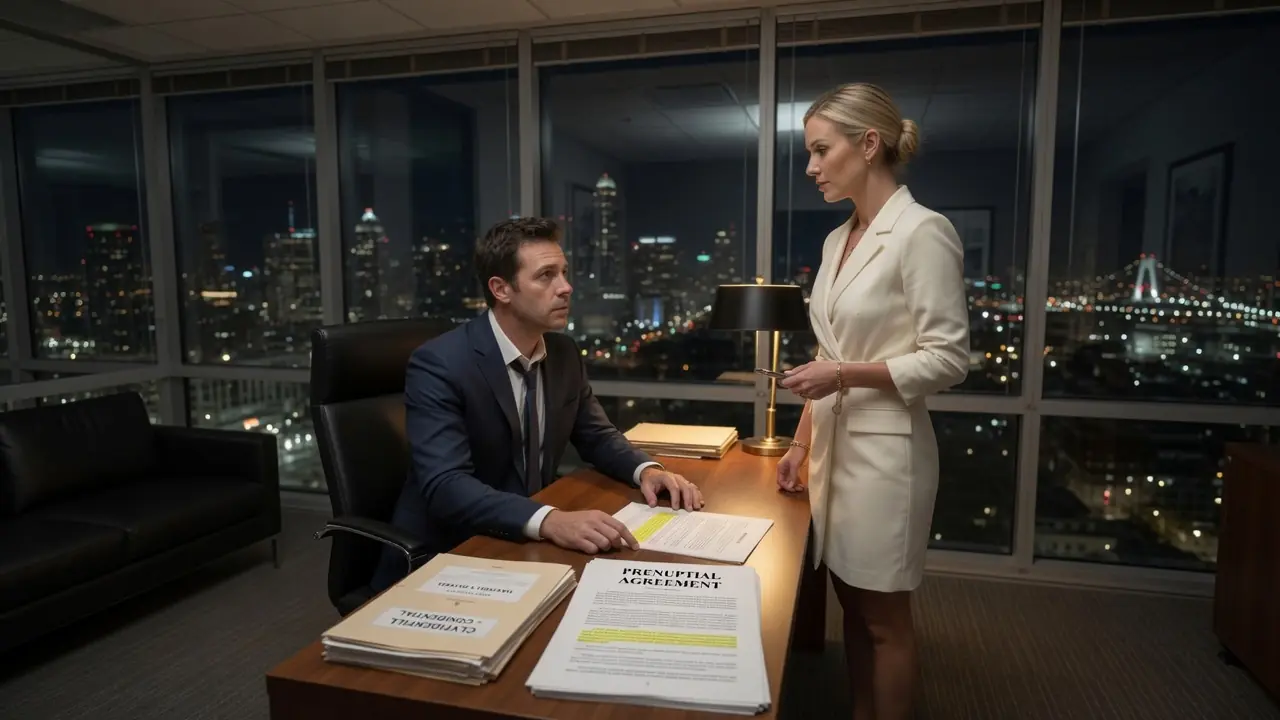
The leather chair in my office had molded itself to my body over 7 years of late nights, becoming as familiar as my own skin. The amber light from my desk lamp cast shadows across the prenuptial agreement I'd been reviewing. Not mine, but a client's. The irony wasn't lost on me, as I made notes in the margins, strengthening clauses that would protect a man who trusted me to anticipate betrayal he couldn't imagine.
My phone buzzed. At 9:47 p.m., Delaney's name appeared on the screen, accompanied by her photo, the one from our honeymoon in Napa, where she'd laughed at something I'd said about the wine being overpriced. She'd looked genuinely happy then. Or maybe I'd just been better at believing her performance. "Hey," I answered, closing the file and leaning back in my chair.
Delaney's voice carried that particular brightness she used when she wanted something. The same tone she'd employed when asking for the BMW, the kitchen renovation, the annual girls trip to Cabo that somehow always extended by 3 days. "David, honey, I need to talk to you about something." I glanced at the clock. She was 3 hours behind in Los Angeles, probably in her hotel room overlooking the strip.
The conference on digital marketing strategies had seemed legitimate enough when she'd pitched it to me two weeks ago. Now hearing that familiar cadence, I felt the first cold finger of suspicion trace down my spine. "What's on your mind?" I asked. "Well, you know how I've been working so hard on the business and this conference has been absolutely incredible for networking?"
She paused and I could hear her moving around, probably pacing as she did when she was nervous. "Lucas Kain is here." The name hit me like a physical blow. Lucas Kain, the actor who dominated social media for the past year. The one whose shirtless photos Delaney had liked on Instagram with embarrassing frequency.
The one she'd mentioned in passing conversations just a few too many times for casual interest. "The actor," I said. My voice remained level. Lawyer training to reveal nothing. "Yes. And David. This is such an incredible opportunity," she continued eagerly. "His people are here and they're looking for marketing consultation for his new production company. This could change everything for us."
"Us?" The word felt like a stone in my mouth. "What exactly are you asking me, Delaney?" "He's invited me to stay the weekend. Not just me. There's a whole group of marketing professionals and we'd be working on strategy." But she trailed off and I could hear her breathing.
I could almost see her biting her lower lip the way she did when she was about to cross a line she knew she shouldn't cross. "About what?" I pressed. "I might not be back Sunday night like we planned. Maybe Monday morning or even Tuesday. This is business, David. But it's also... I mean he's Lucas Kain. This kind of opportunity doesn't come along every day."
I sat forward, my free hand gripping the edge of my desk. 7 years of marriage had taught me to read the spaces between her words, and the space here was vast enough to swallow everything we built together. "Are you asking for my permission to sleep with him?" I asked directly. The silence stretched between us like a taut wire.
When she finally spoke, her voice had shifted, becoming defensive and entitled simultaneously. "God, David, why do you always have to make everything so legal? I'm talking about a business opportunity. If something personal happens, well, we're adults. We've been married for 7 years, and I think we both know that we've grown apart, that maybe we both need to explore what else is out there."
"So, you're telling me you're going to have an affair?" I stated flatly. "I'm telling you that I'm going to live my life," she replied with growing defiance. "You can choose to be supportive or you can choose to be difficult. But either way, this is happening."
Her words landed with surgical precision, each one calculated to wound. This wasn't impulse. This was a woman who'd thought through her betrayal and decided my feelings were an acceptable casualty. "No," I said simply. "Excuse me," she shot back clearly surprised.
"You're right," I replied calmly. "You don't need my permission. But you also don't get to have your cake and eat it, too. You don't get to destroy our marriage and then come home expecting me to pretend it didn't happen." "Oh, please," she scoffed. "You'll survive. You always do. You'll pout for a week, maybe sleep in the guest room, and then we'll go back to our routine of polite distance and separate lives just like we always do."
The casual cruelty of her words hit me harder than rage ever could. This wasn't passion or temporary insanity. This was calculated dismissal of everything I'd thought we shared. She'd already written the script for how this would play out, casting me as the weak husband who would ultimately acquiesce to her choices.
"You're right about one thing," I said quietly. "I will survive." "Good," she said with satisfaction. "Then we understand each other."
After she hung up, I sat in the deepening darkness of my office, staring at the city lights beyond my window. 7 years of marriage, and she'd reduced me to a supporting character in her life story. The devoted husband who worked hard, paid the bills, and would ultimately forgive her anything because he was too weak to demand better.
I opened the bottom drawer of my desk and pulled out a manila folder I hadn't touched in years. Inside was our prenuptial agreement, the one I'd insisted on despite her protests and her mother's horrified lectures about trust and romance. 23 pages of carefully crafted legal language, including section 12, subsection C, the infidelity clause that would void all spousal support and property rights in the event of adultery.
I drafted it myself, learning from the mistakes of my first marriage. Sarah had cleaned me out, taken half of everything I'd worked for, and left me with the bitter knowledge that love without protection was just another word for financial suicide. Delaney had signed it with theatrical sighs and comments about how unromantic it was. She'd probably never read it carefully, certainly never understood the specific language that defined adultery, not just as physical infidelity, but as any intimate, emotional, or physical relationship that violates the fundamental trust and commitment of marriage.
Her phone call had just provided me with documented evidence of her intent to commit adultery. In Texas, a single party consent state. I'd legally recorded her admission of planned infidelity. I pulled out a yellow legal pad and began writing.
By Monday morning, I'd need to contact my banking attorney, trigger the asset protection protocols I'd established years ago, and begin the process that would leave Delaney with exactly what she'd contributed to our marriage. Nothing. The man she'd married was the one who'd trusted her, who'd believed in the possibility of forever.
That man had died somewhere in the space between her request and her dismissive laughter. The man who remained understood that the only person you could truly trust was yourself. Friday morning arrived with the mechanical precision of routine. My alarm sounded at 5:30 a.m. the same time it had every weekday for 7 years.
I dressed in my usual navy suit, knotted my tie with the same practiced hand I'd used since law school, and made coffee in the machine Delaney had insisted we needed, the one that ground beans and frothed milk and cost more than most people's rent. The normalcy felt surreal. 24 hours ago, I'd been a married man. Now, I was a man executing a plan.
My first call was to Marcus Webb, my banking attorney, and the closest thing I had to a friend in the legal community. We'd met in law school, bonded over shared cynicism and late night study sessions, and maintained a professional relationship built on mutual respect and carefully managed paranoia. "David, it's barely 7 a.m." Marcus answered groggy. "Please tell me you're not calling about another client's asset protection crisis."
"This one's personal, Marcus." I replied, "I need you to trigger the protocols we discussed when I set up my accounts." The silence on the other end stretched long enough for me to imagine Marcus sitting up in bed, suddenly alert. We'd spent hours designing those protocols. Contingencies for scenarios I'd hoped never to encounter, but had been too burned to ignore.
"The infidelity clause?" Marcus asked, his voice now fully awake. "The documented admission of intent recorded conversation and she's currently in Los Angeles with the paramour," I confirmed. "I need everything moved by end of business today." "Jesus, David, are you sure about this?" Marcus asked with concern.
I stared at my reflection in the bathroom mirror, seeing the face of a man who'd learned to trust his instincts too late. She told me she was going to have an affair and that I'd survive it. She's spending the weekend with Lucas Kain. "The actor," Marcus exclaimed. "Christ, David, this is going to be a media nightmare."
"Not for me," I said confidently. "I'm the wronged husband with documentation and a prenup. She's the one who chose to destroy our marriage for a celebrity fling." Marcus was quiet for a moment, then shifted into professional mode. "I'll need copies of everything, the prenup, the recording, any supporting documentation. How much time do we have?"
"He's scheduled to return Sunday evening," I answered. "I want everything in motion before she realizes what's happening." "Consider it done, David." Marcus paused. "Are you sure about this? Once we trigger these protocols, there's no going back."
I walked to my closet, looking at the space where half our clothes hung together, his and hers, a symbol of shared lives and mutual trust. By Sunday night, half that space would be empty, and I'd be the one who'd made it so. "She made the choice, Marcus," I said firmly. "I'm just dealing with the consequences."
The next call was to my locksmith, a man who'd worked on my office building for years and understood the value of discretion. The third call was to my accountant, activating the legal separation of assets that our prenup allowed for in cases of adultery. The fourth call was to my assistant, cancelling all weekend appointments and clearing my schedule for personal legal matters.
By 10:00 a.m., I was sitting in my kitchen, surrounded by the debris of a shared life. 7 years of marriage condensed to decisions about who owned what, who'd paid for what, and what belonged to whom. The prenup was explicit. Any assets brought into the marriage remained separate property. Any assets acquired during the marriage through co-mingled funds would be divided according to contribution percentages, and any property purchased solely with my income would remain mine.
The house was mine, bought with money from my practice, mortgage payments made from my accounts. The BMW was hers, a gift I'd purchased for her birthday, title in her name. The furniture was a mixture, but I had receipts for everything, organized in files that Delaney had mocked as obsessive recordkeeping.
I began in our bedroom, methodically packing her clothes into garbage bags. Each item told a story. The black dress she'd worn to our anniversary dinner last month. The yoga pants she'd bought for a fitness phase that lasted exactly 3 weeks. The lingerie I'd never seen her wear, but that appeared on credit card statements from stores I'd never heard of.
In her jewelry box, I found a receipt for a necklace I'd never seen purchased 2 weeks ago, the same day she'd told me about the Los Angeles conference. The receipt was from a boutique in downtown Austin, and the timestamp showed she'd bought it during her lunch break. While I was in court defending a client's asset protection case, the irony was so perfect it felt scripted.
I found her laptop in the home office, password protected, but using the same combination she'd used for everything. Our wedding date. Her email revealed a pattern of deception that went back months. Flirtatious exchanges with men whose names I didn't recognize. Dinner reservations at restaurants where she'd never taken me. Credit card statements for purchases that had never appeared in our house.
Lucas Kain's name appeared in her search history with embarrassing frequency. She'd researched his dating history, his net worth, his upcoming projects. She'd even looked up flight times from Austin to Los Angeles, and hotel rates near the conference center. This wasn't impulse. This was premeditation.
I had printed everything, organized it in folders, and added it to the growing stack of evidence that would support my case. Texas was a no fault divorce state, but fault could still affect property division and spousal support. With documented evidence of adultery and a prenup that explicitly voided support in cases of infidelity, Delaney's legal position was catastrophic.
My phone buzzed with a text from her. "Having an amazing time. The conference sessions are incredible and I'm learning so much. Miss you." I stared at the message, struck by its casual dishonesty. She was lying to me while actively betraying me, maintaining the fiction of our marriage while systematically destroying it. I didn't respond.
Saturday morning, I woke up in the guest room, not out of emotional distress, but because I'd been working late and didn't want to disturb the organization of evidence I'd spread across our bedroom. The locksmith arrived at 8:00 a.m., changing every lock in the house with the quiet efficiency of a man who'd seen this scenario before. "Security system too?" the locksmith asked and I nodded.
The codes were changed, the backup keys relocated, the garage door opener reprogrammed. By the time he left, the house that had been our shared home had become my fortress. Marcus called at noon with an update. All assets secured, accounts separated, and I filed the preliminary paperwork for the divorce.
The prenup is solid, David. She's going to walk away with whatever she brought into the marriage and nothing else. "What did she bring?" I asked. "Student loan debt and a used Honda Civic that was repossessed 6 months before your wedding," Marcus replied matter-of-factly.
I felt something that might have been satisfaction, but it was too cold and calculated for genuine emotion. This was justice, not revenge. This was the consequence of choices she'd made with full awareness of the risks. Sunday afternoon, I sat in my office across the street from our house, watching and waiting.
The irony wasn't lost on me. The same office where I'd taken her call, where I'd planned for this moment, where I'd built the career that would survive her betrayal. At 6:30 p.m., an Uber pulled up to the curb. Delaney stepped out, her phone pressed to her ear, laughing at something the person on the other end was saying.
She looked radiant, glowing with the satisfaction of a woman who'd gotten exactly what she wanted. She walked to the front door, still talking, still laughing. I watched her try the key, saw the confusion cross her face when it didn't work. She tried again, then stepped back, looking at the house as if it had somehow transformed in her absence.
Then she saw the garbage bags on the porch. The phone call ended abruptly. Delaney approached the bags like they might contain explosives, opening the first one and staring at the contents. Her clothes, her shoes, her books, her entire life reduced to black plastic and tie wraps.
My phone rang. "David, what the hell is going on?" Delaney's voice was sharp with panic. "Why are my clothes in garbage bags? And why doesn't my key work?" "Because you no longer live here," I answered calmly. "What are you talking about?" She demanded. "You can't just—"
"I can and I did." I interrupted. "You told me you were going to have an affair and you did. The consequences were clearly outlined in our prenuptial agreement which you signed 7 years ago." "This is insane," she protested. "You can't throw me out over one mistake."
"It wasn't a mistake, Delaney." I corrected her. "It was a choice. You chose Lucas Kain over our marriage, and now you get to live with that choice." I could hear her breathing, could picture her standing on the porch of what used to be our home, surrounded by the physical evidence of her eviction from my life.
"Where am I supposed to go?" she asked, her voice smaller now. "That's not my problem anymore," I replied without sympathy. "You're an adult who makes her own choices, remember? You wanted to live your life without considering my feelings and now you get to find out what that actually looks like."
"David, please," she pleaded. "We can work this out. I made a mistake." "You made a choice," I said firmly. "And I made mine." I hung up and watched her through the window as she stood there, perhaps finally understanding that the man she'd married was not the man she'd betrayed.
She made several more calls, probably to friends or family looking for somewhere to go. Then she loaded the garbage bags into the Uber and disappeared into the night. An hour later, she was back standing at my office door. She looked smaller somehow, diminished by the reality of consequences she'd never imagined would apply to her.
"Can we talk?" she asked quietly. "Face to face like adults." I let her in and watched her settle into the client chair across from my desk. The same place where clients sat when they needed my help protecting their assets from unfaithful spouses. "I don't understand how you could do this," she began. "We've been married for 7 years. We built a life together."
"No, we didn't." I corrected her. "I built a life and you lived in it. There's a difference." "That's not true." She protested. I opened a file folder and spread its contents across my desk. Credit card statements, email printouts, receipts for purchases I'd never seen. Evidence of relationships I'd never known existed.
"You've been having affairs for months, Delaney. Maybe years," I said, watching her face. This weekend wasn't an aberration. It was an escalation. She stared at the papers, her face cycling through emotions: surprise, anger, resignation, and finally something that might have been relief. "You went through my things," she said accusingly.
"I went through our things," I corrected. "This is my house, my computer, my credit cards that paid for your deceptions. You forfeited any expectation of privacy when you decided to systematically betray our marriage." "So, what happens now?" she asked quietly.
"Now you learn what it's like to live without the safety net you took for granted." I explained the prenup is clear. In cases of adultery, you receive no spousal support, no property division, no claim on assets acquired during the marriage. "You're going to leave me with nothing?" she asked, her voice barely above a whisper.
"I'm going to leave you with exactly what you brought to our marriage. Nothing," I stated matter-of-factly. "You chose to destroy what we built together, and now you get to experience the consequences of that choice." She was quiet for a long moment, staring at the evidence of her own betrayal.
When she looked up, her eyes were clearer than I'd seen them in years. "You really planned for this, didn't you?" she asked. "I planned for the possibility of this," I confirmed. "I hoped it would never happen, but I wasn't naive enough to believe it couldn't."
"Because of your first marriage," she said with understanding. "Because I learned that love without protection is just another word for vulnerability," I replied. "Sarah taught me that lesson the hard way. I wasn't going to let it happen again." "And you never told me about the prenup. Not really," she said with dawning realization.
"You just said it was about protecting assets." "You never asked," I pointed out. "You signed it without reading it, just like you made decisions about our marriage without considering the consequences." She stood up, smoothing her dress, and for a moment I saw a flash of the woman I'd married.
Not the entitled princess who'd taken my devotion for granted, but the woman who'd once been capable of grace under pressure. "I'm sorry," she said quietly. "Not because I got caught, and not because I'm losing everything. I'm sorry because I never saw you. I never understood who you really were."
"No, you didn't." I agreed. "The man you married was kind and trusting and generous," she continued. "I thought that made him weak." "The man you married was all of those things," I replied. "But he was also smart enough to protect himself from people who would take advantage of his kindness."
She walked to the door, then turned back. "For what it's worth, Lucas Kain is an asshole. He used me and then he discarded me the moment he found out I was married to a lawyer. His people are terrified of bad publicity." "That's not my problem anymore," I said simply.
"I know," she said with a sad smile. "I just thought you should know that karma is real and it works both ways." After she left, I sat in my office until nearly midnight, not celebrating, not mourning, just existing in the space between who I'd been and who I was becoming.
The man who'd answered her call Thursday night was gone, replaced by someone who'd learned that the only person you can truly trust is yourself. The prenup lay open on my desk. Section 12, subsection C, highlighted in yellow. 23 pages of legal language that had just saved me from becoming a victim of my own generosity.
I'd planned for this moment for 7 years, hoping it would never come, knowing it probably would. Now that it had, I felt nothing but the cold satisfaction of a man who'd learned from his mistakes and refused to repeat them. 6 months after the divorce was finalized, I sat in my new office suite, reviewing the quarterly reports that confirmed what I'd suspected.
Failure had been the catalyst for success I'd never imagined possible. The practice had tripled in size, driven by referrals from clients who'd heard about my own experience and wanted the same level of protection for their own assets. The irony wasn't lost on me. Delaney's betrayal had inadvertently created a niche market for my services, high-net-worth individuals who'd learned, either through experience or observation, that love without legal protection was just another word for financial suicide.
My assistant buzzed through the intercom. "Mr. Hartwell, Mrs. Chen is here for her consultation." Mrs. Chen was a successful surgeon whose husband had been making expensive purchases and taking mysterious trips. She'd found my name through a referral from Marcus Webb, who'd been sending me clients regularly since word got out about my own divorce.
"Dr. Chen, thank you for coming in," I said as she entered. "I understand you're interested in asset protection strategies." She was a small woman with intelligent eyes and the kind of quiet intensity that suggested she'd built her success on precision and careful planning. "Mr. Hartwell, I've heard about your own situation. Sorry you had to go through that, but I'm impressed by how you handled it."
"Thank you," I replied. "What's your current situation?" "23 years of marriage, two children in college, and a husband who's become increasingly secretive about his finances," she explained. "I've built a successful practice, and I'm concerned about protecting what I've worked for."
We spent the next hour discussing strategies, separate accounts, property transfers, documentation protocols, and the legal framework that would protect her assets if her worst fears were confirmed. By the time she left, she had a comprehensive plan and the contact information for investigators who could provide the evidence she might need.
After she left, I walked to the window overlooking downtown Austin. The city had grown in the months since my divorce. New buildings rising from construction sites, the skyline constantly evolving. I had grown, too, though not in ways I'd expected.
The practice had expanded beyond simple asset protection. I had developed expertise in prenuptial agreements, post-nuptial agreements, and divorce strategy for high-net-worth individuals. My reputation for thoroughness and discretion had attracted clients from across Texas and beyond.
My phone rang, interrupting my thoughts. "David, it's Marcus," came the familiar voice. "Are you free for lunch? I have something I want to discuss with you." "Professional or personal?" I asked.
"Both," Marcus replied. "Meet me at that new place on Sixth Street." I found Marcus already seated at a table overlooking the river. Two glasses of wine already ordered. He looked prosperous and satisfied, the way successful lawyers did when they were about to share good news.
"David, I have a proposition for you," Marcus began without preamble. "Partnership in what?" I asked. "Asset protection law," he explained. "We combine our practices, create a firm that specializes in protecting wealth from domestic disputes. Your expertise in prenups and divorce strategy, my expertise in banking and financial law."
I considered this. The past 6 months had been profitable, but also isolating. Building a practice around betrayal and mistrust was emotionally taxing even when it was financially rewarding. "What would that look like?" I asked.
"Webb and Hartwell, attorneys at law," Marcus said with enthusiasm. "We target high-net-worth individuals, executives, professionals, anyone with assets worth protecting. We market ourselves as the lawyers who understand that love and money don't mix." "That's a cynical business model," I observed.
"That's a realistic business model," Marcus corrected. "David, you've seen what I've seen. Half of all marriages end in divorce, and the other half should. We're not destroying marriages. We're protecting people from the financial consequences of their own optimism."
After lunch, I drove through the neighborhood where Delaney and I had lived together. The house had sold quickly, bought by a young couple who'd probably never heard of prenuptial agreements, and believed that love was enough to protect them from the complexities of modern marriage.
I found myself thinking about Delaney more than I cared to admit, not with longing or regret, but with a kind of anthropological curiosity. What had she been thinking? What had she expected to happen? I got my answer sooner than expected.
The coffee shop was crowded, filled with the usual mix of students, professionals, and people who'd made caffeine consumption into a lifestyle choice. I was waiting for my order when I saw her. Delaney sat alone at a corner table, staring at her phone with a kind of intensity that suggested she was avoiding eye contact with the world around her.
She looked different, thinner, more angular, dressed in clothes that suggested retail employment rather than boutique shopping. She saw me before I could decide whether to approach her. "David," she said softly. "Delaney," I replied.
"Can you—would you mind sitting for a minute?" She asked hesitantly. "I promise I'm not going to cause a scene." I sat across from her, noting the changes that 6 months had wrought. The confident woman who'd destroyed our marriage had been replaced by someone who'd learned that actions have consequences.
"How are you?" I asked. "Surviving," she answered with a weak smile. "Working retail at Nordstrom, living in a studio apartment, learning how to live on a budget." "I guess you were right about one thing." "I am surviving."
"That's good," I said simply. "Is it?" she asked. "I'm not sure survival is the same thing as living." She stirred her coffee absently, not meeting my eyes. "I heard about your practice, the expansion, the new clients. I'm glad you're doing well."
"Thank you," I replied. "I also heard about Lucas Kain," she continued. "Sexual harassment lawsuit. Turns out he has a pattern of targeting married women, especially ones married to professionals who might cause problems." She looked up at me then, her eyes clearer than I'd seen them in years.
"I wasn't special. I was just another conquest in a very predictable pattern." "I'm sorry," I said, and meant it. "Are you?" She asked. I really considered the question honestly. "I'm sorry you were used. I'm not sorry about the consequences."
"Fair enough," she said, accepting my honesty. She finished her coffee and stood to leave. "For what it's worth, I hope you find someone who deserves what you have to offer. Someone who sees your kindness as strength instead of weakness."
After she left, I sat alone in the coffee shop, watching the city move around me. 6 months ago, I'd been a man whose life was built on trust and shared dreams. Now I was a man who'd learned to protect himself first and trust second.
That evening, I called Marcus. "Webb and Hartwell," I said when he answered, "I'm in." One year after the divorce was finalized, I stood in the main conference room of Webb and Hartwell, watching Austin's legal and business community mingle at our grand opening reception.
The firm had exceeded every projection we'd made. In 12 months, we'd handled 43 prenuptial agreements, 37 asset protection cases, and 22 divorces for high net worth clients. "David, there's someone here to see you," Marcus said, appearing at my elbow, his expression carefully neutral. "She's waiting in your office."
I found Delaney sitting in the client chair, her back straight, hands folded in her lap. She'd changed again in the months since our coffee shop encounter. Her hair was shorter, styled professionally, and she wore a simple black dress that looked expensive but not new. "Delaney," I said, taking my seat behind the desk.
"David," she replied. "Thank you for seeing me." She reached into her purse and withdrew an envelope, cream colored paper with my name written in her careful handwriting. "I wrote you a letter. I think this one says what I need to say."
I took the envelope, but didn't open it. "Why now?" "Because I saw the news about Lucas Kain and I realized something." She explained, "You didn't just save yourself from my betrayal. You might have saved other marriages from similar destruction."
I'd seen the news coverage. Lucas Kain had been arrested on multiple charges of harassment and exploitation. His pattern of targeting married women finally exposed. His career was over, his reputation destroyed. "That wasn't my intention," I said.
"No, but it was the result," she replied. "By refusing to be my victim, you helped expose him as a predator." She gestured toward the envelope. "It's all in there. My apology, my acknowledgement of what I destroyed, and my gratitude for the lesson you taught me."
"What lesson?" I asked. "That actions have consequences, and that nice people aren't necessarily weak people," she said with quiet conviction. She stood smoothing her dress. "I have a job now, assistant manager at a boutique downtown. It's not much, but it's honest work and I'm good at it."
After she left, I opened the envelope. The letter was three pages long, written in her careful script, and it was perhaps the most honest thing she'd ever said to me. She acknowledged her mistakes, took responsibility for the destruction of our marriage, and thanked me for teaching her that consequences were real.
I folded the letter and placed it in my desk drawer, not as a keepsake, but as a reminder of the importance of boundaries and consequences. Then I returned to the reception where my colleagues and clients were celebrating the success we'd built together.
At 9:00 p.m., after the last guest had left, I sat alone in my office looking out at the city lights. My phone buzzed with a news alert. Lucas Kain had been sentenced to 18 months in prison and ordered to pay restitution to his victims. His career was finished, his reputation destroyed.
I felt a deep satisfaction that had nothing to do with revenge and everything to do with justice. By protecting myself from Delaney's betrayal, I'd inadvertently helped expose a man who'd made a career of targeting vulnerable women. My desk phone rang. A potential client, probably someone who'd heard about our success and wanted the same level of protection for their own assets.
"David Hartwell," I answered. "Mr. Hartwell, this is Dr. Elizabeth Morrison," came the voice on the other end. "I got your name from Dr. Chen. I think I need your help." "What's your situation, Dr. Morrison?" I asked, reaching for a fresh legal pad.
"20-year marriage, successful medical practice, and a husband who's become very interested in my finances lately," she explained. "I found your articles about asset protection, and I think it's time I learned how to protect myself."
I opened a new file and began taking notes. Another successful professional who'd built her life on trust and competence suddenly forced to confront the possibility that her partner might not share her values. As I began the familiar process of explaining asset protection strategies, I felt the deep satisfaction of a man who'd learned from his mistakes and dedicated his life to helping others avoid similar pain.
Delaney had chosen her path and she'd walked it to its inevitable conclusion. I'd chosen mine, and it had led to a life built on wisdom rather than trust, on protection rather than vulnerability. The poetic justice was complete. She'd lost everything she'd taken for granted. Lucas Kain had been exposed and destroyed, and I'd found my true calling in the ashes of betrayal.
It wasn't the life I'd planned, but it was the life I'd earned, and that finally was enough.