The engine died three miles outside of Ashford Creek.
No warning.
No polite flicker from the dashboard.
No dramatic smoke curling from beneath the hood.
Just silence.
Vivian Monroe sat behind the wheel of her black Aston Martin and stared at the empty country road ahead, both hands still gripping the leather steering wheel as if authority alone could make the machine obey.
It did not.
She turned the key again.
Nothing.
She tried once more, slower this time, as if patience could negotiate with a dead engine.
Still nothing.
Vivian exhaled through her nose and leaned back against the seat.
That morning, she had stood in a glass conference room in Boston and convinced twelve board members to approve a $70 million acquisition. She had answered hostile questions without blinking. She had watched three men twice her age try to corner her with numbers, then calmly corrected their own projections in front of the entire room.
Now she could not get her car to start.
The irony felt personal.
Her phone had one bar of signal.
Then none.
The sky was turning the color of old pewter, and rain had begun pressing lightly against the windshield. Ashford Creek was the kind of town people passed through on their way somewhere more important. Vivian had not planned to stop there. She had only taken the back road because her assistant said it would save thirty minutes.
Her assistant had been wrong.
A tow truck arrived forty minutes later.
The driver was an older man named Gus, who had a white beard, a Boston Red Sox cap, and the calm expression of someone who had seen luxury cars betray wealthy people many times before.
“Pretty thing,” he said, hooking the Aston Martin to the tow line.
“It was prettier when it worked,” Vivian replied.
Gus laughed.
“I know a guy.”
That was how Vivian Monroe, CEO of Monroe Global Holdings, ended up at a small garage with peeling blue paint, one crooked sign, and a gravel lot full of pickup trucks, old sedans, and one tractor that looked like it had survived several wars.
The sign above the open bay door read:
Bennett Auto Repair.
The garage smelled of oil, rubber, coffee, metal, and rain.
It was not elegant.
It was not curated.
Nothing in the place had been designed by a consultant to communicate “authenticity.” It simply was authentic. Tools hung on the wall in neat rows. A radio played low from somewhere near the office. Fluorescent lights hummed overhead, and the concrete floor carried years of stains that no amount of scrubbing could erase.
Vivian stepped out of the tow truck, careful not to sink her heels into the wet gravel.
Her navy coat cost more than the garage sign.
Her handbag probably cost more than the tow truck.
She was aware of both facts and disliked herself for noticing.
A man rolled out from beneath an old Ford near the second bay.
He pushed himself upright, wiped his hands on a rag, and looked toward the Aston Martin.
Then toward Vivian.
For one brief second, something passed across his face.
Not recognition.
Not yet.
Just surprise quickly folded away.
“Engine trouble?” he asked.
His voice was low, rough around the edges, and familiar in a way Vivian could not place.
She frowned slightly.
“It won’t start.”
He looked at the car again.
“That does qualify.”
Gus chuckled behind her.
“This is Owen Bennett,” he said. “Best mechanic in three counties, worst coffee in one.”
Owen tossed the rag at him.
“Still better than what you make.”
Gus lifted both hands.
“I brought you a customer. Don’t insult the messenger.”
Owen turned back to Vivian.
“Mind if I take a look?”
“That’s why I’m here.”
The sentence came out sharper than she intended.
Owen only nodded, unaffected.
He moved with the easy confidence of a man who trusted his hands more than conversation. He popped the hood, leaned in, and began checking connections with practiced focus.
Vivian stood nearby, rain dotting the shoulders of her coat.
She should have been irritated.
She had a dinner meeting in New York the next morning. Her laptop was full of documents waiting for approval. Her phone still had no signal. She was stranded in a town she did not know, in shoes not made for gravel, depending on a man with grease on his forearms and a quietness that made her feel strangely seen.
“When did it last start normally?” Owen asked.
“This morning.”
“Any dashboard warnings?”
“No.”
“Battery replaced recently?”
“I bought the car eight months ago. I assume everything was checked.”
He glanced at her.
There was no judgment in his face.
Only a faint trace of amusement.
“Cars don’t care what we assume.”
Vivian almost smiled.
Almost.
Instead, she crossed her arms.
“I run a company. I don’t run diagnostics.”
“That’s probably why the car came here.”
The corner of his mouth lifted.
Something inside Vivian shifted.
Not much.
A tiny movement of memory beneath the surface.
She studied his profile as he worked. Dark hair with a little gray near the temples. Strong jaw. A small scar above his left eyebrow. Hands steady, broad, capable. He wore an old green work shirt with his name stitched over the pocket, jeans faded at the knees, and boots that had clearly earned their shape.
He looked nothing like the men in her boardrooms.
That alone was almost restful.
He tightened something near the battery, then moved to the starter relay.
“Try it now,” he said.
Vivian slid into the driver’s seat and pressed the ignition.
The engine roared to life.
Smooth.
Immediate.
Almost smug.
She stared at the dashboard.
“You’re kidding.”
Owen closed the hood.
“Loose battery connection and a corroded terminal. Expensive car, ordinary problem.”
She stepped out.
“How much do I owe you?”
He shook his head.
“Nothing.”
“That’s not how business works.”
“This took five minutes.”
“Then charge me for five minutes.”
“I’m not billing someone for tightening a connection.”
Vivian reached into her handbag.
Owen lifted one hand.
“No.”
She paused.
People rarely said no to her anymore.
Not like that.
Not rudely.
Not with fear.
Simply no.
She removed a business card instead and held it out.
“At least take this. If you ever need anything.”
He took it politely.
His eyes lowered to the name.
Vivian Monroe.
Founder and CEO, Monroe Global Holdings.
His expression did not change much, but she saw the moment he understood.
“Well,” he said, sliding the card into his shirt pocket, “hope the rest of your drive is less dramatic, Ms. Monroe.”
“Vivian,” she corrected.
“Owen.”
“I know. Gus introduced you.”
“I figured we were being formal for a second.”
This time, she did smile.
It surprised both of them.
A small voice came from the garage office.
“Dad, can I have the blue marker? The red one died tragically.”
Vivian turned.
A little girl stood in the doorway holding a half-finished drawing. She was maybe seven, with brown curls tied messily on top of her head, purple sneakers, and a face full of serious artistic frustration.
Owen’s expression softened so completely that Vivian looked away.
“It’s in the second drawer, Bug,” he said.
The girl noticed Vivian and became shy for exactly two seconds.
Then she held up the drawing.
“I’m making a dragon, but it accidentally looks like a horse with anger issues.”
Vivian looked at the paper.
“It has strong personality.”
The girl considered that.
“I like you.”
Owen sighed.
“Harper.”
“What? She understood the dragon.”
Vivian laughed.
The sound felt unfamiliar coming from her.
Owen looked at her as if he noticed that too.
“This is my daughter, Harper,” he said.
“Nice to meet you, Harper.”
“Are you rich?” Harper asked.
Owen closed his eyes.
“Bug.”
Vivian paused, then said, “Yes.”
Harper nodded.
“Cool. Do rich people have snacks in their cars?”
“Usually not.”
“That seems like bad planning.”
“It does,” Vivian admitted.
Owen pointed toward the office.
“Marker. Now. Before you interview the customer.”
Harper disappeared.
Vivian watched her go.
“She’s wonderful.”
“She’s a lot.”
“That too.”
Owen wiped his hands again.
Rain tapped on the open garage door.
Vivian knew she should leave.
The car was running. The problem was solved. Her life, loud and urgent, waited on the other side of town.
But she stayed beside the hood.
“Have we met before?” she asked.
Owen looked at her carefully.
“I don’t think so.”
There was no flicker of recognition in his eyes.
That bothered her more than it should have.
“No,” she said quickly. “Probably not.”
She got into the Aston Martin and drove away.
But for the next twenty miles, she kept seeing his smile in the rearview mirror.
Not because it was charming.
Though it was.
Because somewhere inside her, a door had opened.
And behind it stood a memory she had not touched in years.
Fifteen years earlier, Vivian had been twenty-one and still called Vivi by people who loved her.
There had been fewer of those people than everyone assumed.
She was a scholarship student at Winslow College, though most people thought she belonged there by birthright because she had learned early how to dress like she had never been afraid of money. Her mother cleaned offices at night. Her father had vanished before she started middle school. Vivian worked two jobs and studied finance like survival depended on it.
Because it did.
One October night, she had left the library after midnight.
The campus had been wet from rain, the stone steps slick beneath her shoes. She remembered carrying three books against her chest and wishing she had enough money for a taxi instead of the long walk to her off-campus room.
Two men followed her past the library gates.
At first, she told herself they were only walking in the same direction.
Then one called out.
“Hey, sweetheart.”
She walked faster.
They did too.
One grabbed her backpack strap near the old chapel walkway.
She remembered the smell of beer.
The sound of her books hitting the ground.
The terror of realizing nobody else was there.
Then a voice from the darkness.
“Let her go.”
The boy who stepped into the lamplight had been tall, lean, and wearing a mechanic’s jacket over a college sweatshirt. He did not look like someone trying to be a hero. He looked scared too, but the useful kind of scared.
The kind that still moved.
One of the men shoved him.
He shoved back.
There was a brief, ugly struggle. A fist. A fall. One of the men ran. The other cursed and followed. The boy stayed standing, breathing hard, blood at his eyebrow.
He picked up Vivian’s books.
“You okay?” he asked.
She had nodded even though she was shaking too badly to stand straight.
He walked her home without asking for anything.
His name had been Owen Bennett.
She remembered that now.
Owen Bennett.
The same scar above the left eyebrow.
The same voice.
The same steady hands.
At her apartment door that night, she had asked, “Why did you help me?”
He had shrugged, young and awkward.
“Because someone should.”
She had carried those words for fifteen years.
Through graduation.
Through her first job.
Through men who underestimated her.
Through boardrooms where powerful people smiled like predators.
Through every year she told herself safety was something she had to build alone.
And now he was in Ashford Creek, fixing cars, raising a daughter, and looking at her like she was a stranger.
Vivian should have kept driving.
Instead, she came back four days later.
The Aston Martin did not need repairs.
She claimed it made a sound.
Owen listened with professional seriousness as she described a noise that did not exist.
“What kind of sound?” he asked.
“A low sound.”
“Low like a hum, a rattle, a grind?”
“Somewhere between those.”
He stared at her.
“Somewhere between a hum and a grind.”
“Yes.”
“Does it happen when you brake?”
“Maybe.”
“When you accelerate?”
“Possibly.”
“When you’re parked?”
She looked at him.
He looked back.
Then he smiled.
“Ms. Monroe, did you invent a car problem?”
Vivian lifted her chin.
“Successful people identify risks early.”
“Uh-huh.”
From the office, Harper called, “Dad, is the rich lady back?”
Owen sighed.
Vivian smiled.
“I see I have a title.”
“You made an impression.”
Harper appeared with a peanut butter sandwich and a missing front tooth.
“Do you want half?” she asked Vivian.
Owen looked surprised.
Harper did not share sandwiches lightly.
Vivian accepted the half sandwich like it was a formal offering.
“Thank you.”
“You can sit in the office. The chair squeaks, but Dad says that builds character.”
Vivian sat.
The chair did squeak.
The car, unsurprisingly, was fine.
But Owen still checked the brakes, tires, belt, fluids, and every system he could justify inspecting.
When he came back to the office, Vivian had peanut butter on one finger and Harper was showing her a collection of rocks named after famous criminals.
“This is Frank,” Harper said, holding up a gray pebble. “He looks suspicious.”
Vivian nodded seriously.
“Frank has secrets.”
Owen leaned in the doorway.
“You two okay?”
“Frank is under investigation,” Vivian said.
Harper looked delighted.
After that, Vivian found reasons to return.
A tire pressure warning.
An oil change.
A question about winter roads.
Once, simply because she was passing through and Harper had made a sign that said FREE COFFEE, which turned out to mean lukewarm instant coffee mixed by a seven-year-old with alarming confidence.
Owen noticed, of course.
He was quiet, not oblivious.
But he did not push.
Their conversations grew in small pieces.
He told her his wife, Marissa, had died three years earlier from an aneurysm no one saw coming. One morning she had been making pancakes. By evening, she was gone. Harper was four then, young enough to blur memories but old enough to miss what she could no longer fully picture.
“She asks if forgetting is the same as not loving,” Owen said one evening while closing the garage.
Vivian’s throat tightened.
“What do you tell her?”
“That love remembers even when the mind loses details.”
He looked embarrassed after saying it.
“Sounds like something from a bad greeting card.”
“No,” Vivian said. “It sounds true.”
She told him less about herself at first.
Not because she wanted to hide.
Because her life had become a public version of itself, and she did not know how to hand someone the private one.
She told him about her company.
About building it from nothing.
About the first investor who told her she was too young, too pretty, too polished, too ambitious, too much. She did not tell him how lonely hotel rooms felt after victories. She did not tell him she kept emergency crackers in her handbag because hunger from childhood had never fully left.
One Friday night, she arrived just as Owen was closing.
No car excuse this time.
No invented sound.
No business card politeness.
He was locking the tool cabinet when she stepped inside.
He looked up.
“Everything okay?”
“No.”
The honesty surprised her.
Owen set the keys down.
Harper was at a sleepover, Vivian knew. The garage was quiet except for rain on the roof and the ticking sound of an engine cooling somewhere in the bay.
“I know you,” she said.
Owen frowned.
“From where?”
“Winslow College. Fifteen years ago. Outside the library.”
He went very still.
Vivian watched the memory find him.
Not all at once.
It moved across his face slowly.
Rain. Stone steps. Blood above his eyebrow. A young woman clutching books with shaking hands.
His eyes widened.
“Vivi?”
No one had called her that in years.
The name struck deeper than she expected.
“Yes.”
He stared at her as if the woman in the navy coat and the girl from the library were trying to occupy the same space.
“I didn’t recognize you.”
“I changed.”
“You did.”
“So did you.”
He touched the scar above his eyebrow without seeming to realize it.
“I wondered what happened to you.”
“I wondered what happened to you too.”
That was not entirely true.
She had done more than wonder.
She had searched for him once, years after college. She found nothing. No social media worth trusting. No alumni update. No professional page. Owen Bennett had vanished into ordinary life, and Vivian had told herself that maybe some people were meant to be memories.
But standing in that garage, she realized memory had been a poor substitute.
“You saved me that night,” she said.
Owen looked down.
“I helped.”
“No. You saved me.”
He shook his head.
“I was terrified.”
“So was I.”
“I didn’t do anything heroic.”
“You stood between me and danger when you didn’t have to.”
He looked back at her then.
The silence stretched.
Not empty.
Full.
“I thought about you,” she said. “For years.”
Owen’s voice softened.
“Why?”
“Because that night was the first time I understood what safety felt like.”
The words trembled.
She hated that.
Vivian Monroe did not tremble in negotiations.
But this was not a negotiation.
Owen leaned against the workbench as if he needed it.
“I wanted to call you after that night,” he said. “I had your number. You wrote it on the back of a receipt.”
“I waited.”
His face changed.
“I called.”
She frowned.
“What?”
“Two days later. Some man answered. Said you didn’t want to talk to me. Said I should stay away.”
Vivian’s stomach dropped.
“My boyfriend at the time,” she whispered.
Owen’s jaw tightened.
“I figured you were embarrassed. Or scared. Or maybe you just wanted to forget.”
“I never got the message.”
He closed his eyes briefly.
Fifteen years.
Not ruined by fate.
Not by choice.
By one petty, insecure man who had answered a phone.
Vivian laughed once, but it broke.
“I thought you forgot me.”
“I thought you chose not to remember.”
They stood with that between them.
The kind of loss that comes not from tragedy, but from missed timing.
From bad information.
From two people walking away wounded by a lie neither of them knew existed.
Owen looked at her.
“Why come back now?”
She could have given the simple answer.
The car.
Curiosity.
Coincidence.
Instead, she told the truth.
“Because I have spent fifteen years becoming powerful enough that nobody could make me feel helpless again. And then my car broke down in your garage, and for five minutes, I was just a woman who needed help.”
She swallowed.
“And you helped me the same way you did then. Without asking what I was worth first.”
Owen’s eyes softened.
“Vivian…”
“I’m not here because of nostalgia,” she said quickly. “I know that’s easy to think. I’m not trying to turn one college memory into a life. I have built too much to be foolish about this.”
He almost smiled.
“That sounds like something a CEO says right before being foolish.”
She smiled through tears.
“Maybe.”
Owen stepped closer, then stopped.
Still careful.
Always careful.
“I have a daughter,” he said.
“I know.”
“My life is not glamorous.”
“I noticed the coffee.”
“That coffee has kept men alive.”
“That coffee has threatened men.”
He laughed quietly.
Then grew serious.
“I can’t be someone’s escape from loneliness.”
“I’m not asking you to be.”
“I can’t give you the life you’re used to.”
She looked around the garage.
The tools.
The oil stains.
The rain.
The office where Harper kept criminal rocks.
Then back at him.
“The life I’m used to is not the same as the life I want.”
Owen looked at her for a long time.
“I’m scared,” he admitted.
“So am I.”
He reached for her hand.
Slowly.
As if giving her time to refuse.
She did not.
His fingers closed around hers, warm and rough and real.
For a moment, neither moved.
Then Vivian stepped closer and rested her forehead against his chest.
Owen held her like a man who remembered the cost of losing what he loved.
Not too tightly.
Never trapping.
Just enough.
The months that followed did not become a fairy tale.
They became better than that.
They became ordinary.
Vivian learned that Harper hated peas but loved pea soup because “blended peas don’t have the same attitude.” She learned that Owen sang badly when he thought no one could hear him. She learned the garage roof leaked in two places, that Gus came by every Wednesday pretending to need air in his tires so he could gossip, and that Ashford Creek knew everyone’s business before lunch.
Owen learned Vivian worked too much when nervous.
He learned she could intimidate grown executives but could not assemble a school project volcano without reading instructions three times. He learned she carried crackers in every bag. He learned that when she got quiet, she was usually remembering hunger, not anger.
Harper accepted Vivian with the bluntness of childhood.
“You’re not my mom,” she said one afternoon while drawing at the kitchen table.
Vivian looked up carefully.
“No, I’m not.”
“My mom had curly hair.”
“I know.”
“Dad says she liked storms.”
“She sounds brave.”
“She was.”
Harper colored a tree purple.
“You can still come to my recital though.”
Vivian’s eyes stung.
“I’d like that.”
“And if I mess up, you clap anyway.”
“Absolutely.”
Harper nodded.
“Then you can stay.”
Owen, listening from the sink, turned away and pretended the dishes required deep attention.
Vivian began spending weekends in Ashford Creek.
At first, she stayed at the inn.
Then sometimes in the guest room at Owen’s small farmhouse, after Harper insisted it was silly for Vivian to pay strangers for a bed when they had one “that only squeaked a medium amount.”
The house was nothing like Vivian’s penthouse.
It had sloping floors, a porch that needed repair, and a kitchen table covered in homework, bills, and small treasures Harper collected from the yard. But it had warmth. Shoes by the door. A kettle that whistled too loudly. A photo of Marissa on the mantel, smiling in a yellow sundress with Harper as a baby in her arms.
Vivian never asked Owen to put the photo away.
One evening, she found Harper standing in front of it.
“Sometimes I forget her voice,” Harper said.
Vivian sat beside her on the floor.
“That must hurt.”
“It does.”
“Do you want to tell me what you remember?”
Harper leaned against her shoulder.
“She called pancakes moon cakes when they were round.”
Vivian smiled.
“That’s a good memory.”
“What if I forget more?”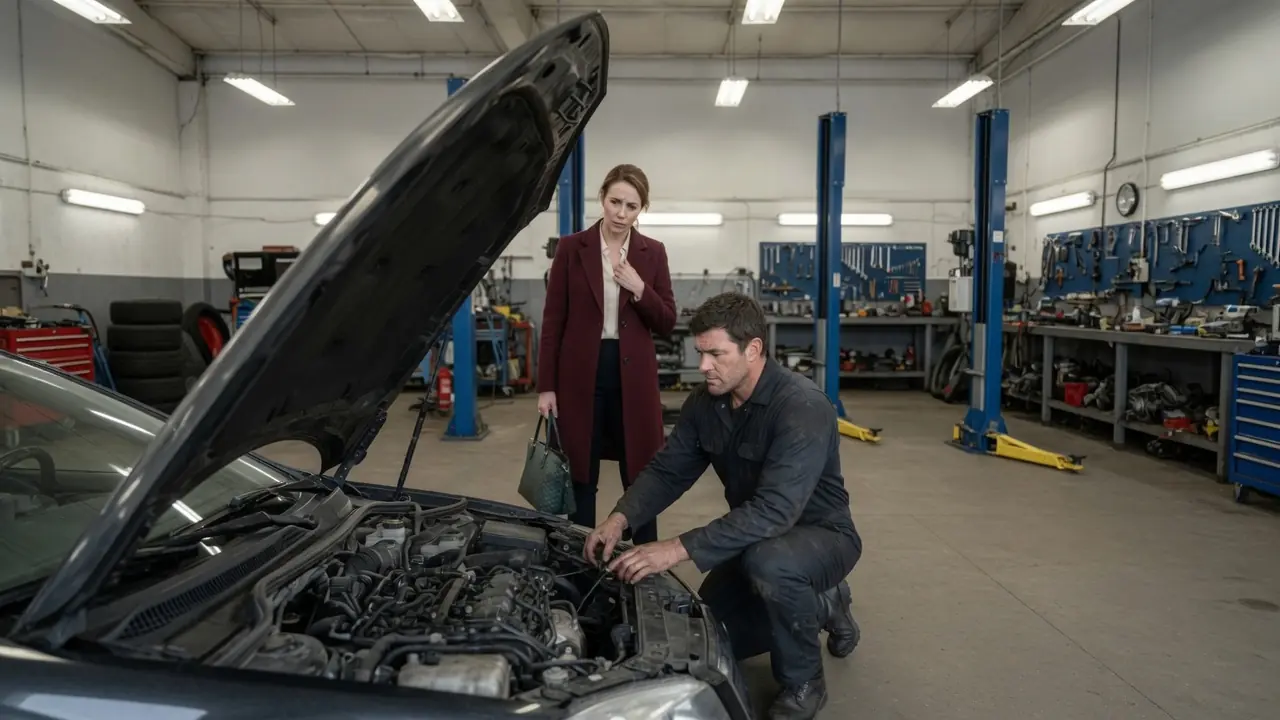
“Then we’ll write them down.”
“We?”
“If you want.”
Harper nodded.
They began a memory book that night.
Owen found them an hour later, writing Pancakes = moon cakes in purple marker.
He stood in the doorway, eyes wet.
Vivian looked up.
“Is this okay?”
Owen nodded.
He could not speak.
Love entered their life carefully.
Not like a storm.
Like someone stepping into a room where a child was sleeping.
Vivian did not move to Ashford Creek right away. Owen did not ask her to. She kept her company, her apartment, her board meetings, her responsibilities. But she also began shifting the shape of her days.
No calls after seven unless urgent.
No working Sundays.
One week each month spent in town.
Her assistant, Nina, was horrified for exactly three days, then admitted Vivian had become less terrifying and more effective.
Monroe Global eventually acquired a small manufacturing plant outside Ashford Creek.
Not because Vivian wanted to impress Owen.
Because the town needed jobs, the plant had potential, and she was tired of success that never touched anyone she could name.
At the ribbon-cutting, Owen stood in the back with Harper on his shoulders.
Vivian saw them while giving her speech and nearly lost her place.
She had spoken before crowds larger than that.
But no audience had ever mattered more.
After the ceremony, a reporter asked if she planned to bring more investment to rural communities.
Vivian looked across the room at Owen.
Then at the workers waiting with cautious hope.
“Yes,” she said. “There are places people overlook because they don’t look profitable fast enough. I’m learning that some things worth building take longer.”
Owen teased her later.
“That sounded philosophical.”
“I’m becoming well-rounded.”
“Dangerous.”
“Very.”
Their first real argument came in November.
It was about a school fundraiser, though of course it was not really about that.
Vivian offered to pay for everything.
New stage curtains.
Costumes.
Sound equipment.
Refreshments.
A professional photographer.
Harper’s teacher nearly fainted with gratitude.
Owen did not.
He waited until they were alone in the garage.
“You can’t buy the whole thing.”
Vivian blinked.
“It’s for the kids.”
“I know.”
“Then what’s the problem?”
“The problem is you still think fixing means funding.”
That stung.
“Money helps.”
“Yes. But sometimes people need to contribute, not be rescued.”
She crossed her arms.
“That sounds noble until the sound system fails.”
He leaned against the workbench.
“And this sounds like you being afraid people won’t need you unless you solve everything.”
Vivian’s face went cold.
Owen regretted the delivery, but not the truth.
“That was cruel,” she said.
“It was honest.”
“Honesty can still be cruel.”
He nodded.
“You’re right.”
She looked away.
Rain tapped against the garage roof, just like the first week.
“I don’t know how to be part of things without becoming useful,” she said finally.
Owen’s voice softened.
“You’re useful. But that’s not why we love you.”
The word hung there.
Love.
They had not said it yet.
Not directly.
Vivian turned back.
Owen looked startled by his own sentence.
Then he stepped into it.
“I love you,” he said. “Not your money. Not your company. Not what you can fix. You.”
Vivian’s eyes filled.
“I don’t know what to do with that.”
“You don’t have to do anything with it.”
“I love you too,” she whispered.
Owen smiled a little.
“See? You did something.”
She laughed through tears and crossed the space between them.
He held her in the garage where they had found each other twice.
Once by accident.
Once by choice.
For Christmas, Harper asked for three things.
A microscope.
A puppy.
And for Vivian to come to Christmas morning “without acting like a guest.”
The puppy was negotiated down to a future discussion.
The microscope appeared under the tree.
Vivian arrived Christmas Eve with one suitcase, cinnamon rolls from Boston, and a nervousness she tried to hide behind a red scarf.
Harper met her at the door.
“You’re late.”
“I’m five minutes early.”
“For guests. Family comes whenever.”
Vivian stood very still.
Owen came up behind Harper and placed a hand on her shoulder.
“She’s been practicing that line all day.”
“It was a good line,” Vivian said softly.
Harper took her hand.
“Come on. We saved you the good ornament.”
The ornament was a small silver car.
Harper had written on it in marker:
THE DAY YOUR CAR BROKED.
Vivian stared at it.
“Broked?”
“I’m keeping the spelling. It has personality.”
Owen kissed Vivian’s temple.
“She insisted.”
Vivian hung it on the tree.
Beside photos of Marissa.
Beside Harper’s kindergarten handprint.
Beside an old wooden star Owen’s father had carved.
No one had moved anything to make room.
They had simply found a place.
That, Vivian realized, was what belonging felt like.
Not replacing.
Joining.
Later that night, after Harper fell asleep on the couch surrounded by wrapping paper and cookie crumbs, Vivian and Owen stood on the porch watching snow fall.
The old garage lights glowed faintly in the distance down the road.
“You ever think about how strange it is?” Vivian asked.
“What?”
“My car breaking down here.”
He smiled.
“I think Gus towed you here because I was closest.”
“Very romantic.”
“I can lie if you want.”
She leaned against him.
“No. The truth is better.”
Owen wrapped his arm around her shoulders.
“I used to think I lost my chance with you fifteen years ago.”
“I used to think you forgot me.”
“Turns out we were both wrong.”
She looked up at him.
“And now?”
“Now your car is maintained properly, and my daughter thinks you’re family.”
Vivian smiled.
“That’s your answer?”
“For now.”
He reached into his coat pocket and pulled out a small envelope.
Vivian raised an eyebrow.
“What is that?”
“Not a proposal.”
She exhaled.
“Good.”
“Wow. Immediate relief. Very flattering.”
She laughed.
He handed her the envelope.
Inside was the old business card she had given him the first day, the one that said CEO, Monroe Global Holdings.
On the back, in Owen’s handwriting, were three words.
Because someone should.
Vivian looked up slowly.
“I kept thinking about what you said,” Owen told her. “That night at college. The garage. All of it. I don’t think love is always about big declarations. Sometimes it’s just showing up because someone should.”
Her hands trembled around the card.
“I don’t need a ring tonight,” he said. “I don’t need a promise you’re not ready to make. I just need you to know that if you ever want this life with us, the door is open.”
Vivian looked through the window.
Harper asleep under a blanket.
The Christmas tree glowing.
Marissa’s photo on the mantel.
A house full of old love and new space.
Then she looked at Owen.
“I want it,” she said.
His breath caught.
“I don’t know all the logistics. I don’t know how to balance the company and Ashford Creek and us. I don’t know how to be someone’s almost-stepmother, or how to love without trying to earn my place every day.”
Owen took her hand.
“We’ll learn.”
“I want Sundays here. And school recitals. And bad coffee. And Frank the suspicious rock. And I want you. I have wanted you longer than I understood.”
Owen pulled her close.
The snow fell around them.
Quiet.
Patient.
Like the world had waited fifteen years to finish a sentence.
One year later, Vivian’s Aston Martin broke down again.
This time, everyone suspected sabotage.
Not by an enemy.
By Harper.
“It is suspicious,” Vivian said, standing in the garage with her arms crossed.
Harper looked offended.
“I am a child.”
“You are a child with tools.”
Owen tried very hard not to laugh.
The problem turned out to be a loose cable.
A real one.
Harper was cleared after a dramatic investigation led by Frank the suspicious rock.
By then, Vivian had a desk in the garage office for the days she worked from Ashford Creek. It sat beside Harper’s art supplies and Owen’s invoices. The chair squeaked less now because Vivian had replaced it, though Owen insisted the old one had character.
The farmhouse porch had been repaired.
The manufacturing plant was open.
Harper’s memory book for Marissa had grown thick with stories, drawings, photos, and a page Vivian added carefully titled Things I Wish I Could Thank You For.
She had written:
Thank you for loving them first.
Owen found it one night and cried in the kitchen.
Vivian pretended not to notice until he reached for her.
Some love stories began with fireworks.
Theirs began with a dead battery.
Or maybe it began fifteen years earlier on wet library steps.
Or maybe it began every time one person saw another in trouble and decided not to keep walking.
Vivian never settled that question.
She only knew that the life she found in Ashford Creek did not make her smaller. It did not ask her to stop being powerful, ambitious, disciplined, or sharp. It only asked her to stop believing those things were the same as being safe.
Owen still fixed cars.
Vivian still ran companies.
Harper still named rocks after criminals.
And every Christmas, the silver ornament went on the tree.
THE DAY YOUR CAR BROKED.
Visitors laughed when they saw it.
Vivian always smiled.
Because the spelling was wrong, but the meaning was perfect.
That was the day the machine stopped.
The day the CEO had to ask for help.
The day a single father tightened a loose connection and unknowingly repaired a much older one.
The day the girl from the library and the boy who saved her finally stood in the same story again.
Not as memory.
Not as what-if.
As home.