Amara Johnson had exactly three things left from her father. A grease-stained notebook, the knowledge to fix any jet engine ever built, and the memory of his voice saying, “Listen, baby girl, machines never lie.” She’d been homeless for seven months when she slipped into Richard Hawthorne’s private hangar that night, just looking for somewhere dry to sleep. His team of million-dollar engineers stood baffled around his broken Gulfstream. But when she saw the tampered fuel line they’d all missed, when she recognized the deliberate sabotage designed to kill, she knew she couldn’t stay silent.
The billionaire’s jet was supposed to crash. Someone wanted him dead. And the only person who could stop it was a 15-year-old girl who’d learned to read engines like music, who everyone dismissed as worthless, and who was about to save them all with five simple words. If you permit, I will fix it.
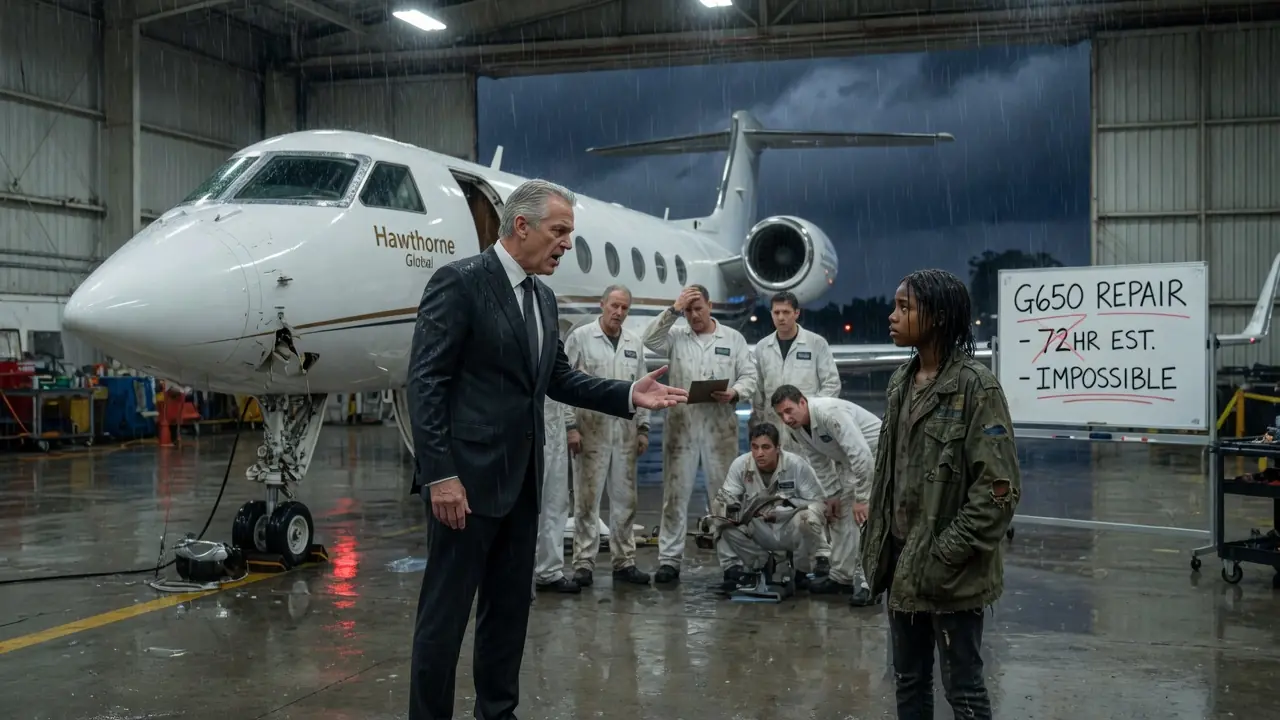
The rain hammered against the steel roof of the private hangar like a thousand angry fists. Richard Hawthorne stepped out of his black Bentley, his Italian leather shoes clicking against the wet concrete as his driver rushed to hold an umbrella over him. Everything about Richard screamed money, from the custom-tailored charcoal suit that cost more than most people’s cars to the Patek Philippe watch gleaming on his wrist. His jaw was set tight and his gray eyes blazed with the kind of fury that made Fortune 500 CEOs tremble in boardrooms.
Where is it? Richard barked at his assistant Marcus, who scurried alongside him with a tablet clutched to his chest. Bay three, Mr. Hawthorne. The engineers arrived two hours ago. Richard’s private jet sat in the center of the hangar like a wounded bird. The Gulfstream G650 was his pride, a seventy-million-dollar marvel of engineering that had carried him across continents to close deals that shaped industries. Now it sat useless, its left engine panel removed, exposing the intricate turbine mechanism within.
Around it, a team of engineers in pristine white coveralls huddled like surgeons around a dying patient. Report, Richard commanded as he approached. Dr. William Foster, the lead engineer, flown in from Seattle at considerable expense, straightened his glasses nervously. Mr. Hawthorne, we’ve run every diagnostic. The turbine assembly shows signs of mechanical failure, but the exact cause remains elusive.
Elusive. Richard’s voice dropped to a dangerous whisper. I pay you three hundred thousand a year to make problems disappear. Not to tell me they’re elusive. Sir, with all due respect, this isn’t a standard malfunction. The compressor stages are intact. The combustion chamber shows no damage, but the engine simply won’t maintain rotation. I don’t want poetry, Foster. I want my plane fixed.
Richard turned to address the other five engineers. You’re supposedly the best in the industry. MIT, Stanford, Caltech. I see degrees worth more than small nations’ GDP standing around my broken plane doing nothing. The hangar had begun to fill with curious onlookers, maintenance workers, cleaning staff, even some of the other pilots whose smaller aircraft shared the facility. They all gathered at a respectful distance, drawn by the spectacle of the mighty Richard Hawthorne’s rare vulnerability.
Whispers rippled through the crowd like wind through grass. I heard he missed the Tokyo merger because of this. That’s a fifty-million-dollar deal down the drain. He fired his last mechanic for using the wrong grade of oil. Outside, the rain intensified, and with it came an unexpected visitor. A small figure slipped through the side entrance, moving like a shadow along the wall.
Amara Johnson was fifteen, though hunger had made her look younger. Her dark skin was ashen from cold. Her clothes, a torn army jacket three sizes too big and jeans held together with safety pins, were soaked through. Her hair, once carefully braided by loving hands, now hung in matted tangles. She hadn’t meant to intrude. The hangar’s warmth had drawn her like a moth to flame. For three days, she’d eaten nothing but half a sandwich from a dumpster behind a deli. A security guard at the main gate had been distracted by the commotion, and she’d seized her chance to find shelter.
Amara pressed herself against the wall behind a tool cabinet, trying to become invisible. But her eyes, sharp and intelligent despite her circumstances, were drawn to the exposed engine. Even from thirty feet away, she could see the complex arrangement of titanium and steel, the precise geometry of the compressor blades, the elegant spiral of the turbine shaft.
Perhaps we need to import the replacement assembly from the manufacturer, another engineer suggested. It would take three days. But three days, Richard’s laugh was bitter. Do you have any idea what three days cost me? Every hour this plane sits here, I’ll lose opportunities. I lose deals. I lose respect. Mr. Hawthorne, Foster tried again, consulting his tablet. The bearing housing shows unusual wear patterns. Without proper inspection equipment—
You have a million dollars’ worth of equipment spread across this hangar, Richard gestured at the diagnostic machines, the computerized scanning tools, the precision instruments. Are you telling me that’s not enough? As the argument escalated, Amara found herself leaning forward. The bearing housing. She could see it from here. The way the light reflected off its surface. Something was wrong with the angle, the way it sat in relation to the compressor assembly.
Her lips moved silently, forming words learned years ago in a different life. Compressor blade clearance, bearing race alignment, thermal expansion coefficient. One of the younger mechanics, a stocky man named Brad, noticed her first. Hey, what’s that kid doing here? All eyes turned to Amara. She froze, her fight-or-flight instinct screaming at her to run, but the rain outside was cold and she was so tired.
Security, Brad called out. We got a trespasser. Wait, another mechanic laughed. That’s just some homeless kid. Look at her. Probably looking for something to steal. What’s the little street rat going to do? Fix a jet engine? Brad mocked, and the crowd erupted in nervous laughter. The kind that comes when people need to release tension.
Richard turned his cold gaze on Amara. She stood there, water still dripping from her clothes, creating a small puddle on the pristine hangar floor. Most people would have run from that stare, but Amara had survived worse than angry rich men. Get her out of here, Richard said dismissively, already turning back to his engineers.
That’s when Amara saw it clearly. The micro-misalignment in the high-pressure turbine section. It was subtle, maybe two millimeters off optimal, but it would cause exactly the kind of failure they were describing. The words tumbled out before she could stop them. Your N2 rotor isn’t tracking true. The high-pressure turbine shaft has a lateral displacement, probably from thermal stress during your last hot section inspection.
The hangar fell silent. Even the rain seemed to pause. Richard turned back slowly. What did you say? Amara swallowed hard. Her voice came out stronger this time. If you permit, I will fix it. The laughter that followed was explosive. Brad slapped his knee. Foster removed his glasses to wipe tears of mirth. Even some of Richard’s business associates who had arrived to witness the chaos chuckled at the absurdity.
This is rich, one of them said. Richard Hawthorne’s million-dollar team stumped by a problem a street child thinks she can solve. But Richard wasn’t laughing. He studied Amara with the same intensity he used to evaluate hostile takeover targets. There was something in her eyes, not arrogance, but quiet certainty. The same look he’d had when everyone said he couldn’t build his empire from nothing.
You know about jet engines? he asked. I know about this one, Amara replied, stepping forward despite every instinct telling her to flee. It’s a Rolls-Royce BR725. Thrust rating of sixteen thousand nine hundred pounds. High-pressure compressor with ten stages. Your problem isn’t in the components. It’s in the alignment.
Foster scoffed. Mr. Hawthorne, surely you’re not going to entertain— How do you know this? Richard interrupted. Amara’s jaw tightened. Does it matter if I can fix it? Everything matters, Richard said. But right now, what matters most is that you’re the first person in six hours who’s offered a specific diagnosis instead of excuses.
Richard’s expression hardened. They’ll say I get results while others make excuses. He turned back to Amara. You have one chance. If you’re wrong, you leave immediately. If you’re right— If I’m right, you let me finish the job, Amara said, surprising herself with her boldness. The crowd murmured. This was unprecedented. Richard Hawthorne didn’t make deals with homeless teenagers.
Sir, Foster intervened. I must protest. This is a seventy-million-dollar aircraft. Insurance liability alone— My concern, not yours, Richard finished. Stand aside. The tension in the hangar could have been cut with a turbine blade. Amara stood her ground as fifty pairs of eyes bore into her. Some were amused, others hostile, but most were simply bewildered.
Explain, Richard commanded, crossing his arms. If you know so much about my engine, tell me exactly what you think is wrong. Amara took a breath, her mind racing through years of accumulated knowledge. Your engineers are looking for component failure, but that’s not it. When the engine was last serviced, someone torqued the high-pressure shaft coupling to spec, but they didn’t account for the thermal expansion variance in your particular model. The BR725 runs hotter than the older 710s. Over time, that extra heat causes the shaft to develop a microscopic offset. It’s maybe two and a half millimeters, but at ten thousand RPM, that becomes a harmonic vibration that triggers the engine control unit to shut down.
Foster’s mouth fell open. That’s—how could you possibly— Furthermore, Amara continued, emboldened by the shock on the expert’s face, I’d bet your maintenance logs show intermittent EGT spikes over the last fifty flight hours. Small ones, maybe twenty degrees over normal, lasting just seconds. Your pilots probably wrote them off as sensor glitches.
Richard pulled out his phone and called his chief pilot. Johnson, pull the engine logs for the last fifty hours. Look for EGT anomalies. There was a pause. Then Richard’s eyebrows rose. How many? I see. Send them to Foster’s tablet. Foster’s tablet pinged. His face went pale as he scrolled through the data. Seventeen instances of brief temperature spikes, exactly as she described.
The laughter had died completely now. In its place was an uncomfortable silence. Who are you? Victoria demanded, her voice sharp with suspicion. What’s your angle here? Amara’s hands clenched at her sides. And for a moment she was eight years old again, standing in a different hangar, watching her father’s patient hands work on a similar engine.
Amara, sweetheart, come here, James Johnson had said, his voice warm with pride. He was senior mechanic at Detroit Metropolitan Airport, one of the few Black engineers to achieve that position in the 1990s. See this? This is the heart of the bird. Every piece has to sing in harmony or the whole song falls apart. Little Amara had climbed onto the work platform, her small hands reaching for the tools. Like your saxophone, Daddy. Exactly like that, baby girl. Here, feel this. He placed her hand on the engine casing. Close your eyes. Feel the metal. It’ll tell you its secrets if you listen close enough.
For six years, he taught her everything. After school, while other kids played video games, Amara studied turbine diagrams. Weekends meant trips to the airport where she’d watch her father resurrect dying engines with the skill of a surgeon and the soul of an artist. She absorbed it all. Every technique, every trick, every hard-won piece of wisdom. Then came the layoffs, the insurance crisis, the medical bills from her mother’s cancer. The day they lowered James Johnson into the ground, Amara had stood in the rain, much like today’s rain, and promised him she’d remember everything.
My angle, Amara said, snapping back to the present, is that I’m cold, I’m hungry, and I know how to fix your plane. That’s all. This is ridiculous, Preston sneered. She probably overheard the engineers talking and is just repeating. Then let her fail, Richard interrupted his son. If she’s lying, we’ll know soon enough.
Brad, the mechanic who’d first spotted her, stepped forward aggressively. Mr. Hawthorne, union rules clearly state that only certified personnel can work on— Union rules also state that consultants can be brought in at ownership’s discretion, Richard countered. She’s a consultant. Pay rate of— He looked at Amara. One dollar plus dinner, Amara added quietly. Despite himself, Richard almost smiled.
Purdue Grant Ellison, Richard’s longtime business rival, had been watching from the VIP observation area. He descended now, his silver hair gleaming under the hangar lights. Richard, old friend, I admire your creativity, but surely you realize the liability here. If something goes wrong, if this child damages the engine further, your insurance will be void. Let me help. I can have my team here in an hour.
How convenient that you’re here, Grant, Richard observed coldly. Almost like you were expecting my plane to be grounded. Grant spread his hands innocently. I was in the area. Heard about your troubles. What are friends for? Amara watched the interplay between the two men and filed it away. She’d survived on the streets long enough to recognize predators circling wounded prey.
Mr. Hawthorne, she said, drawing his attention back, I’ll need specific tools. Number twelve and fourteen combination wrenches, a torque wrench calibrated to inch-pounds, not foot-pounds, a dental mirror, and a frequency harmonic analyzer if you have one. Foster laughed bitterly. A dental mirror? This isn’t a cavity, girl. No, but you need to see the back of the coupling housing without removing the entire assembly, unless you want to spend another six hours in disassembly.
Richard nodded to the mechanics. Get her what she needs. As the tools were gathered, Amara approached the engine. Up close, it was even more beautiful than she’d imagined. Her father had worked on older models, but the principles were the same. She ran her hand along the casing, feeling for vibrations, temperature variations, anything the million-dollar diagnostic machines might have missed.
It’s warm here, she murmured, pressing her palm against a spot near the bearing housing. Warmer than it should be. There’s friction where there shouldn’t be. She grabbed a step ladder and climbed up to eye level with the exposed turbine. The mechanics watched in amazement as this teenage girl in torn clothes began to work with the precision of a veteran engineer. Her movements were deliberate, economical. No wasted motion.
Someone hand me the mirror, she said without looking back. Brad reluctantly passed it to her. She angled it into the housing using a pen light to illuminate the hidden spaces. There, she breathed. Look at this. She held the mirror steady and had Foster look. His expression shifted from skepticism to shock. Scoring on the rear bearing race. How did we miss that? Because you were looking where the computers told you to look, Amara replied, not unkindly. Sometimes you have to trust your hands more than your readouts.
As she began the delicate process of loosening the coupling, Richard found himself moving closer. There was something mesmerizing about watching her work. Her hands, small and scarred from street living, moved with a grace that spoke of deep knowledge and deeper love for the craft. You learned this from someone, he said. It wasn’t a question.
Amara’s hands paused for just a moment. My father. He was the best mechanic in Detroit, could diagnose an engine by sound alone. He died when I was eleven, and my mother from cancer two years before him. Richard absorbed this information. The girl was an orphan. Yet here she was displaying expertise that humbled his million-dollar team.
Victoria approached, her heels clicking sharply. Richard, this is insane. What if she’s some kind of corporate spy? What if Grant sent her? Did I send the rain, Victoria? Grant called out with false joviality. Give me some credit. If I wanted to sabotage Richard, I’d be far more subtle. As Amara worked, she began to explain each step, partly to maintain transparency, partly because teaching helped her focus.
The coupling needs to be loosened in a specific sequence. If you do it wrong, you create uneven pressure that makes the misalignment worse. It’s like tuning a piano. You can’t just tighten one string and expect harmony. One of the younger engineers, a woman named Sarah, moved closer. How do you know the loosening sequence? That’s proprietary information.
Amara smiled slightly. Rolls-Royce based it on the old Pratt and Whitney pattern. Just reversed every third bolt. If you know the history, you know the pattern. For twenty minutes, she worked in relative silence. The crowd growing larger as word spread through the airport that something extraordinary was happening. The homeless girl and the billionaire’s jet. It sounded like a fairy tale. Except fairy tales didn’t usually smell like motor oil and desperation.
Finally, Amara stepped back. I need to check something. She pulled out a grease-stained notebook from her jacket, one of the few possessions she’d managed to keep through months of homelessness. The pages were filled with diagrams, equations, notes in her father’s handwriting, and her own. Foster peered over her shoulder. His gasp was audible. These calculations—they’re brilliant. This is doctoral-level engineering.
My dad didn’t have a doctorate, Amara said quietly. But he understood engines the way poets understand words. She found the page she was looking for, a diagram of harmonic frequencies in turbine assemblies. See, if the shaft is offset by two millimeters, it creates a standing wave at—she did quick mental math—eight thousand seven hundred forty-seven RPM. That’s right in your normal cruise power setting.
Richard pulled Foster aside. Is she right? Foster nodded slowly. I’ve been doing this for twenty years, Mr. Hawthorne. That girl knows more about harmonic resonance in jet engines than most of my PhD candidates. Then why is she homeless? Why don’t you ask her? But Richard didn’t need to ask. He’d built his empire by reading people. And he could read Amara’s story in the careful way she handled the tools, the reverent way she touched the engine, the way she protected that notebook like it contained the crown jewels. This was a girl who’d lost everything except knowledge. And she’d clung to that knowledge like a life raft in a storm.
All right, Amara announced, stepping back from the engine. First phase is complete. The coupling is loosened. Now I need to realign the shaft. But—she hesitated. But what? Richard demanded. It’s a two-person job. Someone needs to hold the alignment gauge while I adjust the mounting points. And it has to be someone who understands the feel of it. Gauges only tell you so much.
The engineers looked at each other. None wanted to be the one to assist the homeless girl who was showing them up. I’ll do it, Richard said suddenly. Everyone stared. Richard Hawthorne, who hadn’t turned a wrench since his youth, who wore suits worth more than cars, was volunteering to get his hands dirty. Sir, Marcus, his assistant, stepped forward. Your conference call with Tokyo— Can wait.
Richard took off his suit jacket, handed it to Marcus, and rolled up his sleeves. Tell me what you need me to do. Amara studied him for a moment, then nodded. Hold this gauge against the housing. When I tell you, press firmly, but don’t force it. You’ll feel when it’s right, like when a key slides into a lock.
As they worked together, an odd chemistry developed. Richard, used to barking orders, found himself following Amara’s quiet instructions. Amara, used to being invisible, found herself directing a billionaire. Feel that? she asked as the shaft shifted slightly. Yes, it’s different. Smoother. That’s what we want. Hold it right there.
As she made the final adjustments, Richard asked, Where have you been living? Around. That’s not an answer. It’s the only one I have. She tightened another bolt. There. Try the gauge now. Richard pressed, and this time, the resistance was gone. The gauge slid smoothly into place. Perfect, Amara breathed. Now we can—
A loud crack interrupted her. One of the precision tools had shattered. Amara examined it and frowned. This was compromised. See the stress fractures? Someone over-tightened it earlier. Brad shifted uncomfortably. Must have been defective. But Amara caught the guilty look he exchanged with Foster. She filed that away too. The streets had taught her that sometimes the most dangerous enemies were the ones who smiled while sharpening their knives.
No matter, she said. I can work around it. As she continued, Richard’s son, Preston, approached. Father, you’re humiliating us. Mother’s friends are already texting about this circus. Then maybe Mother needs better friends, Richard replied without looking at his son. You’re destroying our reputation for what? To prove a point? No, Richard said. Watching Amara work. To fix a plane, but maybe also to remember something I’ve forgotten.
What? That expertise doesn’t always come with credentials. Sometimes it comes with experience and heartbreak and determination that can’t be taught in any university. Amara pretended not to hear, but his words warmed her more than the hangar’s heating system. For the first time in months, she felt seen, not as a problem to be solved or a nuisance to be removed, but as someone with value.
The engine was almost ready for testing now. Just a few more adjustments, a few more careful manipulations of metal and mathematics. But as Amara worked, she noticed something else. Fresh scratches on a fuel line that hadn’t been there before. Someone had been at the engine while she was getting tools. Her eyes found Grant Ellison, who was typing rapidly on his phone, and Brad, who kept checking his watch. Something was wrong. This wasn’t just about fixing an engine anymore.
Mr. Hawthorne, she said quietly, I think we need to talk privately. Richard saw the concern in her eyes and nodded. Everyone, take five. Clear the immediate area. As the crowd reluctantly dispersed, Amara showed him the scratches. Someone’s trying to ensure I fail. If we run the engine now, it’ll seem like I caused a fuel leak.
Richard’s expression darkened. You’re certain? I’ve seen sabotage before. My father lost his job because someone wanted him gone and made it look like mechanical error. I know what deliberate damage looks like. Can you fix it? Yes, but Mr. Hawthorne, someone in this hangar wants your plane to stay broken. The question is why?
Richard looked across the hangar at Grant Ellison, then at his own team. That, young lady, is a very good question. And when you fix my engine, we’re going to find out the answer. Amara nodded and returned to work. The rain continued to pound overhead. But inside the hangar, a different storm was brewing, one that would test not just Amara’s knowledge, but her courage, her integrity, and her ability to navigate the dangerous waters of wealth and power. The first spark of respect had been lit. Now she had to tend that flame carefully, or watch it be extinguished by those who preferred their darkness.
The five-minute break Richard had called stretched on as Amara carefully examined the deliberately damaged fuel line. She’d already started working on a temporary fix using a specialized sealant from her father’s old kit, one of the few things she’d managed to keep through months of sleeping in shelters and abandoned buildings. The hangar had grown eerily quiet, with small groups of people whispering in corners, choosing sides in a battle they didn’t fully understand yet.
Richard stood beside her, sleeves still rolled up, watching her work with an intensity that made others nervous. He’d built his empire by recognizing talent and threats in equal measure. And this girl represented both in ways he was still processing. The fracture pattern, Amara explained quietly, running her finger along the line. It’s too precise. Someone used a specialized cutting tool, probably while everyone was watching me work on the coupling. They counted on the chaos to provide cover.
How long have you been homeless? Richard asked suddenly, the question seeming to come from nowhere. Amara’s hands didn’t pause in their work. Seven months, two weeks, four days. You keep count? Wouldn’t you? She applied another layer of sealant with practiced precision. Every day matters when you’re trying to survive. Every day is a victory or a defeat.
Before Richard could respond, the main hangar doors burst open. Victoria Hawthorne returned, this time accompanied by someone who made Amara’s stomach tighten with a different kind of recognition. Detective Raymond Price from the youth services division. There she is, Victoria announced triumphantly. The runaway who’s been trespassing in private facilities across the city.
Detective Price, a heavy-set man with kind eyes that belied his stern expression, approached slowly. Amara Johnson, I’ve been looking for you. You missed three check-ins with your social worker. Richard stepped between them. The girl is working. Whatever this is about can wait. I’m afraid it can’t, Mr. Hawthorne, Price replied. She’s a minor without guardian supervision. There are protocols.
Then I’m supervising her, Richard said flatly. She’s in my employ. Victoria laughed bitterly. You can’t just claim random children, Richard. This isn’t one of your acquisitions. While the adults argued, Amara kept working. She’d learned long ago that becoming invisible during conflict was sometimes the best strategy. But her hands trembled slightly as she worked. Youth services meant group homes, meant being locked in with kids who’d steal her father’s notebook, meant losing the last connection she had to her past.
Actually, Grant Ellison interjected smoothly, descending from his observation perch, I think we should all be more concerned about the liability issue here. A minor working on dangerous equipment without proper authorization. Richard, your insurance company will have a field day. Since when do you care about my insurance premiums, Grant? Since you started endangering children for your ego, Grant replied with false concern. Detective, I think you should remove the girl immediately. For her own safety.
Amara finally looked up. I’m safer here than I’ve been in months. That’s not for you to decide, Victoria said coldly. You’re a child. I’m a child who knows more about this engine than your entire team of experts, Amara shot back, surprising herself with her boldness. And right now, I’m the only one who can fix it.
Preston, who had been texting furiously in the corner, looked up with a smirk. Actually, that might not be true. Dad, Ellison Aerospace just announced they’re sending their emergency response team. They’ll be here within the hour. Richard’s eyes narrowed. How convenient. Grant, you wouldn’t happen to know anything about that. I make it my business to be prepared, Grant replied smoothly. Unlike some people who bet their reputation on street children.
The lead engineer, Foster, cleared his throat. Mr. Hawthorne, perhaps we should consider Mr. Ellison’s offer. The liability issues alone— The liability, Amara interrupted, standing up and wiping her hands on a rag, is that you have a subtly misaligned turbine shaft that’s creating harmonic vibrations at cruise speed. The bigger liability is that someone in this hangar deliberately damaged the fuel line to make it look like my repair caused a leak. And the biggest liability is that Mr. Ellison here seems to know an awful lot about your engine problems before anyone tells him.
The hangar fell silent. Grant’s friendly mask slipped for just a moment, revealing something colder underneath. That’s quite an accusation from someone with no credentials, he said. It’s not an accusation, it’s an observation, Amara replied. She pulled out her notebook and flipped to a page covered in timestamps. You arrived forty-three minutes after Mr. Hawthorne. You mentioned the Tokyo merger before anyone here discussed it. You knew about the specific model of engine before looking at it, and your emergency response team was mobilized before Mr. Hawthorne even decided to let me try.
Detective Price looked between them, his investigator’s instincts clearly triggered. What exactly is going on here? What’s going on, Richard said slowly, pieces clicking into place, is corporate sabotage. Grant, you knew my plane would be grounded today. Prove it, Grant challenged. I don’t have to prove it. She will.
Richard nodded to Amara. Continue your work. She’s coming with me, Detective Price insisted. Minor protection laws can be waived in cases of specialized employment. A new voice interrupted. Everyone turned to see an elderly Black woman entering the hangar, using a cane but walking with determined dignity. Amara, child, you’ve led me on quite a chase.
Amara’s eyes widened. Mrs. Washington— Judge Washington, the woman corrected gently. Retired, but still capable of signing emergency custody waivers. She turned to Richard. Mr. Hawthorne, I understand you wish to employ my young friend here. You know her? Richard asked. I knew her father. James Johnson was the best mechanic Detroit ever produced and the most honest man I ever met. He fixed my husband’s Cessna for twenty years, often for free when times were tough.
She looked at Amara with warm eyes. I’ve been looking for you since you ran from the group home, child. They wanted to send me to agricultural school, Amara said quietly. Said I needed to learn a practical trade. And fixing jet engines isn’t practical? Judge Washington laughed. Detective Price, I’ll take responsibility for Amara. Mr. Hawthorne, if you’re willing to provide employment and supervision, I can make this legal within the hour.
Victoria stepped forward. You can’t be serious. Richard, think about our reputation. I am thinking about it, Richard replied coldly. I’m thinking about what it means to turn away talent because it comes in an unexpected package. I’m thinking about what it says about us that we’d rather trust credentials than capability. And I’m thinking, Amara added, returning to the engine, that we have about thirty minutes to finish this before Mr. Ellison’s team arrives and muddies the waters.
She reached for a specialized wrench, but it slipped from the tool tray. Brad had loosened it earlier, hoping she’d fail, but Amara caught it mid-fall. Her reflexes honed by months of survival. She looked directly at Brad, who couldn’t meet her eyes. Guilt is heavy, she said simply. My father used to say it makes your hands shake. Is that why you can’t hold your tools steady, Brad?
Brad’s face reddened. I don’t know what you’re talking about. The torque wrench you handed me earlier was calibrated wrong. Off by fifteen percent. Enough to cause failure, but subtle enough to look like my error. The mirror had a hairline crack that would have shattered if I’d applied pressure. Small sabotages, but sabotage nonetheless.
Foster stepped away from Brad, realization dawning. You’ve been working against us? Not against you, Brad muttered. Just ensuring things went a certain way. How much did Grant pay you? Richard asked bluntly. Brad’s silence was answer enough.
Amara continued working, her movements now urgent but still precise. The real damage isn’t in the shaft alignment, she said. That’s fixable. The real damage is in the combustion chamber’s pressure relief valve. Someone replaced it with one rated for lower temperatures. It would fail catastrophically at altitude.
Richard went very still. That could have killed you. Yes, Amara met his eyes steadily. This isn’t just about grounding your plane, Mr. Hawthorne. Someone wanted to ensure that when it flew again, it would be for the last time. Grant’s composure finally cracked. That’s an outrageous accusation. I demand— You demand nothing in my hangar, Richard cut him off. Judge Washington. Detective Price. I believe we need to have a different conversation about crime and punishment here.
As the adults erupted into arguments and accusations, Amara kept working. She had twenty minutes now, maybe less. Her father’s voice echoed in her memory. When the world gets loud, baby girl, that’s when you need to be most precise. Let them shout. You just fix what’s broken. She removed the compromised valve, examining it under her pen light. The part number had been filed off, but she recognized the inferior manufacturing. Her fingers flew across the tools, selecting, adjusting, correcting.
Preston approached hesitantly. How do you do that? Stay focused when everything’s falling apart. Amara glanced at him. When you’ve lost everything that matters, you learn to hold tight to what you’re doing in the moment. It’s all you have. I’ve never lost anything, Preston admitted quietly. Then you’re lucky, Amara replied without bitterness. But it also means you’ve never had to find out how strong you really are.
She located a replacement valve in the spare parts inventory, the correct one hidden behind inferior parts someone had deliberately placed in front. As she installed it, she explained each step to Preston, who found himself genuinely interested for the first time in his life. See how it seats? There’s a specific feel when it’s right. Not too tight, not too loose, like a handshake. Firm, but not crushing.
My father never taught me anything like this, Preston said. He’s teaching you now, Amara replied, nodding toward Richard, who was standing guard over her work, protecting her from the chaos swirling around them. He’s teaching you that merit matters more than appearance. The arguments had reached a crescendo when Amara stood back from the engine and announced, Ready for initial test.
The hangar fell silent. Everyone—from the furious Victoria to the guilty Brad to the scheming Grant—turned to watch. Clear the area around the engine, Amara instructed with quiet authority. Minimum safe distance is thirty feet for ground testing. Richard gave the order and people moved back. Amara made her way to the engine control panel, her father’s notebook tucked under her arm. She looked so small standing there, a child among giants. But there was something in her bearing that commanded respect.
Initiating start sequence, she announced. Her fingers moved across the controls with practiced ease. Fuel pressure nominal. Electrical systems online. Beginning ignition sequence in three, two, one. The engine whined to life. First a whisper, then a hum, then a steadily building roar that filled the hangar with the sound of precisely controlled power. The monitoring screens lit up with data, all green, all within normal parameters.
For thirty seconds, the engine ran perfectly. Then Amara powered it down, the sound diminishing until only the tick of cooling metal remained. The silence that followed was deafening. Then slowly Richard began to clap. The sound echoed in the hangar, solitary at first, then joined by Judge Washington, then Preston, then even some of the mechanics who had mocked earlier. The applause built until it filled the space, washing over Amara like a wave.
But she didn’t smile. Not yet. That was just the initial test, she said, raising her voice to be heard. The real test is sustained operation under load. But there’s a problem. The applause died. What problem? Richard asked. Amara walked back to the engine and pointed to a section near the fuel manifold. This wasn’t here before. Someone added a secondary fuel line while we were arguing. It’s designed to look like part of my repair, but it’s not. If we run the engine at full power, it’ll create a fuel spray that’ll look like catastrophic failure.
Grant stepped forward aggressively. This is ridiculous. She’s obviously covering for her own mistakes. Mr. Ellison, Detective Price interrupted, I’m going to have to ask you to step back. This is now a crime scene. Crime scene? Grant laughed nervously. For what crime? Attempted murder, for starters, Price replied. If what this young lady says is true, someone tried to engineer a fatal aircraft failure. That’s federal jurisdiction.
As if on cue, the hangar doors opened again. This time, it wasn’t Grant’s team that entered, but federal investigators. Richard had made a call while everyone was distracted. Mr. Ellison, the lead investigator said, showing his badge, we need to ask you some questions. While Grant was being questioned, Amara carefully removed the false fuel line. She worked in silence now, the crowd watching her every move. When she finished, she turned to Richard. It’s ready. But Mr. Hawthorne, you should know whoever did this has been planning it for a long time. This isn’t just about one plane or one deal.
Richard nodded grimly. I’m beginning to understand that. Can you make it flight ready? I can make it safe, Amara corrected. Flight ready requires full inspection and certification. But safe? Yes. The engine will run true. Then do it.
As Amara returned to work, Victoria approached her husband. Richard, I’m leaving. This circus, this demonstration of yours, it’s too much. It’s necessary, Richard replied without looking at her. Necessary? Trusting our lives to a homeless child is necessary? Recognizing talent, regardless of its source, is necessary. Protecting whistleblowers is necessary. Doing the right thing, even when it’s uncomfortable, is necessary.
Victoria shook her head. You’ve changed. No, Richard said, watching Amara work. I’m remembering who I was before I became what we are. Victoria left without another word, her heels clicking away in the silence. Preston remained, standing beside his father. Mom’s not coming back, is she? Probably not. Are you okay with that?
Richard considered the question. I’m okay with being someone you can respect again. Preston nodded slowly, then surprised them both by saying, Teach me like she’s teaching me. I want to understand what you built, not just inherit it. For the first time in years, Richard put his arm around his son’s shoulders.
Meanwhile, Amara had completed her final adjustments. She called for another test, this one longer, more comprehensive. The engine ran for five minutes, ten, fifteen. Every reading stayed perfect. But as she was powering down, she noticed something that made her blood run cold. Smoke. Just a wisp from a section she hadn’t touched.
Everyone back! she shouted. Now the evacuation was swift. Amara grabbed a fire extinguisher and approached carefully. The smoke was coming from a timer-activated incendiary device. Crude but effective. They really wanted this plane destroyed, she said, disabling the device with steady hands. This was the backup plan. If the engine failure didn’t work, this would have.
The federal investigator examined the device. This is evidence of conspiracy. Mr. Hawthorne, we’re going to need to place your aircraft under protective custody. After, Richard said firmly. After she finishes what she started. Sir, I can’t allow— You can and you will, Judge Washington interrupted. This child has risked her safety to prevent a tragedy. The least we can do is let her complete her work.
The investigator reluctantly agreed. As the sun began to set outside the hangar, casting long shadows across the floor, Amara made her final repairs. The sabotage had been extensive, but not irreversible. Each correction she made was witnessed, documented, photographed. This wasn’t just repair now. It was evidence.
Grant Ellison was led away in handcuffs, but not before making one last statement. You think you’ve won, Richard? This goes deeper than you know. I’m just one player in a bigger game. Then we’ll find the other players, Richard replied coldly. Brad, the mechanic who’d been turned, broke down completely. He threatened my family, he sobbed. Said if I didn’t help, my kids would suffer. I never meant for anyone to get hurt.
But someone could have been killed, Amara said quietly. My father always said that small compromises lead to big tragedies. As evening approached, Amara completed her work. The engine was not just repaired. It was better than before. She’d found and fixed problems that had been accumulating for years, issues that no one else had noticed or bothered to address.
It’s done, she announced simply. Richard approached her. Name your price. Already did. That’s not enough. You saved my life. Probably my son’s life, too, since he sometimes flies with me. Amara looked at him steadily. I don’t want your money, Mr. Hawthorne. I want something else. Name it. A job. A real job with training and certification. I want to finish what my father started teaching me. I want to become the engineer he always believed I could be.
Richard extended his hand. Deal. But first, dinner. And not just any dinner. You’re eating at my table in my home as my guest of honor. Preston stepped forward. Our guest of honor. As they shook hands, the billionaire, his son, and the homeless girl who’d saved them all. The engine behind them ticked quietly, metal cooling in the evening air. It was the sound of something broken that had been made whole, something dangerous that had been made safe.
But Amara knew this wasn’t over. Grant’s warning echoed in her mind. There were other players, other games. The engine was fixed, but the larger machine of corporate corruption was still running. Judge Washington approached, leaning on her cane. Your father would be so proud, child. He taught me to fix things, Amara replied. But I think Mr. Hawthorne is going to teach me something else. What’s that? How to fight back against the people who break things on purpose.
Richard overheard and nodded grimly. That’s a lesson we’ll learn together. As they prepared to leave the hangar, Amara took one last look at the engine. In its polished surface, she could see her reflection, distorted, but recognizable. She wasn’t the same girl who’d snuck in seeking shelter from the rain. She was someone who mattered now, someone whose knowledge had value, someone who could stand up to power and win.
But she also saw the shadows gathering behind her reflection. The other players Grant had mentioned, the deeper game that was still being played. Mr. Hawthorne, she said suddenly, we need to check your other planes. What? If they sabotaged this one, they might have sabotaged others. This might not have been about one plane. It might have been about your entire fleet.
Richard’s face went pale. He immediately called his security team, ordering immediate inspections of all his aircraft. As they waited for confirmation, Amara allowed herself a small moment of pride. She’d done what her father had taught her. She’d fixed what was broken, but more than that, she’d exposed those who broke things deliberately. The rain had stopped. Through the hangar windows, stars were beginning to appear.
Amara thought of her father, hoping he could somehow see what she’d accomplished. Thank you, she whispered to the memory of him, for teaching me to listen. The engine sat silent now, but ready. Ready to fly, ready to soar, ready to carry its passengers safely through the sky, just like Amara herself. No longer grounded, no longer broken, but ready to rise.
The federal investigators had barely left with Grant Ellison when Amara noticed something that made her stomach drop. The engine she’d just repaired was making a sound, subtle, almost imperceptible, but wrong. She held up her hand sharply, and everyone in the hangar froze. Nobody move, she commanded, her voice carrying an authority that seemed impossible for someone her age. Something’s different.
She approached the engine slowly, like approaching a wounded animal. There—a thin line of fuel forming along a seam that had been perfect just minutes ago. But this wasn’t from her work. The cut was too fresh, too deliberate. Everyone back now. Amara slammed her palm on the emergency cut-off button. The hangar’s ventilation system roared to life, clearing any potential fumes. Mr. Hawthorne, we need your security footage from the last ten minutes. Someone’s still here.
Richard’s jaw tightened. He barked orders to his security team while Amara laid the compromised fuel line on a clean white cloth, examining it under a pen light. The cut was surgical, made with a specific type of blade that would leave traces of metallic residue. This isn’t Brad’s work, she announced. He’s sloppy when he’s nervous. This is professional.
The head mechanic, Foster, who’d been silent since Grant’s arrest, stepped forward aggressively. You’re saying one of us did this after everything that just happened? I’m saying, Amara replied calmly, rolling the line under the light to show the cut angle, that whoever did this is left-handed, has surgical-grade tools, and knew exactly where to cut to make it look like heat-stress failure. The blade went in at a seventeen-degree angle. That’s muscle memory from someone who’s done this before.
Preston had been filming everything on his phone for documentation. He zoomed in on the cut as Amara explained, creating evidence that would be crucial later. The security system was down, the hangar manager stammered. Maintenance window happens every day at six p.m. for fifteen minutes. Convenient, Richard said coldly. Who knows about that window? Just senior staff—and the manager’s face went pale—and our maintenance contractors.
Richard’s personal bodyguard, a former Navy SEAL named Marcus Torres, returned from the server room with a laptop. Mr. Hawthorne, the main system was down, but the backup caught something. Grainy, but something. They crowded around the screen. A figure in a dark jacket moved near the engine, face obscured by a hood. But Amara noticed something others missed. The way they held the tool, the specific stance. That’s not anyone from the ground crew, she said. Look at the wrist position. That’s someone trained in precision work, medical or electronic assembly.
Foster suddenly backed away. This is insane. I’m calling my union rep. We’re not staying here to be accused. Nobody leaves, Richard commanded. Not until we solve this. You can’t hold us prisoner, Foster protested. Judge Washington, who’d been quietly observing, spoke up. Actually, given that this is now a federal crime scene with potential ongoing danger, Mr. Hawthorne has every right to maintain scene security until law enforcement returns.
While the adults argued, Amara noticed something. A junior technician named Lily Chun had been nervously fidgeting with her hands. And there was a small cut on her left palm, fresh, like from handling something sharp recently. But Lily wasn’t left-handed. Amara had watched her work earlier. She was right-handed, which meant she was forced. Amara said quietly to Richard, Look at her. Someone made her do it.
Richard followed Amara’s gaze to Lily, who looked terrified. He approached her gently, his commanding presence softening. Lily, whatever they threatened you with, we can protect you. Lily broke down sobbing. They have my daughter. They took Emma from daycare. Said if I didn’t cut the line exactly where they marked, they’d—they’d—The hangar erupted.
Richard immediately got on his phone to the FBI while Marcus Torres coordinated with local police. Within minutes, an Amber Alert was issued for five-year-old Emma Chun. Amara approached Lily. Where did they mark the line? Lily pulled out her phone with shaking hands, showing a photo someone had sent her. It showed the engine with a precise mark indicated. But Amara noticed something in the reflection on the engine’s polished surface. A partial face.
Preston, can you enhance this? she asked. Preston, surprising everyone with his technical skills, used an app to sharpen the image. The reflection became clearer. It was someone they all recognized. That’s Mitchell Graves, Richard said, his voice deadly quiet. Grant’s personal assistant. He was here earlier during the initial inspection. He never left.
Amara realized he’s been hiding in the hangar this whole time, orchestrating everything. A sound from the upper maintenance walkway made everyone look up. A figure bolted from the shadows, heading for the emergency exit. That’s him! Lily screamed. That’s the man who showed me Emma’s picture. Marcus Torres moved with practiced efficiency, but Mitchell had a head start. He burst through the emergency exit, setting off alarms throughout the facility.
He won’t get far, Richard said. This airport is locked down, but Amara is already moving. Mr. Hawthorne, if he’s smart enough to hide here all day, he’s smart enough to have an escape plan. The maintenance tunnels. They connect to the old Terminal B. It’s been closed for renovation. Perfect place to hide. She was already running, her knowledge of industrial facilities gained from years of seeking shelter in similar places giving her an advantage.
Richard and Marcus followed along with Preston, who refused to be left behind. The maintenance tunnel was dark and narrow, filled with pipes and electrical conduits. But Amara moved through it like she belonged there, following subtle signs—disturbed dust, a fresh handprint on a valve, the lingering scent of expensive cologne that didn’t belong in a utility tunnel.
They emerged in the abandoned terminal to find Mitchell Graves trying to force open a locked door to the parking garage. He spun around, pulling a gun. Stay back. I’m walking out of here. With a kidnapped child’s location, Richard said coldly. I don’t think so. You don’t understand, Mitchell laughed bitterly. This isn’t about you, Hawthorne. You were just collateral damage. Grant was supposed to take over your contracts. Use your routes for shipping things that weren’t supposed to be shipped. Do you have any idea how much money is involved?
I don’t care about the money, Richard said. Where’s the girl? Safe for now. But if I don’t make a call in the next ten minutes, that changes. Amara stepped forward. You’re lying. You’re sweating wrong. What? My father taught me to read engines, but the streets taught me to read people. You’re sweating from fear, not control. You don’t have Emma. Someone else does, and you’re as scared as we are.
Mitchell’s composure cracked. They’ll kill me if I talk. They’ll kill you anyway, Amara said simply. You’re a loose end now. Grant arrested. The plan failed. What do you think happens to loose ends? The gun shook in Mitchell’s hand. In that moment of uncertainty, Marcus Torres acted. The gun went flying and Mitchell was on the ground, subdued. Emma’s at the old Riverside warehouse, Mitchell gasped out. District Seven. They’re holding her until nine p.m. If I don’t confirm the job’s done by then—
Richard was already on the phone with the FBI, relaying the information. Twenty minutes later, they received word Emma had been recovered safely, scared but unharmed. Back in the hangar, Lily collapsed with relief when she heard her daughter was safe. Amara sat beside her, offering silent comfort. She knew what it was like to lose everything, and she knew the overwhelming relief of getting something precious back.
Thank you, Lily whispered. Thank you for noticing, for understanding. We look out for each other, Amara replied. That’s what my dad always said. The workers, the mechanics, the people who actually do the work. We look out for each other. The hangar had transformed into a crime scene investigation hub. FBI agents interviewed everyone while Amara worked to document every instance of sabotage on the engine. It was past midnight now, but she insisted on continuing under the harsh fluorescent lights.
She rebuilt the fuel system with Lily and two line workers who’d volunteered to help. Tommy Morrison, a Vietnam vet who’d been maintaining aircraft for forty years, and Marcus Williams, a young mechanic who’d just gotten his certification. Chain of custody, Amara explained as she set up a meticulous system. Every part we remove gets photographed, bagged, labeled, and signed. We’re not just fixing an engine anymore. We’re building a federal case.
Richard hadn’t left her side except to check on the investigation’s progress. His son Preston had also stayed, surprising everyone by actually being useful, cataloging parts, maintaining the documentation, asking intelligent questions. Why does it matter so much? Preston asked. Richard set up a video link. Three of Richard’s other planes showed similar sabotage, all designed to fail at different times over the coming months. My god, Richard breathed. If Amara hadn’t found this, you’d have been ruined within a year. Amara finished. Maybe dead, depending on which plane you were in when it failed.
Judge Washington, who’d stayed despite the late hour, shook her head. This is corporate terrorism. Grant Ellison wasn’t just trying to steal a business. He was willing to kill for it. Grant was middle management in this, Mitchell Graves said from where he sat in FBI custody. He’d been trying to make a deal all night. You want to know who’s really behind this? Look at who benefits from controlling private aviation routes along the eastern seaboard. Look at what else could be transported on planes that supposedly only carry corporate executives.
The FBI agent’s expression darkened. Are you talking about trafficking? I’m talking about a network that makes Grant Ellison look like a small-time crook. But I want immunity before I say more. That’s not our call, the agent said. But we’ll make sure the prosecutor knows you cooperated.
As dawn approached, Amara made her final repairs. Every sabotage component had been replaced. Every system triple-checked. She was exhausted, running on determination alone. But she wouldn’t stop until it was perfect. You need a rest, Richard said. I need to finish, Amara countered. Your plane, your other planes—they all need to be ready for complete FAA inspection. We can’t give anyone any excuse to ground your fleet.
Why do you care so much? This isn’t your fight. Amara paused in her work, considering the question. My father died because someone decided he was expendable. Someone in power thought one Black mechanic’s life didn’t matter if it meant they could save money on pension costs. They laid him off six months before his pension vested, knowing he was sick, knowing he couldn’t afford treatment without insurance. So yeah, this is my fight. Every time someone in power tries to destroy lives for profit, it’s my fight.
Richard was quiet for a moment. Your father would be proud of you. He’d be proud that I’m using what he taught me, but I think he’d be prouder that I’m not using it alone. She gestured to the team around her—Lily, Tommy, Marcus Williams, even Preston. We’re stronger together. Grant and his people, they counted on everyone being isolated, scared, looking out only for themselves. They didn’t count on us looking out for each other.
As the sun rose, painting the hangar in golden light, the FAA inspectors arrived. They were thorough, skeptical, and unimpressed by Richard’s wealth and influence. But they couldn’t argue with Amara’s work. Every repair was perfect, every documentation complete. I’ve been inspecting aircraft for twenty years, the lead inspector said. This is the most thorough repair job I’ve ever seen. Who’s your chief mechanic?
Richard pointed to Amara. She is. The inspector looked skeptical. She’s a child. She’s a prodigy, Judge Washington corrected. And she just saved not only this aircraft, but potentially hundreds of lives. The inspector studied Amara’s work more carefully, asking her increasingly complex technical questions. She answered each one with precision and clarity, often providing more detail than even he expected.
You need to be in school, he finally said. With talent like this, you should be at MIT or Caltech. First, I need to finish learning what my father started teaching me, Amara replied. Real-world experience, then formal education. That’s the right order. Mr. Hawthorne, the inspector said, if you’re employing her, I need to see proper documentation, work permits, educational provisions—everything.
You’ll have it all by end of business today, Richard assured him. As the inspector signed off on the airworthiness certificate, Amara finally allowed herself a moment of exhaustion. She sat down heavily on a tool cart, her energy finally depleted. Preston brought her a cup of coffee and a sandwich from the airport café. Mom’s lawyers called. She wants to know if you’re going to be living with us.
Amara looked at him in surprise. Your mother hates me. My mother’s gone. Left for her sister’s place in California. She says she won’t live in a house where Dad values strangers over family. Preston’s voice was matter-of-fact, but Amara could hear the hurt underneath. I’m sorry. Don’t be. For the first time in my life, I saw my father stand for something more than profit. That’s worth more than a mother who only cared about appearances.
Richard approached them. Amara, we need to discuss your future. The job offer stands, but you need stability—education, a home. I won’t be your charity case, Amara said firmly. You won’t be. You’ll be my apprentice with a full contract, salary, and benefits. Judge Washington has agreed to be your legal guardian if you’re comfortable with that. You’ll live in the garage apartment at her house. It’s small but private. You’ll continue your education through a combination of tutoring and hands-on training. And you’ll help me understand how we missed all these signs of sabotage.
Amara considered this. What about Lily and the others who helped tonight? Lily’s been promoted to senior technician with a raise and full benefits. Tommy and Marcus are getting similar promotions. We’re also establishing a whistleblower protection program for the entire company. No one should have to choose between their job and their conscience. And Grant’s network, the people Mitchell mentioned?
Richard’s expression hardened. The FBI is on that, but I suspect this is just the beginning. We’ve exposed something bigger than corporate sabotage. Are you prepared for that? Amara stood up despite her exhaustion. She walked over to the repaired engine and placed her hand on its cool metal surface. In its polished reflection, she saw herself—tired, dirty, but unbroken. She also saw the team behind her, the people who’d worked through the night to make things right.
My father used to say that fixing things is noble work. But preventing them from breaking in the first place—that’s the real challenge. She turned to face Richard. I’m prepared. As the morning shift arrived at the hangar, word had already spread about what happened. Workers who’d never spoken to each other before were talking, sharing concerns, watching for signs of trouble. The culture of silence that had allowed the sabotage was breaking down.
Mitchell Graves, in federal custody, had started providing names and details. The network was extensive, reaching into regulatory bodies, maintenance companies, even air traffic control. But with each revelation, the investigators got closer to the truth. We’re going to need more than one repaired engine to fight this, Richard said. Good thing you have more than one plane, Amara replied. And now you have a team that knows what to look for.
As they prepared to leave the hangar, Amara to get her first real sleep in a proper bed in months, Richard to face the media storm that was brewing, Preston to begin learning the actual business instead of just inheriting it. The repaired engine stood as a testament to what was possible when courage met skill, when power protected truth instead of suppressing it.
The sun was fully up now, streaming through the hangar windows. Somewhere in the city, Grant Ellison was being processed into federal custody. Somewhere else, his network was scrambling, trying to cover their tracks. But here in this hangar, something had fundamentally changed. One more thing, Amara said as they reached the door. We should run a full test flight. Not just engine tests, but actual flight. That’s the only way to be completely sure.
Richard nodded. Tomorrow. Weather’s supposed to be clear. You’ll be on board. Of course. Wouldn’t miss it, Amara said, then more quietly, My father never got to fly in a plane he fixed. Always said someday he would. Tomorrow I’ll fly for both of us. The morning of the test flight arrived crisp and clear, with visibility stretching for miles. Amara stood in the hangar at five a.m., having barely slept despite the comfortable bed at Judge Washington’s house. She’d spent the night reviewing every system, every connection, every possible failure point in her mind.
Her father’s notebook lay open on the workbench, turned to a page where he’d written, An aircraft in flight is poetry in motion, but first it must sing on the ground. The hangar was busier than usual. FBI agents maintained a presence. Journalists gathered outside the fence. And Richard’s entire board of directors had arrived to witness what would either be a triumph or a catastrophe for the company.
Nervous? Preston asked, approaching with two cups of coffee. He looked different. Gone were the designer clothes, replaced by practical khakis and a simple polo shirt. Terrified, Amara admitted, accepting the coffee gratefully. It’s one thing to fix an engine. It’s another to stake lives on your work. But you’re sure it’s safe? I’m sure I’ve done everything possible to make it safe. But my father taught me that certainty and arrogance are separated by a very thin line.
Richard arrived with Captain James Sullivan, the test pilot, a former Air Force colonel with thirty years of experience. Sullivan had insisted on reviewing all of Amara’s work personally before agreeing to fly. Miss Johnson, Sullivan said, extending his hand. I’ve been flying for three decades, and I’ve never seen documentation as thorough as yours. You write like someone who understands that lives depend on clarity. They do, Amara replied simply.
As they prepared for the pre-flight check, a commotion at the hangar entrance drew their attention. Grant Ellison was being brought in by federal agents. Not as a prisoner this time, but as a witness. His expensive suit was gone, replaced by a federal detention center jumpsuit. His usual arrogance had crumbled into something desperate. I want to make a deal, Grant announced to the FBI agents loud enough for everyone to hear. Full cooperation for reduced charges. I’ll give you everyone. The whole network.
The lead FBI agent looked unimpressed. You tried to kill people, Ellison. I was just a money man, Grant said desperately. Mitchell Graves handled the technical side, but the orders came from above. Thomas Ashford, the pharmaceutical executive. William Cross from the shipping consortium. Senator Harrison’s chief of staff. They’re using private aviation to move things—drugs, weapons, people. Richard’s routes were perfect for their needs.
Richard stepped forward, his face carved from stone. You tried to murder my son and me for drug runners? You don’t understand the scale, Grant said desperately. We’re talking billions. They own judges, regulators, police commissioners. If I don’t cooperate, I’m dead within a week. Then you better talk fast, the FBI agent said, leading him away.
Amara watched the exchange, then turned back to the plane. We should delay the flight. If there are others— No, Richard said firmly. We fly. We show them that their attempts failed. Fear is what they want. Captain Sullivan nodded. I agree. Besides, the FBI has this place locked down tighter than Fort Knox. If we’re not safe here, we’re not safe anywhere.
They began the pre-flight inspection with Amara leading a methodical check of every system. She had Preston read out each item while Lily verified the readings. Tommy Morrison and Marcus Williams checked the external components. It had become a team effort, with everyone understanding their role. Fuel system checked and clean. Hydraulics pressure nominal. Electrical—all systems green.
As they worked through the checklist, Amara noticed something. A tiny vibration in the left landing gear assembly. She dropped to her knees, pressing her ear against the strut. Everyone quiet, she commanded. In the silence, she heard it—a faint clicking that shouldn’t exist. She grabbed a wrench and carefully opened the inspection panel. Inside, wrapped around the hydraulic line, was a device no bigger than a matchbox.
Clear the area! she shouted. Bomb squad now! The evacuation was swift and professional. Within minutes, the bomb squad arrived and carefully extracted the device. It wasn’t explosive. It was worse—a hydraulic line cutter designed to activate at a specific altitude. If that had triggered during landing, Captain Sullivan said, his face pale, the gear would have collapsed. Amara finished. The plane would have careened off the runway, probably into the terminal.
The FBI agent’s phone rang. He listened. Then his expression darkened. Three more arrests. Maintenance workers at other airports, all connected to Grant’s network. This was coordinated. They knew we’d inspect everything, so they planted devices at the last minute. How many more are there? Richard demanded. We don’t know.
Amara stood up, her jaw set with determination. Then we inspect everything again. Every bolt, every wire, every surface. And this time we use the old methods—hands and eyes, not just scanners. For three more hours, they searched. They found two more devices. One in the avionics bay, another attached to the fuel tank. Each discovery felt like defusing a piece of a larger bomb.
Finally, as noon approached, Amara declared the aircraft clean, but she wasn’t satisfied with just a word. I want Tommy and Marcus to do an independent check, and Captain Sullivan should verify their work. Triple redundancy. That’ll take another two hours, someone protested. Then it takes two hours, Richard said. We do this right.
As the additional inspections proceeded, unexpected visitors arrived. Three young Black girls, teenagers like Amara, accompanied by a social worker. They stood at the hangar entrance looking uncertain. Can I help you? Richard asked. The oldest girl, maybe sixteen, stepped forward. We heard about her—about Amara—how she fixed the plane. We were from the same shelter she ran from. We wanted to see if it was true.
Amara approached them slowly. She recognized the look in their eyes, the mixture of hope and disbelief that anything good could happen to kids like them. It’s true, she said simply. But it’s not magic. It’s knowledge. Knowledge my father gave me before he died. Could we—could we learn too? the youngest asked, probably thirteen.
Richard and Judge Washington exchanged glances. An idea was forming. What if we could? Judge Washington said. Richard, that educational program you mentioned—what if we expanded it? And so, while the final inspections continued, the seeds of something larger were planted. The If You Permit initiative would eventually become a full scholarship program teaching aviation maintenance to kids from backgrounds like Amara’s. But that was the future. First they had to survive the present.
At two p.m., Captain Sullivan declared himself satisfied. The plane was as safe as human effort could make it. But as they prepared for engine start, news came through that made everyone pause. Senator Harrison just resigned, the FBI agent announced. He’s naming names in exchange for immunity. This goes all the way to Washington. Good, Richard said coldly. Let them all fall.
Amara positioned herself at the engine monitoring station, headset on, connected directly to Captain Sullivan in the cockpit. Preston stood beside her with a backup monitoring tablet. The entire hangar fell silent as the startup sequence began. Initiating APU, Sullivan announced. The auxiliary power unit whined to life, providing electrical power and compressed air to start the main engines.
Amara watched the readings like a hawk, listening through specialized acoustic sensors for any abnormal sounds. APU stable. Beginning engine one start. The left engine began its startup sequence. First the ignition, then the gradual spool-up of the turbine. Amara closed her eyes, listening to the harmonics through her headphones. Her father had taught her that engines had voices. You just had to know how to hear them.
Engine one at twenty percent, thirty, forty—the engine note climbed a steady crescendo without flutter or hesitation. Engine one stable. Beginning engine two start. The right engine, the one Amara had rebuilt, came to life. This was the moment of truth. Every repair, every adjustment, every careful calibration would be tested now.
The engine sang. That was the only word for it. The turbine spun up smoothly, its voice joining its partner in perfect harmony. The watching crowd—even those who knew nothing about aircraft—could hear the difference. This wasn’t just mechanical function. It was mechanical perfection. All engines stable, Sullivan reported, requesting taxi clearance.
As the aircraft moved toward the runway, Amara kept her station, monitoring every parameter. Behind her, the hangar had filled with people—workers, investigators, even some reporters who’d been allowed in to document this moment. Tell me what you’re seeing, Richard said, standing beside her. Temperatures are perfect, right in the center of the green. Pressure ratios exactly where they should be. Vibration levels actually lower than factory specifications.
She paused, then added quietly, It’s running better than when it was new. The aircraft reached the runway threshold. In the cockpit, Sullivan and his co-pilot ran through their final checks. The control tower had cleared all other traffic. Everyone understood the significance of this flight. Tower, November Seven Hotel, ready for departure, Sullivan announced. November Seven Hotel, you are cleared for takeoff. Winds calm, visibility unlimited. Good luck, Captain.
Beginning takeoff roll. The engines roared to full power. Amara watched the readings spike, then stabilize exactly where they should. The aircraft accelerated down the runway, gathering speed with smooth authority. V1, Sullivan called. The point of no return. Rotate. The nose lifted. For a moment, twenty tons of aluminum and steel balanced on the edge between Earth and sky. Then, with a grace that defied its mass, the aircraft lifted into the air.
The hangar erupted in cheers, but Amara stayed focused. The real test was sustained flight—climbs, turns, different power settings—for thirty minutes. Sullivan put the aircraft through its paces while Amara monitored every parameter. How’s our patient doing? Sullivan asked through the radio. Flying like she was born to it, Amara replied, allowing herself a small smile.
But then at fifteen thousand feet, something changed. A slight fluctuation in the right engine’s temperature. Not dangerous, not even out of normal range, but different. Captain, reduce power on engine two by five percent, Amara instructed. Any particular reason? Call it intuition. Just for thirty seconds. Sullivan complied. The temperature stabilized, and Amara noticed something in the harmonic pattern—a resonance that shouldn’t exist.
There’s something in the engine, she said. Not mechanical—something foreign. Bring her back. The landing was textbook perfect, but Amara was already grabbing tools. As soon as the engines shut down, she was climbing into the nacelle. Using a borescope, she examined the combustion chamber. There—a small piece of metal, no bigger than a coin, that had somehow made it past all their inspections. But it wasn’t debris. It was manufactured, designed to look like a normal engine component, but made from an alloy that would fail catastrophically at high altitude.
They had a fourth layer, she said, climbing down. In case everything else failed, this was supposed to be the killing blow. The FBI agent examined the component. How did you know? The harmonics were wrong. Just slightly, but wrong. My father taught me that engines don’t lie. They always tell you when something’s not right. You just have to listen.
The discovery of the fourth sabotage attempt sent shock waves through the investigation. Within hours, two more arrests were made—employees at the parts supplier who’d been paid to insert the faulty components months ago, waiting for the perfect moment. But Amara wasn’t satisfied with just finding the problems. She wanted to understand the system that had allowed them to happen.
That evening, she gathered with Richard, Judge Washington, and the FBI team to map out the entire conspiracy. It’s like a machine, she explained, drawing diagrams on a whiteboard. Each person is a component serving a specific function. Grant was the financial mechanism. Mitchell was the technical operator. The suppliers were the input system. But there’s still a control unit we haven’t found—someone coordinating all these pieces.
Her phone buzzed. It was a text from an unknown number. Stop digging or end up like your father. Richard grabbed the phone, forwarding it to the FBI immediately. But Amara wasn’t frightened. She was angry. My father didn’t die for nothing, she said quietly. And neither will I.
The next morning brought a breakthrough. Mitchell Graves, desperate to reduce his sentence, revealed the final piece. Alexander Cross, CEO of Cross Aviation Services, the company that held maintenance contracts for half the private airports on the East Coast. She’s been using maintenance schedules to coordinate shipments, Mitchell explained. When a plane goes in for service, packages get added or removed. The pilots never know. The owners never know. It’s been running for five years.
The FBI moved fast. By noon, Alexander Cross was in custody and her network was unraveling. But she was defiant, hiring the best lawyers money could buy, claiming everything was fabricated. That’s when Amara had an idea. Mr. Hawthorne, we need to check every plane that’s been serviced by Cross Aviation in the last year. Not for sabotage—for extra compartments.
The investigation expanded. Within days, seventeen aircraft were found to have hidden compartments installed during routine maintenance. The evidence was overwhelming. Richard’s reputation, which had taken a hit during the initial coverage, was now fully restored. But more importantly, the entire private aviation industry was forced to confront its vulnerabilities.
A week after the test flight, Amara stood before a congressional subcommittee testifying about aviation security. She wore a simple blue dress that Judge Washington had bought her, the first new clothes she’d owned in over a year. The system failed, she told the senators, because it valued credentials over competence, relationships over integrity, and profit over safety. My father died because someone decided his pension was worth more than his life. Mr. Hawthorne almost died because someone decided his routes were worth more than his life. How many more have to die before we decide that lives matter more than money?
Her testimony led to sweeping reforms in aviation maintenance oversight. The Johnson Protocol, named after her and her father, became the standard for maintenance verification. But the real change came in the hangar. The If You Permit initiative officially launched three weeks after the test flight. The first class had twenty students, all from backgrounds like Amara’s. She taught the first lesson herself, standing where her father might have stood, passing on knowledge that might have died with him.
An engine, she told them, is honest. It doesn’t care about your background, your race, your gender, or your bank account. It only cares if you treat it with respect and knowledge. Master those two things, and you can make anything fly. Richard had changed, too. His divorce was finalized, but his relationship with Preston had never been stronger. They worked side by side now, Preston learning the business from the ground up, literally starting in the hangar.
You saved more than my plane, Richard told Amara one evening as they watched students practice on a training engine. You saved my soul. I’d forgotten why I started this company. For the love of flight, not the love of money. You saved me, too, Amara replied. You gave me a chance when everyone else saw a problem to be removed.
Six months later, Amara stood in a different hangar, this one at MIT. She’d been accepted on a full scholarship, but she deferred for a year to establish the training program. The dean of engineering had come to see her work personally. We could fast-track you, he offered. With your knowledge, you could have your degree in two years. No, Amara said firmly. I’ll do it right. Four years, every class, every lesson. My father didn’t get to finish his education because life got in the way. I’m finishing mine for both of us.
The anniversary of the incident brought everyone back together. Grant Ellison had been sentenced to twenty-five years. Alexander Cross got thirty. The network they’d exposed had led to forty-seven convictions and reforms that changed the industry forever. But the real celebration was in the hangar. Fifty students from the program were graduating their first phase, ready for apprenticeships at airports across the country.
Lily Chun was there with her daughter Emma, who wore a tiny mechanic’s coverall. Tommy Morrison had become lead instructor. Marcus Williams was heading up a new safety inspection team. Preston gave the graduation speech, having earned his pilot’s license in the intervening months. A year ago, I thought privilege was about what you inherited. Now I know it’s about what you do with what you’re given. Each of you has been given knowledge. That’s the greatest privilege there is. Use it well.
As the ceremony ended, Amara walked over to the aircraft that had started it all—Richard’s Gulfstream, now known throughout the industry as the Phoenix, for having risen from near destruction. She placed her hand on its engine cowling, feeling the cool metal that had once been her salvation. Thank you, she whispered.
Richard approached along with Judge Washington. The FBI called. They want you to consult on a new case. Similar patterns, different industry. After my classes, Amara said. Education first, crime-fighting second. Judge Washington laughed. Your father would be so proud. But I think he’d be proudest of this. She gestured to the hangar full of students, all from backgrounds that would have typically excluded them from such opportunities.
That evening, as the hangar emptied, Amara sat down with her father’s notebook one last time. On the final page, she wrote, Dad, I kept my promise. I fixed what was broken. Not just the engine, but the system that tried to break us. Your knowledge lives on in fifty students today, five hundred tomorrow, maybe five thousand eventually. You always said that engines sing when they’re properly maintained. Today I heard a whole chorus. Love always, your future mechanic.
As she closed the notebook, a sound made her look up. One of the new students, a fourteen-year-old girl named Jasmine, was standing by a training engine, her hand on its surface, eyes closed in concentration. What are you doing? Amara asked. Listening, Jasmine replied. You said engines talk if we know how to hear them. Amara smiled. And what’s this one saying? It’s saying it has a slight imbalance in the third compressor stage. Maybe half a millimeter.
Amara checked with the diagnostic computer. Jasmine was right. How did you know that? Jasmine shrugged. My mom used to fix cars before she died. She said machines were more honest than people. Amara saw herself in this girl. Another orphan with inherited knowledge and nowhere to use it. Want to learn how to fix it? If you permit, Jasmine said with a shy smile.
And so the cycle continued. Knowledge passed from one generation to the next, from one survivor to another, from one pair of listening hands to another. In the hangar where a homeless girl had once sought shelter from the rain, a new generation was learning to make things fly. The engines around them stood silent but ready, waiting for the next hands to bring them to life, the next ears to hear their songs, the next hearts brave enough to stand up to those who would break things for profit.
Outside, a plane took off into the sunset, its engines singing the song Amara’s father had taught her to hear. The song of machinery and humanity working in harmony, of knowledge triumphant over ignorance, of courage defeating corruption. Richard Hawthorne’s jet had been saved, but more importantly, James Johnson’s legacy had been preserved, amplified, and set free to soar.
In the distance, thunder rumbled. Another storm approaching. But this time, Amara didn’t need to seek shelter. She had built something stronger than any storm—a community, a purpose, and a future where kids like her could rise from nothing to touch the sky. The hangar lights flickered on as darkness fell, illuminating rows of engines waiting to be understood, problems waiting to be solved, and dreams waiting to take flight. And at the center of it all stood Amara Johnson, no longer homeless, no longer helpless, but home at last in a world she was helping to rebuild, one engine at a time.