Help! Somebody help us, please. Please. A 12-year-old white girl screaming into a blizzard. Tears frozen on her cheeks. Her 14-year-old brother unconscious somewhere behind her in the snow. Wind chill was 38 degrees below zero. Visibility zero. No cell signal for miles. And the only person who heard her, a 68-year-old Black man with a bad knee and three dollars in his bank account.
He stopped his truck, stared into the white wall of nothing. And he made a choice. Stay in the truck, baby girl. I’m going to find your brother. Don’t you move. He had every reason to drive away. Every single one. Nobody would have blamed him. A poor Black man in a white town, invisible for 40 years. But who those children belong to? That’s the part nobody saw coming.
Before we get to that blizzard, before the screaming and the snow and the moment that changed everything, you need to understand something about Winston Herby. You need to understand the kind of man he was before the world finally decided to notice him. Winston woke up every morning at 5:15, same time. Didn’t need an alarm. Forty years of driving 18-wheelers across the country had wired him that way. Even three years after losing his job, the clock inside him never stopped.
The house was cold. Not chilly, cold. The kind where you see your breath before your feet hit the floor. He kept the thermostat at 58 degrees. Propane wasn’t cheap, and the tank was running low. He’d shuffle into the kitchen in two pairs of socks, fill the kettle, make instant coffee, the cheap kind that tastes like cardboard. He drank it standing at the counter because the kitchen table still had Loretta’s sewing machine on it.
Loretta, his wife, gone three years now. Pancreatic cancer. Fast and cruel. He never moved that sewing machine. Her reading glasses still sat on the windowsill. Sometimes the light caught the lenses just right, and for half a second he’d think she was there. Every morning after coffee, Winston carved. That was his thing. Had been since he was a boy in Alabama, watching his grandfather turn a block of pine into a running horse with nothing but a pocketknife.
He carved animals, a cardinal, a pair of owls, a fox with its tail curled just so. He sold them at the Sunday flea market, five dollars each, sometimes three if the buyer haggled. Five dollars for hours of work, but he never raised the price. “People pay what they think it’s worth,” he’d say, and he’d shrug like the number didn’t sting. But it stung.
This morning he was finishing a fox. Small, maybe four inches long, reddish brown wood, smooth as glass. He held it up to the window light. Loretta loved foxes. Said they were clever and misunderstood. Just like you, Win, she used to say. He set the fox on the windowsill next to her glasses, pulled on his layers, two flannels, his heavy Carhartt coat, and the wool hat Loretta knitted him the winter before she got sick. Green and gray stripes, lopsided. Perfect.
He stepped outside. Ridgeline, Montana. Population 2,800. One traffic light. A feed store, a diner called Barlo’s, and a church with a steeple that leaned like it was tired of standing straight. Winston was one of maybe eight Black residents in the whole county. Lived here 40 years. People were polite. They waved. They said, “Morning.” But polite isn’t the same as warm.
When Dale Finch’s barn burned down, the town raised eleven thousand dollars in a week. When Winston’s freight company folded and he lost his pension, thirty years of work gone. Nobody organized anything. A few people said sorry. Pastor Elaine Woodson brought a casserole. That was it. He didn’t complain, just kept showing up. Kept plowing Mrs. Henderson’s driveway for free. Kept fixing the church gutters every fall. Kept being invisible.
“Storm’s coming,” Ray said. “Radio says tonight. Maybe tomorrow morning.” Ray sipped his coffee. “You hear about the Caldwell Ranch? Dot’s got her grandkids visiting. Teenagers from Denver.” Winston nodded. “I’m heading out there this afternoon. She’s got a busted fence post.” “You going to charge her this time? She’s seventy-four, Win. And her son could buy this whole town.” Winston smiled. “That’s her son’s money, not hers.”
Ray pointed at the wooden fox on the porch railing. “That’s a fine one. You should sell these for real money, not five bucks at the flea market.” Winston picked it up, ran his thumb along the tail. “Maybe someday.” “Someday ain’t paying your taxes.” Winston laughed. A real full laugh. The kind that doesn’t match the circumstances at all. “The Lord hasn’t let me down yet, Ray.” “Well, Ray said, brushing donut crumbs off his jacket. The county assessor ain’t the Lord, Win.”
That afternoon, Winston put the little wooden fox in his glove box and headed out toward Caldwell Ranch Road. Eleven miles of gravel, one lane, no cell service past mile marker six. When the snow really came, drifts could close that road in minutes. He didn’t think twice. Dot needed a fence fixed, so he went. That’s who Winston Herby was.
Now, here’s where everything goes wrong. And I mean everything. The blizzard was supposed to hit after midnight. The National Weather Service had been saying it all week. Prepare. Stock up. Stay inside. But not until late tonight. They were wrong. By two that afternoon, the sky went from gray to black. Not dark gray, black, like someone pulled a curtain across the whole state. The wind jumped from fifteen miles an hour to forty-five in under sixty minutes. Snow started falling sideways.
Winston was on his way back from Dot Caldwell’s ranch. The fence post was fixed. He’d stayed an extra twenty minutes because Dot insisted on making him a sandwich. He ate it standing in her kitchen while her two grandkids, Emma, twelve, and Nate, fourteen, sat at the table doing homework. Nice kids, polite. The girl had a loud laugh that filled the room. The boy was quieter, kept looking out the window at the snow like he’d never seen so much of it in his life.
“City kids,” Dot said, shaking her head with a smile. “They think this is a movie.” Winston thanked her for the sandwich, tipped his hat, and left. That was the last normal moment of the day. He was six miles from town when the world disappeared. One minute he could see the road, the next nothing, just white. The wipers were useless. His headlights hit the snow and bounced back like a wall.
The radio crackled. Emergency broadcast. That robotic voice that never sounds urgent enough for what it’s saying. “All residents are advised to shelter in place immediately. Do not travel. Repeat, do not travel.” Winston gripped the wheel. He was already traveling. Six miles from home, one-lane road, no cell signal, no choice but to keep going. He drove slow, ten miles an hour, then five. The truck shuddered in the crosswind. Snow piled against the driver’s side door. He could feel the tires losing grip with every gust.
And then he saw something, a shape, small, moving near the tree line, maybe thirty yards off the road. At first he thought it was a deer, but it was moving wrong, stumbling, waving. He stopped the truck, wiped the inside of the windshield with his glove, squinted through the blur. It was a girl, a young girl in a bright red coat, stumbling through knee-deep snow, waving her arms over her head.
His heart dropped straight to his stomach. He threw the truck in park and shoved the door open. The wind nearly ripped it off the hinges. He stepped out and the cold hit him like a fist to the chest. He yelled, but his voice went nowhere. The wind swallowed it whole. He pushed forward. Twenty yards through the snow felt like two hundred. His bad knee screamed with every step. But he kept going.
He reached her. Emma Caldwell, Dot’s granddaughter. Her face was raw pink, eyelashes crusted with frost. She was crying, but barely any sound came out. Her body was shaking so hard it looked like she was vibrating. She grabbed his arm with both hands, squeezed with everything she had. “My brother, Nate, he’s back there.” She pointed into the tree line, deeper, darker. “We went outside to see the snow and we walked too far and he slipped on something and he fell and he’s not moving. And I tried to pull him, but he’s too heavy.”
“Slow down, sweetheart. Slow down.” Winston put his hands on her shoulders, looked her in the eyes. “How far back?” “I don’t know. Maybe past the big trees, fifty yards, maybe more, into the woods.” In a blizzard with a fourteen-year-old boy who might be unconscious. Winston looked back at his truck. The headlights were already dimming behind the curtain of snow. He looked at Emma, looked into the white void behind her.
He knew the math. At this wind chill, exposed skin gets frostbite in under ten minutes. Hypothermia starts in twenty. If Nate was already down, already still, the clock was almost out. He could put Emma in the truck, drive for help. But the road was disappearing fast. By the time he reached town and someone came back, if anyone even could, it might be too late. He looked at Emma again. Her lips were turning blue. She whispered through chattering teeth. “Please, he’s my brother.”
Winston closed his eyes. One second. Took a breath that burned his lungs all the way down, and he made his choice. He picked Emma up and carried her to the truck, set her inside, cranked the heat to maximum, wrapped the wool blanket from behind the seat around her shoulders. “You stay right here. Don’t open this door for nothing. You hear me?” She nodded, too cold to argue. He grabbed the flashlight from under the seat, tested it. Weak beam, half-dead batteries. It was all he had.
As he turned to go, a gust of wind blew the glove box open. The little wooden fox tumbled out onto the passenger seat. Emma stared at it. Winston didn’t notice. He stepped back into the storm. What Winston did next should have been impossible for a man his age. But he didn’t think about that. He didn’t think about his knee. Didn’t think about his heart. Didn’t think about the fact that he was sixty-eight years old, walking into a whiteout with a dying flashlight and no coat. If things went sideways, he just moved.
Ten steps in and the truck was already fading behind him. Twenty steps and he couldn’t see it at all. Just white everywhere. White above, white below, white in front of him. Like the whole world had been erased. He counted his steps. It was the only way to keep his bearings. If he lost count, he’d lose direction. And if he lost direction out here, that was it for him and for that boy. Ten. Fifteen. Twenty. The snow was knee-deep. Every step was a fight. Lift, push, sink. Lift, push, sink. His bad knee buckled on step twenty-two and he stumbled forward, caught himself with one hand in the snow. The cold shot through his glove and up his arm like electricity. He got back up. Kept going.
“Nate,” he yelled. The wind ripped the name right out of his mouth. He tried again. “Nate.” Nothing, just the howling. Twenty-five. Thirty. Thirty-five. His flashlight flickered. He smacked it against his palm. It steadied, but the beam was getting weaker. He had minutes of battery left, maybe less. The trees were thicker here, pine branches heavy with snow, bending low like arms reaching down. The wind was slightly blocked, but the cold was worse. Wet cold, the kind that gets inside your bones and sets up camp.
He thought about Loretta, what she’d say if she could see him right now. Sixty-eight years old, bad knee, half-dead flashlight, walking into a blizzard for a kid he met once over a sandwich. He could hear her voice clear as a bell. “Winston Herby, you don’t leave a child in the cold. Not ever. Not for anything.” Forty. Forty-five. Fifty. His fingers were going numb. He couldn’t feel his ears anymore. The edges of his vision were starting to narrow like someone slowly closing curtains from both sides. He almost turned back. Right there. Step fifty. He almost turned around. His body was screaming at him. His knee, his lungs, his hands, everything saying the same thing. Go back. You can’t do this. You’re too old. You’re going to die out here.
And then he saw it. Step fifty-five. A dark shape against the snow, curled at the base of a fallen pine. Not moving, just a lump in the white. Nate. Winston dropped to his knees beside the boy. Nate was on his side, arms tucked tight against his chest. His face was grayish white, lips blue, eyes half-open but glassy, unfocused, like he was looking at something far away that nobody else could see. “Hey. Hey, son. You hear me?” Nate’s eyes shifted barely. His mouth moved, but nothing came out. He was alive, but just barely. Early stage hypothermia, maybe worse.
The boy’s jacket was thin, a city jacket not built for this. His jeans were soaked through. One shoe was missing. Winston didn’t hesitate. He unzipped his Carhartt coat, the one good coat he owned, the coat that stood between him and the same fate as this boy, and wrapped it around Nate. Tucked it under him, zipped it up to his chin. Underneath, Winston had two thin flannel layers. That was it. The cold hit him like a truck, like jumping into ice water. Every nerve in his body fired at once. He gasped, clenched his jaw, and then he picked the boy up.
Nate was fourteen, probably one hundred ten pounds. In a warm gym, Winston could have carried him easy, but knee-deep in snow with a bad leg and no coat in minus thirty-eight wind chill. That one hundred ten pounds might as well have been three hundred. He cradled Nate against his chest and turned back toward the truck. Back into the wind, back into the white. He counted backward. Fifty-five. Fifty. Forty-five. He talked to Nate. Had to. Talking kept them both awake. Talking kept his mind from going to the dark place where the cold wanted to take it.
“You ever seen a fox, son? A real one? Not in a book. A real fox out in the wild.” Nate mumbled something against Winston’s chest. “I carved one this morning. Prettiest little thing you ever saw. Your sister’s probably holding it right now. Back in my truck.” Forty. Thirty-five. Thirty. His knee buckled again hard. He went down on one leg. Nate still clutched to his chest. The snow came up to his hip. For a second, just one terrible second, he didn’t think he could get back up. But he did. He didn’t know how. He just did. Twenty-five. Twenty.
Nate’s voice came through thin as paper. “Are we going to die?” Winston’s arms were shaking. His jaw was locked. He could barely feel his own face. But his voice, his voice was steady, rock steady, like the ground that wasn’t there underneath him. “No sir, not today. Not on my watch.” Fifteen. Ten. And then he saw them. Two faint yellow dots in the white, the headlights of his truck, dim and distant and impossibly beautiful. He walked toward them like a man walking toward the only door out of hell.
He reached the truck, shifted Nate to one arm, and pulled the door open. Emma was inside, wrapped in the blanket, eyes wide and terrified. When she saw her brother, she screamed, “Nate! Oh, God! Nate!” Winston laid the boy on the bench seat, pulled Emma close so she could hold her brother. Piled every piece of fabric in the truck on top of them, the blanket, a spare jacket, floor mats, everything. “Hold him tight. Keep him warm. Talk to him. Don’t let him sleep.”
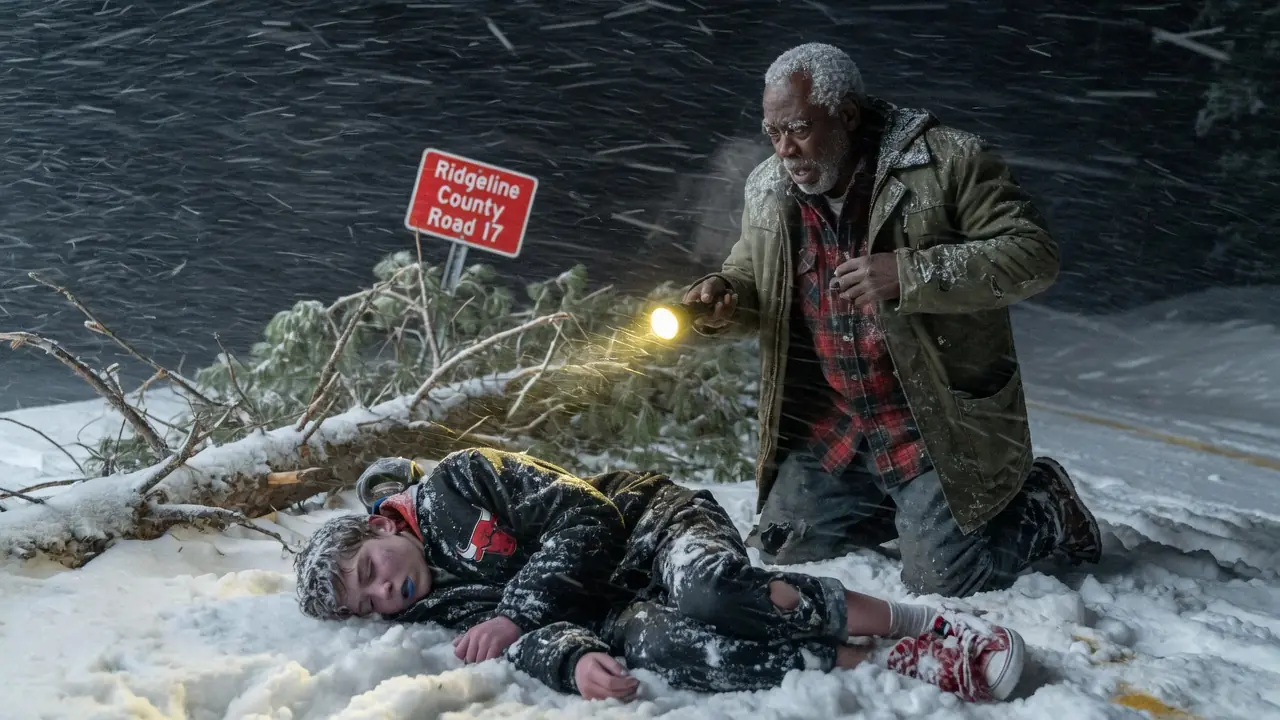
Then he got in the driver’s seat, pulled the door shut, and for thirty seconds, he just sat there, hands on the wheel, shaking so hard the whole truck vibrated. His flannel shirts were soaked with sweat and snow. His skin was the color of ash. He turned the key. The engine was still running. The heat was blasting. He put the truck in drive and he drove five miles an hour, maybe less. The road was almost gone, just a vague depression between two walls of white. Twice the truck fishtailed. Twice he corrected it with the calm of a man who spent thirty years driving an eighteen-wheeler through storms worse than this. Well, maybe not worse than this, but close.
Forty-five minutes. That’s how long it took. Forty-five minutes of crawling through a blizzard with two half-frozen teenagers in his back seat and no coat on his body and nothing in his chest but willpower and a prayer. And then the lights. The lights of Ridgeline. Faint and golden through the snow. The most beautiful thing Winston Herby had ever seen.
The children were safe. But the story Winston Herby thought was over, it was just beginning. He pulled up to the Ridgeline Community Clinic with the horn blaring. Two nurses came running out before he even got the truck in park. They took one look at Nate, grayish skin, barely conscious, one shoe missing, and had him on a stretcher in thirty seconds. Emma walked in on her own, shaking, silent, clutching the wool blanket around her shoulders like armor.
Dr. Priya examined both kids in the back room. Nate’s core temperature was ninety-one degrees. Early stage hypothermia. Another twenty minutes out there and the story would have ended differently. Emma had mild frostbite on four fingers, red and swollen, painful, but she’d keep them all. They were going to be okay. Winston sat in the hallway on a plastic chair. Someone had draped a thin hospital blanket around his shoulders. His flannel shirts were still damp. His hands were in his lap, purplish white, trembling.
A nurse noticed, came over. “Sir, let me look at those hands.” He waved her off. “I’m fine, ma’am. Just cold. Go check on those babies.” He wasn’t fine. Mild frostbite on three fingers and both ears. The nurse treated him anyway. He didn’t complain. Not once. Not a single sound. Sheriff Dale Overton arrived twenty minutes later, red-faced from the cold, stomping snow off his boots. He sat down next to Winston and took his statement. Winston told it plain. No drama, no embellishment, just facts. Found the girl on the road. She said her brother was in the woods. Went in, found him, brought him back, drove to the clinic. That was it. Like he was describing a trip to the grocery store.
The sheriff stared at him for a long moment. “You could have died out there.” Winston shrugged. “Well, I didn’t.” Overton shook his head, made a note in his pad. Then he went to the front desk and asked them to try Doc Caldwell’s landline. Took four tries, but it finally went through. Dot had fallen asleep in her chair by the fireplace. The kids had gone out the back door to see the snow. Just for a minute, they’d said, just to the fence and back. By the time she woke up, they were gone, and the blizzard had swallowed the world. She’d been calling the sheriff’s office for an hour. Couldn’t get through. The lines were jammed.
Two hours later, the roads were barely passable. Dot arrived at the clinic in a ranch truck driven by her foreman. She came through the front door like a woman on fire, grabbed both kids at the same time, and didn’t let go for five full minutes, just held them, rocking, sobbing, not saying a word. Then she turned to Winston. Her eyes were red and swollen. Her hands were shaking, not from cold. She walked over to him, took both of his damaged hands in hers, and held them gently. “You saved my grandbabies.” Her voice cracked on the last word.
Winston shifted in his chair. He was uncomfortable. You could see it in his shoulders, the way he looked at the floor. He patted her hand softly. “Any decent person would have done the same, ma’am.” Dot reached into her purse, pulled out a check she’d already written in the truck on the way over. Five thousand dollars. She pushed it across his lap. Winston looked at the check, looked at her, and gently pushed it back. “Ma’am, I appreciate that more than you know, but I didn’t do it for money. You don’t charge people for helping children.”
She insisted. He refused again. Firm but kind. The way a man refuses when the answer isn’t going to change. Finally, Dot folded the check and slipped it into his coat pocket. “You take it or I’ll leave it on your porch. That’s not a question.” Winston almost smiled. Almost. As he stood to leave, he picked up his Carhartt coat from the radiator where the nurses had dried it. Something fell from the pocket, hit the floor with a soft tap. The wooden fox.
Emma saw it before he did. She scooped it off the floor and held it up. “Mister, you dropped this.” Winston looked at the little fox in her hands. Then he looked at her. Twelve years old. Frostburned fingers. Alive. He smiled. For real this time. “You keep it, sweetheart. That’s a lucky fox.” Emma clutched it against her chest like it was made of gold.
Winston went home that night, heated up some canned soup, changed his bandages, sat in his chair, and listened to the wind rattle the windows. He figured that was the end of it. A scary day, a close call. A story he’d probably never tell because that wasn’t his style. But six hundred miles away, a phone was ringing. And the man on the other end was not the kind of person who let things go.
Denver, Colorado, fortieth floor, corner office. Floor-to-ceiling windows overlooking the Rockies, though tonight they showed nothing but black sky and snow. Gregory Caldwell stood with his back to the room, phone pressed to his ear, still wearing the suit he’d had on since six a.m. His hand, the one not holding the phone, was trembling. Dot had just told him everything. The blizzard. The kids sneaking outside. Nate unconscious in the snow. Emma screaming for help on a road nobody should have been driving on. And the man, the old man who stopped.
Gregory’s jaw was tight. His voice was barely above a whisper. “Who found them?” “An old fellow named Winston Herby,” Dot said. “Lives alone in town. Fixes things for people. Does odd jobs. He was out here fixing my fence when the storm hit early.” Silence on the line. “He went into that blizzard on foot. Greg. Left his truck running and walked into the woods. Took the coat off his own back and wrapped it around Nate. Carried your son out of there in his arms. Sixty-eight years old.”
Gregory closed his eyes. The image hit him like a hammer. His fourteen-year-old boy unconscious, freezing, and a stranger giving up his only coat to save him. “He drove them to the clinic,” Dot continued. “Sat in the hallway with frostbite on his own hands and wouldn’t let the nurse touch him until she checked the kids first.” Another long pause. “I tried to give him money,” Dot said. “Wrote him a check for five thousand. And he pushed it back twice, said, ‘You don’t charge people for helping children.’”
Gregory opened his eyes, stared at his reflection in the dark glass. A man worth four hundred million standing in a corner office, and right now none of it meant a single thing. “I want to meet him,” he said quietly. Two days passed. Winston went back to his routine. Bandaged fingers, sore knee, same life. He fixed Mrs. Henderson’s mailbox that blew off in the storm. Split firewood for Pastor Elaine. Then Ray Hubard showed up on his porch. “Somebody important in town. White. Black SUV, Colorado plates, tinted windows. Parked outside the clinic this morning asking questions.”
Winston shrugged. “Probably some rancher buying feed.” But it wasn’t a rancher. And on the SUV’s door, small and polished, was an emblem, a mountain peak inside a circle. The Caldwell Summit Capital logo. Winston didn’t see it, but you did. Winston Herby had no idea that the man about to knock on his door was worth more than every building in Ridgeline combined. Not a clue.
It was Saturday morning, early. Winston was at his kitchen table carving a new piece, a small bear, just roughed out, still blocky and raw. The radio was on low. Coffee was cold. Loretta’s sewing machine hummed with silence beside him. Then came the knock. Not loud, not aggressive. Three firm knocks. Patient, the kind of knock from someone who’d come a long way and wasn’t in a hurry anymore.
Winston set down his knife, wiped his hands on his jeans, walked to the front door, and opened it. A man stood on his porch, tall, early fifties, expensive coat, dark wool, no logo, the kind that costs more than Winston’s truck. But no tie, no flash, no sunglasses. Just a man with red-rimmed eyes standing in the cold. Behind him, the black SUV idled in the driveway. A driver sat behind the wheel, hands folded, waiting.
“Mr. Herby.” Winston looked at the man, looked past him at the SUV, looked back. “That’s me.” The man swallowed. His voice was thick, like he’d been rehearsing what to say for six hundred miles. And now every word was stuck. “My name is Gregory Caldwell. Emma and Nate. Those are my children.” Winston blinked. Let the words settle. The kids from the storm. The ones out on the ranch road. Gregory nodded. Couldn’t speak for a moment. His jaw worked, but nothing came out. He looked down at his shoes, shoes that cost more than Winston’s monthly grocery bill, and took a breath. “My mother told me what you did.” His voice cracked on the word “did.”
“She told me you found my daughter in a blizzard alone screaming. And instead of driving away, instead of doing what any reasonable person might have done, you stopped. You went into that storm on foot for my son.” Winston shifted his weight, leaned against the door frame. “Sir, it wasn’t—” “She told me you took your coat off.” Gregory’s eyes locked onto Winston’s. “Your only coat in minus thirty-eight degrees, and you wrapped it around a boy you’d never met.”
The porch was quiet, just the wind, and two men standing three feet apart. “Mr. Herby. My son’s core temperature was ninety-one degrees when he reached the clinic.” Gregory’s voice dropped low, almost a whisper. “Do you know what that means? Another twenty minutes out there and I would have been planning a funeral for my fourteen-year-old boy.” The words hung in the frozen air between them. Heavy. Final. True.
Winston didn’t respond. Just stood there, hands in his pockets, looking at this man he’d never seen before, who was trying very hard not to fall apart on a stranger’s porch. Then Gregory reached into his coat. Winston tensed, not sure what to expect. Gregory pulled out something small, held it up. The wooden fox. Winston stared at it. Four inches long, reddish brown wood, tail curled just so, the one he’d carved two mornings ago at this very kitchen table.
“My daughter hasn’t let go of this since you gave it to her,” Gregory said. “She sleeps with it. She holds it at breakfast. She told her mother it’s her lucky fox, and that the man who gave it to her is the bravest person she’s ever met.” Winston’s eyes went glassy. He looked at that little fox made from thirty cents of scrap wood and an hour of patience sitting in the palm of a billionaire’s hand. He didn’t trust his voice, so he just nodded.
Gregory asked to come inside. Winston hesitated. The house was modest, cold, cluttered with the quiet evidence of a man barely getting by. He was embarrassed, but he opened the door anyway. Gregory stepped in and sat at the kitchen table. He saw Loretta’s sewing machine, the half-finished bear, wood shavings on the floor. He saw the red-stamped tax notice that Winston had forgotten to hide peeking out from under a seed catalog. He didn’t stare, didn’t comment, but he saw it and he filed it.
Then his eyes moved to the windowsill. The carvings. A cardinal, wings spread, a pair of tiny owls, a trout leaping from invisible water. A fox, a different one, older, slightly larger. He stood up, walked over, picked up the cardinal, turned it in his hands slowly, ran his thumb along the wing feathers, each one carved individually, precise, alive. “You made all of these?” “Yes, sir. Just a hobby. Something to keep the hands busy.”
Gregory set the cardinal down gently like it was made of glass. “Mr. Herby.” He turned to face Winston. “This isn’t a hobby. This is art.” He sat back down, leaned forward, elbows on the table, and the billionaire in the expensive coat looked the old man in the flannel shirt straight in the eyes. “I run a company called Caldwell Summit Capital. We invest in people and businesses that most firms overlook. I’ve been doing it for twenty-five years. Built it from nothing. I grew up on a dairy farm, picking up milk cans before school. I know what hard work looks like. I know what being overlooked looks like.”
He paused. Let the silence hold. “And I’ve learned one thing in all those years. The most valuable thing in business, in anything, isn’t a product or a strategy or a number on a spreadsheet. It’s character.” He pointed at the wooden fox sitting on the table between them. “And I have never seen more of it than what you showed my children in that storm.”
What Gregory Caldwell proposed next wasn’t what anyone in Ridgeline expected. It wasn’t a handout. It wasn’t pity. It was something Winston Herby never dared to dream. But first, before the offer, before the numbers, before any of that, something happened at that kitchen table that neither man planned. Winston looked down at his bandaged hands. The ones that carved the fox, the ones that carried a fourteen-year-old boy through a blizzard. He was quiet for a long time, the kind of quiet that fills a room.
Then he said very softly, “My wife Loretta passed three years ago. She was the one with plans. She was the one who saw things in me I couldn’t see myself. I just… I’ve been getting by. That’s all. Just getting by.” Gregory nodded slowly. “My father passed when I was nineteen. I was picking up milk cans on a dairy farm in Wisconsin, making six dollars an hour. I know what getting by looks like, Mr. Herby. I know exactly what it looks like.”
Two men, different worlds, different skin, different bank accounts, but right there at that kitchen table with the sewing machine and the wood shavings and the cold coffee, they understood each other perfectly. Gregory stood up. “I’m not here to give you charity. I want to make that clear. I’ve done my homework. I know about your pension, your tax situation. I know what this town owes you and hasn’t paid, but that’s not why I’m here.”
He reached into the SUV driver’s bag and pulled out a folder, set it on the table. “I’m here because I think you deserve an opportunity, a real one, and I’d like to talk about it over breakfast if you let me buy you an egg sandwich at that diner on Main Street.” Winston looked at the folder, looked at Gregory. The faintest smile crossed his face, the first real one in days. “Barlo’s makes a decent egg sandwich.” “Then I’ll see you at eight.” Gregory extended his hand. Winston took it. The billionaire’s grip was firm, but not overpowering. The carpenter’s grip was rough and steady. They held it for one extra second. The kind of handshake that means something.
Next morning, Barlo’s Diner. Eight a.m. Every seat was taken. Every single one. Word travels fast in a town of two thousand eight hundred. The man in the black SUV was having breakfast with Winston Herby. People who hadn’t been to Barlo’s in months suddenly needed coffee. They sat in the corner booth. Gregory ordered the egg sandwich. Winston got the same. Carol Stokes, the owner, brought the coffee herself. Her hands were shaking slightly. She’d never served anyone who arrived in a chauffeur SUV before.
Gregory opened the folder. “First things first,” he said. “Your property taxes, thirty-two hundred dollars. That’s handled. Already wired to the county this morning.” Winston opened his mouth. Gregory raised a hand. “That’s not the opportunity. That’s just the right thing to do. Same with the furnace. I’ve got a team coming next week to install a new one. No argument.” Winston closed his mouth, nodded once. His eyes were wet, but his jaw was set.
“Now,” Gregory said, “the opportunity.” He turned the folder around so Winston could see. Inside were photographs. Winston’s carvings, the cardinal, the fox, the owls. Someone had taken professional photos of them, lit properly, shot against clean backgrounds. They looked like gallery pieces. “I had my team research the artisan wood carving market,” Gregory said. “Hand-carved American-made wildlife art sells for two hundred to eight hundred dollars per piece in galleries, online, collectors markets.” He let that land. “You’ve been selling these for five dollars, Mr. Herby.”
Winston stared at the photographs, his own work, looking back at him like he’d never seen it before. “Here’s what I’m proposing.” Gregory pulled out a second sheet. A business plan, professional, detailed, real. “Caldwell Summit Capital will fund the launch of a business called Herby & Sons Woodcraft. The old Granger Hardware building on Main Street, the one that’s been boarded up three years. We’ll lease it, renovate it, turn it into your workshop and showroom. Professional tools, a website, marketing, and a salary for you during the first year while you build the client base.”
Winston’s hands were flat on the table. He hadn’t moved. “But there’s more,” Gregory said. He leaned forward. “I want you to teach.” Winston looked up. “A youth apprenticeship program. Kids from Ridgeline and surrounding counties, especially kids from families that are struggling. After school, weekends, they come to the workshop and you teach them what you know, how to hold a chisel, how to see what’s inside the wood, how to be patient.” Gregory’s voice slowed down, got quieter. “You saved my kids in a blizzard, Mr. Herby. I want you to save more kids differently. Give them something to build with their hands. Give them patience. Give them pride.”
The diner was dead silent. People were pretending to eat, pretending to read the paper, but every ear in the room was locked on that corner booth. Winston stared at the business plan, the blueprints, the numbers. His scarred, bandaged hands were trembling on the pages. “I’m sixty-eight years old,” he said quietly. “I don’t know anything about running a business.” “That’s what my team is for. You just do what you do. Carve, teach, be exactly who you are.”
Winston looked out the window. The snow was still thick on the ground. Across the street, the old Granger building sat dark and boarded up. Three years of nothing. He turned back to Gregory. His voice wavered, just barely. “Loretta always said I should do more with the carving. She said I was wasting a gift.” Gregory nodded. “Then let’s do it for Loretta.” The total investment, six hundred fifty thousand dollars over three years. More money than Winston had earned in his entire life. Not charity, a partnership built on character.
Winston extended his hand across the table. Gregory took it, and the whole diner, every last person, went still. Then someone at the counter whispered just loud enough for the next stool to hear. “Well, I’ll be damned.” Six months later, you wouldn’t recognize Ridgeline, and you definitely wouldn’t recognize Winston Herby. But what nobody expected, not even Gregory, was how fast everything changed and how far the ripple would reach.
Spring came slow that year. The snow held on through March into April, but inside the old Granger building on Main Street, things were already warming up. The renovation took eleven weeks. New roof, new windows, electrical, plumbing, insulation that actually worked. A local crew did the build. Four guys from Ridgeline who hadn’t had steady work since the lumber mill cut shifts. When the sign went up above the door, half the town came out to watch. Hand-carved letters done by Winston himself, mounted on a slab of reclaimed pine. “Herby & Sons Woodcraft, established by hands that care.”
Inside was something Ridgeline had never seen. Workbenches lined with tools. Real tools, professional grade. A display wall where Winston’s carvings sat behind glass like museum pieces. The cardinal, the trout, the pair of owls, and in the center, in its own small case, the original wooden fox, the one that started everything. Price tags that would make your jaw drop. The cardinal, four hundred fifty dollars. The leaping trout, six hundred. A commissioned piece, a black bear standing on a river rock. Sold to a collector in Bozeman for eight hundred twenty dollars before the shop even opened. Eight hundred twenty dollars for something Winston used to sell for five.
But the carvings weren’t the real story. The real story was the kids. The apprenticeship program launched in June. Ten spots funded by Caldwell Summit Capital. Free tuition, free materials, open to any kid aged fourteen to eighteen from Ridgeline or the surrounding three counties. Priority to families below the poverty line. Forty-two kids applied for ten spots. Winston picked them himself. Didn’t look at grades. Didn’t look at references. He sat with each one for ten minutes and asked them one question. “What do you want to make?” The ones who had an answer, a real answer, not a rehearsed one, got in.
First day of class, eight teenagers standing around a workbench looking nervous. Winston in a clean flannel shirt and a leather apron Loretta would have loved. He held up a block of basswood and a carving knife. “You don’t force the wood,” he said. “You ask it what it wants to be.” One kid, a sixteen-year-old named Caleb Moore from the next county, picked it up faster than anyone. His first carving was a hawk. Rough, uneven, but alive. You could almost see it breathing. Winston held it up for the class. “See that? That’s not beginner’s luck. That’s a gift. Now, make another one better.” Caleb grinned so wide his ears moved.
The local paper, the Ridgeline Courier, ran a front-page story in August. “The Man Who Walked Into a Blizzard.” Full photo spread. Winston in the workshop surrounded by teenagers and sawdust and things being built. A state outlet picked it up. Then a national one. A morning talk show called and asked Winston to fly to New York for a segment. He said, “No, I’m not a TV person. I got a class on Tuesday.” Gregory’s team respected it completely. No pressure, no PR spin, just Winston being Winston.
But the attention brought customers. The online store launched in July. By November, they’d shipped orders to thirty-eight states. The workshop hired two part-time employees, both locals, who’d been out of work. The apprenticeship waiting list grew to sixty names. One student, a single mother, wrote a letter to the courier that got read aloud at a town council meeting. “My son used to get in trouble every day after school. Now he comes home and carves. He’s proud of something for the first time in his life.”
The Ridgeline Rotary Club invited Winston to their annual dinner. First time in forty years. He wore a tie. Loretta’s favorite color, dark green. Pastor Elaine helped him pick it out. By the end of year one, the numbers told a story no spreadsheet could capture. Fourteen apprentices trained. Three part-time jobs created. One hundred eighty thousand dollars in revenue ahead of projections. One apprentice, Caleb Moore, won a state arts competition with a carving of a running deer. Winston paid off every debt he’d ever carried. Every single one. Then he wrote a personal check for two thousand dollars to the Ridgeline Community Clinic. The same clinic that treated his frostbitten hands the night he brought in two frozen teenagers. The nurse who’d bandaged his fingers. She cried when she opened the envelope.
But there’s one more thing Winston did quietly without telling anyone that might be the most beautiful part of this whole story. Every January on the anniversary of the blizzard, Winston drove out to Caldwell Ranch Road. Same route, same eleven miles of gravel, same spot where his truck had stopped that day. He’d park, step out, walk into the tree line until he found it, the fallen pine where he’d found Nate curled up in the snow. And he’d hang something on the lowest branch. A small wooden fox, hand-carved, different every year, same meaning.
He never told anyone he did this. Not Ray, not Pastor Elaine, not Gregory. He just went alone. Early morning before the town woke up. He’d stand there in the cold for a few minutes, hands in his pockets, breath hanging in the air. And he’d talk to Loretta. “We did it, sweetheart. Workshop’s still running. Caleb’s getting real good. You’d love that kid. Got a new batch of students coming next month. Twelve of them this time.” He’d pause, look up through the bare branches at the gray Montana sky. “I wish you could see it, Rea. I really do.”
Then he’d walk back to his truck, drive to town, open the workshop, teach the morning class. Same as always. Gregory visited every quarter. Always brought Emma and Nate. It became their tradition. Denver to Ridgeline four times a year. No business talk, just visits, just family. Because that’s what they’d become. Nate, fifteen now, was learning to carve under Winston’s guidance. Slow, patient, getting better each trip. His first finished piece was a small truck, chunky, a little crooked, but recognizable. A pickup truck, just like Winston’s. Winston kept it on his workbench. Wouldn’t move it for anything.
Emma still carried the fox. Not everywhere anymore. She was thirteen now, too old for that. But it sat on her nightstand every night, first thing she saw in the morning. Then one January, Winston drove out to the fallen pine like always, parked, walked in, reached for the branch, and stopped. Something was already there. A small card hanging from a piece of red yarn. He pulled it down, opened it. The handwriting was young but careful. Blue ink on white paper. “Thank you, Mr. Winston. You are our lucky fox. Love, Emma and Nate.” Taped to the card was a drawing. Two stick figures, one small, one tall, standing next to a truck in the snow. Between them a fox.
Winston held that card in his scarred, bandaged, beautiful hands. And he smiled. The kind of smile that starts slow and deep and doesn’t stop. The kind that Loretta would have matched inch for inch. The workshop is still open. The sign still glows under the streetlight on Main Street. And every January there’s a new fox hanging on that branch.