A Black diner waiter had been working non-stop since before sunrise, doing everything he could to provide for his little daughter. Every morning, an elderly woman with cloudy gray eyes shuffled in, quiet, distant, avoided by the staff’s annoyed looks. But the waiter always treated her with gentle warmth, noticing every detail and even cutting her toast into small squares for her trembling hands. Slowly, she opened up and the two grew close like family. But one morning, she didn’t show up. Instead, four men in sharp black suits walked in and what they told him next left him absolutely stunned.
The brass bell above Rosewood Diner gave a weary clang each time the door opened. Marcus Thompson’s morning anthem. Not cheerful, just tired metal announcing another shift. Another day, hoping the tip jar might be kinder.
The diner was a relic frozen in time. Cracked burgundy booths, sticky linoleum, and the lingering scent of burnt coffee welded into the walls. Tucked in Houston’s Heights, it had served the same working-class crowd for more than four decades.
For Marcus, in his mid-30s, Rosewood was both refuge and cage. Six days a week, from long before dawn until early afternoon, he performed the choreography of survival: balancing plates, pouring coffee, forcing smiles until they felt disconnected from meaning.
Once he had been a promising culinary student with a gift for flavor and a dream of a restaurant where food told stories. But that dream had drowned beneath overdue bills and the weight of single fatherhood. He had grown up in Houston’s Third Ward, son of a nurse and a port worker who filled their home with barbecue, cornbread, and hope. For a while, the future had seemed bright. Then marriage, heartbreak, and abandonment reshaped everything.
His wife Rachel left when their daughter was only three years old, leaving a note that read, “You are a wonderful father. Jasmine will be better off with you.” Overnight, Marcus became both parents. He left the fine dining kitchens for predictable morning shifts so he could pick Jasmine up from school. Stability required sacrificing every ambition he once held.
Years later, exhaustion ruled him. He rose at four each morning, moving quietly through their small apartment to prepare Jasmine’s breakfast and leave a handwritten note: “Daddy loves you more than all the stars.”
Mrs. Rosa from apartment 2C helped Jasmine get ready for school. While Marcus rode the early bus through darkness, hands rough from years of hot plates and cheap detergent.
At Rosewood, he greeted regulars who knew only his name and his polite smile. He kept moving because stopping meant thinking, and thinking hurt.
At home, Jasmine’s laughter was the one force strong enough to lift him. Seven years old now, with curls tied into two puffs and bright brown eyes full of wonder, she was his whole world.
But the math of poverty was merciless. Rent for their modest apartment demanded nearly $2,000 each month. After-school child care cost $750. Jasmine’s allergy medication added a little over $100. Groceries absorbed roughly $400 more. Utilities another $200 and bus fare close to $150. Altogether, the monthly total rose above $3,400, while Marcus earned between $2,600 and $2,900, depending on tips. Even in the best months, he fell more than $500 short. Debt piled relentlessly — nearly $18,000 on credit cards, much of it from his mother’s final medical bills and years of monthly deficits. Three late rent notices already hung on their door. One unexpected expense could shatter everything.
Still, Marcus hid the fear from Jasmine. Every evening when he opened their front door, she ran to him, shouting, “Daddy!” — a moment so warm it briefly erased the weight of scarcity.
He arrived at the diner at 5:43 most mornings. Walter Hayes, the 60-something manager with the permanently greased apron, would glare. “You are three minutes late, Marcus.” “Sorry, Walter. The bus was stuck on the interstate.”
Betty Sullivan, who had worked there for more than half a century, shook her head. “That single dad is always running behind.” Marcus never responded. He tied his apron, brewed coffee, and slipped into the day’s rhythm.
The regulars were a familiar cast in an unchanging play. Frank, the construction foreman, tipped exactly $1 regardless of the bill. Two administrative assistants from a nearby law office gossiped daily about their supervisor’s messy divorce.
And then there was Grace.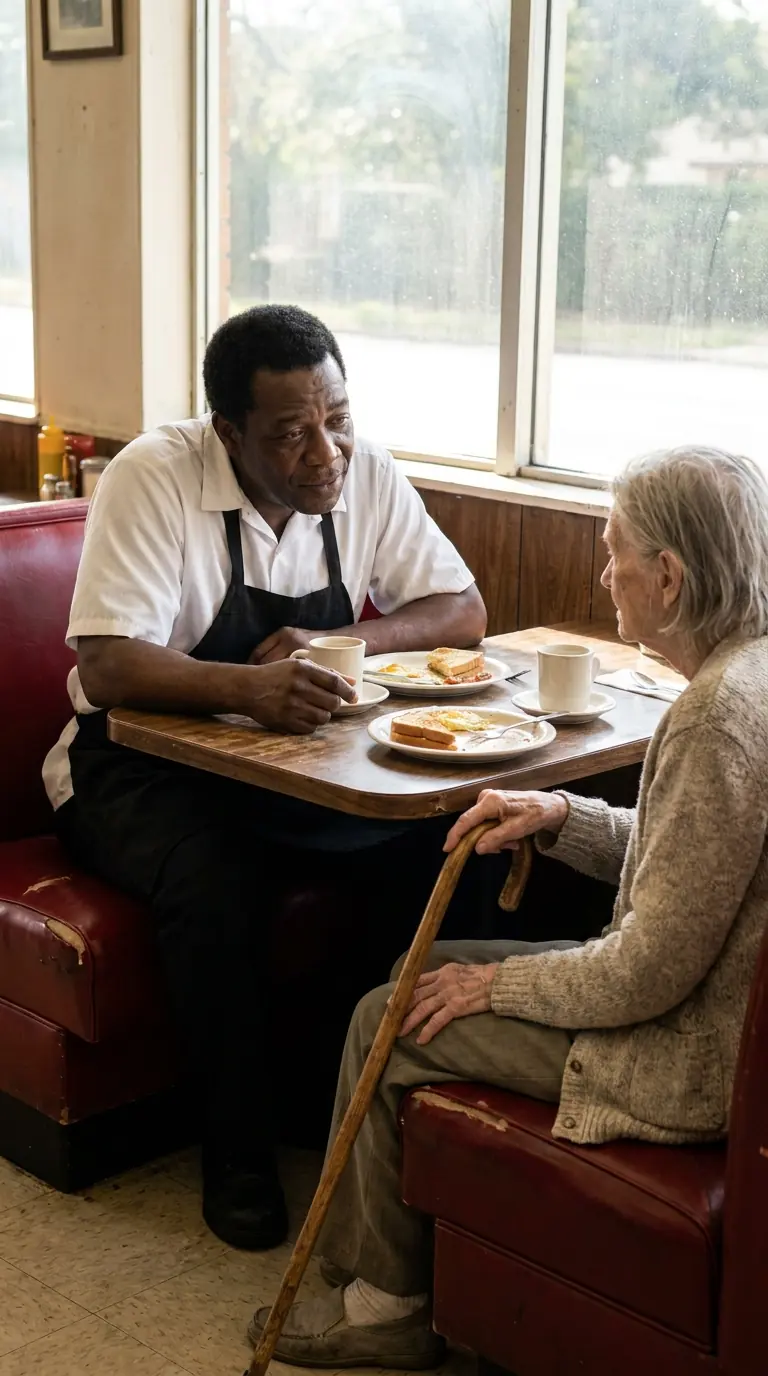
Grace was not simply a regular. She had become part of the diner’s landscape, as permanent as the faded neon sign outside. Every morning at precisely 7:20, she pushed open the heavy glass door and shuffled to the same corner booth by the window. She walked with a wooden cane, her steps slow but dignified. She always wore the same faded cardigan, plain blouse, worn slacks, and well-traveled shoes. Her face was lined with deep wrinkles, her pale gray eyes clouded by early cataracts. She existed like a quiet ghost in a noisy room.
The first morning she appeared nearly two years earlier, Walter warned Marcus, “Do not waste time on the old woman. Black coffee, breakfast special, exact change. No talking.” Betty scoffed, “Waste of a four-person booth.”
But Marcus saw something else. A loneliness. He recognized a dignified solitude that stirred the artist still living deep inside him. He ignored their advice.
On that first morning, he set a menu gently before her. “Good morning, ma’am. I am Marcus. Can I get you some coffee?” She grunted without looking up. He poured the coffee anyway.
The next morning, he greeted her again, and the morning after that. For weeks, she met every kindness with silence, but Marcus persisted softly. “Biscuits look good today, ma’am. Cold outside. This coffee should warm you.”
Then one Monday, nearly three months after she began coming, he brought her breakfast and noticed her struggling to cut her toast. Her knuckles were swollen with arthritis, her fingers trembling. Without hesitation, Marcus took the dull knife from her hand. “Let me help you with that,” he said gently. He cut the toast into four neat squares.
For the very first time, Grace looked up. Her clouded eyes met his warm brown ones. Something flickered — surprise, gratitude, perhaps the ache of being seen after years of invisibility. She gave the faintest nod to Marcus. That small gesture felt monumental.
From that day on, a quiet ritual formed. Each morning, he brought her black coffee, the breakfast special, and toast cut into four perfect squares. Sometimes he shared tiny pieces of his life — a humorous customer moment, a story about Jasmine’s drawings, or the dream he once had of opening a restaurant, blending the soul food of his childhood with modern technique.
Grace said nothing for months, but she listened. Truly listened. Sometimes she left an extra quarter beside her exact payment, a small gesture that meant more to Marcus than a generous tip ever could.
Co-workers teased him. “Still courting your corner girlfriend?” Betty laughed. Walter shrugged. “As long as she does not complain. Do what you want.”
Marcus did not care. Those ten quiet minutes each morning became an anchor in his chaotic life. Something genuine and unperformed. He was not kind to Grace for recognition. He was kind because he saw her, because he knew what it felt like to move through the world unseen.
He had no idea that these small acts, simple daily compassion, were being quietly observed and carefully remembered by a far sharper mind than anyone in that humble diner imagined.
Nearly 19 months passed like water flowing beneath a bridge, steady, persistent, unremarkable to anyone but those who paid attention to such things. Every morning at exactly 7:20, the door swung open, and Grace walked in with her careful measured steps, leaning on her wooden cane. And every morning Marcus stood ready with piping hot black coffee, whatever breakfast special Walter had prepared, and his steady hands cutting the toast into four perfect squares without fail.
But then, as summer heat began yielding to autumn’s gentle relief, something began to shift, subtle as morning light creeping across a darkened room.
It was approximately 17 months into their quiet routine when Grace first spoke beyond accepting her breakfast with a nod. As Marcus refilled her coffee cup one Thursday morning, her hoarse voice emerged, thin as paper but clear. “You have a child.”
Marcus froze mid-pour, the coffee pot suspended in air. It was the first time the elderly woman had initiated conversation beyond accepting her meal.
“Yes, ma’am,” Marcus replied, his face immediately brightening with genuine warmth. “A daughter. She’s seven years old. Her name’s Jasmine.”
Grace nodded slowly, studying him with those pale gray eyes that suddenly seemed more focused despite the cataracts clouding them. “Why are you working such early hours? Who looks after her in the mornings?”
Marcus told her about waking at 4:30, about preparing breakfast the night before and leaving encouraging notes, about Mrs. Martinez from down the hall who helped get Jasmine ready for school each morning.
Grace listened without interruption, her weathered face unreadable but attentive. “That sounds very difficult,” she finally said, her voice carrying a weight Marcus couldn’t quite identify.
Marcus shrugged, a small smile playing at the corners of his mouth. “It’s what needs doing, ma’am. I’m her father. She depends on me.”
Grace studied him for a long, penetrating moment. When she finally spoke again, her voice trembled ever so slightly. “You’re a good father, Marcus Thompson. Better than most.”
Those words struck Marcus with unexpected force. His throat tightened and he had to look away quickly before emotion showed too clearly on his face because nobody had ever said that to him before. Not Rachel, not Walter, not well-meaning neighbors or distant family members. But this elderly stranger, someone he barely knew beyond their morning ritual, had truly seen him, had witnessed and acknowledged the invisible labor of single parenthood that usually went unnoticed.
From that morning forward, Grace began asking about Jasmine whenever Marcus refilled her coffee. What grade was she in? What subjects did she enjoy? Did Marcus read to her at night? And Marcus answered gladly, his entire demeanor transforming whenever he mentioned his daughter.
“Jasmine loves drawing animals, especially horses. I keep every single picture she makes taped to our walls. She wants to be a veterinarian when she grows up. I tell her she can be absolutely anything she sets her mind to.”
Grace listened to every word, and sometimes, very rarely, a faint smile would tug at the weathered corners of her lips. A smile that transformed her entire face, revealing glimpses of the woman she must have been decades earlier.
Then came a Saturday morning in late September that would change everything.
Marcus received a phone call from Mrs. Martinez at 6:45, panic clear in her voice. “Marcus, I’m so terribly sorry. I can’t watch Jasmine today. My son was in a car accident last night. He’s okay, but I need to get to the hospital in Galveston immediately.”
Marcus’s heart plummeted. He had to work. Walter had already written him up twice for schedule issues, and another incident might cost him his job entirely. Jasmine’s usual Saturday art class didn’t start until 10:00, and the instructor couldn’t take her early. With no other option available on such short notice, he made the difficult decision to bring Jasmine to the diner.
“Daddy has to work today, sweetheart,” he explained as they rode the bus through the early morning streets. “You’ll sit quietly and do your homework, okay? And you can bring your coloring books.”
Jasmine, wearing her favorite purple backpack decorated with butterfly stickers, nodded eagerly. “Yes, Daddy. I’ll be really good. I promise. Super quiet like a mouse.”
As soon as they walked through the diner door, Walter looked up from behind the register, his expression darkening immediately. “Marcus, why is your kid here?”
“I’m truly sorry, Walter. My sitter had a family emergency last minute. Her son was in an accident. I had absolutely no other choice. She’ll sit quietly in the back corner. I promise she won’t disturb anyone or get in the way.”
Walter sighed heavily, wiping his hands on his perpetually stained apron. “Fine, but don’t let her lose us any customers with noise or running around.”
“I won’t, sir. Thank you.”
Marcus led Jasmine to a small table near the kitchen where she could remain within his line of sight. “Sit right here and work on your homework, baby. I’ll check on you as often as I can, okay? And you can color after you finish your math worksheet.”
Jasmine opened her workbook and box of crayons, her tongue poking out in concentration as she focused on addition problems.
Marcus started his shift, but his eyes kept flicking toward his daughter every few minutes, monitoring her like a worried sentinel.
At exactly 7:20, the door opened with its familiar chime. Grace walked in, leaning on her cane. But this morning, as she passed the counter, she stopped abruptly, her gaze fixed on Jasmine, the small girl sitting alone, bent intently over her homework.
Marcus noticed immediately and hurried over, embarrassment coloring his voice. “I apologize, ma’am. I had to bring my daughter today. My regular sitter had a family emergency. She won’t cause any trouble at all. I promise.”
Grace looked at Jasmine for a long measuring moment, then back at Marcus. Her pale gray eyes held an expression he’d never seen before. Something raw and achingly human. “That’s your daughter?”
“Yes, ma’am. Her name’s Jasmine. She’s seven.”
Grace remained silent, her weathered hands gripping her cane tightly. Then she said something Marcus never could have anticipated. “Let her sit with me.”
Marcus froze completely, certain he’d misheard. “Ma’am?”
Grace’s eyes met his directly, and for the first time, clear emotion flickered in those pale depths. Pain, longing, profound loneliness, all mixed together. “I’d like to get to know her. May I have that privilege, Marcus?”
Marcus nodded slowly, almost unable to believe what he was hearing. He gently guided Jasmine to the corner booth. “Jasmine, honey, this is Mrs. Morgan. Can you say hello and use your best manners?”
Jasmine looked up with her bright, curious eyes. “Hi, Mrs. Morgan. I’m Jasmine. It’s very nice to meet you, ma’am.”
Grace slowly lowered herself into the booth across from the child, studying her with an expression Marcus couldn’t fully decipher. Something between wonder and heartbreak. “What are you working on, child?” Grace asked, her voice softer than Marcus had ever heard it.
Jasmine grinned proudly and held out her worksheet. “Addition problems. I’m really good at math. My teacher says I might be in the advanced group next year.”
“That’s wonderful. May I see?”
For the next several minutes, Marcus watched from a distance as Grace reviewed Jasmine’s homework, gently correcting a few mistakes and praising her efforts. Then Jasmine pulled out her coloring book. “I’m going to color a picture of my daddy,” she announced. “He’s my superhero.”
Grace’s hands trembled slightly as she watched the child work. “Why is your father your superhero?”
Jasmine didn’t hesitate. “Because he works really hard to take care of me all by himself. He makes me breakfast every morning before I wake up and leaves me notes that say he loves me. And he always picks me up from school and helps with my homework and reads me stories at night. And when I’m scared, he makes everything better. That’s what superheroes do.”
Marcus, standing several feet away, pouring coffee for another customer, heard every word. His vision blurred, and he had to turn away quickly, pretending to check something in the kitchen.
Grace took the coloring page when Jasmine finished. A charmingly clumsy drawing of a stick figure holding a tray of food with messy letters scrolled above it: “My daddy, my hero.”
Grace held the paper with trembling hands as if it were made of the most delicate glass. Marcus noticed something that made his throat tighten — a single tear sliding down the elderly woman’s weathered cheek.
“You’re very fortunate,” Grace said softly, her voice catching slightly. “To have a father who loves you so completely and sacrifices so much for your happiness.”
Jasmine nodded enthusiastically. “Yes, ma’am. He’s the best daddy in the whole entire world.”
Several steps away, Marcus wiped quickly at his own eyes before returning to check on them. “Is everything okay here, Mrs. Morgan? Can I get you anything else?”
Grace looked up at him, her eyes glassy with unshed tears. “Everything is perfect, Marcus. Absolutely perfect. Would you mind terribly if Jasmine stayed with me a while longer? I’d like to teach her some things if that’s all right.”
“Of course, ma’am. Whatever you’d like.”
The next three hours were nothing short of miraculous. Grace, the silent woman Marcus had known for nearly two years, came alive in the presence of this child. She asked Jasmine about school, about friends, about what she wanted to be when she grew up.
“I want to be a veterinarian like Dr. Parker, who takes care of my friend’s dog,” Jasmine said earnestly. “I want to help animals that are sick or hurt. Daddy says I can do anything if I work really hard and never give up.”
Grace smiled, truly smiled for the first time Marcus had ever witnessed, and it transformed her entire face. “Your father is absolutely right, dear child. Do you know your multiplication tables yet?”
“Yes, ma’am. I can do all the way through the fives.”
“Wonderful. Let me teach you some tricks for the higher numbers. Then there are patterns that make it much easier.”
For the next two hours, Marcus watched an entirely different Grace Morgan emerge from behind the walls she built around herself. She patiently explained mathematical concepts to Jasmine, breaking down complex ideas into simple terms. She laughed, actually laughed out loud when the girl grasped a tricky problem. She praised her warmly when Jasmine got answers correct. She was no longer a lonely elderly woman, isolated from the world. She was a grandmother, fully present and engaged in a way that seemed to breathe life back into her.
Around 10:30, Jasmine started yawning, her head drooping. The early morning was catching up with her. She rested her curly head on the table and drifted into sleep right there in the booth. Quietly, reverently, Grace removed her faded cardigan and draped it gently over the sleeping child’s shoulders like a blanket, tucking it carefully around her.
Marcus approached to check on them, emotion flooding through his chest in powerful waves. “Thank you so much, Mrs. Morgan,” he whispered, his voice thick. “You didn’t have to do all this. This was incredibly kind.”
Grace looked up at him, her eyes glassy with unshed tears that caught the morning light. “No, Marcus. Thank you. You gave me something invaluable today.”
“What gift, ma’am?”
Grace’s voice broke slightly. “The chance to be a grandmother again, even if just for a few precious hours.” Then she said something that sent Marcus retreating to the back storage room to compose himself, his chest heaving with emotion he could barely contain. “I once had a daughter and a granddaughter. They’re both gone now, taken from me far too soon. But today… today, it felt like they were still here with me, like I got to hold that love one more time.”
By noon, Grace was preparing to leave much later than her usual 8:45 departure. Jasmine had woken up refreshed and full of energy again. “Mrs. Morgan, will you come back next Saturday?” Jasmine asked hopefully, grabbing the elderly woman’s hand. “You promised to teach me about fractions, and I want to show you more of my drawings.”
Grace knelt down stiffly, taking the child’s small hand in both of her weathered ones. “I promise, dear child. I absolutely promise I’ll be here.”
As Grace walked slowly toward the door, leaning on her cane, Marcus and Jasmine stood by the window, watching her navigate the sidewalk outside with careful steps.
“Daddy,” Jasmine said thoughtfully. “Mrs. Morgan is really nice, but she seems sad inside, like she’s carrying something heavy.”
Marcus hugged his daughter tightly, pressing a kiss to her forehead. “Yes, baby. She does seem sad. That’s why we need to be especially kind to her. Okay? Sometimes people are fighting battles we can’t see.”
Jasmine nodded seriously. “Like how she was kind to us today.”
“Exactly like that, sweetheart.”
Marcus had absolutely no idea that would be the last time he would ever see Grace Morgan alive.
Monday began like every other morning in Marcus Thompson’s carefully constructed routine. He woke at 4:30 in the darkness. He prepared Jasmine’s breakfast — scrambled eggs with cheese the way she liked them, and apple slices arranged in a smiley face. He wrote a small note and stuck it to the refrigerator with a magnet: “Daddy loves you more than all the stars. Don’t forget your inhaler. You’re going to do great on your spelling test. Love, Dad.”
He kissed his sleeping daughter’s forehead gently, grabbed his worn backpack, and stepped outside into the cool Houston morning. Walking three blocks through empty streets to catch the 5:15 bus heading downtown.
He arrived at Rosewood Diner at exactly 5:41, fighting through the usual morning traffic on I-10. Walter grumbled that he was four minutes late. Betty shot him a disapproving glance and muttered something under her breath about unreliability.
The shift began like clockwork, identical to hundreds of mornings before it. By 7:00, Marcus was automatically preparing for Grace. He brewed a fresh pot of black coffee, checked the breakfast special — eggs, sausage links, wheat toast — then carefully cut the toast into four perfect squares out of habit. He arranged everything on the corner booth table where Grace always sat, setting the coffee cup just where she preferred it, slightly to the right.
Then he waited, glancing at the clock above the register.
7:20 arrived. The door remained closed. Marcus looked at the clock again, feeling a small flutter of concern. Perhaps the bus was running behind schedule. It had happened occasionally before.
7:35. Still no Grace. An uncomfortable thread of worry began tightening in Marcus’s stomach like a fist slowly clenching.
“Walter,” he called toward the kitchen. “Do you have any contact information for Mrs. Morgan, the lady who sits in the corner booth every morning?”
Walter looked up from flipping pancakes on the griddle, spatula in hand. “Who? You mean the old woman with the cane? Nah, nobody knows nothing about her. She just shows up, pays cash, and leaves. Why you asking?”
“She hasn’t come in yet. She’s never late. Not once in nearly two years.”
Betty let out a sharp laugh while refilling ketchup bottles at the counter. “With the money she probably has stashed away somewhere, she’s likely on some beach in Florida right now, enjoying the warm weather. Old people do that.”
But Marcus didn’t laugh. A strange unease bloomed inside his chest like a dark flower opening its petals.
7:45. 8:00. 8:30. No Grace.
Marcus poured the wrong order of coffee for table three. He forgot to put in a ticket for table five. His mind kept drifting to that empty corner booth with its untouched breakfast growing cold.
“Marcus, focus,” Walter snapped irritably from the kitchen window. “What’s gotten into you this morning? You’re making mistakes all over the place.”
“I’m sorry, Walter. I’m just worried about Mrs. Morgan.”
“Well, worry on your own time. We got customers waiting.”
By 9:00, Marcus had decided that if Grace still hadn’t appeared by closing time, he would try to find out where she lived and check on her himself. The worry had become a physical weight pressing on his chest, making it hard to breathe properly.
And then at 9:17, the brass bell above the door chimed, but the sound that followed was entirely different from every other morning in Rosewood Diner’s long history.
The entire restaurant fell silent as if someone had pressed a mute button on the world. Even the sizzle from the griddle seemed to pause. Conversations died mid-sentence. Coffee cups froze halfway to lips. Forks stopped moving.
Four men entered the diner, tall and imposing in tailored charcoal suits, moving with the precision of trained professionals. Wireless earpieces glinted in their ears, their faces blank and unreadable. Two positioned themselves at the door, scanning the room with silent vigilance. The other two stepped aside, making way for a fifth figure.
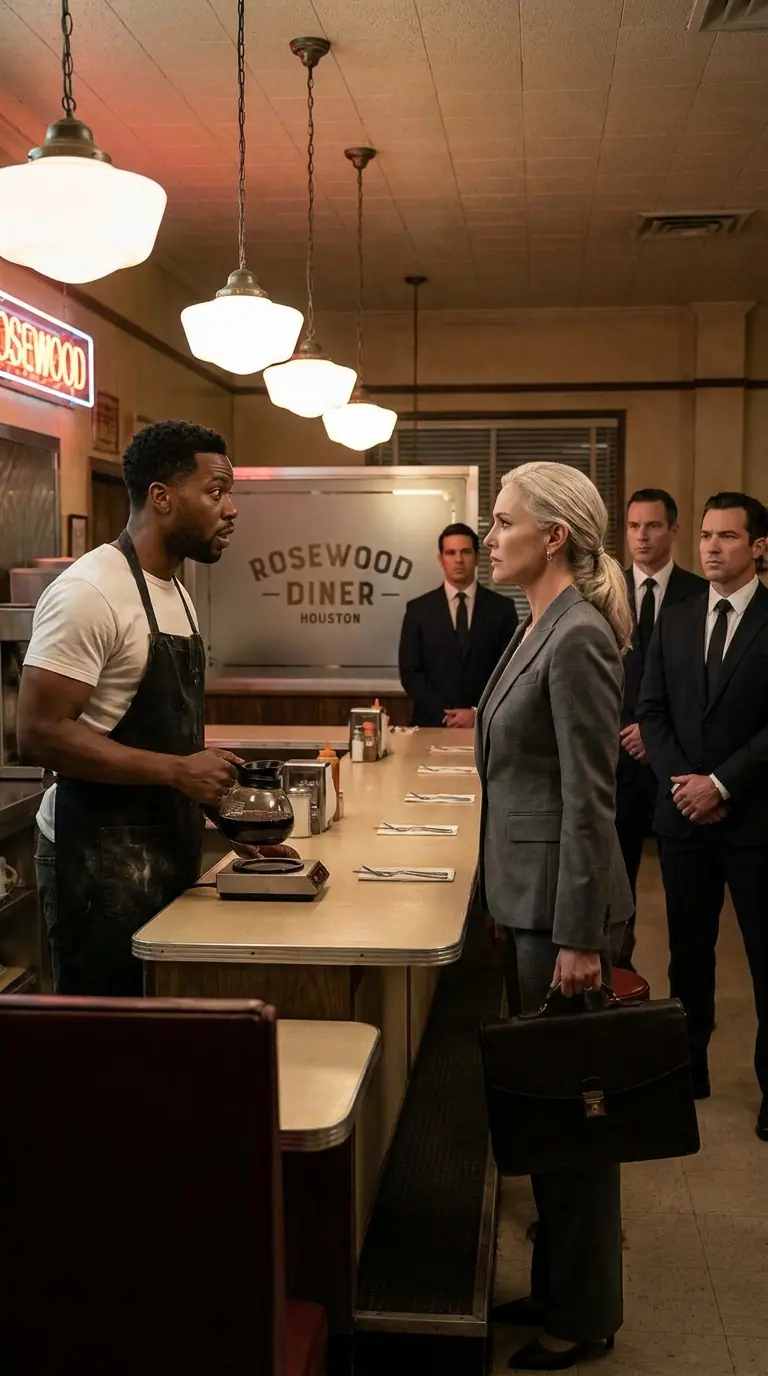
She appeared to be in her late 50s, silver-blonde hair pulled into an elegant bun, dressed in a dove-gray suit worth more than Marcus would earn in months. Reading glasses hung from a delicate chain around her neck and her sharp blue eyes swept across the diner with cool clinical assessment. The leather briefcase in her hand looked expensive enough to cover his rent for half a year.
Walter tried for authority, wiping his greasy hands on his apron. “Can I help you folks with something?”
The woman didn’t acknowledge him. Her gaze completed one slow sweep of the room before settling directly on Marcus, who froze beside the coffee station. The pot suspended midair as his heartbeat quickened.
She approached with measured steps, her heels striking the linoleum with crisp precision. Two bodyguards trailed behind her, the air tightening around them.
“Are you Marcus Anthony Thompson?” she asked, her voice low, controlled, authoritative enough to make anyone stand straighter.
Marcus’s heart clawed at his ribs. He nodded, throat dry. Had he done something wrong? Was this about debt collectors? Had something happened to Jasmine?
The woman studied his face for a long, unreadable moment. “My name is Catherine Bradley, senior partner at Morrison Bradley and Associates. I was Mrs. Grace Elizabeth Morgan’s personal attorney for 32 years.”
The name hit him like a sudden shift in gravity. Grace Morgan. Grace Elizabeth Morgan. He needed a few seconds to understand that the quiet elderly woman in the corner booth had a full identity beyond black coffee and cut toast.
“Mrs. Morgan,” he whispered, “is she all right? She didn’t come in this morning, and I was getting worried.”
A faint crack softened Miss Bradley’s impeccable composure. “Mrs. Morgan passed away peacefully in her sleep late Sunday evening. I’m very sorry.”
The world tilted. The coffee pot in his hand suddenly felt heavy. He set it down before it slipped. A wave of grief surged through him. Swift, unexpected, overwhelming. It made no sense. He didn’t really know Grace. But their quiet ritual — black coffee, simple conversations, four squares of toast — had become a stabilizing force in his chaotic life. Now it was gone.
Images flashed through his mind. Grace smiling at Jasmine, her eyes soft as she taught the child math. Her voice telling him, “You’re a good father.” Her promise to return next Saturday. A promise now broken forever.
“Oh, God,” Marcus murmured, voice cracking. “I’m so sorry. She was such a good person. She didn’t deserve to be alone.” A tear slid down his cheek. He didn’t hide it.
The diner fell silent as customers watched, confused but riveted.
Miss Bradley continued gently. “Mrs. Morgan was extraordinary. She was also meticulous, and in her will she left very specific instructions. One provision requires your immediate presence. A car is waiting. This cannot wait, Mr. Thompson.”
“A will,” he echoed, stunned. “There must be a mistake. I only served her breakfast.”
“There is no mistake,” she said firmly. “You are named in her will as the man who cut her toast into four small squares every morning for 19 months. The man who treated her with dignity when most people ignored her. She noticed everything.”
The precision of that detail stunned him. Grace had been watching him far more closely than he ever realized.
Marcus looked helplessly at Walter, who stared back with a pale, conflicted expression. “I don’t know what this is,” Marcus whispered. “I swear I don’t.”
Walter’s voice softened. “Go on, Marcus. Betty will cover your tables.” Betty gave him a tight, unreadable nod.
Marcus untied his apron with trembling fingers, grabbed his worn backpack, and followed the group outside. The air felt too cold for September. Or maybe it was just him. Staff and customers stared through the diner windows as if witnessing someone being pulled into another world.
A black Mercedes idled at the curb, engine humming softly. A bodyguard opened the door with effortless precision. Marcus slid into the leather seat, the most luxurious thing he had ever touched, and looked back at Rosewood Diner through the tinted glass. It seemed impossibly small, fragile, a fading photograph under the gray Houston sky.
A sharp intuition gripped him. He would never see that place the same way again. The chapter defined by morning shifts, worn aprons, and quiet conversations with a lonely woman had ended. Something new, unpredictable, and far larger than him had already begun.
The Mercedes pulled away. Marcus watched the diner shrink in the side mirror until it vanished around a corner, leaving only the echo of the bell and the memory of a woman who had changed everything without him ever realizing it.
The drive to the law offices was a silent, surreal journey across Houston. Marcus stared through the tinted window as familiar streets transformed into unfamiliar territory. The Heights gave way to downtown’s gleaming towers. Neighborhoods he’d never visited appeared and disappeared like scenes from someone else’s life.
Inside the Mercedes, the world felt hushed and separate, wrapped in the smell of expensive leather and subtle air freshener that probably cost more than his monthly grocery budget. Miss Bradley sat across from him, reviewing documents in her leather briefcase with focused efficiency. Her face remained an unreadable professional mask, giving nothing away.
In Marcus’s mind spun a confused vortex of questions and a dull, persistent grief for the elderly woman he’d barely truly known beyond surface pleasantries and morning coffee. Why would she name him in her will? What could she possibly have left him? And more importantly, who was Grace Morgan really?
Morrison Bradley and Associates occupied three floors of a gleaming glass tower in downtown Houston’s financial district. A world completely alien to anything Marcus had experienced before. Marble floors reflected overhead lights like pools of frozen water. Soaring glass walls provided panoramic views of the sprawling city stretching in all directions. Hushed corridors lined with contemporary art led deeper into the building. Young professionals in expensive suits moved with purposeful efficiency, their shoes clicking rhythmically against the polished floors.
Marcus, wearing his faded jeans and secondhand sneakers, felt like a stray dog that had accidentally wandered into a palace meant for entirely different creatures. He tried to walk with dignity, keeping his shoulders straight, but he felt the weight of every curious glance.
He was led into a spacious conference room dominated by a long polished walnut table that probably cost more than his car was worth before it broke down two years ago. The windows overlooked the city from the 42nd floor.
At one end of the table sat three people who radiated displeasure like heat from a furnace. A man in his early 30s with carefully styled dark hair and a designer suit that fit just slightly too perfectly to be comfortable. His eyes held undisguised irritation, and he checked his expensive watch ostentatiously as Marcus entered. Beside him sat a woman, who appeared to be his mother, dressed impeccably in a cream-colored suit with pearls at her throat. Her face wore an expression of polite disdain, her manicured fingers tapping impatiently against the glossy tabletop. And next to her, a younger woman, late 20s perhaps, with auburn hair pulled back severely, and an expression that flickered between boredom and barely contained anger. She examined her perfect manicure as if the proceedings were beneath her attention.
Miss Bradley cleared her throat as they entered, her voice crisp and professional. “Mrs. Evelyn Morgan Harrison, Mr. Preston Harrison, Miss Olivia Harrison, this is Mr. Marcus Thompson. The final party named in Mrs. Morgan’s will.”
Preston’s gaze slid over Marcus with unconcealed contempt, his lip curling slightly as he took in Marcus’ work clothes and worn shoes. “This is who we’ve been waiting for? A bus boy. Grandmother must have been completely senile in her final years. This is absolutely absurd.”
“Preston, please,” his mother chided, though her tone carried no real reproach. Her look toward Marcus was equally cold and dismissive, as if he were something unpleasant she’d discovered on the bottom of her shoe.
“Mr. Thompson, please have a seat.” Miss Bradley indicated a chair at the opposite end of the table, deliberately separated from the Harrison family by a significant distance. The physical gap felt intentional, a chasm between two completely different worlds that would never touch.
Marcus sat down slowly, his fingers interlaced tightly in his lap to keep them from trembling. The bodyguards positioned themselves along the far wall like statues. The tension in the room could have been cut with one of the dull knives from Rosewood Diner.
“Now that all principal parties named in the will are present, we’ll proceed with the reading.” Miss Bradley announced crisply, opening a thick leather-bound folder. She adjusted her reading glasses and began in an even professional tone.
“The last will and testament of Grace Elizabeth Morgan, executed on June 15th of this year, in the presence of witnesses and notary, being of sound mind and clear judgment.”
Most of the opening legal language washed over Marcus like static, dense terminology about trusts, endowments, museums, and universities he’d never heard of. The sums were so enormous they barely seemed real. Five million to the Houston Museum of Fine Arts, three million to Rice University, two million to medical research. The Morgan estate was a mountain of wealth far beyond anything Marcus could imagine.
Then Miss Bradley paused, her eyes settling on the Harrison family with something close to satisfaction. “To my daughter, Evelyn Morgan Harrison, I bequeath the family property in Austin along with the contents of the Morgan family educational trust, the principal amount equivalent to four million.”
Preston exploded, snorting with outrage. “Four million? That’s an insult. The estate is worth hundreds of millions.”
“Your grandmother liquidated most of her personal assets these past three years,” Miss Bradley replied coolly. “She had full authority. She owed no explanations.”
Evelyn’s composure cracked. “We are her family, her only relatives. We cared for her.”
Miss Bradley arched a brow. “According to her records, you visited four times in five years. Your son visited twice, both to request money. I doubt that qualifies as care.”
Silence cut the room like glass. Evelyn flushed and Preston clenched his jaw.
Miss Bradley continued. “To my granddaughter, Olivia Harrison, I leave $500,000 with the hope she’ll use it more wisely than her father used his opportunities.”
Olivia’s bored expression slipped.
Miss Bradley turned another page. “To my personal physician, Dr. Robert Chen, who treated me with compassion during my illness, I leave $500,000.”
Marcus felt his stomach twist. She had never spoken of any sickness.
Then Miss Bradley’s gaze lifted over her glasses and locked on him. The room seemed to inhale.
“We now reach the final and most significant clause of Mrs. Morgan’s will.” Her voice slowed, clear, and resonant. “To Mr. Marcus Anthony Thompson, the young man at Rosewood Diner, who extended genuine kindness to an elderly woman when he had no reason to, who treated her with dignity when others saw only a nuisance, who never forgot to cut her toast into four small pieces because he noticed her hands trembled from arthritis…”
Marcus blinked as tears stung his eyes. She had noticed everything.
Miss Bradley continued softly. “To Mr. Thompson, I leave a legacy of kindness repaid in the only way I know how. First, an immediate gift of $750,000 to be transferred into an account in his name to ease the burdens he carries so bravely, just as he eased mine during my loneliest mornings.”
The room lurched around him. Three-quarters of a million dollars — enough to free him from every debt, to build a life for Jasmine. Too much to even comprehend.
Preston leapt to his feet. “She left nearly a million dollars to some random waiter? This is insanity. We’ll contest this. She was clearly manipulated.”
“Sit down, Mr. Harrison,” Miss Bradley snapped, her voice steel. “Three independent physicians confirmed her full mental competency before she signed. The will is ironclad.”
Preston sank back into his chair, furious.
Miss Bradley read on. “And finally, because Rosewood Diner was the last place on earth where I felt truly seen, not as a source of money or obligation, but as a human being worthy of kindness, I bequeath to Mr. Marcus Thompson full ownership of the property located at 642 West Dallas Street, Houston, Texas. Purchased nine months ago through Morgan Holdings LLC along with all business assets, equipment, inventory, and existing lease agreements.”
Silence crashed over the room. Marcus stared blankly. Grace had purchased the diner for him.
Preston laughed coldly. “She left him that greasy dump? After all this drama, perfect. Worth 50 grand at best.”
But Miss Bradley didn’t smile. She removed her glasses and studied Marcus with a mix of sympathy and gravity. “There is one more item, Mr. Thompson. The diner property comes with a commercial development portfolio Mrs. Morgan attached to secure its long-term stability. That portfolio, managed by one of Houston’s top investment firms, is valued at approximately $8.2 million.”
The transformation was instant. Preston’s laughter died mid-breath. Evelyn’s hand flew to her mouth. Olivia sat upright.
For Marcus, the floor seemed to vanish. $8.2 million. The diner wasn’t a consolation prize. It was a kingdom, a foundation, a new life.
Grace, the quiet woman with trembling hands, had been Grace Elizabeth Morgan, founder of Morgan Industries, a titan worth hundreds of millions. And she had chosen him.
Preston’s face twisted with hatred. “Fraud. Manipulation. We will contest this. Courts, lawyers, all of it. You won’t see a penny.”
Marcus found his voice, barely. “I didn’t know who she was. I just tried to be kind.”
Miss Bradley stood, gathering papers. “Mrs. Morgan expected this reaction, Mr. Harrison. That’s why she left extensive documentation.” She pulled out a sealed envelope, a handwritten letter explaining her reasoning, 19 months of diary entries documenting her observations, and video testimony recorded with three witnesses confirming her intentions and mental clarity.
She handed the letter to the chairwoman, then looked directly at Preston. “You cannot win this challenge. Mrs. Morgan prepared for every possible attack. Carelessness was not in her nature.”
Preston stood abruptly. “This isn’t over.” He stormed out. Evelyn and Olivia followed, though not before Evelyn hissed at Marcus. “You don’t deserve any of this. You’re nothing but an opportunist.”
Then they were gone, leaving Marcus trembling in the vast conference room.
Miss Bradley sat across from him, her voice gentler now. “I know this is overwhelming. Mrs. Morgan knew it would be. That’s why she instructed me to guide you through every step.” She handed him a card and a thick sealed folder. “A financial advisor will contact you tomorrow. Robert Chen, someone she trusted completely. Do not speak to the Harrison family. If they reach out, you call me immediately. I am available 24 hours a day for the next six months.”
She paused, letting her tone soften further. “Inside that folder is a personal letter from Mrs. Morgan to you. Read it when you’re alone. It will explain what she saw in you.”
Marcus swallowed hard. “Why me? I’m nobody.”
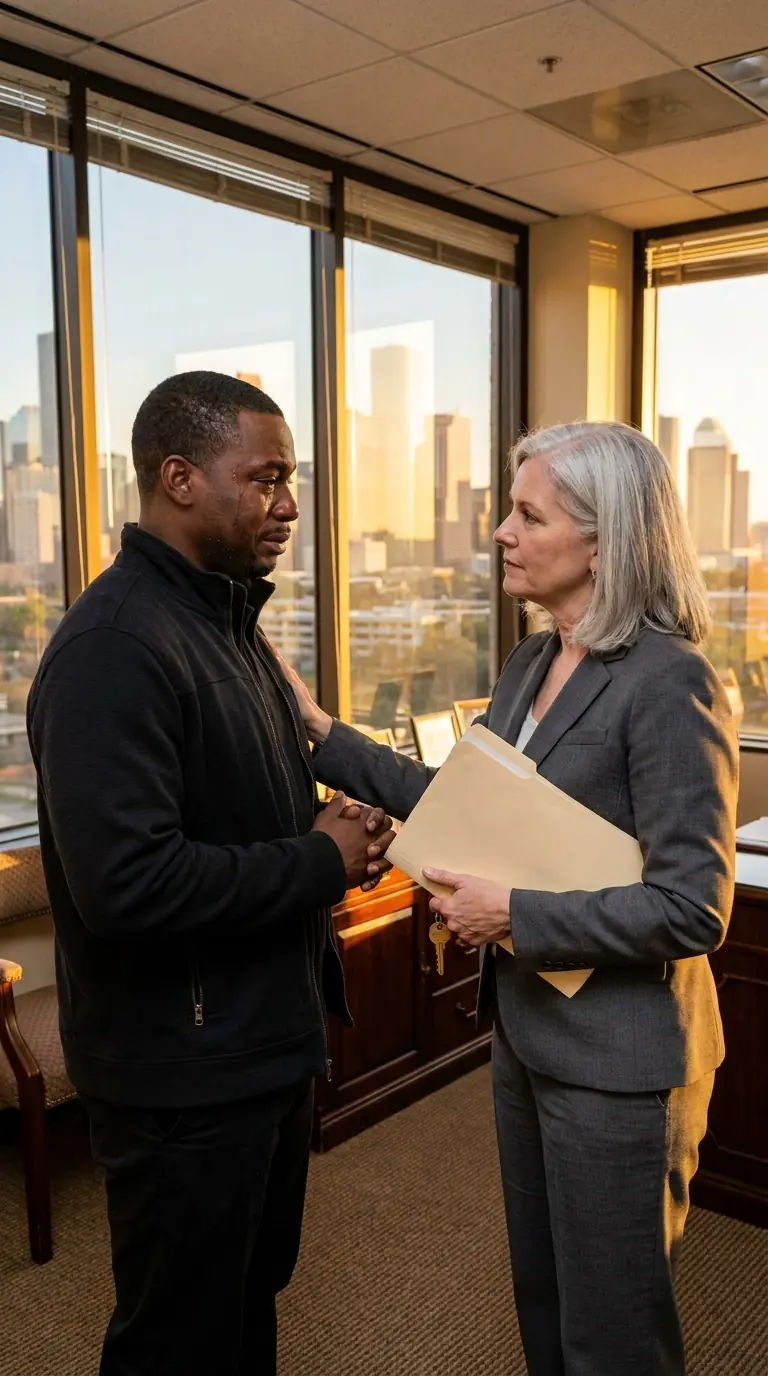
Miss Bradley held his gaze. “That is exactly why she chose you. Because you treated her like somebody when everyone else treated her like nothing. You gave her humanity. She wanted to return the favor.”
She rose and walked toward the door. “Go home, Mr. Thompson. Process this. Tomorrow we begin the legal transfer.” She stopped once more, her voice quieter. “Mrs. Morgan spent the last year of her life happier than she had been in two decades. You gave her that. What she has given you now is simply her way of saying thank you.”
Then she left him alone in the conference room, overlooking the vast Houston skyline, clutching a folder that held the explanation for a miracle he still struggled to believe was real.
The Mercedes dropped Marcus in front of his aging apartment building in the Heights neighborhood. The contrast between the law office’s gleaming luxury and his shabby reality felt jarring enough to induce whiplash. One moment surrounded by walnut wood and nine-figure estates, the next standing before chipped paint and a creaking staircase leading to his cramped home.
He stood on the sidewalk for a long moment, the sealed folder clutched in his hands, trying to understand that his entire life had just changed in ways he couldn’t yet comprehend. $750,000 plus $8.2 million — nearly $9 million total. He literally couldn’t conceptualize numbers that large.
He unlocked the door with trembling hands and stepped inside. His few possessions looked even more meager after what he had just witnessed. An old television balanced on a wooden crate. Jasmine’s drawings taped to every available wall surface with clear tape that was starting to yellow. A small kitchen table with mismatched chairs he’d found at a thrift store. But it was home. It was theirs. And for the first time in four years, he didn’t have to be afraid of losing it.
The first thing Marcus did before even opening Grace’s letter was call Jasmine’s after-school program. His voice shook as he spoke with the program director. “Hi, this is Marcus Thompson, Jasmine’s father. I’d like to pay off our remaining balance in full and prepay for the next two years, please. And I’d like to enroll her in all the enrichment programs she’s been wanting to try. The art classes, the science lab, the creative writing workshop, all of it.”
There was a pause on the other end. “Mr. Thompson, that would be… let me calculate this… that would be approximately $18,400 total for everything.”
Marcus closed his eyes, remembering when even $18 felt impossible. “That’s absolutely fine. Better than fine. I’ll come by tomorrow with payment. Can we also add the summer camps, the ones Jasmine mentioned wanting to attend?”
“Of course, that would bring the total to $22,600.”
“Perfect. Thank you so much.”
After hanging up, Marcus called his landlord, a man who’d been threatening eviction for months. “Mr. Kowalski, this is Marcus Thompson in apartment 4B. I’d like to pay off all my back rent and prepay for the next year, please.”
Another long pause. “Is this some kind of joke, Marcus?”
“No, sir. I’m completely serious. How much do I owe you total, including late fees?”
“Including the late fees, $4,300. And a full year’s rent in advance would be another $21,600.”
“I’ll bring you a check tomorrow for $26,000. Will that cover everything and make us square?”
The landlord’s voice changed completely. Suspicion morphing into obsequious friendliness. “Of course, Marcus. Of course. And uh, if there’s anything you need fixed in the apartment…”
“Actually, yes. The bathroom sink has been leaking for six months. The bedroom window doesn’t close properly, and the stove only works on two burners. Can you have someone fix all that this week?”
“Absolutely. I’ll send someone tomorrow.”
Marcus hung up and sank onto his worn couch, his chest heaving. He had just committed to spending nearly $50,000 in two phone calls, and he still had over eight million left. It felt surreal, like he was playing with Monopoly money instead of making real decisions.
The weight of everything that had happened suddenly crashed down on him like a collapsing building. He folded forward, elbows on knees, face in hands, and wept — not from sadness this time, but from the overwhelming release of a burden he’d carried for so unbearably long. The constant fear, the nightly calculations of which bill could wait another week, the shame of having to ask Mrs. Martinez to watch Jasmine for free when he couldn’t afford child care, the terror that one unexpected expense — a broken bone, a car repair, anything — would send them spiraling into homelessness. All of it lifted in a single morning, dissolved like salt in water.
He cried until he had nothing left, until he was empty and raw and new, until he could finally breathe without the weight of desperation pressing on his chest.
When the tears finally stopped, Marcus washed his face in the bathroom, staring at his reflection in the cracked mirror. The same face, the same person, but everything had changed.
He made himself a cup of instant coffee, all he could afford usually, and sat down at the kitchen table. With trembling fingers, he opened the sealed folder Miss Bradley had given him.
Inside was a handwritten letter on thick, expensive paper. Grace’s handwriting was shaky but clear. The writing of someone whose hands no longer cooperated fully, but whose mind remained sharp.
“My dear Marcus,
If you’re reading this, then the world has learned my secret, and you have received my gift. I imagine you’re confused, perhaps even angry that I wasn’t forthright with you. Let me explain. I couldn’t tell you who I was while I was alive. It would have changed everything between us. I needed to know your kindness was genuine, not motivated by expectation of reward or recognition.
Every morning I tested you without you knowing. Watched to see if your compassion was performance or authentic character. You passed every test simply by being yourself.
The money is for your freedom. Freedom from the grinding poverty I watched drain the light from your eyes day by day. The diner is for your heart. A place to build the dream you mentioned once of a restaurant that honors your parents’ memory.
This key is for your future. Understanding why I chose you. It opens my private study in my home. Catherine knows the address. Go there alone when you’re ready. You’ll understand why you were never just a kind waiter, but the answer to a question I’ve been asking for 20 years. Does true goodness still exist in this world? You proved to me that it does.
One last request from a lonely old woman who found unexpected joy in her final months. Please go to my study. Understand the full story and use what you find there wisely. There are people who will try to take this from you, Marcus. Be prepared to fight for it. I’ve been fighting for what matters my entire life. Now I’m passing that battle to you.
With deepest gratitude and respect,
Grace Elizabeth Morgan
P.S. My zipper stays. There’s a small gift for Jasmine in the bottom drawer of my desk. Save it for her 8th birthday. I wish I could be there to see her face when she opens it.”
Marcus read the letter three times, each time understanding more. Grace hadn’t just left him money. She’d left him a mission, a purpose, something worth fighting for. The mention of enemies made his stomach clench. Preston Harrison’s threats echoed in his memory.
He looked at the brass key that had fallen from the envelope when he opened it. Antique, beautifully crafted, attached to a ribbon. A key to understanding, a key to Grace’s true story.
Marcus knew he needed to visit her study, but first he had to pick up Jasmine from school. He glanced at the clock. 2:15. Mrs. Martinez would get her at 3:30 as usual, but Marcus wanted to pick her up himself today. He wanted to hold his daughter and remember why all of this mattered.
He grabbed his jacket and headed out, taking the bus to Jasmine’s school. When she saw him waiting at the pickup area instead of Mrs. Martinez, her face lit up like sunrise.
“Daddy, you came!” She ran to him and he scooped her up, holding her tight, breathing in the scent of her hair — strawberry shampoo and childhood innocence.
“I missed you today, baby girl.”
“I missed you, too. Guess what? I got a 100 on my spelling test. And Mrs. Chen said my drawing was the best in the class.”
“That’s wonderful, sweetheart. I’m so proud of you.”
As they rode the bus home together, Jasmine chattering about her day, Marcus made a decision. He would visit Grace’s study tomorrow. Tonight, he would just be present with his daughter, soaking in the miracle of having more time, more resources, more everything to give her.
That evening, Marcus made Jasmine’s favorite dinner — spaghetti with butter and parmesan. Not the fancy kind, just the simple comfort food she loved. They ate together at their small table, and for the first time in years, Marcus didn’t feel the knot of anxiety in his stomach, wondering how he’d make rent.
After dinner, after reading bedtime stories, after Jasmine finally fell asleep, clutching her favorite stuffed horse, Marcus sat alone in the darkness of their small living room. He thought about Grace sitting in that corner booth every morning for nearly two years, lonely, observant, testing him without his knowledge. And he thought about tomorrow when he would unlock the secrets she’d left behind and discover what battle he was now supposed to fight.
Old habits died hard. Even knowing he had millions in the bank, Marcus still felt a jolt of anxiety when he thought about spending money. It would take time to truly believe this was real, that the constant fear could finally end. But for tonight, in the quiet darkness, Marcus let himself feel something he hadn’t felt in years. Hope. Pure, uncomplicated, overwhelming hope that maybe, just maybe, everything was going to be okay.
The address Bradley provided led Marcus deep into River Oaks, a neighborhood he’d only seen in magazines. Towering oaks, immaculate lawns, mansions behind iron gates. This was the Houston of old wealth, worlds away from anything he had known.
Grace Morgan’s home sat at the end of a quiet cul-de-sac, a stately brick colonial with white columns and ivy climbing its walls. Roses bloomed across the front garden, elegant and restrained like old money that didn’t need to boast.
Miss Bradley waited on the steps when Marcus arrived by taxi, having arranged for Mrs. Martinez to take Jasmine to school. “Mrs. Morgan never allowed visitors inside for 12 years,” she explained as she unlocked the heavy door. “Not even family. She did all business downtown. This was her sanctuary.”
The interior stole Marcus’s breath. Hardwood floors gleamed beneath crystal chandeliers, scattering the morning light. Every room held carefully chosen furniture, refined, comfortable, never ostentatious. Fresh flowers filled the spaces, maintained even after Grace’s death.
But what stopped Marcus cold were the paintings. A luminous Monet above the fireplace. Waterlilies shimmering in the light. A Van Gogh landscape across the room. A Degas dancer in the hallway. A Renoir in the dining room. Contemporary works he didn’t recognize but instinctively knew were valuable.
“She was one of the most discreet art collectors in North America,” Miss Bradley murmured. “This collection alone is worth over $100 million. This is what Preston really wants.”
Marcus felt dizzy. $100 million on the walls. Yet the house carried a deep loneliness. Not a single family photo, no signs of daily life, no books left open or mugs waiting to be washed. The home felt like a museum kept alive only by habit.
“Her private study is upstairs,” Miss Bradley said, guiding him up a curved staircase. She stopped at a solid oak door. “She gave me a sealed envelope three years ago with instructions to open it only after her death and only with you present. I’ve never entered this room.”
She handed him an antique brass key. “The house is yours now, too, though we haven’t reached that portion of the will.” The news made Marcus’s head spin. The mansion was his.
“I’ll be downstairs,” Miss Bradley said softly, leaving him alone.
Marcus unlocked the study with trembling hands. The room was nothing like the rest of the house. Warm, lived-in, profoundly human. Shelves packed with books lined three walls — literature, business texts, art history, cookbooks. A worn leather armchair sat beside a cold fireplace, a half-finished crossword on a small table. The air smelled of paper, lavender, and a faint memory of pipe tobacco.
But the wall behind the mahogany desk stole his breath. A massive corkboard filled the entire space, eight feet high, twelve feet wide, covered in photographs, clippings, legal documents, financial reports, handwritten notes, all connected by colored string. Red for family, blue for business, green for timelines. A complicated web built over years.
This was the real Grace Morgan — a strategist, a planner, a mind that never stopped tracing connections.
Marcus stepped closer, overwhelmed. At the center of everything hung a single photograph that didn’t match the corporate documents around it. A young woman with a radiant smile stood in front of a small restaurant. Dark hair in a ponytail, apron tied around her waist. The sign above her read “Margaret’s Kitchen — Where Everyone Belongs.” The resemblance to Grace was unmistakable. This was her daughter captured in a moment of pure happiness.
Marcus’s eyes were drawn to yellowed newspaper clippings arranged in careful chronological order below the photograph.
“Local restaurant owner Margaret Morgan, 36, killed in drunk driving accident.” Houston Chronicle, March 15th, 2003. The article included a photo of a car wrapped around a telephone pole.
Marcus felt his stomach clench. “8-year-old daughter also killed in tragic crash.” Houston Post, March 16th, 2003.
Grace had lost her daughter and granddaughter in the same accident. Both gone in an instant.
Marcus’s eyes continued scanning. “Morgan Industries CEO announces extended leave following family tragedy.” Harrison Enterprises acquires bankrupt restaurant chain at auction. Business Journal, November 2003. “Morgan returns to business, launches aggressive expansion.” “Morgan Industries hostile takeover of Harrison Enterprises complete.” Financial Times, June 2007.
The pieces began falling into place like a puzzle, revealing its hidden image. Each article a brushstroke in a larger portrait of grief and revenge. Margaret must have been Grace’s daughter, someone who opened welcoming places where people could gather and share meals, someone who believed restaurants should be community centers, not just businesses. She died young, tragically, along with her eight-year-old daughter, and someone named Harrison — Preston’s father — had profited from the aftermath, purchasing Margaret’s failed restaurants at bankruptcy auction prices while Grace was drowning in grief.
Grace had spent years orchestrating revenge against the Harrison family, building power until she could strike back, until she could crush the man who’d profited from her daughter’s death.
Marcus’s eyes moved to another section of the board dedicated to Preston Harrison. Photos showed him on yachts in the Mediterranean, in nightclubs in Miami, always surrounded by excess and beautiful people, and empty luxury. Financial reports documented massive losses from failed ventures, a tech startup that burned through $4 million in eight months, a cryptocurrency investment that collapsed, a nightclub that closed after six months. Copies of checks Grace had written to cover her grandson’s gambling debts — $1.2 million over five years. A note in Grace’s shaky handwriting: “He carries her name, but not her heart. He has her ambition, but not her soul. He sees people as resources, not humans, just like his father.”
Finally, Marcus’ gaze settled on a small section of board with recent additions clearly made in the last few months of Grace’s life. Pinned there was a distant photograph of Marcus himself, taken without his knowledge. He was standing outside Rosewood Diner during a break, smiling down at Jasmine, who must have brought him a drawing during her lunch hour that day. The love on his face was unmistakable, pure, unguarded, complete.
Beside it, a handwritten note in Grace’s careful script: “He has her heart. He understands what Margaret knew. That dignity and kindness matter more than profit. That people aren’t transactions. That the measure of success isn’t wealth accumulated but lives touched with compassion.”
Below that another note in fresher ink: “Watched him refuse a tip from elderly customer who couldn’t afford it. Watched him share his own lunch with homeless man. Watched him stay late to help new waitress learn the register. Not performance. Character.”
“Margaret would have loved him.”
Tears slid down Marcus’ cheeks as understanding flooded through him in waves of emotion that threatened to knock him off his feet. It had never been about the toast. Grace hadn’t been testing his kindness randomly. She had been searching desperately for someone who embodied what her daughter believed — that the true value of a place isn’t measured in money, but in the warmth and dignity it offers to every person who walks through its doors, regardless of their status or wealth.
Rosewood Diner, shabby and struggling, reminded her of Margaret’s Kitchen. By leaving it to Marcus, Grace wasn’t just giving a gift. She was entrusting him with her daughter’s legacy, asking him to keep alive the values Margaret had died too young to fully realize.
A new resolve hardened Marcus’ grief into something stronger, something like steel forged in fire. This wasn’t about inheriting money anymore. It was about honoring the faith of a lonely woman who had lost the person she loved most and found an echo of that love in an overworked waiter’s simple kindness.
Preston Harrison didn’t just want money. He wanted to destroy the last thing his grandmother had built. The only legacy Grace believed truly mattered. The idea that businesses could operate with both profit and humanity. That success and compassion weren’t mutually exclusive.
Marcus stepped to the desk, his legs shaky. On its polished surface sat a sealed envelope with his name written in Grace’s distinctive handwriting, placed carefully in the center, as if it had been waiting specifically for this moment.
He opened it carefully, his hands still trembling. Inside were a letter and an official-looking document — a single share certificate from Morgan Industries, ornately printed with Grace’s signature.
The letter read:
“Marcus,
By now you’ve seen the web. My life’s work displayed like evidence in a trial. You understand now that this isn’t random chance. I found you because I was looking for you, though I didn’t know your name until I saw you.
Knowledge is power, and you’ll need both in the coming months. This single share gives you the legal right to attend the annual shareholders meeting scheduled for November 15th. Preston will be there. He’ll attempt to seize control of the board, to dismantle everything I’ve built in Margaret’s memory, to turn Morgan Industries into just another soulless corporation that values profit over people. He thinks you’re nobody, just a convenient waiter his senile grandmother got sentimental about. Prove him catastrophically wrong.
Everything you need is in this room. Study it, understand it, use it. The financial reports show his failures. The legal documents show his recklessness. The private investigators’ reports show his character — or lack thereof.
But more importantly, understand what you’re fighting for. You’re not fighting for money or power. You’re fighting for the idea that people like Margaret, people like you, deserve a place in this world. That kindness isn’t weakness. That seeing people as human beings, not resources, is actually the highest form of strength.
Your friend always,
Grace
P.S. Under no circumstances let them intimidate you. You earned this through character, something the Harrison family has never understood. Margaret’s Kitchen failed because she valued people over profit margins. I won’t let her dream die because she was too good for this cruel world.”
Marcus looked around the study again with new eyes. The web of information wasn’t random. It was a complete dossier on Morgan Industries, its enemies, its allies, its vulnerabilities and strengths. Every financial report, every legal document, every piece of evidence he might need to defend Grace’s legacy.
She hadn’t just left him a diner and a fortune. She had left him an arsenal for the battle she knew was coming. The war with Preston Harrison was inevitable. Preston had already threatened legal action, and Grace Morgan had just armed the most unlikely soldier for the fight of both their lives.
Marcus pulled out his phone and called Miss Bradley. “How long do I have before this shareholders meeting?”
“Five weeks. November 15th.”
“I need your help. I need to understand all of this.”
There was a pause. Then Miss Bradley’s voice came back stronger. “Mrs. Morgan anticipated you’d say that. I’m prepared to devote whatever time necessary. She left very specific instructions for me to assist you.”
“Then let’s begin,” Marcus said, looking at the wall of information. “I have a lot to learn.”
“You have something more important than knowledge, Mr. Thompson. You have what Grace spent her whole life searching for. Genuine character. Everything else we can teach you.”
As Marcus hung up, he looked one more time at the photograph of Margaret smiling in front of her restaurant, and he made a silent promise. “I’ll fight for your dream. I promise.”
The following four weeks transformed Marcus Thompson in ways he never could have imagined possible. Every morning, he continued working at Rosewood Diner. Miss Bradley insisted it was important to maintain normalcy, to not let Preston know they were preparing. Marcus served coffee, cleared plates, and smiled at customers all while his mind spun with corporate strategies and financial analyses.
But every afternoon, after picking up Jasmine from school and spending precious hours helping with homework and playing games, after putting her to bed with stories and songs, Marcus returned to Grace’s study and became a student of corporate warfare.
Miss Bradley proved to be an excellent teacher, patient but demanding. “Mrs. Morgan spent 60 years building her business acumen,” she said during their first evening session. “We have four weeks to give you enough knowledge to survive. We can’t make you an expert, but we can make you dangerous.”
They started with the basics of Morgan Industries’ structure. Grace had been brilliant in her final years. She’d systematically broken the company into smaller, independently profitable divisions: real estate development, investment management, philanthropic foundations, and the original manufacturing core that had made the Morgan fortune three generations ago.
“Why break it apart?” Marcus asked, studying the organizational chart spread across Grace’s desk.
“Control,” Miss Bradley explained. “Each division has its own board, its own voting structure. Preston can’t simply seize the company wholesale. He’d have to fight for each division separately, and he doesn’t have the resources for that kind of extended battle. Grace starved him deliberately. She knew his character, knew he’d try something like this.”
Marcus learned about proxy votes, shareholders’ rights, fiduciary duties. He read through financial reports until his eyes burned. Learning to spot the patterns of Preston’s failures — promising starts followed by catastrophic decisions, good ideas destroyed by poor execution and undisciplined spending.
“But he has one significant advantage,” Miss Bradley explained one evening, pointing at a detailed shareholder chart. “Three board members who were loyal to his father, Grace’s late son-in-law. They see Preston as the rightful heir, the true Morgan blood, despite his lack of character. They’ll support him out of nostalgia and old loyalties, not logic.”
Marcus studied the chart carefully. Arthur Chen, 78 years old, original partner. Victoria Morrison, 65, longtime board member. And Daniel Foster, 52, who’d worked with Preston’s father.
“So, what’s Preston’s strategy at this meeting?” Miss Bradley’s expression darkened. “At the shareholders meeting, Preston will call for a vote of no confidence against James Morrison, the current CEO, the man Grace handpicked as her successor. If Preston can create enough chaos and uncertainty, he can panic the smaller investors, crash the stock price, and force a buyout by another conglomerate where he’ll be installed as a figurehead CEO with a golden parachute. His ego would rather burn everything than accept being ignored or controlled.”
Marcus stared at the single share certificate on the desk, still not quite believing it gave him any real power. “So, how do I stop him? This one share doesn’t give me voting power.”
Miss Bradley’s reply was quiet but firm. “With the only weapon Grace gave you. The truth. That share gives you the legal right to enter that meeting and speak during shareholder concerns. You can’t win with votes, but you might win with hearts and reason if you’re brave enough to stand up there and speak authentically.”
The strategy they developed over the next four weeks was audacious, almost recklessly so. Marcus would tell the truth, the whole truth, about Grace’s loneliness, about Margaret’s dream, about what the company was supposed to represent beyond just profit margins.
“You have to make them see Grace as a person, not just a name on a building,” Miss Bradley insisted. “Make them understand what she was trying to protect. Most of these board members never knew her personally. She’d withdrawn from public life after Margaret’s death. You knew her in her final years better than anyone.”
Marcus practiced his speech dozens of times, but the words always felt inadequate, rehearsed, hollow. How could he possibly communicate what Grace had meant, what this legacy represented to a room full of wealthy strangers who’d never served coffee or struggled to make rent?
In parallel with the corporate education, Marcus began making changes at Rosewood Diner carefully, thoughtfully, with input from Walter and Betty.
First rule, Maria Gonzalez, his financial adviser, said during their initial meeting about the diner. “Don’t make any major decisions for at least six months. Let yourself adjust. The money isn’t going anywhere, but small meaningful improvements — those you can start immediately.”
Marcus raised everyone’s wages by 35% starting with Walter and Betty. Walter’s eyes had actually filled with tears when Marcus handed him the new contract and a check covering two months of advanced salary. “Nobody’s ever… Thank you, Marcus. Truly. I thought I’d be sold this place and would be managing for some faceless corporation that didn’t care. Instead, I get you. Grace knew what she was doing.”
The real turning point with Betty came during a brutal October heatwave when the ancient kitchen air conditioning finally died completely, turning the small space into an oven that made working dangerous.
“That’s it. I quit.” Betty threw down her apron, her face flushed and dripping with sweat. “I’m 57 years old. I’m not working in hell itself for any amount of money. This is unsafe.”
The old Marcus would have panicked and begged. The new Marcus simply nodded calmly. “You’re absolutely right, Betty. These conditions are completely unacceptable and potentially dangerous. I should have fixed this weeks ago.”
He pulled out his phone and called the first commercial HVAC company he found online. “This is Marcus Thompson at Rosewood Diner. Our kitchen AC unit just died completely and it’s currently over 100° in there. How fast can you get someone here to install a new commercial system? Money is not a concern. I need this fixed today.”
Three hours later, a crew arrived with a brand new industrial cooling system. By 6:00 p.m., the diner was cool and comfortable for the first time in years. Marcus paid for the emergency service without hesitation. $6,300 that would have been impossible a month ago, but now barely registered.
The next morning, the diner was cool and comfortable. Betty returned to work quietly, and when she called him “boss” for the first time, the word carried genuine respect instead of mockery. “You’re doing right by us, Marcus. You’re treating us like people, not just labor costs on a spreadsheet. We won’t forget that.”
Over the next few weeks, Marcus made other improvements — new equipment for the kitchen, professional knife sharpening service, fresh paint in the bathrooms, a complete cleaning of the ventilation system. Nothing dramatic, nothing that changed the diner’s essential character, but everything that showed respect for the people who worked there.
“This is what Grace wanted,” Marcus told Walter one evening after closing. “A place that works well and treats people with dignity. That was always Margaret’s vision.”
Walter looked at him thoughtfully. “You know what Grace told me when she bought this place nine months ago? Her representative said she wanted it preserved as a working diner, not converted into condos or torn down. Said it reminded her of something important. I didn’t understand then. I do now.”
But every night Marcus returned to Grace’s study and the real preparation continued. Miss Bradley brought in experts. A corporate communications coach who taught Marcus how to speak confidently, how to project authority without arrogance, how to handle hostile questions. A body language specialist who helped him understand how to stand, where to place his hands, how to make eye contact effectively.
“You’re going to be the outsider in that room,” the communications coach explained. “Everyone will judge you on sight. Your clothes, your background, your race, everything. You can’t change that, but you can control your message and your delivery. Speak clearly, speak truthfully, and don’t apologize for existing.”
Marcus learned about Morgan Industries’ history, memorizing key dates and achievements. He studied the financial reports until he could quote earnings and growth percentages without notes. He reviewed the investigator reports on Preston — the gambling debts, the failed businesses, the pattern of starting strong and ending in disaster.
“But don’t make it personal,” Miss Bradley warned. “Attack his record, not his character. Let the facts speak. The moment you make it personal, you lose credibility.”
The day before the shareholders meeting, Marcus stood in Grace’s study one final time, looking at everything he’d learned. The web on the wall had become familiar, each connection now making sense. He looked at the photograph of Margaret smiling in front of her restaurant, and he felt the weight of what he was about to attempt.
“I hope I don’t let you down,” he whispered to the empty room. “Either of you.”
His phone rang. Miss Bradley. “Are you ready?”
“No,” Marcus said honestly. “But I’m going anyway. That’s all Grace ever asked. She didn’t want perfection. She wanted someone who’d show up and fight for what’s right, even when it’s terrifying.”
The meeting was scheduled for 10:00 the next morning. Marcus barely slept, running through scenarios in his mind, imagining Preston’s attacks, rehearsing responses.
At dawn, he stood before the mirror in Grace’s guest bedroom. Miss Bradley had insisted he stay at the house the night before. A professional stylist had come the previous afternoon, bringing several tailored suits. Marcus wore a perfectly fitted charcoal suit, crisp white shirt, burgundy tie. His hair was neatly cut. His shoes polished to a mirror shine. He looked composed, professional, confident. Inside, his heart pounded like a war drum.
“You’re ready,” Miss Bradley said from the doorway, offering a rare smile. “Grace would be proud of who you’ve become. Remember, you’re not fighting for money or power. You’re fighting for the idea that people like Margaret, people like you deserve respect. That kindness isn’t weakness.”
Marcus nodded, squaring his shoulders. “Let’s go.”
Two security guards provided by Miss Bradley as a precaution escorted Marcus to the waiting car. As they drove through Houston’s downtown streets toward Morgan Tower, Marcus caught his reflection in the window. The frightened waiter was gone. In his place was someone stronger, someone fighting not just for himself, but for a legacy worth preserving, for a dream that deserved to survive.
The battle was about to begin, and Marcus Thompson had no intention of backing down. Not now, not ever.
Morgan Industries headquarters occupied floors 40 through 52 of the gleaming downtown tower that bore its name. The 48th floor conference room seemed built to intimidate — floor-to-ceiling windows overlooking Houston, a massive U-shaped table seating 50, and gallery seating for another 150 shareholders, analysts, and reporters.
Led by Miss Bradley with two security guards at her sides, Marcus took his seat in the front row reserved for shareholders. The moment he walked in, hundreds of eyes locked onto him. Curious, skeptical, some openly hostile. Whispers rippled through the room. “Who’s that?” “That’s the waiter Preston keeps talking about.” “He shouldn’t be here.”
Marcus kept his posture steady. Don’t shrink. Don’t apologize. You have every right to sit here.
The meeting opened with routine business — quarterly reports, projections, charts that blurred together under the fluorescent lights. Marcus listened attentively. He’d studied these documents until he could recite them from memory.
CEO James Morrison gave a stable but uninspiring presentation, exactly the kind of cautious leadership Grace had appreciated.
Then the chairwoman announced, “We’ll now move to new business.”
Preston Harrison rose immediately. Standing at the center like a performer on stage, dressed in a flawless navy suit. He launched into a speech about family legacy, innovation, disruption, and bold leadership. His charisma filled the room. He painted Morrison as outdated, the board as timid, and himself as the visionary heir ready to reclaim what was rightfully his.
With dramatic timing, he ended, “I call for a vote of no confidence in the current CEO and nominate myself as chairman of the board.”
A ripple of murmurs swept the room. Some board members nodded. Younger shareholders leaned in.
Morrison responded, speaking calmly about stable growth, but compared to Preston’s theatrics, he looked colorless. Preston countered every point with rehearsed confidence.
“Does anyone else wish to speak?” the chairwoman asked.
Miss Bradley turned to Marcus and gave the faintest nod.
Marcus stood. Whispers surged again.
“I’d like to speak.”
Preston let out a laugh. “With respect, I thought this portion was for shareholders, not service staff. Security.”
Marcus faced the chairwoman. “I am a shareholder. My name is Marcus Anthony Thompson. I hold a legitimate share of Morgan Industries stock.”
After checking his documents, the chairwoman nodded. “Mr. Thompson may speak.”
Marcus stepped to the microphone. His hands trembled, but he held the mic steady and looked directly into the eyes of the board members and analysts.
“Mr. Harrison spoke about legacy,” he began. “I want to tell you about the Grace Morgan I knew. Not the executive, but the lonely woman who spent her last months in a small diner drinking black coffee and eating toast I cut for her because her hands shook.”
He told them about the quiet conversations, the afternoon spent teaching Jasmine math, and the way Grace watched people looking for something deeper than profit.
At first, the room listened politely, but as he spoke, the atmosphere shifted. Executives leaned forward. Even Preston’s allies watched with unexpected attention.
“Grace wasn’t thinking about stock prices. She was thinking about her daughter Margaret, whose dream was a business built on dignity and compassion — values this company was founded on but gradually forgot.”
Then Marcus turned to Preston. “Mr. Harrison talks about vision, but according to documents Grace left in Miss Bradley’s care, what has that vision produced?” Miss Bradley placed a binder on the chairwoman’s desk. Independent verifications included.
Marcus continued, voice steady. “$6.8 million lost on failed ventures. $1.2 million in gambling debts his grandmother quietly paid. Three bankruptcies from businesses he personally ran.”
Gasps spread across the room.
In Grace’s own handwriting: “Preston has the ambition of a conqueror and the judgment of a fool. I cannot entrust my daughter’s legacy to him.”
Preston exploded. “Lies! I’ll sue!”
But the chairwoman silenced him.
Marcus went on. “Grace believed James Morrison understood sustainable growth, but she also believed this company needed to recover its soul.” He took a breath. “So, I propose the creation of the Margaret Morgan Legacy Initiative — 15% of annual profits dedicated to supporting small business owners through grants, mentorship, and microloans. And I volunteer to oversee it under board supervision to honor Margaret’s vision.”
Preston shot up. “Insanity! 15% is tens of millions wasted on charity!”
“Actually,” a voice said from the back. Arthur Chen, the oldest board member and Grace’s longtime friend, slowly stood. “I knew Grace for 50 years,” he said. “I watched her pour her heart into this company. Preston, your father was a good man. You’re not him. Grace gave you every chance. You squandered them.”
Arthur leaned on his cane. “I vote to keep James Morrison as CEO. And I vote for the Legacy Initiative. Grace wanted this company to stand for something more than money. Today, I choose to honor her.”
A silence followed, heavy, charged. Then Victoria Morrison stood and began clapping. One by one, applause spread across the room. Younger board members, investors, analysts, half the room rose to their feet.
Preston’s expression cracked.
The chairwoman called for order. “We will now vote.”
Motion one: no confidence in CEO James Morrison. Results: 78 opposed, 12 in favor. Motion fails.
Motion two: establish the Margaret Morgan Legacy Initiative. This vote lasted longer. Some were hesitant, but Arthur’s support carried weight. Result: 42 in favor, 18 opposed. Motion passes. Marcus was officially approved as director of the initiative.
The room dissolved into chaos — reporters shouting, board members arguing, Preston storming out — but in the midst of it, Miss Bradley appeared beside Marcus.
“Well done,” she said quietly. “Grace would be proud.”
Marcus watched Preston disappear through the doors, rage burning across his face. “Is it really over?” Marcus asked.
“The will fight is over,” she said. “But men like Preston don’t accept defeat easily. Be careful.”
Marcus felt exhaustion crash into him. Relief mixed with purpose. He had defended something larger than himself. And for the first time, he felt the weight of responsibility that came with being trusted.
Grace Morgan hadn’t only left him an inheritance. She had placed her faith in him. She had bet everything on the idea that character mattered more than pedigree, and she’d been right.
Marcus took one last look at the conference room, a space designed to intimidate. Today, a former diner waiter had stood at its center and changed its future.
He walked out beside Bradley, not triumphant, but grounded, determined, ready for what came next. Because this wasn’t just about winning a vote. It was about becoming the kind of man Grace believed he could be.
Nine months later, Rosewood Diner had been transformed, but never erased. The interior was brighter, cleaner, and equipped with efficient modern appliances. New cushioned booths replaced the cracked vinyl and fresh paint covered walls that had been dingy for decades. The kitchen gleamed with professional-grade steel, and yet the heart of the diner endured — an affordable, welcoming place for working people to sit down and feel seen.
Grace’s corner booth remained exactly as she’d left it, now preserved behind protective glass mounted on the wall. Inside sat her coffee cup, a worn menu, and a plate with four squares of toast. Above it, a bronze plaque read: “Grace’s Corner — Where everyone deserves dignity.” In memory of Grace Elizabeth Morgan, 1941–2024, and Margaret Morgan, 1967–2003.
Marcus now split his days between running the diner and directing the Margaret Morgan Legacy Initiative, an organization quietly transforming lives across Texas. Walter served as general manager, finally paid what his decades of expertise deserved, and Betty led the staff with full benefits for the first time in her career.
In its first nine months, the initiative had funded 43 small businesses — a bakery in Austin run by a formerly incarcerated woman rebuilding her life, a family restaurant in San Antonio started by Vietnamese immigrants, a Dallas food truck operated by a veteran with PTSD who found healing through cooking. Each business received not just funding but mentorship, training, and long-term support.
For the first time in years, Marcus had time. Time to breathe, to paint, and to be present with Jasmine. Time not spent in desperation, but in living.
The first grant recipient had been Sophia Rodriguez, a young woman determined to open a bakery specializing in her grandmother’s Mexican pastries. Marcus personally mentored her weekly at the diner. “Pass it forward,” he told her. “That’s all Grace ever asked. Success isn’t the end, it’s the beginning of helping the next person.”
Abuela’s Kitchen opened in March and thrived immediately. Sophia, following Marcus’ example, had already begun mentoring someone else.
One Saturday in late June, Marcus sat in the diner during the breakfast rush. Jasmine, now eight, thoughtful and tall, worked on her homework in Grace’s booth, which Marcus kept functional rather than sealing off. Jasmine treated it with reverence.
“Daddy,” she asked quietly. “Do you think Mrs. Morgan would like what you’ve done?”
Marcus looked around. Customers from every walk of life laughing together. The smell of fresh coffee. Walter’s pancakes. Construction workers dining beside lawyers. Elderly regulars treated no differently from wealthy ones.
“Yes,” he said. “I think she’d love it.”
He opened a worn folder Grace had left for this exact day — Jasmine’s 8th birthday, tomorrow. Inside lay an antique silver locket and a handwritten note for Jasmine.
“Kindness is the most valuable inheritance. Money disappears. Buildings crumble, but compassion ripples forward through generations.”
Grace wrote about Margaret, about seeing potential in those others ignored. About how Marcus had restored her dignity when she felt invisible.
Marcus wiped his eyes just as Jasmine looked up. “What’s that, Daddy?”
“Something Mrs. Morgan wanted you to have. Even though she’s gone, she still thought of you.”
“I miss her,” Jasmine whispered.
“I miss her too.”
The bell above the door chimed. An elderly man entered, thin and weathered, moving with the hesitation of someone unsure he belonged anywhere. Marcus recognized the look. He’d seen it in Grace’s eyes that first morning.
He approached gently. “Good morning, sir. Table for one?”
The man nodded, barely speaking. Marcus guided him to a comfortable booth, promised fresh coffee, and assured him there was no rush.
Passing Jasmine, he heard her whisper. “He looks sad.”
Marcus knelt beside her. “Yes. That’s why we must be kind. Sometimes people only need someone willing to see them, like Mrs. Morgan taught you.”
“Exactly.”
Sunlight streamed across Grace’s plaque as Marcus carried the coffee over, the bronze glowing like gold. He paused, murmuring inwardly. “Thank you, Grace.”
Legacy isn’t what we leave to people, but what we leave in them.
Preston Harrison never contested the will again. Grace’s paperwork had been airtight. Six months later, he moved to Los Angeles to pursue a crypto venture with what remained of his inheritance.
Evelyn Morgan Harrison sent one letter. Surprisingly gracious. “Perhaps Grace understood something I didn’t. That kindness to strangers can matter as much as loyalty to family. I’m sorry for our cruelty at the will reading. Use her gift well.”
Marcus framed the letter. A reminder that even adversaries can grow.
The Legacy Initiative expanded faster than Marcus imagined. By the end of year one, it had funded 87 businesses and trained over 200 entrepreneurs. More importantly, it built a community of people determined to run businesses with both profit and humanity.
James Morrison, the CEO Grace trusted, became one of Marcus’ strongest allies. “Your grandmother was right about you,” he said. Investors agreed. Morgan Industries stock climbed, fueled by goodwill and positive publicity. Compassion, it turned out, was good business.
One evening in late summer after closing the diner, Marcus stood alone in the golden light. He’d gone from drowning in debt to someone with purpose and power. But the greatest gift Grace had given him wasn’t financial. It was permission to believe that who he was had always been enough.
His phone buzzed. Sophia had secured a lease for her second location. Marcus smiled. “I just opened a door.” He texted back. “You walked through it. That’s all Grace ever did for me.”
Tomorrow was his day off, time reserved entirely for Jasmine. As he locked up, he noticed a young woman standing across the street, staring at the diner with a familiar mix of hope and fear.
“Can I help you?” he asked.
She explained she wanted to open a restaurant someday and had been told the owner might offer advice.
Marcus smiled. “I’m Marcus Thompson. Come by tomorrow at two. Tell me about your dream.”
Her face brightened. “Really?”
“Absolutely. That’s what we do here.”
As Marcus headed to his modest Honda, he felt Grace’s presence like a warm hand on his shoulder. This is what you wanted, he thought. Not monuments, just kindness rippling outward, one person at a time.