A quiet winter morning settled over Milford like a tired sigh. Snow clung to the edges of the sidewalks, and the sky above town hung low and gray, heavy with more weather waiting to fall. At the corner of Maple and Maine Street sat a small café with fogged windows and a flickering neon sign that buzzed whenever the cold got too sharp.
Inside, the warmth smelled like coffee, cinnamon, old wood, and long years of survival.
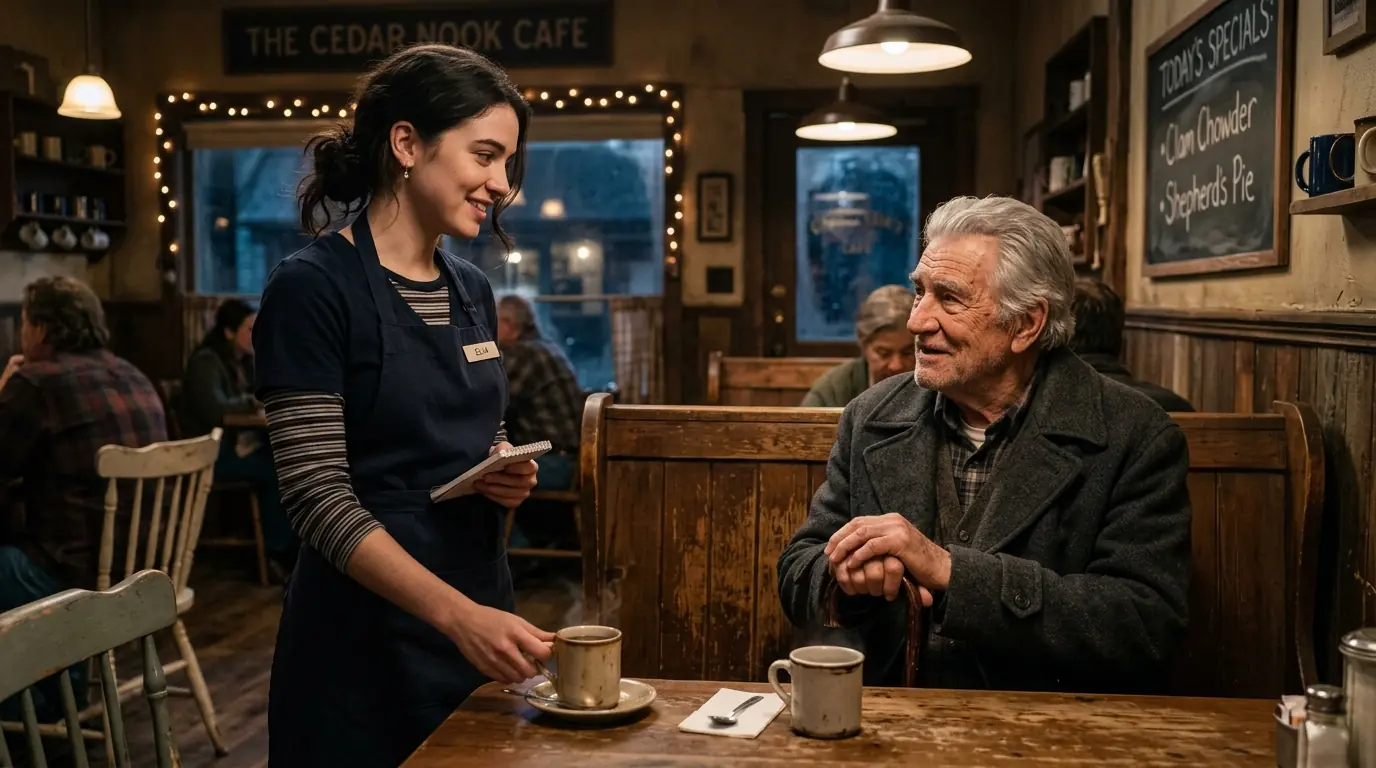
Aaliyah Brooks moved quickly between the tables with practiced ease, balancing a coffee pot in one hand while wiping down the counter with the other. At 22 years old, she already wore exhaustion the way other people wore perfume. Quietly. Constantly. Invisible to anyone who wasn’t really paying attention.
Her smile was familiar around town. Soft. Patient. A little tired.
The bell above the café door chimed softly.
Aaliyah glanced up.
An older man stepped inside.
He was tall, though age had bent him slightly forward. Silver hair combed neatly back. Gray wool coat tailored perfectly across narrow shoulders. One hand gripping a black wooden cane polished smooth from years of use.
He looked like the kind of man who once belonged in courtrooms and country clubs instead of small cafés in forgotten towns.
The man paused near the entrance, scanning the room carefully.
His pale blue-gray eyes moved across the empty tables, the cracked tile floor, the handwritten menu board, and finally settled on Aaliyah.
“Black coffee,” he said quietly. “No sugar.”
His voice sounded dry and worn, like paper folded too many times.
“Coming right up,” she replied.
She turned toward the espresso machine while the man slowly made his way toward the corner booth by the window. The booth where morning light always landed cold and pale across the table.
The café hissed softly around them.
Steam rose from the machine as Aaliyah poured the coffee carefully into a ceramic mug warmed by the dishwasher. She carried it over and set it gently in front of him.
“Careful,” she said softly. “It’s hot.”
The old man wrapped both hands around the mug as though trying to absorb the heat into his bones. He took one sip, winced slightly, then set it down harder than necessary.
“Too hot,” he muttered.
Aaliyah smiled faintly.
“Maybe you forgot how to enjoy warmth.”
The words slipped out before she could stop them.
The old man slowly lifted his eyes toward her.
And for the first time, he truly looked at her.
Not the quick glance customers usually gave waitresses. Not the distracted stare of someone thinking about work or bills or weather.
This was different.
His gaze lingered on her face, the curve of her cheekbones, the line of her jaw, the dark steady eyes that refused to look away.
Something flickered across his expression.
Recognition.
Pain.
A strange silence settled over the café.
Even the old radio behind the counter seemed quieter somehow.
“Let me know if you need anything else,” Aaliyah said gently.
She turned and walked back toward the counter, but she could still feel his eyes following her the entire way.
The café was called Maple and Maine because of the intersection where it sat like a forgotten memory from better years. It had been there long before Aaliyah was born, back when Milford still believed factories would stay open forever and families wouldn’t leave town searching for better lives.
Now the paint peeled from the walls.
The booths squeaked.
The heater barely worked.
And when it rained, the neon sign outside flickered like it was struggling to stay alive.
Still, people came.
Mostly because there weren’t many places left.
Aaliyah had worked there for three years. Ever since graduating high school. No college money. No backup plan. Just long shifts, tired feet, and the constant hope that one day she might save enough to leave.
Maybe study journalism.
Maybe social work.
Something that mattered.
But life had a way of shrinking dreams into survival.
Her mother’s medical bills kept piling up. Their little house on Birch Street barely stayed warm during winter. The furnace groaned through the night like it resented them for still being alive.
So Aaliyah stayed.
She poured coffee.
Smiled at strangers.
Pretended she didn’t mind disappearing inside other people’s routines.
Behind the register sat an old radio with cracked dials and faded silver knobs. It had belonged to her father once.
Marcus Brooks.
The man she barely remembered.
He had gone to prison when she was 2 years old after being convicted of murder. Her mother almost never spoke about the trial. Never explained what truly happened.
One day Aaliyah had a father.
The next day she only had newspaper clippings and silence.
Sometimes, late at night, she would take out the old cassette tape her mother kept hidden in a shoebox beneath the bed. She’d listen to Marcus’s voice for a few minutes at a time just to remember he had once been real.
The radio crackled softly.
“And in local news,” the cheerful morning host announced, “the Milford Community Foundation received an anonymous donation of $100,000 this week. Officials say the funds will go toward heating assistance for low-income families during the winter storm season.”
Aaliyah snorted quietly.
“Anonymous,” she muttered while wiping down the counter. “Rich people love helping people as long as nobody asks where the money came from.”
Across the café, the old man remained silent.
Watching her.
Studying her.
God help him, she looked exactly like Marcus.
Edward Grant tightened his grip around the coffee mug until his knuckles whitened.
For thirty years people had stood when he entered a room.
They had called him Your Honor.
They had feared him.
Respected him.
Obeyed him.
None of that mattered anymore.
Because sitting behind the counter of this tiny café was the daughter of the man he had destroyed.
And she had no idea.
For the next three mornings, Edward returned at exactly 7:05.
Always the same booth.
Always the same black coffee.
Always watching her from a distance while guilt slowly hollowed him out from the inside.
By the third morning, Aaliyah stopped asking what he wanted.
She simply poured the coffee and carried it over automatically.
“Morning, Mr. Grant,” she said lightly.
Edward nearly flinched hearing his name in her voice.
“You remembered.”
“You’re hard to forget.”
He tried to remain cold with her. Tried to keep a safe distance between them.
But Aaliyah possessed a dangerous kind of kindness. The kind that slipped through cracks people spent decades building around themselves.
One morning, Edward unfolded an old newspaper while waiting for his coffee.
The article headline had faded from years of rereading.
Marcus Brooks Convicted of Murder.
He had memorized every word.
Aaliyah set the coffee down beside him.
“Same as usual.”
“If you remember it,” Edward muttered sharply, “serve it faster next time.”
The harshness surprised even him.
Aaliyah paused.
For a moment he expected anger.
Instead she smiled slightly.
“I guess perfection takes time.”
Edward looked up immediately.
Nobody spoke to him that way anymore.
Not with humor.
Not with ease.
Not like he was simply a man instead of a monument built from authority.
Heat crept into the back of his neck.
“Noted,” he muttered quietly.
An hour later the café had nearly emptied.
Edward stood slowly, leaning heavily on his cane. His knees ached. His back burned. Age had turned every movement into negotiation.
He reached into his coat pocket for his wallet.
Nothing.
He checked the other pocket.
Still nothing.
“My wallet,” he muttered.
Aaliyah looked over immediately.
“Everything okay?”
“I must’ve left it at home.”
“You can pay tomorrow.”
“No.”
The word came out too sharply.
Aaliyah stayed calm.
“It’s fine, really.”
“I don’t take pity.”
Without arguing, she quietly pulled five dollars from the tip jar and slipped it into the register.
“There,” she said. “Paid.”
Edward stared at her.
“What are you doing?”
“You’ll pay me back tomorrow. Or maybe you won’t.”
“I don’t need charity.”
Aaliyah looked directly into his eyes.
“Good,” she said softly. “Because I don’t give pity, Mr. Grant. Only kindness.”
The words struck him harder than any sentence he had ever delivered from the bench.
Because Marcus Brooks used to speak exactly the same way.
That night Edward returned home to a mansion so large it echoed with emptiness.
His wife had been dead for years.
His son rarely called anymore.
The silence inside the house felt endless.
Standing in the hallway, Edward reached into his coat pocket for his gloves and suddenly froze.
His wallet was there.
Right where it always was.
Slowly, he opened it.
Inside sat the café receipt.
And beneath the printed total, written in neat looping handwriting, were four simple words.
Paid by kindness.
Edward sat heavily on the bench near the door.
For a long time, he simply stared at the receipt while memories rose around him like floodwater.
The factory fire.
The courtroom.
The sentence.
Marcus Brooks standing before him insisting he was innocent.
And Edward ignoring the truth because the truth threatened everything he had built.
Twenty-three years earlier, Marcus Brooks had run into a burning factory and saved Edward’s son.
Three years later, Edward sentenced him to twenty-five years in prison for a murder he knew deep down Marcus did not commit.
Marcus Brooks died in prison three months earlier.
And Edward had never once found the courage to confess.
Snow buried Milford the following week beneath six inches of white silence.
The storm rolled through town like an angry spirit, rattling windows and knocking out power across half the county.
But Maple and Maine opened anyway.
It always did.
The old backup generator coughed and sputtered beneath the café floor while weak yellow lights flickered overhead.
By eight in the morning, the place sat almost empty except for Aaliyah standing behind the counter holding a cup of coffee in both hands while snow spiraled outside the windows.
She noticed immediately when the bell chimed.
Edward Grant stood in the doorway covered in snow.
“You shouldn’t be out in this weather,” she said quickly.
“Old habits,” he muttered weakly.
She hurried him toward a table and poured him fresh coffee, adding cream this time without asking.
Neither spoke for a while.
Outside, wind screamed down Main Street.
Finally Edward looked at her.
“Do you believe in forgiveness, Miss Brooks?”
The question hung heavily between them.
Aaliyah tilted her head.
“Depends who’s asking.”
“A man who doesn’t deserve it.”
She studied him carefully.
“Most people who ask for forgiveness don’t think they deserve it,” she said quietly. “That usually means there’s still something good left in them.”
Edward almost broke right there at the table.
Instead he stared down at the coffee.
“I spent my whole life believing I was doing the right thing,” he whispered.
“That sounds honorable.”
“It was cowardice.”
Aaliyah leaned forward slightly.
“What changed?”
Edward’s voice cracked.
“I did.”
The silence afterward felt sacred somehow.
Like the pause between prayer and confession.
Aaliyah wanted to ask what pain lived inside this man.
Wanted to understand why grief seemed permanently carved into his face.
But she didn’t push.
Instead she simply reached across the table and rested her hand gently over his.
“You’re kinder than you think you are,” she said softly.
Edward looked down at her hand resting on his.
You don’t know me, he thought.
God, if only you knew me.
A week later, Aaliyah locked up the café early after the heat finally failed completely.
The temperature had dropped below twenty degrees.
She walked home through frozen streets with her scarf wrapped tightly around her neck.
Halfway down Birch Street she noticed a black Rolls-Royce parked near the curb.
It didn’t belong there.
The driver’s door opened slowly.
Edward Grant stepped out holding a large manila envelope.
“Aaliyah,” he called weakly.
Then suddenly his face twisted in pain.
The envelope slipped from his hand into the slush.
And he collapsed.
Aaliyah ran immediately.
“Mr. Grant!”
He struggled desperately for breath while snow soaked through his coat.
“Stay with me,” she begged, kneeling beside him.
His trembling hand gripped hers tightly.
“Tell your father…” he whispered painfully.
Aaliyah froze.
“…I’m sorry.”
Then his eyes rolled back.
The ambulance arrived minutes later.
As paramedics worked over Edward’s body beneath flashing red lights, Aaliyah picked up the envelope from the slush.
Inside she found three things.
A handwritten letter.
A check for $250,000.
And an old black-and-white photograph.
Her breath caught instantly.
The man in the photo carrying a little blonde boy from a burning building was her father.
Marcus Brooks.
And the child in his arms was Edward Grant’s son.
Everything shattered into place at once.
At the hospital, Edward finally confessed.
He had been the judge at Marcus Brooks’s trial.
He had sentenced Marcus despite knowing the case was wrong.
Fear.
Politics.
Cowardice.
That was his excuse.
Aaliyah wanted to scream at him.
Wanted to hate him completely.
Part of her already did.
But another part saw the broken old man beneath the guilt.
Before she left, Edward told her about a blue box hidden in his attic.
Inside it, Aaliyah discovered court documents, police reports, and a cassette tape labeled:
Marcus Brooks. Final Statement.
Hands trembling, she pressed play.
“My name is Marcus Brooks,” her father’s voice said softly. “I’m recording this because I don’t know if I’ll get another chance to tell the truth.”
Aaliyah’s chest tightened painfully.
“I didn’t kill anyone,” Marcus continued. “But they threatened my family. They said if I fought the case, they’d go after Diane. After Aaliyah. So I took the blame.”
A long pause followed.
Then came the words that shattered her completely.
“If Judge Grant sentences me, I hope he knows I don’t blame him. I hope he remembers his son is alive.”
Marcus had forgiven Edward long before Edward could forgive himself.
Three days later, Aaliyah walked into a local radio station carrying the tape recorder.
That night the entire city heard Marcus Brooks’s voice for the first time.
Public outrage exploded immediately.
News outlets spread the story across the state.
And before midnight, Edward Grant himself arrived at the station asking to speak live on air.
Sitting beneath studio lights across from the daughter of the man he had condemned, Edward finally confessed publicly.
“My name is Edward Grant,” he said into the microphone. “And I failed an innocent man.”
His voice shook.
“So many years I convinced myself I was protecting justice. But the truth is I was protecting myself.”
The entire studio sat silent.
“Marcus Brooks saved my son’s life,” Edward continued. “And I repaid him by destroying his.”
Tears filled his eyes.
“There is no apology large enough for what I did.”
Aaliyah sat quietly across from him listening while decades of guilt finally collapsed inside the old man.
Three days later Edward Grant died peacefully in his sleep.
On his desk sat one final letter addressed to Aaliyah.
Inside was a single sentence.
Forgive yourself, even if you can’t forgive me.
One year later, Maple and Maine looked different.
Part café.
Part radio studio.
Part sanctuary.
The old dishwashing sink had been replaced by microphones and recording equipment. The café walls carried framed photographs of Marcus Brooks and Edward Grant side by side beneath a plaque reading:
The Marcus Brooks and Edward Grant Foundation.
For Truth. For Justice. For Redemption.
Every morning at exactly 6:59, Aaliyah Brooks sat before a microphone and greeted Milford with the same calm steady voice.
“Good morning, Milford,” she would say. “This is Aaliyah Brooks, and you’re listening to The Morning Voice, where truth has a sound.”
Her broadcasts spread far beyond Milford.
Soon schools, radio stations, and podcasts across the country shared her work.
The foundation funded scholarships for children from working families, veterans, and victims of wrongful convictions.
And every morning before sunrise, Aaliyah poured two cups of black coffee.
One for herself.
And one for the empty corner booth by the window.
Ten years later, Aaliyah Brooks stood beneath bright lights inside the National Press Hall in New York City accepting the Edward Grant Humanitarian Award.
By then her foundation operated nationwide.
Wrongful conviction cases had been reopened because of her work.
Young reporters from forgotten communities carried her mission forward.
As applause filled the hall, Aaliyah smiled softly.
“This award,” she said, “belongs to every person who chose compassion when it would’ve been easier to walk away. Because kindness doesn’t end with one act. It echoes.”
In the front row sat Edward Grant’s grown son holding his father’s old pocket watch quietly in his hands.
After the ceremony ended, Aaliyah stepped outside into the cold New York night and looked up at the city lights.
Somewhere nearby, faint jazz music drifted from a café radio.
She smiled.
The sound of kindness was still soft.
But now it reached the whole world.