In a run-down neighborhood, there was a young Black woman who sold street food every day. Each day, she saved her last meal for an old man in a wheelchair. People laughed at her, called her foolish, said she was being played. But one day, the old man disappeared, leaving behind only a letter with the address of a fancy hotel. And when she walked through those doors, the truth she discovered changed her life forever.
South Ridge was not the kind of neighborhood that made it onto postcards. The sidewalks were cracked, the buildings faded, and the only green came from weeds pushing through the pavement. But in a narrow corner of the block under the shade of an old sagging tree, a woman named Eugene Harris opened her food stand every morning without fail.
She was 24, small-framed with skin the color of deep brown earth and hair she tied back into a bun that barely held. Her eyes carried the weariness of someone who had lived through too much too soon. But when she smiled, it softened everything.
She didn't have much. Her stall was built from mismatched planks of plywood held together by rusted nails and prayer. A makeshift tin roof rattled every time the wind picked up. The sign that read “Home Meals” was painted by hand, slightly crooked but bright. Her menu was simple: rice, stewed beans, mashed yams, and once in a while something fried when she could afford oil. The flavors though were honest, made with care, and the regulars knew it. People came because Eugene cooked with a kind of patience most had forgotten.
She lived just three blocks away in a single room she rented behind a closed-down laundromat. The room had no running water and the electricity flickered at night. She cooked on a coal stove, bathed with cold water from a bucket, and often went to bed hungry. Still, every day at dawn, she pushed her cart to the spot by the tree, and set up like clockwork. Not because business was booming — most days she barely broke even — but because it gave her purpose. It gave her rhythm.
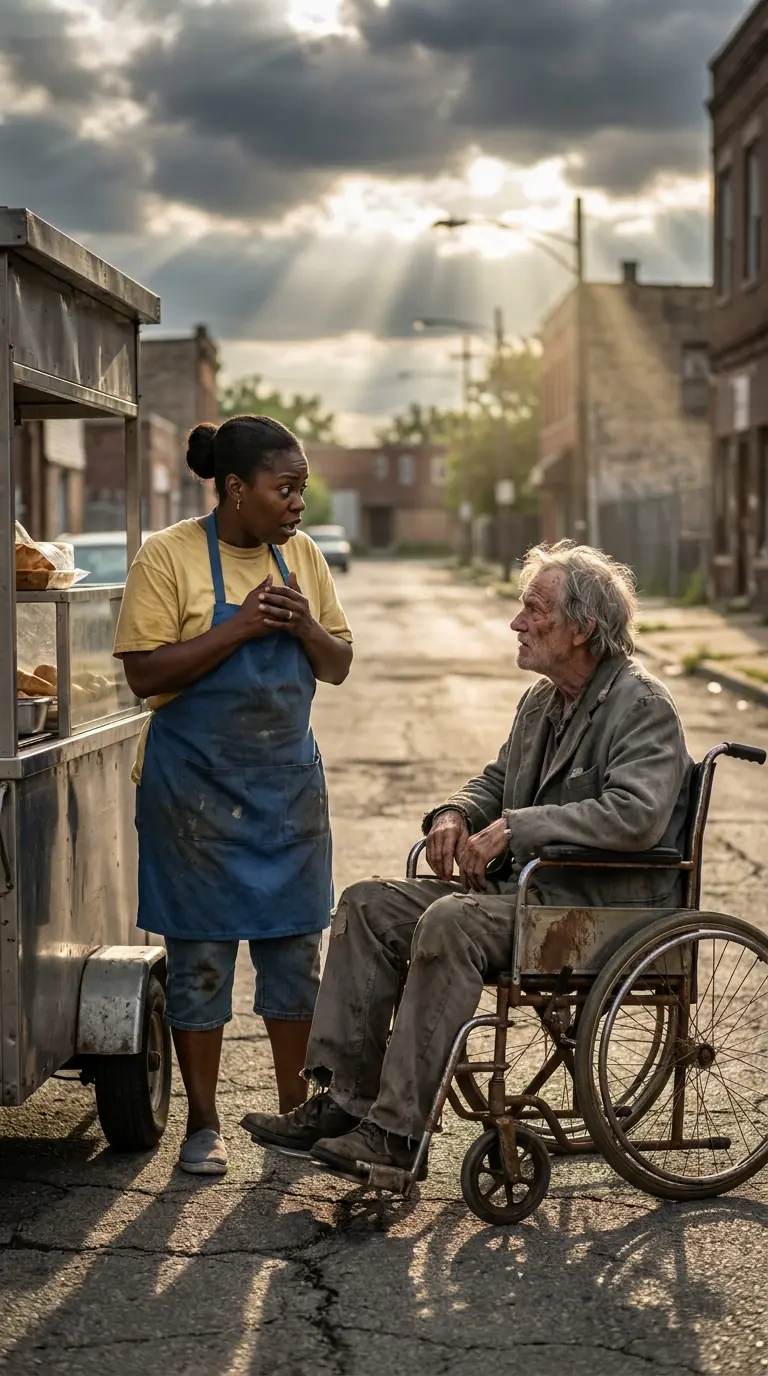
That afternoon, like many before, the sun pressed down hard. The smell of sweat and street smoke filled the air. Eugene wiped her forehead with the edge of her sleeve and turned to stir a pot of beans. That's when she noticed him again. Same time, same spot. An old white man sitting in a weathered wheelchair at the edge of the street. He didn't speak. He never did. His clothes were threadbare, his shoes missing laces, and his face looked like it hadn't been washed in days. His wheelchair creaked every time he adjusted one wheel, clearly off balance.
She had seen him the first time about a month ago. He'd appeared out of nowhere, pushing himself slowly down the cracked sidewalk, making no noise beyond the occasional squeal of his wheels. At first, Eugene had done what most people did. She looked and then looked away. But something about his stillness caught her. He didn't beg. He didn't stretch out a hand or call for help. He just sat there watching. Or maybe not even that. He kept his eyes down like he was apologizing for existing.
People whispered. A man at the bus stop said he was probably dangerous. A woman buying plantains muttered, “Why would a white man be out here like that? Drugs, probably.” A teen snorted, “Maybe he's just crazy.” Eugene heard it all. But she also saw what others didn't. The way his hand shook when the wind blew, how he tried to hide his cough into the sleeve of a coat with no lining.
The second time she saw him, she brought him a bowl of rice. She didn't say much, just placed it on a plastic stool near his wheelchair. He looked up startled, then nodded once. That was it. No thank you, no questions. She didn't need them.
Since then, it had become a quiet ritual. Every afternoon, when her rush was over and she had a little food left, she gave it to him. Sometimes it was a full plate. Sometimes just a handful of yams. She never asked for his name, and he never offered. Everyone called him John.
One day, her friend Tara, who sold fruit a few stalls down, pulled her aside. “You keep feeding that man like he's your responsibility,” she said, eyeing John with suspicion. “What if he's faking? What if he's watching you waiting to do something crazy?”
Eugene sighed. “If he is,” she said calmly, “then I guess I'll be the fool who gave a meal to someone who didn't deserve it. But I'd rather be that fool than the one who ignored someone starving.”
Tara shook her head. “Girl, your heart's too soft.”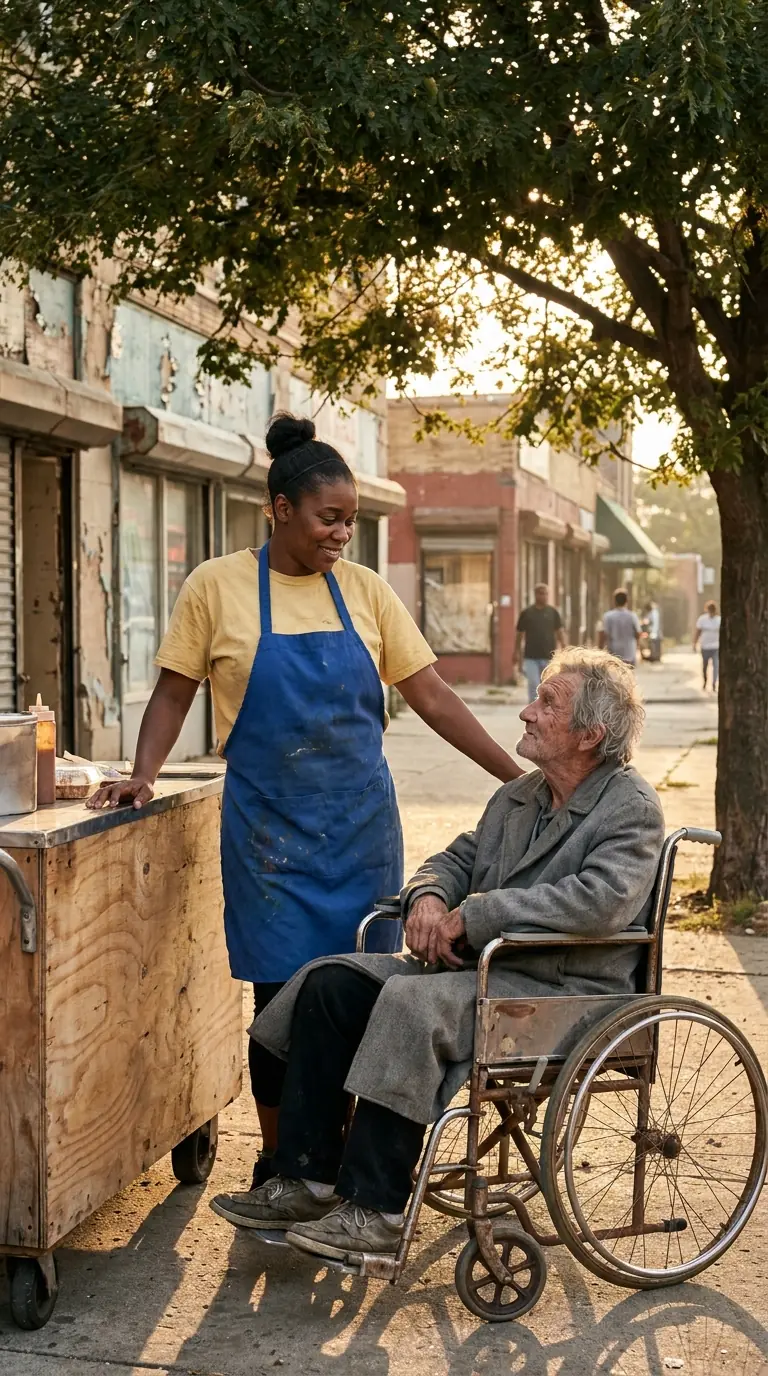
“Maybe,” Eugene said, “but soft doesn't mean stupid.”
That afternoon, she had only one plate of food left. Rice with beans and a single piece of meat. Her stomach rumbled. She hadn't eaten all day. She looked at the plate, then at John, who hadn't moved from his usual spot. The shadows under his eyes looked deeper than usual. He was shivering slightly, even though it wasn't cold.
She walked over and placed the plate beside him. “This is all I have today,” she said. “I'll find something else later.”
John looked at her for a long moment. His eyes were gray-blue, faded, but alert. His hands hovered over the food for a second, then slowly picked up the spoon. He nodded again. Still no words, but this time his eyes didn't look away.
As he ate, Eugene sat on the curb, watching cars pass by. People glanced at them and kept moving. One man wrinkled his nose and muttered, “What's she doing with him?” Another woman across the street laughed under her breath. Eugene didn't react. She was used to judgment. People had been measuring her worth since she was a child — too poor, too dark, too quiet. But this moment wasn't about them. It was about the man in front of her. Someone forgotten, someone invisible, and the small choice she made every day to see him.
Later that night, when she closed up shop and dragged her cart back home, her feet ached, and her stomach still growled. But in her heart, there was something steady, something right.
That night, lying on her thin mattress, she thought about John, about the way he chewed slowly like every bite needed to be earned. About how he never expected, only accepted. She didn't know who he was or where he had come from. But she knew what she saw — a man who had nothing and never asked for more than what was given. And sometimes, she told herself as she drifted off to sleep, that was enough reason to care.
The next day would come. She would get up again, cook again, sell again, and when the clock hit one, if John appeared, she'd be ready. Because even in a city that rarely gave back, Eugene had decided she would give anyway. And maybe, just maybe, that choice meant something.
It had been nearly a month since Eugene first handed that plate of rice and beans to the quiet old man in the rusted wheelchair, the man she still only knew as John. By now, their routine had become almost sacred. Every day, sometime in the afternoon but always before two, he would appear like clockwork at the edge of the street, rolling slowly toward the shade of the tree near her food stand. Eugene never had to look for him — somehow she always felt when he was near. The sound of the uneven wheel grinding against the broken pavement had become familiar, almost comforting.
People noticed, of course. In a place like South Ridge, not much went unseen. The old man with the pale skin and silent mouth was not from this neighborhood. That much was clear. He stood out in every way. He was white, alone, and visibly worn down. But what struck most people was not his presence. It was his stillness. He didn't speak, didn't gesture, didn't ask. He simply sat. That kind of silence made people uneasy.
Eugene noticed that too. She saw how others reacted to him. A pair of teenagers once whispered loudly enough for her to hear, calling him a ghost, a freak. An older woman, arms full of groceries, muttered that he was probably some drug addict who had lost his mind. One man in a crisp delivery uniform sneered as he walked past, shaking his head with a disgusted snort.
Eugene didn't respond, not once. She had nothing to prove to them. What mattered to her was that every day when she handed him a meal — sometimes hot rice, sometimes beans with boiled eggs, sometimes just bread and soup — he accepted it with quiet dignity. No words, no demands, just a small, tired nod that said more than anything spoken.
Over time, her curiosity about John began to grow. She found herself thinking about him at night, wondering who he had been before life had stripped him of everything. There was a certain composure in the way he held himself despite the torn clothes and worn shoes. She noticed a long scar along the side of his neck, mostly hidden beneath the collar of his shirt. His hands, though rough and weathered, were steady when he held the spoon. He didn't tremble from illness or hunger. He moved like a man who had known control and had only recently been denied it.
A black sedan rolled up slowly and parked across the street. It was a newer model, spotless with tinted windows and chrome trim that caught the sunlight. That kind of car didn't belong here. Eugene stopped what she was doing and watched. The driver's door opened and a tall man stepped out. He was white, in his late 50s, maybe, wearing a light gray suit that fit like it had been tailored yesterday. His shoes were polished. His hair was silver, neatly combed back. He stood there for a moment just looking around. Then his eyes settled on John.
Eugene noticed a flicker of something in his face. Recognition perhaps or disbelief. The man didn't move right away. He stood still, studying John with an intensity that felt strange. John, for his part, didn't look up. But Eugene saw the subtle way his back stiffened, how his hand froze just above the bowl. Something was happening.
The suited man took one step forward, then stopped. His eyes narrowed. Eugene looked back and forth between them. The man seemed as though he wanted to speak, but thought better of it. After a few seconds, he turned, walked back to the car, got in, and drove off. The whole thing lasted less than two minutes, but the air had changed.
When Eugene returned to her stand, she found herself watching John more closely. He was now eating again slowly, but his posture was different, rigid, guarded. She didn't say anything at first, but after a few minutes, she stepped closer.
“Do you know him?” she asked quietly, not sure if she expected a response.
John didn't answer. He paused his spoon halfway to his mouth, then resumed eating. Eugene didn't push. She nodded to herself and returned to her station, but something inside her had shifted. The question lingered. Who was he really? What kind of man could sit so still, eat so little, and yet carry so much tension in his shoulders?
That evening, while closing up, Eugene's friend Marcus from the fruit stall walked over. He leaned against her cart, sipping from a paper cup. “You feeding that guy again?” he asked, not unkindly, just curious.
Eugene nodded, wrapping up her pots. “Yeah, every day.”
Marcus shook his head slowly. “You ever think he might be dangerous? I mean, no offense, but he's not from here. And he doesn't talk. That's weird.”
Eugene wiped her hands on her apron. “Maybe, but I've seen dangerous people, Marcus. They don't sit still and eat lentils. They look you in the eye and make you feel small. He's not like that.”
Marcus tilted his head. “Fair. But something about him, I don't know. You trust him.”
Eugene looked toward the tree where John had been. He was gone now, vanished like always without a word. “I trust that he's hungry,” she said. “And that's enough for me.”
But even as she said it, her mind returned to the man in the gray suit. That look, that hesitation, that silence. It wasn't random.
That night, Eugene lay on her mattress, staring at the ceiling. The fan above her clicked with every turn, its rhythm almost soothing. But sleep didn't come easy. She kept replaying the scene in her head. The way John froze, the way the man stared. Something was beneath the surface and it had started to stir. Maybe John wasn't just a stranger. Maybe he had been someone once, someone important or someone dangerous or someone both.
Eugene didn't know, but she was beginning to realize something else. If she wanted to keep helping him, she might have to be ready to face whatever truth came with it. In South Ridge, people survived by keeping their heads down. But Eugene had never been good at that. And now her heart was tangled in something that went deeper than a bowl of food.
And the next afternoon, when John returned, Eugene greeted him with the usual warmth. She didn't ask any more questions. She served him a full plate, extra stew this time. He nodded once, she nodded back. For now, that was enough. But in her chest, the questions kept growing.
And across the city, in a room with high ceilings and polished floors, a man in a gray suit was making a call. His voice was low, cautious. “I saw him. He's still alive.”
It started like every other morning. Eugene was up before the sun the same way she had been for years, sweeping the dust off the patch of concrete that served as her storefront floor. She set her pots over the flame and stirred slowly, letting the scent of rice and seasoned stew rise into the early morning air. The streets were still quiet then, just the occasional bark of a dog or the rattle of a passing bus in the distance.
By 8:30, the neighborhood had begun to hum with life. Vendors dragged out their carts. Students in wrinkled uniforms shuffled past, and the regular buzz of city motion filled the air. But Eugene's eyes weren't on the street. They kept drifting to the edge of the road, to the spot beneath the tree where John always appeared. Only this time, he didn't.
At first, she told herself he was late. Maybe the wheel on that busted old chair had finally locked up. Maybe he had gone to a clinic or found shelter somewhere for the night and just overslept. But as the sun climbed higher and the usual lunch hour arrived, a subtle chill began to creep into her chest.
She tried not to show it. She smiled at her customers, ladled out steaming portions, and made small talk, but every few minutes her gaze wandered back to that empty space under the tree. She even left a bowl out for him on the edge of her table just in case.
By the end of the day, the bowl remained untouched. Eugene packed up slowly, her hands moved with less energy, her arms feeling heavier than usual. She didn't know what she was worried about exactly. After all, the man was a stranger. She didn't even know his last name. But still, she couldn't shake the feeling that something was wrong.
The next morning, she got up even earlier. She cooked faster, moved with urgency. By 9:00, the food was ready. By 10, she had cleaned her entire station twice, and still there was no sign of him. The third time she checked down the road, she stepped away from her stand and crossed the street, peering down both ends like a mother waiting for a child to return from school.
She turned to Mama Ruth, who was setting up her fruit stall nearby. “Mama Ruth,” she called out, trying to keep her tone light. “Have you seen the old man who usually sits near my stand, white in a wheelchair?”
Mama Ruth glanced up, shrugged casually. “You mean that one with the bandaged legs? Haven't seen him today. Maybe he rolled somewhere else. You know how they are.”
Eugene nodded politely, even smiled, but her heart sank a little. She moved on to ask Darnell, the boy who sold bottled water two blocks down. “Hey, Darnell,” she said, her voice softer. “Remember the man who sits under the tree near my food stand, white wheelchair? You've seen him since yesterday?”
Darnell looked up from his cooler, eyes squinting under the sun. “Nah, I seen him last on Tuesday. Ain't been around since. Why are you worried about him?”
Eugene gave a small nod. “Just wondering, that's all.”
But inside, the worry was becoming harder to ignore. John never missed two days. Rain or shine, hungry or tired, he always showed up. And now he was just gone. Vanished like smoke.
By noon, Eugene was barely able to focus. Her hands moved out of habit, scooping rice, wiping spills, giving change. But her mind was somewhere else entirely. At moments, she found herself staring into the distance, forgetting what she was doing. One customer had to call her name twice before she realized she hadn't added the stew.
That night, she couldn't sleep. She sat on the edge of her bed, the same bowl from yesterday beside her. It still had a few grains of untouched rice clinging to the side. She picked it up, held it in both hands like it meant something. Maybe it did.
The next morning, on the third day, Eugene woke up to a heavy sky. Clouds hung low, thick and gray. The air felt damp like it might rain, but no drops fell. She didn't bother setting up as usual. Instead, she sat on her stool, hands folded, watching the street.
Around 10:30, a man approached. He wasn't from the neighborhood — that much was obvious. He wore a clean buttoned shirt tucked into slacks. His shoes were shined. His skin was dark like hers, but his expression was guarded, distant. He didn't speak at first, just walked up to her counter and placed a brown envelope on the table.
Eugene blinked. “Can I help you?”
The man looked at her, then shook his head once. “Just read it and don't tell anyone you got it.” He turned and walked away before she could ask anything else.
Eugene stood frozen for a moment, then picked up the envelope with both hands. It felt heavier than it should, not in weight, but in meaning. She opened it slowly, peeling back the flap with trembling fingers. Inside was a single piece of paper, thick, clean, expensive stock written in simple block letters. It read, “Sapphire Hotel, 4:00. Don't tell anyone.” There was no signature, no explanation, just that.
Eugene's heart began to pound. She looked around, but no one was watching. The street was noisy again. Buses groaning past, kids yelling in the distance. But in her world, everything had gone quiet. She folded the paper carefully, tucked it back inside the envelope, and held it to her chest.
Who had sent it? Why her, and why the secrecy? For a long moment, she stood there unmoving. Then she took a deep breath and whispered under her breath, “I'm going.”
Not because she wasn't scared. She was. But something about the envelope, about the way the man said nothing else, told her this wasn't a joke. It was about John. And if there was even a chance that he needed help, she had to find out.
She locked her stand early that day. It was just after 3:30 when she stepped out in a simple dress and her best shoes, which were still scuffed at the toes. She hailed a cab and gave the address. The driver raised an eyebrow, glancing at her through the mirror. “Sapphire Hotel?” he asked, surprise in his voice. “That's not usually where folks from this area go.”
Eugene just nodded. “I know. Please, just take me there.”
The ride was quiet. As the cab weaved through traffic, Eugene held the envelope in her lap, her fingers running over the edges again and again. She stared out the window, but didn't really see anything. Her mind was racing, filling in blanks she didn't understand. Was John in trouble? Was someone threatening him? Was he even alive?
When the cab pulled up in front of the Sapphire Hotel, she paused. The building was tall, all glass and marble with gold letters above the entrance. A doorman in a crisp uniform stood under a black awning, holding the door open for another guest in a suit. Eugene stepped out slowly, heart pounding. She adjusted her dress, took one last breath, and stepped forward.
She didn't know what waited on the other side, but whatever it was, it had something to do with the quiet man in the wheelchair who had once been just a stranger under a tree. And now he was a mystery she couldn't ignore.
The Sapphire Hotel stood taller than anything Eugene Harris had ever entered. Its shining glass exterior glistened under the late afternoon sun like something pulled straight from a movie scene. As the taxi dropped her off in front of the grand steps, she hesitated for a brief second, clutching the brown envelope tightly in her hand. Her palms were damp. The hotel sign gleamed above the door in silver lettering, and even the doormen looked like they belonged to another world. She had never seen anything like it.
Inside the lobby, the air was cool, scented with something expensive she couldn't name. Every surface sparkled. People in tailored suits and dresses moved confidently, their steps soft against the marble floors. Eugene stood out, and she knew it. Her dress, though clean and pressed, was simple. Her shoes were worn at the edges, and she walked with the kind of caution that only comes from never being in such a place.
As she approached the front desk, the young man behind it gave her a quick scan from her shoes to her hands, then back to her eyes. His polite smile barely reached his eyes. “May I help you, ma’am?” His tone was professional but distant.
“Yes,” she said, clearing her throat. “I was asked to come here. Someone sent me a letter. It said 4:00 p.m. at this hotel.” She reached into her bag and handed over the note.
He glanced at it, then paused. “What's your name?”
“Eugene. Eugene Harris.”
He looked back down at the paper, then raised an eyebrow, trying to hide his confusion. “Wait here one moment,” he said, then turned and disappeared into a back room.
Eugene looked around, feeling out of place. A few people passed behind her. One woman whispered something and the other chuckled. Eugene kept her chin up, her fingers still holding the strap of her bag tightly. Her heart beat loud in her ears.
Moments later, a tall man in a black suit appeared from a side corridor. He walked directly to her. “Miss Harris,” he asked, “please come with me.”
She followed him silently through a long hallway with soft carpeting and walls lined with modern art. The hotel had a quiet elegance, the kind you didn't question. Finally, they stopped at a dark wooden door. The man knocked twice, then opened it. “Go on in,” he said. “He's expecting you.”
Eugene stepped in slowly. The room was spacious with soft lighting and tall windows that allowed golden sunlight to pour in. A large desk sat near the center, and behind it, facing the window, was a man in a wheelchair.
Eugene's heart skipped. The back of the man's head looked familiar, too familiar. His shoulders weren't slumped like before. His hair was combed neatly. The wheelchair was polished, modern. Her breath caught.
“John,” she whispered.
He turned slowly and for the first time, Eugene saw his full face without the dust, the grime, or the tired sadness that used to define it. His skin looked healthier. His eyes were alert, thoughtful. He wore a crisp white shirt with gold cufflinks and gray slacks. His expression softened when he saw her.
“Eugene,” he said gently.
She took a step forward. “John, is that… is that really you?”
He gave a small nod. “Yes, but my name isn't John. It's Kevin. Kevin Anderson.”
She froze, trying to make sense of what she was hearing. “I… I don't understand. What is this?”
Kevin gestured to the seat in front of him. “Please sit. Let me explain.”
Still stunned, she sat, her hands trembling in her lap.
“I wasn't lying about being tired or being weak. But I didn't come to your shop by accident,” he began. “Years ago, I was the CEO of Anderson and Grant. We built hospitals, schools, technology firms. I had more money than I knew what to do with. But somewhere along the way, I lost track of what mattered.”
Eugene listened, her eyes wide, trying to piece this together. The man she had fed with her last plate of beans was a billionaire.
“I stepped away from the company,” he continued. “I wanted to find something, someone who was good without needing attention, without needing cameras or praise, someone who would help another human being just because it was right.”
“Why me?” Eugene asked, her voice quiet.
“You didn't just give me food, Eugene. You gave me dignity. You looked at me like I mattered. You didn't flinch when others laughed. You didn't walk away. You gave without ever asking who I was or what I had.”
Kevin reached down and pulled a folder from his bag. He placed it on the desk and slid it toward her. Her name was written on the cover.
“What's this?” she asked.
“It's yours. A new nonprofit foundation, Anderson Harris Foundation. I've already secured the paperwork, the funding, the legal team. You will co-lead this with me if you're willing. I'll stay behind the curtain. You'll be the face. Because people like you are rare, Eugene, and the world needs to see them.”
She blinked, stunned. “I don't know what to say.”
“You don't have to say anything now. Just know this. You earned this. You changed my life.”
Eugene looked down at the folder, then back up at him. “Why haven't you told anyone? Why the secrecy?”
Kevin leaned back slightly in his chair. “Because I need to know. If I give you this, will you keep doing good things even when nobody is watching? Or will you change once the lights come on?”
“I won't change,” she said firmly. “Because I didn't help you for a reward. I helped you because it was the right thing to do.”
Kevin smiled. “That's what I hoped you'd say.”
For a few moments, they sat in silence. The late sunlight bathed the room in a soft glow. Eugene's mind raced, but her heart felt calm. Somehow it made sense now. The quiet man in the wheelchair had always seemed like he carried a world of stories, and now she knew why.
“There's one more thing,” Kevin said. “I'd like to keep this quiet for now. You'll have full access to everything, but no press, no interviews, just action.”
Eugene nodded slowly. “That's fine. I don't need anyone to clap. I just need to work.”
Kevin extended his hand across the desk. “Then let's begin.”
Eugene reached out and shook it. Her fingers still trembled, but there was strength behind them. She had walked into the hotel expecting a mystery. She was leaving with a mission. And for the first time in weeks, she smiled, not just with her mouth, but with her whole being.
In her chest, something had shifted. Not because she now had money or power, but because someone finally had seen her.
The next morning, Eugene Harris stood in front of her small mirror and tried to smooth out the wrinkles on her only decent blouse. The fabric, a soft shade of coral, had been worn many times, but she made sure it was clean and pressed. She tucked it neatly into her black skirt, checked the folder with the paperwork twice, and then stared at herself for a long second. Today, she was not just Eugene the food vendor. Today, she was the co-founder of a charity. That thought still felt strange in her chest, like trying on someone else's shoes, but it was real. Kevin Anderson had made sure of that.
After the unexpected meeting at the hotel, after he revealed who he truly was, they had talked late into the evening about the foundation he wanted her to help run — the Anderson Harris Foundation. It would help feed the poor, fund local food programs, and give second chances to people like her.
But today, she had to sign the final paperwork and register the organization officially. That meant a visit to the city administration building. It was a tall, modern structure in downtown with glass windows that reflected the clouds and security guards that never smiled.
Eugene arrived early, clutching her folder with both hands. As she stepped into the air-conditioned lobby, her shoes clicking on the polished marble floor. She paused to get her bearings. The ceiling stretched high above and people moved quickly around her. Men in suits, women in heels, briefcases swinging, phones pressed to ears.
She approached the reception desk where a woman with a headset sat typing. Eugene waited politely until the woman looked up. Her eyes did a quick scan from Eugene's shoes to her natural hair bun to the plain folder in her hands.
“Can I help you?” the receptionist asked, her voice neutral, but her eyes cool.
Eugene nodded. “Yes, I have an appointment to meet with the registrar. I'm submitting documents for the Anderson Harris Foundation.”
The receptionist's fingers paused over the keyboard. “Do you have an appointment confirmation number?”
Eugene hesitated. “I have the name and time. Kevin Anderson arranged it.”
The receptionist gave a tight smile. “Ma’am, I need a confirmation code, otherwise…”
Before she could finish, a tall security guard walked over. He gave Eugene a slow once-over. “Everything okay here?” he asked, not looking at the receptionist, but at Eugene directly.
The woman behind the desk responded. “She says she has an appointment with someone named Kevin Anderson, but there's no code.”
The guard folded his arms. “Ma’am, are you making a delivery? You can't be up here without clearance.”
Eugene's face tightened. She took a breath. “I'm not making a delivery. I'm here on business. Kevin Anderson is expecting me.”
The guard looked unconvinced. “Do you have ID?”
She handed him her driver's license. He stared at it for a few seconds longer than necessary. “And what's this foundation about?” he asked, his tone skeptical.
Eugene's voice stayed calm, but her pulse was racing. “We're registering a nonprofit. I'm the co-founder.”
The receptionist looked up again, surprised. “You're the co-founder?”
“Yes, I am.”
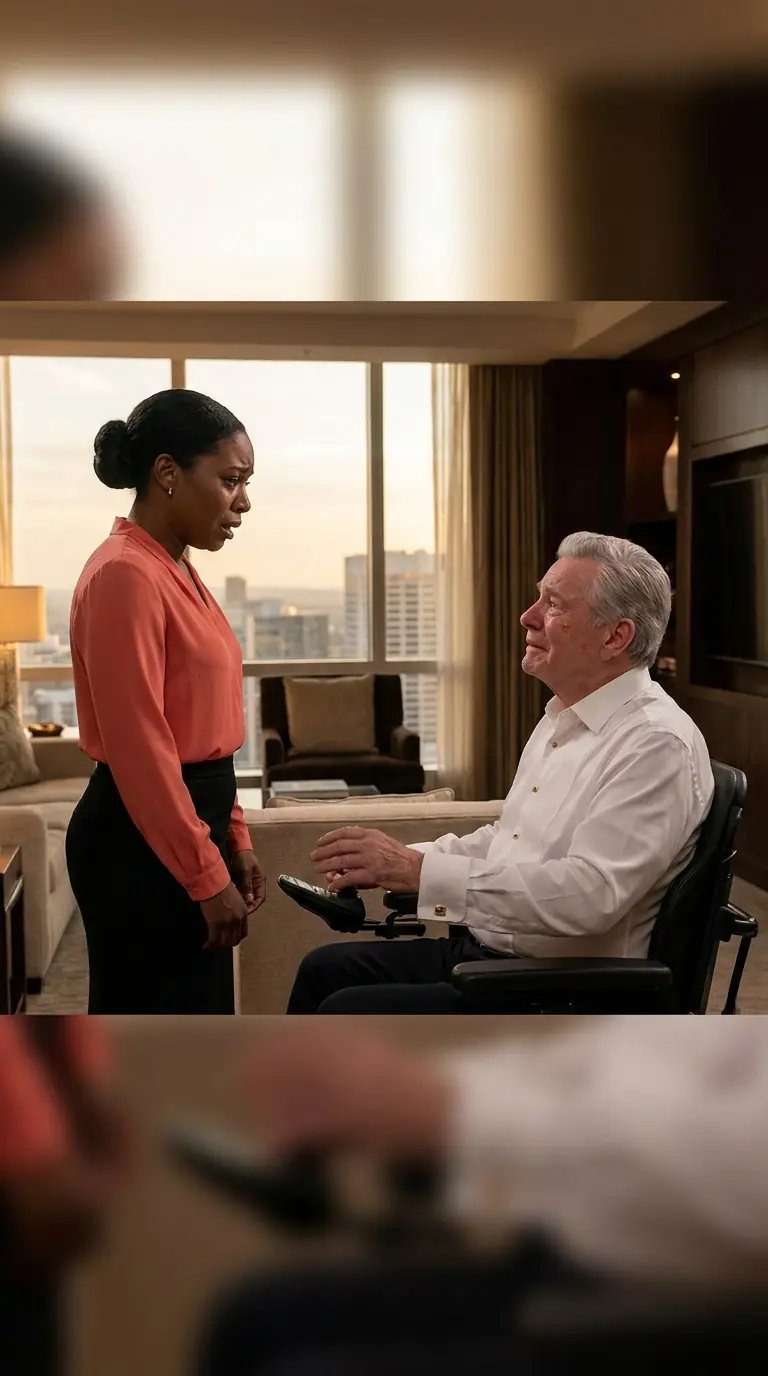
Just then, the elevator doors at the far end of the lobby opened with a soft chime. Kevin Anderson rolled out in his sleek motorized wheelchair, dressed in a navy blazer and crisp white shirt. He moved with quiet ease, nodding to a few people in the lobby as he made his way toward them.
When the guard noticed Kevin, his posture changed immediately. “Mr. Anderson, sir.”
Kevin stopped beside Eugene and looked from the guard to the receptionist. His expression was calm but unmistakably firm. “Is there a problem?”
The guard straightened. “No, sir. We were just verifying.”
“This is Miss Eugene Harris,” Kevin said, his voice steady. “She's my partner in the Anderson Harris Foundation. She had an appointment.”
The receptionist swallowed. “I didn't realize, sir.”
Kevin turned his wheelchair slightly toward her. “She told you her name. She told you mine. That should have been enough.”
No one said anything. He looked back at Eugene, who was now holding her folder tightly against her chest. “You ready?” he asked.
She nodded. “Yes.”
They headed toward the elevator together. As the doors slid shut behind them, Kevin didn't speak right away. When they were halfway up, he turned slightly and said in a low voice, “Money can get you through a door, but skin color still decides who's welcome.”
Eugene looked at him and said nothing. But in her chest, she felt a familiar ache. Not surprise, not shock, just the slow, deep sting of being made invisible.
They spent the next hour signing documents, shaking hands, and posing for photos with lawyers and administrators, who once Kevin explained who she was, couldn't stop smiling at her. But Eugene knew what they had thought at first. It was in their eyes, in the hesitation, in the subtle shift of tone.
As she walked out of the building later, sunlight hitting her face, Eugene knew that the road ahead wouldn't be smooth. Even with Kevin beside her, even with his name on the foundation, there would be people who only saw her skin, who would doubt her until proven otherwise. But she also knew something else. She was done shrinking. She had earned this space, and now she intended to take it.
There was a different kind of silence in the car that evening, the kind that settles between people who have crossed invisible lines of understanding. Eugene sat with her hands folded in her lap, watching the soft blur of city lights pass outside the window. Next to her, Kevin Anderson sat in his wheelchair upright, but relaxed, his eyes fixed ahead, quiet and unreadable.
The gala was being held at the Langston Hall, an upscale ballroom known for hosting the city's most powerful. The invitation had arrived in a thick white envelope sealed in gold, her name printed cleanly at the center. Formal dress code, guests of honor will be introduced on stage. That line had shaken her more than the name of the venue itself. She wasn't used to being seen like that.
Eugene had chosen a simple navy dress, nothing too flashy, but well-fitted with pearl earrings borrowed from a neighbor. As they pulled up to the entrance, a valet opened the door for her. She stepped out cautiously, heels making contact with the marble floor beneath the red carpet.
The lobby was already buzzing. Waiters in black and white uniforms moved in lines like clockwork, offering wine, champagne, little hors d'oeuvres balanced on trays. Everything smelled expensive — perfume, polished wood, and money.
Inside, chandeliers spilled golden light across the wide room. The walls were high, the ceiling painted with a mural of birds in flight. Eugene paused at the entrance, her breath caught for a second. She wasn't sure if it was the splendor or the feeling of being entirely out of place. Her skin, her dress, her name — everything about her felt too loud for that room.
A man in a tuxedo walked by, giving her a once-over glance. He leaned to the woman beside him, whispered something, and chuckled. She caught it. “The caterer brought their niece.” The woman smiled, not unkindly, but as if the joke were too harmless to matter.
Eugene's face remained still. She stepped aside to let them pass. Her heart felt tight in her chest. Kevin approached beside her, his wheels humming softly against the floor. He noticed her silence.
“You okay?” he asked gently.
She nodded, eyes forward. “I'm fine.”
“Don’t let the room fool you,” he said. “Half the people in here are wearing borrowed names and rented dignity, but you — you earned every right to be here.”
They moved toward the main hall together. A few heads turned. Kevin Anderson was recognizable, even in a chair. But the woman beside him sparked questions. A few smiled, some nodded politely. Others simply stared, trying to place her, trying to explain her presence in a space that rarely made room for people like her.
At their table, Eugene sat between Kevin and a retired congressman. Across from her was a corporate executive with a shiny Rolex and a look of confusion. He stared at Eugene for a full beat before asking, “So, what brings you here tonight?”
Before she could answer, Kevin interjected calmly. “She's with me. Eugene is one of the most important people in this room.”
The executive smiled faintly as if indulging a joke. “Is that so?” he said. “Well, then I'll be on my best behavior.”
Dinner was served — steak with asparagus, tiny salads that looked more like decoration. Eugene picked at her plate quietly. She could feel eyes occasionally drifting toward her. Curious and uncertain. She caught snippets of conversation — stock markets, golf courses, private schools. At times, someone would smile at her, but not quite look her in the eye. She kept her head high, her posture straight. She belonged here, even if they didn't know it yet.
After dessert, a woman with silver hair and a voice like crystal took the stage. “Ladies and gentlemen, please welcome Mr. Kevin Anderson.”
Applause broke out. Kevin rolled himself to the center slowly. The room fell quiet. He positioned himself at the podium, adjusted the microphone, and paused. His eyes scanned the crowd, calm but deliberate.
“There was a time,” he began, “when I could walk into rooms like this, and people would rush to shake my hand. I built companies. I sat on panels. My name meant something, at least to those who benefited from it.” A few people nodded, recalling his legacy.
“But there came a day when my name wasn't enough. A day when I was seen as disposable, when I lost everything I thought defined me.” His voice didn't crack, but something in the room tightened.
“And on that day,” he continued, “I found myself hungry, weak, and alone on a sidewalk in South Ridge. No one made eye contact. People turned their backs except one person.” He turned his head slightly and his eyes found Eugene, a young woman with very little of her own. “She fed me, not because she knew who I was, not because she wanted anything in return, but because she believed I was worth feeding.”
The room was dead silent.
“Her name,” he said with quiet pride, “is Eugene Harris, and she reminded me of the world I want to help build.”
Murmurs ran through the crowd, heads turned toward her, some faces shifted visibly — recognition, shame, awe.
Eugene sat still, her fingers clutched the fabric of her dress beneath the table. Kevin continued, “Tonight, I am honored to announce the formation of the Anderson Harris Foundation, a joint partnership. Because it's not just about giving, it's about who teaches you how to give.”
He motioned to the side. An assistant walked on stage holding a framed certificate. The lights dimmed slightly. A spotlight found Eugene. Kevin spoke one last sentence. “Please stand and help me honor someone who never asked for anything and gave anyway.”
The applause was slow at first. A few stood, then more. Within seconds, the entire room was on their feet.
Eugene stood slowly, unsure, then entirely overwhelmed. Her breath caught again, but for a different reason this time, her heart pounded. She looked around the room, eyes wide. Some people looked at her with awe, some with embarrassment. Some simply clapped, unsure what they were applauding, but moved all the same.
She walked toward the stage. Kevin extended the certificate to her with a nod. “Thank you,” she whispered, barely audible through the mic.
Kevin leaned closer. “Thank you for saving me.”
They stood there together side by side as the crowd cheered. And for once, Eugene didn't feel out of place. She felt seen, not as a server, not as a stranger, but as someone whose kindness had rewritten the meaning of success.
And just like that, the spotlight shifted. Not toward the wealth or the titles or the trophies, but toward one woman and the quiet strength she had carried all along.
When Eugene Harris stood inside the wide, gleaming hall of her new restaurant, she didn't see just polished floors and elegant chandeliers. She saw memories. Those long mornings of boiling rice over a shaky fire, of brushing off dust from her wooden stall under the sun, of gently placing meals in front of a man everyone else ignored. And now, standing in a space where gold-trimmed menus lay on every table, she exhaled deeply, almost in disbelief.
This was Harris Table — her restaurant named not after her success, but after her journey. Kevin Anderson had given her the means, but it was her kindness that had carved the path here. And today, the grand opening wasn't just a ribbon-cutting ceremony. It was a homecoming.
The ribbon outside shimmered in the morning light. Dozens of neighbors, local leaders, old customers, and even journalists stood in anticipation. But Eugene didn't wear a designer dress or heels. She wore a soft blue shirt and simple black flats. She hadn't changed her essence, only her reach.
Kevin was there, too, seated in his chair, calm, present, proud. His eyes followed Eugene as she stepped forward to speak. Her voice, still marked by humility, carried clearly.
“I started serving food under a tree with borrowed pots,” she said. “Back then, I didn't know what tomorrow would bring. I only knew how to share what I had, no matter how little. Today, I opened these doors, not just for those with fine suits and ties. This place is for everyone. Everyone who has ever felt invisible.”
The crowd clapped, some nodded quietly. Kevin smiled slow and content, but Eugene wasn't done. She turned and pointed toward the white truck parked beside the restaurant. Printed on the side in big blue letters: Harris Food Line. Hot meals with dignity.
Her voice softened. “Every week that truck will go into the same neighborhoods I came from. Under bridges, to the edge of train stations, near market corners — wherever someone is hungry. And we won't just give them food, we'll give them respect.”
After the ribbon fell, Eugene personally opened the restaurant doors. Inside, the scent of rosemary chicken and buttery rice filled the air. Light jazz played in the background, elegant, but not pretentious. Clean, but still warm. Harris Table was built to feel like a hug. And it did.
A man in a gray blazer leaned over to a woman at his table and whispered, “I didn't expect a place like this from someone like her.” Eugene heard it. She didn't flinch. She simply turned to the next guest with a smile and said, “Welcome. Your table is ready.”
Later that afternoon, Eugene slipped out the back door. Dressed down, wearing a cap and apron. She joined the crew loading the food truck, not because she had to, but because she wanted to. One of the staff, a young woman named Rosie, looked surprised. “Ma’am, you don't have to do this.”
Eugene wiped sweat from her brow. “I know. That's exactly why I'm doing it.”
They drove down South Ridge Avenue where cracked sidewalks told stories of struggle. Children waved as the white truck slowed down. Eugene stepped out and began handing out boxes — each with rice, beans, greens, a bottle of water, and a handwritten note. The note read, “You matter. Eat well. Stay strong.”
An elderly man in a wheelchair looked up, startled. “You're that woman on TV. The one from the restaurant.” Eugene nodded. She handed him a box and sat beside him on the curb for a minute.
“Used to be me sitting here,” she said. “Only difference — I didn't have you handing me food.”
He looked at the food, then at her. “God bless you.”
That night, back at Harris Table, Eugene took off her apron and walked into her office. On her desk sat a framed photo — Kevin and her standing beside the truck, both smiling. She sat down slowly, her legs sore, but her heart full. She opened a small drawer and pulled out a notebook. On the first page, she wrote, “Harris Table is not about what I earned. It's about what I refuse to let die inside me — kindness.”
The next day, a group of young professionals visited the restaurant for lunch. One of them, a woman with a clipboard, asked to speak with Eugene. “Miss Harris, we're building a campaign to promote social responsibility in business. Your story, your actions are exactly what we want to feature.”
Eugene blinked. “I'm not really one for the spotlight.”
The woman replied, “You already are in it.”
By the end of the week, Harris Table was not only serving locals. It had become a symbol — not of charity, not of luck, but of purpose, of what happens when one person decides to do good without expecting applause.
The staff, once unsure, now moved with confidence. Waiters greeted guests with genuine smiles. Cooks plated every dish with care. And Eugene — she made sure every single person who walked through those doors felt seen. Not served. Seen.
Kevin often visited, not as a guest of honor, but as a quiet supporter. He once told Eugene, “The greatest wealth is not what you store, but what you spread.”
Eugene nodded, then added, “And I'm not done spreading.”
At the end of each week, she'd stand beside the food truck again, dressed plainly, passing out boxes. She never told the recipients who she was. To them, she was just someone who cared. And that, to Eugene, was enough.
One evening, a teenager approached her while waiting in line at the truck. He held his food, looked at her, and asked, “Why are you doing this? You already made it.”
Eugene paused. She knelt to his eye level, and replied, “Because someone once gave me food when I was hungry, and now I want to be that someone for as long as I live.”
As the sun set behind the South Ridge skyline, casting golden light over the streets, Eugene stood there, her apron slightly stained, her hands tired, but her soul at peace. The girl who once fed a stranger under a tree now fed a city. Not out of pity, but out of love. This was her return, her gift back to the world. And she was just getting started.
Kevin Anderson had always been the man people turned toward, not away from. His face once filled boardroom screens. And his voice once steered the direction of major financial markets. But power, as he would learn, doesn't scream when it slips away. It whispers, fades, and then leaves you with nothing but silence.
Years before Eugene ever saw him in that wheelchair, Kevin sat at the head of a hundred-million-dollar table. He ran a financial empire built not just on money, but on the idea of legacy. At least that was the illusion. Behind the polished floors and glass offices were sharks with tailored suits and knives in their smiles. And one mistake, one oversight — or so he thought — was all it took for them to devour him.
There had been a transaction approved through his office tied to a partner company involved in illegal offshore operations. The media spun it like wildfire. Headlines screamed betrayal, corruption, fraud. Within days, investors pulled out. Shareholders revolted. The board called an emergency meeting and in that room where he had once been untouchable, they voted unanimously to push him out. No one looked him in the eye. Not even the man who had once called Kevin his brother. Not even the assistant who used to bring him coffee with a smile every morning.
Within weeks, the empire collapsed. He didn't go broke, not yet. But his name did. That was the part he never expected. The way silence grew around him. Phones that used to ring every hour stopped buzzing. People changed numbers. Invitations disappeared. Reporters waited outside his house, but no friends came through the front door. His world shrunk to a mansion full of hollow echoes.
Then came the car crash. It wasn't life-threatening, but it left him with spinal damage — enough to require surgery and recovery in a wheelchair for months. Alone, nurses came and went. Therapists spoke kindly, but coldly, and the mirror in his bathroom began to feel like a stranger.
One night, unable to sleep, he found himself digging through a box from his college years. At the bottom was a photo — him and a woman in a kitchen, both laughing. She was the head cook at the diner where he had once worked as a dishwasher during his junior year. He remembered her name, Dolores. She used to slip him extra toast, hide soup in paper cups when she knew he couldn't afford groceries. She never asked for thanks. That memory clung to him for days. In a world where everything was about image, she had seen through the dirt on his apron and treated him like a man.
It stayed with him. When Kevin healed enough to function again, he didn't reenter the business world. He sold most of his properties, closed accounts, donated stock quietly. He kept one lawyer, one accountant, and made a decision that even they questioned.
“I'm going off the grid,” he told them. They blinked. “Off the grid, sir,” the accountant repeated. “Yes, I'm going to find something real. Someone real.”
He began by moving into a modest apartment under a fake name. From there, he mapped out cities across the state. He created a plan not to test people, not to trap anyone, but to observe, to learn if kindness still existed when it couldn't benefit from reward.
In South Ridge, something felt different. The town was tired, worn, layered in economic bruises, but it pulsed with a quiet rhythm. It didn't pretend to be more than it was. That honesty attracted him. He bought an old wheelchair and wore it like a badge, not to deceive, but to surrender any advantage he once had. He chose a tattered coat, grew out his beard, kept silent.
Each day he rolled himself to the corner near Eugene's stand. He never begged, never asked. People passed by. Some dropped coins, others looked away. But one woman, a young Black woman with strong eyes and tired hands, noticed him. Not once, not twice, but every single day. She spoke with warmth, handed him food, and never once asked what he had to give in return. When it rained, she brought an umbrella. When it was cold, a blanket. She didn't smile for cameras. There were no cameras. She just cared.
That to Kevin was sacred. He kept coming back. Not because he needed the food, but because he needed to believe people like her still existed. And Eugene proved it quietly, steadily.
Months passed before he ever said a word. But when he finally did, it was in a note. One line. “Meet me. Sapphire Hotel. 4:00.” Even then, he didn't know if she'd show up, but she did. And when she walked into that hotel, awkward, nervous, unsure, he saw not just the woman who had fed him, he saw strength. He saw the courage that most CEOs would envy. And he knew that she, not he, was the kind of leader the world needed.
That day, when he revealed who he was, he didn't expect forgiveness. He didn't expect applause. He expected questions. But instead, Eugene listened. Not to judge, but to understand. And in her understanding, Kevin found something he hadn't felt in years. Peace.
Now watching her from afar, building the food truck, running Harris Table, hugging elders in the streets, he no longer wondered about the value of money or power. He understood they were tools, not identities. He rolled his chair down South Ridge one quiet morning, parked outside Harris Table, and waited for Eugene to notice him.
She stepped out 10 minutes later, wiping her hands on her apron. Their eyes met.
“You here for breakfast?” she asked.
Kevin smiled. “No, just watching purpose in action.”
Eugene laughed. “You're still corny.”
“Always,” he replied as they sat together under the awning sipping coffee.
Kevin leaned back and breathed deep. “I used to think I had everything,” he said. “Now I realize I was just collecting distractions. This — this quiet morning, this coffee, your truck feeding folks on the corner — that's everything.”
Eugene nodded slowly. “Funny how we both had to lose everything to see what mattered.”
Kevin looked out at the sidewalk where a child was holding his mother's hand, staring into the restaurant with wonder. “Or maybe,” Kevin said, “we had to lose everything to become someone worth meeting.”
And in that moment, there were no spotlights, no suits, no boardrooms, just two people sitting side by side. One had built towers, the other bridges, and together they rebuilt belief in humanity, in kindness, in second chances.
For Kevin, it wasn't just a chapter closed. It was redemption finally earned — not from a jury, not from Wall Street, but from a woman who had no reason to care and chose to anyway. And that made all the difference.
The restaurant was quiet that night, more quiet than usual. Outside, the streets of South Ridge were settling down into the hush that came with dusk as shopkeepers flipped signs to closed and porch lights blinked on one by one. Inside Harris Table, the air still held the smell of roasted garlic and thyme, but the music had stopped and the staff had already left.
Eugene Harris sat alone at the wooden table in her office, a chipped mug of tea going cold beside her hand. She had done the dishes herself. She didn't have to, but sometimes when her thoughts got too loud, the water and soap helped her focus. Now her hands were dry, and a soft pain tugged at the base of her neck. She rolled her shoulders and leaned forward, opening the drawer on her right. From it she took out a small box — plain and worn, no bigger than a lunch container. She placed it in front of her like it held something sacred because it did.
She looked at the box for a long time. Not opening it yet, just letting the silence stretch. Her fingers traced the grain of the wood. Finally, she opened the lid and pulled out a folded piece of paper — cream-colored, thick, not from a printer. She had written it by hand days ago. A letter meant for someone who would never read it. She unfolded it slowly, not to read it again, but to hold it, feel the ink through the page like it carried weight beyond words.
She thought about Kevin. There had been moments recently when everything felt surreal. The gala, the applause, the cameras — people who had never said her name, now quoting it in papers. But this letter wasn't for them. It wasn't even for him. Not really. It was for her.
She had written, “Dear Kevin, I never knew who you were when I handed you that first meal. I didn't need to. All I saw was a man in need of warmth. A man no one looked at. A man people talk past. I knew that look because I've worn it, too. I didn't help you because I thought you might be someone important. I helped you because you were there. Hungry. Alone. Because once I was, too. And someone handed me a sandwich when I had nothing. I remember it like it was yesterday. And I promised myself I'd pay that kindness forward when I could. You didn't owe me anything. You still don't. But the day you told me the truth, you gave me something I didn't even know I needed — recognition. Not for being successful, not for opening a business, but for being decent. And that — that meant more than anything anyone's ever given me. Thank you for not making me pretend to be someone else. For not asking me to change to be worthy. Thank you for seeing me just as I was.”
Eugene didn't cry. She thought she might, but the tears didn't come. Instead, her chest tightened, her heart full, but not heavy. It was a quiet kind of full, like knowing you've done something good and not needing anyone to clap for it.
She folded the letter again, creased the paper carefully along the same lines, slid it back into the envelope, then into the box. She closed the lid, and clicked the tiny brass lock. Rising from her chair, she reached up and placed the box on the top shelf of her cabinet behind an old family photo and a glass jar filled with foreign coins. She stood there for a moment longer, hand on the shelf, eyes still on that box.
Not everything needs to be shared to be real.
In the hallway, the motion light flickered on. She turned to see Matthew, her line cook, walking past to grab his phone. “Everything okay?” he asked.
She smiled faintly. “Yeah, just finishing up.”
He nodded and disappeared. Eugene turned off the desk lamp, casting the room into soft darkness. She walked out into the dining area, now empty, the tables neatly reset for tomorrow. The chairs were stacked. The floor had been swept. But it wasn't just the restaurant that felt at peace. It was her.
She paused at the glass door before locking it. Outside, Kevin had once sat in his wheelchair, quiet as a shadow, blending into the city's blind spots. The memory made her linger. That version of him — silent, observant, wounded — was still the truest in her mind. Not the billionaire, not the philanthropist, just the man who listened without demanding.
Her hand brushed the door handle before she finally turned the lock and stepped outside. The night was cool, the breeze light. Across the street, an old man fed pigeons, same as every Thursday. Down the block, a woman swept the sidewalk in front of a closed salon. The world kept spinning, but something inside her had settled.
Eugene walked to her car, not in a hurry, not thinking of emails or tomorrow's orders, just present, just breathing. In the glove box was another copy of the letter. She hadn't meant to make two, but when she finished the first one, she felt the urge to write it again, not to give, not to mail, just to make sure the words existed twice. Because sometimes words were like people. They needed to know they weren't alone.
She drove home with the windows half open, letting the night in, letting it wash over her like a soft reset. The traffic was light, no honking, no rush, just street lights flickering past one after another like quiet sentinels.
At a red light, she turned to the passenger seat and smiled at the second letter. Unsent, unread, but real.
In the months to come, Eugene would win awards, be invited to speak, get interviewed by people who once ignored her, and she would handle all of it with grace. But that box in her office would remain closed. That letter would remain unsent. Because what mattered wasn't the applause. It was the quiet knowing. That in a world obsessed with being seen, she had chosen to see — and to remember, even when no one else did, especially then.
Saturday mornings in South Ridge were never particularly quiet, but they had a rhythm. Grocery bags rustling, old cars coughing to life, distant radios playing half-tuned gospel or soft jazz. The city wasn't trying to impress anyone. It just moved.
On that particular morning, Eugene stood by the back of her food truck, adjusting a stack of warm meal containers, making sure each had the right portion and a clean napkin folded on top. The truck wasn't fancy. It didn't need to be. It was a pale blue vehicle with a modest sign that read “Harris Table Outreach.” The words weren't printed large, but they didn't have to be. Folks in the neighborhood knew the smell of real food. They knew the difference between charity for attention and kindness meant to heal.
She'd been running this route every Saturday for over a year now. Rain, shine, wind, it didn't matter. The same stops, the same greetings. Her hands, stronger now from work, moved with quiet confidence.
Today she made one final stop. Not on the route, not in the plan. But something about that street — the one near the abandoned lot where weeds grew taller than children and pigeons ruled the sidewalk — pulled her there. It was the exact corner where Kevin used to sit back before he had a name to her.
She parked, stepped out, and scanned the sidewalk. For a moment, nothing. Then from the edge of a crumbling wall, a small movement caught her eye. It was a boy. Couldn't have been older than nine. Skin pale under layers of dirt, a hoodie two sizes too big, sneakers with the soles curling off. He didn't beg, didn't even speak, just watched her like a stray animal might watch a hand extended too quickly.
Eugene didn't move toward him right away. She just opened the back of the truck and reached for a container. Not the one on top. She knew better. She reached for the one she packed herself this morning. A little extra rice and extra piece of cornbread, some sautéed greens, the way her grandmother used to make. She placed it gently on the sidewalk edge, then stepped back.
The boy looked at it, then at her, not suspicion exactly, but uncertainty, like he'd seen kindness go sideways before. “It's warm,” she said softly. “And it's yours.”
His eyes didn't leave hers. Then, slowly, almost defiantly, he reached for the container, clutching it to his chest like it might disappear. She bent down again, this time pulling out a pair of thick wool socks folded clean and tied with a ribbon. She held them out. “For later when it gets cold.”
He hesitated longer this time, but finally he stepped forward and took them. His fingers brushed hers. And for the first time, she saw something shift behind his eyes. Not trust. Not yet, but less fear.
He took a bite of cornbread, chewed slowly, swallowed. Then, in a small voice, he asked, “Are you coming back?”
She paused. The question wasn't really about food. It never was. “No,” she said gently. “But maybe one day you'll do this for someone else.”
The boy didn't answer. He just looked at her like trying to understand a language he barely remembered.
Eugene smiled and stepped back into the truck. As she drove off, she checked the side mirror. He was still standing there, container in one hand, socks in the other.
Back at the restaurant that night, she sat with a journal open, not writing yet, just thinking. Her hands still smelled like garlic and metal. She flipped a few pages, scanning old entries, menus, notes, plans. Then, with a new pen, she wrote, “One act of kindness doesn't change the world, but it changes one world. Maybe that's enough.”
She underlined it, closed the journal. There would be more nights like this — quiet, reflective, grounded. There would also be more interviews, more attention, more noise. But she knew how to find silence now. She knew how to hold stillness like a secret.
In the back of her mind, Kevin's voice echoed. Not the public one from speeches or galas, but the quiet one from their last private talk. “Legacy isn't money, Eugene. It's what people do because of you when you're not around.”
That legacy, she realized, didn't need a plaque. It didn't need a name on a building. It needed a lunchbox on a sidewalk, a pair of socks handed over gently, a look that said, “I see you and I'll remember.”
The next morning, a staff member asked if she wanted to post something about the outreach. Photos had been taken. Stories could be shared. Eugene shook her head. “Let's just feed folks. That's the story.”
And that was how it stayed. The world kept noticing her, but she kept noticing the world back, especially the parts people ignored. And every now and then, on a random Saturday, she'd stop by that same old corner. Not always to drop off food. Sometimes just to see if someone new was sitting there waiting for a kindness they didn't yet know existed.
Not every act of compassion needs to be big. But it does need to be passed on for the one who will come after.