“Go ahead, sweetheart—call 911. Guess who they’re gonna send? Cops like me.”
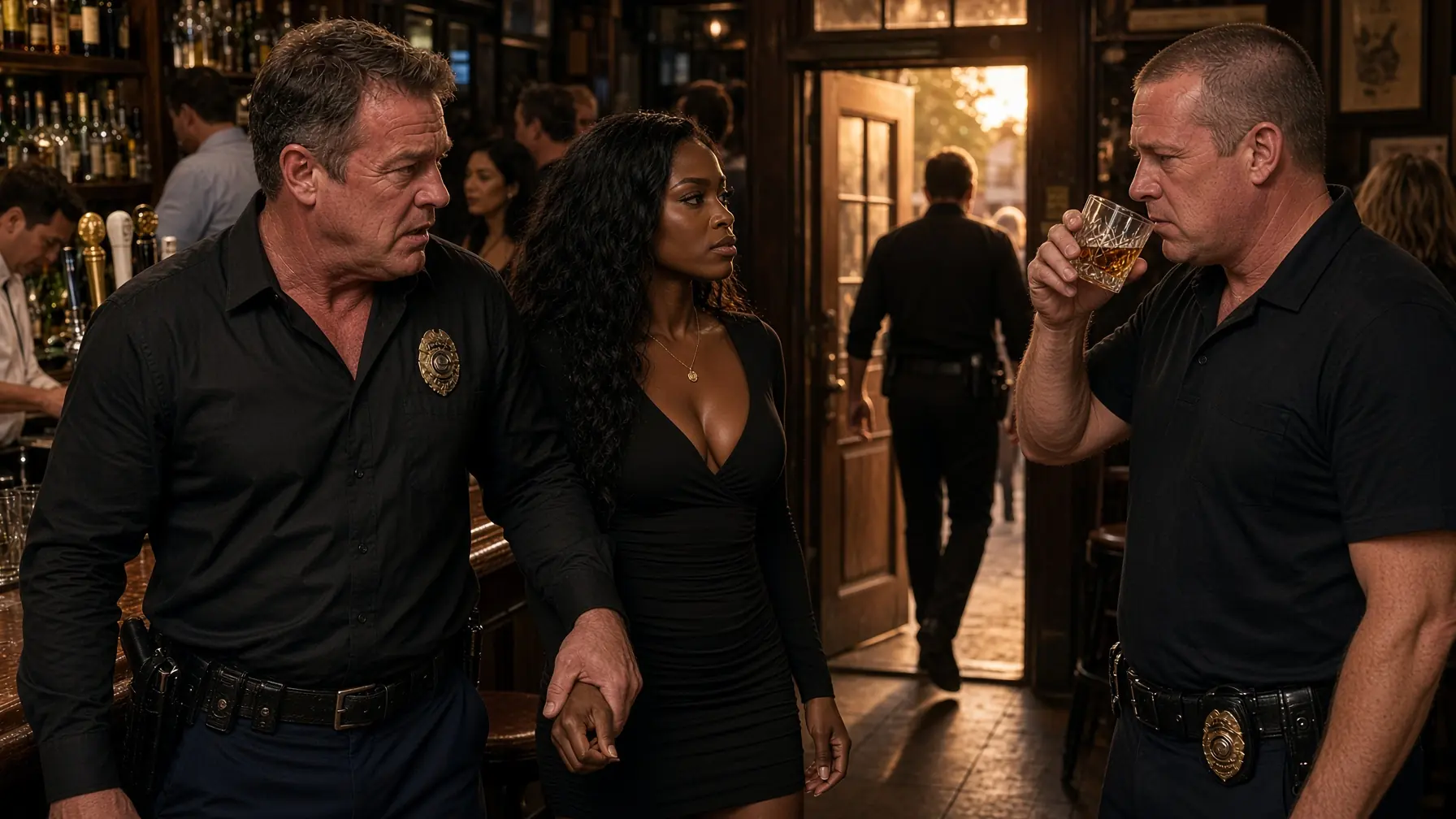
Officer Ryan Cole said it with whiskey on his breath and his fingers locked around my wrist.
His other hand was pressed against my waist like he thought my body was something he had already paid for.
Beside him, Officer Mason Reed lifted his glass, laughed, and shifted half a step to the left so I could not get around him.
“And who are they gonna believe,” Mason said, “you, or two badges?”
The bar around us had gone into that nervous kind of silence that is never fully quiet. Glasses still clinked. Someone at the far end laughed too loudly at something that was not funny. The bartender kept wiping the same section of polished wood over and over again because he did not know what else to do.
I looked Ryan Cole straight in the face.
“Take your hand off me.”
He smiled wider.
“Or what? You gonna get me arrested in my own department?”
I stopped pulling away.
That surprised him.
The grin stayed on his face for one more second.
Then I looked past both of them toward the entrance and said, very calmly:
“No. I just kept you talking until the person behind you got here.”
Mason lowered his glass.
Ryan’s hand loosened at my waist.
Both men turned.
And the look that came over their faces when they saw who had just stepped through the door was the first honest expression either one of them had shown me all night.
That was the moment the room changed.
But to understand why, you need to know why I was in that bar in the first place, and why I did not panic when two drunk men with badges decided I was supposed to be afraid of them.
My name is Zuri Monroe.
I was twenty-seven years old that fall. I worked as a civil rights attorney for the city’s Office of Public Integrity, which sounded impressive if you said it quickly and exhausting if you actually did the job. Most of what I handled involved reading complaint files, meeting with people nobody had listened to the first time, and reminding powerful institutions that “policy review” was not the same thing as accountability.
I was also, at the time, helping put together a nightlife safety initiative with a handful of downtown business owners and city departments. The project had started after a string of harassment complaints in bars and clubs—women followed to their cars, employees brushed off when they reported aggressive customers, management more worried about receipts than safety.
That Thursday night, I was supposed to be meeting two people at Halstead’s, an upscale bar downtown.
The first was the bar’s owner, Martin Halstead.
The second was Police Chief Elena Vasquez.
Chief Vasquez had been in the job less than a year. She had inherited a department with decent public messaging and ugly habits buried underneath it. To her credit, she understood that some of the worst behavior never made it into official press releases. It lived in the margins. In traffic stops, in hallway jokes, in the way certain officers treated women when they thought no one important was looking.
She and I had spoken twice before. We did not agree on everything, but she was serious, and that alone made her unusual.
Halstead’s had volunteered to be one of the first bars in the pilot program. Better camera placement. Staff training. clearer procedures for harassment complaints. Direct emergency contacts. Quiet reporting methods for women who needed help leaving without escalating a scene.
Chief Vasquez was coming to discuss how the police side would work.
She texted me at 8:41 p.m.
Running 15 behind. Don’t let Halstead charm you into bad coffee.
I smiled when I read it.
By 8:50, I was already inside.
Halstead’s was one of those places that wanted to look casual while charging twelve dollars for fries. Exposed brick. Brass lighting. Dark polished wood. Men in quarter-zips pretending not to check market news on their phones. Women dressed like they understood exactly how visible they were and had made peace with it.
I wore a fitted black dress, gold hoops, and heels I was already regretting.
I had just ordered sparkling water when Ryan Cole noticed me.
I did not know his name at first.
What I noticed first was the look.
Some men do not approach a woman. They position themselves like they have already interrupted something and expect you to adjust.
He was broad, flushed, early forties, with the loose swagger of somebody who had been drinking enough to feel invincible and not enough—yet—to fall over.
His badge was clipped openly to his belt.
Not unusual for an off-duty cop who wanted the room to know what he was.
That told me something immediately.
A truly secure man does not advertise power to strangers for sport.
His friend was shorter, thicker through the shoulders, buzz cut, whiskey in hand, face already carrying that reddish shine heavy drinkers get under bar lights. He stayed one step behind Ryan at first, grinning the way men grin when they believe they are about to witness a performance they will enjoy.
Ryan looked me up and down and said, “You waiting on someone, or just making the place look better?”
I gave him the kind of polite non-smile women learn by necessity.
“I’m meeting colleagues.”
“That right?”
“Yes.”
He did not leave.
“I’m Ryan.”
I said nothing.
He touched his badge with one finger.
“Officer Ryan Cole.”
Still nothing.
His grin tightened slightly.
That was another thing men like him hated.
Not rejection. Silence.
Rejection at least acknowledges they were in the room.
Silence treats them like weather.
Mason stepped closer.
“Mason Reed.”
He lifted his glass like we were at a private party.
I said, “Nice to meet you. Excuse me.”
Then I moved to step around them.
Ryan blocked me casually, as if it had happened by accident.
“Hey now. No need to be rude.”
“I’m not being rude.”
“You kind of are.”
“I said excuse me.”
He leaned in a little.