The first thing Jordan Coleman noticed was the wheel.
One of the front wheels on the gray shopping cart had turned sideways and locked against the asphalt, forcing the cart into a crooked angle beside him. Five minutes earlier, he had been pushing it toward his car with bottled water, a garment bag, and a small box of printed programs stacked inside. Now Jordan was kneeling on one knee in the middle of the Westgate Commons parking lot while a police officer stood over him pointing a finger inches from his face.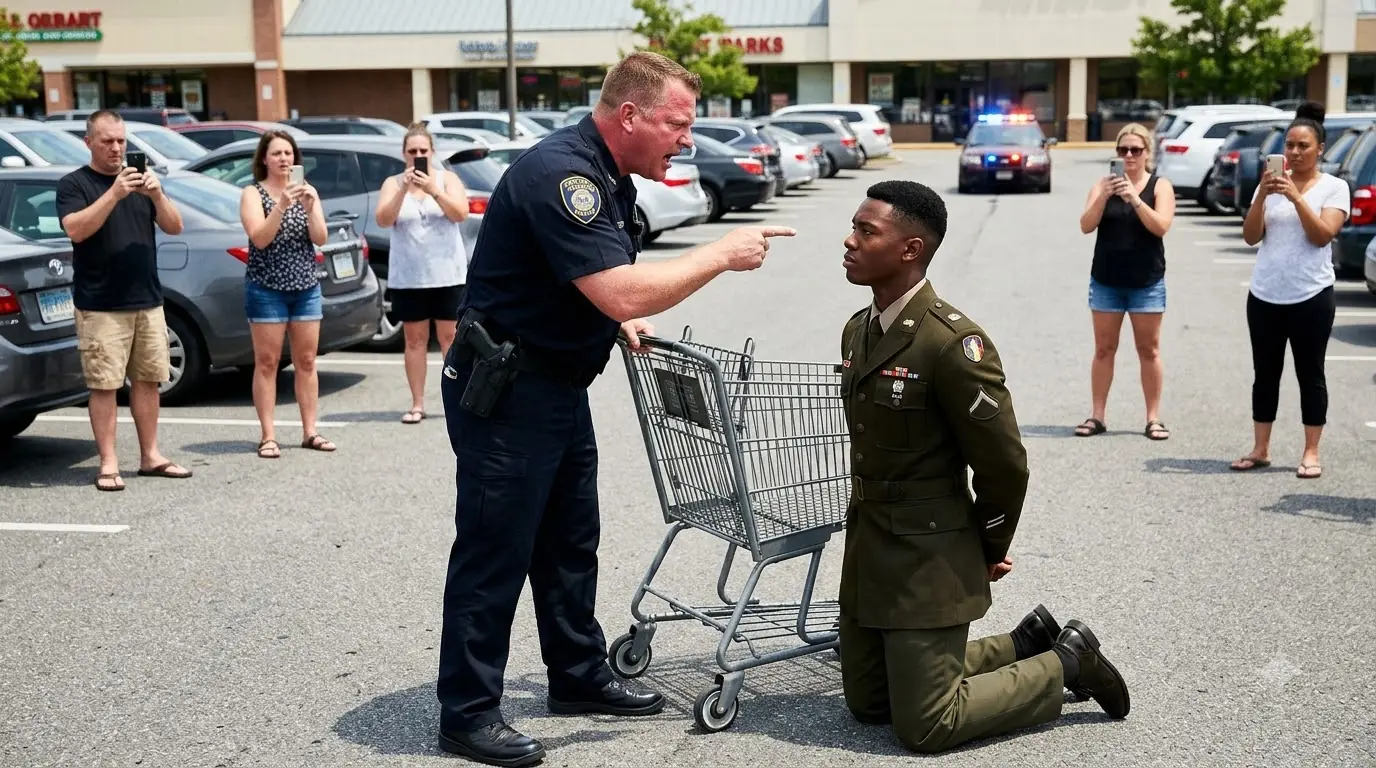
“Keep that knee down.”
Jordan lifted his eyes.
The officer was breathing harder than the situation required. He was a broad, forty-six-year-old white man with short light-brown hair, a flushed neck, and the kind of square build that made his dark navy uniform look almost too tight across the shoulders. His nameplate read HALE.
Jordan said quietly, “My identification is in my inside jacket pocket.”
Officer Brent Hale pointed at him again.
“You reach anywhere I haven’t told you to reach, and this gets worse.”
Jordan looked toward the shopping cart.
Then back at the officer.
“You asked me who I am.”
“I asked you to stay still.”
“You also said you don’t believe the uniform is mine.”
Brent’s jaw tightened.
“Because I’ve got eyes.”
Jordan did not answer.
That seemed to irritate him more than an argument would have.
Around them, people were beginning to stop.
A young woman beside a white SUV held her phone vertically.
A middle-aged man near the cart return did the same.
Two teenagers stood outside a shoe store watching.
Someone farther away said, “What happened?”
Nobody seemed to know.
Jordan knew only that his right knee was beginning to hurt against the hot pavement.
He also knew a convoy was supposed to reach the shopping center in less than ten minutes.
He hoped it was early.
Jordan had arrived at Westgate Commons at 11:16 that morning because he had forgotten bottled water.
Not for himself.
For forty children scheduled to attend the afternoon preparedness ceremony at the Georgia Capitol.
Jordan worked for the Georgia Emergency Services Corps, a civilian state organization responsible for disaster coordination, public evacuation support, emergency logistics, shelter planning, and community response training.
At twenty-two, he was one of the youngest field coordination specialists in the agency.
Young enough that people regularly assumed he was an intern.
Sometimes he corrected them.
Usually he did not care.
That afternoon was different.
Jordan was scheduled to receive the Governor’s Distinguished Public Service Medal for what happened nine months earlier during the Briar County floods.
He disliked discussing it.
News reports made it sound cleaner than it had been.
A school bus carrying twenty-seven children became trapped after floodwater tore through a rural road faster than expected. Jordan had been coordinating shelter supplies nearby when the emergency call reached his team.
By the time responders arrived, water had already reached the bus steps.
The driver had been injured.
The children were panicking.
Jordan entered the water with two rescue technicians, established a rope line, climbed into the bus, and helped move every child through a rear window one by one.
The final child was six-year-old Marcus Bell.
Marcus had refused to leave without his backpack.
Jordan remembered shouting over the water:
“You can get another backpack!”
Marcus screamed:
“My mom’s picture is inside!”
Jordan went back.
The bus shifted while he was inside.
A window shattered.
The entire vehicle moved several feet downstream.
Jordan found the backpack beneath a seat, tied it across his chest, and crawled back toward the rear window.
Thirty seconds later, the bus rolled onto its side.
Everyone survived.
Jordan spent two nights in a hospital after debris cut his left shoulder and infection set into one wound.
He returned to work ten days later.
That was the story everyone wanted to tell.
Jordan preferred another one.
The bus driver, Dana Webb, had kept twenty-seven frightened children calm while bleeding from a broken arm.
A county road worker named Miguel Santos had anchored the rope line in water up to his waist.
A volunteer named Lucy Grant performed CPR on a child who inhaled water.
Jordan believed any medal that carried only his name was incomplete.
The governor’s office disagreed.
So at 2:00 p.m., Jordan was expected at the capitol.
A state police convoy was scheduled to collect several ceremony participants from Westgate Commons because the shopping center served as a convenient meeting point near the highway.
Jordan had arrived early.
He bought water.
Then everything changed.
The uniform attracted attention before the officer did.
Jordan’s formal state service uniform was olive green, sharply pressed, with a black tie, polished shoes, brass buttons, and ribbons representing emergency deployments, flood response, and public-service recognition.
People occasionally mistook it for something else.
Jordan was used to that.
The cashier asked:
“Big ceremony?”
Jordan smiled.
“Something like that.”
She looked at his ribbons.
“You important?”
“My mother says no.”
The cashier laughed.
Jordan paid.
He pushed the gray shopping cart outside.
The heat struck immediately.
Georgia in late June.
Bright sun.
Heavy air.
Rows of cars shimmering under the midday light.
Jordan was halfway toward his red Honda Accord when Brent Hale’s patrol car stopped behind him.
The officer stepped out.
“Hey.”
Jordan turned.
“Yes?”
“You.”
Jordan stopped pushing the cart.
Brent approached slowly.
His eyes moved from Jordan’s face to the uniform.
Then to the ribbons.
Then back.
“What’s this supposed to be?”
Jordan frowned.
“My uniform.”
“I can see that.”
Brent stepped closer.
“I’m asking what it’s supposed to be.”
Jordan gave the name of the agency.
Brent stared.
“Never heard of it.”
“That doesn’t mean it doesn’t exist.”
The answer came out more sharply than Jordan intended.
Brent noticed.
“So you want to be smart?”
“No.”
“What are you doing here?”
“Shopping.”
Brent looked into the cart.
Bottled water.
Garment bag.
Printed programs.
Nothing unusual.
He asked:
“You got identification?”
“Yes.”
“Show me.”
Jordan began reaching toward the inside of his jacket.
Brent instantly raised his hand.
“Stop.”
Jordan stopped.
“Hands where I can see them.”
Jordan slowly raised both hands.
“My credential is exactly where I was reaching.”
Brent stepped closer.
“You don’t move until I tell you.”
Jordan nodded.
“All right.”
A normal interaction could still have ended there.
It did not.
The original call to police had come from a store employee.
Not a theft report.
Not a threat.
Not a report of violence.
The employee told dispatch:
“There’s a guy walking around in some decorated uniform, and I don’t know if it’s real.”
Dispatch classified the call as suspicious circumstances.
Brent happened to be nearby.
Later, investigators would ask why a decorated uniform created suspicion.
The employee would struggle to explain.
“He looked really young.”
“Anything else?”
“No.”
“Did he threaten anyone?”
“No.”
“Ask for money?”
“No.”
“Claim authority over anyone?”
“No.”
“What exactly was suspicious?”
The employee paused.
“I guess I just thought somebody should check.”
That vague suspicion reached Brent.
He turned it into certainty.
“You’re telling me you work for the state?”
Jordan answered:
“Yes.”
“At twenty-two?”
Jordan’s eyes narrowed slightly.
“How do you know my age?”
“You look twenty-two.”
“I am.”
Brent gave a humorless laugh.
“That’s convenient.”
Jordan felt irritation rising.
He pushed it down.
“My wallet is in my back pocket.”
“No.”
“My state credential is inside my jacket.”
“No.”
“You asked for identification.”
“I’m deciding how we do this.”
Jordan looked toward Brent’s radio.
“You can call the agency.”
Brent said:
“I don’t need you explaining police work to me.”
“I’m trying to help you verify what I told you.”
“Then stop talking.”
Jordan became silent.
Brent stepped around him.
Examined the uniform.
The ribbons.
The polished shoes.
Then his gaze returned to Jordan’s face.
“Where’d you get the decorations?”
Jordan stared at him.
“What?”
“You heard me.”
“They were issued.”
“By who?”
Jordan answered again.
Brent shook his head.
“I’ve seen impersonators before.”
Jordan almost laughed.
That would have been a mistake.
He controlled it.
“I am not impersonating anyone.”
“Then identification should be easy.”
“I agree.”
Jordan slowly gestured toward his jacket with two fingers.
“It’s right there.”
Brent’s hand moved toward his belt.
“I told you not to reach.”
“I didn’t.”
“You pointed.”
Jordan exhaled.
“Officer, what exactly do you want me to do?”
That question should have forced clarity.
Instead Brent heard challenge.
He stepped close enough that Jordan could smell coffee on his breath.
“Kneel.”
Jordan’s expression changed.
“What?”
“On your knee.”
“Why?”
“Because I said.”
Jordan looked around.
People were watching now.
He felt heat rise through his neck.
“I’m not threatening you.”
Brent pointed toward the ground.
“Kneel.”
Jordan remained standing.
“No.”
The word was calm.
That made it worse.
Brent grabbed the gray shopping cart and shoved it sideways.