Danielle Cross knew the aircraft before she stepped aboard.
She knew its acquisition price, maintenance schedule, engine hours, insurance structure, cabin refurbishment cost, annual utilization target, and the exact week its walnut veneer had been installed in Savannah. She knew which vendor supplied the cream leather seats and how many hours of hand-finishing had gone into the polished cabinetry.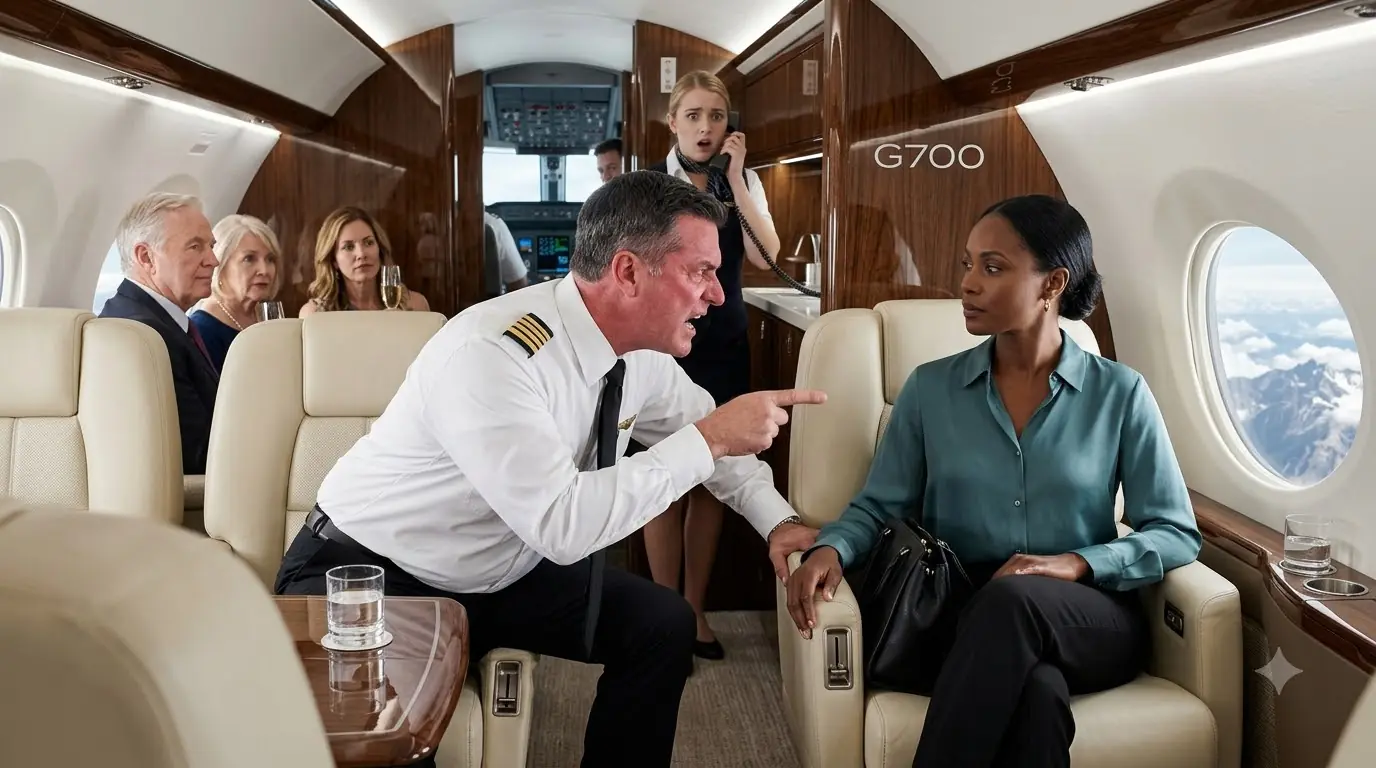
She also knew seat 2A was hers.
Not because she was chief executive officer.
Because that was the seat printed on her reservation.
Danielle stopped at the top of the boarding stairs and looked into the cabin without moving.
The Gulfstream G700 was immaculate.
Warm indirect lighting traced the ceiling.
Cream leather seats faced polished tables.
Glossy walnut panels reflected the amber glow of the cabin.
At the far end, a flight attendant named Melissa Grant stood beside the galley with a professional smile.
“Welcome aboard, Ms. Cross.”
Danielle noticed the hesitation before her surname.
Not recognition.
Just confirmation.
Good.
The reservation listed her under a personal travel profile with none of the usual executive coding attached.
Only six people inside Apex Crown Aviation knew Danielle was taking the flight.
Captain Richard Mallory was not one of them.
Neither was Melissa.
Neither were the passengers.
That was intentional.
For three months, Danielle had been receiving reports she did not like.
Not dramatic complaints.
That made them easier to dismiss.
A Latino software founder who said crew members repeatedly questioned whether he had boarded the correct charter.
A Black physician who said she had been asked to move from the forward cabin despite an assigned seat.
An Asian American couple who claimed a captain repeatedly referred to them as “guests of the principal passenger” even after being told they were the chartering clients.
A young white entrepreneur in a hoodie who said a flight attendant had initially refused to serve him from the premium beverage cabinet because she assumed he was part of the technical crew.
None of those complaints had resulted in a formal finding.
That bothered Danielle.
Not because every allegation had to be true.
Because the language used to close them was almost identical.
Service misunderstanding.
Crew discretion.
Cabin-management concern.
Passenger expectation mismatch.
Those phrases described conclusions without describing events.
Danielle had spent twenty-two years building companies.
She had learned to distrust any system that produced smooth language where observable facts should have been.
So she stopped reading summaries.
She started asking for originals.
That was when things became strange.
Several original complaint narratives were missing attachments.
Two had been reclassified after submission.
One complainant’s wording had been shortened from nearly eight hundred words to a single sentence:
Passenger dissatisfied with premium-service expectations.
Danielle had asked who edited it.
Nobody gave a clear answer.
She decided to observe the operation herself.
Not from a boardroom.
From a seat.
She wore a teal silk blouse, black trousers, gold hoop earrings, and simple heels.
No assistant.
No executive security.
No designer luggage with obvious branding.
No aircraft-owner credentials visible.
Her handbag was expensive, but only someone who knew leather construction would recognize it.
Danielle wanted the crew to see exactly what most passengers saw.
A middle-aged Black woman traveling alone.
Nothing more.
“May I take that for you?” Melissa asked.
Danielle handed over a small garment bag.
“Thank you.”
“Seat 2A is prepared.”
Danielle smiled.
“Perfect.”
She walked forward and sat.
Three other passengers were already aboard.
Howard Bell, sixty-two, white, silver-haired, a private-equity partner from Denver.
His wife Catherine, fifty-eight, sat across from him.
Behind them was Nathaniel Price, a thirty-six-year-old technology executive from Boulder.
None knew Danielle.
Howard gave her a polite nod.
Catherine smiled briefly.
Nathaniel remained focused on his phone.
Normal.
Danielle preferred normal.
The flight was traveling from Denver to Palm Beach with a fuel-stop contingency that likely would not be needed.
Apex Crown had sold the trip as a shared premium charter.
Every passenger purchased an individual seat rather than chartering the entire aircraft.
That business model had helped make the company profitable.
Danielle created it six years earlier.
Traditional private aviation was efficient for those wealthy enough to charter entire aircraft, but many executives and professionals wanted flexibility without paying for twelve empty seats.
Apex Crown built scheduled luxury routes between business hubs.
The model grew quickly.
Too quickly, perhaps.
When growth outran culture, problems appeared at edges executives could not see from headquarters.
Danielle suspected this was one.
The cabin door closed.
Melissa performed the safety briefing.
The engines started.
Danielle looked out the window.
She felt the familiar vibration beneath the seat.
For her, aviation had never become ordinary.
She had grown up near Atlanta beneath a flight path.
As a child, she used to lie in her backyard and identify aircraft by silhouette.
Her mother, Denise Cross, worked two jobs and laughed whenever Danielle announced that one day she would own airplanes.
“Start with owning your schoolbooks,” Denise used to say.
Danielle did.
Then a used car.
Then part of a logistics company.
Then all of it.
Then another company.
Then an aircraft brokerage.
Then Apex Crown.
At forty-three, Forbes called her a billionaire.
Danielle still heard her mother whenever she reviewed expenses.
Own your schoolbooks first.
The aircraft climbed through twenty thousand feet.
Seatbelt signs remained illuminated.
Melissa moved quietly through the cabin.
Danielle opened a notebook.
Not an electronic tablet.
Paper.
She had found people behaved differently around executives using laptops than around passengers writing casually.
She noted small details.
Boarding greeting good.
Safety briefing complete.
Beverage service delayed approximately three minutes.
No issue.
Passenger interaction professional.
Then the cockpit door opened.
Captain Richard Mallory stepped out.
Danielle knew his file.
Fifty-five.
More than thirteen thousand flight hours.
Seven years at Apex Crown.
Excellent technical record.
No safety violations.
Two commendations for handling weather diversions.
Four passenger complaints.
All closed without action.
One of those complaints was the Black physician.
Mallory walked toward Howard Bell.
“Mr. Bell, good to see you again.”
Howard smiled.
“Richard.”
They shook hands.
Mallory greeted Catherine.
Then Nathaniel.
Then he saw Danielle.
His expression changed.
Not dramatically.
Enough.
He glanced toward Melissa.
Then toward Danielle’s seat.
Then toward the forward cabin placard.
Danielle watched.
Mallory said, “Excuse me.”
Danielle looked up.
“Yes?”
He pointed toward her seat.
“You’re sitting here?”
Danielle glanced down.
“That appears to be the case.”
Mallory did not smile.
“What seat are you assigned?”
“2A.”
“Can I see your boarding confirmation?”
Danielle opened her handbag.
She did not ask why.
Not yet.
She handed him the digital confirmation on her phone.
Mallory read it.
His face remained tight.
Danielle watched carefully.
Evidence had answered the first question.
Now she wanted to see what came next.
Mallory returned the phone.
“There’s been a cabin change.”
Danielle nodded.
“What change?”
“I need you to move toward the rear section.”
“Why?”
“Operational requirement.”
Danielle looked toward the rear.
Several seats remained empty.
Then she looked back at him.
“What operational requirement?”
Mallory hesitated.
“Weight and balance.”
Danielle almost smiled.
The aircraft’s weight-and-balance system was automated.
Moving one passenger approximately fifteen feet aft could matter under certain configurations.
This was not one of them.
More importantly, if the crew had identified a weight-and-balance issue before departure, Melissa would have coordinated it before takeoff.
Danielle closed her notebook.
“Was there a weight-and-balance recalculation after departure?”
Mallory’s eyes narrowed.
“You familiar with aircraft operations?”
“A little.”
“I’m the captain.”
“I understand.”
“Then I need you to move.”
Danielle remained seated.
“May I see the change notice?”
Mallory stared.
“No.”
“Why not?”
“Because operational decisions are not passenger documents.”
“Then can you tell me the new distribution requirement?”
His face hardened.
“This isn’t a debate.”
Danielle nodded slowly.
That was useful.
Not an answer.
Useful.
Behind Mallory, Melissa had stopped near the galley.
She looked uncomfortable.