30,000 feet in the air, both pilots were unconscious. The plane was falling, and every adult on board was out of options until a 12-year-old black girl from a small apartment with a second-hand flight simulator quietly walked into the cockpit and took the controls.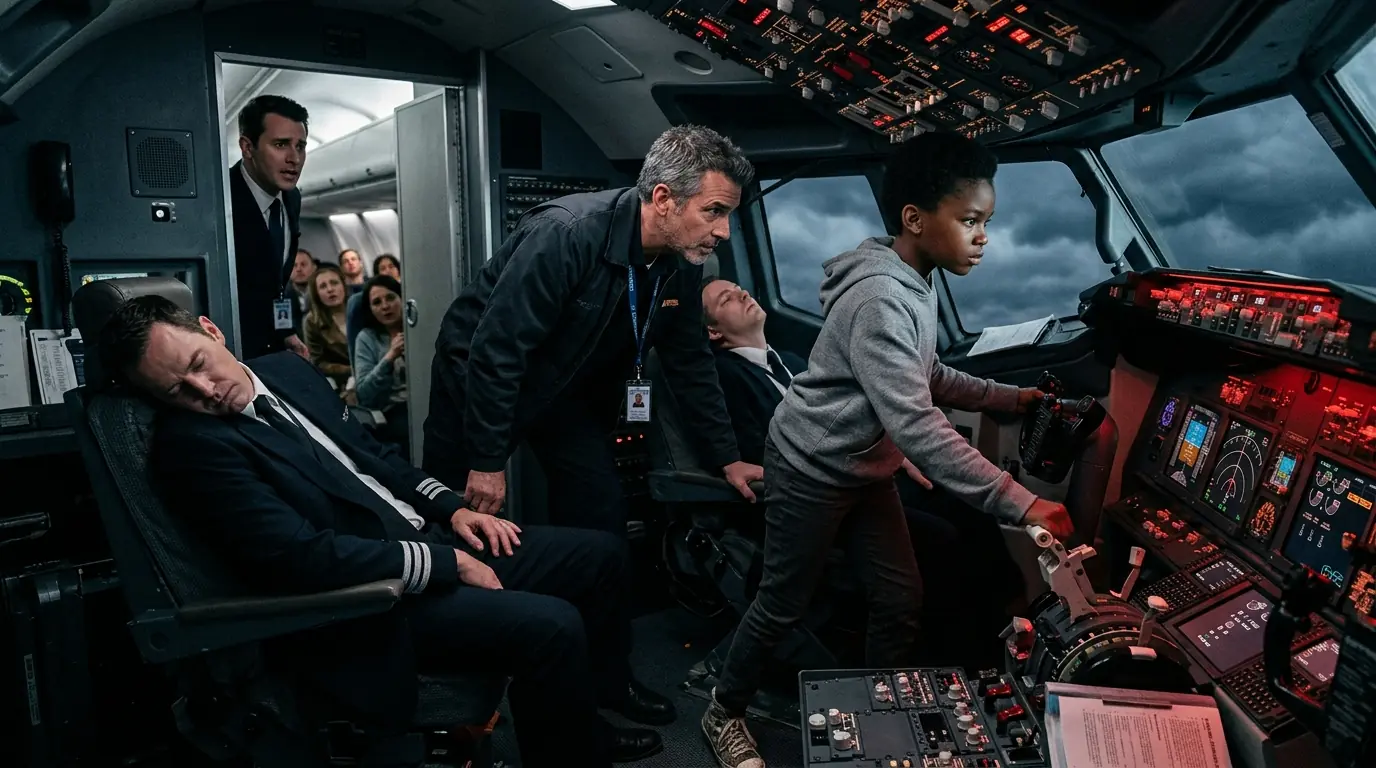
Nobody handed her the seat. Nobody voted on it. She just knew something the rest of them didn't. And what she knew was about to save 200 lives and expose the truth behind her father's death.
The gymnasium at Eastfield Community Center smelled like floor wax and folding tables. Someone had strung a banner across the back wall: bright blue letters on white paper reading STEM Stars Youth Expo: Inspiring the Next Generation. Half the letters were slightly crooked; the people who'd put it up had clearly been in a hurry.
Zariah Washington stood near the back of the room with her arms folded, watching. She was 12 years old, small for her age, with close-cropped natural hair and dark brown eyes that moved across a room the way a camera pans—slowly, deliberately, taking everything in. She wore a plain gray hoodie and sneakers that had seen better days. She didn't look like someone you'd notice at first. That was fine with her.
The flight simulation booth was set up near the far wall, and it had drawn the biggest crowd of the afternoon. A man named Mr. Pryor—the kind of adult who introduced himself with a firm handshake and talked loudly even in quiet rooms—was leading a group of about 15 kids through a demo on a laptop mounted to a folding stand. He had a pointer, and he used it often.
"Now," Mr. Pryor said, tapping the screen, "when a pilot wants to initiate a descent, they push forward on the yoke—this control here—and that nose goes down. Simple physics: the plane follows the nose."
Zariah's eyes narrowed. She unfolded her arms. She'd been listening for about three minutes. In three minutes, she'd heard two things that weren't quite right and one thing that was flat-out wrong. She told herself to stay quiet. She always told herself to stay quiet. But the third thing—the idea that a descent was simply a matter of pushing the nose down, full stop, no other variables—sat in her chest like a splinter.
She raised her hand. Mr. Pryor didn't see it; he kept talking. She raised it higher. A girl next to her nudged her friend and whispered something. They both glanced at Zariah.
"Excuse me," Zariah said—not loud, not rude, just clear.
Mr. Pryor paused. He looked over. "Yes?"
"That's not complete," she said. "When you initiate descent, you can't just push forward on the yoke without adjusting your power setting. If you pitch down without reducing thrust, you're going to overspeed. You have to manage both simultaneously: attitude and power. They work together."
The room got that particular kind of quiet that happens when something unexpected cuts through the noise. Mr. Pryor looked at her for a moment. Then he smiled—the way adults smile when they're about to explain something they think you don't understand.
"Well," he said, "this is a basic demonstration. We're simplifying things for the audience."
"I understand," Zariah said, "but if you're teaching kids aviation, even a simplified version shouldn't have errors. Someone might remember this and think it's how it actually works."
Someone in the crowd laughed. Not with her—at the situation. At the 12-year-old correcting the instructor.