The man hit the concrete hard.
His body slammed onto the hospital driveway with a sound that turned heads before the shouting did. A Black man in a dark suit, face pressed to the ground. One arm twisted behind his back, the other pinned beneath a knee.
A police officer’s voice cut through the morning air, loud and rehearsed.
“Stop resisting.”
He wasn’t resisting. He wasn’t even moving.
Phones came up fast. A nurse froze midstep near the emergency entrance. A middle-aged man in a windbreaker stopped pushing his wife’s wheelchair. Someone near the curb whispered, “Oh no,” the way people do when they know they’re about to witness something they won’t forget.
The officer leaned more of his weight down, grinding the man’s shoulder into the concrete.
“I said, stop resisting.”
“I’m not,” the man on the ground said, his voice strained but steady. “I’m not resisting.”
It was 7:18 a.m. in downtown Chicago. Shift change at the hospital. Ambulances idling, coffee cups in hand. The kind of ordinary morning where no one expects to see a man in a suit treated like a threat outside an emergency room.
Another officer stepped closer, hand hovering near his holster.
“Where’d you get the car?” he demanded.
The man turned his head just enough to breathe.
“It’s mine.”
The first officer laughed. Not a big laugh, a sharp one.
“Sure it is.”
Someone in the growing crowd said, “What is this about?”
No one answered.
“I smell marijuana,” the second officer announced, loud enough for everyone to hear.
Several people looked at each other. The air smelled like diesel, antiseptic, and burnt coffee. Nothing else.
“That’s not true,” the man said. “I don’t use drugs.”
“Don’t talk,” the officer snapped. “You’re making this worse.”
A woman in scrubs took a step forward.
“He hasn’t done anything,” she said. Her badge swung from her neck as she moved. “I saw the whole thing.”
“Ma’am, step back,” the officer barked. “This doesn’t concern you.”
“It concerns everyone,” another voice said.
A white man in his late 50s, graying beard, hands clenched at his sides, stepped forward.
“You can’t just throw someone on the ground like that.”
The officer didn’t look at him. He kept his knee planted.
“Sir, this individual became aggressive.”
Aggressive.
The word hung there, heavy and familiar.
The man on the ground swallowed. His cheek burned against the concrete. He could feel small stones cutting into his skin. Somewhere behind him, a radio crackled.
“I need you to listen to me,” he said carefully. “I am not a threat. I’m here for a reason.”
“Oh, we know your reason,” the first officer said. “Loitering, trespassing, acting suspicious.”
“I was walking into the hospital at seven in the morning.”
The officer said, “Dressed like that.”
The man closed his eyes for a moment. When he opened them, his gaze met the crowd. Not pleading, just aware.
A teenager filming whispered, “This is crazy.”
The second officer leaned down close enough that the crowd could hear him.
“You want to make this easy or hard?”
“I want you to take your knee off my back,” the man said. “That’s all.”
A woman gasped. Someone cursed under their breath. The nurse in scrubs shook her head, tears welling.
“This is wrong,” she said louder now. “This is wrong.”
“Step away from the scene,” the officer shouted.
The man on the ground spoke again, slower this time.
“You’re being recorded. Everyone here is recording.”
“That won’t help you,” the first officer said. “Cameras don’t change facts.”
A third officer arrived, younger than the others. He stopped short when he saw the man on the ground. His eyes flicked to the phones, then to the knee pressed into the man’s back.
“Do we have probable cause?” he asked quietly.
The first officer shot him a look.
“We have enough.”
The younger officer hesitated just for a second. It was enough for the crowd to notice.
“Officer,” the man on the ground said, his voice tight but controlled. “Please, I’m asking you as a professional. This isn’t necessary.”
The first officer sneered.
“Now you’re a professional.”
The man didn’t respond. His breathing was shallow now. The nurse knelt instinctively, then stopped, afraid.
“What’s your name?” someone in the crowd asked.
The man answered without looking up.
“Marcus.”
“Marcus what?” the officer demanded.
Marcus didn’t answer right away. Not because he was afraid, but because he was choosing his words.
Before he could speak, the second officer reached for his arm.
“Search him.”
“I do not consent to any search,” Marcus said immediately. “I have not committed a crime.”
“There it is,” the officer said. “Non-compliant.”
A woman’s voice cracked from the back of the crowd.
“He’s not fighting you.”
“Back up,” the officer shouted again.
Marcus turned his head slightly, enough to project his voice.
“I need you to hear me. You called me here.”
That got a laugh.
“Yeah?” the first officer said. “Who called you?”
“You did,” Marcus said.
The crowd murmured. The younger officer frowned.
“What does that mean?”
“It means,” Marcus said carefully, “that this is a mistake.”
The first officer shook his head.
“You’re delusional.”
“I’m telling you the truth.”
“Save it for the station.”
The knee pressed down again. Marcus grunted, then forced himself still. Every instinct told him to move to protect himself. Years of discipline told him not to.
A man in a Cubs cap stepped forward.
“You’re going to hurt him,” he said. “If something happens to him…”
“You want to be next?” the officer snapped.
Silence followed. The kind that comes when people are afraid but still watching.
Marcus opened his eyes. His jacket had shifted, tugged by the rough handling. Something metallic caught the light for just a second near his waist before the officer adjusted his stance.
The nurse noticed it. So did the younger officer.
“What’s that?” someone whispered.
The first officer didn’t hear. He was too busy asserting control, too sure of his authority, too comfortable in the moment.
Marcus spoke again, his voice calm despite everything.
“This doesn’t have to go any further.”
The officer laughed.
“Too late for that.”
Around them, sirens wailed somewhere in the distance. Inside the hospital, automatic doors slid open and shut, indifferent to the scene unfolding just outside.
Phones kept recording. Hands shook. Faces hardened.
And in that moment, before anyone understood who Marcus really was, before the truth could stop what was happening, the entire country’s familiar question hovered unspoken in the air.
If this is what they’ll do to a man in a suit in daylight outside a hospital, what happens when no one is watching?
They hadn’t learned this behavior overnight.
What unfolded outside the hospital that morning was not the result of a bad day, or stress, or a single poor decision. It was the product of years, decades of reinforcement, of lessons taught quietly, repeated often, and rarely questioned.
The first officer, Sergeant Tom Keegan, had been wearing a badge for 21 years. He’d learned early what mattered and what didn’t. Paperwork mattered. Image mattered. Loyalty mattered. Complaints did not, at least not the kind that came from people who looked like Marcus Hail.
Keegan had seen internal affairs files disappear into drawers. He’d watched body camera footage reviewed by supervisors who already knew what they planned to conclude.
No policy violation, they’d say, even when everyone in the room knew better. Especially when everyone in the room knew better.
He’d learned that the right language could turn anything into procedure.
Aggressive. Suspicious. Non-compliant.
Words that sounded neutral, but carried weight like weapons.
Beside him stood Officer Rick Daly, 15 years on the force, nodding along as if the morning were unfolding exactly as expected. Daly had grown up believing police were the thin blue line holding chaos back. He believed that deeply, and that belief had hardened into something else over time. Anyone who challenged him wasn’t just questioning his actions. They were questioning his identity.
Behind them, Officer Evan Brooks shifted his weight. Twenty-six years old, barely two years out of the academy. He joined the department after college because he wanted to make a difference. That phrase had been repeated so many times during recruitment, it felt hollow now.
Brooks had been taught the rules. He’d memorized them. Probable cause. Use of force continuum. Constitutional rights. In training, those things had seemed clear. In real life, they blurred fast.
He looked at Marcus on the ground and saw something that didn’t match the story being told. A man in control of himself. A voice that didn’t crack. Eyes that weren’t darting.
Brooks noticed those things because he’d been taught to look for danger. And this didn’t look like danger.
But Brooks also noticed Keegan’s posture. Confident, unconcerned. A man who knew how this usually ended.
Brooks had seen it before. A complaint filed, a union rep present, a report adjusted, the department closing ranks. No one outright saying, “We can get away with this.” They didn’t need to. The system said it for them.
Across the street, watching from the curb, people were doing their own calculations.
A middle-aged woman clutched her purse tighter than necessary. She’d grown up trusting police without question. Her father had been an officer in the suburbs. She wanted to believe there was a reason for what she was seeing. She searched for one, any one that would make it make sense.
A man with salt-and-pepper hair folded his arms and stared hard. He’d served in the Marines. He believed in authority and order, but he also believed in restraint. This didn’t look like restraint.
Inside the hospital, a nurse named Laya Chen watched through the glass doors. She worked trauma. She knew what unnecessary force did to a body. She also knew what it did to a mind. She had treated patients who never trusted anyone in uniform again.
“This is how it starts,” she said quietly to a colleague. “And this is how it usually ends.”
Back outside, Keegan adjusted his stance slightly, never lifting his knee.
Control was the point. Public control.
He wanted witnesses. He wanted the message to land.
Marcus felt the weight and understood the message clearly. He had seen it from the other side. He knew how easily a situation could be written into a report that bore little resemblance to reality.
He chose every word with care, not because he was afraid, but because he understood the rules of the game better than most people watching.
“You don’t have to do this,” he said again.
Keegan shook his head.
“You people always say that.”
The phrase slipped out without thought. Daly didn’t react. Brooks did. His jaw tightened.
Brooks had grown up in a small town where everyone knew everyone. He’d joined the force believing accountability was part of the job. He hadn’t yet learned how inconvenient accountability could be.
He leaned closer to Keegan.
“Sarge,” he said under his breath. “We should slow this down.”
Keegan didn’t look at him.
“We are slowing it down.”
“No,” Brooks said. “I mean…”
“I know what you mean,” Keegan cut in. His voice was calm, almost kind. “And you’ll learn.”
That was how the lesson was passed on. Not through lectures, through moments like this. Moments where nothing happened afterward. Moments that taught officers which lines were real and which were imaginary.
Daly glanced at the phones.
“A lot of cameras.”
Keegan smirked.
“Cameras don’t tell the whole story. Reports do.”
The words landed heavier than he intended.
Brooks swallowed. The crowd heard it, too.
A man near the back muttered, “That’s messed up.”
Someone else said, “They think they’re untouchable.”
And that was the truth of it. Not arrogance exactly. Familiarity. The kind that comes from never seeing consequences stick.
Marcus listened to all of it. He felt the system pressing down as surely as the knee on his back. He thought about how many times he’d reviewed cases where things escalated for no good reason. How often the explanation was officer safety. How rarely anyone asked whose safety mattered.
He thought about how power worked, not in theory, but in practice. How it flowed downward. How it protected itself.
“This is bigger than me,” he said quietly.
Keegan scoffed.
“Everything’s bigger than you right now.”
The irony passed unnoticed.
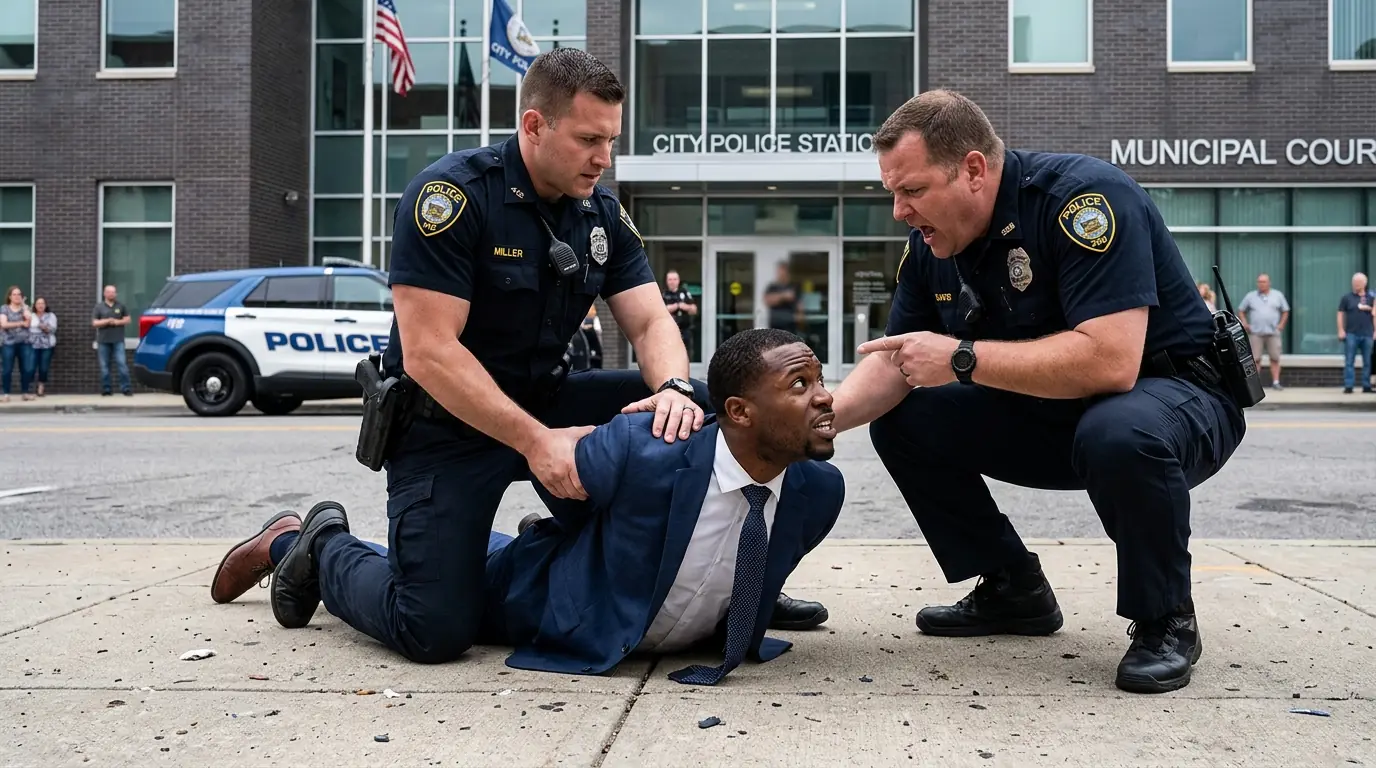
Brooks shifted again. His hand hovered near his radio. He imagined writing the report later. He imagined choosing the words. He wondered which version would become official. He wondered if he’d have the courage to push back or if he’d learned the same lesson Keegan had.
Around them, the morning moved on. Cars passed. A siren wailed and faded. Life continued as it always did, even when something was breaking in plain sight.
And beneath it all was the unspoken understanding that made moments like this possible. The belief that some people would not be believed. That some stories would never matter. That even if someone got hurt, the system would absorb it and move on.
That belief had been taught carefully, repeated often, rewarded quietly, until the day it wasn’t.
Marcus lay still, not because he had been defeated, but because he understood exactly how quickly a moment like this could spiral.
He felt the cold bite of metal as the cuffs closed around his wrists, tighter than necessary. The click echoed louder than it should have, like a door shutting.
Hands secured, Officer Rick Daly said, more for the cameras than for his partners, “You’re being detained. Failure to cooperate will result in additional charges.”
“I’ve cooperated,” Marcus replied. His voice was calm, even from the beginning.
Sergeant Tom Keegan paced once in front of him, then stopped. He looked down the way someone looks at a problem they’ve already decided how to solve.
“You keep talking like you know how this works,” he said. “That’s not helping you.”
Marcus met his gaze.
“I know exactly how this works.”
That earned him a scoff.
Keegan turned to the crowd.
“Sir matched the description of a suspicious individual. We approached. He became verbally confrontational.”
“That’s not what happened,” someone shouted.
Keegan ignored it. He always did. Words were easy to manage. Paper was patient.
Officer Evan Brooks stood a step back, watching the scene with a knot forming in his chest. The cuffs, the posture, the way Marcus held himself upright even while restrained. It didn’t fit the script Brooks had seen so many times.
Something about the man’s restraint felt deliberate, not submissive.
Brooks glanced at Daly.
“Sarge, we still haven’t…”
Keegan cut him off with a look sharp enough to sting.
“We’re past that.”
Marcus shifted slightly to ease the pressure on his shoulder.
“You don’t have probable cause,” he said. “You didn’t before. You don’t now.”
Daly crouched beside him.
“You want to add resisting to the list?”
“I haven’t resisted,” Marcus said. “And you know it.”
Daly leaned in closer.
“You don’t get to tell us what we know.”
Across the driveway, Laya Chen felt her stomach twist. She had seen patients come in after encounters like this. Broken ribs, dislocated shoulders, eyes full of something that didn’t heal.
She raised her voice again, steadier this time.
“He’s not a threat. You’re escalating this.”
Keegan finally turned toward her.
“Ma’am, last warning.”
She didn’t move.
“This is a hospital,” she said. “You’re treating him like a criminal outside an ER.”
“That’s exactly where criminals belong,” Keegan shot back.
Marcus inhaled slowly. He could feel his heart rate climbing, not from fear, but from the weight of the moment. He thought of the call that had pulled him from his mourning. Thought of the reason he’d come here in the first place. Thought of how absurd it all was.
“You asked me to come,” he said again, louder now. “Someone from this department did.”
Daly laughed.
“Nobody asked you to do anything.”
“Yes,” Marcus said. “They did.”
Keegan’s smile thinned.
“You expect us to believe that?”
“I’m not asking you to believe anything,” Marcus replied. “I’m asking you to stop.”
The crowd murmured. The phrase landed differently this time. Not defiant, not desperate, certain.
Brooks felt it, too. He took a half step forward.
“Who called you?” he asked before he could stop himself.
Keegan’s head snapped toward him.
“Brooks.”
Marcus turned his head just enough to look at the younger officer. Their eyes met. Marcus saw something there. Uncertainty, curiosity, maybe even respect.
“Your department,” he said. “That’s all I’m going to say right now.”
Keegan let out a short, humorless laugh.
“This guy thinks he’s special.”
“I don’t think I’m special,” Marcus said. “I think this is a mistake.”
Daly rolled his eyes.
“They all say that.”
“That’s because it usually is,” Marcus replied.
Keegan’s patience snapped.
“Search him.”
Daly reached into Marcus’s jacket pocket, rougher than necessary. Keys, wallet, phone, ordinary things. The crowd leaned in, waiting for something incriminating that never came.
“Nothing,” Daly muttered.
“Check the other side,” Keegan said.
Daly shifted his grip, tugging the jacket aside. For a brief second, sunlight caught on metal near Marcus’s waist. Just a flash. Then fabric fell back into place.
Brooks noticed. So did Laya.
“What was that?” someone whispered.
Daly didn’t react. He was too focused on the absence of evidence.
Keegan frowned, irritated.
“Get him up,” he said. “We’re taking him in.”
As Daly and Brooks lifted Marcus to his knees, Marcus winced, then steadied himself. He took a breath.
“This doesn’t have to go the way you think it does,” he said.
Keegan leaned close, voice low.
“You don’t get to decide how this goes.”
Marcus looked at him evenly.
“Neither do you.”
The words were simple. Not a threat, not a boast, just a fact.
Keegan straightened.
“I’m done with this,” he said. “Cuff him tighter.”
Daly complied, though his movement slowed. Brooks hesitated, then adjusted the cuffs slightly, easing the pressure just enough that Marcus noticed.
“Thank you,” Marcus said quietly.
Brooks swallowed.
“You should have kept quiet,” he murmured back, unsure why he said it.
Marcus shook his head.
“Silence is how this keeps happening.”
The crowd had grown larger now. People stood shoulder to shoulder, phones steady, faces set. This was no longer confusion. It was recognition.
A man near the back spoke up.
“If he hasn’t done anything, why are you arresting him?”
Keegan pointed.
“Step back, sir.”
“For what?” the man asked. “Asking a question?”
Keegan didn’t answer. He didn’t need to. Authority had always filled the gaps for him.
Marcus shifted again, and this time his jacket rode higher. The metallic edge showed longer now, unmistakable in the morning light.
Laya’s breath caught in her throat.
“That’s…” she began, then stopped.
Brooks saw it clearly. His eyes widened.
Marcus felt the air change. He didn’t look down. He didn’t need to. He had hoped quietly against his better judgment that it wouldn’t come to this, that the truth could surface before the symbol had to.
But the truth was already there, straining against the weight of a system that refused to see it.
Keegan was still talking, still in control, still certain for a few more seconds at least.
And in that narrow space, before the badge was recognized, before power revealed itself, everyone watching understood the most dangerous part of the moment.
This was how it would have ended if nothing stopped it.
Everything stopped with a single sentence spoken by someone who had nothing to gain from saying it.
“Wait,” Laya Chen said, her voice cutting through the noise.
It wasn’t loud, but it was clear. The kind of clarity that makes people turn without knowing why.
She stepped closer, eyes fixed on Marcus’s waist where the fabric of his jacket had shifted again.
“That’s a badge,” she said. “That’s a police badge.”
For a split second, no one reacted.
Sergeant Tom Keegan let out a short, dismissive breath.
“Ma’am, step back.”
“I’m not mistaken,” Laya replied. Her hands trembled, but her voice didn’t. Years in trauma care had taught her how to speak when seconds mattered. “I’ve seen that badge before. That’s a chief’s badge.”
The word landed wrong, heavy, unwelcome.
Officer Rick Daly glanced down, irritation flashing across his face. Then his expression changed. His eyes narrowed, not in suspicion this time, but recognition.
He shifted Marcus slightly, and the jacket fell away just enough for the emblem to catch the morning light.
Gold, five points, worn, not decorative.
Daly’s hand froze in midair.
Officer Evan Brooks felt his stomach drop. He stared, his mind racing ahead of what his eyes were confirming. Training manuals flashed through his head. Department memos. The email from city hall he’d skimmed two days earlier and forgotten.
Keegan saw at last.
“What the hell is that?” he muttered, though his voice had lost its edge.
No one answered him.
The crowd leaned forward as one body. Phones stopped shaking.
A man in the back whispered, “Oh my God.”
Someone else said, “That’s real.”
Marcus straightened slowly as Daly’s grip loosened without instruction. He didn’t pull away. He didn’t reach for the badge. He simply stood there, cuffed hands in front of him. Now his jacket had opened, the emblem fully visible.
“I told you,” Marcus said quietly. “This is a mistake.”
Keegan took a step back, then another. His mouth opened, closed. He looked around, searching for something. Authority. Control. A version of events that still belonged to him.
“That’s not…”
He started, then stopped. His eyes flicked to Brooks.
“Is that…”
Brooks nodded once. He didn’t trust his voice.
Keegan swallowed hard.
“Sir,” he said, and the word sounded foreign coming from him. “Why didn’t you say something?”
Marcus met his gaze. There was no anger there, no satisfaction, just something tired.
“I did.”
Daly’s hand shook as he reached for the cuffs.
“I didn’t know,” he said, more to himself than anyone else. “I swear I didn’t know.”
“You didn’t ask,” Marcus replied.
The radio at Keegan’s shoulder crackled. No one touched it. The sound seemed intrusive now, like a phone ringing at a funeral.
“Chief,” Brooks said, finally finding his voice. “You’re Chief Marcus Hail.”
Marcus nodded once.
“Yes.”
Keegan’s face drained of color. He looked at the badge again, as if hoping it might disappear.
“This can be cleared up,” he said quickly.
“We can stop,” Marcus said.
The word wasn’t loud. It didn’t need to be.
Keegan stopped.
Marcus turned slightly, taking in the crowd, the cameras, the hospital entrance behind them. He spoke with the same measured calm he’d used since the beginning, but now every word carried weight.
“Remove the cuffs.”
Daly hesitated for half a second, then complied. The metal fell away with a soft clink that sounded far too loud in the sudden quiet.
Marcus rolled his wrists once, feeling the ache. He adjusted his jacket, not to hide the badge, but to settle it properly where it belonged.
Keegan stood rigid, hands useless at his sides.
“Chief, I…”
“You put your knee on my back,” Marcus said, “outside a hospital, in front of witnesses, without cause.”
Keegan nodded rapidly.
“Yes, sir. I understand. I’m sorry. This won’t happen again.”
Marcus looked at him, then really looked at him.
“That’s not the point.”
The crowd watched, barely breathing.
“This didn’t stop because you realized I was innocent,” Marcus continued. “It stopped because you realized who I am.”
No one argued.
Brooks felt a flush of shame rise in his chest. He thought of how close this had come to going further. How easily it could have. He thought of how many times it probably had.
Keegan cleared his throat.
“What would you like us to do, sir?”
Marcus didn’t answer right away. He took a slow breath, grounding himself. The morning had changed. He could feel it.
“Step back,” he said finally. “All of you.”
They did.
“Secure your radios,” Marcus said. “Call a supervisor now.”
Keegan reached for his radio with stiff fingers. His voice cracked as he spoke into it, words stumbling over one another.
The crowd erupted in murmurs, disbelief rippling outward. Someone laughed softly, not out of humor, but shock. A woman wiped her eyes. A man shook his head again and again.
“That was about to be bad,” someone whispered.
Laya exhaled, her knees weak. She leaned against the wall, one hand over her mouth. She met Marcus’s eyes, and he gave her a small nod. Gratitude. Recognition.
Sirens approached in the distance, closer this time.
Marcus turned back to Keegan.
“You’re relieved,” he said. “Effective immediately.”
Keegan nodded, swallowing.
“Yes, sir.”
Daly stared at the ground. Brooks stood straight, unsure whether to feel relieved or sick.
Marcus looked at Brooks.
“You spoke up,” he said. “You hesitated.”
Brooks swallowed.
“I should have done more.”
“Maybe,” Marcus said. “But you noticed.”
The moment stretched heavy with everything that had almost happened.
Marcus stepped back, creating space where there had been none. The cameras kept rolling. The truth no longer needed to hide.
And in that space where authority had failed and then been exposed, everyone present understood something all too clearly.
Nothing had stopped because it was wrong. It stopped because power had finally shown its face.
Power didn’t roar that morning. It didn’t threaten or demand. It stood quietly in the open and forced everyone to look at what they had almost done.
By the time the supervisors arrived, the scene outside the hospital had changed completely. The crowd hadn’t dispersed. If anything, it had grown. People stood with their phones lowered now, not recording chaos, but witnessing accountability.
The air felt different, heavier, but clearer.
Marcus Hail spoke little while the initial reports were taken. He answered questions when required, correcting facts with precision, never raising his voice. Every word he chose carried intention, not because he wanted revenge, but because he understood what moments like this could become if mishandled.
Sergeant Tom Keegan stood off to the side, shoulders slumped, eyes avoiding the cameras. The authority he had worn so comfortably minutes earlier was gone. What remained was a man confronting consequences he had been taught would never arrive.
Officer Rick Daly signed a statement with shaking hands. He didn’t look angry. He looked stunned, as if a rule he’d trusted had suddenly vanished.
Officer Evan Brooks watched it all unfold with a knot in his chest that didn’t loosen. He felt relief, yes, but it was tangled with something else. A realization that scared him more than the incident itself. He had almost stayed quiet, almost let it continue, and almost suddenly felt dangerous.
Inside the hospital, Laya Chen sat on a bench near the entrance, hands folded, replaying the moment she spoke up. Her heart still raced. She didn’t feel heroic. She felt shaken. She thought about how easily she could have looked away, how many times she probably had before.
When Marcus finally turned to address the crowd, it wasn’t with a speech. It was with a sentence.
“Thank you for staying,” he said. “For paying attention.”
Someone asked, “What happens now?”
Marcus paused. He looked at the officers, at the witnesses, at the building behind him where lives were saved every day.
“Now,” he said, “the system does what it’s supposed to do.”
People had heard promises like that before. They waited, unsure.
And then the system surprised them.
By noon, internal affairs had opened a formal investigation. By the end of the day, body camera footage had been secured, witness statements collected, and the officers involved placed on administrative leave pending review.
Not quietly, not temporarily, publicly.
Marcus insisted on it.
“This doesn’t get handled in the dark,” he told city officials later that afternoon. “If the public saw the harm, they deserve to see the response.”
The mayor agreed, not out of pressure, but because the truth was impossible to ignore. The footage was already spreading. The story was already moving faster than spin ever could.
But Marcus knew consequences alone weren’t enough.
Two days later, he stood in front of a room filled with command staff, union representatives, and city leaders. The atmosphere was tense, defensive. He began without notes.
“I didn’t reveal my badge because I wanted special treatment,” he said. “I revealed it because someone else recognized it. That matters.”
He let the silence work.
“What happened to me almost happens every day to someone without a title,” he continued. “The only difference is that their stories don’t stop halfway through.”
He outlined changes that wouldn’t be optional. Mandatory de-escalation retraining. Revised use-of-force thresholds. Independent civilian review with real authority. Clear consequences tied to action, not intent.
Some pushed back. They always did.
Marcus listened. Then he said, “If the badge only protects us from accountability, it doesn’t deserve respect.”
The room went quiet.
Officer Brooks sat in the back during that meeting, still in uniform, still uncertain. When Marcus finished, Brooks stood.
“I want to stay,” he said. “But I want to do it right.”
Marcus nodded.
“Then help change what needs changing.”
That was how transformation began. Not with slogans, with choices.
Weeks passed. The investigation moved forward. The department didn’t collapse. It adjusted slowly, unevenly, but it moved. Marcus walked through precincts and listened more than he spoke. He heard anger, fear, resistance. He also heard relief from officers who had been waiting for permission to do better.
The city followed closely. So did the country.
One evening, Marcus returned to the hospital, not for work, just to walk through the entrance where it had happened. The concrete had been cleaned. Life moved on.
Laya spotted him from the desk and smiled softly.
“Looks different,” she said.
“It does,” Marcus replied.
“People are talking,” she added. “Not just about what happened, about what could change.”
Marcus nodded.
“That’s the point.”
Before he left, a man approached him. Mid-50s, blue-collar, nervous.
“I didn’t say anything that day,” the man said. “I should have.”
Marcus shook his head.
“You stayed. That mattered.”
The man swallowed.
“I’ll speak up next time.”
Marcus placed a hand on his shoulder.
“That’s how systems change.”
Later that night, Marcus sat alone in his office, the city lights stretching beyond the window. He loosened his tie and thought about the question that still followed him.
If he hadn’t had that badge, what then?
He didn’t have an answer he liked, but he had one he could work with.
Power, he had learned, doesn’t make people better. It reveals who they already are. And when used with intention, it can expose cracks wide enough for change to take root.
The badge on his desk caught the light as he stood to leave.
It wasn’t a shield.
It was a responsibility.
And this time, it would mean something beyond the man wearing it.
What happened outside that hospital in Chicago was not just a confrontation between police officers and a man on the ground. It was a moment that peeled back the surface of everyday life and exposed how power truly works when no one thinks they’re being challenged.
Marcus Hail did nothing extraordinary that morning. He didn’t shout. He didn’t threaten. He didn’t demand respect. He followed the law, spoke calmly, and trusted that professionalism would protect him.
And still, he was slammed to the ground, restrained, and treated as a problem to be controlled rather than a person to be heard.
The only thing that stopped it was not fairness. It was not restraint. It was not the realization that he was innocent. It was recognition of power.
When the badge appeared, everything changed. Voices softened. Hands trembled. The system that had moved confidently a moment earlier suddenly hesitated. The same actions that were justified seconds before became unacceptable. The same man who had been ignored was now addressed carefully.
Not because he had become more human, but because his authority had become visible.
That is the uncomfortable truth at the center of this story.
Marcus didn’t win because he was right. He survived because he was powerful.
And instead of using that power to humiliate, punish, or take revenge, he did something far more difficult. He chose accountability. He chose transparency. He chose reform over retribution.
He turned a moment that could have ended quietly into one that demanded change, so that the next person without a badge might not need one.
The lesson here isn’t just about policing. It’s about all of us.
Power exists everywhere, in workplaces, communities, families, and institutions. Sometimes we hold it, sometimes we don’t. But character is revealed in how we act in both positions.
Do we stay silent when it’s easier? Do we speak up only when we’re protected? Do we assume the system will work itself out even when we see it failing in real time?
Marcus’s story reminds us that dignity should never depend on status, and justice should never require proof of importance.
It challenges us to pay attention, to question authority respectfully but firmly, and to understand that change doesn’t begin with outrage alone. It begins with courage, consistency, and accountability.
For those watching who carry responsibility in their jobs, this story asks, “How do you use your authority?”
For those without it, it asks, “Who are you willing to stand up for, even when it’s uncomfortable?”
And for all of us, it asks the hardest question of all.
What would have happened if no one had spoken up?
Stories like this matter because they don’t just entertain. They reflect reality, and they push us to think differently about the world we live in and the one we want to leave behind.