Broke Student Quietly Paid for Embarrassed Veteran's Bill — Next Day, His Life Changed Forever
Lunch rush at Mabel’s Diner. Elijah Reyes, a broke 19-year-old engineering student, counts the last few bills in his wallet. The money meant for groceries and bus fare until his next dishwashing paycheck. Lose it, and his family eats instant noodles all week.
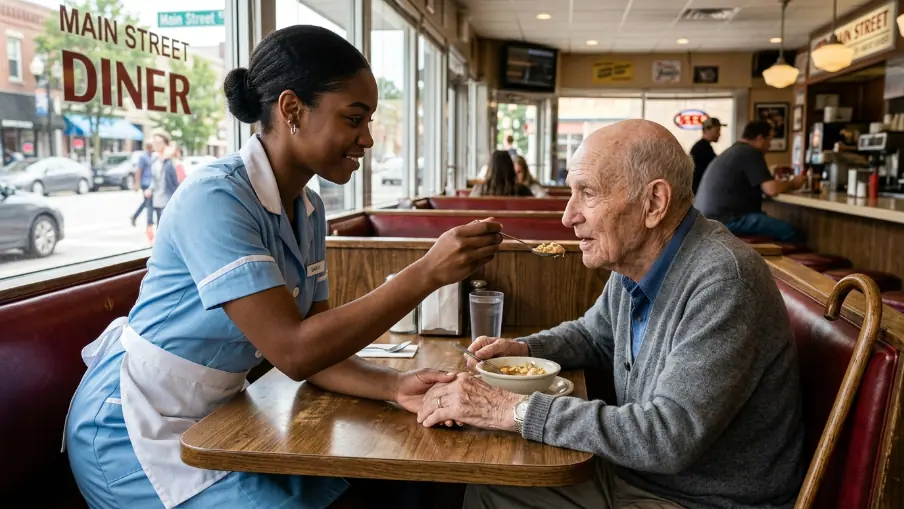
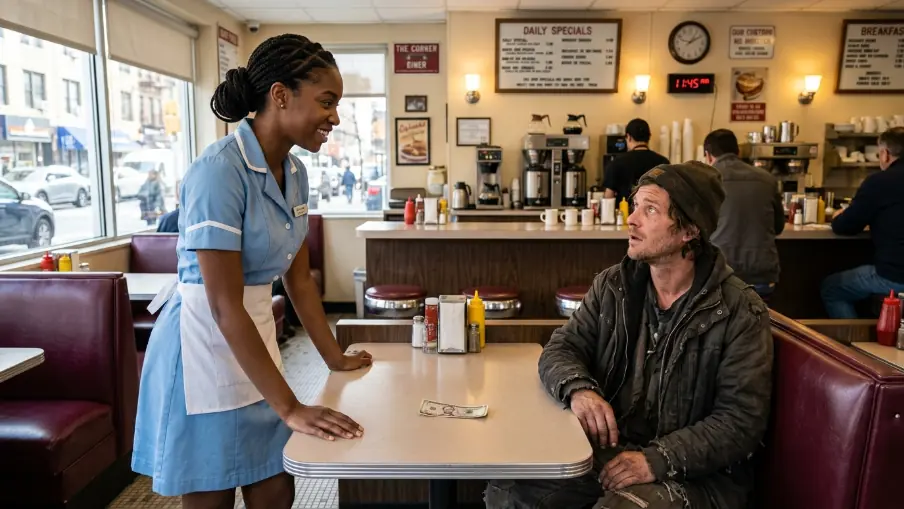
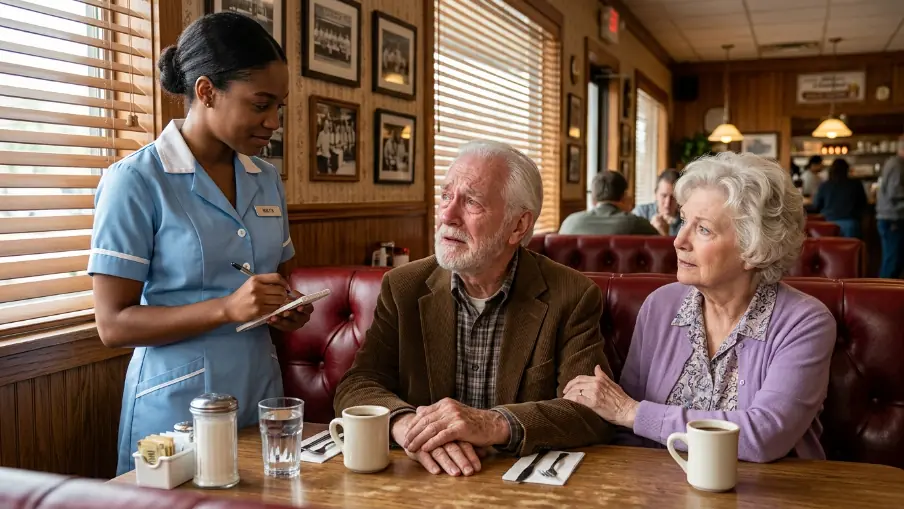
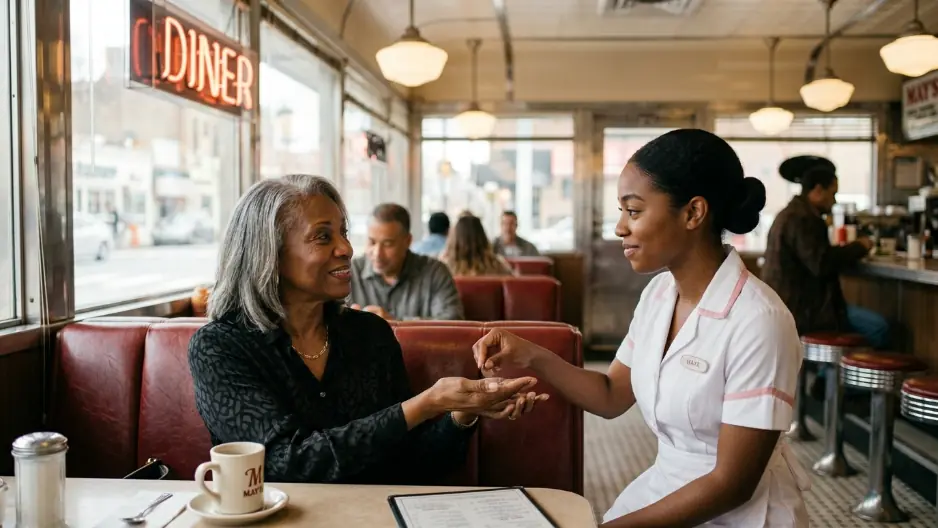
Then he hears the quiet tension from booth six. An elderly veteran, Walter Haynes, sits stiffly while the server explains his card has been declined twice. Nearby customers glance over, then quickly look away. Walter quietly asks her to take the pie back, even though he already touched it.
The humiliation in his voice hits harder than hunger. Elijah knows that feeling too well. If he pays the bill, he won’t survive the week. If he walks away, nobody would blame him.
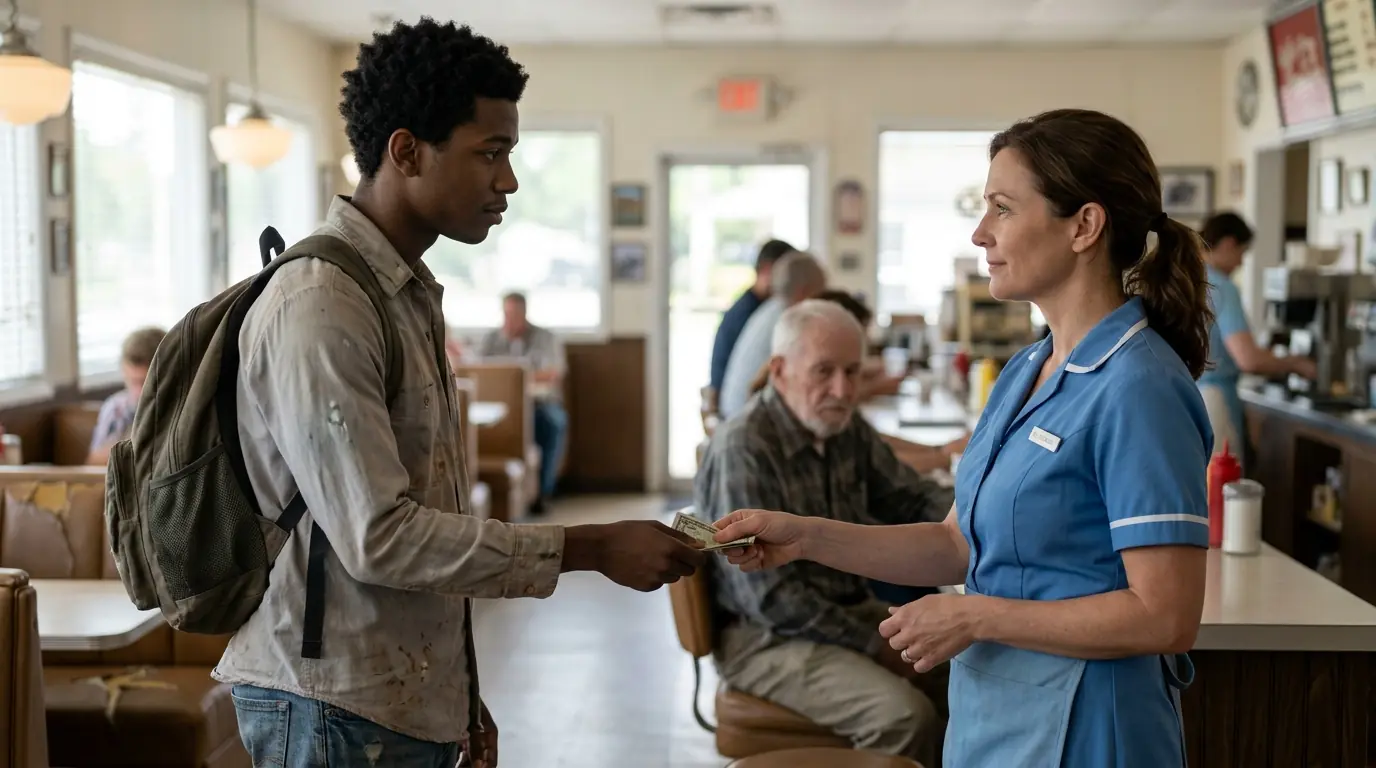
After a long pause, Elijah slides his remaining cash across the counter and whispers, “Cover his meal. But don’t tell him it was me.”
Tomorrow, men in suits will walk into Elijah’s classroom asking for him by name.
The fluorescent light in the kitchen flickered as Elijah Reyes dragged himself out of bed at 4:30 a.m. His muscles ached from last night’s shift of hauling dishes and scrubbing pots at Joe’s restaurant. Through the thin walls of their cramped apartment, he heard his mother’s whispered counting.
“Three forty. Three sixty.”
Lena Reyes sat at their wobbly kitchen table, arranging worn dollar bills into careful piles. Dark circles marked her eyes. She’d probably been up half the night worrying about the rent.
“Morning, Mom,” Elijah said softly, not wanting to startle her.
Lena quickly swept the money into an envelope. “You should sleep more, Mijo. You look exhausted.”
“I’m fine.”
He grabbed the instant oatmeal from the cabinet, noticing they were down to their last few packets. As he waited for the water to boil, he spotted Sophia trying to slide past, clutching her backpack close.
“Hey, what’s that paper you’re hiding?” he asked.
Sophia’s shoulders slumped as she pulled out a crumpled notice. “It’s nothing, just a stupid debate team fee.”
Elijah took the paper, his heart sinking at the $75 amount. Sophia loved debate. She’d light up talking about their practice sessions, planning arguments like a young lawyer.
“We’ll figure it out,” he promised, though he had no idea how.
“Don’t worry about it,” Sophia said, attempting a smile that didn’t reach her eyes. “I can quit. It’s not that important.”
“It is important,” Elijah insisted, splitting his oatmeal portion and pushing half toward her. “You’re the best debater they have. Just give me a few days.”
Lena watched them with worried eyes. “The pharmacy called. My prescription went up again this month.”
“I’ll handle it, Mom.” Elijah grabbed his worn backpack, heavy with engineering textbooks. “I get paid Friday.”
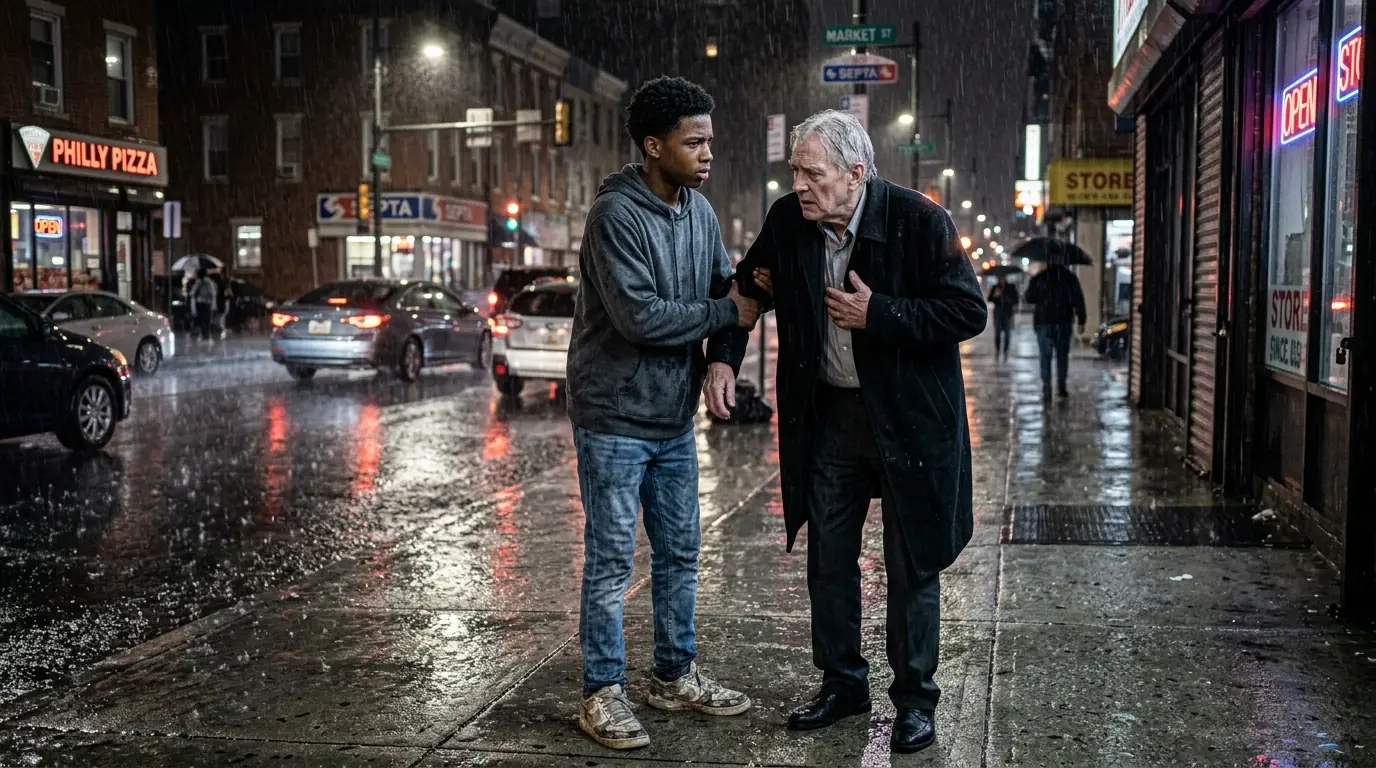
The bus ride to campus was crowded. When an elderly woman with grocery bags got on, Elijah immediately stood up, ignoring how his legs trembled with fatigue. The woman’s grateful smile made it worth it.
Between classes, he spotted Marcus from his engineering lab struggling with a broken laptop charger.
“Let me look at it,” Elijah offered, though he could have easily sold his spare parts instead of using them for repairs.
“I can’t pay you,” Marcus admitted.
“No charge.”
Elijah fixed the frayed wire, remembering how many times their own appliances had needed creative repairs at home.
During his lunch break, he noticed Mr. Jenkins, the campus groundskeeper, sharing his sandwich with his grandson, Tommy. The boy’s frame was too thin, his clothes clearly hand-me-downs.
Without drawing attention, Elijah walked over and offered his apple and granola bar.
“Hey, Tommy, I’m not hungry. Want these?”
In Professor Bell’s engineering class, Elijah struggled to focus as she explained the new software they’d need for next week’s lab. The $120 access code might as well have been $1,000.
He caught Professor Bell watching him with concern when he didn’t write down the purchase instructions.
“Mr. Reyes,” she called as class ended. “A moment?”
“Yes, Professor.”
“You’re one of my strongest students when you’re focused. But lately…” She paused. “Is everything all right?”
“Just tired,” he said quickly. “Working extra shifts.”
Her eyes softened with understanding. “The software is essential for this course. Don’t fall behind.”
“I won’t,” he promised, though his wallet held exactly $23.47, barely enough for bus fare and one meal to get through his next 12-hour shift.
At home that afternoon, Lena was getting ready for her home health aide shift.
“The electric bill came,” she said quietly.
“I can cover part of it,” Elijah assured her, mentally recalculating how to stretch his remaining dollars.
Sophia looked up from her homework. “I really can quit debate, Elijah. Stop worrying about my fees.”
“No way.” He ruffled her hair. “Future lawyers need to practice. I’ll figure something out.”
Later that morning, after his classes finished, Elijah stood outside Mabel’s Diner, clutching a torn coupon for half off breakfast items before 11:00 a.m. Through the window, he could see the usual crowd of regulars nursing coffee cups. His stomach growled. He hadn’t eaten since the previous day’s lunch.
The bell chimed as he pushed open the door, the smell of coffee and pancakes making his hunger sharper. He held the coupon like a shield, hoping to make his last few dollars stretch until payday.
The vinyl booth seats were cracked, the linoleum floor scuffed, but the diner was clean and warm. For a moment, he allowed himself to imagine having enough money to eat here regularly, to treat Sophia to chocolate chip pancakes, to buy his mom a real breakfast instead of quick oatmeal between shifts.
The hostess gestured toward an empty booth. “Sit anywhere, hon.”
Elijah slid into a seat, carefully smoothing his coupon on the scratched tabletop as he prepared to order the cheapest item on the menu.
The laminated menu crinkled in Elijah’s hands as he scanned the prices, mentally calculating what he could afford with his coupon. The lunch rush hadn’t started yet, leaving the diner quiet except for the soft clink of coffee cups and murmured conversations.
Movement in the corner caught his eye. An elderly man in a worn but carefully pressed jacket slid into a back booth. His posture was military straight despite stooped shoulders. His weathered hands, spotted with age, held the menu close to his face as he studied each item with careful attention.
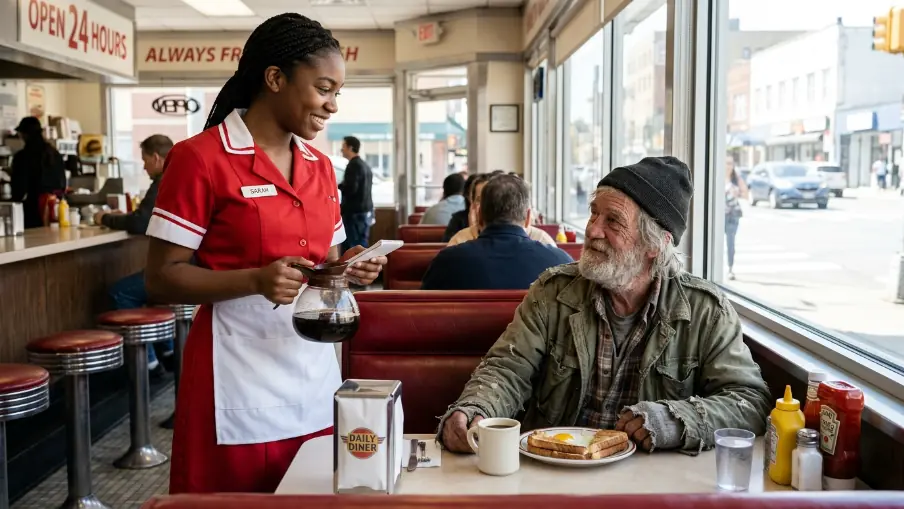
Tanya Fuller, the server with kind eyes and sensible shoes, approached his table.
“Good morning, sir. Can I start you with some coffee?”
“Just water, please.” The man’s voice was soft but clear, carrying the weight of dignity. “And…” He hesitated, finger tracing down the menu. “The senior breakfast special with wheat toast.”
“Sure thing.” Tanya jotted it down. “Anything else?”
The man, Walter Haynes, Elijah would later learn, looked longingly at the dessert display case.
“Perhaps a slice of apple pie, if it’s fresh.”
“Baked this morning,” Tanya assured him with a smile.
Elijah watched as Walter ate methodically, cutting each bite of eggs into precise portions, making the food last. It was a familiar dance, the careful rationing of a meal when you weren’t sure when the next one might come. The pie sat untouched, saved for last like a precious reward.
When Tanya brought the check, Walter reached for his wallet with steady hands. He pulled out a card and handed it over with quiet confidence. Elijah noticed his own coffee had gone cold, forgotten as he observed the scene unfolding.
Moments later, Tanya returned with a troubled expression.
“I’m sorry, sir. Your card was declined.”
A flush crept up Walter’s neck. “That’s impossible. Please try again.”
She did. The card reader beeped its rejection once more.
“I have another.” Walter’s voice remained level, but his hands trembled slightly as he extracted a second card.
The nearby diners pretended not to notice, but Elijah saw their sideways glances, the slight shake of heads, the whispered comments behind raised menus.
The second card failed, too.
“There must be some mistake.” Walter’s composure cracked just slightly. “I checked my balance yesterday.”
He pulled out his phone with unsteady fingers, squinting at the screen.
“Take your time, sir,” Tanya said gently, but her discomfort was visible. She had other tables to serve, other customers waiting.
“The pie,” Walter said quietly. “Please remove it from the bill. I…” He swallowed hard. “I shouldn’t have ordered it anyway.”
Elijah’s hand moved to his own wallet, fingers brushing the thin stack of bills inside. $23.47. All he had to last until payday. He needed that money for groceries, for bus fare to work. His family was counting on him.
But his mother’s voice echoed in his head. Dignity isn’t about what you own, Mijo. It’s about how you treat others when they’re hurting.
The shame on Walter’s face was a different kind of hunger, one that Elijah recognized too well. He’d seen it in his mother’s eyes when she couldn’t afford Sophia’s school pictures, in his sister’s forced smile when she pretended not to want new shoes.
Quietly, Elijah waved Tanya over.
“Add his bill to mine,” he whispered. “But please don’t tell him who paid it.”
“You sure, honey?” Tanya studied his worn clothes, the coupon on his table. “That’s a lot for someone using a breakfast discount.”
“I’m sure.”
Elijah handed over his debit card, praying it wouldn’t decline and make everything worse. The transaction went through. Elijah signed quickly, leaving his untouched coffee and slipping out while Walter was still searching his wallet.
Through the window, he saw Tanya approach Walter’s table, saw the older man’s surprise and confusion as she explained his bill had been taken care of.
Standing in the cold morning sunlight, Elijah pulled out his wallet and counted what remained. Four singles and some change. Not enough for groceries, barely enough for bus fare. He’d have to walk some days, maybe skip a few meals. His stomach growled, reminding him he’d left without eating.
But the image of Walter’s dignity being restored, the relief that would replace that terrible shame, filled something deeper than hunger.
Elijah tucked the nearly empty wallet back into his pocket, adjusted his backpack, and began walking toward the bus stop. The morning sun cast long shadows across the sidewalk as he mentally calculated how many miles he could walk each day to save on fare, which meals he could skip, and how to make it through the week on pocket change and determination.
The autumn wind cut through Elijah’s thin jacket as he hurried away from Mabel’s Diner. His legs already ached from last night’s shift, and campus was nearly two miles away. He checked his phone. Forty-seven minutes until lab started. If he walked fast enough, he might make it.
Each step reminded him of his empty wallet. The few coins jingling in his pocket felt like a mockery of money. His stomach churned, remembering the untouched coffee he’d left behind. But every time doubt crept in about helping Walter, he pushed it away by recalling the veteran’s trembling hands, the quiet dignity in his voice.
Sweat dampened his shirt by the time he climbed the science building steps. The digital clock in the hallway showed 1:17 p.m. Twelve minutes late.
Professor Bell looked up from her laptop as he slipped into the laboratory, her expression a mixture of concern and disappointment.
“Mr. Reyes,” she said quietly as he passed her desk. “The software access code.”
He shook his head, shame burning his cheeks. “Not yet, Professor. I’m sorry.”
“You need it by next week’s assignment. No exceptions.”
“Yes, ma’am.”
He slid onto his lab stool, aware of the other students already deep into their work. His own screen remained blank, a perfect mirror for his bank account.
His phone buzzed. A text from Lena.
Electric company called again. Need to pay something by Friday or they’ll disconnect. Don’t worry, I’ll figure it out.
Elijah’s throat tightened. He knew what figuring it out meant. His mother pawning her wedding ring or borrowing from her already strained church friends. He turned the phone face down, unable to reply.
Back at Mabel’s Diner, Walter Haynes sat frozen in his booth, staring at the receipt Tanya had brought him, marked paid in bold letters.
“Please,” he said, catching Tanya’s sleeve as she passed. “Who was it?”
She hesitated. “Sir, they asked to stay anonymous.”
“I need to thank them properly.” Walter’s voice carried the weight of old-fashioned courtesy. “It’s important.”
Tanya glanced at the receipt she still held. “Well, he used a student discount, community college ID.”
She described Elijah, a young Hispanic man, work clothes with dish soap stains, worn backpack.
“He left without finishing his coffee,” Walter noted softly, looking at the abandoned cup.
“Yeah.” Tanya’s expression softened. “And he used a breakfast coupon. Those kids don’t have much to spare.”
Walter’s weathered hands folded carefully around his own empty cup.
“No, they don’t.”
The afternoon stretched endlessly for Elijah. His head throbbed from hunger as he tried to focus on Professor Bell’s lecture about thermal conductivity. The equations blurred on the whiteboard. He had to blink hard to clear his vision.
His phone buzzed again, this time a text from Marco at the restaurant.
My kids got strep throat. Any chance you could cover my shift tonight?
Elijah’s muscles screamed at the thought of another eight hours scrubbing pots. But Marco had covered for him last month when Sophia needed school supplies. That’s what broke people did for each other.
No problem, he texted back. Hope your kid feels better.
The industrial kitchen was already steamy when Elijah arrived. He tied on his apron, ignoring the hollow feeling in his stomach. Eight hours. He could handle eight hours.
Halfway through the shift, black spots danced at the edges of his vision. He gripped the edge of the sink, letting the hot water run over his hands until the dizziness passed.
The head cook noticed. “Hey, kid, take your break. You look ready to fall over.”
“I’m fine,” Elijah insisted, but his hands shook as he picked up another pot.
It was past midnight when he finally got home. The apartment was dark except for Lena’s reading lamp. She sat at the kitchen table, surrounded by bills and calculator tape.
“You must be starving,” she said, starting to rise. “Let me heat something.”
“Already ate at work,” Elijah lied smoothly. “You should get some sleep, Mom.”
She looked uncertain. “You’re working too hard, Mijo.”
“I’m fine.”
He kissed her cheek, then waited until she went to bed before slipping his last $20 into her purse. It wasn’t enough for the electric bill, but it might buy them another day or two.
Morning came too quickly. Elijah dragged himself to his engineering class, choosing a seat in the back where Professor Bell might not notice his bloodshot eyes. He hadn’t bothered checking his bank balance. Negative numbers wouldn’t change anything.
The lecture began. Elijah tried to focus on differential equations instead of his growling stomach.
Then a sharp knock cut through the classroom silence. Everyone turned toward the door.
Two men in expensive suits stood in the hallway, their faces unreadable. Professor Bell paused mid-sentence. One of the men stepped forward.
“We’re looking for Elijah Reyes.”
The classroom fell silent as every head turned toward the door. Two men in expensive suits stood in the doorway, their polished appearance stark against the worn institutional backdrop. Professor Bell’s marker hovered mid-equation.
“We’re looking for Elijah Reyes,” the older man repeated, his voice carrying authority without aggression.
Elijah’s stomach clenched. His mind raced through possibilities, each worse than the last. The bursar’s office about his unpaid fees. Immigration officials about his mother’s paperwork. Bill collectors. Police.
“Mr. Reyes.” Professor Bell’s gentle prompt broke through his panic. She’d noticed his rigid posture, the fear in his eyes.
Elijah stood slowly, aware of 27 pairs of eyes following his movement. His classmates’ whispers felt like static in his ears. The loose change in his pocket seemed to mock him with each step toward the door.
In the hallway, fluorescent lights cast harsh shadows on the men’s faces. The older one extended his hand.
“Mr. Reyes, I’m Adrien Vale. This is my associate, Mr. Thompson. We represent a private legal and philanthropic firm.”
Elijah shook their hands automatically, his palms damp. “Is something wrong?”
“Not at all,” Adrien assured him. “We’re here on behalf of Walter Haynes. He’s quite interested in speaking with you.”
The name hit Elijah like a physical force. The man from the diner.
His voice cracked slightly. “How did he…”
“The server recognized you from your student discount,” Adrien explained. “Mr. Haynes was quite moved by your actions yesterday. He’d very much like to thank you personally.”
Elijah shifted uncomfortably. “That’s not necessary. I didn’t do it for thanks.”
“Which is precisely why he insists on meeting you.” Adrien’s smile seemed genuine.
But Elijah had learned early that expensive suits rarely brought good news to people like him.
“I have class,” Elijah gestured weakly toward the door. “And work later.”
Professor Bell appeared in the doorway, her expression carefully neutral. “Mr. Reyes, you may be excused. Please keep me informed.”
Elijah wanted to protest, but years of respecting authority held his tongue. He retrieved his worn backpack, following the men through empty corridors that suddenly felt miles long.
Outside, a sleek black car waited.
Elijah hesitated. “Where are we going?”
“Our downtown office,” Adrien said. “It’s about 15 minutes away. Mr. Haynes is waiting there.”
The car’s leather interior made Elijah acutely aware of his shabby clothes and unwashed hair. He sat stiffly, hands folded in his lap, watching familiar streets transform into the glass and steel landscape of downtown.
Adrien spoke quietly with his associate while Elijah tried to make sense of this surreal moment. Yesterday, he’d helped an elderly veteran keep his dignity. Today, men in thousand-dollar suits were chauffeuring him through the city. Nothing added up.
The car pulled into an underground parking garage beneath a towering office building. In the elevator, Elijah caught his reflection in the polished doors. He looked small, tired, out of place.
The law firm occupied the entire 20th floor. Through glass walls, Elijah glimpsed people in suits moving purposefully between offices. A sign read, Vale, Wittman and Associates.
As they walked past one office, Elijah noticed files spread across a conference table. His eyes caught fragments of text. Veterans Educational Trust and Haynes Unit Foundation. Another folder bore Walter’s name and what looked like military insignia.
His confusion deepened. What did a declined diner bill have to do with legal documents and veterans organizations?
Adrien led him down a quiet hallway to a private conference room.
“Mr. Haynes is waiting inside. Take all the time you need.”
Elijah’s hand trembled slightly as he reached for the door handle.
The room was warm, sunlit, dominated by a long mahogany table, and there, standing despite obvious fatigue, was Walter Haynes. He looked different in the morning light, still dignified, but the shadows under his eyes spoke of sleepless nights. His suit was well-kept, but decades old. He gripped the back of a chair for support, yet refused to sit until his guest arrived.
Their eyes met across the room. In that moment, Elijah saw something shift in Walter’s expression. Recognition, perhaps, or confirmation of something he’d been waiting to verify.
“Mr. Reyes,” Walter said softly. “Thank you for coming. We have much to discuss.”
The conference room felt too grand for Elijah, with its polished wood and floor-to-ceiling windows overlooking the city. He stood awkwardly until Walter gestured to a chair.
“Please sit. You look as tired as I feel.”
Walter’s voice carried warmth beneath its formality. He lowered himself into a leather chair, wincing slightly.
“Sir, I…” Elijah began, but Walter held up a weathered hand.
“First, let me thank you properly. What you did yesterday meant more than you know.”
Walter’s eyes were sharp despite his obvious fatigue.
“The server told me you left before finishing your own coffee.”
Elijah’s face grew warm. “It wasn’t a big deal.”
“We both know that’s not true.” Walter leaned forward. “I saw your work clothes. The way you counted change afterward. That bill wasn’t spare money for you.”
Elijah stared at his hands folded tightly in his lap. The morning sun through the windows made his calluses more visible.
“But that’s exactly why we’re here,” Walter continued. “You chose to help when it cost you something real, when you had every reason not to.”
Adrien Vale entered quietly, placing a folder before Walter before withdrawing.
Walter opened it, revealing yellowed documents and old photographs.
“What I’m about to tell you starts 50 years ago with 12 men coming home from war.”
Walter’s fingers traced a black-and-white image of young soldiers.
“We’d seen the worst of humanity, but also the best. Men sharing their last rations, carrying each other through hell, keeping promises that mattered.”
He slid forward another document, its letterhead faded, but still bearing military insignia.
“When we got back, we made a pact. Those of us who survived would build something lasting. Not a monument, but a way to help good people rise above hardship.”
Elijah studied the paper, a trust agreement dated 1973. The language was formal, but its purpose was clear. An educational fund for hardworking young people from struggling families.
“We pooled everything,” Walter explained. “Combat pay, GI Bill benefits, even land some of us inherited. Created a proper endowment with rules and trustees. For almost 20 years, it worked beautifully, helping dozens of students through college, trade school, whatever path they chose.”
His expression darkened. “Then things fell apart. Deaths, legal disputes, mismanagement. The money got tied up in court. The original mission got buried under paperwork and politics.”
He pushed another document forward, a recent court order.
“Two days ago, I finally won back control as the last living trustee. That’s why my cards failed at the diner. The accounts were being transferred.”
Elijah’s mind spun trying to connect these pieces.
“Sir, I don’t understand what this has to do with me.”
Walter’s tired face softened.
“For years, I’ve been looking for the right person to help restore this trust’s purpose. Not just someone smart or ambitious. There are plenty of those. I needed someone who understood its heart.”
He gestured at the old photos.
“These men didn’t build this to create headlines or win praise. They built it because they knew what it meant to carry each other.”
“When you paid that bill,” Walter continued, “you weren’t trying to network or impress anyone. You saw someone hurting and chose to help, even though it cost you. That’s exactly what this trust was meant to recognize.”
Adrien returned with more paperwork. Walter sorted through it, pulling out several forms.
“We’d like to help you, starting with your immediate school expenses. There’s also a possibility of a scholarship for further engineering studies and a paid internship through one of our partner companies.”
Elijah’s throat felt tight. “I can’t accept that. It would feel wrong, like I helped you just to get something back.”
“That’s precisely why you’re the right choice.” Walter’s voice carried absolute conviction. “This isn’t payment for a favor. It’s recognition of who you are. The trust exists to find people like you. People who do right things when no one’s watching.”
The morning sun warmed Elijah’s shoulders as the reality of this moment settled over him. His mind raced to his mother counting pills to make prescriptions last longer, to Sophia hiding school fee notices, to his own dreams of university engineering programs that had seemed impossible yesterday.
“I need to talk to my family,” he said finally.
Walter nodded approvingly. “Of course. Take these documents home. Review them carefully. But know, this isn’t charity. It’s an investment in character.”
That evening, Elijah sat at his family’s small kitchen table, the trust papers spread before him. Lena listened with tears in her eyes as he explained everything. Sophia bounced in her chair, her face glowing with possibility.
“Mijo,” Lena whispered, touching the old photographs of Walter’s unit. “Sometimes God works in ways we don’t expect.”
Sophia hugged Elijah fiercely. “I told you good things would come. I told you.”
Under the flickering kitchen light, surrounded by the people he loved most, Elijah allowed himself to feel something he’d guarded against for years. Hope.
Elijah barely slept, his mind racing with possibilities that had seemed impossible just days ago. When morning came, he and Lena took the bus downtown together, her hand gripping his arm with motherly concern.
The legal office looked even more imposing in the clear daylight. Adrien Vale met them in the lobby, his professional demeanor softening slightly at Lena’s protective presence.
“Mrs. Reyes, welcome. Mr. Haynes is expecting you both.”
The conference room felt different with his mother beside him. Lena sat straight-backed in her chair, her work uniform crisp despite its age, her eyes watchful as Walter spread the documents across the table.
“Before we begin,” Adrien said, pulling out a leather portfolio. “I want to be clear about what Mr. Haynes is proposing.”
He looked directly at Lena.
“The Veterans Trust is being revived with a focused approach. Rather than spreading thin resources across many recipients, we’re starting with one student who embodies the original mission.”
Walter nodded. “Someone who shows the character these funds were meant to recognize.”
Adrien produced several forms. “First, we’re addressing immediate needs. This document authorizes emergency educational assistance to clear Elijah’s current semester obligations.”
Lena leaned forward, reading carefully. “And what do you expect in return?”
“A fair question,” Walter said. “We expect Elijah to continue showing the same integrity that brought him here, to study hard, to help others when he can. Nothing more complicated than that.”
Adrien outlined the specifics. Overdue tuition paid, required software provided, a bus pass for the semester, and textbook coverage.
Then he mentioned the internship possibility.
“We partner with several engineering firms,” he explained. “One has agreed to interview Elijah for a paid position that works around his class schedule.”
Lena’s hands twisted in her lap. “It seems too good to be true. There must be some catch.”
Walter’s expression softened.
“Mrs. Reyes, I understand your caution. But consider this. Your son helped me when he thought I was just a struggling stranger. He did it privately, at personal cost, expecting nothing back. That tells me everything about his character and your influence in raising him.”
Tears welled in Lena’s eyes, but she blinked them away.
“We’ve always managed on our own.”
“And you’ve done remarkably well,” Walter said gently. “But this trust exists because my unit understood that sometimes good people need a bridge to cross difficult waters.”
They spent the next hour reviewing every detail. Adrien explained the scholarship terms, the internship structure, and the trust’s expectations. Lena asked pointed questions about obligations and conditions. Walter answered each one with patient honesty.
By early afternoon, Elijah held signed copies of the assistance forms. His hands trembled slightly as he and his mother left the office.
“Mijo,” Lena said softly as they walked to the bus stop. “I’m proud of you. Not for getting help, but for being the kind of person who gives it first.”
On campus, Elijah went straight to the bursar’s office. The hold on his account lifted like a weight from his shoulders. In the computer lab, he downloaded the engineering software he’d been missing, no longer having to borrow other students’ computers.
Professor Bell was in her office when he knocked. She looked up from grading and smiled.
“Come in, Elijah. I heard there were some interesting developments.”
He explained everything, still somewhat dazed by the morning’s events. Professor Bell listened intently, nodding.
“You know,” she said when he finished, “some students would see this as a lucky break and nothing more, but I suspect you’re wondering if you deserve it.”
Elijah shifted uncomfortably. “It feels strange accepting so much help.”
“Let me ask you something,” she said, leaning forward. “If you saw that veteran struggling again tomorrow, would you still help him, knowing nothing would come of it?”
“Of course.”
“Then stop feeling guilty about receiving assistance you’ve earned through character.” She smiled. “Sometimes the universe recognizes kindness in unexpected ways.”
That evening, Elijah walked through the grocery store with an unfamiliar sense of security. He filled a cart with real food. Fresh vegetables, meat that wasn’t about to expire, bread that wasn’t day-old discounted. Sophia bounced alongside him, chattering about her upcoming debate tournament.
“And now I can stay on the team,” she exclaimed. “Wait until I tell Mrs. Martinez I can go to the regional competition after all.”
At home, while putting away groceries, Elijah’s phone rang. The number was unfamiliar.
“Elijah, it’s Walter Haynes.”
The older man’s voice sounded tired, but warm.
“I know it’s been a full day, but I wondered if you might visit again tomorrow. There are some things about the trust and about my own past that I’d like to share with you.”
Walter’s house sat on a quiet street lined with aging maples. The small front yard showed signs of careful maintenance despite his age, with neat hedges and tidy flower beds flanking a well-worn path.
Elijah checked the address twice before climbing the concrete steps to knock.
“Right on time,” Walter said, opening the door.
He moved with deliberate care, his military bearing still evident despite the slight stoop of his shoulders.
The living room smelled of coffee and old books. But it was the dining room that caught Elijah’s attention. Every surface held carefully arranged items, faded photographs in simple frames, bundles of letters tied with faded ribbon, and banker’s boxes labeled with dates and locations.
“Please sit,” Walter gestured to a chair, pouring coffee into two mugs that had seen better days. “I wanted you to see this, all of this, to understand where the trust really came from.”
He lifted a photograph from the nearest stack. Six young men in uniform stood arm in arm, their faces bright with youth despite the dusty backdrop.
“That’s my unit, 1965. The tall one on the end is Jimmy Martinez. He used to mail half his pay home to his sister’s kids in New Mexico.”
Walter’s fingers traced the image gently.
“The short fellow next to him, that’s Frank Cooper. Had the worst boots in the unit until Pete Williams, he’s the one with the crooked smile, gave Frank his spare pair. Said his feet were tough anyway from working his daddy’s farm.”
Elijah leaned forward, drawn in by the personal details that made these long-ago soldiers real. Walter picked up another photo, then another, naming each man and sharing not tales of combat, but moments of simple human kindness.
“We made a pact,” Walter said, his voice growing softer. “Not the dramatic kind you see in movies, just a quiet promise that if any of us made it home and built something good, we’d find ways to help young folks who needed a hand up. Not charity, opportunity.”
He opened a worn leather folder filled with legal documents.
“The trust started small. Jimmy sold some land he inherited. Pete contributed his GI Bill funds since his father was paying for his college. Others sent what they could spare. We wanted it to grow slowly, carefully, helping one or two students at a time.”
Walter’s hands trembled slightly as he closed the folder.
“But things got complicated. Deaths, disputes, poor investments by later trustees. My own…” He paused, pain flickering across his features. “My son Thomas and I had a falling out. He was meant to help manage the trust, but I drove him away with my stubbornness. Haven’t spoken to him in 15 years.”
Elijah sat quietly, recognizing the weight of this confession.
Walter continued. “After that, I withdrew from everything. Let the trust languish. Failed the promise we made.”
He looked up, meeting Elijah’s eyes.
“Until that morning in the diner, when you showed me that kind of simple decency still exists.”
“The men in those photos,” Elijah said carefully. “They helped each other without expecting anything back.”
Walter nodded. “Exactly. That’s why I want you involved in rebuilding this, not just as a recipient, but as a voice helping shape its future. These young men in the photos, they’d recognize something of themselves in you.”
They spent the next hour going through more records, scholarship applications from the trust’s early years, thank-you letters from past recipients, carefully preserved news clippings about the veterans’ successes and setbacks.
Later that afternoon, Elijah walked into Marshall Engineering Associates for his internship interview. The office occupied two floors of a converted industrial building with glass-walled project rooms and the quiet hum of focused work.
Sarah Marshall, the firm’s founder, reviewed his transcript while asking pointed questions about his coursework. Elijah answered honestly, including where he struggled and how he worked to improve.
“Tell me about this gap in your fall semester,” she said, indicating a period of lower grades.
“I was working extra shifts to help with my sister’s school fees,” Elijah explained. “It affected my study time, but I’ve since found better balance.”
Sarah nodded, making a note. Then she presented a technical problem, a real issue from a current project. Elijah worked through it methodically, showing his process, even when uncertain.
“You didn’t try to bluff when you weren’t sure,” she observed. “I like that.”
The interview ended with a tour of the workshop where prototype testing took place. Elijah’s genuine interest in the equipment and respectful questions to the technicians clearly registered.
That evening, he pushed open his apartment door to find Sophia setting the table with their mother’s good plates, the ones reserved for special occasions.
“Well?” Lena asked, pausing in the middle of serving actual home-cooked enchiladas, a luxury they hadn’t enjoyed in months.
Elijah’s grin said everything.
“I start Monday. Part-time during the semester, full-time in summer if I do well.”
Sophia squealed and hugged him. Lena wiped her eyes with her apron.
The apartment filled with the unfamiliar sound of laughter without worry, the scent of food cooked without counting every penny, the feeling of breathing freely after holding their breath for so long.
As morning classes resumed, Elijah found himself able to focus without the constant weight of financial worry pressing down. His new laptop, a basic but reliable model provided through the trust, displayed the engineering software that had been out of reach just weeks ago.
During lab sessions, Professor Bell noticed the difference immediately.
“Your calculations are much cleaner now,” she said, reviewing his latest project. “When you’re not exhausted from overnight shifts, your natural talent shows through.”
She mentioned an upcoming regional showcase where engineering students could present innovative solutions to community problems.
“I’d like to nominate you. Your perspective on practical applications could stand out.”
At his internship, Elijah absorbed everything. He organized technical documents, assisted with equipment maintenance, and carefully observed the senior engineers. Sarah Marshall often found him studying manuals during lunch breaks instead of socializing.
“You don’t have to skip meals to prove yourself,” she told him, dropping a sandwich on his desk one afternoon. “We hired you because you think things through, not because you never stop working.”
The biggest change came at home. Lena no longer had to choose between medicine and utilities. Sophia’s debate tournament fees were paid on time.
One evening, Elijah overheard his sister on the phone with a friend.
“My brother’s doing amazing things,” she said proudly. “He’s helping restore this whole veterans program, like actually making a difference.”
The trust preparations kept Elijah busy between other commitments. Walter’s house became a second home as they sorted through decades of records. Adrien Vale visited regularly, guiding them through legal requirements and public relations considerations.
“People need to understand this isn’t just about money,” Walter insisted during one planning session. “It’s about recognizing character that would otherwise go unseen.”
Adrien nodded. “Which is why your story matters, Elijah. It shows exactly what the trust was meant to support.”
They organized a modest ceremony at the local veterans center. Walter wanted it dignified but not flashy. Elijah helped arrange chairs, straighten flags, and welcome the small crowd of community leaders, veterans, and education advocates.
When it was his turn to speak, Elijah gripped the podium and took a deep breath.
“I never wanted attention for helping someone. That’s not why you do it. But standing here, I realized something important. Sometimes good people need to be seen. Not for pride, but so others know they’re not alone.”
His voice grew stronger as he continued.
“There are students everywhere working two or three jobs, helping their families, trying to build better lives. They skip meals to buy books. They fix things instead of replacing them. They give away their last dollar sometimes because they know exactly how it feels to need help.”
In the audience, Lena wiped tears from her eyes. Sophia beamed. Professor Bell nodded encouragingly.
“The men who created this trust understood that kind of quiet dignity,” Elijah said. “They knew poverty can make decent people feel invisible, but they believed character matters more than circumstances. They built something to prove it.”
Walter stood carefully and joined him at the podium.
“Today we officially announce the restoration of the Veterans Educational Legacy Trust,” he declared. “And I’m proud to name Elijah Reyes as our first recipient and future youth liaison. He embodies everything our founding members hoped to support.”
Local reporters took photos. Community leaders offered congratulations. A small news crew captured Walter and Elijah shaking hands. By evening, clips were spreading on social media and local news sites.
Walking across campus the next morning, Elijah felt strange receiving smiles and greetings from strangers. A journalism student asked for an interview. Two veterans stopped him to share their own stories of help given and received.
“Hey, scholarship guy,” called a student he barely knew. “Way to go.”
Near the science building, Professor Bell caught his eye and gave him a proud thumbs-up. For once, Elijah allowed himself to smile back without reflexively deflecting praise.
But across the quad, partially hidden by a group of expensive-looking motorcycles, Darren Pike watched the scene unfold. His designer jacket and carefully styled hair marked him as someone who had never worried about paying bills. His expression darkened as he observed yet another person congratulating Elijah.
Pike’s fingers tapped restlessly against his phone as his eyes narrowed, tracking Elijah’s progress across campus with unmistakable suspicion.
Elijah noticed something was wrong the moment he stepped into the engineering building. Conversations stuttered to a halt. Students glanced away quickly. Others huddled over phones, shooting furtive looks in his direction.
At his usual desk, he opened his laptop and found his inbox flooded with forwarded links. The first led to a student blog post titled, “Too Good to Be True: The Suspicious Rise of Our Latest Campus Celebrity.”
His hands trembled as he read allegations that he had somehow orchestrated the entire diner incident. The post suggested he had researched Walter beforehand, knowing about the trust’s value. It painted him as a calculating opportunist who preyed on a lonely old man’s generosity.
“Don’t let it get to you,” Professor Bell said quietly, appearing beside his desk. “People love tearing down good news.”
But it was already getting worse.
Between classes, Elijah overheard snippets of conversation.
“I heard he followed the old guy around for weeks.”
“My cousin said the trust was worth millions.”
“Pretty convenient timing, right?”
During lunch, Darren Pike held court near the campus coffee shop, his expensive watch glinting as he gestured to an attentive crowd.
“Look, I’m just saying what everyone’s thinking. Some random dishwasher suddenly gets control of veterans’ money? Please. My father’s on three charitable boards. These scams happen all the time.”
Elijah wanted to confront him, to explain that he had never wanted attention or money, but engaging would only feed the gossip. He turned away, his untouched sandwich growing stale in his backpack.
His phone buzzed. Adrien Vale’s name flashed on the screen.
“Turn on Channel 6,” the lawyer said without greeting.
Gregory Voss, silver-haired and wearing an impeccable suit, spoke smoothly to the camera.
“I worked with the trust for years. Walter Haynes has been declining mentally for some time. He’s easily confused about financial matters. This sudden fixation on a random student is concerning. We’re filing for an emergency review of his capacity to manage these funds.”
Elijah felt sick. In the background, students whispered and pointed. Someone laughed.
Professor Bell found him in the engineering lab, staring blankly at his textbook.
“Document everything,” she insisted. “Every interaction with Walter, every witness from the diner, every piece of paperwork. Don’t engage with rumors, but keep careful records.”
“It doesn’t matter,” Elijah said. “They’re making me look like a con artist. The truth sounds fake compared to their story.”
His phone buzzed again. Lena’s message made his heart sink.
People at work asking questions. Someone shared article about investigation. Please call.
Sophia texted next.
Kids posting mean stuff online. Say you tricked that nice old man. I told them they’re wrong, but they won’t listen.
Walter’s call came during Elijah’s last class.
“Don’t worry, son,” he said, but his voice sounded thin and tired. “We’ll fight this. I know exactly what I’m doing. Voss is the one who…”
A coughing fit interrupted him.
“Walter, please don’t strain yourself,” Elijah begged. “Maybe I should step back. Make this easier.”
“Don’t you dare,” Walter snapped. “That’s exactly what they want.”
The final blow came at sunset. Adrien’s voice was grave over the phone.
“The review board is freezing all trust activities pending investigation. Your funding and internship are suspended. I’m sorry, Elijah. We’ll challenge it, but these things take time.”
Elijah sat heavily on a campus bench watching students stream past. Just yesterday, they had smiled and congratulated him. Now they avoided his eyes or stared with open suspicion.
His phone kept buzzing. More links, more accusations, more concerned messages from Lena. The screen blurred as his eyes welled up.
A shadow fell across him.
Darren Pike stood there, expensive shoes planted firmly on the concrete.
“Hey, scholarship guy,” he said with mock sympathy. “Rough day? Maybe you should have picked an easier target.”
Elijah stood, shoving his phone in his pocket. The urge to defend himself, to scream the truth, burned in his throat.
Instead, he walked away silently, Pike’s satisfied chuckle following him across the darkening quad.
The next morning hit Elijah like a physical blow. His phone screen filled with notifications before he even sat up in bed. The first message was from the engineering firm. Internship status suspended, pending review.
The second came from the college administration. Notice of ethics inquiry. Mandatory response required.
His hands shook as he scrolled through the flood of messages. Social media tags mocked his fake charity act. Comment threads dissected every detail of the diner story, twisting his anonymous kindness into calculated manipulation.
“Elijah.”
Lena stood in his doorway, still in her night shift uniform.
“The hospital called. They’re… they’re putting my hours on hold until the situation is resolved. They said patients’ families complained.”
He closed his eyes, guilt crushing his chest. “Mom, I’m so sorry. I never meant…”
“Don’t.” Her voice was firm but gentle. “Don’t apologize for being kind.”
Sophia emerged from her room, phone clutched tight.
“My debate coach wants to talk about maintaining team reputation. Like I did something wrong by being your sister.”
The morning deteriorated from there. Professor Bell called to warn him that several wealthy donors had contacted the engineering department, expressing concerns. His student ID card beeped red at the library entrance. Account restricted. The cafeteria cashier, who had always smiled, now avoided his eyes.
By noon, Adrien Vale’s news got worse.
“Gregory Voss has aligned with Walter’s nephew, James Haynes,” the lawyer explained. “They’re filing a joint petition questioning Walter’s mental competency. We need you at the legal meeting this afternoon.”
The law office felt colder than Elijah remembered. Walter sat straight-backed but pale as opposing attorneys laid out their accusations.
James Haynes, a sharp-featured man in his fifties, spoke about protecting Uncle Walter from exploitation. Gregory Voss presented carefully selected trust documents suggesting years of confused decisions.
“This young man,” Voss said, gesturing dismissively at Elijah, “has taken advantage of a lonely old soldier’s generous nature. The speed of his involvement is deeply suspicious.”
“That’s a lie,” Walter snapped, but his voice wavered. His hands trembled as he reached for his water glass.
During a break, Elijah found Walter alone in the conference room. The old man’s exhaustion was visible now. Deep lines around his eyes, shoulders slightly hunched.
“Walter, please,” Elijah said quietly. “Let me withdraw. I’ll sign whatever they want. This is killing you.”
“No.” Walter’s grip on his cane tightened. “They’re counting on you giving up. Truth matters more than comfort, son. My unit understood that.”
But the truth felt increasingly fragile.
Walking home across campus, Elijah heard someone call his name.
Darren Pike stood with a group of students near the engineering building.
“Hey everyone, it’s our local saint.” Darren’s voice dripped sarcasm. “Tell us again how you just happened to be in that diner. How you just happened to help the one veteran in town controlling a trust fund.”
Students snickered. Elijah kept walking, face burning.
“What’s wrong?” Darren called after him. “No humble speech about kindness today, or does virtue only pay when there’s money involved?”
That evening, the apartment felt heavy with returned desperation. Lena sorted through bills they thought were handled. Sophia erased cruel comments from her social media. The brief taste of hope made their poverty feel sharper now, like a wound reopened.
“We’ll manage,” Lena insisted, but her voice cracked. “We always have.”
Elijah’s phone rang. Adrien again, but this time, the lawyer’s controlled voice held real fear.
“Walter collapsed during our call,” Adrien said. “They’re taking him to Memorial Hospital. His blood pressure…”
“Elijah, are you there?”
Elijah stood frozen, phone pressed to his ear. As their fragile world cracked further, through the thin walls he could hear Sophia crying in her room. On the kitchen table, the unpaid electric bills seemed to mock their brief dreams of stability.
“Should I…” Elijah’s throat felt tight. “Should I come to the hospital?”
“Not yet,” Adrien advised. “Given the allegations, it might be better to wait. I’ll keep you updated.”
After hanging up, Elijah sat in the dark kitchen. The same kitchen where just days ago they had laughed over a real dinner and dared to believe things were changing. Now the shadows felt familiar again, like old friends returned to mock their presumption that life could be different.
Lena touched his shoulder gently. “This isn’t your fault.”
“Isn’t it?” Elijah stared at his hands, dishwasher’s hands still raw from the chemicals he’d need to return to full-time now. “I should have just walked past that diner booth. Left well enough alone.”
“No,” Lena said firmly. “You did what I raised you to do. What your father would have done.”
The mention of his father, rarely discussed, made Elijah’s chest ache. He wondered what advice he would have given, how he would have handled seeing his son’s simple act of kindness twisted into something ugly and suspicious.
The kitchen clock ticked loudly in the silence. Somewhere in Memorial Hospital, Walter fought his own battle. One Elijah couldn’t help with, couldn’t even witness. The distance felt like another failure.
Sophia appeared in the doorway, eyes red but chin lifted in that stubborn way she had.
“What do we do now?”
Elijah wished he had an answer that could restore her faith, that could make sense of how quickly dreams could shatter. But the night offered no wisdom, only the weight of returned uncertainty and the bitter taste of hope interrupted.
Dawn hadn’t yet broken when Elijah pushed through the hospital’s automatic doors. The fluorescent lights made everything look harsh and unreal. After his sleepless night, a nurse directed him to the cardiac wing, where he found Adrien Vale standing outside Walter’s room, suit jacket draped over his arm.
“He’s awake,” Adrien said quietly. “Blood pressure stabilized, but he’s…” He hesitated. “Well, you’ll see.”
Inside, Walter looked smaller against the white sheets, but his eyes blazed with familiar intensity.
“These idiots,” he growled, gesturing at the medical charts, “acting like I’m some addled old fool who can’t manage his own affairs.”
“Mr. Haynes,” the nurse cautioned, adjusting his IV. “Your pressure…”
“My blood pressure can wait.” Walter’s hand trembled as he reached for water. “They’re using this to push their agenda. I know exactly what I’m doing and why I’m doing it.”
Elijah moved to help with the water glass, but Walter waved him off.
“I’m not an invalid, son. Not yet.” His voice softened. “Though they’d love to prove otherwise.”
Adrien cleared his throat. “We need to discuss the situation. Gregory Voss’s legal team is moving fast while you’re here.”
“Of course they are,” Walter muttered. “Vultures circling.”
“They’re pushing hard on the competency angle,” Adrien explained to Elijah. “Without Walter able to make public appearances right now, they’re painting a picture of a confused veteran being taken advantage of by a…”
He paused diplomatically.
“By a poor kid with an agenda,” Elijah finished flatly.
Walter slammed his hand on the bedside table, making them all jump.
“It’s garbage. Complete garbage. I’ve never been clearer about anything.”
The nurse returned with a warning look, checking Walter’s monitors. Adrien waited until she left before continuing.
“The problem is perception matters in cases like this. They’re building a narrative that’s unfortunately convincing to outsiders.”
Elijah stared out the window at the gray morning. Everything felt wrong. The antiseptic smell, the beeping machines, the way Walter’s strong voice occasionally wavered. This was his fault. If he’d just walked past that diner booth.
“Stop it,” Walter said sharply, reading his expression. “I know that look. You’re not responsible for any of this.”
“But…”
“No buts.” Walter struggled to sit up straighter. “You did something decent without expecting anything back. That’s exactly what this trust was meant to recognize. Don’t let them make you doubt it.”
Elijah nodded, but his chest felt tight.
After promising to return later, he headed for the elevator. In the lobby, a man in an expensive suit stepped into his path.
“Mr. Reyes, David Marshall, representing Mr. Voss’s interests.” The lawyer’s smile was practiced. “Do you have a moment?”
Elijah’s instincts screamed to keep walking, but he stopped.
“What do you want?”
“To offer a solution that could help everyone.” Marshall guided him to a quiet corner. “This situation is unfortunate. Nobody wants it dragging out, especially with Mr. Haynes’s health concerns.”
“Get to the point.”
“Sign a simple statement acknowledging that Mr. Haynes, while well-meaning, may have been overgenerous in his promises. Suggest that perhaps his enthusiasm exceeded his judgment.” Marshall’s voice stayed smooth. “In return, the ethics inquiry goes away quietly. A modest settlement would help your family immediately.”
The offer hit Elijah like a physical blow. He thought of Lena’s exhausted face, of Sophia’s school activities slipping away again. One signature could fix so much. But the price was Walter’s dignity, his trust, everything he believed in.
“No,” Elijah said quietly.
“Think carefully,” Marshall pressed. “This could all disappear. Your family could have security.”
“By saying Walter’s confused? That he doesn’t know his own mind?”
Elijah stepped back. “No. I won’t do that to him.”
“Admirable loyalty.” Marshall’s smile thinned. “But loyalty doesn’t pay bills, does it?”
“Neither does selling out someone who believed in me.”
Elijah walked away, hands shaking.
Later that afternoon, he found Professor Bell in her office grading papers. She looked up as he slumped into a chair.
“They offered me a deal,” he said without preamble.
She set down her red pen. “Let me guess. All you have to do is throw Walter under the bus.”
“Pretty much.” Elijah stared at his hands. “It would fix everything, at least on the surface.”
“But destroy everything that matters underneath.” Professor Bell leaned forward. “Real character isn’t tested when doing the right thing is easy. It’s tested when honesty becomes expensive. When integrity costs you something vital.”
“What if I’m not strong enough?”
“The fact that you’re asking that question suggests otherwise.” She smiled slightly. “Now, what are you going to do about it?”
Elijah stood. “Find the truth. The real truth, not whatever version Voss is selling.”
Instead of heading home that evening, he drove to Walter’s house. Using the spare key Adrien had given him, he unlocked the door and flicked on the lights. Dust motes swirled in the air as he surveyed the stacks of boxes and files filling the dining room.
Somewhere in these papers was the real story about Walter’s unit, about the trust’s creation, about what had gone wrong, about why Voss was so desperate to regain control.
Elijah shrugged off his jacket and pulled up a chair. One by one, he began opening boxes, organizing papers by date. The truth was here. He just had to find it.
The kitchen light cast a harsh glow over the dining room table where Elijah sat, surrounded by decades of paperwork. His eyes burned from fatigue, but he couldn’t stop reading. Each yellowed page might hold the key to saving Walter’s legacy.
He picked up another dusty folder, this one containing handwritten ledgers from the 1970s. The neat columns showed regular deposits from veteran pensions, property rentals, and small local fundraisers.
But something felt off.
Elijah grabbed a legal pad and started making notes, his engineering mind searching for patterns.
“The numbers don’t add up,” he muttered, flipping between years.
Entire sections were missing. Not just random gaps, but specific periods where larger transactions should have appeared. He found references to land donations worth thousands, but they vanished from later summaries without explanation.
The front door opened, and Elijah tensed until he heard Adrien’s familiar footsteps.
“Thought I might find you here,” Adrien said, setting down a ring of keys. “These open the storage unit behind the VFW hall. More trust records there.”
Elijah rubbed his tired eyes. “Look at this.”
He pointed to the ledger.
“See these property listings from ’82? Three parcels of prime development land, but they disappear from the books by ’85. No sale records, no transfer documentation.”
Adrien leaned closer, his normally composed face tightening.
“Gregory Voss joined the trust’s advisory board in 1984.”
“You think he’s been hiding assets all this time?”
“I have suspected for years.” Adrien loosened his tie. “But proving it, that’s another matter. Records vanished, digital files corrupted, paper trails dead-ended.”
“So we rebuild them.” Elijah stood, stretching his cramped muscles. “I need help, though. People who can access old records, recover damaged files.”
“You really think you can piece this together?”
“I have to try.” Elijah thought of Walter in that hospital bed, fighting for his dignity. “And I might know where to start.”
After two hours of sleep on Walter’s couch, Elijah made it to his morning class. Instead of heading to the library afterward, he walked to the maintenance building where he’d once shared his lunch.
The older groundskeeper, Jim, was checking equipment.
“That favor you mentioned last month,” Elijah said, “about your grandson needing math help?”
Jim looked up. “Still struggling with algebra.”
“I’ll tutor him twice a week. In exchange, can you introduce me to that county clerk you mentioned? The one who handles property archives?”
A slow smile spread across Jim’s weathered face.
“Martha? Known her 30 years. Let me make a call.”
Next, Elijah found Kevin, the classmate whose laptop charger he’d repaired. Kevin was hunched over a computer in the engineering lab.
“Remember when you said you owed me one?” Elijah asked. “How good are you at recovering corrupted files?”
Kevin’s eyes lit up at the technical challenge.
“Got some dead hard drives and damaged scans. Lots of them. But it’s important.”
“Give me two days,” Kevin said, already reaching for his data recovery tools. “I love impossible puzzles.”
Professor Bell was grading papers when Elijah knocked on her office door.
Without looking up, she said, “I was wondering when you’d ask for help.”
“I need someone who understands how to organize historical documents properly. Create a real timeline.”
She finally raised her eyes. “Bring everything here after your last class. We’ll start sorting chronologically.”
During lunch, Elijah used his last few phone minutes to call Tanya Fuller. She answered on the fourth ring.
“I was hoping you’d call,” she said. “I saw the news about Mr. Haynes.”
“I need a witness who can verify what really happened that morning. Someone who saw I never asked for anything.”
“I’m taking care of my mom in Cleveland right now, but…” She paused. “I can drive back Thursday. Tell them how you tried to leave before he could even thank you.”
“You’d do that?”
“Truth matters,” Tanya said simply. “See you Thursday.”
By late afternoon, Elijah had filled three notebooks with dates, names, and connecting threads. The scattered pieces were finally forming a pattern. He just needed time to make it clear enough for others to see.
He was reviewing property deeds when Sophia burst into Walter’s house, still wearing her debate team jacket.
“I found something.”
She waved her phone.
“I was researching veterans organizations for my history project. And look.”
She pulled up a local newspaper digital archive. The article was from 1969, yellowed even in digital form. Local Heroes Create Educational Legacy. Below the headline was a grainy photo of Walter’s unit standing in front of Trinity Methodist Church.
“They announced the trust’s creation during a special service,” Sophia read excitedly. “The article mentions specific donation amounts, founding members…”
She scrolled further.
“And look, they stored duplicate records in the church archives in case anything happened to the originals.”
Elijah stared at the photo. Young Walter stood proudly among his unit, all of them believing their sacrifice would echo forward through generations. Now those same records might help protect everything they’d built.
“Sophia, you’re amazing.”
He hugged her quickly.
“I need to call Adrien. If those church records still exist…”
“Already did,” she grinned. “The secretary says they never throw anything away. We can check their archives tomorrow morning.”
For the first time since Walter’s collapse, Elijah felt real hope. The truth wasn’t lost, just buried, waiting to be uncovered by people who cared enough to dig.
Sophia’s words still hung in the air when Elijah grabbed his coat.
“We need to go now before the church closes.”
Lena was already reaching for her car keys. “I’ll drive.”
Adrien loosened his tie and nodded. “I’ll follow in my car. We might need to document everything officially.”
The late afternoon sun cast long shadows as they pulled into Trinity Methodist’s modest parking lot. The small brick church stood exactly as it had in the 1969 photograph, its white steeple reaching toward darkening clouds. A few lights still glowed in the office windows.
Elijah helped Lena up the worn concrete steps while Sophia clutched her phone with the digital article. Adrien arrived moments later, carrying his briefcase and a small camera.
Inside, the church was quiet except for distant hymn practice. A white-haired woman looked up from the office desk, her glasses hanging from a beaded chain.
“We’re about to close for the day,” she began, but Elijah stepped forward.
“Please, it’s about Walter Haynes and his military unit. They founded a trust here in 1969.”
The woman’s expression shifted. “Walter Haynes. I remember that dedication service. My father was the custodian back then.”
She studied their faces. “What’s happened to Walter?”
“He’s in the hospital,” Lena explained softly. “And some people are trying to take control of the trust he protected for so long.”
“The veterans’ educational fund.”
The administrator stood slowly.
“Wait here.”
She disappeared down a hallway and returned with a ring of old keys.
“The archives are in the basement. We never throw away dedication materials. Church policy.” She smiled. “Good thing, too. My father always said those veterans’ papers were important.”
They followed her down creaking stairs to a room that smelled of aged paper and wood polish. Metal filing cabinets lined the walls, and cardboard boxes filled metal shelves. The administrator moved with certainty to a corner cabinet marked Special Dedications, 1960 to 1970.
“Here,” she said, unlocking the drawer. “Everything from that service should be inside.”
Elijah’s hands trembled as he lifted out the first folder. Inside, yellowed papers documented the trust’s founding in careful detail. Original donor lists showed contributions from each unit member, many giving significant portions of their military benefits.
Property deeds recorded land donations worth thousands, the same parcels that had mysteriously vanished from later records.
“Look at this,” Sophia whispered, holding up a handwritten letter.
The ink had faded, but the words were clear.
To future trustees, we write this warning after our recent dispute with Gregory Voss regarding fund management. His aggressive investment proposals threaten the trust’s founding purpose. Under no circumstances should he be granted independent financial control.
Adrien was photographing every page.
“This is exactly what we needed. Direct evidence of prior concerns about Voss, plus documentation of the missing assets.”
Lena found a property map labeled with specific parcel numbers.
“These match the ones Elijah found in Walter’s ledgers, the ones that disappeared.”
“And here’s the original mission statement,” Elijah said, carefully unfolding a typed document bearing multiple signatures. “It specifically emphasizes character assessment of recipients and protecting the fund from exploitation.”
He looked at Adrien.
“Walter wasn’t confused. He was following their exact intentions.”
They spent an hour carefully documenting everything. The administrator helped organize copies, her own memories of the dedication service adding valuable context.
As they prepared to leave, she pressed a small photo into Elijah’s hand. Walter and his unit stood proudly on the church steps, young faces full of purpose.
“Tell Walter we’re praying for him,” she said. “Those men built something precious here.”
Back at Walter’s house, they found Kevin waiting with his laptop.
“Got through most of those corrupted files,” he announced. “You need to see this.”
The recovered digital scans revealed years of suspicious transfers during Voss’s management period. Small amounts moved regularly between accounts, gradually draining dedicated scholarship funds into private holdings.
“Classic fraud pattern,” Adrien said, adding the files to his growing evidence pile. “He probably thought deleting the records would hide it forever.”
Elijah’s phone buzzed. A message from Tanya.
Just emailed my sworn statement about the diner. Driving back tomorrow morning. Tell Walter to hang in there.
“We should get to the hospital,” Lena suggested. “Walter needs to know what we found.”
The hospital corridors were quiet during evening visiting hours. They found Walter propped up in bed, looking tired but alert. His face brightened when he saw them.
“You’ve been busy,” he said, noting their excitement.
Elijah pulled up a chair.
“The church kept everything, Walter. Every document, every warning about Voss, every detail about the missing properties.”
He showed Walter the old photograph.
“They never forgot what you and your unit built.”
Walter’s hands trembled as he touched the faded image.
“We were so young,” he whispered. “So determined to make it matter.”
“It matters,” Sophia said firmly. “And now everyone will know the truth.”
Adrien outlined the evidence they’d gathered, the original documents, the recovered files showing fraud, Tanya’s statement confirming Elijah’s character.
For the first time in days, real hope filled Walter’s tired eyes.
“You did all this?” he asked Elijah. “After everything they said about you?”
“You trusted me,” Elijah answered simply. “I couldn’t let them destroy what your unit created.”
As visiting hours ended, Adrien’s phone lit up with an urgent message. He read it twice before looking up.
“The board wants an emergency hearing tomorrow morning. Full review of all evidence.”
He straightened his shoulders.
“This is it. The chance to set everything right.”
Elijah squeezed Walter’s hand before leaving.
“Get some rest. Tomorrow we show them what really matters.”
Dawn was still hours away, but none of them felt tired. Too much hung in the balance. The truth had been buried in a church basement and corrupted files, in faded warnings and forgotten promises. Tomorrow, it would finally come to light.
The morning sun streamed through tall windows into the trust board’s formal meeting room, casting long shadows across polished wood and leather chairs. Elijah straightened his borrowed tie, feeling the weight of every eye in the packed chamber.
Behind the curved board table sat seven stern-faced trustees, their nameplates gleaming. Adrien Vale moved purposefully beside him, arranging documents with practiced precision.
To Elijah’s left, Lena and Sophia sat with perfect posture, their faces a mix of pride and worry. Professor Bell nodded encouragingly from her seat near the front, while Tanya Fuller, still in her diner uniform from the morning shift, wrung her hands nervously.
Across the aisle, Gregory Voss exuded expensive confidence in his tailored suit. He leaned close to Walter’s nephew, James Haynes, whispering behind a manicured hand. Their legal team spread papers like a barrier across their table.
The board chairman, Margaret Wittman, tapped her gavel.
“This emergency hearing will now commence regarding the status and control of the Veterans Educational Trust Fund.”
Voss’s lead attorney rose first, his voice filling the hushed room.
“Our evidence will show that Walter Haynes, while deserving our respect, is no longer capable of sound financial judgment. His impulsive decision to grant trust access to a random young man he barely knows demonstrates dangerous vulnerability to manipulation.”
Elijah’s chest tightened as the lawyer continued.
“Mr. Reyes, despite his careful image, orchestrated a calculated encounter at a diner targeting an elderly veteran known to control dormant assets. The trust’s subsequent redirection toward Mr. Reyes cannot stand.”
Photographs appeared on the presentation screen. Walter looking confused at the hospital. Elijah at the public announcement. Bank records highlighting the temporary fund transfers. The lawyer’s words twisted everything pure into something suspicious.
Adrien stood calmly when his turn came.
“The truth here is beautifully simple,” he began. “But first, let’s address the missing history that Mr. Voss hoped would stay buried.”
He revealed the church archives chronologically, founding documents, property deeds, donor lists, and the crucial early warning about Voss’s attempts to redirect funds.
“These records show decades of systematic fund mismanagement under Mr. Voss’s influence, with millions in assets gradually disappearing from official accounts.”
Recovered digital files filled the screen next, tracking suspicious transfers that had slowly drained scholarship reserves.
“The pattern is clear,” Adrien explained. “Small amounts moved regularly between accounts, eventually vanishing into private holdings.”
Voss’s face remained impassive, but his fingers drummed the table with increasing speed.
Tanya Fuller spoke next, her voice gaining strength as she described that morning at the diner.
“Elijah tried everything to stay anonymous. He didn’t even finish his own coffee because he wanted to leave before Mr. Haynes could thank him. I had to check the receipt just to know who he was.”
Professor Bell’s testimony cut through attempts to paint Elijah as an opportunist.
“In my 20 years of teaching, I’ve rarely seen such a combination of intelligence and humility. Mr. Reyes never sought special treatment despite genuine hardship. He often helped struggling classmates, even when it cost him time and resources he couldn’t spare.”
The morning stretched into afternoon. Each side presented evidence, questioned witnesses, and argued interpretations. Elijah felt the weight of judgment in every whisper and shuffling paper.
Then the room fell silent as Walter Haynes appeared in the doorway.
He moved slowly but deliberately, assisted by a nurse, but clearly determined. His hospital bracelet stood out starkly against his pressed shirt sleeve.
James Haynes half rose, looking uncomfortable, but Walter walked past without acknowledgment.
“I apologize for my delayed arrival,” Walter said clearly, his voice carrying despite its age. “My doctors advised against this appearance. But some things matter more than comfort.”
He declined the offered chair.
“I’ve listened to others question my judgment and capacity, so let me speak plainly. I’ve spent years trying to restore this trust to its original purpose, helping promising young people overcome hardship with dignity. When I saw Elijah Reyes sacrifice his own needs to spare a stranger’s pride, I recognized exactly what my unit hoped to support.”
Walter turned to face the board directly.
“Elijah tried multiple times to step away rather than risk damaging the trust’s reputation. He demonstrated the same selfless character that inspired us to create this fund after the war. If you want to question my judgment, question why I allowed others to divert these resources for so long before finding someone truly worthy of our mission.”
The room remained hushed when Elijah finally stood to speak. His hands trembled slightly, but his voice stayed steady.
“I never wanted attention or recognition,” he began. “I definitely never wanted to cause trouble for Mr. Haynes or this trust. I helped that morning at the diner because my mother taught me dignity matters more than money. I didn’t know about the trust, the veterans’ mission, or any larger purpose.”
He paused, looking at the photographs of young soldiers on the evidence screen.
“But learning about why those men created this fund, what they hoped it would mean for future generations, that made me understand something important. They didn’t build this to create headlines or reward ambition. They built it to make sure hardship wouldn’t bury decent people forever.”
The board chairman studied him carefully.
“And now that you understand their purpose, what do you believe should happen?”
“I believe their promise deserves to be kept,” Elijah answered simply. “Not just for me, but for everyone they hoped to reach. That matters more than any personal benefit.”
Margaret Wittman nodded slowly.
“The board will now retire to deliberate. We will return with our decision shortly.”
The heavy doors closed behind the trustees, leaving the packed room in tense silence. Elijah felt Lena’s hand slip into his as they waited for judgment.
The board members filed back into the room as the sun dipped low outside the windows. Their faces remained carefully neutral, but Margaret Wittman’s posture suggested resolution rather than doubt.
The crowded room held its breath.
“After reviewing all evidence and testimony,” she began, her voice carrying clear authority, “this board makes the following determinations.”
She lifted the first document.
“Walter Haynes’s authority as primary trustee is upheld without reservation. His judgment shows neither impairment nor manipulation, but rather a clear understanding of the trust’s founding principles.”
Relief washed over Walter’s tired face as Lena squeezed Elijah’s hand.
“Furthermore,” Wittman continued, “the financial evidence presented reveals years of systematic fund mismanagement under Gregory Voss’s influence. We are forwarding all documentation to the appropriate authorities for investigation.”
Voss’s confident facade cracked. His lawyer frantically whispered in his ear, but he sat frozen, color draining from his face.
“The Veterans Educational Trust Fund is hereby fully restored to active status under Walter Haynes’s direction, with all recent decisions regarding scholarships and programs maintained.”
Wittman’s gaze found Elijah.
“Mr. Reyes is completely cleared of any wrongdoing. His selection as inaugural recipient stands, along with all associated educational support.”
The tension in the room broke. Sophia buried her face in her hands, shoulders shaking with relief. Professor Bell smiled broadly while Tanya clapped quietly from her seat.
“One final note,” Wittman added. “This board commends the thorough investigation that exposed long-hidden misconduct. Mr. Reyes’s dedication to uncovering truth rather than simply defending himself speaks to his character.”
As the formal proceedings concluded, celebrations remained subdued but heartfelt. Adrien shook hands warmly with Elijah’s family while Walter received gentle congratulations from board members who had known him for years.
The following days brought waves of restoration. The college president personally apologized to Elijah, ensuring his academic record reflected only his merit. The engineering firm not only reinstated his internship, but expanded it to include project leadership opportunities.
But the most meaningful development came when Walter called Elijah to his house one evening, spreading weathered blueprints across his dining room table.
“These were in the original trust documents,” Walter explained, smoothing the faded paper. “The founders always intended to create a community workspace somewhere that combined practical training with academic support.”
The plans showed a renovated storefront with classroom space, repair stations, and a community gathering area.
Walter’s eyes brightened as he traced the details.
“They never got to build it,” he said. “But now we can. The trust will fund it fully, and I want you to help lead it.”
Months passed in a blur of renovation and preparation. The old building, just three blocks from Elijah’s apartment, slowly transformed. Fresh paint covered worn walls. New equipment filled workstations, and warm lighting replaced harsh fluorescence.
On opening day, the space hummed with life. Students crowded study tables while a single mother learned appliance repair basics from a patient instructor. Veterans shared coffee and stories in comfortable chairs. The air smelled of fresh coffee and possibility.
Lena had found her calling, coordinating community outreach, connecting families with resources they never knew existed. Sophia’s debate skills flourished as she mentored younger students, her confidence growing with each session.
Walter’s presence filled the space even when he couldn’t physically attend. His unit’s photographs lined one wall, carefully restored and framed. Beside them hung the trust’s founding letter, its promises now renewed in living color.
Elijah moved through the busy room, checking in with students and adjusting schedules. He paused near the coffee station, noticing an older man in a worn jacket studying the posted meal prices with growing discomfort.
The man’s hands shook slightly as he checked his wallet, embarrassment creeping across his face as he realized he couldn’t afford even the modest cost. He started to turn away, shoulders hunched.
Without drawing attention, Elijah stepped to the counter.
“Add his meal to my tab,” he said quietly to the volunteer server. “No need to mention it.”
He moved on before the man could notice, just as he had done that morning in the diner so many months ago.
Some things hadn’t changed, and shouldn’t.
Later that afternoon, Elijah stood beneath the newly installed bronze plaque honoring Walter Haynes and his unit. The workshop buzzed around him with conversations, laptop keys clicking, and the gentle whir of repair tools.
The plaque’s words caught the warm light.
Founded in honor of those who believed kindness should multiply.
Below that, Walter’s unit motto.
Lift as you climb.
A student called out with a question about calculations. Sophia’s voice rang clear from the debate practice room. Lena’s laugh mingled with a veteran’s story near the coffee station. The older man from earlier sat contentedly with an empty plate, dignity intact.
This was what Walter’s unit had dreamed of. Not just helping one person, but creating a place where help could flow endlessly forward.
The trust they built had waited decades for its moment, persisting through neglect and corruption until it found the right catalyst.