One rainy night at a small diner, a 17-year-old Black student was working hard washing dishes after school. For days, he had saved every coin just to treat himself to a burger. But just as he was about to eat, an elderly couple walked in, soaked, hungry, and saying they had lost their wallet. Malik hesitated, then decided to give them his only meal. A short while later, they left a message for him on a napkin, and the words written there would become the turning point that changed his life forever.
The evening rain had started before sunset, slow at first, then steady enough to blur the windows of Murphy’s Diner. The sign out front, two pink neon letters flickering, buzzed like an old refrigerator. Inside, the place smelled of coffee, fried onions, and wet coats. The dinner crowd had thinned to a few truck drivers and two nurses from the hospital down the street.
Behind the counter, the dishwasher station rattled and steamed while Malik Brown, sleeves rolled, stacked dripping plates one after another. He was 17, tall but narrow in the shoulders, his hands red from hot water. A soft gospel tune played from the kitchen radio, and every so often he mouthed a line under his breath, off-key but calm.
When he finished loading the last tray, he wiped his forearm across his brow and glanced toward the front window, where people sat eating hamburgers beneath yellow light. His stomach gave a quiet twist.
Three days he’d been saving for one meal. No bus fare, no sodas from the school machine, no snacks at lunch, just coins pocketed away until they made eight dollars and some change. Enough for a burger and fries, maybe even a milkshake if he asked Sophia to skip the whipped cream.
Sophia, the waitress with kind eyes and silver roots in her hair, noticed him standing still.
“You done back there, sugar?”
“Almost,” he said. “Just letting the water cool before I drain it.”
“You better sit a minute. You look worn out.”
He smiled a little. “Guess that’s permanent.”
She laughed softly and turned back to wipe the counter. The bell above the door jingled as another gust of rain blew in, followed by a couple in heavy coats. They shook off the wet and slid into a booth near the window.
By closing time, the floor smelled of bleach, and the town outside had gone nearly silent, except for the hum of passing tires on wet pavement. Malik clocked out and stepped into the drizzle. He had three miles to walk home. The bus driver waved when he passed, but Malik waved him on. Three dollars and forty-seven cents was too high a price for comfort.
He zipped his jacket tight and started the long walk down Elm Street. The rain smelled of iron and grass. Storefronts were dark except for a laundromat light that flickered blue across the sidewalk. Malik walked past the barber shop, past the empty lot where a grocery store used to stand. He counted his coins once more inside his pocket, small silver hopes clinking against one another.
When he reached home, the lights were dim. His grandmother, Miss Chenise, was asleep in her recliner, the hiss of her oxygen tank filling the tiny living room. A quilt covered her thin legs, and a picture of her late husband smiled from the mantelpiece.
Malik moved quietly, setting his wet shoes by the door. He checked the tank gauge, made sure her glass of water was full, then bent to kiss her forehead. The scent of menthol rub clung to her skin.
She stirred.
“That you, baby?”
“Yes, ma’am,” he whispered. “Go on back to sleep.”
“Don’t stay up all night with that schoolwork. The world will wait till morning.”
He smiled. “Yes, ma’am.”
He wrote a note on a scrap of paper, “Love you, Grandma,” and tucked it beside her hand before heading to his small room.
There wasn’t much there. A single bed, a folding desk, stacks of textbooks lined like soldiers. He changed into a dry shirt and sat on the edge of the bed, staring at the old ceiling fan turning lazy circles.
Tomorrow, he’d buy that meal. He could almost taste it, the warm bun, the salt of fries. He let the thought carry him into sleep.
Morning brought a gray sky and the chill smell of wet pavement. Roosevelt High buzzed with chatter about college applications and basketball tryouts. Malik kept to himself, a neat spiral notebook under his arm.
In first period English, Mrs. Patterson pinned new scholarship forms to the board. After class, she called, “Malik, stay a second.”
He stopped by her desk. She was a kind woman in her 50s, soft-spoken but sharp when it came to her students.
“You still thinking about applying to State U?”
He shrugged. “Thinking, ma’am. Just don’t think I can afford to.”
“Grades like yours, you can’t afford not to.” She smiled, slipping a packet into his notebook. “There’s help out there. Promise me you’ll at least fill this out.”
“I’ll try,” he said quietly.
Inside, he felt that small ache again, the distance between effort and opportunity. But he thanked her, and she squeezed his shoulder before sending him on.
At lunch, he ate from a brown bag: peanut butter sandwich, apple, and a bottle of tap water he’d filled at home. His friends teased him good-naturedly, asking when he’d buy cafeteria pizza again. He laughed along, hiding the reason behind a shrug.
After school, he hurried back to Murphy’s Diner for his evening shift. The air inside was thick with the smell of frying oil and coffee grounds. He tied on his apron, set the radio to a quiet station, and lost himself in the rhythm of work.
By 8:00, the rain had returned, steady this time, drumming on the roof like fingers on a drum. Through the kitchen window, he watched cars splash by under the streetlights. By 10:00, he’d earned another few dollars. That was enough. He could finally sit down like a real customer.
He clocked out, washed his hands, and slipped into an empty booth. Sophia grinned when she saw him.
“Well, look at that. Mr. Big Spender himself.”
“Tonight’s the night,” he said with a shy grin.
She brought him the menu, even though he already knew what he wanted.
“Burger, fries, and small shake.”
“You sure you don’t want the large?”
He shook his head. “Small’s perfect.”
As she walked away, he leaned back, listening to the rain beat against the windows. It felt like reward enough just to sit there under warm lights with the smell of food around him.
When Sophia set the plate down, the burger steaming, he smiled wide.
“Looks beautiful,” he said.
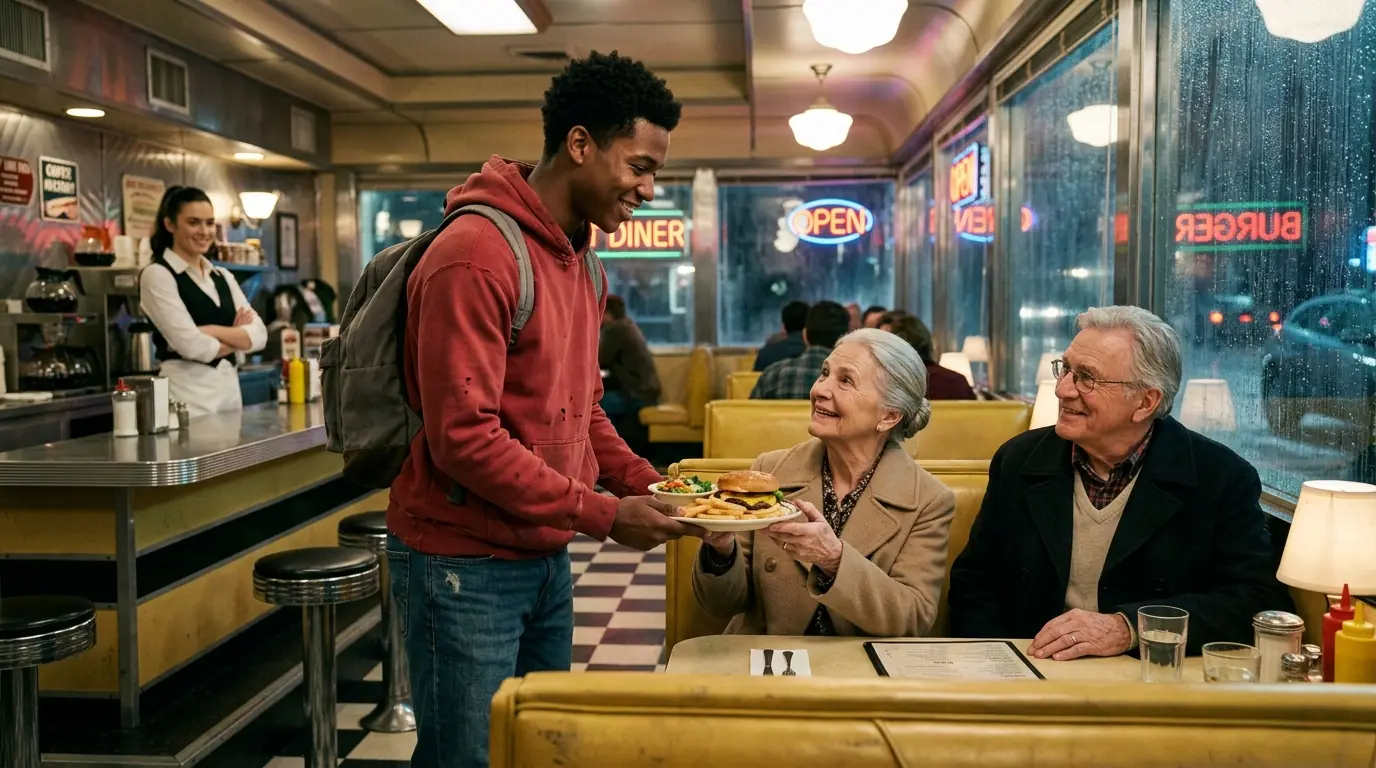
Before he could take his first bite, the door opened with a rush of wind and rain. An elderly couple stepped in. A man in a tan overcoat, a woman clutching a small purse. Their clothes were soaked, and the man’s gray hair was plastered to his forehead.
Sophia hurried over with towels.
“Evening, folks. Rough night out there.”
“We seem to have lost our wallet,” the man said, embarrassed. “We were driving home and stopped here for coffee. I must have dropped it somewhere between the car and the road.”
Sophia looked uncertain. “Oh dear. Well, sit down and warm up anyway.”
They took the corner booth, table six, near the window. The woman rubbed her hands together, shivering.
Malik watched them quietly. He’d seen people struggle before, but something about the old man’s voice, tired yet polite, made him hesitate. His own meal sat untouched.
He thought of Miss Chenise telling him once, “If kindness costs you nothing, give it quick. If it costs you something, give it slower, but give it anyway.”
Before he could overthink it, Malik stood, lifted his tray, and walked over.
“Excuse me, sir, ma’am,” he said softly. “You can have this if you want. It’s fresh.”
They both looked up, surprised.
“Oh, no, son,” the woman said. “We couldn’t.”
He set the tray down anyway. “Please. My grandma says, ‘Kindness is the only thing that multiplies when you give it.’”
The old man studied him a moment, eyes the color of steel under the diner lights. Then he nodded slowly.
“That’s mighty generous of you.”
“It’s just a burger,” Malik said with a small smile. “And I can make another paycheck tomorrow.”
They thanked him quietly, almost shyly. Sophia watched from behind the counter, wiping her eyes with a napkin.
The rain kept drumming against the glass as the couple ate. When they finished, the man took a pen from his coat pocket and wrote something on a napkin. He folded it carefully and handed it to Malik.
“Just in case,” he said. “Name’s Harold. This is Margaret. You’ve done more than you know.”
Malik nodded, unsure what to say. “Hope your night gets better.”
They left soon after, stepping back into the rain. Through the window, he saw a tow truck pull up beside a silver Mercedes a few blocks down. The driver, Pete Harland, jumped the engine while the man, Harold, stood beside him.
A moment later, Malik saw Harold pull a wallet from his pocket and pay Pete cash. Then the car drove off into the wet night.
Malik blinked, confusion cutting through the warmth he’d felt moments earlier. He looked down at the empty plate, then at Sophia.
“Did you see that?” he asked quietly.
She nodded, frowning. “Looked like that man found his wallet awful quick.”
He sat back in the booth, the sound of rain suddenly louder. “Guess I’m easy to fool.”
Sophia reached over and touched his arm. “Or maybe you’re one of the few left who’d give something just because it’s right. Don’t let that feel like losing.”
He didn’t answer. He just watched the neon light flicker red across the puddles outside.
The walk home felt longer than usual. The wind had cooled, and every step splashed through shallow water. He kept thinking about the man’s sharp eyes, the careful way he’d folded that napkin.
By the time he reached Elm Street, his clothes were soaked through. He slipped quietly into the apartment so he wouldn’t wake Miss Chenise, but she stirred anyway.
“You smell like rain,” she murmured half asleep.
He chuckled softly. “Guess it tried to wash me away.”
She opened her eyes a little. “You eat tonight?”
He hesitated. “Not really.”
“Why not?”
He looked down at his shoes. “Gave my food to some folks who lost their wallet.”
Miss Chenise smiled faintly. “Then you ate something better than food, baby.”
He knelt beside her chair, resting his head on her knee. The oxygen tank hissed beside them, steady as breathing. For a moment, he felt small again, like the boy she used to rock after thunderstorms.
“I don’t know if it mattered,” he said quietly.
“It always matters,” she whispered, “even when it don’t show right away.”
He stayed there till her breathing grew slow again. Then he rose, went to his room, and took the napkin from his pocket. The handwriting was neat, expensive ink pressed into cheap paper.
A name and address: Harold Whitmore, Whitmore Foundation.
He frowned, tucking it into his Bible on the nightstand before turning out the light.
Outside, the rain eased. Somewhere, a dog barked. He thought of the empty plate at Murphy’s Diner and the strange couple’s car disappearing into the dark. Doubt pressed against him, but so did a quiet pride he couldn’t quite explain.
Maybe Grandma’s right, he thought as sleep pulled him under. Maybe kindness finds its own way back.
He didn’t know that far away, in a tall building downtown, two people were already talking about him, about a boy who gave up his only meal on a rainy night. He didn’t know that the napkin now rested on a mahogany desk beside a single note that read, “Candidate identified.” And he couldn’t have guessed how that small, inconvenient act of goodness would change everything he knew about the world and about himself.
The rain stopped before dawn. The city glistened under street lamps, clean and waiting.
The next morning, dawn washed clean. Sunlight caught the puddles in the cracked sidewalks, and the air smelled faintly of wet pavement and coffee drifting from Murphy’s Diner. Malik woke early, the image of the napkin still in his mind. For a while, he lay staring at the ceiling fan, listening to the distant rumble of city buses starting their routes.
The thought of the night before pressed against him like a half-remembered dream. Down the hall, Miss Chenise was humming an old hymn while making oatmeal. The smell of cinnamon filled the apartment.
Malik rose, dressed quietly, and joined her at the table. She looked better that morning, a small color back in her cheeks.
“Morning, baby,” she said, smiling. “Rain done cooled the world off.”
“Yes, ma’am,” he said. He poured milk into two chipped bowls. “I think the diner roof leaked again.”
She laughed softly. “It’s been leaking since before you were born. Some things just hold on.”
They ate in silence for a bit, the television murmuring in the corner about a new community project being discussed downtown. Miss Chenise stirred her oatmeal thoughtfully.
“You ever think about college?” she asked.
He nodded, not meeting her eyes. “All the time.”
“Then you go. Don’t let money scare you off.”
He hesitated. “It’s not just the money, Grandma. It’s leaving you alone.”
“I’ve been alone before,” she said gently. “But if kindness is what you got, you use it. Don’t bury it just to stay near me.”
He didn’t answer. Instead, he thought about the name on the napkin, Harold Whitmore, and wondered again who that man really was.
After school, he stopped by the diner to pick up an extra shift. The manager was out back smoking when Malik asked.
“Sure thing, kid,” the man said. “Friday night. If you can handle the late hours, I can handle it.”
Sophia winked from the counter. “You always can.”
The evening passed quietly. Malik washed, wiped, stacked, and carried, his hands moving by memory, but his mind kept circling the same question.
Why had the couple lied? What kind of people pretended to lose a wallet just to test someone? The more he thought about it, the smaller his act of kindness seemed. Maybe they’d only wanted a story to tell their friends.
He caught himself scowling at the sink.
“You look like you’re fighting ghosts,” Sophia said, sliding a tray past him.
He shrugged. “Just thinking.”
“Well, stop. Thinking too much never washed a plate.”
He laughed a little, and she smiled back. Still, that uneasy feeling stayed with him through closing time.
When the rain started again, he walked home under the soft hiss of falling water. He didn’t notice the dark sedan parked halfway down Elm Street with its lights off, nor the man sitting inside taking notes.
Two days later, Saturday morning, Malik was sweeping the front steps when the mailman handed him a thick envelope. It was heavier than usual, cream-colored with embossed letters: Whitmore Foundation.
His stomach flipped. He tore it open carefully, afraid it might disappear if he breathed too hard. Inside was a short letter printed on fine paper.
“Dear Mr. Brown, we would like to speak with you regarding an opportunity related to community leadership and education. Please visit our office Monday at 10:00 a.m., 215 Broad Street. Transportation costs will be reimbursed. Sincerely, Margaret and Harold Whitmore.”
He read it twice, then a third time.
Miss Chenise looked up from her chair. “Something wrong, baby?”
He handed her the letter. She squinted through her reading glasses, then gave a soft whistle.
“Sounds mighty official.”
“I don’t even know what it means,” he said.
“Then you go and find out.”
“But what if it’s a mistake?”
She smiled. “If it is, at least it’ll be a fancy mistake.”
He laughed, tension easing a little. Still, he folded the letter carefully, tucked it into his school notebook, and spent the rest of the weekend half wondering, half dreading what waited downtown.
Monday came bright and cold. Malik borrowed one of Miss Chenise’s old bus tokens from a jar she kept for emergencies and rode into the city. Broad Street shimmered with early sunlight on glass buildings. The Whitmore Foundation’s offices stood tall and quiet, with marble steps and brass handles polished to a shine.
Inside, the air smelled of lemon polish and paper. A receptionist greeted him kindly.
“Mr. Brown, they’re expecting you.”
He followed her down a hallway lined with photographs: community centers, children reading, volunteers planting gardens. At the end, double doors opened to a wide office where Harold and Margaret sat behind a desk the color of honeyed wood.
“Malik,” Harold said, rising with a firm handshake. “Thank you for coming.”
The boy nodded, unsure whether to sit until Margaret motioned gently. She poured tea into small cups.
“We owe you an explanation,” she said.
He looked from one to the other. “You mean about the diner?”
“Yes,” Harold said, his tone steady but warm. “We staged that evening.”
“It was a test, though I dislike that word. We wanted to see what someone would do when kindness wasn’t convenient.”
Malik blinked. “So the whole thing, losing your wallet, the car trouble, all of it?”
“Arranged,” Harold said. “We’ve been reviewing candidates for a program that helps young people with strong community values. You were recommended by your school principal.”
“My principal?” he said, surprised.
“She spoke highly of you,” Margaret said. “Said you tutor children at the library after class, help your grandmother, work nights, and still keep perfect grades.”
Malik felt heat rise to his face. “I just try to do what’s right.”
“That’s exactly what we look for,” Harold said. “People who act from the heart, not for recognition.”
He didn’t know what to say. The tea sat untouched in front of him, steam curling upward.
“We’d like to invest in your future,” Harold continued. “A full scholarship to any university you choose. Tuition, books, housing, everything covered. You’ll also intern with our foundation during the summers.”
Malik stared. “That can’t be real.”
“It’s very real,” Margaret said softly. “And one day, when you finish college, we hope you’ll lead one of our community projects.”
He sat back, stunned. The air seemed suddenly lighter, too thin to breathe.
“But why me?”
Harold smiled faintly. “Because when we created a small moment of hardship, you answered it with generosity. You gave away something precious, not knowing anyone was watching. That tells us everything.”
He lowered his gaze. “I didn’t do it for a reward.”
“That’s the point,” Harold said. “Which is why you deserve one.”
For a long moment, no one spoke. Outside, sunlight poured through the tall windows onto the polished floor.
Malik finally looked up. “If I take this, I’d want to use it for something that helps people like my grandma. Folks who don’t have much.”
“That’s exactly the spirit we hope to find,” Margaret said. “There’s a property near Riverside Mall, an old shopping center we plan to rebuild as a community resource. You’ll learn every part of that process with us.”
He nodded slowly, still half disbelieving. “I don’t know what to say.”
“Say yes,” Harold said simply.
He smiled then, small but real. “Yes.”
That night, he told Miss Chenise everything. She listened without interrupting, eyes wide behind her glasses.
“They said they’re giving you all that?” she asked finally.
“Yes, ma’am. College, internship, even a job after.”
She leaned back, hand over her heart. “Lord, I knew that napkin meant something.”
He laughed. “You think I should take it?”
“I think God’s already answered that,” she said. “You just follow through.”
For the first time in months, she looked younger, her eyes bright. Malik felt a swelling in his chest, relief, excitement, and gratitude tangled together. He sat beside her, and they prayed quietly, her frail hand clasping his.
Weeks turned into months. Between schoolwork and foundation meetings, Malik barely found time to rest. The Whitmores invited him to community dinners and planning sessions. He learned about budgets, blueprints, and how to speak with city officials. Each evening, he’d return to Elm Street, exhausted but glowing with purpose.
Sometimes he thought back to the night at Murphy’s Diner and marveled at how that single decision had opened a door wider than he’d ever imagined. Yet doubt never left entirely. Could he live up to what they saw in him?
One afternoon, Harold took him to the Riverside Mall site. The place was huge and silent, weeds pushing through cracked asphalt. Wind whistled through broken windows.
“This is where your community center will stand,” Harold said. “A clinic, classrooms, job training, all under one roof.”
Malik looked around at the emptiness. “It’s hard to picture it.”
“That’s why we have architects,” Harold chuckled. “But we need heart, too. That’s your part.”
They walked through puddles reflecting the cloudy sky. Malik bent to pick up a small piece of glass shaped like a diamond.
“Feels strange,” he said quietly, “thinking this could all belong to people who never had a place before.”
Harold nodded. “Every good thing begins as an idea, but it grows only if someone believes in it.”
Later, in the car ride back, Malik stared out the window at passing houses.
“Mr. Whitmore?”
“Yes?”
“Why did you and your wife start doing this? Helping people?”
Harold thought for a moment. “Because once someone helped me when I didn’t deserve it, and it changed everything.”
Malik watched his reflection in the glass. Maybe that’s all kindness is, he thought, a debt we keep paying forward.
Spring came early that year. The community buzzed about the new project. Local papers ran stories with his picture beside the Whitmores. Neighbors congratulated him at the diner. Sophia called him “our hometown hero.” He felt proud but uneasy with the attention.
One Friday evening, a boy from school named Travis cornered him outside the bus stop.
“So, they just hand you a scholarship for giving away a burger?” Travis said, sneering. “Must be nice.”
“It wasn’t about that,” Malik said quietly.
“Yeah, sure. Some of us bust our tails every day, and nobody’s throwing money at us.”
He walked away, shaking his head, and Malik stood there stung. The words followed him home like shadows.
That night, he told Miss Chenise.
“People always going to talk,” she said, stroking his arm. “Don’t let envy steal your joy. You just keep doing right.”
He nodded, but it still hurt. He lay awake later, staring at the ceiling, wondering if the Whitmores had made a mistake choosing him. He wasn’t special. He was just a kid who’d been hungry and tried to help.
A month later, Miss Chenise’s health took a dip. Her arthritis flared, and the oxygen tank seemed to hiss louder. Malik spent more time at home helping with her medicine, cooking simple meals. The foundation offered to send a nurse, but Miss Chenise refused.
“I got my boy,” she said.
Harold visited once, bringing flowers.
“You’re the heart of this project, ma’am,” he told her kindly. “We’re building it for folks like you.”
She smiled, thin but proud. “Then make sure my grandson keeps his feet on the ground.”
After he left, she looked at Malik.
“He’s a good man. But remember, kindness is only real when it keeps going. Don’t let it stop with a name on a building.”
He promised he wouldn’t.
One humid evening in May, Malik sat in the diner again, papers spread across the counter, design plans, class notes, and a half-empty coffee cup.
Sophia watched him scribbling. “You sure you’re still 17? You work like a grown man.”
He grinned. “Trying to make up for lost time.”
The bell above the door jingled, and a young mother stepped in, carrying a crying toddler. She looked exhausted, clothes damp from the rain. Sophia started to seat her, but Malik rose.
“Let me get this one,” he said softly.
He guided them to a booth, brought over a napkin for the child’s face, and ordered a bowl of soup on his own tab. The woman tried to protest, but he shook his head.
“Just warm up, okay?”
When she finally smiled, something settled in his chest, a calm, familiar warmth. It reminded him why he’d started all this in the first place.
As he walked back to his seat, Sophia gave him a look, both teasing and tender.
“Still giving away food, huh?”
He chuckled. “Guess it’s a habit.”
That night, walking home, he realized that kindness no longer felt like sacrifice. It felt like breathing, something natural, steady, necessary.
Summer arrived. The groundbreaking ceremony for the Riverside Center drew hundreds of people. Reporters took photos of Malik in a hard hat, shovel in hand beside the Whitmores. When the crowd dispersed, he stayed behind a while, staring at the empty lot, now filled with the scent of freshly turned soil.
Margaret joined him.
“You look thoughtful.”
“I was just remembering how this all started,” he said.
“With a hamburger,” she said with a soft laugh.
He smiled. “Seems small now.”
“Never small,” she corrected. “The smallest things carry the largest ripples.”
He glanced toward the horizon, where the sun burned orange through thin clouds.
“I want to make sure it stays honest,” he said quietly. “That this center really helps people.”
She touched his arm gently. “If your heart’s in it, it will.”
Late that night, back home, Miss Chenise sat by the window, watching fireflies blink in the yard. Malik knelt beside her chair, resting his head on her lap.
“They started building today,” he said.
“I saw on the news,” she whispered. “Looked like my boy was digging to plant hope.”
He chuckled softly. “Something like that.”
She stroked his hair, her fingers thin and cool. “Don’t forget what I told you. Every act of kindness is a seed. Some sprout quick, some take years, but they all grow if you keep tending them.”
“I won’t forget,” he said.
For a while, they sat in silence, the sound of crickets thick in the night. Then Miss Chenise whispered, “You proud of yourself yet?”
He thought about it, then smiled faintly. “Getting there.”
Toward the end of summer, Malik received his university acceptance letter. Full scholarship confirmed. Classes to start in the fall.
The Whitmores insisted he choose whatever major spoke to him.
“I think I’ll study community development,” he told them. “I want to understand how to build things that last.”
Harold nodded approvingly. “Then you’ll fit right in.”
The next weeks moved like a dream. Between packing for college and overseeing the early stages of construction, Malik barely noticed how fast time ran. Only once did he feel the old ache again, when Miss Chenise’s health faltered badly one humid afternoon.
He rushed home from a meeting to find her breathing shallow.
“Grandma, don’t talk,” he said, frightened.
She smiled faintly. “I just wanted to tell you something.”
“What is it?”
Her voice was thin. “Kindness doesn’t end with you. Promise me you’ll teach it.”
“I promise,” he whispered.
She squeezed his hand, then drifted into sleep, the oxygen tank hissing softly beside them. He sat there till dawn, watching her chest rise and fall, the city waking beyond the window.
When the first walls of the community center rose, Malik stood among the workers in a hard hat, the smell of fresh concrete in the air. He could almost see the future inside those bare frames: children playing, people learning computer skills, a clinic where his grandmother could have been treated close to home.
The thought filled him with a quiet pride that steadied his heart.
That evening, Harold clapped a hand on his shoulder.
“You’ve come far, son. But remember, leadership isn’t about being seen. It’s about seeing others.”
Malik nodded. “I understand.”
He looked out over the site one last time before heading home, the setting sun painting the half-built walls in gold. For a moment, he imagined Miss Chenise standing there smiling. Her soft, proud smile. And he knew that every mile walked in the rain, every plate washed, every small choice to care had led him right here.
That night before bed, he opened his Bible to the place where he’d once hidden the napkin. The ink had faded slightly, but the name was still clear. He ran his finger across it and whispered, “Thank you.”
Then he added another folded paper beside it, a note written in his own hand.
“When kindness finds you, let it grow.”
Outside, the city hummed low and steady, a sound like breathing. He turned off the lamp and lay back, listening. Tomorrow there would be more work, more study, more decisions. But for now, the world felt balanced, like rain finally easing after a long storm.
He closed his eyes, unaware that this was only the middle of the journey, not the end. Trials would come again, sharper and deeper, testing not his hands, but his heart. Yet for tonight, he rested easy, knowing that kindness, his grandmother’s lesson, his own small gift, had carried him this far.
Autumn came early that year. The air in Roosevelt City turned crisp, and the trees that lined Elm Street shed their first yellow leaves onto the cracked sidewalks. Malik Brown walked to the bus stop one bright morning with a backpack over his shoulder and the weight of a new life inside it.
College, something he’d once thought belonged to other people, the ones with cars and quiet homes and time to dream.
The bus rattled through downtown past the rising frame of the community center. From the window, he could see beams of fresh steel reaching toward the sky, workers in orange vests moving like ants below. He pressed his forehead to the glass, smiling.
The sign hanging on the fence already read, “Riverside Community Resource Center, funded by the Whitmore Foundation.”
Someday, his own name would join those words, though the thought still felt unreal.
At the university, he kept mostly to himself. His dorm room smelled of new paint and soap. His roommate was friendly but loud. Classes filled his days: sociology, public administration, community planning. In the evenings, he worked part-time at the foundation office downtown, helping with outreach events.
It was a good life, but a busy one. The rhythm left little time for home, and that began to worry him. Miss Chenise’s calls grew shorter. Sometimes, when he phoned after class, she’d answer with a thin, tired voice and say, “I’m fine, baby. You just study hard.”
But her breath sounded shallower than before.
He told himself she was just resting. More than that, the nurse Harold had arranged to check on her every few days would call if anything was wrong. Still, the worry sat under his ribs like a stone.
One evening after midterms, he rode the late bus back to Elm Street. The air was sharp, the sky bruised purple. Inside the apartment, the light from the kitchen fell across the living room floor where Miss Chenise sat reading her Bible. When she looked up, he saw how much thinner she’d become.
“You look good, Grandma,” he said softly, kneeling to hug her. “You’ve been eating?”
“I eat what I can.” She smiled faintly. “You look tired, boy. College doing its job?”
“Trying to.”
He pulled up a chair. “They’re teaching me how cities work, how to build things that help people.”
“Good,” she said, closing her book. “But don’t let all them big ideas chase out the small ones. The small kindnesses, they’re the glue.”
He nodded, but his throat felt tight. She noticed.
“Something on your mind?” she asked.
He hesitated. “Sometimes I think about the diner that night. How simple it was. One small thing, and somehow it started all this.”
“That’s how life works,” she said. “One little door opens another. You never know who’s watching or why.”
He sat quiet, the hum of the oxygen tank filling the pause.
Who’s watching? he thought.
The Whitmores still checked in often, kind but formal. Yet sometimes he wondered what they really saw in him. Was he still the boy from Murphy’s Diner, or already becoming something else?
December came with its first snow. The community center skeleton turned white under it, and Malik joined the workers during winter break, helping to shovel and haul materials. His breath smoked in the cold air, his gloves stiff with frost.
At night, he’d sit with Harold in a small trailer on site, sipping hot coffee while they reviewed progress charts pinned to the wall.
“You ever get homesick?” Harold asked one night.
“Every day,” Malik admitted. “But Grandma says I’m right where I need to be.”
“She’s a wise woman.”
He nodded, staring at the blueprint under the lamp. “Sometimes I worry I won’t live up to what you expect.”
Harold looked at him carefully. “What we expect is that you stay true to yourself. The rest will follow.”
They worked in silence a while. Outside, wind rattled the trailer windows. Malik thought about that answer long after he’d gone home.
January brought bad news. Miss Chenise caught a winter infection that turned quickly to pneumonia. The nurse called while he was in class. He was on the first bus back to the city, heart hammering.
At the hospital, the smell of disinfectant and coffee hit him like a wall. He found her in a narrow room by the window, tubes running from her nose, the oxygen machine whispering beside the bed.
Her eyes opened when he touched her hand.
“There’s my boy,” she whispered.
He tried to smile. “You scared me.”
“I’m fine,” she said, though her voice trembled. “Just tired.”
The doctor explained quietly that she’d need rest and close care. The center’s clinic wouldn’t open for months. He felt a flash of helpless irony at that. Here he was helping build a place meant to heal others, and he couldn’t yet help the one person who mattered most.
That night, he sat by her bed long after visiting hours. Snowflakes drifted outside the window like slow-falling feathers. Miss Chenise slept, her breath shallow but steady.
Malik whispered, “You got me this far, Grandma. I’m not done yet.”
In his mind, he saw flashes: the diner lights, the rain, the plate of food sliding across the table. Every good thing seemed to trace back to that one act, but he also remembered the sharp sting of doubt afterward and how he’d almost regretted it.
The memory made him shiver.
What if I’d walked away? he thought. None of this would exist.
A nurse touched his shoulder gently. “She’s resting easy,” she said. “You should, too.”
He nodded, but didn’t move for a long time.
Weeks passed in a blur of hospital visits and classes. Harold called often, offering help.
“Whatever you need, son,” he said.
But Malik refused extra money. He wanted to stand on his own. The Whitmores sent flowers and arranged home care when Miss Chenise returned to the apartment. For a while, she improved, and he allowed himself to hope.
One Saturday afternoon in early March, she asked him to take her outside. The sun had finally broken through after weeks of gray. He wheeled her down the block, where the first buds were showing on the trees. Children played stickball in the street, their laughter ringing through the neighborhood.
She watched them with shining eyes.
“You see that, baby?” she said. “That’s why you do what you do.”
He smiled. “Yeah.”
They sat a long while in the weak sunlight, just listening. A breeze carried the smell of fried food from Murphy’s Diner. It made them both laugh.
“Funny how life circles back,” she said. “Maybe it’s trying to remind us something.”
She reached for his hand. “It always does.”
That night, she grew tired early. He helped her to bed, checked the oxygen tank, and sat beside her until she drifted off.
Her last words before sleep were, “Keep that light shining, baby.”
He whispered, “I will.”
Three days later, she was gone. Quietly, in her sleep, the nurse found her still holding her rosary, a faint smile on her lips.
Malik felt the world narrow to silence. He arranged the small funeral with the foundation’s help. The church filled with neighbors, students, and even the Whitmores, who sat near the back out of respect. Sophia from the diner brought a basket of flowers.
When it was over, Harold placed a gentle hand on Malik’s shoulder.
“She’d be proud,” he said.
But Malik only nodded, unable to speak. Pride wasn’t what he felt, just an empty ache.
That night, alone in the apartment, he walked through the quiet rooms, touching the things she’d loved: her quilt, her Bible, the old photo of his grandfather in his army uniform. The oxygen tank sat silent in the corner, useless now. He sat on the floor beside it until dawn.
When he finally stood, he noticed her Bible open on the table. Inside was a folded note in her handwriting.
“Baby, when I’m gone, don’t look for me in the house. Look in the faces you help. That’s where I’ll be.”
He pressed the note to his heart and wept.
The weeks that followed were gray. Classes blurred. The construction site buzzed without him for a while, but Harold eventually coaxed him back.
“Work heals,” he said gently.
So Malik returned, quieter than before, but steady. He spent long hours walking the corridors of the half-built center, touching the unfinished walls. Sometimes, he’d imagine his grandmother sitting in one of the future clinic rooms, smiling the way she used to when something made sense.
One afternoon, standing in what would soon be the main lobby, he heard Harold’s voice behind him.
“You’ve been carrying a lot, son.”
“I’m fine,” Malik said automatically.
“No,” Harold said, stepping closer. “You’re surviving. That’s not the same.”
Malik stared at the dusty floor. “I keep thinking she should have lived to see this. She believed in it more than anyone.”
“She does see it,” Harold said. “Every time you lift a hammer, she’s right here.”
The words broke something inside him. He looked up, eyes wet.
“You ever lose somebody like that?”
Harold nodded slowly. “My son. Many years ago. He was about your age. I learned the only way to honor someone gone is to keep their love moving forward.”
For a moment, they stood in silence, dust motes drifting through sunlight between them.
“Then that’s what I’ll do,” Malik said quietly.
Harold smiled, placing a hand on his shoulder. “That’s all any of us can do.”
By summer, the building neared completion. The first coat of paint went up, soft cream with blue trim, and Malik felt something inside him lift. He spent hours with the design team, choosing furniture, planning the computer lab, setting up the clinic schedule.
Each decision felt like a conversation with his grandmother’s memory.
Would this help someone like you, Grandma?
In July, the Whitmores invited him to their home for dinner. The house sat on a hill overlooking the river, its wide porch strung with yellow lights. Margaret served roast chicken and green beans.
Halfway through the meal, she said, “We have something for you.”
Harold handed him a small envelope. Inside was a contract, official letterhead, embossed seal.
“This confirms your appointment as assistant director when the center opens,” Harold said. “You’ll oversee daily operations while finishing your degree.”
Malik looked up, stunned. “I’m not sure I’m ready.”
“You’re readier than you think,” Margaret said.
He felt a rush of gratitude and fear. “I’ll try not to let you down.”
Harold smiled. “Just keep doing what got you here. That’ll be enough.”
That night, he couldn’t sleep. Back in his dorm, he sat by the window, watching lights shimmer on the river. His grandmother’s note lay folded in his wallet. He read it again slowly.
“Look in the faces you help,” he whispered to the empty room. “I hope I’m doing this right.”
The next morning, he skipped class and took the early bus to the almost-finished center. Workers greeted him with smiles. He’d made a point to learn every name.
In the clinic area, he met a woman named Rosa who was cleaning windows. She spoke little English, so he helped her translate the safety instructions. She thanked him shyly. As she left, her eyes looked tired but hopeful. He caught himself thinking she could be one of the first patients here someday.
And just like that, the ache in his chest eased.
August heat settled heavy over the city. On the final inspection day, Malik walked through the quiet building alone. The room smelled of new paint and sawdust. He stopped in the main hall, where sunlight streamed through wide glass panels onto the polished floor.
For a long moment, he stood there listening to the hum of air conditioners, feeling the weight of silence. He remembered the diner, the rain, the burger cooling on the plate. He remembered the doubt, the grief, and the people who had lifted him along the way.
A realization unfolded inside him, slow but certain. Kindness had never been about reward or recognition. It was about connection. An invisible thread running from one heart to another, tying strangers together across time.
He closed his eyes and whispered, “Thank you, Grandma.”
A tear slid down his cheek, but it felt light, almost joyful.
Just then, Harold stepped in behind him.
“Everything ready for tomorrow?” he asked.
Malik nodded. “Almost. Just needed a minute alone.”
“I understand,” Harold said softly. “Tomorrow, the world sees what one small act can grow into.”
Malik turned, smiling through the tears. “It’s not mine alone. It’s everyone’s.”
Harold looked proud. “That’s the right answer.”
That evening, walking home, Malik passed Murphy’s Diner. The neon sign still flickered, same as years ago. Through the window, he saw Sophia serving coffee to a few regulars. He pushed open the door, the bell chiming its familiar note.
“Well, look what the wind blew in,” Sophia exclaimed. “If it ain’t Mr. Bigshot.”
He laughed. “Just stopping by to say thank you for everything.”
She poured him a cup of coffee on the house.
“You nervous about tomorrow?”
“A little,” he admitted. “Feels like Grandma should be there.”
Sophia smiled gently. “She will be. You’ll feel it.”
He looked around the old diner, the same booths, the same hum of the fridge, and thought of the boy he’d been, hungry and hopeful. It felt like a different lifetime. Yet the warmth of that place still wrapped around him like an old quilt.
When he left, the sky was full of stars. He paused on the sidewalk, looking back once more. The window reflected the streetlight, bright and steady like a signal from the past. He whispered, “Thank you,” and walked on.
The next morning dawned clear. Banners fluttered across the entrance of the new Malik Brown Community Center. A small crowd gathered: neighbors, teachers, workers, families. Reporters set up cameras.
Malik stood beside Harold and Margaret, heart pounding as he looked at the faces: old, young, Black, white, brown. He felt his grandmother everywhere, in their eyes, in their smiles.
When the mayor handed him the scissors for the ribbon cutting, his hands trembled slightly. He took a breath, thinking of Miss Chenise’s words.
“Keep that light shining.”
Then he cut the ribbon, and cheers rose into the blue morning air.
Inside, children ran laughing through the halls. An elderly man tested a new blood pressure machine in the clinic. Volunteers served sandwiches in the cafeteria. The building pulsed with life.
Harold clasped his hand. “You did it!”
Malik shook his head. “We did it.”
He turned toward the sunlight streaming through the high windows, feeling both joy and peace. Somewhere within that light, he imagined his grandmother smiling, whispering, “See, it always matters.”
As the celebration swelled around him, he stepped aside for a moment, letting the sound wash over him. Outside, the city buses rumbled past, carrying people to work, to home, to whatever waited next. Life kept moving, ordinary and miraculous at once.
He closed his eyes and breathed deeply. The air smelled of new beginnings: paint, coffee, laughter, and something softer he couldn’t name. Maybe it was hope.
For the first time since she’d passed, he felt truly at peace. Not because the pain was gone, but because he finally understood what she’d meant.
Kindness wasn’t a single act or a finished building. It was motion, a circle that kept widening long after the hands that started it were gone.
He opened his eyes and smiled. Tomorrow there would be problems to solve, budgets to balance, people to help. But tonight, he allowed himself to rest in the glow of what kindness had built.
The first year after the grand opening passed in a blur of work. The Riverside Community Center filled each day with motion, voices in the halls, the buzz of computers in the learning lab, the scent of soup simmering in the cafeteria.
Malik Brown arrived every morning before sunrise, unlocking the doors while the city was still stretching awake. He would stand for a moment under the entry sign that bore his name, feeling both pride and humility mix inside his chest.
“Morning, Mr. Brown,” the janitor called each day, tipping his cap.
“Morning, Earl,” Malik always replied, smiling as if to remind himself that ordinary greetings were the foundation of everything he’d built.
Inside, the building had found its rhythm. Children crowded the after-school room for homework help. Young mothers learned computer skills in the lab, and old men gathered in the clinic waiting area, swapping stories while the nurse checked their blood pressure. The place breathed like a living thing.
Some nights, when the last lights dimmed and the echo of laughter faded, Malik would walk the corridors alone, tracing his fingers along the smooth walls. He thought of Miss Chenise and whispered, “We did it, Grandma.”
In those moments, he could almost hear her humming one of her hymns in reply.
By late spring, the center had become the heart of the neighborhood. Crime dropped, new shops opened nearby, and the once-empty parking lot filled each weekend with families attending small festivals or community movie nights.
The local paper called it the Malik Effect. The headline embarrassed him, but he clipped it anyway and tucked it into his grandmother’s Bible. He tried not to let praise make him careless.
Harold still visited every few weeks, walking the grounds with his cane and gentle eyes.
“How’s the ship holding?” he’d ask.
Malik would grin. “Still afloat, sir.”
One afternoon, they sat together in the shaded courtyard where a fountain whispered softly. Children were chasing each other through the spray. Harold’s voice carried the raspy edge of age.
“You’ve done more here in two years than most men do in twenty. How does it feel?”
Malik watched the children, their laughter rising like birds.
“Good,” he said slowly. “But I keep thinking there’s more. More people out there who need this.”
Harold nodded. “There always will be. The world’s hunger for kindness never ends.”
“Then maybe that’s my job,” Malik said quietly. “To keep feeding it.”
Harold smiled. “That’s exactly your job.”
At home, the apartment on Elm Street felt different without Miss Chenise. But he kept it neat, her chair still by the window. On quiet nights, he’d sit there reading her old Bible, the note in her handwriting pressed between the pages.
Look in the faces you help.
It had become his compass.
Sometimes, when loneliness crept in, he walked to Murphy’s Diner. The place hadn’t changed. The neon still flickered. Sophia still poured coffee with the same easy kindness. She’d tease him that he worked too hard and insisted he eat for free for old time’s sake. He always left extra tips hidden under the sugar jar.
One rainy night, he arrived to find the diner half empty. A young couple sat in the corner booth, their clothes damp, the woman rocking a baby wrapped in a thin blanket. They looked nervous, whispering to each other.
When Sophia brought their check, the man patted his pockets and turned pale.
“I’m so sorry,” he said. “I must have left my wallet in the car.”
Sophia gave him a worried look, remembering another night long ago. She turned her eyes toward Malik at the counter.
He didn’t hesitate. He rose, walked over, and smiled gently.
“Don’t worry about it,” he said. “Dinner’s covered.”
The couple looked startled.
“We can pay you back,” the man said quickly.
“No need,” Malik replied. “Just pass it on someday.”
The woman’s eyes filled with tears. “Thank you, sir.”
As they left, Sophia came over, hands on her hips, pretending to scold him.
“You’ll go broke saving the world.”
He laughed. “Seems to be working out so far.”
But when the door closed behind the couple, he sat quietly for a moment, letting the feeling settle inside him. The same calm warmth he’d felt years ago when he’d given up his own meal. Only now, it carried no doubt, only certainty.
Kindness had circled back again, alive and well.
The next morning, the sun poured gold across the center’s front lawn. Malik unlocked the doors and stepped into the cool, air-conditioned lobby. He found a note waiting on his desk, Harold’s handwriting shaky but firm.
“Margaret’s health is failing. We’ve moved to our lake house for peace. Come visit when you can. H.”
He sat down, staring at the words. The Whitmores were in their 80s now. He had known this day would come.
That evening, he drove two hours north to the lake. The road curved through green hills, and by sunset, he reached their small cottage overlooking the still water. Margaret lay in a chair by the window, a blanket over her knees. Harold stood beside her, smiling as Malik entered.
“Look who’s here, love,” Harold said softly.
Margaret’s eyes opened, clear and gentle.
“My goodness, Malik. You grew into yourself.”
He knelt beside her. “You gave me the chance.”
“No,” she whispered. “You gave it meaning.”
They talked for hours about the center, about the children, about Miss Chenise. When dusk fell, Margaret reached for his hand.
“Promise you’ll keep the work alive,” she said. “Not the buildings, the work.”
“I promise,” he said, voice low.
She smiled, eyes glistening. “Then we can rest easy.”
A week later, Harold called to tell him she’d passed peacefully in her sleep. Malik attended the small funeral by the lake, standing with Harold beneath a sky washed pale with spring light.
As they watched the minister lower a small urn of ashes, Harold whispered, “Kindness was her language. Thank you for learning to speak it.”
Malik placed a single white lily beside the urn and nodded, unable to speak.
Months slipped by. Harold spent less time at the foundation, leaving more decisions in Malik’s hands. There were new grants to manage, new programs to open. He traveled to other cities, advising small nonprofits on how to build community centers of their own.
Each trip brought him in contact with people who reminded him of the ones he’d grown up among: workers, mothers, students, elders trying to find hope.
At one ribbon cutting in a neighboring town, an elderly man shook his hand and said, “You’re the kindness fellow, right? We read about you.”
Malik laughed. “I’m just one man trying to keep good things going.”
“Keep it up, son,” the man said. “World needs that.”
Driving home that night under a sky thick with stars, he thought of how his grandmother used to point at the heavens and say, “Each one of those lights is somebody doing good somewhere.”
He smiled to himself. The road ahead still stretched long, but the light was everywhere.
Two years later, Harold Whitmore passed quietly at 91. The foundation board gathered in the same marble office where Malik had first met him as a scared 17-year-old boy. They voted unanimously to appoint Malik as executive director.
The announcement made local news again, but he barely read the headlines. Instead, he walked alone that evening along the river, thinking of the Whitmores and Miss Chenise, three lights now beyond reach but still guiding him.
He stopped at the bridge, leaning on the railing as the city glowed around him. The wind off the water was cool and smelled faintly of rain.
“I’ll keep it going,” he whispered. “I swear I will.”
Under his leadership, the foundation expanded. New centers opened in nearby towns, each modeled after Riverside. They offered clinics, libraries, and job training programs for people who’d never had such chances before. Malik insisted that each one be staffed with locals, people who understood their neighbors. He visited every site, shaking hands, remembering names, listening more than he spoke.
One afternoon, during an opening ceremony at a new center in Harpertown, a teenage boy approached him shyly.
“Mr. Brown,” he said. “My grandma told me you used to wash dishes at Murphy’s Diner. That true?”
Malik smiled. “Sure is.”
The boy grinned. “Guess that means there’s hope for me.”
“There’s always hope,” Malik said. “Just keep doing right even when nobody’s watching.”
The boy nodded, eyes bright.
That simple exchange stayed with Malik long after he drove home. It reminded him how small acts could spark entire lives.
By the fifth anniversary of the Riverside Center, the community decided to hold a celebration. They set up tents on the lawn, hung lights from the trees, and filled the air with music and laughter.
Malik gave a short speech from the steps.
“Five years ago, this was a parking lot full of weeds,” he told the crowd. “Today, it’s a place where people find health, jobs, and friendship. But it didn’t start with me. It started with one simple act, one meal shared with strangers. Never forget that small things grow mighty.”
The crowd clapped, but what touched him most were the faces: the nurse who’d cared for Miss Chenise, the children now teenagers, the mothers who’d learned new trades. In their eyes, he saw the truth of everything he’d learned. The echo of kindness multiplying, just as his grandmother had promised.
Later that night, after everyone left, he stayed behind with the janitor to gather the folding chairs. The moon rose over the roofline, bright and calm. Malik looked up at it and whispered, “You’d like this, Grandma.”
The breeze rustled the trees as if in answer.
Time moved gently. The foundation’s work continued, and Malik, still young but seasoned by experience, found a quieter rhythm. He bought the old apartment building on Elm Street and renovated it into affordable housing for seniors, naming it the Chenise Residences.
On opening day, he placed her worn Bible in a glass case by the front door so residents could see the note inside. Many stopped to read it, some wiping away tears.
When a reporter asked why he’d chosen that project, he answered simply, “Because love deserves an address.”
That phrase ended up on the front page the next day, and people began calling the small cluster of buildings around the center the Love District. The name made him blush, but he secretly liked it.
Years passed. One summer evening, after finishing paperwork in his office, he walked to Murphy’s Diner, as he always did when he needed to think. The sky was violet, the air heavy with heat. Inside, the booths were mostly empty except for a few regulars.
Sophia, now gray-haired but quick as ever, waved him in.
“Your usual, sweetheart?” she asked.
“Please.”
She poured his coffee and slid him a slice of pie.
“You remember that night?” she said, leaning on the counter. “The rain, the couple who lost their wallet.”
He smiled. “I remember.”
“Funny thing,” she said. “You never did tell me how it ended.”
He looked out the window, where streetlights glimmered on wet pavement. “Let’s just say it changed everything.”
She nodded, satisfied. “Knew it would.”
They talked a while longer, and when he left, the air smelled of fresh rain again. He walked slowly, savoring the familiar street. The city had changed, new shops, new lights, but the soul of it felt the same.
He paused at the crosswalk and glanced back at the diner. Inside, a teenage boy was clearing tables, wiping each carefully, just as he once had. The sight made him smile.
The circle keeps turning, he thought.
That autumn, at 40 years old, Malik stood again on the steps of the Riverside Center for a ceremony renaming the foundation’s scholarship program in his grandmother’s honor. The banner read, “The Miss Chenise Scholarship for Compassionate Leadership.”
He delivered a short speech that trembled a little at the end.
“My grandmother used to tell me, ‘Kindness don’t cost a thing, but sometimes it’ll cost you everything you got.’”
He paused, scanning the crowd.
“She was right, but the return is beyond measure. If you give from your heart, life will give back in ways you can’t imagine.”
When the applause died down, a woman in the crowd approached with two children.
“Mr. Brown,” she said softly. “You don’t remember us, but you once paid for our dinner when our car broke down. We were strangers that night. Now I volunteer here every weekend.”
He stared, remembering the rainy evening years ago.
“Rosa and Miguel?”
She nodded, smiling through tears. “We never forgot.”
He laughed, shaking their hands. “Neither did I.”
The children looked up at him wide-eyed, and he crouched to their level.
“Be good to each other,” he said. “That’s how you make the world better.”
They nodded solemnly, and he felt that gentle warmth spread through him again, the quiet satisfaction that no success could replace.
As twilight settled, the crowd dispersed, leaving the courtyard glowing with string lights. Malik lingered, listening to the crickets. He sat on a bench near the fountain, the same spot where he and Harold had once talked about feeding the world’s hunger for kindness.
Water trickled softly beside him. The night air carried a faint chill, whispering through the trees. He closed his eyes and thought of them all: Harold, Margaret, Miss Chenise, Sophia, every face that had shaped him. He imagined them standing around him in the soft glow of memory.
Smiling, he whispered, “Thank you, all of you.”
A single leaf fell into the fountain, spinning in the water until it drifted toward the drain, carried by the quiet current. He watched it go, peaceful.
When he finally rose to leave, he turned once more to look at the center. Lights burned in a few windows where late workers finished their tasks. From inside came the sound of laughter, someone telling a story, another answering with a chuckle.
It was ordinary, human, perfect.
He walked down the path toward Elm Street. The night smelled of rain again. Somewhere in the distance, a church bell rang, marking the hour. Malik looked up at the sky, where a single star blinked through the clouds.
He smiled, hearing his grandmother’s voice in memory.
Each one of those lights is somebody doing good somewhere.
He whispered, “Then we’re shining all right.”
The wind rustled the leaves as if agreeing.
At the corner, he paused to let a group of children run past, chasing each other with paper lanterns. Their laughter echoed down the street. One of them turned and waved.
“Night, Mr. Brown.”
“Night, kids,” he called, heart swelling.
He watched them disappear into the glow of the center behind him, the building alive with light, hope, and the promise that kindness once given never dies. It just changes hands.
Then he turned for home, walking slowly under the streetlights, hands in his pockets, the quiet rhythm of the city keeping time with his steps.
Somewhere, a diner sign flickered pink against the wet pavement, the same soft light that had started everything so long ago.
He smiled to himself, whispered a prayer of thanks, and kept walking, one man in the steady rain, carrying the unbroken circle of kindness forward into the night.