The first insult came before the boarding announcement.
It was not loud. It was not dramatic. It did not come with shouting, spitting, or a finger shoved in someone’s face the way people imagine racism behaves when it wants to be obvious. It came in a smooth voice, with a pressed uniform, a polite smile, and a hand placed across the entrance to Gate 18.
“Gentlemen, this lane is for premium passengers only.”
Malachi Freeman stopped first.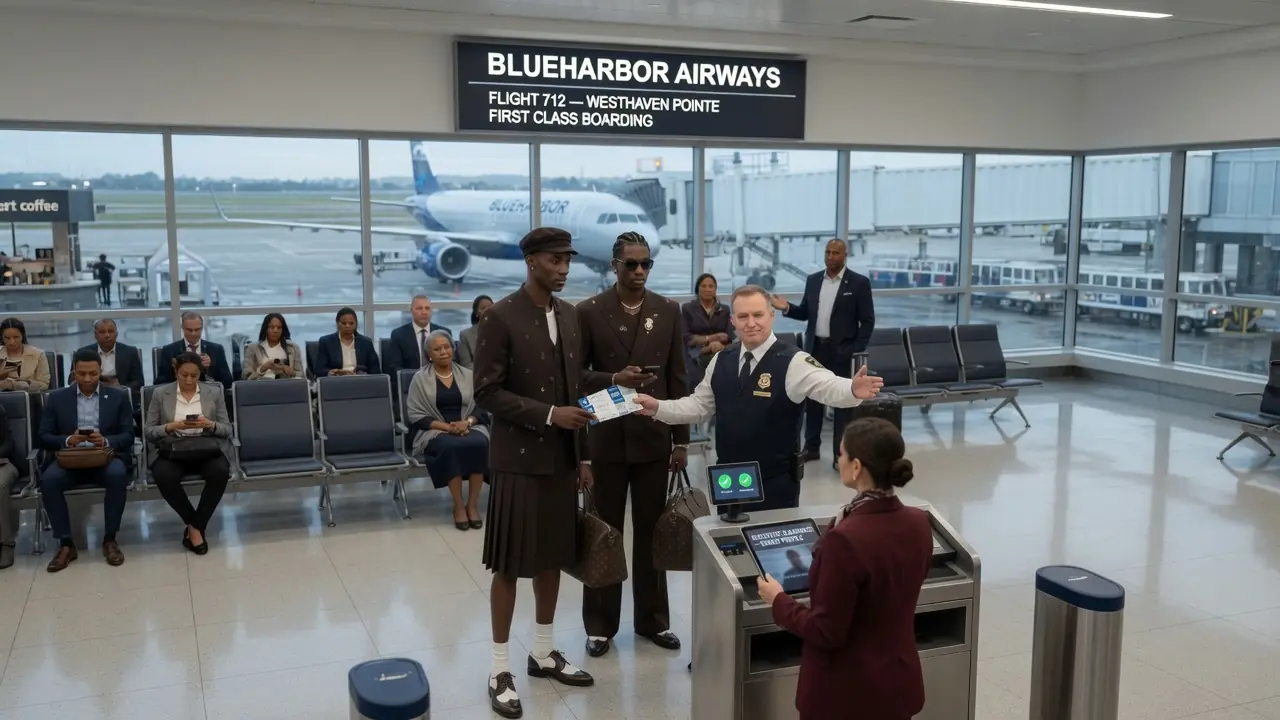
His twin brother, Micah, stopped half a step behind him, rolling the handle of a small black suitcase across the polished airport floor. They were thirty-eight years old, Black, identical in the way that still made strangers stare twice, though anyone who knew them could tell the difference immediately. Malachi carried his anger quietly, deep in his jaw. Micah carried his in his eyes, where it flashed before he could hide it.
They were standing inside Marrow Gate International Airport, in the private boarding corridor of BlueHarbor Airways Flight 712 to Westhaven Pointe.
The flight belonged to them.
Not in the way frequent travelers joke about paying enough for tickets to own the plane. Not in the way wealthy men say “my airline” because they prefer one brand over another. BlueHarbor Airways, the aircraft, the crew contracts, the routes, the debt, the brand, the gate lease, and the polished silver logo above the jet bridge all belonged to Freeman Meridian Group.
Which meant they belonged to Malachi and Micah Freeman.
But the security officer in front of them did not know that.
Or maybe, Malachi would later think, he knew exactly what he wanted to believe first.
The officer’s name tag read: Glen Rusk.
He was a thick-necked white man in his late forties, with a square face, pale eyes, and the careful stillness of someone who enjoyed being the person between other people and where they wanted to go. His uniform was clean. His shoes were shined. His badge sat straight on his chest.
Behind him, Gate 18 buzzed with the ordinary tension of expensive travel.
A woman in a cream pantsuit spoke into her phone about a board presentation. A teenage boy in wireless headphones leaned against a pillar, pretending not to listen. A man with silver hair and a navy blazer folded his newspaper slowly so he could watch without looking like he was watching.
Malachi held up his boarding pass.
“We’re on this flight.”
Glen did not take it.
“I understand that, sir. But this lane is for BlueHarbor Premier and first-class boarding.”
Micah let out one small laugh.
Not amusement.
Warning.
“That’s what our passes say.”
Glen’s eyes flicked to their clothes.
That was the second insult.
Malachi and Micah were not dressed poorly. They were dressed simply. Dark wool coats. White shirts. No ties. Black jeans so well cut they cost more than some of the luggage around them. Clean sneakers. No watches. No visible diamonds. No designer logos announcing wealth for people who needed money translated into symbols.
To Glen Rusk, they looked like men who had wandered into the wrong doorway.
To themselves, they looked like two brothers who had spent half their lives proving they did not need to look rich to be powerful.
“May I see your boarding passes?” Glen asked.
Malachi handed his over.
Micah handed his over too, slower.
Glen scanned the first one with the handheld device attached to his belt. The scanner chirped green. He scanned the second. Green again. For a moment, something flickered in his face, not apology, not respect, only irritation that the machine had refused to support his first assumption.
He looked down at the screen.
Then back up.
“These will need secondary verification.”
Malachi tilted his head.
“Why?”
“System irregularity.”
Micah stepped forward slightly.
“The system accepted them.”
“Secondary verification is at officer discretion.”
There it was.
Discretion.
One of those words that can mean safety in honest hands and prejudice in dishonest ones.
Malachi glanced past Glen toward the gate podium. A gate manager in a burgundy BlueHarbor blazer watched them over the top of her tablet. Her name tag read: Lorna Vale. She had sharp brown hair, a perfect customer-service smile, and eyes that had already decided which side of the story would be easier to defend.
“Can you ask the gate manager to check our reservation?” Malachi said.
Lorna heard him.
She did not move closer.
Glen looked back at her anyway, and something passed between them.
Not words.
Permission.
“She is busy preparing boarding,” Glen said.
“So are we,” Micah replied.
A few passengers turned now.
Not fully.
People rarely turn fully when they want to watch humiliation. They angle their bodies toward neutrality and let their eyes do the dirty work.
Glen lowered his voice.
“Sir, if you continue raising your tone, I will have to remove you from the boarding area.”
Micah smiled.
It was not friendly.
“My tone?”
Malachi lifted one hand gently against his brother’s arm.
Not to silence him.
To remind him why they were there.
They had not come to Gate 18 by accident.
The new ownership announcement was scheduled for 9:00 a.m., twenty minutes after Flight 712 departed. The public version was simple: Freeman Meridian Group had acquired BlueHarbor Airways after months of private negotiations. The airline had been struggling for years under outdated leadership, rising complaints, declining trust, and a culture so polished on the surface that nobody wanted to admit what was rotting underneath.
Malachi and Micah had planned to take the first flight of their ownership quietly.
No press.
No entourage.
No executive escort.
Just two brothers boarding like ordinary passengers, watching how ordinary passengers were treated when nobody knew power was nearby.
Now they had their answer before stepping onto the plane.
The truth was, BlueHarbor meant more to them than a business deal.
Their mother, Evelyn Freeman, had cleaned BlueHarbor aircraft at Marrow Gate for nineteen years. She wore blue gloves, carried a gray supply cart, and came home smelling faintly of citrus cleaner and jet fuel. She used to tell the boys that every plane held a thousand stories before it ever left the ground.
“When people sit down,” she would say, “they are leaving something, chasing something, or trying to become someone else before they land.”
Evelyn never flew much herself.
She could not afford to.
But she treated every airplane like a chapel somebody would trust with their life for a few hours. She checked seat pockets for trash, wiped tray tables twice, tucked lost toys into a clear bag with care, and once chased a family through the terminal to return a little girl’s stuffed giraffe before the door closed.
BlueHarbor never made her rich.
It barely made her tiredness legal.
But she was proud of honest work.
Then, when Malachi and Micah were seventeen, Evelyn tried to board a BlueHarbor flight to see her dying sister in Bellweather Coast. She had saved for three months. She had worn her best purple dress. She had carried a small suitcase and a paper ticket folded inside her Bible.
A supervisor at that same airport accused her of using an employee discount fraudulently.
She missed the flight.
Her sister died that night.
Evelyn never sued. Never made a scene. Never told the boys the full story until years later, when illness made her voice softer and memory less willing to protect the people who hurt her. But she kept the unused boarding pass in a shoebox under her bed.
Malachi and Micah found it after she died.
That was the first time Micah said, “One day, we should buy the whole thing.”
At the time, Malachi thought he was grieving out loud.
Twelve years later, they signed the acquisition papers.
Now, at Gate 18, a security officer was telling them they did not belong in the premium boarding lane of the airline their mother once cleaned.
Life has a cruel sense of symmetry.
Lorna Vale finally walked over when the first-class passengers began whispering too openly to ignore.
“Is there a problem here?” she asked.
Micah laughed once.
“That depends on whether you plan to solve it.”
Malachi handed her the boarding passes.
“We would like to board the aircraft.”
Lorna glanced at the names.
Malachi Freeman.
Micah Freeman.
She scanned both passes again.
Green.
Then her tablet flashed something across the screen that made her expression change.
Executive clearance.
Board-level profile.
Ownership restricted account.
The words appeared for less than two seconds before she tapped the screen and looked up again, face suddenly tighter.
“You are very early,” she said.
Malachi looked toward the jet bridge.
“Boarding started.”
“For general passengers soon. But we have to verify certain high-profile profiles with corporate.”
Micah stared at her.
“High-profile profiles?”
Lorna’s cheeks colored slightly.
Glen folded his arms.
A man in the navy blazer stepped closer, pretending to adjust his carry-on handle.
His name would later be identified as Preston Hollis, a luxury hotel developer who had already complained that morning because the espresso machine in the SkyClub was not working. He looked at the brothers, then at Lorna.
“Look, I don’t want to get involved,” he said, with the confidence of someone fully involving himself, “but some of us have connections to make. If their documents are questionable, maybe move them aside?”
Micah turned toward him.
“No one asked you.”
Preston raised his eyebrows.
“That attitude may be part of the issue.”
Malachi felt his brother’s body shift beside him.
He knew that shift.
They had been twins long enough to feel each other’s temper like weather.
“Micah,” he said quietly.
Micah looked at him.
Then back at Preston.
“Lucky day,” he said.
Preston frowned.
“What is that supposed to mean?”
“It means my brother still has patience.”
A teenage girl near the window covered her mouth to hide a smile.
Lorna did not smile.
“Gentlemen,” she said, “I need you to step out of the lane while we resolve this.”
“No,” Malachi said.
The word was calm.
Too calm.
Glen’s eyes sharpened.
“Excuse me?”
“We are ticketed passengers. Our boarding passes are valid. Your system accepted them. The delay began only after you looked at us and decided the machine must be wrong.”
Lorna’s voice cooled.
“That is a serious accusation.”
“It is a serious observation.”
Preston sighed loudly.
“This is ridiculous.”
Malachi turned toward him, and something in his expression made the man take half a step back.
“You are right,” Malachi said. “It is.”
A boarding announcement began overhead.
“BlueHarbor Airways Flight 712 to Westhaven Pointe is now boarding first-class passengers, BlueHarbor Premier members, and passengers requiring additional assistance.”
The gate area shifted forward.
People gathered their bags.
A woman in pearls moved closer, then stopped when she realized the lane was blocked. A father with two small children looked confused. A flight attendant appeared at the aircraft door inside the jet bridge and glanced down the corridor, waiting.
Lorna raised her tablet.
“Ladies and gentlemen, please give us one moment.”
Micah looked at the boarding sign.
“Perfect. We’re first class.”
Glen moved in front of him.
“You are not boarding until verification is complete.”
“Verification of what?” Micah asked.
“Identity.”
“You have our IDs.”
“Eligibility.”
“You have our tickets.”
“Purpose of travel.”
That one made Malachi’s face change.
“Purpose of travel?”
Glen looked satisfied that he had found firmer ground.
“Yes.”
Malachi stepped closer, slow enough not to be mistaken for aggression, close enough that Glen had to look up slightly.
“Our purpose,” he said, “is to sit in seats 1A and 1B, on an aircraft operated by BlueHarbor Airways, flying from Marrow Gate to Westhaven Pointe, according to the tickets issued to us by the airline.”
Glen’s jaw tightened.
“You think you’re clever.”
Micah looked around.
“Actually, he is. That’s why I let him talk first.”
A few passengers laughed softly.
That made everything worse.
People like Glen Rusk could tolerate defiance more easily than public embarrassment.
He reached for the radio at his shoulder.
“Need terminal security at Gate 18. Two noncompliant passengers refusing to step aside.”
Malachi closed his eyes for half a second.
Not in fear.
In disappointment.
Micah pulled out his phone.
“Finally,” he said.
Lorna pointed at him.
“Do not record staff without consent.”
“This is an airport,” Micah said. “There are cameras above us, cameras behind us, cameras at the counter, cameras at the jet bridge, and probably three passengers already pretending to text while filming. But sure, let’s discuss consent.”
A Black woman sitting near the window stood slowly.
She was in her sixties, wearing a navy dress and a gray travel shawl. Her name, as Malachi later learned, was Dr. Celeste Warren, a retired surgeon flying to attend her grandson’s graduation.
“Excuse me,” she said.
Lorna did not look pleased.
“Ma’am, please stay seated.”
“I am seated in 2A,” Dr. Warren said. “And I have been watching since those two gentlemen arrived. Their passes scanned green. Twice. Yours did too. You are delaying them because you do not think they look like who your screen says they are.”
Preston rolled his eyes.
“Oh, here we go.”
Dr. Warren turned her head slowly.
“You are welcome to remain quiet while adults practice courage.”
The teenage girl near the window actually laughed that time.
Preston’s face flushed.
Glen spoke into his radio, louder now.
“Noncompliant passengers and escalating bystander interference.”
Malachi looked at the ceiling.
Micah looked at his brother.
“Still want to do this quietly?”
Malachi did not answer.
Because the truth was no.
He no longer wanted quiet.
Quiet was what his mother had done when BlueHarbor humiliated her. Quiet was what companies counted on when dignity became inconvenient. Quiet was how policies became weapons, because victims were trained to leave before the room became uncomfortable for everyone else.
“No,” Malachi said finally. “Not quietly.”
Two terminal security officers arrived within minutes.
The first was a young man named Aaron Bell, nervous, clean-cut, not yet old enough to hide discomfort well. The second was a woman named Marsha Trent, older, sharper, with the hardened face of someone who had seen enough airport chaos to know most emergencies begin as someone’s ego.
Glen pointed toward the twins.
“These two are refusing secondary verification.”
Marsha looked at Malachi and Micah.
“Gentlemen, may I see your boarding passes and IDs?”
Malachi handed them over.
Micah did too.
She scanned both.
Green.
She looked at her device.
Then looked again.
Something flickered across her face, but unlike Lorna, she did not hide behind irritation. She stepped slightly away and spoke into her radio.
“I need a corporate liaison at Gate 18. Immediately.”
Lorna stiffened.
“That is unnecessary.”
Marsha did not look at her.
“I disagree.”
Glen frowned.
“What are you doing?”
“My job.”
The words landed quietly, but everyone near the gate heard them.
Marsha handed the IDs back to Malachi and Micah.
“Thank you for your patience.”
Micah took his ID.
“We haven’t had much of that returned to us.”
Marsha nodded once.
“That appears accurate.”
Lorna’s face had gone pale.
Glen leaned toward Marsha.
“Do you see something I don’t?”
“Yes,” she said.
“What?”
Marsha looked at him.
“Enough to stop talking until someone above us gets here.”
That was the first moment the gate truly changed.
It moved from performance to uncertainty.
Passengers who had been entertained became uneasy. Lorna stopped tapping her tablet. Glen no longer looked certain that authority was a wall behind him. Preston retreated toward the coffee stand, though not far enough to stop watching.
Then the elevator doors behind the gate opened.
Three people stepped out.
The first was a tall Black woman in a charcoal suit with silver locs pulled into a low knot. Her name was Naomi Pierce, general counsel for Freeman Meridian Group. She walked like a person who had never been late to a room that mattered.
Beside her was Arthur Kline, BlueHarbor’s interim chief operating officer, a thin white man with glasses, a nervous mouth, and a folder clutched against his chest like a shield.
Behind them came Vivian Rhodes, the outgoing BlueHarbor executive chair.
Vivian was seventy, elegant, and furious in a way that good breeding could not soften. She had spent forty years inside the airline industry, and though she had resisted the sale at first, she had come to respect the Freeman twins during negotiations because they did something few wealthy men did.
They listened before they bought.
Now she stopped at Gate 18 and took in the scene.
Malachi and Micah blocked from boarding.
Security gathered.
Passengers watching.
Lorna pale.
Glen defensive.
Vivian’s face turned cold.
Arthur Kline hurried forward.
“Mr. Freeman. Mr. Freeman. I am so sorry.”
The words moved through the gate like electricity.
Mr. Freeman.
Mr. Freeman.
Not “gentlemen.”
Not “passengers.”
Not “sir” wrapped around suspicion.
Mr. Freeman.
Lorna’s tablet slipped slightly in her hand.
Glen blinked.
Preston stared.
Micah smiled without humor.
“Arthur,” he said. “We were just learning about purpose of travel.”
Arthur looked physically ill.
Naomi Pierce turned to Marsha.
“Who called for corporate?”
Marsha lifted her hand.
“I did.”
“Why?”
“Because their credentials verified and staff continued to obstruct them.”
Naomi nodded.
“Thank you.”
Then she turned to Lorna.
“Explain.”
Lorna opened her mouth.
Closed it.
Opened it again.
“The system flagged their profiles as restricted.”
Naomi’s voice stayed even.
“And?”
“And we needed to confirm—”
Arthur cut in, voice strained.
“Restricted owner profiles are not a fraud flag. They are an executive protection flag. Every station manager received training yesterday.”
Malachi looked at Arthur.
“Did they?”
Arthur’s face flushed.
“Yes. Mandatory.”
Micah glanced at Lorna.
“Maybe the email went to spam.”
No one laughed.
Not this time.
Naomi looked at Glen.
“Why was terminal security called?”
Glen straightened.
“They became noncompliant.”
“How?”
“They refused to step aside.”
“After valid scans?”
He hesitated.
“Yes, but—”
“After presenting ID?”
“Yes, but—”
“After the gate manager saw executive restricted status?”
Glen looked at Lorna.
That tiny glance told Naomi everything.
She turned to the passengers.
“Did anyone here witness this interaction from the beginning?”
Dr. Celeste Warren stepped forward.
“I did.”
The teenage girl raised her hand.
“So did I.”
A father near the second row said, “I recorded some of it after the security officer raised his voice.”
Preston suddenly became fascinated by the floor.
Naomi nodded.
“Thank you. We will take statements from anyone willing after boarding.”
Then Vivian Rhodes stepped forward.
Her voice was old, polished steel.
“Since some people at this gate appear confused, allow me to clarify. Malachi Freeman and Micah Freeman are the majority owners of Freeman Meridian Group, which completed its controlling acquisition of BlueHarbor Airways at 6:00 a.m. this morning. That makes them, in the simplest possible language, the owners of this airline.”
Silence.
Total.
The kind of silence that has weight.
A boarding screen changed behind them, flashing the BlueHarbor logo in soft blue light, suddenly looking less like a brand and more like evidence.
Micah looked at Glen.
“Purpose of travel,” he said softly. “Inspection.”
Malachi looked at Lorna.
“And memory.”
Lorna swallowed.
Glen’s face had gone red now, but not with shame.
With anger.
That bothered Malachi more than denial would have. Shame meant a person had recognized harm. Anger meant they were upset that the harm had become inconvenient.
“This is not fair,” Glen said.
Micah laughed once.
“No, Glen. It wasn’t.”
Naomi turned her head slowly toward him.
“Officer Rusk, you will surrender your terminal credential to Officer Trent immediately. You are suspended pending investigation.”
Glen stiffened.
“You cannot do that. I am airport security, not airline staff.”
Marsha Trent stepped forward.
“But I can.”
Glen stared at her.
“Marsha—”
“No,” she said. “You turned a valid boarding situation into a race-coded removal call. Hand me the badge.”
A few passengers murmured.
Glen removed his credential with sharp, angry movements and placed it in Marsha’s hand.
Lorna looked like she might faint.
Arthur turned to her.
“Ms. Vale, you are relieved from gate duty immediately.”
“I followed protocol.”
Vivian’s eyes narrowed.
“No. You hid behind it.”
That sentence seemed to strike Lorna harder than the suspension.
Because it was specific.
Because it was true.
Two replacement gate agents arrived moments later, breathless and confused. Boarding resumed fifteen minutes late. But before Malachi and Micah stepped onto the jet bridge, Malachi turned back to the waiting passengers.
“I apologize for the delay,” he said.
The gate stayed silent.
“This airline owes you better than what you just witnessed. It owes everyone better. And as of this morning, that becomes our responsibility.”
He looked toward Dr. Warren.
“Thank you for speaking.”
She nodded.
“You are welcome. But I should not have had to.”
Malachi accepted that.
“No. You should not have.”
As they walked down the jet bridge, Micah was quiet.
That rarely happened.
The aircraft door stood open at the end of the corridor. A flight attendant named Elise Moreno greeted them with nervous professionalism, though her eyes were wet.
“Mr. Freeman. Mr. Freeman. Welcome aboard.”
Micah stopped.
“Did you know?”
She understood the question.
“No. But I saw some of it from the door. I wanted to come out.”
“Why didn’t you?”
Her face tightened.
“Gate authority.”
Malachi nodded slowly.
“That answer is going to become part of the problem we fix.”
They took seats 1A and 1B.
For the first time all morning, the brothers sat.
Outside the window, baggage carts moved across the tarmac. A fuel truck pulled away. Ground crew in reflective vests walked between vehicles with orange wands. The world of aviation continued with its usual choreography, indifferent to how many invisible humiliations had been folded into its systems.
Micah leaned back.
“Mom would have hated this.”
Malachi looked out the window.
“Mom lived this.”
Micah closed his eyes.
Neither brother spoke for a while.
The plane pushed back twenty-two minutes late.
Passengers settled.
Seat belts clicked.
A baby cried three rows behind them.
As the aircraft taxied toward the runway, Malachi thought of Evelyn Freeman standing in this same airport decades earlier, holding a boarding pass no one honored. He thought of her purple dress. The Bible in her purse. The sister she never got to say goodbye to.
Then he thought of Glen Rusk’s hand across the lane.
Same gate system.
Different decade.
Same message.
You do not belong here.
Micah opened his eyes just before takeoff.
“We’re not doing a memo.”
“No,” Malachi said.
“We’re not doing one of those polished apologies about regrettable experiences.”
“No.”
“We’re cutting it out.”
Malachi turned toward him.
“Root and all.”
By the time Flight 712 landed in Westhaven Pointe, Naomi Pierce had already gathered statements, secured video, pulled access logs, and found something worse than one bad morning.
The problem was not only Glen Rusk.
It was not only Lorna Vale.
It was a tag inside BlueHarbor’s gate management system called “Enhanced Courtesy Review.”
At first glance, the label sounded harmless.
Corporate language often does.
But Naomi found that passengers marked for Enhanced Courtesy Review were delayed, questioned, or redirected at a rate nearly six times higher than unmarked passengers in premium cabins. The tag was supposed to identify travelers who needed extra assistance: elderly passengers, language support, medical accommodations, first-time minors.
Instead, at Marrow Gate, certain staff had used it as a soft suspicion list.
Black passengers.
Latino passengers.
Young travelers dressed casually in premium cabins.
Anyone whose appearance did not match what staff imagined wealth, status, or legitimacy should look like.
The twist was not that Malachi and Micah owned the airline.
The deeper twist was that their mother had been marked by the same kind of internal code twenty-one years earlier.
Back then, the system was paper.
A handwritten note on a supervisor’s clipboard.
Employee fare irregularity. Verify before boarding.
Evelyn Freeman had not been irregular.
She had been a grieving woman trying to see her sister one last time.
When Naomi uncovered the old archives two days after the Gate 18 incident, she found a scanned incident record from that day. The supervisor who blocked Evelyn had written one line that made Malachi leave the room when he read it.
Passenger became emotional when questioned and was denied boarding for operational discretion.
Operational discretion.
Different decade.
Same blade.
The brothers held a company-wide meeting one week later inside Hangar 4 at Marrow Gate.
Not a press conference.
Not yet.
Employees came in from ticketing, baggage, cabin crew, maintenance, reservations, security coordination, gate operations, and executive management. Some looked nervous. Some looked defensive. Some looked bored in the way people look bored when they believe accountability is a weather pattern that will pass over them.
At the front stood Malachi and Micah.
Behind them, on a large screen, was a photograph of Evelyn Freeman in her BlueHarbor cleaning uniform from 1998. She was smiling beside a supply cart, one hand on her hip, the airline logo stitched above her heart.
Malachi spoke first.
“This is our mother,” he said.
The hangar quieted.
“Her name was Evelyn Freeman. She cleaned BlueHarbor planes for nineteen years. She raised twins on wages this company barely made livable. She believed work done honestly had dignity, even when the people above her forgot to pay dignity back.”
Micah stepped forward.
“Twenty-one years ago, she was denied boarding on this airline because someone decided she did not look like the kind of passenger who deserved to be believed. Last week, my brother and I were denied boarding for the same reason, only the language had improved.”
A few employees looked down.
That was good.
Looking down meant the words had found skin.
Malachi continued.
“BlueHarbor does not have a customer service problem. It has a recognition problem. It recognizes status faster than humanity. It recognizes suspicion faster than proof. It recognizes polished luggage faster than valid documents. That ends now.”
Then the screen changed.
Enhanced Courtesy Review.
Access logs.
Demographic patterns.
Complaint closures.
Gate delay reports.
The room shifted.
People who had expected a speech realized they were inside an audit.
Naomi Pierce walked them through the findings with the calm precision of a surgeon explaining where the infection had spread. Lorna Vale had used the tag seventy-three times in eighteen months. Glen Rusk had escalated twenty-nine gate interactions, most involving passengers of color, casual-dressed premium travelers, or customers with employee-family fare histories.
But the biggest name appeared last.
Preston Hollis.
The hotel developer from Gate 18.
The man who claimed he did not want to get involved.
He was not only a passenger.
He was a major investor in a competing regional airline called SilverCrest Air and had been quietly working with two BlueHarbor executives to push negative customer incident reports ahead of the acquisition. His goal was simple: make Freeman Meridian Group’s transition look chaotic, weaken public trust, and force a resale of key routes SilverCrest wanted.
Gate 18 had not been planned.
But when the twins were stopped, Preston recognized the opportunity.
He complained loudly enough to pressure staff, then sent edited video clips to a business reporter before the plane even took off. He expected a headline about disorder under new ownership. He did not expect the “noncompliant passengers” in his recording to be the new owners.
Micah stood in front of the hangar and smiled slightly.
“Mr. Hollis wanted a story,” he said. “So we are giving him one.”
Within forty-eight hours, BlueHarbor filed legal action against Preston Hollis, SilverCrest Air, and two former BlueHarbor executives involved in the sabotage of internal reporting. Lorna Vale was terminated. Glen Rusk lost his airport security contract after investigation. Several complaint files were reopened.
But Malachi refused to let the story become only punishment.
Punishment was easy.
Culture was harder.
The brothers created the Evelyn Freeman Passenger Dignity Standard.
It required documented reasons for secondary screening tied to behavior or verifiable system risk, not appearance, class assumptions, emotional response, or employee discretion disguised as instinct. It created an independent review line for gate escalations. It protected employees who challenged biased treatment in real time.
Marsha Trent was asked to lead the first training session.
Dr. Celeste Warren joined the external advisory board.
The teenage girl who filmed the incident sent in her video with a note that read, “My dad says adults make excuses when systems are wrong. I hope this helps.” Micah kept that note in his desk.
Six months later, BlueHarbor Flight 100 took off from Marrow Gate under a new slogan.
Not luxury.
Not speed.
Not “the sky belongs to everyone,” which Micah rejected because it sounded like a billboard trying too hard.
The new slogan was simpler.
Every passenger is already enough.
On that first rebranded flight, Malachi and Micah boarded with no announcement.
They wore suits this time, not because they needed armor, but because the day belonged to their mother. In Malachi’s inside pocket was Evelyn’s old unused boarding pass, sealed in a clear sleeve. In Micah’s pocket was the BlueHarbor wings pin she had worn on her cleaning uniform for nineteen years.
At the gate, a young father in work boots approached with two children and a nervous expression.
His ticket had an issue.
The agent scanned it.
Frowned.
Then, instead of making a face or calling security, she smiled gently and said, “Let’s figure this out together.”
Micah heard it.
So did Malachi.
Neither brother said a word.
But Malachi looked out the window toward the plane, and for just a second, he imagined Evelyn Freeman standing there in her purple dress, suitcase in one hand, Bible in the other, being told that her ticket was good and her grief did not need to prove itself before boarding.
That was the thing about justice.
It did not give back the dead.
It did not reopen missed doors.
It did not return his mother to the seat she should have occupied twenty-one years earlier.
But sometimes, if people were brave enough to name the wound, justice could change the next door.
The boarding announcement came over the speaker.
“BlueHarbor Airways Flight 100 to Bellweather Coast is now ready for boarding.”
Bellweather Coast.
The city Evelyn never reached.
Micah heard the destination and looked at his brother.
Malachi nodded once.
They stepped into the lane.
No one stopped them.
No hand rose across their path.
No one asked why men like them were standing there.
The gate agent scanned their passes.
Green.
She looked up and smiled.
“Welcome aboard, Mr. Freeman. Mr. Freeman.”
Micah glanced at Malachi.
This time, the title did not feel like revenge.
It felt like repair.
They walked down the jet bridge together.
Twin brothers.
Black men.
Sons of a woman who had cleaned airplanes nobody thought she would ever own.
And behind them, passengers followed one by one, carrying bags, children, worry, hope, grief, business plans, vacations, funerals, weddings, and all the thousand reasons people trust a machine to lift them into the sky.
Malachi paused at the aircraft door and touched the old boarding pass inside his jacket.
Then he whispered, so quietly only Micah heard him, “She’s getting on this time.”
Micah swallowed hard.
“Yes,” he said. “She is.”
The flight attendant welcomed them.
The cabin lights glowed soft and warm.
And for the first time in BlueHarbor’s history, the airline flew under owners who knew exactly what it meant to be kept at the gate.
They had bought the company.
But more than that, they had changed the question.
Not who looks like they belong.
Not who seems important enough.
Not who appears worthy of trust before the machine confirms it.
The question was simpler now.
Who is standing in front of us?
And the answer, every time, had to begin with this:
A person.
Already worthy.
Already human.
Already enough.