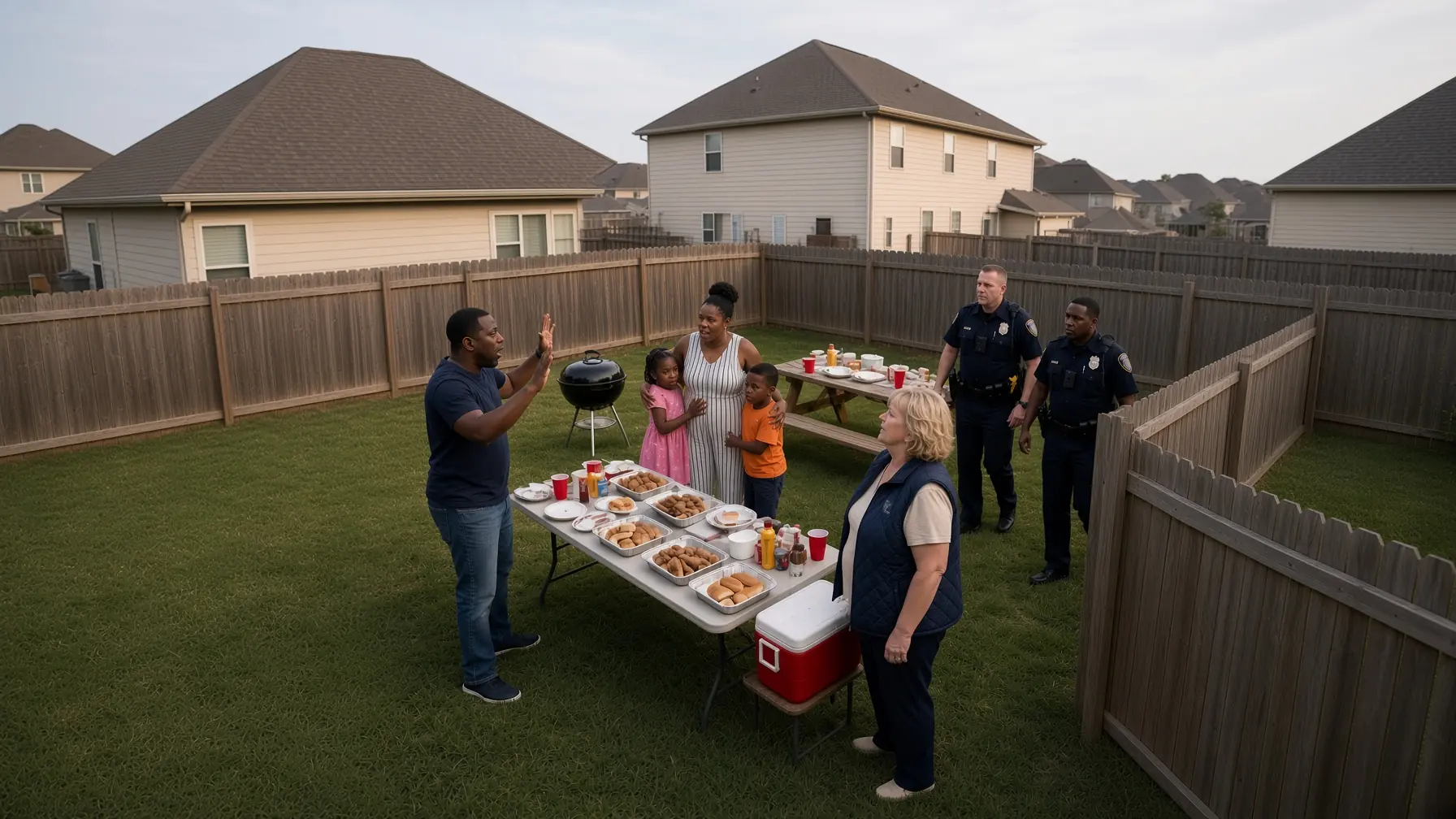
By two o’clock Saturday afternoon, the backyard behind the Carter house smelled like hickory smoke, garlic butter, and peach cobbler. Derrick Carter stood beside the grill wearing a faded Morehouse College T-shirt and an apron his eleven-year-old son had given him for Father’s Day that read, Dad: Master of Fire and Questionable Decisions. His wife, Monica, was arranging plates on a long folding table while their daughter Avery chased bubbles across the grass and their son Malik tried to convince everybody that he could beat his father in cornhole.
It was the kind of day Derrick had worked years to be able to enjoy.
The Carter family lived in Brookstone Terrace, a quiet subdivision forty minutes north of Atlanta where mature oak trees arched across the streets and most houses had white columns, stone mailboxes, and lawns maintained with almost suspicious consistency. Derrick and Monica had purchased their home four years earlier after saving for nearly a decade. Derrick owned a commercial electrical company, and Monica worked as a pediatric nurse practitioner at Emory.
They were not rich in the way some of their neighbors were rich.
But they were comfortable.
More importantly, the house was theirs.
That afternoon was supposed to be simple.
Derrick’s younger sister was coming with her husband.
Two cousins were bringing their children.
Monica had invited a few close friends from work.
And one special guest had said she might stop by if her schedule allowed.
Derrick did not mention that guest to anyone outside the family because he did not want the barbecue turning into a political event.
He wanted burgers.
Ribs.
Music.
Children running barefoot.
That was all.
Across the street, Lorraine Beckett stood behind the blinds of a house she had owned for only nineteen days.
She had moved from a gated development outside Birmingham after her husband’s consulting firm transferred him to Atlanta. Lorraine was fifty-two, white, sharply dressed even on weekends, with honey-blonde hair cut precisely above her shoulders and a habit of observing people as though life were an inspection she had been assigned to conduct.
Brookstone Terrace was still unfamiliar to her.
The Carters were unfamiliar too.
She had seen Derrick leaving early in a work truck.
She had watched Monica come home in medical scrubs.
She had seen children shooting baskets in the driveway.
But she had never introduced herself.
Derrick waved the first time they passed on the sidewalk.
Lorraine looked at him for a second before offering a quick smile and continuing toward her mailbox.
Monica brought over banana bread three days after Lorraine moved in.
Lorraine thanked her politely.
Then asked whether the Carters were renting.
Monica remembered the question because nothing about the conversation had involved housing.
“No,” she said.
“We own.”
Lorraine looked briefly surprised.
Then smiled.
“Of course.”
Monica told Derrick about it that night.
He shrugged.
“Maybe she’s nosy.”
“She’s definitely nosy.”
“That’s not illegal.”
Monica laughed.
“No.”
“But annoying should be.”
They let it go.
Now Lorraine stood inside her living room watching the backyard across the street fill with Black adults and children.
A car arrived.
Then another.
Then a minivan.
Music drifted faintly between the houses.
Not loud enough to shake windows.
Not loud enough to violate any ordinance.
But loud enough that Lorraine noticed.
She watched Derrick carry a tray toward the grill.
Watched Monica hug an older woman arriving through the side gate.
Watched children race around a sprinkler.
Watched people laugh.
Nothing she saw looked dangerous.
That should have ended it.
Instead, the gathering made her uneasy.
Lorraine had spent much of her adult life believing she was very good at reading situations.
She used words like “instinct.”
“Awareness.”
“Common sense.”
When she distrusted somebody quickly, she rarely asked herself why.
She preferred believing her judgment had discovered something everyone else had missed.
At 2:17, she called her husband, Frank Beckett, who was playing golf.
“There are a lot of people across the street.”
Frank sounded distracted.
“Okay.”
“I mean a lot.”
“How many?”
“I don’t know.”
“Maybe fifteen.”
Frank paused.
“So?”
“There are cars everywhere.”
“Are they blocking our driveway?”
“No.”
“Then what’s wrong?”
Lorraine frowned.
“I just don’t like it.”
Frank laughed softly.
“Lorraine, they’re having a barbecue.”
“You don’t know that.”
“I can literally hear music through the phone.”
She lowered her voice.
“There are people going in and out.”
“That’s generally how parties work.”
Lorraine hung up irritated.
Frank did not understand.
At least, that was what she told herself.
Five minutes later, two teenagers arrived carrying coolers.
One wore baggy basketball shorts.
The other had dreadlocks falling almost to his shoulders.
Lorraine moved closer to the window.
She watched them enter through the side gate.
No one stopped them.
No one checked anything.
The gathering kept growing.
Her unease became a story.
The story became certainty.
At 2:31 p.m., Lorraine picked up her phone.
She dialed 911.
“911, what’s the address of your emergency?”
Lorraine gave Brookstone Terrace.
Then said:
“There’s a suspicious gathering across the street.”
The dispatcher paused.
“What kind of suspicious gathering?”
“A lot of people.”
“Are they fighting?”
“No.”
“Weapons?”
“I haven’t seen any.”
“Is anyone injured?”
“No.”
“What are they doing?”
Lorraine looked through the blinds.
Derrick flipped ribs.
Avery ran past holding a water balloon.
“They’re moving around the property.”
“Do you believe they are trespassing?”
“I don’t know.”
“Do you know who lives there?”
Lorraine hesitated.
“I believe it’s a family.”
“Do you know them?”
“Not really.”
The dispatcher waited.
“What exactly are you concerned about?”
Lorraine became frustrated.
“This is a very quiet neighborhood.”
The dispatcher said nothing.
Lorraine continued.
“We don’t usually have gatherings like this.”
“What kind?”
She paused.
“Large.”
The dispatcher asked:
“Is the music excessively loud?”
“It’s loud enough.”
“Is anyone threatening you?”
“No.”
“Have they entered your property?”
“No.”
Lorraine looked toward the yard again.
Then she said the sentence that transformed discomfort into accusation.
“I think there may be illegal activity.”
“What makes you think that?”
“Just the way people are coming and going.”
“What illegal activity?”
“I don’t know.”
“Drugs?”
“Possibly.”
The word came easily.
Too easily.
The dispatcher classified the call for a welfare and disturbance check.
Two patrol units were sent.
Lorraine hung up.
For a moment, she felt relief.
She had done something.
She had protected the neighborhood.
That was how she would explain it later.
Across the street, Derrick had no idea police were coming.
He was explaining brisket temperatures to Monica’s brother when Malik shouted:
“Dad, you’re burning the chicken.”
“I am not.”
Smoke rolled upward.
Malik pointed.
“That chicken looks like a tire.”
“It’s charred.”
“It’s black.”
Derrick stared at him.
“You picked the worst possible phrasing.”
Malik laughed so hard he nearly dropped his lemonade.
Monica heard the exchange from the table.
“Leave your father alone.”
“He’s destroying dinner.”
“We have other food.”
“That is not confidence.”
Everybody laughed.
Then sirens entered Brookstone Terrace.
Not loud.
Only a short burst as the first cruiser turned into the subdivision.
The laughter faded.
Derrick looked toward the side gate.
A second patrol car followed.
Blue lights reflected across the windows of parked vehicles.
The first cruiser stopped in front of Derrick’s driveway.
Avery froze beside the sprinkler.
“Dad?”
Derrick put the tongs down.
Monica came beside him.
“What happened?”
“I don’t know.”
Two officers stepped from the first car.
A third got out of the second.
The lead officer, Sergeant Matthew Klein, appeared to be in his early forties.
He was white.
Solid build.
Professional posture.
His hand rested near his duty belt as he approached the side gate.
Derrick walked toward him before the officer entered.
“Afternoon.”
Klein looked at Derrick.
“Sir, do you live here?”
“Yes.”
“This your property?”
“Yes.”
“Can I see identification?”
Derrick paused.
“For what?”
Klein’s expression changed slightly.
“We received a complaint.”
“What kind?”
“Possible disturbance and suspicious activity.”
Derrick looked behind him.
Someone had turned off the music.
Children had stopped running.
Adults stood silently near the tables.
The barbecue suddenly looked like evidence.
“What suspicious activity?”
“We’re checking.”
“Checking what?”
Klein lowered his voice.
“Sir, I’m trying to keep this simple.”
Derrick looked at him.
“So am I.”
Monica stepped beside her husband.
“This is our home.”
Klein nodded.
“Okay.”
“Then why does he need ID?”
“To confirm residency.”
Monica stared.
“You were called because people are eating barbecue.”
“We don’t know that yet.”
Derrick laughed once.
Not because anything was funny.
“What exactly do you think is happening?”
Klein glanced toward the yard.
“Large gathering.”
“On private property.”
“Multiple vehicles.”
“Guests.”
“Noise complaint.”
Derrick pointed toward the now-silent speaker.
“That thing was at maybe twenty percent.”
Klein looked toward the other officers.
One had already started writing down license plates.
Derrick’s patience weakened.
“Why are you recording plates?”
The officer looked up.
“Routine.”
“Routine for what?”
Klein stepped slightly closer.
“Sir.”
Derrick turned back.
“Let us handle the call.”
“My family is the call.”
Klein did not answer immediately.
That silence told Derrick more than words would have.
Monica felt Avery’s hand slip into hers.
The eight-year-old pressed against her mother.
“Are we in trouble?”
Monica looked down.
“No, baby.”
“Why are the police here?”
Monica swallowed.