The scaffold groaned before it broke. That was the first thing she heard, a low complaint of wood against wood, the way an old chair sometimes speaks when someone stands upon it. Vivienne heard it and looked up because she had learned in her 24 years to pay attention to sounds that did not belong. The sky above the half-built stone wall was the color of weak tea, and the men on the scaffold were small, dark shapes against it, and one of those shapes was leaning back too far. She was standing in the lane that ran along the edge of the estate, a basket of pears on her hip, and a shawl the color of moss pulled tight against the chill.
She had come this way because it was shorter than the road, and because the road passed the vicar's cottage, and the vicar's wife had a way of stopping her to speak of matches Vivienne did not wish to make. So she had taken the lane. She had taken the lane, and now she was standing under a scaffold that was beginning to lean. The wood cried out again, louder this time. A plank at the top jumped an inch and settled wrong.
The man at the top of the scaffold, the one leaning back, put out a hand to catch himself against a beam that was no longer where it had been a heartbeat before. His hand closed on air. His body followed his hand. Vivienne dropped the basket. The pears rolled into the grass.
Small green thuds she would remember later, though she did not notice them now. She stepped forward, not backward, which was the wrong thing to do and the only thing she could do. The man was falling. He was falling toward the stones piled at the base of the scaffold, and the stones would kill him, and there was no one else close enough. She did not think about it.
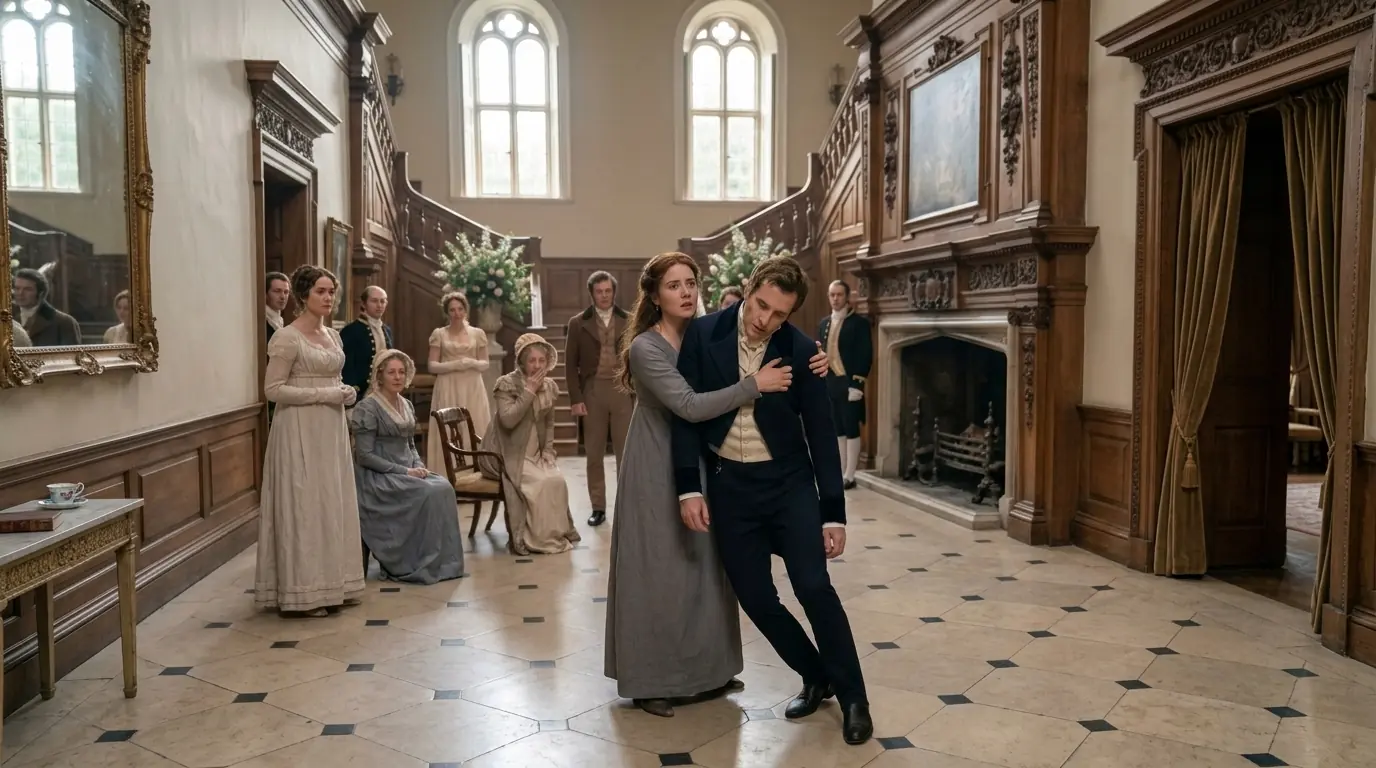
She would think about it later, lying awake with her heart still knocking against her ribs. Now she only moved. She threw her arms wide and up, the way one catches a child who is slipped from a chair. And the falling man came down against her chest and her shoulder, and the whole length of her body, and the force of him drove her to her knees in the wet grass. He was heavier than she had guessed, much heavier.
She felt the breath leave her lungs in a hard little sound, felt his shoulder strike her collarbone, felt his elbow drag across her jaw. He smelled of sawdust and sweat and faintly of soap that was too fine for a workman. She noticed that last thing and then forgot she had noticed it. They landed together in the grass. The man half across her lap, one of his arms flung over her knees, his face turned into the wool of her shawl.
For a long moment, neither of them moved. The scaffold above them shuddered and settled and did not fall further. A crow shouted somewhere in the elms. Somewhere a hammer had stopped. "Sir," she said.
Her voice came out thin. She tried again. "Sir, can you hear me?" The man drew a breath that shook. He turned his head, and she saw a streak of blood along his temple, where a splinter had caught him, and dark hair the color of wet bark, and eyes that were not the eyes of a laborer. She did not know how she knew this in the first instant of seeing them.
She only knew. The eyes were gray, the color of a river under cloud, and they had the tired weight of a man who had been carrying too many things for too many years. "I hear you," he said.
His voice was low. It was also not the voice of a workman. It was schooled. Every vowel had been taught. She stared at him.
He stared back at her. The pears lay in the grass around them like green stones. His arm was still across her knees. His shoulder was still pressed against hers. The scaffold was still creaking, though more quietly now.
The way a dog grumbles when it has been scolded and has decided to be still. "You are bleeding," she said. Yes. Can you stand? I do not know yet.
He tried. He got one foot under him and pushed and his weight came off her and for a moment she thought he would manage it. And then his knee gave and he came back down beside her in the grass, less gracefully this time, his palm flat in the wet earth. He made a small sound in the back of his throat that was almost a laugh. "I appear to be less capable than I hoped," he said.
"Do not try again yet," she said. Sit. Breathe. There is no hurry. He looked at her sideways as if she had said something surprising.
Perhaps she had. Perhaps women in his life did not tell him to sit and breathe. She did not know his life. She only knew that he was hurt and that a man who has fallen from a scaffold should not stand on his own strength before he has counted his bones. "Where are the others?" she said.
She meant the men who had been up on the scaffold with him. She could hear voices now coming closer. Boots in the lane, someone shouting a name. The name was not one she knew. "They are coming," he said.
His gray eyes had not left her face. "You saved my life." "I stood in the wrong place at the right time," she said. "It is not the same thing." "It is exactly the same thing."
She did not answer. She reached into the pocket of her apron and drew out the square of linen she carried there for the small cuts one collected in a day of walking country lanes, and she pressed it against his temple where the blood was running.
He did not flinch. His skin was warm under her fingers. It smelled of rain and of wood smoke and of something underneath that she could not name. "Hold this," she said.
He raised his hand and covered hers for a moment before she withdrew it. And then he was holding the linen against his own temple, and she was sitting back on her heels in the grass, and her heart was going very fast. And she did not know why. She did know why. She would not admit that she knew.
The men came around the corner of the wall. Then, three of them, and one of them was an older man with a face gone the color of ash. And when he saw who was sitting in the grass, he made a sound that was not a word. He fell to one knee. Not because his knee gave, because he chose to.
"Your grace," the older man said. Vivienne did not move. She was still on her heels in the wet grass. Her hand was still stretched out toward the man with the linen at his temple. She heard the words, "Your grace," and she heard them again inside her own head, and she felt the world.
She felt the world she thought she had been standing in slide one careful inch to the left. The man in the grass beside her closed his eyes for a moment. When he opened them, he was not looking at the older man. He was looking at her. Not now, Pel, he said quietly.
In a moment. Not now. Your grace are you. In a moment, Pel. The older man rose and stepped back and did not speak again, though his face said many things.
The other two men had also stopped moving. One of them had removed his cap. The other was staring at Vivienne with an expression she could not read. She looked at the man beside her. the man with the sawdust on his sleeve and the fine soap under the sweat and the eyes the color of a river under cloud. She looked at the way the older man had gone to one knee for him.