The music had not even reached its second dance, and already Lynette Hartley wanted to disappear. She stood at the edge of the ballroom at Marlowe Hall with her hands folded so tightly before her that her knuckles had gone pale beneath her gloves, watching two hundred candles throw their golden light over silk she had not chosen and did not quite believe was hers to wear. The gown had belonged to her mother, taken in at the waist and let down twice at the hem to hide where the original fabric had frayed. It smelled faintly of lavender and old cedar, of a wardrobe that had not been opened in three years. Dressing before the small, spotted mirror in her room that evening, Lynette had told herself no one would notice.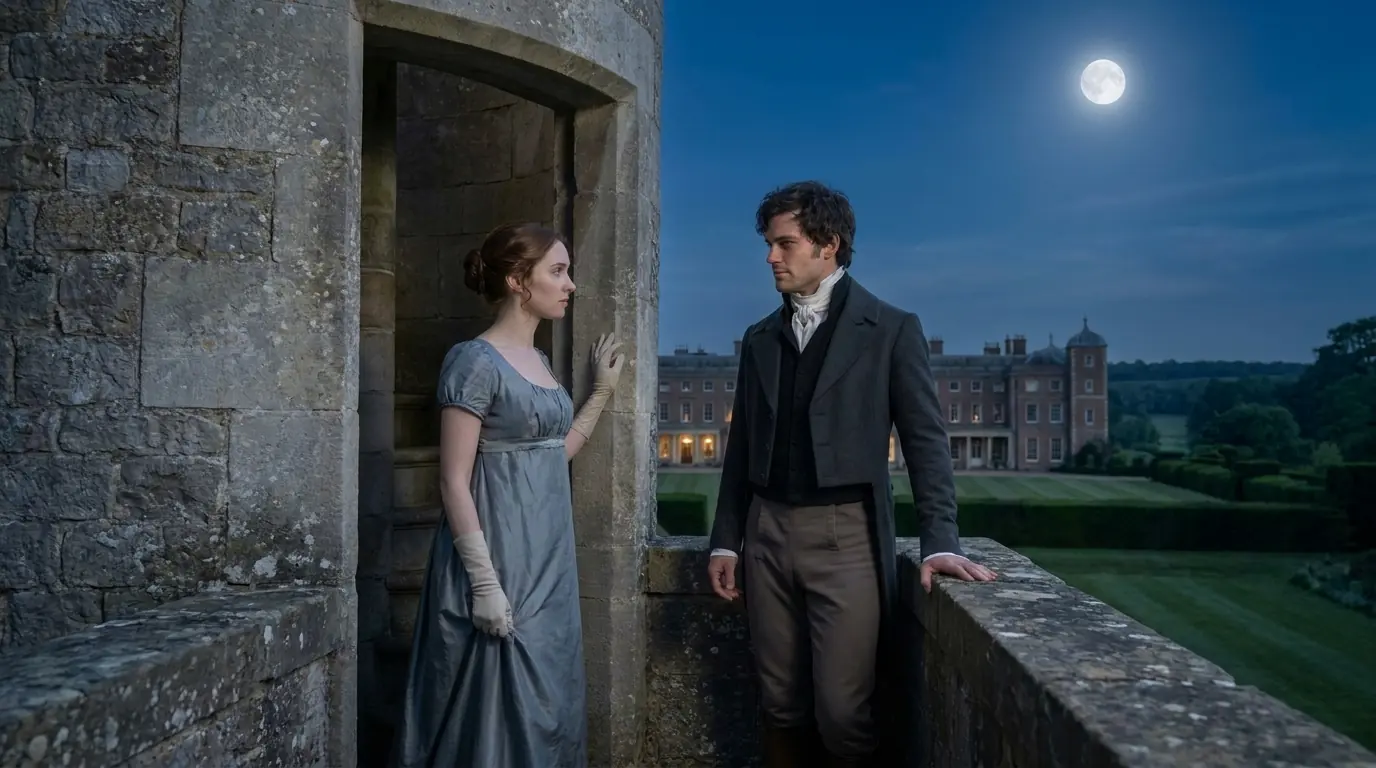
She had told herself a great many things.
Across the room, her cousin Cassandra laughed at something a gentleman had said, and the sound carried bright and easy, the way everything about Cassandra carried. Heads turned toward her as they always did, helplessly, as though she were a window thrown open in a stuffy room. Lynette did not resent her for it. That was the strange, quiet ache of loving someone who outshone you without ever meaning to. There was no one to blame, only the small, persistent mathematics of being the plainer cousin in the room, the poorer relation, the girl in the mended gown standing three feet from the punch table because it gave her somewhere to look besides the crowd.
She had torn her own gown an hour before the carriages arrived. Cassandra's spaniel, overexcited by the commotion of dressing, had darted between Lynette's feet on the stairs, and she had caught her heel in the delicate lace of the pale blue gown—the only dress ever made entirely for her—and heard it rip clean from the waist seam. There had been no time to mend it. Her aunt, sweeping past with a comb in one hand and irritation already written across her face, had said only, "Wear your mother's, then, and be quick about it," as though the matter were beneath further discussion. So Lynette had put on a dead woman's dress and descended to a ball she had never wished to attend.
She was twenty-three, well past the age of expecting miracles from ballrooms, and invisibility ought not to have troubled her so much. Yet there was something about that night—the heat of too many candles, the press of silk and perfume, the particular cruelty of a string quartet playing something achingly lovely while she stood unclaimed at the edges—that made invisibility feel less like relief and more like erasure. She waited until no one appeared to be watching, then slipped through a side door onto the terrace. From there she moved past hedges silvered with moonlight toward the old stone tower at the far end of the garden.
She did not know that she was being watched.
A tall man in a dark coat had made his own quiet escape from the crowded rooms nearly twenty minutes earlier. At the sight of her crossing the lawn alone, he went still, struck by the particular way she held her shoulders—the posture of a woman who had spent much of her life trying to occupy less space than she deserved. He did not follow her, not yet. He only watched her go, and something in him that had long remained closed, like a window shuttered against rough weather, opened just enough to admit the cold, clean air of curiosity.
The tower had stood at Marlowe Hall longer than the house itself, a relic of an earlier century preserved for its view of the valley and for children's games of knights and princesses on quieter days. Lynette had discovered its winding staircase on her first visit to her aunt's home, when she was twelve, newly orphaned, and newly aware that she would never again live anywhere that was fully hers. She had climbed it then to cry where no one could see her. She climbed it now for much the same reason, though she was too proud, even alone, to admit that was what she was doing. With one hand trailing along the cold stone and the other gathering her borrowed skirts, she climbed until the noise of the ball had faded into a distant golden murmur.
When she emerged onto the small open platform, ringed by a low parapet, the entire moonlit valley fell away below her. She was not alone. A man stood at the far side, his back half-turned, one hand resting loosely on the ledge as though he had been there some time watching the same stars she had come to see. At the sound of her step, he turned, and for one unguarded instant surprise crossed his face. Then came something more startling still: not displeasure, but interest.
"Forgive me," Lynette said at once, retreating toward the stairs. "I did not know anyone had come up."
"Do not go on my account." His voice was low and unhurried, entirely without the polished performance she associated with the gentlemen below. "I confess I came here for much the same reason you did, I imagine. It grows very loud down there after a while."
She hesitated at the top of the stairs. In the moonlight, she could make out only the shape of his face: a strong jaw, dark hair disordered as though he had run a hand through it more than once, and eyes that studied her with an attention she was not accustomed to receiving.
"I am enjoying it a great deal more now than I was five minutes ago."
She did not know what to make of that, so she said nothing. Sensing her uncertainty, he gestured toward the parapet beside him.
"There is a fine view of the valley from here. I doubt many of the guests below even know the tower is open tonight."
"I have known of it since I was a girl," she admitted, coming forward despite herself. Something in his voice asked nothing of her and performed nothing for her. "I used to climb it to be alone."
"And tonight?"
"Tonight is much the same." The answer escaped before she could stop it. Color rose into her cheeks, and she was grateful for the darkness. "Forgive me. That was not a fit thing to say to a stranger."
"I would rather hear a true thing badly timed than a pleasant thing that means nothing," he said. "Most people at that ball have said a great many pleasant things to me tonight. You are the first honest one."
They stood a little apart at the parapet. The valley spread silver and black beneath them, and the silence that followed was strangely comfortable. The wind lifted a loose curl from Lynette's temple, and she did not reach to smooth it. For the first time that evening, she did not feel measured and found wanting.
"You came a long way up in that dress," he said at last. "It looks old—not unfashionable, but old, as though it belonged to someone before you."
Lynette stiffened, waiting for the small cruelty that usually followed such observations, the cutting remark disguised as curiosity that Cassandra's friends delivered so skillfully. It did not come.
"It was my mother's," she said, surprising herself with the truth. "She died when I was young. I do not often wear it. There was an accident with my own gown tonight, and there was no time to mend it."
"It suits you," he said simply. "Better, I think, than whatever fashionable thing you intended to wear."
She laughed before she could stop herself, a short, startled sound unlike the practiced laugh she had schooled herself to produce in company. "You cannot know that. You have not seen the other gown."
"No," he agreed. "But I can see this one and the woman wearing it, and I find I have no complaint to make of either."
The compliment, if it was one, was delivered so plainly that she did not know how to receive it. She had been complimented before in the calculated manner of ballrooms, where every kind word carried the faint aftertaste of obligation or strategy. This felt different. It felt like a man saying something simply because he believed it was true.
"I ought to go back down," she said, though she made no move to do so. "My aunt will wonder where I have gone."
"Will she?"
It was not quite a question. Something in his tone suggested he had already guessed a good deal about her aunt and about the particular unhappiness of being a poor relation at a wealthy woman's ball. Lynette wondered, with a small private unease, how much a stranger could read from so little.
"I should go," she repeated more firmly, turning toward the stairs.
"Wait."
He did not reach for her. He was careful—always careful, she would later remember, never presuming more of her than she offered. Still, the single word stopped her.
"I do not know your name."
For one reckless moment, she considered giving him a false one. It would have been easier and would have cost her nothing. But something about the honesty of the tower, and the honesty he had drawn from her without demanding it, made a lie feel impossible.
"Lynette," she said. "Lynette Hartley."
"Lynette," he repeated, as though testing the shape of it. Something in the way he spoke made her feel absurdly that he had been waiting to hear it. "It is a fine name. Songbirds are undervalued, I think. Everyone prizes the peacock and forgets the bird that actually sings."
She did not know how to answer, so she inclined her head and descended the dark staircase, her heart beating harder than the climb alone could explain. Only when she had nearly reached the bottom did she realize she had never asked his name.
She learned it the following morning over her aunt's breakfast table, when the whole household erupted into the particular excitement reserved for news of consequence. Her aunt's voice rose an octave, and Cassandra's spoon clattered against her saucer.
The Duke of Rothermere had been at the ball.
He had come, it was said, at his mother's quiet urging, to look over the season's most promising young ladies with an eye toward marriage. He was twenty-six, possessed vast estates, and had remained unmarried far longer than fashion considered reasonable. His manner was famously reserved. He had spoken to almost no one at the ball, left before the final dances, and shown no clear interest in any lady present—except, Lynette's aunt added with great significance, that one of the footmen had seen him climbing the garden tower alone and returning a quarter of an hour later looking like a man who had seen something worth returning for.
"It must have been Cassandra he meant," her aunt declared, already turning the full weight of her ambition toward her daughter. "She walked in the gardens for a time last night, did she not? My dear, it must have been Cassandra."
Lynette said nothing. She sat very still while her tea cooled before her and allowed the words to settle over the table like snow. What could she possibly say? That she had been the woman on the tower? That the man everyone now called a duke had spoken to her plainly, as though she were a person worth speaking to? That he had known nothing of her poverty or of her family's disappointment in her, had known only her name and the true thing she had said without meaning to, and had seemed, in that ignorance, more interested in her than any man had been in years?
It was nothing, she told herself firmly. A stranger's kindness on a dark tower, offered to a woman he could not properly see. It meant nothing and would come to nothing. She would not allow herself to hope for more. Hope, in her experience, was a costly and unreliable traveling companion, and she had learned long ago to travel without it.
She did not know that Gideon Ashworth, Duke of Rothermere to society and Gideon only to the very few who had ever known him closely, spent that same breakfast hour standing at his study window with a cup of chocolate cooling untouched at his elbow. He was not thinking of Cassandra Hartley, whose name and prospects his mother had recited with careful enthusiasm the week before. He was thinking of a woman in an old blue-gray gown who had told him, without knowing who he was, that she climbed towers to be alone. He had gone to the ball prepared to be bored. He had left unable to stop thinking of Lynette Hartley.
It was three days before he called at Marlowe Hall. When the carriage bearing the ducal crest rolled up the drive, the household fell into the particular chaos only the arrival of a title could produce. Lynette's aunt swept Cassandra into the best parlor and arranged her upon the sofa in the strongest light, like a woman placing a treasured ornament. Lynette was told, without unkindness but without hesitation, that she might attend to the tea things in the kitchen. There was no need, her aunt explained, for so many young ladies underfoot when a duke came calling.
Lynette did not argue. She had learned not to.
The second housemaid had taken ill, so Lynette carried the tea tray herself. She entered the parlor with her eyes lowered and her borrowed composure fixed carefully in place. She did not look up until she heard him say her name.
"Miss Hartley."
She raised her eyes. He stood near the window, and daylight showed her what moonlight had concealed. He was younger than she had imagined and graver, with a face made for restraint rather than display. His eyes fixed upon her with such intensity that she nearly dropped the tray.
"Your Grace," she managed, setting it down with hands that were not quite steady.
Her aunt's expression passed through surprise, calculation, and something very near alarm before settling into a bright, brittle smile. "You are acquainted with my niece, Your Grace?"
"We met at your ball," he said, his gaze still upon Lynette. "On the garden tower. Until this moment, I did not know she was your niece rather than your daughter."
The silence that followed was thick enough to touch. Cassandra's smile faltered. Lynette's aunt did not visibly waver, but something behind her expression hardened, and Lynette felt the familiar cold drop of dread in her stomach—the sense that she had disturbed, without intending to, some careful arrangement built around her.
"My niece is a great help to this household," her aunt said smoothly, in a tone that managed to praise and diminish her in the same breath. "She has been with us since she was a girl. Her circumstances, I am afraid, are not what they once were."
"I did not ask after her circumstances," Gideon said, with a mildness that did not quite conceal its edge. "I asked after her name, and I find I have thought of little else since."
Lynette did not remain for the rest of the visit. She excused herself on the pretense of fetching more sugar and did not return until she heard the duke's carriage wheels moving away over the gravel. When she entered the parlor again, her aunt sat perfectly upright upon the sofa, and Cassandra was crying quietly and furiously into a handkerchief.
"You said nothing to me," her aunt said, "of meeting a duke on the tower."
"I did not know who he was," Lynette replied, which was true and did nothing to soften the moment.
"You will not encourage him. You have no fortune, Lynette, no connections beyond this house. Whatever passed between you on that tower was a moment's fancy, nothing more. You would do well to remember that before you allow yourself to believe otherwise. A man like that does not choose a woman like you. He is confused. Men of his rank sometimes mistake novelty for feeling."
The words were meant to wound, and they did, precisely because Lynette had already half-believed them herself. She had spent three days telling herself the same thing in gentler language. She murmured something that might have been agreement, went to her room, and did not come down again until supper. Long after the house had gone quiet, she lay awake telling herself her aunt was right, that it would come to nothing, and that she would not permit herself to want it to.
Gideon called again four days later. This time, he asked plainly and without apology whether Miss Lynette Hartley might walk with him in the garden. Her aunt could not refuse a duke, whatever her private feelings. Lynette found herself beside him on the same path she had crossed alone on the night of the ball, the tower now visible in daylight at the far end of the lawn, its ancient stones pale and almost ordinary beneath the sun.
"Your aunt does not approve of my calling," he said once they were beyond earshot of the house.
"My aunt does not approve of a great many things," Lynette replied. "Chief among them is the notion that I might be worth calling upon at all."
She had not meant to say anything so raw, so plainly bitter, and she braced herself for pity or for the awkward retreat of a man confronted with a wound he had not expected to find. Instead, Gideon stopped walking and turned to face her. There was no pity in his expression, only a quiet, focused anger that startled her.
"Then your aunt is a fool," he said. "And I do not say that lightly. I have met a great many women this season who were presented to me as prizes—dressed, arranged, and coached to please me—and not one of them said a single true thing in my hearing. You told me on a dark tower that you climbed it to be alone because the noise below became too loud, and you did not know who I was when you said it. That has remained with me every day since."
He took one step closer, not enough to crowd her, only enough to make clear that he wished her to hear every word.
"I did not come here to indulge a fancy. I came because I have not been able to stop thinking of you, and because I begin to suspect that you have spent your whole life being told you are worth less than you are. I find I cannot bear it."
No one had ever spoken to Lynette with such unguarded directness. Something in her chest seemed to crack open painfully, like ice giving way beneath the first warmth of spring.
"You know nothing of me beyond a quarter of an hour on a tower," she said, though her voice had lost its firmness.
"Then let me know more. Walk with me. Talk with me. Let me be wrong about you if I am wrong, but let me discover it for myself rather than accepting the judgment of a woman who has every reason to want me looking elsewhere."
After that, Lynette could not refuse him entirely, though she tried to guard herself against hoping too much. He called the following week and the week after that. Each visit followed much the same pattern: a walk in the garden, a conversation that moved from the trivial to the unexpectedly intimate, her aunt watching from a window with an expression that grew more brittle each time, and Cassandra becoming quieter and more watchful as the ground shifted beneath a household that had always revolved around her.
They spoke first of harmless things: the weather, the neglected rose beds, the book Lynette had been reading in secret because her aunt considered novels an indulgence. Then harmless things gave way to larger ones. Gideon spoke of the loneliness of inheriting a title before he had learned what sort of man he wished to become, and of the exhausting suspicion that every smile offered to him concealed a calculation. Lynette told him about arriving at Marlowe Hall at twelve with two trunks, her mother's old gowns, and no certainty that she would be permitted to stay. Neither of them offered false comfort. They simply listened, and in the listening each began to understand how rare it was to be met without performance.
He never treated her poverty as a tragedy from which he must rescue her, and she never treated his rank as proof that his life had been easy. That equality, quiet and almost invisible to anyone watching from the windows, mattered more to Lynette than compliments ever had. Yet every time his carriage left, she reminded herself that a duke could afford sincerity for an afternoon and still choose a suitable bride when the season demanded it. Hope had begun to return despite her discipline, and its return frightened her more than disappointment ever had.
On the fourth visit, Lynette finally asked the question she had carried since the morning after the ball.
"Why did you come to that ball at all? I understand you were expected to look over the season's ladies. Was Cassandra the woman you intended to see?"
Gideon was quiet for a moment. She saw something pass behind his eyes, not evasion but the careful weighing of a man deciding how much truth a moment could bear.
"My mother spoke of your cousin," he admitted. "She is well regarded and well connected, and by every measure my mother uses to judge such things, she might have made a suitable match. I will not pretend otherwise. I went to the ball with the vague intention of being agreeable to Miss Cassandra Hartley, if the evening gave me cause."
Something cold settled in Lynette's chest, though she had half-expected the answer. "And then you found me on the tower instead."
"And then I found you on the tower instead," he said. "Everything I had gone there intending became, within a quarter of an hour, entirely irrelevant to me. I have not thought of your cousin since, Lynette, except to wonder how one family could contain two such different women and properly value only one of them."
"You cannot know that what you felt was real," she said. The words came sharper than she intended, edged by the fear she had carried since her aunt's warning. "You met a stranger in the dark who said one true thing to you, and you have built a great deal upon it. What if it is only novelty? What if my aunt is right? What if you wake one morning and discover you mistook curiosity for feeling, and I am left having believed in something that was never mine to believe in?"
It was the most honest fear she had spoken aloud since her mother died. Gideon did not dismiss it. He stood with it, absorbing its full weight, and that, Lynette later understood, was the moment she truly began to trust him.
"I cannot prove a feeling to you with words alone," he said quietly. "I know that. But I can tell you this: I have spent six years being courted for my title and my land by women who never once asked what I wanted, because it did not occur to them that I might want anything beyond what I already possessed. You have never asked me for anything, Lynette—not my name, not my rank, not my fortune. You did not even know who I was when you told me the truest thing anyone has said to me in years. If that is novelty, then I hope I never recover from it."
She could not answer. Her throat had closed around something too large for words. But when he took her hand briefly at the foot of the tower, she did not pull away. Some long-guarded and carefully rationed part of her heart began, cautiously, to believe.
The trouble, as it so often does, came from inside the house rather than from beyond it.
Cassandra had said little during the weeks of the duke's courtship, but her silence had been building toward something. It broke one evening when Lynette entered the drawing room and found her cousin waiting alone, pale and rigid.
"You have taken him," Cassandra said without preamble. "The way you take everything that ought to have been mine. Do you think I do not see it? Do you think Mother does not see it? You came into this house with nothing, Lynette—no fortune, no name worth mentioning—and you have spent ten years allowing us to clothe you, feed you, and treat you as one of our own. This is how you repay us: by stealing the one match that might have secured this family's future."
The words struck exactly where they were intended, in the tender place where gratitude and resentment had always lived side by side in Lynette's heart. She had never asked to be taken in. She had never asked to be reminded, so consistently and precisely, of the debt she was expected to repay through obedience, gratitude, and a willingness to disappear into the background of every room.
"I did not seek him out," she said, her voice trembling despite her effort to steady it. "I climbed a tower to be alone, Cassandra, as I have always done. He happened to be there. I did not take anything from you. He was never yours to lose."
"He was meant to be." Tears stood in Cassandra's eyes now, real ones. Lynette, wounded as she was, felt a flicker of pity for her cousin, who had spent her life being told she was owed the world and was only now discovering that the world did not always agree. "Everyone expected it. My mother built the whole season around it. And you—quiet, plain, forgotten Lynette—you took him without even trying, without even wanting him, and left me with nothing."
"I did not take him without wanting him," Lynette said softly. The admission cost her something, but it was true, and she was suddenly tired of pretending otherwise. "I want him, Cassandra. I have wanted very little in my life because wanting has usually led to disappointment, and I learned long ago to guard myself against it. But I want this. I am sorry that it causes you pain. I am not sorry for wanting it."
Cassandra left without another word. Lynette remained alone in the drawing room for a long time, her hands pressed to her mouth, uncertain whether what she felt was grief, relief, or some tangled combination of both.
Her aunt did not confront her directly, but the household grew colder in the weeks that followed. The retaliation came in small cruelties disguised as practicality. Lynette was given more chores and fewer invitations. Her meals became smaller, her private hours fewer. She said nothing to Gideon, partly from pride and partly because she feared that, if she asked him to rescue her from her own family, she would become exactly the kind of burden her aunt had always accused her of being.
He noticed without being told.
One afternoon, he arrived to find her thinner than she had been a fortnight earlier, her hands roughened from work not reasonably expected of a lady. Something in his face became very still and very dangerous.
"Who has done this to you?"
It was not a question.
"No one has done anything," she replied. "I am only tired. It has been a difficult season."
"Lynette." He spoke her name as he had on the tower, as though it were something precious he feared dropping. "I am not a fool, whatever else I may be. I see what has changed in this house since I began calling upon you. I will not stand by and watch you punished for a courtship I began. Tell me what has happened."
She told him at last. Not all of it, not the long years of quiet erasure that had preceded him, but enough: the extra work, the cold meals, the whispered remarks she was intended to overhear. He listened without interruption, his jaw tightening with every detail. When she finished, he stared toward the garden for a long time.
"I will not ask you to endure this," he said. "Not for my sake and not for any sake at all. You have endured enough in your life without adding my courtship to the list of things that cost you comfort in your own home."
"What would you have me do? Refuse you? Send you away so my aunt may forgive me and my life may return to what it was?"
"No."
He turned to face her fully. There was something new in his expression now: decisiveness, a settling of purpose, as though a private debate within him had finally resolved itself.
"I would have you marry me, Lynette Hartley. I would have you leave this house forever and never again spend a single day being made to feel less than you are."
She stared at him, certain she had misheard. "That is not a proposal. That is a rescue."
"It is both," he admitted. "And I will not apologize for either."
He stepped closer, though he still did not touch her.
"I love you. I did not expect to say it so plainly on a garden path without flowers, music, or any of the things meant to accompany such declarations. But I have never been a man for performance, and you have never asked me to be one. So I will simply say it. I love you, and I have loved you, I think, since a woman in an old blue-gray gown told me a true thing on a dark tower and did not know I was worth lying to. Marry me. Let me choose you plainly and completely before everyone who has ever made you feel unchosen."
Lynette began to cry then, quietly. The tears she had restrained through weeks of small cruelties and years of careful self-erasure finally broke free. Gideon did not reach for her at once or presume upon her answer. He only waited with one hand open at his side until she stepped into it herself.
"Yes," she said when she could speak again. "Yes, I will marry you."
Gideon went into the house with her and asked to speak to her aunt before the afternoon was over. Lynette was not present for the whole interview, but the voices carried through the closed drawing-room doors: her aunt's disbelief, her attempt to speak of suitability and family obligations, and Gideon's calm refusal to permit Lynette to be discussed as though she were an inconvenience he had failed to notice. When the doors opened, her aunt's face was pale and rigid. Gideon's expression was unchanged. The engagement was announced that evening, not as a favor to a poor relation, but as the deliberate choice of the Duke of Rothermere.
Cassandra withdrew to her room and would not receive Lynette. That refusal hurt more than Lynette wished to admit. She had loved her cousin through all the uneven years between them, through every careless kindness and every unconscious cruelty, and some part of her had hoped that love would prove stronger than humiliation. It did not, at least not then. Lynette allowed herself to grieve, but she would not surrender the life before her merely to preserve the comfort of those who had expected her to remain small.
The wedding, when it came, was not large. Lynette asked for something small and true rather than the grand, performative spectacle her aunt might once have arranged for Cassandra. Yet every member of the household who had once overlooked her attended, and Lynette stood at the front of the chapel in a gown entirely her own, chosen by herself for the first time in her life. She did not feel invisible at all.
Her aunt attended, stiff and correct, and offered congratulations born more of duty than warmth. Standing on the far side of a threshold she had never expected to cross, Lynette found she could forgive the coldness, at least in part, because she no longer required her aunt's approval to know her own worth. Cassandra did not attend, and Lynette grieved privately for what might have existed between them if the world had made room for both women to be valued at once. She remembered Cassandra laughing beneath the ballroom candles, brilliant and apparently effortless, and understood at last that being favored had trapped her cousin in expectations of a different kind. But Lynette did not allow that grief to poison the joy of the day. Her happiness did not require anyone else's ruin in order to be real.
That evening, they returned to Gideon's estate—her estate now, Lynette reminded herself, still marveling at the strangeness of it. Before they entered the house, he took her hand and led her without explanation around the side of the building. At the edge of the garden stood a small stone folly, smaller than the tower at Marlowe Hall but unmistakably built in its likeness.
"I had it built the week after our wedding was announced," Gideon admitted. He looked almost sheepish, a quality she found unbearably dear after months of watching him remain so composed. "I know it is a strange gift for a bride, but I wanted you to have a place here that was entirely your own from the first day. Somewhere you could climb to be alone if the noise below ever grew too loud, and somewhere you would never again have to wonder whether anyone would follow."
Lynette climbed the narrow staircase that evening in her wedding gown, her hand in his. At the top, with the quiet sweep of her new home spread golden and safe beneath the darkening sky, she understood fully and finally what it meant to be seen. Not admired from a distance, not measured and found wanting, but truly seen in the particular, unglamorous truth of who she was—and chosen anyway, and chosen still.
"I used to think," she said softly, leaning into him as the last light faded from the valley, "that towers were only for hiding in."
"And now?" he asked, his arms settling around her, steady and sure.
"Now I think they are for finding someone, too, if the right person is willing to climb."
Below them, the house glowed with warm, waiting windows. Above them, the first stars had begun to appear. There was no crowd left to escape and no ballroom noise to flee, only the quiet, settled peace of two people who had found each other in the dark and had no intention of ever letting go.