The letter arrived on a Tuesday, smudged with trail dust and folded so many times the creases had worn soft as cloth. Sarah Merritt held it between her fingers like it might dissolve, standing in the doorway of the mercantile where she’d worked for three years, watching the ink blur slightly in the afternoon heat. Behind her, Mrs. Pulk was arranging tins of peaches, humming something tuneless, and Sarah knew she had maybe two minutes before questions started flying. She stepped outside. The sun hammered down on Crest Falls’ main street, turning the dirt to powder that rose with every passing horse.
Sarah moved to the shade of the overhang and read the letter again, though she’d already memorized every word during her lunch break. Widow, six children, ranch outside Bitterroot, two days north, seeking a woman of good character and strong constitution. No romance required, just partnership, honest work for honest pay. She’d answered the advertisement four weeks ago, sitting at her narrow desk in the boarding house room she rented from the Hendersons, writing by candlelight because oil cost too much. She hadn’t expected a reply. Women like her, thirty-one, plain-faced, too tall, and too angular, didn’t get replies. But here it was, signed Calibb Stone in handwriting that looked like it had been carved rather than written.
Mrs. Pulk had emerged from the mercantile, wiping her hands on her apron, her eyes already sharpening with curiosity. “Just correspondence,” Sarah said. “From who?” “A cousin.” Mrs. Pulk’s mouth tightened. She didn’t believe it, but she also didn’t press. Not yet. She would later over supper or tomorrow when the store was quiet. Sarah had learned that secrets in Crestfall lasted about as long as morning dew. “Well, don’t linger too long. We’ve got a shipment coming in before five.” Sarah nodded and tucked the letter into her skirt pocket. Her hand brushed against the other letter there, the one from Dr. Brennan in Silver City, written six months ago in precise clinical script. Complications from the fever, permanent damage. I’m very sorry, Miss Merritt.
Calibb Stone smelled like woodsmoke and horse sweat when he met her at the station. Sarah’s first thought was that he looked tired in a way that went deeper than lack of sleep. He was maybe thirty-five, broad through the shoulders, with dark hair that needed cutting and lines around his eyes that could have been from squinting at the sun or from something heavier. “Miss Merritt.” “Yes.” He nodded once, picked up her single carpet bag without asking, and started toward a wagon hitched to two bay horses that looked better fed than most people Sarah knew. She followed, her boots stirring up dust, her dress already clinging to her back in the heat. Bitterroot was smaller than Crestfall, just a handful of buildings scattered along a rutted road, and the mountains in the distance looked close enough to touch.
“It’s about an hour to the ranch,” Calb said as he helped her onto the wagon seat. His hands were rough, his grip firm, but not unkind. “Kids don’t know you’re coming. Thought it would be easier that way.” “Easier for who?” He glanced at her, and for a second something almost like humor flickered in his face. “Fair question.” They rode in silence for the first twenty minutes, the wagon creaking beneath them, the landscape opening up into rolling grassland dotted with cattle. Sarah watched the horizon and tried not to think about the fact that she was riding toward a life she’d agreed to in a letter with a man she’d never met to raise children who weren’t hers and never would be.
“My wife died two years ago,” Calb said suddenly. “Influenza. She was… she was good. Real good. Kids miss her something fierce.” “I’m sorry.” “Yeah.” He was quiet for a moment, then added, “I tried managing on my own, but it’s too much. Ranch work, the kids, keeping the house from falling apart. I need help. They need someone who will stay.” Sarah heard the weight in that last word. “I’ll stay.” He looked at her then, really looked, like he was trying to see past the surface to whatever was underneath. “Why’d you answer the ad?” She could have lied. Could have said something about wanting a fresh start, about adventure, about any of the reasons women usually gave when they were being polite. But something in his face, maybe the exhaustion, maybe the honesty, made her choose truth instead.
“I can’t have children,” she said quietly. “Found out last year. Figured no man would want me for a wife after that, but maybe someone would want me for this.” Calb’s jaw worked for a moment, then he nodded slowly. “That’s honest with everyone.” “Only when it matters.” “It matters.” He turned his attention back to the horses. “Kids’ names are Emma, Daniel, Lucy, Thomas, Grace, and Samuel. Emma’s the oldest, thirteen. Samuel’s four. They’re good kids. Wild sometimes, but good. I don’t expect perfect, because you won’t get it.”
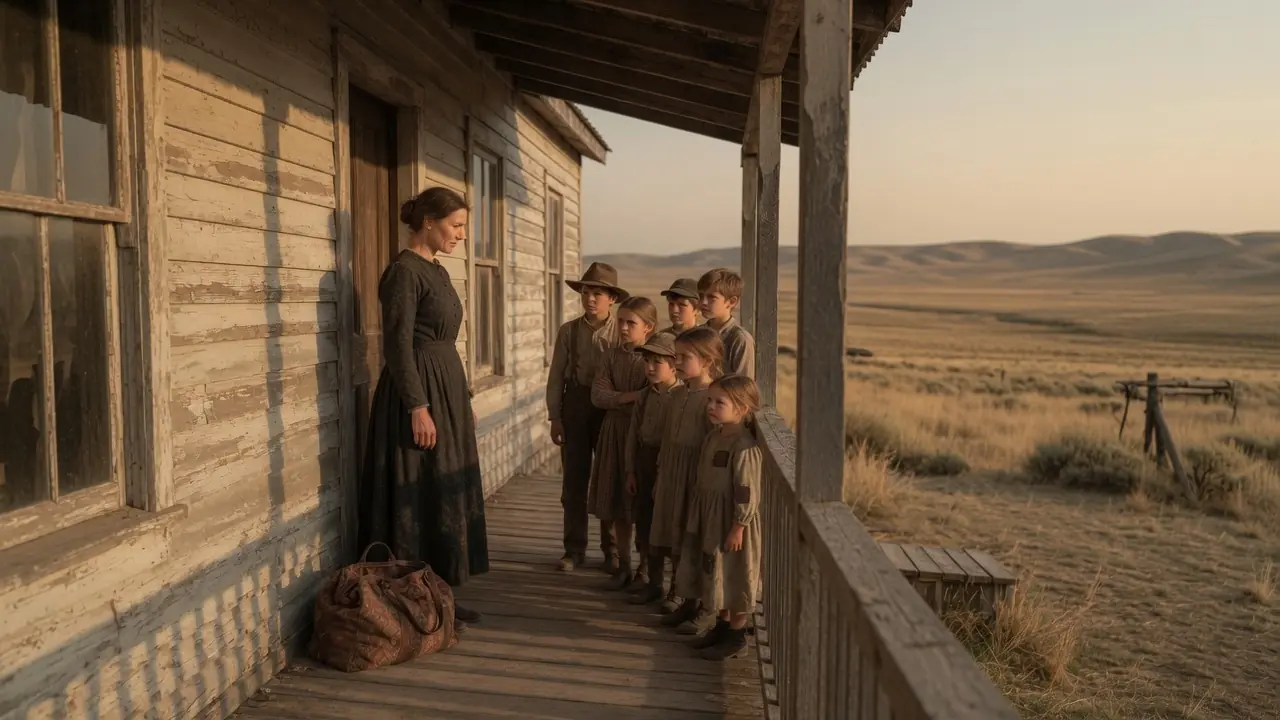
The ranch house was bigger than Sarah expected. Two stories of weathered wood with a porch that wrapped around the front and a stone chimney rising from one end. Chickens scattered as the wagon pulled up. And somewhere behind the house, she could hear children’s voices, high and excited, tangled together in a game she couldn’t quite make out. Calb set her bag on the porch. “I’ll introduce you, then I’ve got to check the north fence before dark.” “I’ll handle supper,” Sarah said. He studied her for a long moment, then nodded. “All right.”
The children came around the corner in a rush, six of them ranging from tall and gangly to small and dirty-kneed, all of them stopping short when they saw Sarah standing on the porch. Emma was in front, a thin girl with dark braids and her father’s serious eyes. The others bunched behind her like she was a shield. “This is Miss Merritt,” Calb said. “She’s going to be staying with us, helping out.” “For how long?” Emma’s voice was flat. Careful. “Permanent, if it works out.” Sarah saw the way Emma’s face closed up, the way the younger children exchanged glances. She’d expected this, the suspicion, the loyalty to a mother who wasn’t here anymore. But it still felt like stepping into cold water.
“I’m not trying to replace anyone,” Sarah said quietly. “I’m just trying to help.” Emma’s eyes narrowed slightly. Then she turned to her father. “We were doing fine.” “We were getting by,” Calb corrected. “That’s not the same thing.” One of the middle children, Lucy, maybe ten, with blonde hair in tangles, tugged on Emma’s sleeve. “Is she going to make us do more chores?” “I’ll make supper tonight,” Sarah said, “and we’ll figure out the rest as we go.” She didn’t wait for permission. She picked up her bag and walked into the house, leaving them standing in the yard. And if her hands were shaking slightly as she set the bag down in the front room, well, nobody needed to know that.
The kitchen was a disaster. Dishes piled in the basin, flour dusting the counter, a pot with something burned stuck to the bottom sitting on the stove. Sarah rolled up her sleeves and got to work. Pumping water, scrubbing, organizing. She found potatoes in a bin, onions hanging in a net, a side of salt pork in the cold box. Basic, but enough. She was peeling potatoes when Emma appeared in the doorway. “You don’t have to do that,” the girl said. “I know.” “I mean, I usually do,” Emma added, gentler this time. Sarah set down the knife and turned to face Emma properly. “You’ve been doing a lot, haven’t you?” Emma’s jaw tightened. “Somebody had to.” “You’re right. But you’re thirteen. You shouldn’t have to do it all.” “Mama did.” The words hung in the air, sharp and defensive.
Sarah took a breath, chose her next words carefully. “I’m sure she did, and I’m sure she was wonderful at it, but I’m not here to be your mama, Emma. I’m here to help your dad and to make things a little easier. That’s all.” Emma stared at her for a long moment, then turned and walked out. Sarah went back to the potatoes. Supper was quiet, awkward, the kind of meal where everyone focused on their plates and the scrape of forks on tin was the loudest sound in the room. Calb sat at the head of the table, the children arranged on either side, and Sarah had taken the spot at the far end, feeling like an intruder even though she’d cooked the food they were eating.
“It’s good,” Daniel said suddenly. He was maybe ten, freckled, with a gap between his front teeth. “Better than Emma’s.” Emma shot him a look that could have stripped paint. “Emma’s cooking is fine,” Calb said firmly. “Miss Merritt’s is also fine. We are grateful for both.” “Thomas,” younger than Daniel, with dark curls and gravy on his chin, piped up. “Are you going to sleep in Mama’s room?” The table went silent. Sarah set down her fork carefully. “I don’t know yet. Your father and I haven’t discussed it.” “You can have the spare room upstairs,” Calb said. His voice was even, but Sarah saw the tension in his shoulders next to the girls. Emma stood abruptly, her chair scraping back. “May I be excused?” Calb nodded, and she left, her footsteps heavy on the stairs. The younger children watched her go, then turned back to their plates, subdued now, the brief moment of normalcy shattered.
Sarah finished her meal in silence, helped clear the table, and retreated to the spare room as soon as she could. It was small, plain, with a narrow bed and a window that looked out over the dark fields. She sat on the edge of the mattress and let herself feel the full weight of what she’d done. Leaving Crestfall. Coming here. Stepping into a family that didn’t want her and a life that felt like trying to fit into someone else’s clothes. But when she lay down and closed her eyes, she didn’t let herself cry. She had made her choice.
The first week passed in a blur of work and silence. Sarah cooked, cleaned, mended clothes, tended the garden behind the house. The children orbited around her like wary animals, close enough to observe but not close enough to trust. Emma barely spoke to her. Daniel and Thomas were polite but distant. Lucy watched her with big, solemn eyes. Grace, who was six, sometimes smiled but always ran away if Sarah smiled back. Samuel, the youngest, clung to Emma like a shadow. Calb was gone most days, working the ranch, fixing fences, dealing with cattle. When he came in at night, he was too tired for conversation, just nodded his thanks for the meal and disappeared into his room. Sarah told herself it would get easier. She told herself she just needed time.
But on the eighth day, when she found Emma crying in the barn, hidden behind a stack of hay bales, everything shifted. Sarah almost walked away. This wasn’t her business. Emma had made it clear she didn’t want comfort from a stranger. But something stopped her. Maybe it was the sound of the girl’s sobs, raw and desperate. Or maybe it was the memory of her own grief, the kind that had no place to go. She sat down a few feet away, not too close, and waited. Eventually, Emma’s crying slowed. She wiped her face with her sleeve and glared at Sarah. “What do you want?” “Nothing. Just making sure you’re all right.” “I’m fine.” “You don’t sound fine.”
Emma’s face crumpled again, and this time she didn’t try to hide it. “I hate this. I hate that she’s gone and you’re here and nothing’s the same and it’s never going to be the same again.” Sarah’s chest ached. “You’re right. It won’t be the same.” “Then why are you here?” “Because your father needed help. Because you all needed help, even if you don’t want to admit it.” “We were fine.” “You were drowning,” Sarah said quietly. “I see it, Emma. You’re carrying too much, and it’s not fair, and I’m not here to take your mama’s place. I’m here so you can stop carrying everything alone.” Emma stared at her, tears streaking through the dust on her face. “I don’t know how to stop.” “Then let me help you figure it out.”
It wasn’t forgiveness. It wasn’t trust. But it was something, a crack in the wall. And when Emma nodded, just barely, Sarah felt the first fragile thread of connection pulled taut between them. Things changed after that, slowly, in small increments. Emma started talking to her. Not much, but enough. Daniel asked her to help him with his sums. Lucy brought her wildflowers from the field. Grace stopped running away. Thomas showed her his collection of interesting rocks. Samuel let her braid his hair one morning when Emma was busy. And Calb started staying at the supper table a little longer, asking about her day, telling her about the ranch. They weren’t friends exactly, but they were becoming something. Partners, maybe. Two people trying to build something functional out of broken pieces.
One evening after the children were in bed, Sarah found him on the porch, sitting on the steps, staring out at the dark fields. She almost went back inside, but he glanced over and said, “You don’t have to disappear every night.” She sat down beside him, keeping a careful distance. “Didn’t want to intrude.” “You’re not.” He was quiet for a moment, then added, “Kids are doing better. Emma especially. She’s strong. She’s had to be.” He looked at her then, his face half-shadowed in the dim light from the window. “You were right what you said in your letter about partnership. I think that’s what this is.” “Is that enough?” Sarah hadn’t meant to ask, but the question slipped out anyway. Calb considered it. “I don’t know yet. But it’s more than I had before.” She nodded, and they sat there in companionable silence until the night grew too cold and they went inside.
The turning point came in October when the first frost dusted the fields and Samuel got sick. It started as a cough, nothing serious, but by the third day he had a fever that wouldn’t break, and Emma was white-faced with fear, remembering influenza, remembering their mother. Calb rode for the doctor, and Sarah stayed with Samuel, sponging his forehead with cool water, singing songs her own mother had sung, holding his small, hot hand. The other children clustered in the doorway, watching, and Sarah saw the terror in their faces. “He’ll be all right,” she said, even though she didn’t know. Even though the fear was clawing at her own throat. “He’s strong. He’ll pull through.”
The doctor came, diagnosed pneumonia, left medicine and instructions. Calb and Sarah took turns sitting with Samuel through the nights, and somewhere in those long, dark hours, exhausted and terrified, they stopped being strangers. “I can’t lose another one,” Calb said on the fourth night, his voice breaking. Sarah reached across the space between their chairs and took his hand. “You won’t. We won’t.” And when Samuel’s fever finally broke on the sixth day, when his eyes fluttered open and he whispered, “Sarah,” instead of “Mama,” she felt something crack open inside her chest. Not grief this time, but something else. Something that felt dangerously like hope.
Winter settled over the ranch, and Sarah settled into her life there. She wasn’t Emma’s mother or Daniel’s or any of theirs, but she was theirs in a different way. Steady. Present. Someone who stayed. Calb smiled more. The children laughed more. The house felt less like a place people were just surviving and more like a home. And late one night in January, when Calb kissed her in the kitchen after everyone else was asleep, Sarah kissed him back and thought about how sometimes the things you thought you couldn’t have came to you in different shapes, unexpected and imperfect, and more precious because of it.
“I choose you,” he said against her mouth. “Not because I need help. Because I want you here.” Sarah pulled back just enough to see his face. “Even though I can’t—” “I choose you,” he said again, fierce now. “These kids are ours. This life is ours. That’s enough.” And standing there in the warm kitchen with flour still on the counter and dishes waiting in the basin, Sarah finally believed him. She had come here broken, thinking partnership was all she could hope for. She was leaving with something bigger. A family that was hers. A man who chose her. And a future that felt, for the first time in years, like it might actually be beautiful.