The notice arrived on a Tuesday, tucked into the hand of a smirking groomsman from Julian’s rented lodge. It was not an invitation so much as a declaration of war printed on thick, creamy cardstock that felt heavier and more valuable than anything left in Oak Haven Manor. The Duke of Blackwood, it announced, would be hosting his annual hunt. Eleanor Vance read the words in the gray morning light of the breakfast room, a room that had long forgotten the smell of bacon or fresh bread. It smelled now of damp stone and the ghost of beeswax.
Her cousin, Julian Thorne, sat opposite her, stirring a cup of weak tea he had insisted Mrs. Gable brew. He had been at Oak Haven for a week, a self-imposed visit that felt more like a siege. “A bit of sport,” Julian said, his voice slick with false conviviality. “It will be the event of the season in this dreary corner of the world.” “Of course, you shall be going.” It was not a question. It was a statement of fact, as plain and solid as the threadbare patch on the elbow of her gray morning gown.
Eleanor placed the card down beside her plate. “And why is that?” Julian gave a theatrical sigh, a performance for an audience of one. “My dear Eleanor, one must have a mount for a hunt, a proper hunter. And as I was just observing to your man Thomas, your stables are, well, they are a monument to equine history. One plow horse and a pony with a limp.” He took a delicate sip of his tea. “Hardly the impression one wishes to make on a duke.” The cruelty was in the gentleness of his tone. It always was.
For six months, ever since her father had passed, Julian had been circling Oak Haven like a patient vulture. The will had been a shock, her grandfather’s will, a document full of archaic clauses and strange stipulations that governed the estate. It was not hers outright. It was hers to keep only if she could prove by Michaelmas next that the estate was well-managed and productive. If not, it passed to the next male heir, to Julian. He was bleeding her dry, using his London lawyers to challenge every expenditure and question every tenant agreement. The estate was failing not because she was a poor manager, but because he was actively strangling it. The hunt was merely another turn of the screw, another way to remind her of her isolation and her poverty.
“Perseus is a fine horse,” she said, her voice quiet. Julian actually laughed, a short, ugly bark. “He’s a beast of burden, Eleanor. A magnificent one, I’m sure, but he’s meant for pulling a plow, not for clearing fences in pursuit of a fox. You would be a laughingstock.” She looked down at her hands resting in her lap. They were not the soft, pale hands of a lady. They were capable hands, stained with garden dirt and ink from the ledgers she pored over late into the night. She knew every field of Oak Haven, every stream, every crumbling stone wall. She knew this land in a way Julian, with his polished boots and sneering condescension, never would.
And in that moment, a seed of an idea, hard and defiant, took root. Julian wanted to humiliate her. He wanted to display her poverty to the entire county, to the one man whose influence was absolute, the Duke of Blackwood. The Duke owned the neighboring lands, and his word could sway any magistrate Julian might try to corrupt. If she was to be made a spectacle, then let it be a spectacle of her own making. She lifted her chin. “I will be attending.” Julian’s smile was a thing of sharp, predatory satisfaction. He believed he had just driven her into a trap of her own devising. “Excellent,” he purred. “I shall look forward to it immensely. Do try not to get left behind in the first meadow.” He rose, placed his napkin on the table, and sauntered out, leaving the scent of his expensive cologne to curdle in the damp air.
That afternoon she found Thomas in the stables. The air was thick with the sweet smell of hay and old leather. Perseus stood in his stall, his massive head hanging over the door. He was a Percheron, gray and dappled like a stormy sky, with feathered feet and a placid wisdom in his gaze. He nudged her hand with his soft nose, searching for the apple she always carried. “He wants her to fail, Thomas,” she said, her voice low as she stroked the horse’s powerful neck. “He wants the entire county to see me fall.” Thomas, a man of few words and even fewer illusions, continued to methodically polish a piece of brass from an old harness. He had served her father, and his father before him. He was as much a part of Oak Haven as the ancient oaks that gave the manor its name. “A horse knows the land,” he said, not looking at her. “And a horse knows its rider. That’s all there is to it.” “The Duke will be there,” she murmured. “They say he is formidable.” “He’s a man on a horse,” Thomas replied, setting down the brass. “Same as any other. Some sit taller is all.”
The preparations were a quiet act of defiance. Eleanor brought out her father’s old saddle. It was heavier than a lady’s sidesaddle and worn, but the leather was supple and strong. Thomas checked every stitch. She spent hours in the paddock with Perseus, not training him to jump—that would be madness—but reacquainting him with the feel of a rider, the subtle shifts in weight, the pressure of a knee. He was intelligent and willing, his gait a rolling, ground-covering trot that felt less like riding and more like being carried by a gentle hill. She worked on her riding habit. It was her mother’s, made of a sensible gray wool, refitted for her years ago. The seams were strong, but the color was faded, the style hopelessly out of date. She mended a small tear near the hem, her stitches small and neat, an invisible repair, a metaphor for her life.
The night before the hunt, Julian found her in the study, the ledgers spread out before her under the light of a single candle. “Still wrestling with your sums,” he asked, leaning against the doorframe. “There is an easier way, you know. My man of business has drawn up a most generous offer.” “My home is not for sale, Julian.” “It is not a home,” he said. “It is a pile of stones held together by ivy and debt. Tomorrow everyone will see it. They will see the last desperate daughter of a failed line tilting at windmills on a cart horse. They will pity you and then they will forget you.” She did not look up from the page. “Good night, Julian.” His silence was more menacing than his words. He lingered for a moment, then was gone.
Eleanor stared at the flickering flame of the candle. Pity was a weapon. She knew that. And tomorrow she would be handing it to her enemies, loaded and aimed at her own heart. But there was a difference between pity and respect. Pity was given to the weak. Respect was earned by the strong. And if she could not be elegant or wealthy or fashionable, then she would be strong. She would endure.
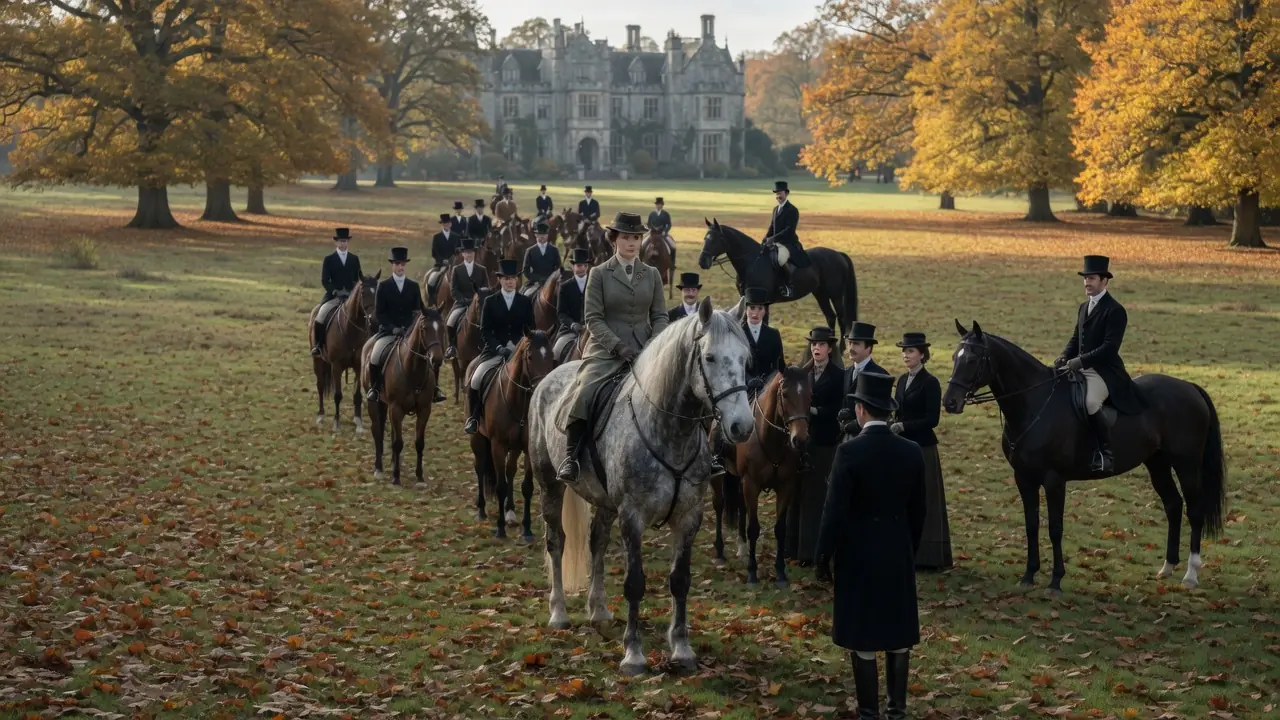
The morning of the hunt dawned cold and clear. The sky was a pale, unforgiving blue. A hard frost silvered the fields, crunching under Perseus’s heavy hooves as they made their way down the long rutted drive of Oak Haven. Eleanor sat astride, the man’s saddle feeling solid and secure beneath her. She was cold, but her resolve was a fire in her belly. The grounds of Blackwood Park were another world, a world of wealth, power, and effortless grace. Dozens of riders were assembled on the vast lawn before the great house, their mounts gleaming like polished chestnuts, their coats the colors of jewels. Laughter and bright chatter filled the air, plumes of breath misting in the cold.
As Eleanor rode Perseus onto the lawn, a hush fell. It started near the gate and spread like a ripple in a pond. Conversations faltered. Heads turned. The laughter did not stop, but its quality changed. It became quieter, sharper, aimed. She saw Julian, magnificent on a bay thoroughbred, holding court with a circle of fashionable ladies. He caught her eye and gave a small, almost imperceptible shake of his head, a pantomime of commiseration that was, in fact, pure triumph. Eleanor kept her gaze forward, her back straight. She guided Perseus to the edge of the crowd, taking her place near an old stone wall apart from the others. She felt the stares like physical things. A woman on a plow horse. It was absurd, a joke. She knew it, but she would not let them see it break her.
Then he appeared. The Duke of Blackwood. He rode out from the stables on a stallion as black as midnight, a creature of fire and muscle that made every other horse on the lawn look common. The Duke himself was cast in the same mold, tall and severe, with a face that looked as though it had been carved from granite, dark hair, eyes the color of a winter storm, and a mouth that looked as if it had never learned to smile. He was power incarnate. His gaze swept across the assembled company, a king surveying his court. It passed over her, then snapped back. For a moment, he simply stared. His eyes took in the whole picture: the faded gray habit, the heavy, sensible horse, the determined set of her jaw. A flicker of disbelief crossed his face, then something else. Pure, unadulterated amusement. It wasn’t a loud laugh. It was a short, sharp bark of sound quickly suppressed. He turned to the man beside him, murmured something, and the man chuckled. The Duke did not look at her again. He had seen, judged, and dismissed her in the space of a single breath.
The sound of his laugh, small as it was, echoed in the sudden silence of Eleanor’s mind. It was worse than Julian’s open mockery. It was the casual cruelty of a man so far above her that her presence was nothing more than a brief, comical diversion. A stone in his shoe. A fly in his wine. The shame was a hot, prickling wave. She felt her cheeks burn. For one terrible second, she wanted to turn Perseus around and flee, to retreat to the crumbling safety of Oak Haven. But then the huntsman raised a brass horn to his lips. The call, clear and wild, cut through the crisp air. The hounds, held in check by the handlers, began to bay, a chorus of frantic excitement. The horses shifted, their energy electric. The moment of choice was over. The hunt was on.
Alistair Sinclair, Duke of Blackwood, felt the familiar surge of adrenaline as his stallion Aris gathered himself for the first gallop. The thunder of hooves, the cry of the hounds, the mad, exhilarating rush across open country. It was one of the few things that could silence the constant grinding machinery of his thoughts. The responsibilities of the dukedom, the endless correspondence, the political maneuvering in London, all of it fell away, replaced by the simple, primal chase. He barely gave the woman on the draft horse a second thought. The sight had been so incongruous, so utterly out of place that the laugh had escaped him before he could check it. It was poor form, he knew, unbecoming of a host. But really, what was the woman thinking? This was the Blackwood hunt, not a country fête. It was a serious and dangerous business. He dismissed her as some eccentric local, a spinster with more pride than sense. She would be left behind before they even reached the first copse.
The pack streamed across the frosted meadows, a river of white and tan, their noses to the ground. The field of riders followed, a chaotic cavalcade of color and sound. Alistair held Aris back slightly, letting the most reckless of his guests surge ahead. He knew this land. Every rise and fall, every treacherous patch of bog, every shortcut. The hunt was not a sprint. It was a test of stamina and intelligence for both horse and rider. They cleared the first set of low stone walls, a ripple of riders flying over them. He glanced back out of habit, assessing his field, and he saw her. She was not attempting the jump. Instead, she was trotting the big gray horse along the wall to a spot where it had crumbled, creating a gap. She guided the horse through it with a quiet command, losing no momentum, and rejoined the throng on the other side. It was a sensible move, a practical one. Most of the ladies, determined to be seen as daring, had urged their more delicate mounts over the wall, landing with jarring force. Alistair frowned. It was a minor thing, but it was efficient.
The chase led them towards Briarwood, a dense and tangled forest that marked the boundary between his lands and the neighboring estate, Oak Haven. He knew of it, of course, a once proud property that had been sliding into neglect for years under the mismanagement of the late Mr. Vance. The daughter, he’d heard, was now trying to hold it all together. That must be her. The picture began to make a grim sort of sense. The faded habit. The plow horse. It wasn’t eccentricity. It was poverty. The thought soured the taste of the chase in his mouth. His laugh had not been aimed at an eccentric, but at a woman’s desperation. The knowledge sat uncomfortably in his gut.
Inside the woods, the pace slowed. The path was narrow and treacherous, a lattice of gnarled roots slick with damp moss. The air grew colder, smelling of earth and decay. The hounds’ cries became more sporadic as they worked to pick up the scent. Here the hot-blooded, flighty thoroughbreds were at a disadvantage. They danced nervously, their delicate legs ill-suited to the uneven ground. Alistair saw Lady Annelise, the season’s reigning beauty, pull her mare up short, the animal having stumbled badly. Further on, a young baronet was dismounting to check his horse’s leg. And then he saw Miss Vance again. She was moving through the trees on a parallel track, one he knew well, but that most riders avoided. It was steeper, but clearer. Her big horse placed its feet with the slow, deliberate confidence of an animal born to navigate difficult terrain. It did not fight the ground. It yielded to it, accommodated it, and the woman on its back moved with it, a part of its steady rhythm. She was not fighting the woods. She was part of them.
His curiosity now peaked, sharpened into something else. Respect. He watched as she came to a place where a great oak had fallen long ago, its trunk blocking the path. It was too high to jump even for his Aris. The main body of the hunt was forced to detour, adding a quarter of a mile to their route. Miss Vance, however, simply dismounted. She did not hesitate. She looped the reins over Perseus’s head, and with a soft word, led him through a narrow, difficult gap between the fallen trunk and a thicket of thorns. She moved with an economy of motion he had only ever seen in his most experienced grooms. Then she remounted smoothly and without fuss, and continued on. By the time the rest of the hunt emerged from the far side of Briarwood, breathless and scratched, she was already there, waiting patiently, her horse’s sides barely heaving.
Julian Thorne, her cousin, Alistair vaguely recalled, rode up beside her, his face flushed. Alistair was too far away to hear the words, but the man’s posture was aggressive, leaning in towards her. Miss Vance simply looked ahead, her expression unreadable, and Thorne eventually spurred his horse away in a show of pique. The fox broke cover then, streaking across the open land that stretched for miles. The chase was on again, faster and more frantic than before. This was where the thoroughbreds should have shone, on the long open gallop. But the ground was deceiving. It looked flat, but it was pitted with hidden dips and covered in tough, wiry heather that could trip a horse moving at speed.
Alistair let Aris have his head, the powerful stallion devouring the ground. He flew past rider after rider, his eyes fixed on the distant fox. But he was also now intensely aware of the gray horse and its silent rider. She was not trying to match their pace. Instead, she was taking a different line, a long curving arc to the west. He knew that route. It followed the high ground, the firmer ground. It was longer but safer and ultimately faster. She understood the land. This was no longer about a woman on a plow horse. This was about a horsewoman of extraordinary skill and intelligence, using the tools she had to their absolute best advantage. The other riders were competing against each other. She was competing against the terrain itself, and she was winning.
The afternoon began to wane, the sun slanting low in the sky, turning the frostbitten grass to gold. The hunt had become a gruelling affair. The initial pack of fifty riders had dwindled to fewer than a dozen. A fine mist began to rise from the damp ground, blurring the edges of the world. The fox, clever and tenacious, had led them on a punishing chase across the whole of the Blackwood estate and onto the wild, untamed fells that bordered Oak Haven. Alistair’s own mount was beginning to tire. Aris was still strong, but the relentless pace had taken its toll. He saw Lord Ashworth pull up, his horse lathered in sweat and blowing hard. Two others followed his example, turning back towards the distant comfort of Blackwood Park.
Julian Thorne was still in the hunt, his face a mask of grim determination. He was a decent rider, Alistair had to give him that, but he was pushing his horse too hard, driven by some private fury. Every time he glanced over his shoulder, his eyes went to the steady, implacable figure of his cousin. Miss Vance and her gray horse were still there, always there, not in the lead, but never far behind, an anchor, a constant presence. Perseus’s heavy, rhythmic gallop was not fast, but it was tireless. He was built for a full day’s work, not a short, sharp burst of speed. The long hunt had become his domain.
They came to a swollen stream, the peaty water brown and churning after recent rains. It was wide, and the banks were steep. The hounds plunged in without a thought, but the horses balked. “We’ll have to find the old bridge,” someone called out. “It’s a mile east of here.” Alistair was about to agree when he saw Miss Vance ride Perseus right to the edge. The horse didn’t hesitate. He lowered his great head, tested the water with a hoof, and then walked in, the water swirling around his powerful shoulders. He moved like a force of nature, unstoppable. Miss Vance sat calmly, her hands steady on the reins, forging a path to the other side. She did not look back. She did not need to.
Alistair swore under his breath, a sound of pure admiration. He urged Aris into the water, following her path. A few of the remaining riders, emboldened, did the same. Julian Thorne was among them, his horse skittish and nervous in the cold water, but he forced it across, his eyes burning with a frustrated fire. On the far side, the land rose steeply towards a ridge of rock and heather. The mist was thickening now, clinging to the ground in damp gray shrouds. Visibility was shrinking with every passing minute. The huntsman called out that the fox had likely gone to ground. The chase was effectively over. All that was left was the long, weary ride home.
It was then that Julian Thorne made his final foolish move. A high, crumbling stone wall stood between them and the ridge. It was a reckless jump, especially in the fading light and with a tired horse. But Thorne saw his chance to finally, definitively leave his cousin behind. He aimed his bay at the wall and spurred it hard. The horse rose, a beautiful, desperate arc against the gray sky, but its back legs caught the top stones. There was a sickening crunch of rock and a cry of alarm. The horse stumbled on landing, throwing Julian from the saddle. He hit the ground hard and the horse panicked, bolted into the mist, and was gone.
One second. Two seconds. Three. The remaining riders stared in shock. It was Eleanor who moved first. She turned Perseus without a word and trotted to where her cousin lay in a heap by the wall. Alistair was only a moment behind her. Julian was alive, but his face was white with pain. He was clutching his ankle, cursing in a low, vicious stream. “The blasted horse. My ankle. It’s broken.” Eleanor dismounted, her movements weary but certain. She knelt beside him. “It may be twisted, not broken. Can you put any weight on it?” “Of course I can’t, you fool!” he snarled, his vanity obliterated by pain and humiliation. She ignored the insult. Her hands were surprisingly gentle as she examined the injury, her touch firm and knowledgeable. “It is swelling badly. You cannot walk on it.” She looked around, her gaze piercing the deepening twilight. “The tenant farm at Hollowdale is just over that ridge, less than a half a mile. They can send for a cart for you.” She looked at Alistair and for the first time she addressed him directly. Her eyes, he saw now, were a clear, intelligent green. “Your grace, if one of your men could help me get him onto my horse, I can lead him to the farm.”
Alistair was struck dumb for a moment. After the day she had endured, after the public scorn and her cousin’s private malice, her first instinct was one of practical, dispassionate kindness. She was not gloating. She was not even angry. She was simply solving the problem. “That won’t be necessary, Miss Vance,” he said, his voice rougher than he intended. He dismounted. “My men and I will see to Mr. Thorne. You have ridden a long and difficult day. You should see to yourself.” He expected her to argue, but she simply nodded, a flicker of profound exhaustion finally showing in her eyes. She had done her duty. She had offered aid. It had been refused. She could now, in good conscience, leave.
She remounted her great gray horse. She looked small and frail atop its massive back, a ghost in the twilight. Without another word to her cousin, she turned Perseus and began to ride west towards the fading silhouette of Oak Haven. Alistair watched her go. He detailed two of his men to help the pathetic, moaning Julian Thorne towards the farm. Then, acting on an impulse he did not fully understand, he swung himself back onto Aris’s back. “I will see Miss Vance home,” he announced to no one in particular. “The rest of you, make your way back to the park.” He urged Aris into a canter, the stallion’s hooves muffled by the damp earth. He followed the lone figure into the mist. A strange and unfamiliar feeling tightened his chest. It was the feeling of a man who had just witnessed something extraordinary and was acutely aware that he had begun the day by laughing at it.
He caught up to her as dusk settled into true night. The sky was a deep, starless indigo. They were on Oak Haven land now. The fields were low, the fences in disrepair. He rode beside her in silence for a long time. The only sound was the creak of leather and the soft thud of eight hooves on the turf track. Perseus walked with his head low, tired but undefeated. Aris beside him seemed to sense the mood, his usual fiery energy banked to a quiet walk.
“Miss Vance,” Alistair finally said, his voice quiet in the vast stillness. She turned her head slightly. “Your grace.” “Your horse,” he said, looking at the Percheron’s broad back. “He has the heart of a lion.” Something moved at the corner of her mouth. Not quite a smile, but almost. “He has the heart of a farmer,” she replied. “He knows that the day’s work is not done until the sun is down.” They rode on, the silence between them no longer empty, but filled with the unspoken events of the day. He had seen her tenacity, her knowledge of the land, her quiet courage, her compassion in the face of cruelty. He had seen all of it, and he knew with a certainty that shook him that she was the most formidable woman he had ever met.
The silhouette of Oak Haven Manor appeared against the sky, a dark, sprawling shape with only one or two windows showing a faint flickering light. He could see the crumbling gate posts, the overgrown drive. He saw the truth of it, the physical manifestation of her struggle, the plow horse, the mended habit, the quiet dignity. It all coalesced into a single stark image of a woman holding back the tide with nothing but her own two hands. He escorted her all the way to the stable block, a crumbling stone building that looked as tired as its occupants. An old man, the one she called Thomas, emerged with a lantern, his face etched with worry. The worry melted into relief when he saw her. “Miss Eleanor,” he breathed. “You’re safe.” “We are safe, Thomas,” she said, and the weariness in her voice was profound. She slid from Perseus’s back, her legs clearly unsteady after so many hours in the saddle. She stood for a moment, leaning against the great horse’s side, her hand resting on his warm, steady flank. A silent communion.
Alistair dismounted. “Allow me to see you to the house.” She looked at him then, her green eyes searching his face in the flickering lantern light. She seemed to be weighing him, measuring him. Finally, she gave a small, tired nod. He walked beside her across the cobbled yard towards a small side door. An older woman in a housekeeper’s uniform opened it before they arrived, her expression as worried as the stableman’s. “Oh, thank the Lord,” the woman said, bustling Eleanor inside. “You must be frozen to the bone, child.” Eleanor paused in the doorway and looked back at Alistair. “Thank you for the escort, your grace. It was not necessary.” “I believe it was,” he said. He expected her to close the door. He had done his duty as a gentleman. But she hesitated. The housekeeper looked from her to the Duke, a question in her eyes. “Mrs. Gable,” Eleanor said, her voice barely a whisper. “Could you find some brandy for the Duke?” It was a question, an offering, an invitation. And Alistair knew with absolute certainty that if he walked away now, he would be walking away from something of immense and singular importance. “I would be honored, Miss Vance,” he said. He stepped out of the cold night and into the quiet, shadowed hall of Oak Haven Manor.
The house felt different from his own grand estate. It was not silent with the emptiness of echoing marble halls. It was quiet with the hushed breath of long-held history and present struggle. It smelled of wood smoke and old paper and something indefinably resilient, like winter grass. The housekeeper, Mrs. Gable, led him into a study. A small fire crackled in the hearth, a brave little battle against the cavernous chill of the room. The walls were lined floor to ceiling with books, their leather spines cracked and faded. A large desk was covered in papers and heavy ledgers. This was the heart of the house. The command post of Eleanor’s quiet war.
Eleanor entered a moment later, having shed her dirt-stained riding jacket. She looked smaller without it, more vulnerable, but the iron in her spine remained. She moved to a decanter on a side table that held a small amount of amber liquid. Her hands were steady as she poured two glasses. She handed one to him, her fingers brushing his for a fleeting second. Her skin was cold. “Please,” she said, gesturing to a worn leather armchair by the fire. He sat, the chair groaning in protest. He felt large and out of place in his fine clothes, an intruder in this sanctuary of faded gentility. She did not sit, but stood by the mantelpiece, one hand resting upon it as if for support. She stared into the flames.
“My cousin,” she began, her voice low and even, “believes that a woman is incapable of managing an estate. He believes I will fail. He’s doing everything in his power to ensure it.” Alistair swirled the brandy in his glass. The warmth from the fire was beginning to seep into his bones. “What I saw today was not failure, Miss Vance.” She gave a short, mirthless huff of breath. “What you saw today was desperation. Julian has allies, men of business, lawyers. They challenge every decision. They frighten the tenants. They want to prove neglect. They want to prove Oak Haven is no longer productive, as my grandfather’s will stipulates.” She finally turned to look at him, her gaze direct, unblinking. The firelight caught in her eyes, turning them the color of moss and gold. “He told me I would be a laughingstock. And I was. Your grace laughed.”
It was not an accusation. It was a simple statement of fact, laid bare between them. The memory of it burned in his throat, more potent than the brandy. He met her gaze. He would not lie. He would not prevaricate. She deserved more than that. “Yes,” he said, his voice quiet. “I did. And it was an act unworthy of a gentleman, and certainly unworthy of you. For that, I offer my sincerest apology.” She held his gaze for a long moment, then gave a slow, almost imperceptible nod. She had not expected the apology, he realized. She had only expected the truth.
“He is trying to take my home,” she said. The words falling into the quiet room like stones into a deep well. “He wants me to become so tired, so impoverished, so utterly defeated that I will sell him my birthright for a pittance before the deadline at Michaelmas.” “The hunt. I thought if I could just show that I was still part of the county, still here, still fighting. I thought perhaps someone might see.” He understood then. The ride on the plow horse was not an act of folly. It was a flare sent up from a sinking ship, a desperate signal. “I saw, Miss Vance,” he said, his voice low and intense. “I saw.”
He rose from the chair and walked to stand before her. He was much taller than her and he was conscious of the power his physical presence projected. He kept a respectful distance. “Your cousin is a fool,” he said. “But he is a dangerous one. This tactic, this war of attrition, is insidious, but it is not unbeatable.” A flicker of something—hope, fear—crossed her face. “I have no one to turn to. My father’s friends have fallen away.” “You have me,” he said. The words were out before he had even consciously formed them. They felt truer than anything he had said all day. “If you will have me.”
He was the Duke of Blackwood. His resources were vast. His influence absolute in this part of the country. He saw the path forward with perfect clarity. “My estate manager is the best in the north of England. He will review your ledgers, your tenant agreements. He will find a way to make this land productive to satisfy the terms of the will. My lawyers,” he continued, the plan forming as he spoke, “will engage with your cousin’s. They will bury them in paperwork. They will counter every challenge with a dozen of their own. We will fight his war of attrition with an arsenal he cannot hope to match.”
She was staring at him, her lips slightly parted. The exhaustion had been replaced by a stunned, fragile hope. “Why?” she whispered. “Why would you do this?” It was the essential question. He was a man who did nothing without reason, without calculating the advantage. Helping her offered him no material gain. It was a complication, a distraction. He looked at her, at the smudge of dirt on her cheek she had missed, at the quiet strength in her eyes, at the unyielding set of her jaw. He thought of her on the great gray horse, a solitary, defiant figure against the world. “Because,” he said, the answer arriving simple and whole, “I do not abide bullies. And because today on the hunting field I witnessed a display of courage and horsemanship that I shall not soon forget. Oak Haven is your home, Miss Vance. He will not take it from you.”
He did not offer her marriage. He did not offer her charity. He offered her an alliance, a partnership. He offered her respect. The one thing she had been denied. Tears welled in her eyes. She did not let them fall. She blinked them back, her throat working. One second. Two. “I… I accept your help, your grace,” she managed, her voice thick with emotion. “And I thank you.” He gave a curt nod, feeling a sense of rightness, of purpose that he had not felt in years. “Good. My man will call on you tomorrow morning.” He placed his empty brandy glass on the mantelpiece. It was time to leave, to give her space to absorb the sudden, shocking turn of events. He walked to the door of the study, then paused, turning back. “Miss Vance.” “Yes?” “Eleanor,” he said, using her given name for the first time. It felt right on his tongue. “His name is Perseus, after the hero who slew monsters.” A true, genuine smile finally broke through her reserve. It transformed her face, chasing away the shadows. It was like the sun coming out after a long gray winter. “Yes,” she said. “I suppose it is.”
He left her then, standing in the warm circle of firelight, a small, unmovable fortress in her crumbling castle. As he rode back through the cold darkness towards the blazing lights of Blackwood Park, Alistair knew that the hunt had not truly ended at dusk. It had only just begun. And this time he was not the hunter. He was the ally of the woman on the plow horse, and it was a role he found he was more than willing to play.
The next six months were a quiet revolution. Alistair’s estate manager, a shrewd and practical Scotsman named McLeod, descended upon Oak Haven like a benevolent storm. He walked every field with Eleanor, listening more than he spoke. He saw not the neglect Julian had engineered, but the potential her father had let lie fallow. He saw the richness of the soil, the strength of the water sources. Working with Eleanor’s intimate knowledge of the land, they devised a plan not for grand, sweeping changes, but for small, intelligent ones: draining the waterlogged west meadow, planting a hardier strain of wheat in the north fields, leasing the upper pastures to a sheep farmer from the next valley, bringing in immediate revenue. Each move was a small victory, a single stone rebuilt in a crumbling wall.
In London, Alistair’s lawyers met Julian’s with a glacial wall of impenetrable legal might. For every query Julian’s men raised, they received a hundred pages of documentation in return. For every threat, a polite but ironclad counter-threat. Julian’s war of attrition, designed to exhaust a lone woman’s limited funds, was now being waged against the bottomless coffers of the Duke of Blackwood. The hunter had become the hunted.
Alistair himself became a regular presence at Oak Haven. He would ride over from Blackwood Park in the late afternoons, ostensibly to consult with McLeod or to review the progress. But soon the pretenses fell away. He came to see Eleanor. They would walk the lands together, the conversation shifting from crop rotation and tenant rights to other things: books, the changing face of the country, their childhoods. He learned that her quietness was not shyness, but a habit of observation. She listened before she spoke. And when she did speak, her words had weight. She learned that his stern demeanor was a shield forged in a lonely youth to protect a deep sense of duty. He was a man who felt the weight of his title, not as a privilege, but as a profound and unending responsibility.
One crisp spring afternoon they stood on a hill overlooking Oak Haven. The west meadow, once a bog, was now green with new grass. The roof of the main house had been repaired, the slates a dark, solid gray against the sky. The house was breathing again. “I received a letter from my solicitor this morning,” Alistair said, not looking at her. He watched a kestrel ride the wind over the valley. “Your cousin has withdrawn his challenge to the will. He has accepted a modest settlement to relinquish any future claim.” Eleanor stood very still. The wind whipped a strand of dark hair across her face. She did not speak for a long time. The battle was over. She had won. “He’s gone then,” she said, her voice soft. “He has returned to London. I do not imagine we shall be troubled by him again.” He finally turned to look at her. He had expected elation, triumph. Instead, he saw a profound, bone-deep weariness and a quiet, shimmering relief. The soldier coming home from the war.
“Thank you, Alistair,” she said, her voice thick. “You and McLeod did the work, Eleanor. I merely provided the munitions.” She smiled, a real smile that reached her eyes. “The munitions were rather essential to the outcome.” He found himself smiling back. It felt unfamiliar, but not unpleasant. In her presence, he was not the Duke of Blackwood. He was simply Alistair, a man who had found something he hadn’t even known he was looking for.
He had sent her a gift a month prior, a beautiful, intelligent Connemara mare, spirited but gentle. She had been touched, but he noticed that she still rode Perseus as often as not. The great gray horse was a reminder of where she had come from, of the battle she had fought and won. He took a step closer. The air between them felt charged. “Oak Haven is safe,” he said. “It is yours unconditionally.” “Yes,” she whispered. “And what will you do now, Miss Vance?” he asked, his voice dropping lower. “Now that the war is over.” She looked up at him, her green eyes searching his. “I had not dared to think that far ahead.” “Then allow me to make a suggestion.” He reached out and for the first time took her hand. Her fingers were strong and capable, and they curled around his. “The world is a large place, but I find my own world has become rather small. It is centered here on this hill with you.”
Her breath hitched. “I did not help you to put you in my debt,” he continued, his voice earnest. “I helped you because I saw in you a spirit and an integrity I had never encountered. You are the strongest person I know, Eleanor Vance. You are practical and kind, and you have a quiet dignity that outshines all the manufactured beauty in London. I find I cannot imagine my life without it, without you.” He paused, the words catching in his throat. “I am asking you to be my wife, to be my duchess. Not because you need saving, but because I believe I am the one who needs you.”
Tears welled in her eyes again. This time she let one fall. It traced a silver path down her cheek. “The Duke of Blackwood,” she said, a note of wonder in her voice, “asking to marry the woman who rode a plow horse to his hunt.” “The woman on the plow horse,” he corrected gently, raising her hand to his lips, “was the only true aristocrat on the field that day. The rest of us were merely pretenders.” She laughed then, a sound of pure, unadulterated joy. It was the most beautiful sound he had ever heard. “Yes, Alistair,” she said. “Yes, I will marry you.”
Six months later they were wed in the small parish church that served both their estates. It was a quiet affair attended by tenants and trusted friends, not the London society pages. Julian did not attend. His defeat was total, and his name was never spoken. That evening, standing on the great lawn of Blackwood Park, Eleanor looked across the valley to the warm, welcoming lights of Oak Haven Manor. It stood safe and secure, a testament to her endurance. Beside her, Alistair slipped his arm around her waist. “Happy, Your Grace?” he murmured into her hair. She leaned her head against his shoulder. “The title will take some getting used to.” “Take all the time you need,” he said. “We have the rest of our lives.”
The air was cool, smelling of cut grass and the promise of summer. She was no longer the overlooked woman in the corner. She was the Duchess of Blackwood. She was the mistress of Oak Haven. She was a woman who had been laughed at and who had, in the end, won everything. Not through vengeance or cruelty, but through the simple, unyielding strength of her own character. She had been seen, truly and completely, by the one man who mattered, and it had made all the difference.