The old man entered the bookstore just after noon, carrying a worn canvas bag and a folded letter in his coat pocket.
His name was Edwin Mercer, and he was eighty-two years old. He wore a faded brown overcoat, a pale blue shirt buttoned neatly at the collar, dark trousers, and black leather shoes polished carefully though the soles had thinned with age. His silver hair was combed back beneath a soft gray cap, his face was lined with years of quiet work, and his hands trembled slightly as he held the strap of his bag.
The bookstore was called Mercer & Finch Books.
It stood on a busy street in Portland, Oregon, between a flower shop and a small bakery. The front windows were wide and bright, filled with stacks of bestselling novels, coffee table books, stationery, candles, and handwritten signs announcing weekend author events. Inside, the store smelled of paper, espresso, and polished wood. Shelves rose high along cream-colored walls. A café hummed near the back, where customers sat with laptops, iced coffee, and half-read books.
Edwin paused just inside the door.
For a moment, he did not move.
The place was larger than he remembered.
Forty-five years earlier, Mercer & Finch had been one narrow shop with uneven floors, two secondhand shelves, and a counter Edwin had built himself from old pine boards. His wife, Clara Finch Mercer, had painted the first sign by hand. She had chosen the green color because she said bookstores should feel like places where something living could grow.
They had opened with almost no money.
Edwin had sold used paperbacks, repaired torn pages with careful fingers, and hosted children’s reading hours on Saturday mornings. Clara had made tea in the back room and remembered every shy reader who came in looking for a book but afraid to ask. They did not build the store to impress rich collectors. They built it so ordinary people could find stories that made life feel wider.
In those early years, a small shelf stood near the front window.
Clara called it the Open Shelf.
Anyone could take a book from it, no questions asked. Customers could leave books there too. Children took adventure stories. Elderly neighbors took mysteries. Tired workers took paperbacks for the bus ride home. Clara believed nobody should be kept from a book because they were short a few dollars.
After Clara died, Edwin could not stay in the store every day. The smell of paper reminded him of her hands. The counter reminded him of her laughter. The green sign reminded him of the first morning they opened, when she kissed his cheek and whispered, “Now we belong to the neighborhood.”
So Edwin sold the operating side to a regional bookseller, but he kept the family name, the founder’s rights, and one written promise: the Open Shelf would remain as long as the Mercer & Finch name remained above the door.
For years, he trusted that promise.
Then, the week before, an old neighbor called.
“Edwin,” she said, “they removed Clara’s shelf.”
At first, he thought she must be mistaken.
But the letter that arrived two days later confirmed it. The Open Shelf had been discontinued as part of “premium brand repositioning.” In its place, the store planned to install a display of luxury journals and imported pens.
Edwin had read the letter three times at his kitchen table.
Then he folded it neatly, placed it in his coat pocket, filled his canvas bag with old photographs and documents, and took the bus across town.
Now he stood inside the store that carried his name, searching for the shelf where Clara’s kindness used to live.
It was gone.
In its place stood a black metal display stacked with expensive notebooks wrapped in ribbon.
A young employee behind the front counter looked up.
Her name tag read: Kayla.
“Can I help you?” she asked.
Edwin smiled gently.
“Yes. I’d like to speak with the store manager, please.”
Kayla glanced at his coat, his old shoes, and the faded canvas bag on his shoulder.
“Do you have an appointment?”
“No.”
“Is this about a return?”
“No,” Edwin said. “It’s about the Open Shelf.”
Kayla frowned.
“The what?”
Edwin felt the small pain of being forgotten pass through him.
“The community shelf that used to stand near the window.”
“Oh,” she said. “That was removed.”
“I know.”
“Then what do you need?”
“I need to understand why.”
Before Kayla could answer, a man in his late thirties walked over from the café area. He wore a fitted charcoal sweater, dark jeans, polished brown shoes, and square glasses that made him look more thoughtful than he sounded. His name was Preston Lane, the store manager.
“What’s the issue?” Preston asked.
Kayla turned toward him.
“This gentleman is asking about the old free shelf.”
Preston looked Edwin over once.
That one look told Edwin everything.
To Preston, he was not a founder.
Not a reader.
Not a man with history in his hands.
He was an old person with a worn coat, an outdated question, and no obvious reason to matter.
Preston gave a tight smile.
“Sir, the Open Shelf was removed last month.”
“Yes,” Edwin said. “I received the notice.”
“Then there’s your answer.”
Edwin studied him.
“A notice is not an answer.”
Preston’s smile disappeared slightly.
“The shelf didn’t fit our current retail direction. We’re creating a more elevated customer experience.”
“Elevated,” Edwin repeated.
“That’s right.”
“With fewer free books?”
Preston exhaled as if patience were an expensive service he had already provided too long.
“Sir, this is a bookstore, not a charity room.”
A woman browsing nearby looked up.
Kayla stared down at the counter.
Edwin held the strap of his canvas bag more tightly.
“That shelf was part of this store before the café, before the stationery wall, before the loyalty app, before all of this.”
Preston gave a short laugh.
“I’m sure it was meaningful to someone years ago.”
Edwin’s eyes softened with hurt.
“It was meaningful to Clara.”
Preston tilted his head.
“And Clara is?”
“My wife.”
Preston paused only briefly.
“I’m sorry, but we can’t base business decisions on personal memories.”
Edwin looked toward the window.
The notebooks in the new display were beautiful. Cream paper. Gold edges. Elegant labels. They were the kind of objects people bought to feel literary without ever needing to write anything honest.
“Personal memories are why bookstores exist,” Edwin said quietly.
Preston’s face hardened.
“Sir, please don’t lecture me about bookstores.”
Edwin turned back to him.
“I opened this one.”
The words fell softly.
For one second, the store became still.
Then Preston laughed.
Not loudly.
But enough for people to hear.
“You opened this store?”
“Yes.”
Kayla’s face flushed.
A customer in the café glanced over his laptop.
Preston folded his arms.
“Sir, Mercer & Finch is owned by Broadleaf Retail Group. It has been for years.”
“I know who operates it,” Edwin said. “I also know who built the first counter.”
Preston’s expression shifted from amusement to irritation.
“Look, I don’t know what story you’re carrying around, but we get people all the time who come in with emotional attachments to old versions of businesses. Things change.”
“Yes,” Edwin said. “But not every change is improvement.”
Preston stepped closer.
“Are you here to buy something?”
Edwin looked at him.
“I came to protect something.”
“Then you need to contact corporate.”
“I did.”
“Then wait for them.”
“I received their letter.”
“Then the matter is closed.”
Edwin’s voice remained calm.
“No. The shelf is closed. The matter is not.”
A small silence spread around them.
Preston glanced toward the café, where more people were watching now. His face tightened with embarrassment, and embarrassment made him crueler.
“Sir,” he said, lowering his voice, “you are disturbing paying customers.”
Edwin looked around.
No one had complained.
A teenage girl near the poetry shelf was watching with wide eyes. An older woman held a paperback against her chest. A man at the café pretended to type while listening.
“I am asking a question in a bookstore,” Edwin said. “If that is disturbing, the store has become too delicate.”
Kayla’s mouth twitched as if she almost smiled, then she looked away.
Preston noticed.
His voice sharpened.
“Kayla, call security.”
Edwin closed his eyes for a moment.
He thought of Clara.
He thought of her standing on a wooden stool, placing the first books on the Open Shelf: a children’s mystery, a poetry collection, a worn cookbook, three romance novels, and a copy of The Secret Garden with a cracked spine.
“Books find people,” she had said. “Sometimes before people know they need them.”
Now the shelf was gone, and the man managing her store thought kindness was clutter.
A security guard approached from the entrance. He was a broad man in his fifties with kind eyes and a calm expression. His name tag read: Marcus.
“What’s happening?” Marcus asked.
Preston gestured toward Edwin.
“This gentleman is refusing to leave and making claims about the store.”
Edwin looked at Marcus.
“I haven’t refused. I asked to speak with someone who understands the founder’s agreement.”
Marcus studied him.
Unlike Preston, he did not look at the coat first. He looked at Edwin’s face.
“Sir,” Marcus said gently, “would you like to sit for a minute while I find someone from the office?”
Preston snapped, “No. He needs to leave.”
Marcus hesitated.
“Mr. Lane—”
“Now.”
Edwin nodded slowly.
“It’s all right,” he said.
But it was not all right.
He turned toward the door, and as he did, his canvas bag slipped from his shoulder. It landed softly on the wooden floor, and several old photographs slid out.
Kayla hurried around the counter to help.
One photograph stopped near Preston’s shoe.
He bent down, annoyed, and picked it up.
Then his expression changed.
The photograph showed a much younger Edwin standing beside a woman with dark curly hair and bright eyes. Behind them was the original green sign: Mercer & Finch Books. Edwin held a stack of used novels. Clara stood beside the Open Shelf, smiling as a little boy chose a book from it.
Kayla picked up another photograph.
Then another.
Her face went pale.
“Mr. Lane,” she whispered.
Preston did not answer.
The teenage girl near the poetry shelf stepped closer.
“That’s the same sign,” she said softly.
The older woman with the paperback looked at Edwin more carefully.
“Oh my,” she said. “You’re Edwin Mercer.”
Edwin turned toward her.
She pressed a hand to her chest.
“You and Clara gave me books when I was a girl. My mother used to clean offices at night. She couldn’t buy me new books, but Clara told me the Open Shelf was for readers, not charity.”
Edwin’s face softened.
“What was your name?”
“Ruthie Parker,” she said, tears forming in her eyes.
Edwin smiled faintly.
“You liked horse stories.”
Ruthie laughed through tears.
“I became a librarian.”
The store went silent.
Preston stared at the photograph in his hand.
Before he could speak, a woman appeared from the office hallway near the back. She was in her early sixties, wearing a navy blazer, black trousers, and thin gold glasses. Her gray hair was pinned neatly, and her face carried the steady authority of someone who had learned to judge people by how they behaved when surprised.
Her name was Diane Fletcher, regional director for Broadleaf Retail Group.
“What is going on out here?” she asked.
Then she saw Edwin.
Her eyes widened.
“Mr. Mercer?”
Preston closed his eyes briefly.
Edwin looked at her.
“Good afternoon.”
Diane walked toward him quickly.
“I didn’t know you were coming.”
“No one did,” Edwin said.
Diane looked at the photographs on the floor, then at Marcus, Kayla, and Preston.
“What happened?”
Edwin bent slowly to pick up one photograph, but Marcus stepped forward.
“I’ve got it, sir.”
“Thank you,” Edwin said.
Preston tried to speak first.
“Ms. Fletcher, there was a misunderstanding. He came in asking about the old shelf and making claims—”
“The Open Shelf,” Diane corrected.
Preston stopped.
Diane turned to Edwin.
“Please tell me.”
Edwin took the folded letter from his coat pocket.
“I came because Clara’s shelf was removed. Mr. Lane told me this is a bookstore, not a charity room. He said the matter was closed. Then he called security.”
Diane’s face changed.
Kayla looked down.
Preston’s cheeks reddened.
“I didn’t know who he was,” Preston said.
Edwin looked at him with quiet sadness.
“That sentence keeps doing a great deal of work for people.”
Diane’s voice hardened.
“This is Edwin Mercer, co-founder of Mercer & Finch Books. His wife, Clara Finch Mercer, created the Open Shelf. The agreement to keep it is attached to the use of this store’s name.”
Preston stared at the floor.
Diane continued, “But even if he had been a stranger, your behavior would still be unacceptable.”
Edwin looked at her.
That was the sentence he had needed to hear.
Not because he wanted revenge.
Because it meant someone understood.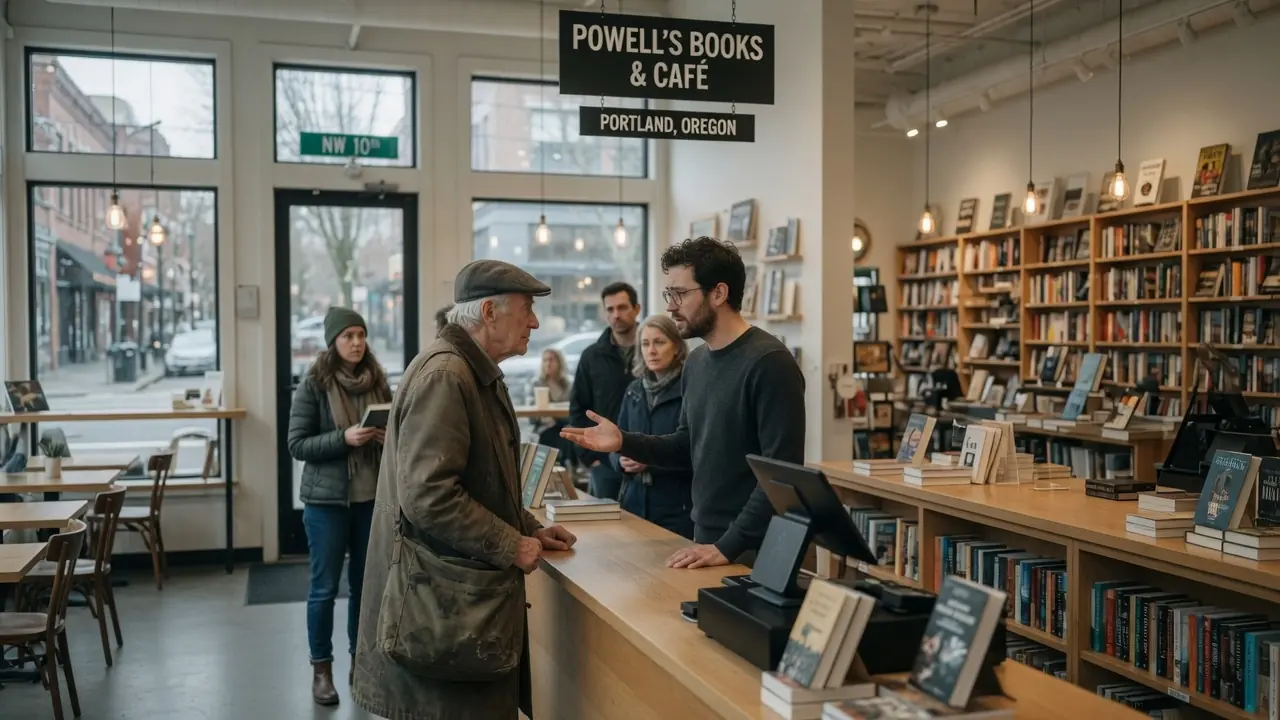
Preston swallowed.
“Mr. Mercer, I apologize. I didn’t realize—”
“That I mattered?” Edwin asked.
Preston had no answer.
Edwin picked up Clara’s photograph and held it gently.
“She mattered too. And you turned her promise into a notebook display.”
Diane looked toward the front window.
Her expression tightened.
“I approved that display,” she said quietly.
Edwin turned to her.
“Then you share the responsibility.”
“Yes,” Diane said. “I do.”
That honesty surprised him.
It also softened him.
“Good,” he said. “Then you can help repair it.”
Diane nodded.
“Immediately.”
She faced Kayla.
“Remove the notebook display.”
Kayla moved quickly.
Diane turned to Preston.
“You are relieved of floor duty pending review.”
Preston’s head snapped up.
“Over this?”
Diane stared at him.
“Over forgetting that a bookstore is not made better by removing access and calling it premium.”
Preston’s jaw tightened, but he said nothing. He removed his manager badge and placed it on the counter.
As he walked toward the office, Marcus collected the remaining photographs and carefully returned them to Edwin’s bag.
“Thank you,” Edwin said.
Marcus nodded.
“My grandmother used to bring me here,” he said quietly. “I remember that shelf.”
Edwin smiled.
“Then you remember Clara.”
“I think I do.”
Kayla returned from the window, carrying the last stack of expensive notebooks.
Her eyes were red.
“I’m sorry,” she said. “I didn’t know what the shelf was.”
Edwin looked at her.
“You should have asked.”
She nodded.
“Yes.”
“But now you know,” he said. “That is where responsibility begins.”
By three o’clock, the window display had been cleared.
By four, Diane had called corporate legal.
By five, the Open Shelf agreement was confirmed, and Broadleaf Retail Group accepted that removing it had violated the founder’s terms.
But Edwin was not interested in winning a legal point.
He wanted Clara’s shelf back.
So he stayed in the store as employees brought out an old wooden bookcase from storage. It was dusty, scratched, and missing one small piece of trim, but Edwin recognized it immediately.
His hands trembled as he touched the side.
“I built this in our kitchen,” he said.
Ruthie Parker, the librarian, had stayed all afternoon. She stood beside him now, holding a stack of children’s books she had purchased from the store.
“For the shelf,” she said.
Edwin looked at her.
“Clara would like that.”
By six o’clock, the Open Shelf stood once again near the front window.
Kayla made a handwritten sign.
Edwin watched as she carefully printed the words.
The Open Shelf
Take a book. Leave a book. Read freely.
He stepped closer.
“May I add something?”
Kayla handed him the marker.
His fingers shook, but he wrote beneath her words.
For Clara.
The store grew quiet around him.
Diane placed the first book on the shelf, a copy of The Secret Garden.
Ruthie added the children’s books.
Marcus added a mystery novel.
Kayla added a paperback poetry collection from her own bag.
Then Edwin reached into his canvas bag and removed one last book.
It was old, green, and worn at the corners.
Inside the front cover, Clara had written:
For the reader who needs this next.
Edwin placed it in the center of the shelf.
The teenage girl who had been watching from the poetry section approached shyly.
“Can I take one?” she asked.
Edwin smiled.
“That is what it’s for.”
She chose the poetry book Kayla had placed there.
“I’ll bring one back,” she promised.
“No rush,” Edwin said. “Books know how to travel.”
The girl smiled and walked away holding the book against her chest.
That small moment did more to heal Edwin than any apology could have.
Over the next few weeks, the store changed.
The Open Shelf became popular again, but not in the way marketing teams measure popularity. People came quietly. A young father left picture books his child had outgrown. A college student left a stack of novels after graduation. An elderly woman took a large-print mystery and returned the next week with three more.
Diane ordered staff training, but Edwin insisted it begin with the store’s story.
Not with sales goals.
Not with loyalty memberships.
With Clara.
A framed photograph was placed beside the shelf. It showed Edwin and Clara on opening day, young and hopeful, standing beneath the hand-painted green sign.
The plaque below read:
Edwin Mercer and Clara Finch Mercer, founders of Mercer & Finch Books. Built on the belief that stories should find everyone.
Kayla took special care of the shelf. She dusted it every morning. She straightened the books. She welcomed people who looked unsure. When someone asked if the books were really free, she always answered, “Yes. Clara wanted them that way.”
Marcus began placing books there too. He had a habit of leaving old detective novels, saying his grandmother would approve.
Preston Lane did not return to the store.
Some employees said he was good at numbers.
Diane replied, “A bookstore needs numbers. It also needs a soul.”
One month later, Edwin returned on a Saturday morning.
He wore the same brown coat, the same gray cap, and the same polished shoes. This time, Kayla opened the door before he reached for it.
“Good morning, Mr. Mercer.”
“Good morning, Kayla.”
The Open Shelf was full.
Not messy.
Alive.
Children crouched in front of it. A young woman slipped a paperback onto the second shelf. An older man selected a western novel and smiled as if he had found an old friend.
Edwin stood nearby and watched.
Diane joined him with two cups of tea from the café.
“Thought you might prefer this to coffee,” she said.
“Clara would have.”
Diane handed him the cup.
“I owe you another apology.”
“You already gave one.”
“Still,” she said. “I thought removing the shelf was a small retail decision. It wasn’t.”
“No,” Edwin said. “It was a small moral decision. Those are often the ones people miss.”
Diane nodded slowly.
They stood together in silence.
Then Kayla approached, holding a thin notebook.
“Mr. Mercer,” she said, “I started writing down stories from people who use the shelf. Not private things. Just memories they want to share.”
Edwin looked at the notebook.
On the first page, someone had written:
I took my first book from this shelf in 1988. Today I left one for somebody else.
Edwin blinked hard.
Kayla waited.
“Is that okay?” she asked.
He nodded.
“Clara kept notebooks like this.”
Kayla smiled.
“Then I’ll keep it going.”
Edwin looked at her young face, the same face that had once looked at his old coat and seen only inconvenience.
Now she saw more.
That was enough.
Near noon, a little boy came to the shelf with his mother. He reached for the green book Edwin had placed there weeks earlier, the one with Clara’s handwriting inside. Edwin watched him open the cover.
The boy read the inscription aloud.
“For the reader who needs this next.”
He looked up at his mother.
“Can I be that reader?”
His mother smiled.
“Yes.”
Edwin had to turn toward the window.
Outside, Portland moved on as always. Cars passed. People carried coffee cups. Rain threatened from a pale gray sky. The world did not stop for an old man’s memories.
But inside the bookstore, one promise had survived.
That was enough.
Before leaving, Edwin took a small card from the counter and wrote a note. He placed it on the Open Shelf beside Clara’s photograph.
It read:
A free book is not a lost sale.
It is an open door.
Then he placed his cap on his head and walked slowly toward the exit.
Marcus opened the door.
“See you next Saturday, Mr. Mercer?”
Edwin smiled.
“Yes. Next Saturday.”
As he stepped outside, he looked back at the green sign above the door.
Mercer & Finch Books.
For years, he had thought the store belonged to the past.
Now he understood that the past could still work, if the living agreed to carry it.
Clara’s shelf was back.
Her name was remembered.
Her kindness had found new hands.
And everyone who worked at Mercer & Finch learned the lesson Edwin had carried through the door in an old brown coat, with photographs in a canvas bag and grief folded carefully in his pocket.
A bookstore is not grand because its shelves are perfect.
It is grand because someone lonely can walk in and feel less alone.
No reader should have to look wealthy before being welcomed.
No old man should have to prove his history before being heard.
And no place built from love should ever remove kindness just to look more expensive.