Sweat pulled at the base of Beatrice’s spine, trapped beneath three merciless layers of rigid silk, unyielding whalebone, and the damp cotton of her chemise. The air in the Dowager Countess’s library was thick, tasting distinctly of souring lavender water, burning beeswax candles, and the desperate metallic tang of too many human bodies packed into the adjoining ballroom. She pressed her shoulders flat against the mahogany wainscoting, hoping the wood’s faint coolness might seep through her gown. It did not.
The incessant scrape of fiddles bled through the heavy double doors, a frantic, shrill sound that set her teeth on edge. Out there, the marriage mart was in full bloody swing. Mothers circling like hawks in taffeta. Younger sons puffing out hollow chests.
Men with rotting teeth and bloated inheritances were sizing up terrified girls as if checking the teeth of a broodmare. Beatrice dragged a jagged breath into her lungs, the corset biting hard into her lower ribs. She was twenty-four, ancient by the brutal metrics of the ton. This was her fifth season, funded by the rapidly dwindling dregs of her late father’s estate.
Her uncle’s ultimatum had been delivered that morning over cold toast and tepid tea. Find a husband by the end of the week, Beatrice, or I am packing you off to Yorkshire to marry cousin Edgar. Edgar, a man who breathed entirely through his mouth and collected dead moths.
“You cannot hide in here forever,” Clara hissed.
Her younger sister was pacing the perimeter of the Persian rug, her own pink skirts rustling like dry leaves. Clara was nineteen, still possessed the shiny, unbruised optimism Beatrice had shed years ago, and smelled pleasantly of rose water rather than impending doom. “Lord Harrington is looking for you. He asked me twice if you had retired to the retiring room.”
“Tell him I died,” Beatrice muttered, closing her eyes. The red glare of the gas lamps bled through her eyelids. “Tell him I caught cholera in the carriage and spontaneously combusted. Tell him anything, Clara.
Just keep that man and his wet, grasping hands away from me.”
“He has ten thousand a year.”
“He has the breath of a dying badger,” Beatrice shot back, opening her eyes.
The library was suffocating. Dust motes danced lazily in the heavy air, indifferent to her panic. She reached up, fingers fumbling with the high lace collar of her gown, desperately trying to create a fraction of space against her throat. Her pulse throbbed against the delicate skin there, frantic and trapped.
“Beatrice, please,” Clara pleaded, stopping her pacing to wring her gloved hands. The white kid leather squeaked slightly. “Uncle was not making idle threats. You know he wasn’t.
You have to secure someone, anyone. It doesn’t have to be a love match. It just has to be a match.”
The sheer, crushing reality of it settled over Beatrice like a wet wool blanket. Her life was not her own.
Her body, her time, her future. They were commodities, and depreciating ones at that. A sudden, hysterical bubble of laughter lodged in her throat. The absurdity of it all, the indignity.
She pushed herself off the wall, the silk of her skirt catching on a splinter of the wainscoting with a quiet rip. She did not even care. “Anyone?” Beatrice repeated, her voice dropping an octave.
Entirely stripped of the polite musical cadence she was trained to use, she stalked toward the heavy oak doors separating the library from the corridor, her boots clicking sharply against the polished floorboards where the rug ended. “You want me to marry anyone?”
“Keep your voice down,” Clara whispered, eyes darting to the door.
“Why? Who is listening? The dead moths?” Beatrice slapped a palm against the cool, dark wood of the door.
The wood grain was rough against her skin. She was so tired. Her bones ached with it. Her mind was a frayed rope snapping thread by thread.
“Fine. You want a match? I concede. I surrender to the whims of the market. I will marry the first man who enters this room.
I don’t care if it’s the footman with the lazy eye. I don’t care if it’s the chimney sweep. I’ll take the bloody coal boy over another minute in that ballroom.”
“Beatrice, stop being dramatic.”
“I am completely serious,” Beatrice said, leaning closer to the door, the hysterical edge in her voice sharpening into something dangerously close to a sob. She swallowed it down, forcing a bitter, wide smile. “The very next man to turn this handle. I’ll drop to my knees and propose myself.
Let’s let fate decide, Clara. It couldn’t possibly do a worse job than Uncle.”
The heavy brass handle beneath her left hand turned. With a sharp metallic clack, the latch disengaged. Beatrice snatched her hand back as if the metal had turned to red-hot iron.
The heavy oak door groaned on its hinges, swinging inward, pushing a rush of distinctly cooler air into the stifling library. It did not smell like lavender water or beeswax. It smelled like damp wool, leather, and rain. He did not stroll in.
He appeared.
Alistair, the Duke of Cudden, stepped over the threshold. The air in the room seemed to instantly, violently compress. Beatrice stopped breathing.
Clara made a small, pathetic squeaking sound at the back of her throat and took three rapid steps backward, nearly tripping over a velvet footstool. The Duke was not supposed to be here. He was not supposed to be anywhere near this specific mid-tier ball. He was a phantom of the upper echelons, a man who existed mostly in hushed, terrified whispers.
He was thirty-two, notoriously reclusive, and carried a reputation so black it practically absorbed the light in the room. He had buried two older brothers and a father in the span of five years, inheriting a dukedom heavily mortgaged by gambling and drowning in scandal. He looked entirely out of place among the gilded spines of the Dowager’s books.
He was wearing evening clothes, but they looked wrong on him. Too stark, too severe. His cravat was tied with ruthless precision, but his dark hair was damp at the ends, curling slightly against his collar, as if he had walked through the London drizzle without a hat.
He stopped just inside the room. His eyes, the pale, startling color of fractured winter ice, locked instantly onto Beatrice. He did not say a word. The silence stretched, taut and agonizing.
The muffled fiddles from the ballroom sounded a million miles away. Beatrice could hear the erratic, hammering thud of her own heart in her ears. She could feel the exact place where her fingernails were digging half moons into the palms of her hands.
He slowly reached behind him and pushed the heavy door shut. It closed with a heavy, definitive thud that seemed to rattle the very floorboards. Heat rushed up Beatrice’s neck, a humiliating flush that prickled against her skin. She wanted the floor to open up and swallow her whole.
Alistair did not possess a face made for gentle expressions. It was a landscape of sharp angles and hard plains, scarred slightly above the left eyebrow, a souvenir from a duel that society matrons still gossiped about in hushed, thrilled tones. “Your Grace,” Clara whispered, her voice trembling so violently it sounded like a plucked string. She dropped into a deep, panicked curtsy, her knees hitting the floorboards with an audible knock.
Alistair did not spare Clara a glance. His gaze remained pinned to Beatrice, heavy and assessing. He was categorizing her, she realized, with a jolt of defensiveness. He was looking at her frayed cuffs, the slightly out-of-fashion cut of her dark green bodice, the way her hair was beginning to slip from its pins.
Beatrice forced her chin up. If she was going to be ruined by her own careless tongue, she would not do it cowering. She executed a stiff, shallow curtsy, her joints popping in the quiet room. “Your Grace,” she said.
Her voice came out raspy, completely devoid of the hysterical energy from ten seconds prior. Alistair took a slow step into the room. His boots made no sound on the thick rug. Up close, the smell of him was overwhelming.
Rainwater, saddle soap, and something uniquely cold and metallic. He was exceptionally tall, forcing Beatrice to tilt her head back just to maintain eye contact.
“The footman,” Alistair said.
His voice was a low, gravelly baritone that vibrated in the tight space between them. It was not a question. It was a recitation of evidence.
Beatrice swallowed hard. The inside of her mouth tasted like ash. “It was a jest, Your Grace. The heat in this room breeds madness.”
“The chimney sweep,” he continued, taking another agonizingly slow step forward. The distance between them was now less than three feet. It was highly improper. It was terrifying.
“The coal boy.”
“I was speaking in hyperbole,” Beatrice snapped, her pride suddenly flaring, overriding her survival instincts. She crossed her arms over her chest, a defensive barrier against the sheer physical mass of the man in front of her. “My sister and I were having a private conversation.
I am unaware of how long you were loitering in the corridor, but it is generally considered poor form to eavesdrop.”
Clara whimpered from her place near the window. Alistair’s dark eyebrows twitched. Not a frown, not a smile, just a microscopic adjustment of the muscles in his face.
“I do not loiter. Miss Hail.”
Beatrice replied, lifting her chin higher. “Beatrice Hail.”
“Miss Hail.” He tested the name on his tongue. It sounded foreign in his mouth. “I was attempting to find a room in this cursed house that did not contain Lord Harrington attempting to explain his gout to anyone cornered long enough to listen.
I opened the door. You shouted your matrimonial intentions at the wood.”
He looked her up and down again. This time the gaze was slower, more deliberate. It felt like a physical touch, a rough hand dragging over the silk of her dress.
Beatrice’s breath hitched, the whalebone of her corset digging fiercely into her ribs.
“You are of age,” he observed.
Not a compliment, a calculation.
“I am twenty-four, old for the market. I am aware.” Her nails dug deeper into her palms. The pain was grounding.
It kept her from shrinking away. “If you have come in here simply to insult my marital prospects, Your Grace, you can save your breath. My uncle provides that service daily and free of charge.”
Alistair tilted his head. The faint light from the gas lamp caught the scar above his brow, making it look stark white against his tanned skin.
“Who is the uncle?”
“Arthur Hail. He holds the estate, such as it is.”
“Ah. The man who lost one thousand pounds at White’s last Tuesday on a single hand of Faro.”
Alistair’s voice was dry, devoid of pity. Beatrice flinched. She had not known about the one thousand pounds. She only knew about the vanishing household budget and the sudden urgency to marry off the nieces.
A cold knot formed in her stomach, heavy and lead. So, it was worse than she thought. Cousin Edgar was not just a threat. He was a financial necessity.
Edgar’s father had money. She uncrossed her arms, her posture sagging slightly under the weight of the revelation. The fight abruptly drained out of her, leaving behind only the bone-deep exhaustion she had been carrying all evening.
“Yes,” she said quietly, dropping her gaze to the top button of his waistcoat. It was black onyx, slightly scuffed. “That uncle.”
Alistair watched the fight leave her. He noted the slight tremor in her hands, the sudden shallowness of her breathing. He reached into his coat pocket and withdrew a silver watch, clicking it open with his thumb. The sharp noise made Clara jump again.
“It is ten minutes to midnight,” Alistair said, snapping the watch shut and slipping it away. He looked back down at Beatrice, his pale eyes burning with an intense, unreadable calculation. “Tell me, Miss Hail, were you a woman of your word before the heat drove you mad?”
Beatrice frowned, looking up at him in confusion. “I beg your pardon?”
“You made a declaration,” Alistair stated, his voice flattening into something entirely business-like. The gravelly warmth was gone, replaced by cold iron. “You stated you would marry the first man who walked through that door.
I walked through the door.”
Beatrice stared at him. The silence returned, thicker this time. The smell of damp wool and leather seemed to coat the inside of her throat. “You cannot be serious,” she breathed.
“I am rarely anything else,” he replied, his face a mask of absolute stoicism. “Do you accept, or do you intend to make a liar of yourself?”
Beatrice felt a profound sense of vertigo, as if the floorboards beneath her had suddenly tilted at a forty-five-degree angle. She looked at the Duke, searching his scarred, impassive face for the punchline.
There was none. His eyes were flat, locked onto hers with the intensity of a predator studying a particularly confusing piece of prey.
“You are mocking me,” Beatrice said, her voice dropping to a harsh whisper. Her throat felt tight, defensive anger rushing back to replace the exhaustion.
“Because I am desperate. Because my uncle is a fool. You think this is an amusing game.”
“I despise games,” Alistair countered smoothly, not taking a single step back. “I find them inefficient. I am entirely in earnest, Miss Hail.”
“Why?” The word tore out of her, raw and unpolished. She gestured wildly to the room, to herself. “Look at me.
I am a penniless spinster from a disgraced family. You are the Duke of Cudden. You could walk into that ballroom and have your pick of any heiress with a pulse and a dowry large enough to sink a battleship.”
“I do not want an heiress,” Alistair said flatly. “Heiresses come with ambitious fathers, hovering mothers, and expectations of grand romance and poetry.
I have no poetry in me, Miss Hail, and I detest ambitious fathers.”
He half turned, pacing two steps away before turning back. It was the most animated movement she had seen him make. He moved like a large, dangerous animal confined to a small cage, fluid but tightly coiled.
“My situation requires a wife. Immediately,” he explained, his tone conversational, as if they were discussing the weather rather than a lifetime commitment. “The details are not suitable for a drawing room, but suffice it to say, if I am not married by the end of the month, the entailed lands of Cudden will revert to a cousin who makes your uncle look like a saint. He intends to raise the tenant farms to build a racing track.”
Beatrice blinked. The sheer pragmatism of his reasoning halted her panic. It was not about her. It was about land.
It was a transaction.
“So, you need a warm body to satisfy a legal clause,” she summarized, her cynical edge returning, sharpening her words.
“I need a woman who will not expect me to court her, who will not swoon at my feet, and who is desperate enough to sign a marriage settlement without demanding three months of negotiations,” Alistair corrected, his gaze pinning her down. “You appeared to meet the criteria perfectly the moment I opened that door.”
From the corner, Clara let out a strangled gasp, finally finding her voice. “Beatrice, you cannot. He is—he is—”
Clara could not finish the sentence. The rumors surrounding Cudden were legendary. That he had killed his brother in a rage. That he kept a harem in his country estate.
That he was mad. Alistair’s gaze flicked to Clara for a fraction of a second, entirely dismissive, before returning to Beatrice.
“Your sister is concerned for your welfare. Touching but unhelpful. You have a choice, Miss Hail.
You can walk out of this room, face your uncle, and marry cousin Edgar, or you can marry me.”
Beatrice’s mind raced. The library felt suddenly freezing, the sweat on her skin turning to ice. Marriage to Edgar meant a lifetime of quiet decay in Yorkshire, managing his collections, enduring his damp hands and vacuous conversations.
It was a slow death by suffocation. Marriage to Alistair. What was that? She looked at him.
He was terrifying. He was cold. He was entirely devoid of anything resembling warmth or affection. But he was honest.
Brutally, surgically honest. He was not promising her love. He was offering her an escape hatch.
“If I agree,” Beatrice said, her voice shaking slightly, betraying the calm she was trying to project, “what are the terms?”
Alistair’s eyes darkened slightly, a flicker of genuine surprise crossing his features before it was instantly smoothed away. He had not expected her to engage. He had expected hysterics.
“You will be the Duchess of Cudden,” he said, his voice dropping lower. “You will have access to my accounts within reason. You will reside at my primary estate in Derbyshire or the London townhouse, whichever you prefer. I require you to manage the households and present a respectable front to society when strictly necessary.”
“And an heir.” Beatrice forced the words out. Her face burned so hot she thought it might actually blister. It was the crude reality of their world.
The unmentionable transaction at the core of every marriage contract. Alistair looked at her for a long, heavy moment. The muscle in his jaw twitched.
“That,” he said quietly, “will be negotiated at a later date, when we are both less cornered.”
It was a concession, a small, strange mercy from a man who supposedly had none. Beatrice looked down at her hands. The cheap silk of her gloves was fraying at the seams.
She thought of the thousand pounds her uncle had lost. She thought of Edgar’s wet breathing. She thought of the fifty years stretching ahead of her. A long, dark tunnel with no light at the end.
She looked back up at the Duke. He was waiting. He had not rushed her. He stood perfectly still, offering her a lifeline woven out of razor wire.
“I will not be a silent ornament,” Beatrice said, her voice finding its footing, ringing clear and steady in the quiet room. “I will not be locked away in Derbyshire while you conduct whatever business necessitates this marriage. If we do this, it is a partnership. A cold one perhaps, but a partnership.”
Alistair reached out slowly, stripping the dark leather glove from his right hand. He held his bare hand out toward her. It was large, calloused, and bore a heavy gold signet ring that looked centuries old. “A partnership, Miss Hail,” he agreed.
Beatrice stared at his hand. The reality of what she was doing crashed over her, a terrifying, exhilarating wave. She was marrying the devil to escape the deep blue sea. She stripped off her own frayed silk glove, dropping it onto the velvet footstool.
Her hand was pale and trembling slightly as she reached out. When her fingers slid into his, his grip was instantly firm, entirely engulfing her hand. His skin was warm, a sharp contrast to the coldness of his demeanor. The physical contact sent a jolt up her arm.
A sudden, terrifying awareness of the man she had just bound herself to. “I believe,” Alistair said, his thumb brushing lightly over her knuckles, a startlingly intimate gesture that made her breath catch, “we have an arrangement.”
Arthur Hail’s study smelled of sour, old paper and the sharp, undeniable scent of a man rapidly running out of time. Beatrice stood rigidly just inside the doorway. Her uncle sat behind a mahogany desk cluttered with unopened bills and half-empty crystal decanters. His face was flushed, a mottled purplish red that spread from his tight collar to his receding hairline.
When Beatrice had first walked in, flanked by Clara, Arthur had opened his mouth to unleash a tirade about her disappearing from the ballroom. Then Alistair had stepped out of the hallway shadows and into the lamplight. Arthur’s mouth had snapped shut with an audible click. The color drained from his face so fast Beatrice thought he might actually faint.
“Your Grace,” Arthur stammered, scrambling to his feet. His knee caught the edge of the desk, rattling the decanters. He did not seem to notice the pain. “To what do I owe the profound honor?”
Alistair did not sit. He walked slowly toward the desk, his presence sucking the remaining air out of the small, stuffy room. He stopped two feet from the edge, looming over the shorter, sweating man. “I am a man who values brevity, Hail,” Alistair said.
His voice was pitched low, but it commanded the space entirely. “I have come to inform you that I will be marrying your niece. The arrangements will be finalized by special license before the end of the week.”
Arthur blinked, his bloodshot eyes darting wildly from Alistair to Beatrice and then back again. His brain was visibly struggling to process the information. He looked like a fish hauled violently onto the deck of a ship.
“Beatrice,” Arthur choked out. A nervous, oily smile stretched across his face. “You wish to marry Beatrice, but she has no dowry, and my own finances are currently tied up in investments.”
“I am aware of your investments at White’s,” Alistair replied smoothly.
Arthur flinched as if struck. Beatrice dug her fingernails into her palms, watching the exchange with a sickening sense of detachment. This was how her life was decided. Over a messy desk between a gambler and a stranger.
She felt a wave of nausea roll through her stomach, hot and bitter. She wanted to scream. She wanted to throw a decanter against the wall just to hear the glass shatter. Instead, she locked her knees to keep them from trembling.
“I require no dowry,” Alistair continued, his tone turning crisp and business-like. “In exchange for a swift and entirely uncontested transfer of guardianship, I will assume the entirety of the Hail estate’s current debts, all of them.”
The silence that followed was suffocating. Beatrice heard Clara let out a soft, ragged breath beside her. Arthur’s greed warred openly with his terror. His eyes widened, calculating the sheer volume of debt Alistair had just casually offered to erase.
The purplish flush returned to his cheeks. “All of them,” he whispered.
“Every note, every ledger,” Alistair confirmed. He reached into his coat, producing a folded piece of heavy parchment. He tossed it onto the desk.
It landed with a heavy, definitive slap. “My solicitor drafted this upon my instructions yesterday, leaving the name blank. I am a prepared man. You will sign it now.
It legally relinquishes any claim or control you have over Beatrice. Effective immediately upon the reading of the vows.”
Arthur reached for the paper with trembling, sweaty fingers. He did not even read it. He simply grabbed a quill, dunked it haphazardly into an inkwell, and scratched his signature across the bottom.
The sound of the nib scraping against the parchment made Beatrice’s teeth ache. Just like that, she was sold. Alistair picked up the parchment, blowing lightly on the wet ink before folding it away. He turned to Beatrice, his expression unreadable.
“Pack your trunks, Miss Hail,” he said, his pale eyes pinning her to the spot. “My carriage will collect you on Thursday morning at eight o’clock sharp. We will proceed directly to St. George’s, and from there to Derbyshire.”
He did not wait for a response. He walked past her, the scent of damp wool and cold iron lingering in his wake, and disappeared into the corridor.
Dust danced lazily in the shafts of gray morning light filtering through the high arched windows of St. George’s. The church was cavernous, freezing, and entirely empty, save for the four people standing near the altar. Beatrice shivered, pulling her woolen shawl tighter around her shoulders.
She was not wearing white. There had been no time and certainly no money for a proper gown. She wore a dark slate-blue traveling dress that had belonged to her mother, hastily altered by Clara the night before. The heavy fabric felt like armor, stiff and unyielding.
The high collar scratched relentlessly at her throat. Beside her, Alistair stood perfectly still. He wore a severe black frock coat, his posture rigidly straight. He had not spoken more than three words to her since she had stepped into his carriage two hours prior.
The vicar, a frail man with a wet, rattling cough, cleared his throat and began the liturgy. His voice echoed thinly off the cold stone walls. Beatrice felt entirely disconnected from her own body. It was as if she were floating near the vaulted ceiling, watching a stranger participate in this grim pantomime.
Her stomach churned violently. She had eaten nothing but half a piece of dry toast in three days. Her head pounded with a dull, rhythmic ache.
“Do you, Alistair, take this woman?”
She turned her head slightly to look at him. His profile was sharp, cut from granite. The scar above his eyebrow was stark white in the dim light. What kind of madness had possessed her?
She was binding herself to a man who looked like he could snap her in half without breaking a sweat, a man society whispered had blood on his hands.
“I do,” Alistair said.
His voice was deep, steady, and betrayed absolutely nothing. The vicar turned his watery eyes to Beatrice. “Do you, Beatrice, take this man?”
Panic, cold and sharp, pierced through her numbness. Her throat closed. She could not breathe. The smell of old hymnals and damp stone was suffocating.
She looked back at Clara, who was standing in the front pew, weeping silently into a handkerchief. If you do not say it, you go back to Arthur. You go to Edgar.
Beatrice swallowed the lump of terror in her throat. Her tongue felt like sandpaper. “I do,” she rasped.
“The ring,” the vicar prompted, coughing softly into his fist.
Alistair reached into his waistcoat pocket. He did not fumble. He produced a simple, thick band of unadorned gold. He reached out and took her left hand.
His fingers were warm, rough with calluses, a shocking contrast to her own freezing, trembling skin. He slid the heavy gold onto her finger. It was slightly too large, slipping loosely over her knuckle.
“With this ring, I wed,” Alistair murmured, his pale eyes lifting from her hand to meet her gaze.
For a fraction of a second, Beatrice thought she saw a flicker of something in those glacial depths, an acknowledgement of the sheer, terrifying gravity of what they had just done. But then he blinked and the mask was back in place.
The vicar pronounced them man and wife. There was no kiss. There was no celebration. They moved to the vestry to sign the register.
The scratch of the pen on the thick paper sounded exactly like the quill her uncle had used to sell her. Beatrice signed her new name, Beatrice Cudden, and stared at the wet ink. It looked like a forgery.
When they stepped out of the heavy church doors, the London sky had opened up, unleashing a torrential, freezing downpour. “The carriage is waiting,” Alistair said, raising a black umbrella to shield her, though he left himself entirely exposed to the rain. “Derbyshire is a two-day journey in this weather. We should not delay.”
The interior of the ducal carriage was deeply upholstered in dark blue velvet, smelling strongly of polished leather and beeswax. It was luxurious, heavily sprung to absorb the shock of the cobblestones, and agonizingly claustrophobic. Beatrice sat stiffly in the forward-facing seat, her hands folded tightly in her lap, her thumb instinctively rubbing the unfamiliar weight of the gold band on her finger.
Rain lashed violently against the glass window, blurring the passing gray streets of London into streaks of mud and misery. Alistair sat opposite her, his long legs stretched out, his muddy boots resting casually on the floorboards. He was staring out the window, his jaw clenched, seemingly lost in his own dark thoughts. Water dripped steadily from the brim of his hat onto the velvet seat.
He did not seem to care. The silence stretched for ten miles, then twenty. The rhythmic clatter of hooves and the drone of the rain became a maddening percussion in Beatrice’s aching head.
“You are shivering,” Alistair stated suddenly, his voice cutting through the gloom.
He did not look away from the window. Beatrice stiffened. “I am perfectly fine.”
He finally turned his head, his pale eyes scanning her face. He reached into the deep pocket of his greatcoat and pulled out a silver hip flask.
He unscrewed the cap and held it across the small space between them. “Drink,” he ordered softly.
Beatrice looked at the flask, then up at his face. “What is it?”
“Whisky. It will stop your teeth from chattering.
The sound is distracting.”
Her pride flared, hot and sharp. She wanted to refuse. She wanted to tell him to go to hell, but she was freezing, her damp dress clinging miserably to her legs, and the knot of anxiety in her stomach was pulling tighter with every mile that separated her from London.
She snatched the flask from his hand, her fingers brushing roughly against his. She brought it to her lips and took a large swallow. The liquor burned a fiery path down her throat, hitting her empty stomach like a lit match. She choked, a harsh, entirely unladylike sound, coughing into her fist as her eyes watered.
Alistair watched her, a microscopic twitch at the corner of his mouth the only indication that he found the situation remotely amusing. “Small sips, Duchess,” he advised dryly.
Duchess. The title sounded absurd.
It sounded like a prank. She shoved the flask back at him. “Do not mock me.”
“I am merely offering survival advice,” he replied, taking the flask and taking a slow, measured pull before capping it.
He leaned his head back against the velvet squabs, closing his eyes. He looked exhausted. The sharp lighting inside the carriage threw the hollows of his cheeks and the scar above his brow into stark relief.
“Why Derbyshire?” Beatrice asked, the whisky emboldening her, unraveling the tight spool of fear just enough to let the anger peek through. “If this is a business arrangement, why drag me to the middle of nowhere? Could I not have stayed in the London house?”
Alistair opened his eyes, the icy blue catching the dim light. “Because my business is in Derbyshire, and as my wife, your place is where I dictate it to be.”
Beatrice bristled, leaning forward slightly. “We agreed to a partnership. Partners communicate. They do not dictate.”
“We agreed you would not be a silent ornament,” Alistair corrected, his voice dropping to that dangerous, gravelly register. “And you are currently proving you are anything but silent. But make no mistake, Beatrice.
The estate I am fighting to keep is in Derbyshire. The people trying to take it from me are circling the borders. I need you there, visible, establishing a household.”
“Who is trying to take it?” she demanded, refusing to back down from his stare.
He looked at her for a long time, the carriage swaying violently as they hit a deep rut in the road. “My cousin,” Alistair finally said, his voice flat, stripped of all emotion. “And the creditors he has bought off. They believe I am unstable, unfit to manage the dukedom.”
“Are you?” The question slipped out before she could catch it, raw, unedited.
Alistair did not flinch. He leaned forward, closing the distance between them, until she could smell the sharp tang of the whisky on his breath beneath the scent of wet wool.
“I am entirely ruthless,” he said softly, his eyes locking onto hers with terrifying intensity. “I am violent when necessary, but I am not mad. If you plan to survive this marriage, you would do well to learn the difference.”
Mud splattered against the carriage window, a thick yellow-brown sludge that finally obscured the relentless Derbyshire rain. Beatrice had spent the last eight hours staring at the bleak, jagged landscape of the Peak District, a jarring contrast to the manicured parks of London. Her spine felt fused together. The slate-blue wool of her traveling dress was heavy with damp, smelling faintly of wet sheep and stale carriage leather.
When the carriage finally lurched to a halt, the sudden absence of motion made her stomach roll. Alistair pushed the door open before the footman could reach it, stepping out into the deluge. He did not offer his hand. He simply stood in the gravel, waiting, the collar of his greatcoat turned up against the wind.
Beatrice scrambled out, her boots sinking instantly into an inch of icy mud. She stumbled, her heavy skirts dragging her down, and caught herself against the iron rim of the carriage wheel. The metal was freezing, biting into her bare palm. She looked up.
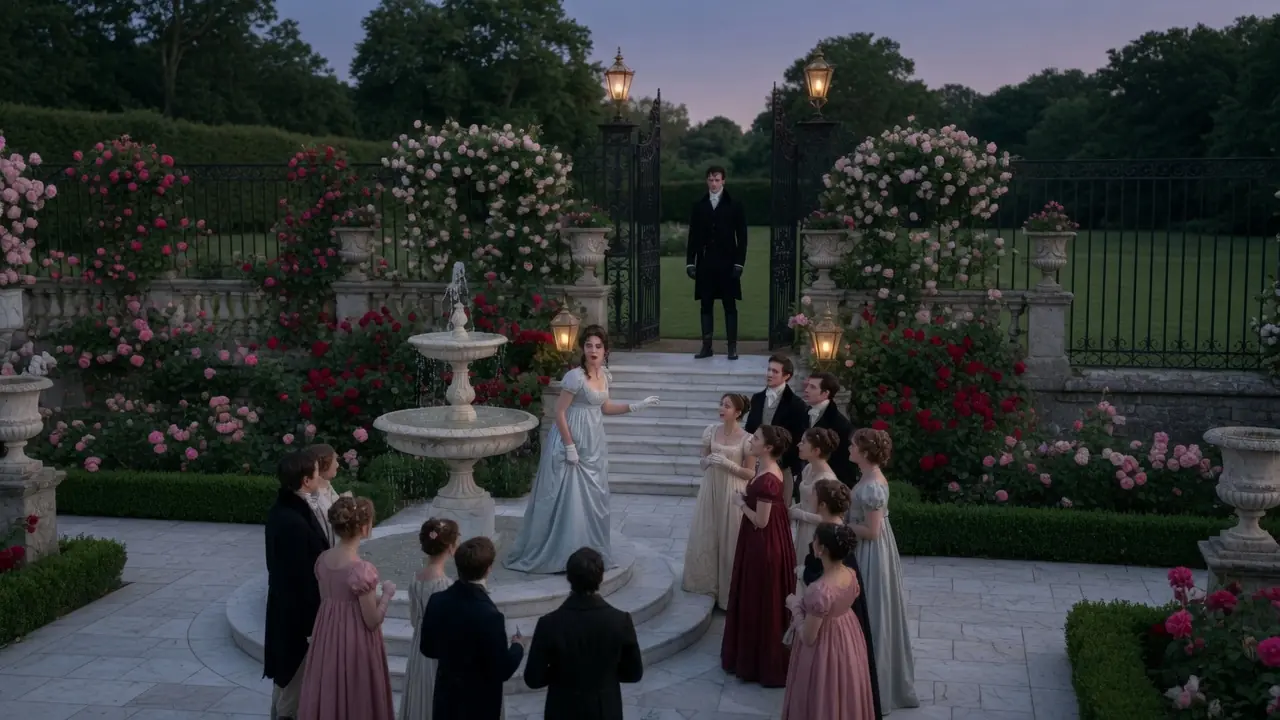
Ashcroft Hall was not a home. It was a fortress slowly succumbing to a siege of moss and neglect. Built of dark, unyielding millstone grit, it loomed against the bruising sky, massive and utterly devoid of welcome. Half the windows on the upper floors were dark, staring out like missing teeth.
“Do not dawdle, Beatrice,” Alistair said, his voice carrying over the wind. He was already taking the wide stone steps two at a time. “The damp will settle in your lungs.”
She gritted her teeth, hoisted her sodden skirts with two fists, and followed him. The heavy oak doors groaned open, revealing a cavernous entry hall that smelled of cold ash, dog hair, and centuries of trapped air. The temperature inside was barely warmer than the courtyard. A single meager fire sputtered in a hearth large enough to roast an ox.
A small, sparse line of servants waited in the gloom. They looked terrified. There were perhaps ten of them, far too few for a house this size. An older woman stepped forward, her black bombazine dress rustling.
Her face was tightly pinched, her eyes darting nervously toward Alistair before settling on Beatrice. “Welcome to Ashcroft, Your Grace,” the woman said, executing a stiff curtsy. “I am Mrs. Gable, the housekeeper. We were not expecting you so soon.
The master suites are not entirely aired.”
“My wife requires a hot bath, Mrs. Gable,” Alistair cut in, ignoring the welcome entirely. He stripped off his wet gloves, tossing them onto a dusty side table. “And a fire that actually produces heat, not just smoke.
Send a tray up. Meat, bread, something hot to drink.”
“Yes, Your Grace. Right away.” Mrs. Gable practically scurried backward.
Alistair turned to Beatrice. In the gray light of the hall, he looked hollowed out. The journey had stripped away the last veneer of aristocratic polish, leaving behind a man who looked dangerous and bone tired.
“I have estate managers waiting in the library,” he told her, already turning away. “Mrs. Gable will show you to your rooms. Do not wander the east wing. The floors are rotting.”
“Wait,” Beatrice demanded, the word echoing sharply against the vaulted ceiling. Alistair stopped, his broad shoulders stiffening. He slowly turned his head.
“Yes?”
“You are leaving me to navigate a rotting house with a terrified housekeeper while you lock yourself away.” Her voice shook, a mixture of exhaustion and sudden, biting anger. “We have been married forty-eight hours. I do not even know where the kitchens are.”
“You are the Duchess of Cudden,” he replied, his tone chillingly flat. “Find them.”
He walked away, his boots echoing loudly on the flagstones before disappearing behind a heavy oak door that slammed shut with finality. Beatrice stood entirely alone in the freezing hall. The remaining servants watched her with wide, silent eyes.
A tremor started in her knees, threatening to travel up her entire body. She wanted to collapse onto the dirty floor and weep. She wanted Clara. She wanted the predictable, suffocating boredom of her uncle’s house.
But a deeper, older instinct flared in her chest. Spite. Pure, unadulterated spite. He thought she would cower.
He thought she was merely a signature on a piece of paper, a legal convenience to be parked in a cold room. She turned to Mrs. Gable. The housekeeper flinched.
“Mrs. Gable,” Beatrice said, deliberately dropping the pitch of her voice, smoothing out the tremor. “Where is the steward’s office?”
“The steward, Your Grace?”
“The man who holds the keys and the ledgers,” Beatrice clarified, taking a step toward the woman. “The man who is currently responsible for the fact that I can see my own breath in the main hall of a ducal estate.”
“Mr. Finch is in his office, the kitchen corridor, but—”
“Take me there.”
“But Your Grace, your bath.”
“I will bathe when this house is fit for human habitation,” Beatrice snapped. She let her sodden skirts drop, uncaring as the mud stained the flagstones. “Right now, I require the household ledgers, every key on the property, and the immediate presence of whoever is responsible for ordering coal.
Show me the way.”
Over the next four weeks, Ashcroft Hall tasted constantly of lye soap, beeswax, and bitter black tea. Beatrice did not rest. She waged war on the decay.
She discovered that Alistair was not simply neglectful. He was financially cornered. The massive debts he had absorbed from her uncle were only a fraction of the bleeding. Ashcroft was hemorrhaging money due to decades of mismanagement by his late father.
The tenant farms were failing. The roof of the west wing was caving in, and the staff had not been paid full wages in six months. Alistair spent his days riding the estate borders in the freezing rain, and his nights locked in the library, arguing with solicitors and foremen. They barely saw each other.
When they did cross paths in the drafty corridors, they exchanged curt, transactional sentences.
“The roofers require another ten pounds.”
“Approve it.”
“The grain stores are contaminated.”
“Burn them.”
It was a bloodless marriage. But as Beatrice sat at a massive oak table in the steward’s office, her fingers permanently stained with cheap ink, her back aching from the hard wooden chair, she felt something entirely alien taking root in her chest. Purpose.
She was no longer a spinster hiding in a library. She was the absolute authority in a household that desperately needed one. She fired two footmen for stealing silver. She haggled viciously with the local coal merchant until he lowered his prices out of sheer exhaustion.
She ordered the rotting carpets ripped up, preferring the cold stone to the smell of mildew. Late one Tuesday evening, Beatrice was in the kitchens. The room was stiflingly hot, filled with the smell of roasting mutton and boiling cabbage. She was standing over the cook, a massive woman named Mrs. Patmore, inspecting the weekly grocery lists.
The heavy kitchen door swung open. The sudden draft made the oil lamps flicker. Alistair stood in the doorway. He was covered in mud, his riding boots caked with it up to the knees.
His dark hair was plastered to his forehead with rain, and his jaw was set in a hard, violent line. He looked around the kitchen, his pale eyes finally landing on Beatrice. The kitchen staff froze, holding their breath.
“My study,” Alistair said.
It was not a request. Beatrice carefully set the ledger down on the flour-dusted table. She wiped her hands on the rough canvas apron she had tied over her plain wool daydress. “I am reviewing the accounts, Alistair.”
“The accounts can wait.” He did not raise his voice, but the gravelly undertone sent a shiver down her spine. “Now, Beatrice.”
She untied the apron, handed it to a terrified scullery maid, and followed him out. His study smelled of old leather, wood smoke, and the sharp tang of brandy. Alistair stood by the window, staring out into the pitch-black night. He held a crumpled letter in his fist.
“My cousin Reginald will arrive tomorrow,” Alistair said without turning around. “With two solicitors from London.”
Beatrice stopped in the center of the room. The exhaustion of the day suddenly slammed into her bones. “Why?”
Alistair turned. The firelight caught the scar above his eye, making it look fresh. “To petition the courts for a writ of lunacy. He intends to prove I am mentally unfit to hold the title, thereby seizing control of Ashcroft and the remaining entailed assets.”
The words hung in the air, heavy and toxic.
“Can he do that?” Beatrice asked, her voice quiet.
“He can try.” Alistair walked over to his desk, tossing the letter onto the leather blotter. He leaned his hands on the desk, his head bowed.
He looked entirely worn through, the sheer physical mass of him seemingly hollowed out by the weight of the assault. “He has bribed witnesses, servants I dismissed years ago. They will testify to my violent fits, to my irrational behavior. My isolation here will be framed as madness.”
Beatrice looked at him. She saw the mud on his boots, the fraying cuffs of his coat. She thought of the mountain of ledgers she had just balanced. The grueling, desperate fight to keep this crumbling stone fortress standing.
“And what of your marriage?” she asked.
Alistair lifted his head. His eyes met hers, calculating and cold. “He will claim it is further proof of my instability, that I dragged a penniless spinster from a ballroom in a fit of mania.
He will question you, Beatrice. He will look for cracks. He will try to make you admit that I am dangerous, that I frighten you.”
The silence in the study grew suffocating. The only sound was the crackle of the fire and the rain lashing against the glass.
“Do I frighten you, Beatrice?” he asked softly.
She held his gaze. Did he? He was large, unyielding, and carried a darkness she could not begin to fathom. He had bought her to secure his land.
He had left her to freeze in a hostile house.
“You irritate me,” Beatrice said slowly, deliberately. “You are arrogant, uncommunicative, and you track mud onto the rugs I just paid a small fortune to have beaten.”
A microscopic tension left Alistair’s shoulders.
“But you do not frighten me,” she continued, taking a step toward the desk. “And I will not let some London dandy walk into my house and tell me my husband is a lunatic. Not after I spent three hours today arguing with the butcher over the price of salt pork.”
Alistair stared at her. For the first time since she had met him, the hard, flat mask of his face slipped. The corner of his mouth twitched, threatening to form an actual smile.
“Your house,” he murmured.
“My house,” Beatrice confirmed, planting her hands on her hips. “So, what is our strategy?”
Reginald Cudden smelled heavily of bay rum, expensive cigars, and desperation dressed up as concern. He was a handsome man, entirely too soft around the jawline, wearing a velvet morning coat that looked ridiculous against the grim backdrop of Ashcroft’s receiving room.
The two solicitors flanking him looked like nervous crows in their black suits, clutching leather portfolios. Beatrice sat on a stiff brocade sofa, her hands folded neatly in her lap. She wore her best gown, a deep burgundy silk she had salvaged from the trunks, carefully mended and pressed by Mrs. Gable. Her hair was pinned back severely.
She looked every inch the stern, unyielding Duchess. Alistair stood by the unlit hearth, leaning casually against the mantelpiece. He had shaved, changed into a crisp white shirt and a perfectly tailored black coat, and looked entirely, terrifyingly sane.
“I must say, Alistair,” Reginald drawled, pacing a slow circle on the faded Persian rug. His boots squeaked slightly. “I was shocked to hear of your sudden nuptials to a Miss Hail. Was it the daughter of that tragic gambling addict?”
“My wife’s family history is not the subject of this visit, Reginald,” Alistair said. His voice was smooth, relaxed, but Beatrice could see the muscles in his jaw ticking.
“Of course not.” Reginald offered a patronizing smile, finally stopping to look at Beatrice. His eyes swept over her, openly evaluating and dismissing her in the same breath. “It is merely concerning.
A man in your delicate mental state making such rash, life-altering decisions. A sudden marriage to a woman of no standing. It speaks to a certain lack of impulse control, a detachment from reality.”
“I assure you, Mr. Cudden,” Beatrice interjected, her voice ringing out clearly in the large room, “my husband’s grip on reality is entirely firm.
It is his grip on his wallet that is tight, but I suppose one must be frugal when dealing with relatives who treat the family coffers as their personal gambling stakes.”
One of the solicitors choked on a cough. Alistair’s eyes flashed with a dark, sudden amusement. Reginald flushed, his smile slipping.
“Your Grace. I appreciate your loyalty, however newly minted it may be, but you are unaware of the history here. Alistair has suffered episodes.”
“Episodes?” Beatrice raised a brow, mimicking the exact haughty expression she had seen her uncle use a hundred times. “You mean the episode where he spent the last month repairing the tenant farm roofs that you allowed to rot when you acted as his steward three years ago? Or perhaps the episode where he successfully negotiated a lower interest rate with the London banks, a task you repeatedly failed to accomplish?”
Reginald’s face darkened from pink to a mottled red. He took a step toward the sofa. The cloying scent of bay rum washed over her, making her stomach clench. “You are being fed lies by a sick man, madam.
He is violent. He is unpredictable. Need I remind you of how his brother died?”
The air in the room instantly turned to ice. Alistair pushed off the mantelpiece.
He did not move fast, but the sheer predatory grace of his movement made both solicitors take a simultaneous step backward. “You will not speak of Thomas,” Alistair said. The gravel in his voice had turned to crushed glass. “Not in this house, not in front of my wife.”
“It is a matter of public record that he died during a physical altercation with you,” Reginald snapped, though his voice wavered slightly as Alistair closed the distance between them.
Beatrice’s heart hammered against her ribs. She did not know the truth about the brother. Society gossips had always claimed Alistair murdered him in a duel over a woman. She stood up.
Her silk skirts rustled loudly in the tense silence. “My husband’s grief is his own,” Beatrice said, walking deliberately to stand beside Alistair. She did not look at Reginald. She looked at the two solicitors.
“Gentlemen, you have come here seeking evidence of lunacy. What you have found is a duke managing his heavily indebted estate and a duchess who is currently auditing his books. If you wish to proceed with this frivolous petition, I will personally ensure that every ledger detailing Mr. Cudden’s embezzlement during his tenure as steward is entered into the public record.”
She had found the ledgers two nights ago, hidden beneath a pile of moldy feed receipts. The numbers had been clumsy, an amateurish siphoning of funds.
Reginald froze. His eyes darted to the solicitors, who suddenly looked extremely uncomfortable.
“You have no proof,” Reginald hissed, losing the last of his aristocratic polish.
“I have ink, paper, and a rudimentary understanding of arithmetic,” Beatrice countered smoothly. “It is more than enough for a magistrate. Now, unless you have business concerning the actual running of this estate, I suggest you leave. The roads are muddy, and I do not wish my floors tracked up any further.”
Reginald stared at her, his jaw working silently. He looked at Alistair, who was watching Beatrice with an expression she had never seen before, a strange, heavy mixture of shock and profound satisfaction.
“This isn’t over, Alistair,” Reginald spat, turning on his heel. He stormed toward the door, the solicitors practically scrambling to keep up with him. The heavy oak doors slammed shut behind them.
The silence that rushed back into the room was deafening. Beatrice stood perfectly still, the adrenaline slowly draining from her system. Her hands began to shake. She clasped them tightly in front of her, staring at the closed door.
She had just threatened a man with blackmail. She had defended a man who might very well be a killer.
“Where did you find the ledgers?” Alistair asked.
His voice was quiet, stripped of the anger from moments before.
“In the old tack room,” Beatrice replied, keeping her back to him. Her throat felt tight. “Beneath the rotting saddles.”
“He was careful to hide them before I threw him off the estate three years ago. I spent months looking for them.”
“He was an idiot,” she said bluntly. “He documented his own theft in the margins.”
She heard Alistair step closer. The scent of him, clean linen, wood smoke, and that underlying metallic coldness wrapped around her.
“You defended me,” he said.
It sounded like a question, an accusation, and a confession all at once. Beatrice finally turned to look at him. He was standing less than two feet away. The pale ice of his eyes was entirely focused on her, searching her face for a trap.
“I defended my home,” she corrected, though the words sounded flimsy even to her own ears.
Alistair reached out slowly, deliberately. He raised his hand. Beatrice held her breath, forcing herself not to flinch.
His large, calloused fingers brushed against the side of her face, tracing the sharp line of her jaw. His touch was incredibly gentle. A stark, jarring contrast to the violence he projected to the world. The heat of his skin against hers sent a sharp electric shock down her spine.
Her breath hitched.
“Thomas was drunk,” Alistair said softly, his thumb resting against her cheekbone. The confession spilled out of him into the quiet room. “He came at me with a hunting knife in a blind rage over gambling debts.
We struggled. He slipped on the wet stones of the terrace. The blade caught his own throat. I tried to stop the bleeding.
I couldn’t.”
Beatrice stared up at him. The sheer, horrific tragedy of it settled over her. He had carried that weight. He had let society brand him a monster because the truth, that his brother was a violent addict who caused his own death, would have destroyed his mother.
She did not offer pity. Pity was cheap. Instead, she reached up and wrapped her hand around his wrist. His pulse beat steadily beneath her fingers.
“Reginald is a fool,” Beatrice said, her voice dropping to a fierce whisper. “And we are going to bury him.”
Alistair’s eyes darkened. The distance between them suddenly felt charged, heavy with a thick physical tension that had nothing to do with fear and everything to do with the sudden, terrifying realization that they were entirely, irrevocably tethered to one another.
“Yes,” Alistair murmured, his gaze dropping to her mouth. “We are.”
Midnight found the estate plunged into absolute silence. The rain had finally stopped, leaving behind a heavy, damp stillness. Beatrice sat in the library, a single oil lamp illuminating the massive mahogany desk.
She was supposed to be reviewing the butchery accounts, but the numbers were swimming before her eyes. The adrenaline from the confrontation with Reginald had completely evaporated, leaving her hollowed out, her muscles aching with a deep, bone-weary exhaustion.
The heavy door creaked open. Alistair walked in.
He had discarded his coat and cravat. His white shirt was open at the collar, revealing the strong, tanned column of his throat. He carried two crystal tumblers and a heavy glass decanter filled with amber liquid. He did not ask for permission.
He walked around the desk, pushed the butchery accounts out of the way, and set the glasses down. He poured a generous measure into both. “Drink,” he ordered, sliding a tumbler toward her.
It was an exact echo of the carriage ride from London. But the tone was different. It was not a command born of irritation. It was a rough, awkward offering of comfort.
Beatrice picked up the glass. The heavy crystal felt cool against her tired fingers. She took a sip. It was expensive brandy, burning smooth and hot down her throat, settling into a warm pool in her stomach.
Alistair leaned against the edge of the desk, facing her. He took a slow swallow from his own glass, watching her over the rim. “The solicitors sent a messenger an hour ago,” he said, his voice a low rumble in the quiet room. “Reginald has formally withdrawn the petition.
They reviewed the copies of the ledgers you had Mr. Finch run over to their inn. They advised him that pursuing the matter would result in his own imprisonment.”
A long, shuddering breath escaped Beatrice’s lips. She sagged back against the hard wooden chair, closing her eyes.
It was over. The immediate threat, the crushing weight of the unknown, had finally lifted.
“Good,” she whispered.
She opened her eyes to find him still watching her. The firelight played across the harsh angles of his face, softening the scar, deepening the shadows.
“Why did you do it, Beatrice?” he asked quietly.
“I told you I defended my—”
“Do not give me the excuse of the estate,” Alistair interrupted, setting his glass down on the desk with a soft clink. He leaned forward, bracing his hands on the armrests of her chair, trapping her. “You stood between a known madman and his attackers.
You staked your own reputation on a man you barely know, a man who bought you to satisfy a legal clause. Why?”
Beatrice looked up at him. He was so close she could smell the brandy on his breath, the clean scent of soap on his skin. Her heart began a slow, heavy thud against her ribs.
She could not lie to him. The brutality of their arrangement demanded honesty.
“Because you were the first person in my entire life who did not lie to me,” Beatrice said, her voice remarkably steady despite the proximity. “My father lied about our wealth.
My uncle lied about my prospects. Every man in that ballroom lied about their intentions. You walked into that room, offered me a transaction devoid of romance, and gave me exactly what you promised.”
Alistair’s jaw tightened. “A crumbling estate and a target on your back.”
“A home,” she corrected fiercely. “A place where my word has weight. Where my actions matter. You didn’t buy a wife, Alistair.
You bought a partner, and partners do not let interlopers steal their land.”
He stared at her, the intensity in his pale eyes burning away the last of the physical distance between them.
“A partnership,” he murmured, the word tasting different now. Heavy, loaded.
“Yes.”
He reached out, his large hand brushing aside a stray lock of hair that had escaped her severe bun, tucking it behind her ear. His knuckles grazed the sensitive skin of her neck. A violent shiver ripped through her.
“Our original terms,” Alistair said, his voice dropping to a gravelly whisper, his thumb resting against her pulse point. It was racing frantically beneath his touch. “Stated that the matter of an heir would be negotiated when we were both less cornered.”
Beatrice could not swallow. The air in the library was suddenly entirely composed of fire and ozone. “Yes.”
“Are you cornered, Beatrice?”
He was not asking about Reginald. He was asking about this, about the cage of their marriage, about the reality of what happened when two desperate people bound themselves together and accidentally forged a weapon.
She looked at the harsh, scarred face of her husband. She saw the violence he was capable of and the profound, aching loneliness he carried. She felt the heavy gold ring on her left hand, a symbol of a transaction that had somehow morphed into a terrifyingly real tether.
“No,” she breathed, lifting her chin, her eyes locking onto his. “I am exactly where I chose to be.”
Alistair did not hesitate. He leaned down and kissed her.
It was not a gentle, polite kiss. It was desperate, bruising, and tasted of brandy and raw need. He brought his other hand up to cup her face, his fingers tangling in the hair at the nape of her neck, tilting her head back to deepen the kiss.
Beatrice gasped against his mouth, her hands instinctively coming up to grip the lapels of his shirt. The fabric was soft under her fingertips, a stark contrast to the hard muscle beneath. She kissed him back with equal ferocity, pouring every ounce of her exhaustion, her fear, and her strange, stubborn pride into the contact.
It was messy. Her teeth clicked against his. He groaned, a low, guttural sound that vibrated against her lips and pulled her up out of the chair, pressing her back against the edge of the mahogany desk.
The ledgers scattered onto the floor with a heavy thud. Neither of them cared. Alistair broke the kiss, his breathing ragged, his forehead resting against hers. His hands were gripping her waist tightly, holding her flush against him.
“You are a menace, Duchess,” he rasped.
“And you are tracking mud on my rugs again,” Beatrice replied, her voice shaking slightly, her fingers sliding into the dark hair at the nape of his neck.
Alistair let out a sound that might have been a laugh. Rough and entirely unused.
He scooped her up into his arms, the sudden loss of gravity making her gasp. He did not carry her like a fragile porcelain doll. He carried her like a prize he had fought a war to claim. He kicked the library door open with a heavy boot, carrying her out into the dark, freezing corridor.
As they moved toward the main staircase, the shadows of the rotting house fell away. It was not a fairy tale. It was a transaction made in desperation, a partnership forged in cold stone and bitter ink.
But as Beatrice buried her face into the crook of Alistair’s neck, inhaling the scent of damp wool, brandy, and rain, she knew she had won. She had joked she would marry the first man who walked through the door. Fate, it seemed, had a deeply cynical, beautifully imperfect sense of humor.