Sweat dripped onto the grease-stained concrete as the ground began to vibrate. It wasn't an earthquake. It was the synchronized thunder of 275 Harley-Davidsons closing the perimeter. 19-year-old Caleb stared at the dismantled pile of chrome and steel. He had just dissected a warlord's prized motorcycle.
The San Joaquin Valley heat in mid-July was oppressive enough to warp your reality. But the problems at Oildale Customs were cold, hard facts. Caleb was 19, completely broke, and drowning in the debts left behind by his late uncle. The shop was a dusty relic of the 1980s, sitting at the dead end of a cracked industrial park. The banks were threatening foreclosure, the suppliers had cut off his credit, and the local clientele had long since moved on to cleaner, modernized dealerships.
Caleb was a prodigy with a wrench, possessing an intuitive, almost unsettling understanding of combustion engines. But talent couldn't pay the electricity bill. It was a Tuesday afternoon when the shop's rusted bay doors rattled in their tracks. The sound preceded the machine, a low, guttural, syncopated rhythm that seasoned mechanics recognized instantly. It wasn't just a motorcycle. It was a statement of violence.
Through the heat waves shimmering off the asphalt, rode Silas "Grip" Henderson. Anyone who lived in the valley knew the name, even if they only dared to whisper it. Grip was the sergeant-at-arms for the most notorious Hells Angels charter on the West Coast. He was a mountain of a man, scarred and weathered, wrapped in leather and denim that bore the legendary winged death's head patch. Behind him, acting as a rear guard, were two younger prospects, their eyes scanning the perimeter like hawks.
Grip killed the engine, and the heavy silence that followed was suffocating. He kicked the kickstand down, the metal scraping against Caleb's concrete floor, and dismounted. The bike was a masterpiece and a monster, a heavily modified 1947 Harley-Davidson Knucklehead. It was a legacy machine, passed down through the club's hierarchy, steeped in decades of outlaw history. It boasted an open primary, a suicide clutch, and a custom rigid frame painted a deep, blood-red candy apple that seemed to absorb the light in the dim garage.
Caleb wiped his hands on a filthy rag, his heart hammering against his ribs, but he forced himself to walk out from behind the counter. "What can I do for you?" he asked, keeping his voice as steady as he could muster. Grip didn't smile. He didn't even take off his dark sunglasses. He simply pointed a thick, calloused finger at the engine block. "This piece of garbage is trying to kill me, kid, and nobody in a 100-mile radius can figure out why."
Caleb looked at the bike. The pressure in the room was immense. Turning away a Hells Angel, especially an officer of Grip's stature, was dangerous. Taking the job and failing was even worse. "I can take a look," Caleb said cautiously. "Leave it here for a few days." "No," Grip interrupted, stepping into Caleb's personal space. The smell of stale tobacco, leather, and gasoline rolled off him. "Tomorrow is the Nevada run. 300 brothers are riding through the Mojave. I am leading the pack. This bike needs to be flawless by sundown today."
"You fix it, I hand you five grand in cash, and the club makes sure nobody ever bothers this shop again. You fail, well, I wouldn't want to see this nice building catch fire due to faulty wiring." It wasn't a negotiation. It was an ultimatum. Grip tossed the heavy brass keys onto Caleb's workbench, signaled to his prospects, and walked out. "Sundown, kid," Grip called out over his shoulder before climbing onto the back of a prospect's bike and roaring off into the heat.
Caleb was left standing alone with the ghost-ridden machine. The clock on the wall read 1:15 p.m. Sundown was at 8:10 p.m. He had less than 7 hours to cure an incurable mechanical disease, or his life, and his uncle's legacy, would literally go up in flames. For the first 2 hours, Caleb played by the book. He started with the basics, refusing to let panic dictate his actions. He checked the spark plugs, perfectly gapped, no fouling.
He tested the compression, rock-solid across both cylinders. He drained the fuel lines, inspecting them for the slightest microscopic blockage, and found nothing. The electrical harness, as Grip had said, was brand new and meticulously routed. By 3:30 p.m., Caleb had the bike strapped down to his uncle's antique dynamometer, a machine that allowed him to run the bike at highway speeds while it remained stationary in the shop. He kicked the heavy engine over. It settled into a beautiful, rhythmic idle.
He clicked it into gear and rolled the throttle back. The speedometer needle climbed. 50, 60, 70. Everything was smooth. The engine roared, a deafening mechanical symphony. Then the needle touched 75. Instantly, the pitch of the engine changed. It was a sick, metallic stutter. The entire frame of the motorcycle shuddered violently against the dyno straps. The tachometer needle bounced erratically, and the engine choked, gasping for air and fuel before violently backfiring and dying completely.
Caleb cut the ignition. The silence rang in his ears. It wasn't the carburetor. It wasn't the electrical system. It wasn't the fuel delivery. The mechanics who had looked at this bike before were legends in the valley, and they had missed it because they were looking for a conventional problem. Caleb grabbed a high-powered flashlight and laid down on the greasy floor, sliding under the hot engine block. He traced the lines of the custom rigid frame, inspecting the welds.
He looked at the engine mounts, and then he saw it. A tiny, almost imperceptible line of fresh, shiny metal dust near the rear engine mount. He touched it. The metal was burning hot, far hotter than it should have been. Caleb scrambled out from under the bike, his mind racing. The pieces clicked together in a horrifying realization. It wasn't a misfire causing the vibration. The vibration was causing the misfire.
At exactly 75 mph, the harmonic resonance of the Knucklehead engine reached its peak, and the custom frame, the prized blood-red chassis of the bike, had a catastrophic, hidden flaw. The main down tube had been severed and sleeved from the inside. It was a brilliant, highly malicious piece of sabotage. When the engine hit that specific frequency, the internal sleeve shifted, pinching the main wiring loom that had been internally routed through the frame, grounding out the ignition system, and sending a violent shockwave through the chassis.
If Grip pushed it to 80 mph, the internal sleeve would shatter, the frame would snap in half, and at that speed, Grip would be killed instantly. Caleb looked at the clock. 5:00 p.m. He had a choice. He could patch the wire, tell Grip the bike was fixed, take the five grand, and run. But when the frame inevitably snapped on the Mojave highway, the Hells Angels would know exactly who had touched the bike last. They would hunt him down.
The only way to save his own life, and ironically, the life of the outlaw who threatened to burn his shop down, was to fix the frame. But fixing the frame meant doing the unthinkable. It meant entirely dismantling a patched Hells Angels motorcycle. In biker culture, taking apart a member's bike without explicit permission, especially stripping it down to the bare frame, is an act of supreme disrespect. It implies the rider doesn't know their own machine. If Caleb took it apart and couldn't put it back together by sundown, he was a dead man.
Caleb grabbed his heavy-duty air impact wrench. He didn't have time to be terrified. For the next 2 hours, Oildale Customs became a blur of frantic, highly orchestrated mechanical surgery. Caleb dropped the exhaust pipes, drained the oil, disconnected the transmission, and finally hoisted the heavy Knucklehead engine out of the chassis using a chain block. By 7:15 p.m., Grip's legendary, terrifying motorcycle was nothing more than a skeletal frame and hundreds of parts scattered across the concrete floor.
Caleb took an angle grinder to the blood-red paint, showering the dark garage in sparks. He cut into the frame, exposing the sabotaged internal sleeve. It was precisely machined, a deliberate assassination attempt. Someone inside Grip's circle or a highly skilled rival wanted him dead and wanted it to look like a tragic mechanical failure. He quickly fabricated a solid steel slug, pounded it into the frame tube, and welded it shut, fusing the chassis back into a single, indestructible piece of steel.
He checked the clock. 7:45 p.m. 25 minutes until sundown. Panic finally set in. Reassembling a custom Knucklehead was a delicate process that usually took days. He had minutes. His hands were bleeding, his muscles cramped, but he worked with desperate, hyper-focused speed. He wrestled the engine back into the mounts, torqued the bolts, reconnected the custom suicide clutch, and desperately started routing the electrical wires.
At 8:05 p.m., the sun dipped below the horizon, casting long, menacing shadows across the valley. Caleb was still bolting on the rear fender when he heard it. It started as a low rumble in the distance, like thunder rolling over the Tehachapi Mountains. But the sky was clear. The rumble grew steadily louder, deeper, vibrating the tools on Caleb's workbench. It wasn't just Grip returning with his two prospects. The sound became a deafening roar that shook the very foundation of the cinder block building.
The windows rattled in their frames. Caleb froze, the wrench slipping from his oily hands. He walked slowly to the rusted bay door and peered through the crack. The entire street leading to his dead-end shop was a sea of headlights. 275 Hells Angels, the entire combined force of three regional charters, had arrived to escort their sergeant-at-arms. They rolled in a tight, disciplined formation, their leather cuts stark against the twilight. They fanned out, systematically blocking the intersection, the alleyways, and the main road. Every single exit was sealed by a wall of heavy American iron and hardened men.
Caleb looked back at Grip's bike. The gas tank wasn't bolted down. The fuel lines weren't connected. It was a gutted carcass. The thunder of the engines abruptly died as one by one the riders cut their ignitions. The silence that fell over the industrial park was heavier and far more terrifying than the noise. Heavy boots crunched on the gravel outside. The bay door handle began to slowly turn. The rusted hinges of the bay door screamed in protest as they were forced open.
The twilight spilled into the garage, but it was entirely blocked by a wall of massive silhouettes. Grip stepped into the shop, his heavy engineer boots echoing on the concrete. Behind him was the president of the charter, a terrifying, silver-bearded titan known as Iron Jack Crowley, along with four heavily tattooed enforcers. They moved with the predatory grace of wolves entering a cage. Outside, the remaining 270 members stood in absolute, disciplined silence, waiting for a signal.
Grip's eyes bypassed Caleb entirely and locked onto the motorcycle lift. The silence shattered. Grip let out a sound that was half roar, half snarl. The candy apple red Knucklehead, the pride of the charter, the machine that had crossed a million miles of unforgiving American asphalt, was butchered. The gas tank rested on a milk crate. The wiring harness hung like gutted entrails from the handlebars. The exhaust pipes were scattered across the floor.
"What in the hell have you done?" Grip's voice was dangerously quiet, a stark contrast to his massive frame shaking with rage. Caleb took a step back, his spine hitting the edge of the workbench. His lungs felt tight, as if the oxygen had been sucked out of the room. "Grip, listen to me." "I gave you an order," Grip lunged forward, closing the distance in a single stride. He grabbed Caleb by the front of his grease-stained shirt, lifting the 19-year-old completely off his feet. Grip's knuckles were white, his eyes burning with a violent intensity. "I told you to fix a misfire. I come back and you've stripped my bike to the bone. You stripping parts to sell, kid? You think you can hustle the club?"
"Let him down, Grip," Iron Jack's voice boomed from the doorway. It wasn't a suggestion. It was a command that commanded absolute obedience. Grip hesitated, the muscles in his jaw ticking, before he roughly shoved Caleb back against the bench. Caleb gasped for air, his hands trembling, but he forced himself to stand tall. He knew that showing fear right now was a death sentence. He had to show them the truth.
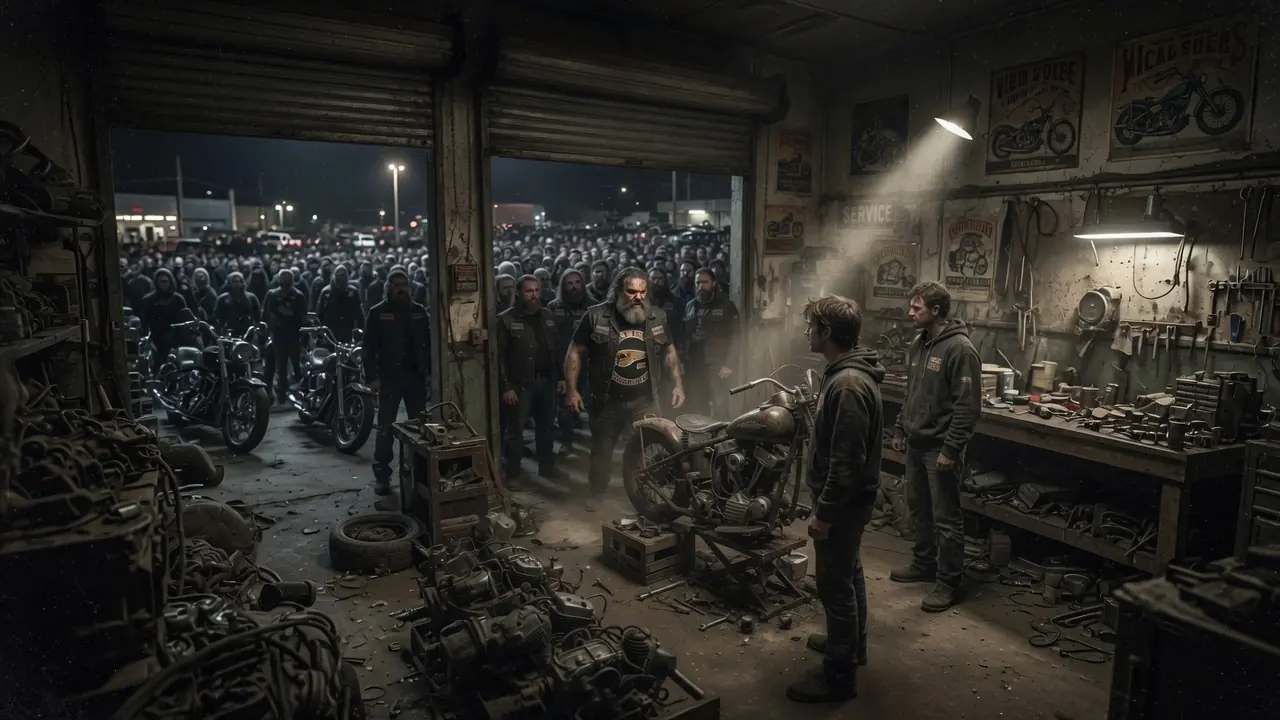
"I didn't strip it to steal from you," Caleb said, his voice cracking slightly before he steadied it. He reached behind him on the workbench, his fingers closing around the cold, heavy piece of machined steel he had cut from the frame. "I stripped it because your misfire wasn't an engine problem. It was an assassination attempt." The words hung in the suffocating air. The enforcers by the door shifted their weight. Grip's eyes narrowed into dark slits. "Watch your mouth, boy."
Caleb tossed the heavy steel cylinder onto the metal workbench. It landed with a loud, ringing clang. "Look at it," Caleb demanded, pointing a bloody, grease-stained finger at the metal. "Look at the machining on that sleeve. Look at the wear marks." Grip stared at Caleb for a long second, trying to read the kid's face for deceit, before he finally looked down at the workbench. Iron Jack walked over slowly, his heavy boots crunching over stray bolts. The president picked up the steel sleeve, examining it under the harsh fluorescent shop light.
"I ran it on the dyno," Caleb explained rapidly, his adrenaline spiking. "Your carburetors are fine. Your timing is flawless. But when the bike hits exactly 75 miles per hour, the harmonic resonance of that massive twin-cylinder engine peaks. Someone cut your main frame down tube, shoved this internal sleeve inside, and tacked it back together with just enough weld to hold it steady at low speeds." Iron Jack rotated the sleeve. His expression grew darker with every passing second.
"At highway speeds," Caleb continued, stepping closer to the evidence, "the vibration made that loose sleeve shift violently inside the frame tube. It was pinching your internal wiring harness against the steel, grounding out your ignition system and causing the misfire. That's why nobody else could find it. They were looking at the engine. They weren't looking at the chassis." Grip looked from the sleeve to the freshly welded, unpainted section of his motorcycle's frame. The realization was beginning to dawn on him, pooling in his eyes like dark water.
"If you pushed it to 80," Caleb said, his voice dropping to a grim whisper, "the harmonic stress would have snapped that weakened down tube completely in half. At that speed, the front end of the bike would collapse underneath you. You would be dead, Grip, and highway patrol would write it off as a tragic, catastrophic mechanical failure." Iron Jack handed the steel sleeve to Grip. Grip ran his calloused thumb over the precise, deliberate lathe marks on the metal. This wasn't a factory defect. It wasn't a rusted joint. It was a meticulously engineered death trap.
"Who?" Grip growled, the word vibrating in his chest. "Who had access to my bike while the frame was being painted last month?" Iron Jack turned slowly, looking back out the bay doors toward the sea of leather and denim blocking the street. "Only three people," the president said, his voice dangerously calm. "Me, you, and the prospect who helped load it onto the trailer down in Fresno." Grip's head snapped up. "Skinner."
"Dutch," Iron Jack said quietly, looking at one of the massive enforcers by the door. "Go fetch Skinner. Bring him to the alley. Quietly." Dutch nodded once, a cold, predatory smile spreading across his scarred face, and disappeared into the night. Grip turned back to Caleb. The violent fury in the sergeant-at-arms' eyes had vanished, replaced by a profound, heavy silence. He looked at the severed piece of metal, then at the 19-year-old kid who had risked his life and the wrath of an entire biker gang to dismantle a machine to find the truth.
"You saved my life, kid," Grip said quietly. Caleb swallowed hard. "I fixed the frame. I welded a solid steel slug inside the tube. It's fused. It will never break." He looked at the clock on the wall. It was 8:20 p.m. "But the bike is still in pieces and you have a run tonight." Grip looked at the gutted Knucklehead. He didn't yell. He didn't threaten. He simply reached into his leather cut, pulled out a thick pair of black mechanics gloves, and pulled them over his massive hands. "Then we better get to work," Grip said. "What do you need?"
For the next 45 minutes, the dusty, failing shop of Oildale Customs witnessed something entirely unprecedented. The sergeant-at-arms of the most feared motorcycle club on the West Coast was acting as an apprentice to a broke 19-year-old mechanic. Outside, the 270 Hells Angels remained in their imposing blockade, their headlights casting long, cinematic shadows against the cinder block walls of the industrial park. They kept the police out. They kept the curious away. They formed an absolute perimeter while their machine was resurrected.
Inside the bay, the tension was replaced by a frantic, rhythmic synchronization. Caleb was in his element. The fear was gone, replaced by pure, unadulterated focus. He barked out socket sizes and wrench types. Grip handed them over instantly. "3/8 drive, 1/2 inch socket," Caleb muttered from beneath the bike, securing the oil pump lines. A heavy wrench slapped into his palm. "Got it," Grip grunted. They worked with a desperate speed.
Caleb rerouted the wiring harness externally along the frame spine, abandoning the internal routing that had nearly cost Grip his life. He zip-tied it tight, ensuring it would never pinch. He lifted the heavy, teardrop gas tank, and Grip guided it onto the mounts, securing the bolts. The smell of high-octane racing fuel, burning flux, and sweat filled the garage. Caleb's knuckles were bleeding, the cuts stinging from the harsh chemical cleaners. But he didn't stop. He connected the braided fuel lines to the rebuilt carburetors, set the choke, and tightened the massive primary drive belt.
At exactly 9:05 p.m., Caleb stepped back, wiping his greasy forehead with the back of his arm. The 1947 Knucklehead was whole again. It lacked the polished, showroom finish it had hours ago. The frame was scarred with raw weld marks and the wiring was exposed, but it looked meaner. It looked like a machine that had survived a war. Strapping it down, Caleb breathed heavily, grabbing the heavy-duty nylon ratchets. Grip helped him roll the massive motorcycle backward onto the dynamometer rollers. They strapped the front wheel into the chock and pulled the rear straps taut until the suspension compressed.
This was the moment of absolute truth. If Caleb's weld failed, if his diagnosis was wrong, the bike would tear itself apart right here in the bay. Grip climbed onto the leather saddle. He looked down at Caleb. "Ready?" Caleb nodded, stepping over to the dyno's control computer. "Give it hell." Grip turned the brass ignition key. He primed the carburetors, found top dead center on the engine stroke, and threw his massive weight down on the suicide kickstart. Cough. Sputter. Nothing.
The silence from the street outside felt heavy enough to crush the building. 270 men were listening. Grip reset the pedal. He adjusted the choke slightly. He kicked it again. The Knucklehead erupted into a deafening, thunderous roar. Blue flames spat from the open exhaust pipes, illuminating the dark garage with rapid, violent flashes. The sheer concussive force of the exhaust rattled the wrenches off Caleb's workbench. It sounded magnificent.
"Roll it up!" Caleb shouted over the mechanical thunder, his eyes glued to the dyno screen. Grip clicked the bike into first gear. The massive rear tire spun against the steel roller of the dynamometer. The speedometer on the screen began to climb. 30 miles per hour. 40. 50. The engine ran with a violent, beautiful rhythm. The floor of the shop vibrated beneath Caleb's feet. 60. 70. They were approaching the dead zone. The speed that had nearly killed the sergeant-at-arms.
Caleb held his breath, his eyes darting between the raw weld on the frame and the spinning rear tire. 74. 75. The engine screamed, a high-pitched harmonic wail of American steel and combustion. Caleb watched the tachometer. The needle was pinned. It didn't bounce. It didn't stutter. The frame remained entirely rigid. The death wobble was gone. Grip didn't stop. He rolled the throttle wide open. 80. 90. 100 miles per hour. The motorcycle roared on the stationary dyno, sounding like a fighter jet preparing for takeoff. It was flawless.
The phantom misfire was dead and the sabotage was defeated. Grip chopped the throttle and pulled the clutch, letting the engine wind down to a heavy, aggressive idle. He hit the kill switch. As the engine died, another sound immediately replaced it. From the street outside, a massive, synchronized roar erupted. 270 Hells Angels were revving their own engines in unison, a deafening mechanical applause that shook the very foundations of Oildale. They had heard the Knucklehead scream to 100 miles per hour. They knew their leader was riding tonight.
Grip unstrapped the bike and rolled it off the dyno. He kicked the stand down and walked over to Caleb. The massive biker reached into his leather vest and pulled out a thick envelope. He slapped it hard onto Caleb's chest. Caleb took it. It was heavy, much heavier than $5,000. "There's 10 grand in there," Grip said, his gravelly voice cutting through the ringing in Caleb's ears. "Five for the fix. Five for having the guts to take a grinder to my frame to save my life."
"I don't know what to say," Caleb stammered, looking at the envelope that would instantly pay off the bank, save the building, and keep his uncle's legacy alive. Grip put a heavy hand on Caleb's shoulder, his grip tightening like a vice. "You don't say anything. You just keep those doors open. Because from now on, Oildale Customs is the only shop this charter uses. Anyone gives you trouble with the bank, the suppliers, or the local trash, you tell them Grip sends his regards."
Grip turned, threw his leg over the repaired Knucklehead, and fired it up with a single, effortless kick. He rode out of the bay and into the cool night air. As Caleb walked to the door, he watched Iron Jack and Grip pull to the front of the massive formation. In the alley across the street, he saw Dutch and two other enforcers wiping their hands on shop rags, leaving a dark, motionless shadow behind the dumpsters. The traitor had been handled. The club had cleaned its house.
Grip raised a single fist in the air. 270 motorcycles shifted into gear with a simultaneous, earth-shaking clack. With a final roar that rattled the teeth in Caleb's skull, the Hells Angels tore out of the industrial park, a river of chrome, leather, and red tail lights disappearing into the dark expanse of the Mojave desert, leaving a 19-year-old kid standing alone in the quiet, victorious grease of his saved sanctuary.
Caleb's debts were paid by Monday. Oildale Customs didn't just survive, it became sacred ground. The Hells Angels kept their word, forming an impenetrable shield around the mechanic who saved their leader's life. That terrifying night wasn't the end of his uncle's legacy, but a forged-in-fire beginning. Caleb learned that to fix a broken machine or a broken life, you must be brave enough to tear it completely apart.