A carriage wheel snapped clean off on the frostbitten road, and the old woman inside tumbled forward with a sharp cry that cut through the cold morning air like a blade. Nobody stopped. Carriages rolled past. Footmen looked away.
Lords and ladies on their way to Dunverly Hall for the grand bride choosing kept their curtains drawn, their chins lifted, their hearts sealed shut. A woman bleeding on the road was not their concern. Not today. Not when a duke was waiting.
But one girl stopped. She was not noble. She carried no family crest, no title, no invitation to the hall where the most powerful duke in all of Ravenscroft was about to choose his future duchess. She had come only to sell ribbons at the market.
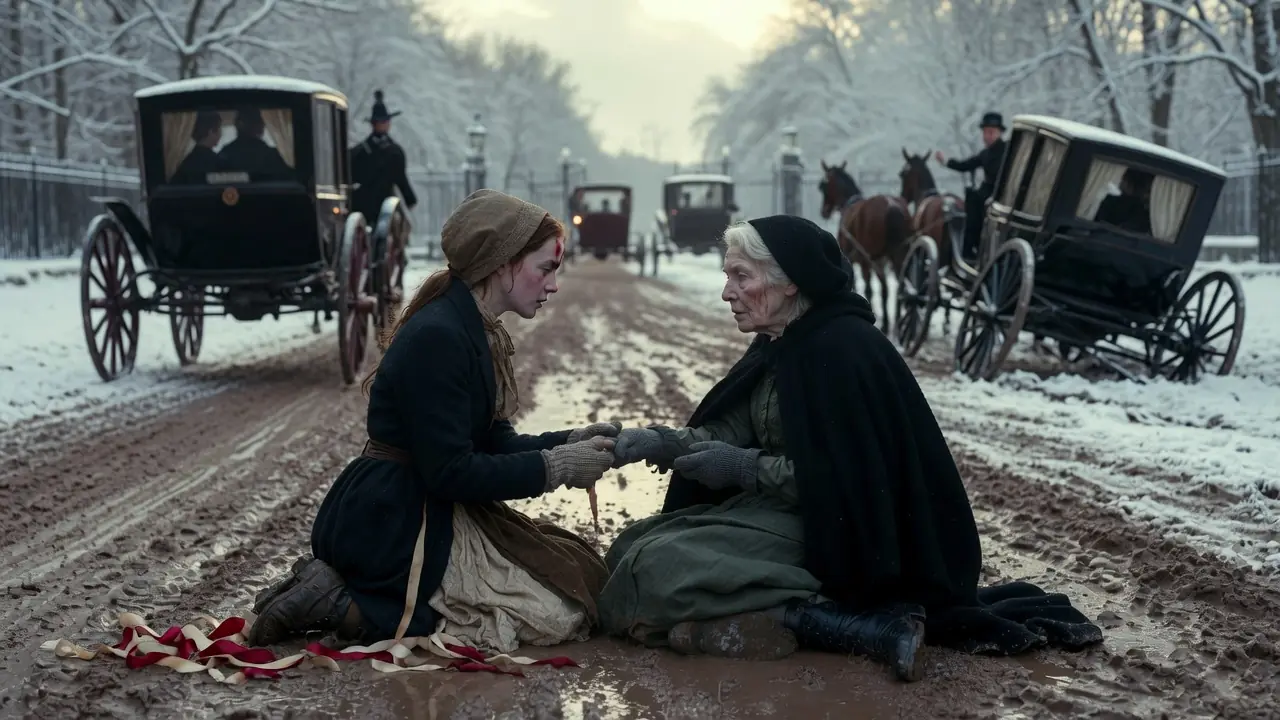
That was all. That was the whole of her morning plan. Yet she dropped everything. She knelt in the mud beside the trembling old woman, pressed clean cloth against the cut on her brow, and held her steady while the world rushed past without a single glance backward.
The old woman gripped her hand and looked at her with eyes that had seen decades of grief. She whispered something, just four words. Words so strange and so heavy that the girl felt her whole chest tighten. She did not understand them yet.
But by the time she walked through the gates of Dunverly Hall, summoned by a duke she had never met, standing among the most beautiful and powerful women in the land, she would understand everything. And the truth waiting inside those walls would break her open and put her back together in a shape she never expected. The ribbon slipped from Dessa’s fingers the moment the carriage wheel cracked. It was not a soft sound.
It was violent, sudden, like a bone breaking under great pressure, and it sent the old woman inside the carriage lurching sideways with a cry that Dessa heard from 20 feet away. The horses reared. The driver scrambled down, cursing under his breath. And then, as though the road itself had rehearsed this moment, every other carriage simply moved around the wreckage and continued forward without pause.
Dessa stood frozen for exactly 3 seconds. She counted them later in the quiet of her memory and felt ashamed it took even that long. The old woman was half hanging out of the tilted carriage door, one frail arm braced against the frame, her white hair loose and wild, a thin line of red tracing down from her brow to her cheek. The driver was arguing with his own horse.
No footman appeared. No passing lord opened a curtain. The grand road to Dunverly Hall was full of people going somewhere important, and not one of them had anywhere in their hearts for an injured woman on the ground. Dessa dropped her basket.
Ribbons spilled across the frost, red and golden ivory, curling against the mud like fallen petals, and she did not look back at them. She crossed the road in quick strides, mud pulling at her boots, cold air biting her face, and she reached the carriage door just as the old woman lost her grip and began to fall. Dessa caught her. She was not large or particularly strong, but she planted her feet and took the weight, wrapping both arms around the old woman's narrow frame and easing her down slowly, carefully, the way one handles something precious and breakable.
The woman gasped. Her fingers clutched at Dessa's coat with surprising force. "I have you," Dessa said. "I have you. Stay still." The old woman did not stay still. She turned her face upward and looked at Dessa with eyes the color of deep winter water, pale and ancient and achingly alert.
And something in that gaze made Dessa's breath catch in a way she could not name. "You stopped," the old woman said. "Of course I stopped." "No one stops," she said quietly. "Not on this road. Not today." Dessa helped her sit against the grassy bank at the road's edge, then tore a strip from her own underskirt without hesitation and pressed it firmly against the cut on the woman's brow. It was not deep, but head wounds were proud bleeders, and the old woman's color had gone the pale gray of cold ash. "What is your name?" Dessa asked, keeping her voice even and calm, the way her mother once spoke during storms. "Ottoline," the woman said. "And you, child?" "Dessa. Dessa Lauren." Ottoline's fingers, which had been resting loosely in her lap, suddenly tightened into a grip so fierce that Dessa nearly pulled back in surprise.
But the old woman's eyes had gone somewhere far away, somewhere behind Dessa's face, searching for something in the middle distance that only she could see. "Lauren," she whispered. "Yes, ma'am." Ottoline said nothing more for a long moment. The driver had finally calmed the horses and was inspecting the broken wheel with the expression of a man who understood he was going nowhere fast. The road continued to swallow carriages whole, all of them heading to Dunverly Hall, all of them carrying daughters dressed in their finest, all of them chasing the same extraordinary prize. The Duke of Greyfeld was choosing a bride today.
Dessa was not among the hopefuls. She had known from birth that she was not the sort of girl dukes chose. She was the sort of girl who sold ribbon at market, who mended her own boots, who lived in the narrow house at the end of Corwick Lane with a roof that complained loudly every time it rained. She had no dowry, no connections, no mother alive to pin up her hair and whisper social strategies into her ear.
She had only herself, and on most days that felt like enough. Today it felt like very little. Not because of the duke. She did not care about the duke.
She cared because her ribbon basket was now half ruined in the road mud, and that ribbon represented 3 days of careful work and a week's worth of income she could not afford to lose. But Ottoline was still watching her with those pale winter eyes, and Dessa found she could not yet make herself stand and go. "Where were you going?" Dessa asked. "To the hall," Ottoline said. Dessa blinked. "To Dunverly Hall for the bride choosing?" "Not as a candidate," the old woman said with a dry, tired sound that was almost a laugh. "I was invited by my son. He does not know I have come.
Whatever happens after he sees my face is his to decide. But he will see my face. That much I owe him." Dessa felt something move in her chest, something warm and aching and entirely inconvenient. She looked at the broken wheel.
She looked at the driver who was shaking his head in the universal language of hopeless mechanical defeat. She looked down the long road at the line of carriages still flowing toward the grand iron gates of Dunverly Hall, growing smaller with distance, gleaming in the pale winter light. Then she looked back at Ottoline. "My cart is at the market turning," she said. "It is small, and it smells like wood polish and old sacking, and it will not impress anyone. But the horse is steady and the wheel is sound." She stood and offered her hand. "Come.
I will take you." Ottoline took her hand, and just like that, without any understanding of what she was walking into, Dessa Lauren turned away from her ruined ribbons and drove a stranger toward the most powerful house in all of Ravenscroft. Dunverly Hall rose from the landscape the way mountains rise, without apology, without softness, with the absolute certainty of something that had existed long before anyone living and intended to exist long after. Its iron gates stood open for the first time in 4 years. Footmen in starched livery lined the drive in two precise rows.
Carriages were being received with great ceremony, ladies descending like flowers shaken from a bouquet, each one announced by name to a waiting secretary who recorded them in a leather-bound ledger with the gravity of a man recording history. Dessa drove her small cart to the far left of the receiving line, where it attracted precisely the kind of attention she had been hoping to avoid, which was the wrong kind, immediate and sharp and full of poorly concealed amusement. A footman approached with the expression of a man who had been trained to show no expression and was currently failing. "This entrance is for invited guests only," he said. "I am accompanying an invited guest," Dessa replied, and she helped Ottoline down from the cart with steady hands before the footman could think of a counter argument. Ottoline descended with a dignity so complete that it silenced the footman entirely.
Despite the torn cloth pressed to her brow, despite the mud on her traveling coat, despite the wholly unsuitable cart she had arrived in, she moved with the unhurried grace of a woman who had once known exactly what it meant to belong in a place like this and had not entirely forgotten. She gave the footman her name. His face did something complicated. He disappeared inside with remarkable speed.
Dessa stood with the cart, unsure whether to stay or go, and was still deciding when a second figure appeared at the top of the stone steps. This one was not a footman. He was tall and severe, with the kind of face that had once been young and striking and was now something more interesting, all angles and weight and controlled intensity. He wore no color for the ceremony.
He wore gray, which suited him the way iron suits a bridge, not decorative but entirely necessary. He stopped at the top of the steps and looked down. His eyes found Ottoline and something happened to his face that Dessa had no word for. It was not quite recognition.
It was something beneath recognition, something that lived in the body before the mind catches up, a flinching open, a sudden unguarded breath, a cracking along the edges of a carefully maintained composure. "That," said a young woman appearing at Dessa's elbow out of nowhere, breathless and bright-eyed and apparently unbothered by the scene unfolding on the steps, "is the Duke of Greyfeld, Cassian Greyfeld, and I have never in four years of attending these functions seen him look like that at anything." Dessa turned to look at the speaker. She was perhaps 19 with a sharp, clever face and hair that was escaping its pins at a rate that suggested the pins had never really stood a chance. "Who are you?" Dessa asked. "Petrine Soulcroft," the girl said cheerfully, "third daughter of Lord Soulcroft of Wenmouth, entirely unqualified to be a duchess. Here primarily because my mother threatened consequences I prefer not to consider." She tilted her head. "Who are you and how did you arrive in that cart?" "Dessa Lorn, ribbon seller. The cart is mine." Petrine stared at her for a moment, then burst into the most genuine laugh Dessa had heard in some time.
But Dessa was no longer looking at Petrine. She was looking at the steps where Ottoline had climbed slowly, deliberately, one hand trailing the stone rail, and where the Duke stood motionless above her, like a man who had turned to stone and was only just remembering how to breathe. Ottoline stopped two steps below him. She looked up.
He looked down. "Cassian," she said, just his name, nothing more. But the way she said it, with 17 years of silence packed into three syllables, it landed in the cold air like a bell struck hard, resonant and shaking and impossible to unhear. The Duke moved, not with the measured authority he had worn coming down those steps. He moved with something raw and ungoverned, stepping down to her level, his hand coming up as though he meant to reach for her and then stopping, hovering, unsure whether what he was seeing was real enough to touch. "You died," he said.
His voice was low, controlled, but something underneath it was not controlled at all. "I did not," she said. "I read the letter. The letter was written by people who wished me gone," she said. "I cannot undo 17 years, Cassian. I can only stand here and tell you that I never stopped, not for a single day. I never stopped." The Duke of Greyfeld, who was by all accounts the most composed man in Ravenscroft, who had run his estate and his affairs and his grief for 17 years without visible fracture, closed his eyes.
Just for a moment, just 3 seconds, maybe 4. When he opened them, they were not dry. He said nothing. He offered his arm with the formality of a man who did not yet trust himself to speak, and Ottoline took it, and he walked her inside without looking back at the assembled crowd, without acknowledging the dozens of watching eyes, without performing any version of himself for anyone present.
The door closed behind them. The entire gathered crowd seemed to exhale at once. Petrine made a sound beside Dessa that was half whistle, half sigh. "Well," she said, "that is not how these afternoons usually begin." Dessa realized her hands were shaking. She pressed them flat against her skirt and breathed slowly.
A sharp voice cut across the courtyard before she could recover herself. "You there, the girl with the cart." Dessa turned. The speaker was a tall woman with the posture of someone who had been told they were important so many times they had begun to believe gravity applied differently to them. She was perhaps 50, impeccably dressed, her gray hair swept into an arrangement that must have taken considerable effort and pins. She was looking at Dessa with the particular expression reserved for things found in inconvenient places. "This is Lady Overton," Petrine murmured helpfully. "She organizes the bride selection on behalf of the Duke's household.
She is formidable and she does not enjoy surprises." Lady Overton did not wait for an introduction. "You brought that woman," she said to Dessa, not a question, an accusation with the shape of a question. "She was injured on the road," Dessa said. "Her carriage wheel broke. I offered her transport." "You have no invitation to this property." "No, my lady." "Then you will leave." Dessa had every intention of leaving. She had accomplished what she came to do, which was nothing she had actually planned to do, and her ribbons were still drying in the mud somewhere on the main road, and her morning was a complete ruin. Leaving was entirely sensible.
But then a footman appeared at the great door and looked directly at her. "His Grace," the footman said with some formality and a certain visible surprise, "requests that the young woman who transported Lady Ottoline be brought inside." Lady Overton's expression underwent a rapid and unwilling transformation. Petrine grabbed Dessa's arm with barely contained delight. "Oh," she breathed. "Oh, this is the most interesting bride selection I have ever attended, and I have attended seven." Dessa looked at the door. She looked at the cart. She looked at her mud-stained boots and her ribbon seller's coat and her entirely unprepared self.
Then she walked inside. The entrance hall of Dunverly Hall was everything the outside promised and then some. Dark wood, high ceilings, portraits in heavy frames, fires burning in two great hearths, and a staircase wide enough to fit Dessa's entire house standing sideways. Arranged along the hall in careful groupings were the bride candidates, some 30 young women of varying degrees of beauty and anxiety, all watching Dessa walk in with expressions ranging from confusion to outright offense.
She was not supposed to be here. Everything about her said so. Her coat, her boots, her unadorned hair, her complete absence of jewelry or powder or the particular way ladies moved when they had been trained since childhood to be looked at. A man stepped forward from a side room.
Not the Duke. This one was younger, perhaps Dessa's own age of 23, with an open, handsome face and the kind of easy manner that suggested he had been liked by most people for most of his life and had found it a reliable condition. "Miss Lorn?" he said. "Yes. I am Lord Raffin Torl, the Duke's cousin and sometimes secretary when he needs someone he trusts with tasks he does not want mishandled." He smiled. It was a good smile, uncomplicated and real. "His Grace asks if you will wait.
He would like to thank you personally." "That is not necessary," Dessa said. "Perhaps not," Raffin agreed pleasantly, "but His Grace was very specific. And Cassian Greyfeld being very specific is not something one argues with comfortably." He glanced around the hall with gentle amusement. "Can I offer you something warm while you wait? You look as though the morning has been eventful." Dessa almost laughed. Eventful was one word for it.
She accepted a seat near the fire and a cup of something hot and sweet, and she sat with her hands wrapped around the cup and her eyes moving carefully around the room, cataloging the strange new world she had stumbled into without map or compass or any reasonable explanation for why the most powerful Duke in the country wanted to speak to a ribbon seller from Corwick Lane. From across the hall, 30 pairs of eyes watched her with varying degrees of hostility. From a tall window near the stairs, a young woman with dark red hair and a calculating expression watched her with something sharper than hostility, interest. And from behind the closed door of the Duke's private study, raised voices moved through the wood like heat through stone.
One of them was Ottoline's, one of them was Cassian's. And a third voice, cold and precise and very controlled, belonged to someone Dessa had not yet seen. She pressed her hands tighter around the cup. The fire cracked.
The voices continued. And Dessa Lorn sat in the middle of Dunverly Hall, entirely uninvited, completely unprepared, and absolutely unable to leave. The third voice behind the door belonged to Lord Cennic Drawl. Dessa did not know his name yet.
She learned it from Petrine, who had somehow materialized beside her near the fire with a second cup of something hot and the expression of a person who collected information the way others collected silverware, carefully, consistently, and with great personal satisfaction. "Lord Cennic Drawl," Petrine said quietly, leaning close enough that her words went nowhere beyond Dessa's ear. "He is the Duke's appointed guardian from age 12 onward. After the letter came saying Ottoline had died, Drawl stepped in, managed the estate, managed the finances, managed Cassian himself until he came of age." She paused. "Some say managed is too gentle a word." Dessa looked at the closed door. "What word would they use instead?" she asked. "Controlled," Petrine said simply. The voices behind the door sharpened. Ottoline's came through clearly once, not words, just tone.
And the tone was the sound of a woman who had survived 17 years of forced silence and was done being quiet. Cassian's voice followed, lower, harder, the kind of sound a man makes when something in him is pulling two directions at once, and neither direction is kind. Drawl's voice said nothing for a long stretch. That silence was somehow the loudest thing in the room.
Raffin appeared at Dessa's side with the unhurried calm of a man navigating familiar chaos. "Do not be alarmed," he said, though his jaw was tight. "I am not alarmed," Dessa said. "I am confused, which is different." "Yes," he agreed. "Confusion is survivable." He glanced at the door. "Alarm may yet have its moment." A sharp crack came from inside the study, not a voice, something physical, something struck or thrown, and then absolute silence. Every woman in the entrance hall went still. Then the door opened. Lord Cennic Drawl lay walked out first.
He was not what Dessa expected. She had built him in her imagination as large and loud, the shape of a villain in a penny theater piece. He was neither. He was perhaps 60, lean and elegant with silver hair combed back from a narrow face and eyes the color of old pewter.
He moved with complete composure, as though the meeting behind that door had been entirely routine, as though nothing about it had touched him. He surveyed the entrance hall with the unhurried gaze of a man assessing property. His eyes landed on Dessa. They stayed there 2 seconds longer than necessary.
Then he smiled. It was a perfectly constructed smile, warm at the surface and hollow underneath, the kind of smile that had been practiced until it looked natural and would never actually be natural. "The girl from the road," he said pleasantly, "how charitable of you to assist an old traveler." "It was nothing extraordinary," Dessa said. "No," he agreed softly. "I suppose it was not." He walked away. He walked with the particular ease of a man who believed nothing in a room could threaten him, and Dessa watched him go with a feeling she could not immediately name, settling like cold water in her stomach. Petrine exhaled slowly beside her. "He knows who she is," Petrine murmured, so quietly Dessa almost missed it.
Dessa turned. "Ottoline?" "He knows who Ottoline is, which means he knows what her being alive means." Petrine looked at Dessa with eyes considerably more serious than her usual brightness. "17 years of control over one of the wealthiest dukedoms in Ravenscroft. That does not dissolve quietly just because a mother walks back through a door." Dessa thought about the smile, the two extra seconds of attention, the way he had said nothing extraordinary with such precise gentleness. Her hands tightened in her lap. The study door opened again, and Cassian Greyfeld stepped out.
He was different from the man who had appeared at the top of the steps. That man had been cracking open. This one had sealed himself back together with visible effort. Every line of him composed and deliberate, but the composition was newer, less settled, the way a wound looks when it has just been bound and has not yet decided whether it will heal or worsen.
He crossed the hall. The assembled women straightened instinctively, a collective pulling toward him like flowers turning without meaning to. He stopped in front of Dessa. She stood.
He was taller than she had realized on the steps, and younger looking up close despite the weight his eyes carried, which was not the weight of years, but the weight of particular losses carried in particular silence. "Miss Lorn," he said. "Your Grace, my mother tells me you caught her when she fell." "She would have caught herself," Dessa said. "I was simply closer." Something moved in his expression, not quite a smile, the shape a smile leaves behind when the person is not yet ready to make one. "She also tells me you tore your own clothing to tend her wound without being asked." "It was the practical choice. I had no other clean clothes." "And you drove her here in your market cart." "Her carriage wheel was broken. Yours was the destination she named." He looked at her steadily for a moment, and Dessa had the unsettling sensation of being read, not assessed in the way the other women in the room were being assessed, measured for grace or beauty or family name, but actually read, the way one reads something unfamiliar and is not yet sure what it means. "You will stay for the afternoon," he said. It was not precisely a question. "I have a market stall, Your Grace.
My ribbons are already ruined." "I will have the ribbons replaced," he said, "and the stall loss compensated. Please stay." Dessa opened her mouth to decline and found she had no adequate reason to give. The ribbons would be replaced. The morning was already gone, and somewhere behind a closed door Ottoline was sitting alone in a house full of strangers in a situation that had not yet resolved itself into anything safe. "For Lady Ottoline's comfort," Dessa said finally, "not for anything else." "Of course," Cassian said.
He returned to managing his household, to the bride selection, to the great complicated machinery of the afternoon that had not stopped simply because the world had shifted on its axis. Raffin appeared with a quiet word, and Cassian moved into the formal receiving room where the selection proceedings were meant to begin. Dessa sat back down. Across the hall, the woman with dark red hair was still watching her.
She crossed the room with the deliberate grace of someone who had decided on a destination and intended to arrive. "Countess Oren Belgrave," she said, not offering her hand. "Eldest daughter of the Earl of Tolmer. I have been considered the primary candidate for this selection for the past 3 months." "Dessa Lorn," Dessa replied, "ribbon seller, not a candidate for anything." Oren studied her with those sharp, calculating eyes. "Then what are you?" she asked. "At present," Dessa said honestly, "I am not entirely sure." Oren's gaze moved to the study door, then back to Dessa, and something crossed her face that was more complicated than simple rivalry. There was fear in it, carefully managed, impeccably dressed fear, but fear nonetheless. "That old woman," Oren said quietly, "the one you brought. Do you know who she is?" "She told me her name." "Her name is the least of it." Oren stepped closer, dropping her voice to something that barely qualified as sound. "Ottoline Greyfeld did not simply die 17 years ago, Miss Lorn.
She disappeared 3 days before she was supposed to testify before the estate council that Lord Drawl had been falsifying the Greyfeld inheritance accounts. She vanished. A letter arrived, and Drawl became the most powerful unelected man in the county." She paused. "Now she is back, and Drawl was in that room." Dessa felt the cold water in her stomach turn to ice. "Is she safe?" Dessa asked. Oren looked at her with something that was almost respect. "That," she said, "is exactly the right question." She walked away before Dessa could ask anything more, back to her position among the candidates, her face rearranging itself into the careful pleasantness of a woman playing a long and dangerous game with full awareness of the rules.
Dessa stood. She moved toward the study door. A footman stepped into her path. "Miss Lorn, the selection proceedings are beginning in the east room. His Grace has arranged for you to observe from the" "Where is Lady Ottoline?" Dessa asked. "Up halls.
She is resting in the green sitting room, second passage to the left." Dessa went left. The green sitting room was small and warm with a fire that had been freshly built and curtains drawn against the cold. Ottoline sat in a chair near the hearth, a fresh cloth against her brow, a cup of tea cooling at her elbow. She looked exhausted in the way of someone who has carried something heavy for 17 years and has only just set it down and does not yet know how to stand without the weight.
She looked up when Dessa entered. "You are still here," she said. "I said I would stay." Ottoline smiled. It was a real smile, worn at the edges, ancient with surviving. "Sit with me," she said. Dessa sat. For a moment, neither of them spoke.
The fire settled. Outside the door, the house moved with the sounds of the selection. Heels on marble, voices in hallways, the distant, authoritative tones of Lady Overton directing the choreography of ambition. "He is angry," Ottoline said at last. "He thought you were dead." "Yes, but the anger is not at me. It is at everything he cannot undo. 17 years of grief he did not need to carry. 17 years of decisions made under Drawl's hand that he believed were his own." She looked at the fire. "He is a good man, my son.
He became good in spite of everything, which is the harder kind of good to become." Dessa thought about the man who had stood before her in the hall. The weight in his eyes, the way he had asked her to stay was not like a duke issuing a preference, but like a person asking for something they needed and were uncertain they had the right to need. "What happens now?" Dessa asked. Ottoline turned to look at her, and those pale winter eyes held something new in them, something sharp and purposeful and very deliberate. "Now," Ottoline said, "we must be very careful. Drawl has not survived 17 years by being slow.
He knows I am here. He knows what I can prove, and he will move before I have the chance to move first." She reached out and placed one hand over Dessa's. "I need you to do something for me, child." Dessa looked at the hand over hers. The fingers were thin, but steady. "What?" she asked. "Stay close to my son," Ottoline said. "Not for the selection, not for any of that nonsense. Simply be near.
You see things clearly. You act without hesitation. I watched you on that road, and I knew it within 60 seconds." She squeezed gently. "Cassian is about to face something that will try to bury him. He will need someone near him who has nothing to gain from his ruin." Dessa stared at her. "I am a ribbon seller," she said. "Yes," Ottoline agreed, "that is precisely why." The selection proceedings began at 2:00 in the East Room, and Dessa watched from a cushioned bench near the servants' corridor entrance, which was not where guests sat, but was considerably better positioned for seeing everything without being seen. 30 women, 30 careful smiles, 30 futures on quiet display.
Cassian moved through the formalities with the efficiency of a man completing a necessary task, present in body, attending in manner, absent in the particular way that only becomes visible when you are looking for it. Dessa was looking for it. She noticed it in the fraction of a second too long before each response, in the way his eyes sometimes moved to the door as though expecting something unwelcome to walk through it, in the slight tension across his shoulders that never quite released. Raffen stood to the side and caught Dessa's eye once across the room.
He gave a small nod. She was not sure what it meant. She nodded back. Lady Overton was magnificent in her element, steering proceedings with a voice like a well-oiled hinge, smooth and relentless, introducing each candidate with the practiced warmth of a woman who had organized human display events so many times she had stopped noticing that was what they were.
Aren Belgrave presented herself last, which was strategic and obviously intentional, and she was extraordinary at it. She spoke to Cassian with the ease of long familiarity, because there was some, Dessa gathered, three months of correspondence arranged by their respective households. She said everything correctly. She was composed and intelligent and appropriate in every visible way.
Cassian responded to her with more warmth than he had shown the others. Dessa watched this and felt nothing in particular about it, which she noted and set aside. What she did feel was the specific discomfort of a pair of eyes on the back of her neck. She turned.
Lord Drawl stood in the doorway behind her. He was not watching the selection, he was watching her. "Comfortable?" he asked pleasantly. "Well enough," Dessa said. He came to stand beside the bench, not sitting, simply standing with his hands behind his back and his eyes on the room ahead, a posture of casual observation that felt anything but casual. "You are an interesting addition to this afternoon," he said. "A market girl with no invitation, no name, no reason to be inside these walls, and yet here you sit." He paused. "His Grace must have found your service to his mother quite moving." "He was grateful. It was a natural response." "Natural?" Drawl repeated softly, tasting the word. "Yes.
Cassian has always been susceptible to natural responses, emotion dressed as instinct. It was his greatest vulnerability as a boy. One hoped he had grown past it." Dessa kept her eyes on the room. "One hopes for many things," she said. A silence, the kind that is not empty. "I knew a Lauren once," Drawl said, "years ago.
A physician named Aldous Lauren who worked the northern routes. Competent man. Principle, which was occasionally inconvenient." Another pause. "Any relation?" Dessa's heart did something sudden and painful. Her father's name, spoken in this man's mouth with the careful lightness of a threat being delivered in the register of conversation.
She said nothing. "No matter," Drawl said warmly. "It is a common enough name." He straightened and turned to leave. "Enjoy the proceedings, Miss Lauren. I hope your afternoon continues to be eventful." He walked away. Dessa breathed through her nose, slowly, once, twice, until her heartbeat settled back below the level of panic. Her father had died when she was 14.
A road accident on the northern route, they had told her. A wheel, a ditch, a night too dark for anyone to find him in time. A wheel. She stared at the floor and thought about Ottoline's carriage, about the wheel that had cracked so violently it sent the whole vehicle sideways, about the specific sound it had made, not the soft degradation of age and wear, but something sharp, something that ended all at once, something that had been cut.
Her mind moved through this slowly, the way one walks ground suspected of being unsound. She stood from the bench and slipped out through the servants' corridor before she could decide whether she was being foolish. She found Raffen in the passage outside the study speaking quietly with a footman who departed at her approach. "Lord Raffen," she said. He turned, read her face.
His easy manner did not leave him, but it sharpened underneath. "What has happened?" he asked. "Ottoline's carriage wheel," Dessa said. "Before it broke on the road, was the carriage kept in Drawl's stables, even briefly?" Raffen was very still for a moment. "She arrived from the coaching inn at Welford," he said slowly. "The carriage was hired there, but Drawl knew she was coming. He had contacts at every coaching station between here and the northern settlements. He has maintained them for years." He looked at her. "Why?" "The wheel did not fail," Dessa said. "It broke. There is a difference." Raffen stared at her.
Then he said a single quiet word under his breath that she pretended not to hear and turned toward the study door. "Cassian needs to know this," he said. "Now. He is in the middle of the selection." "The selection can wait 5 minutes. His mother's safety cannot." Raffen pushed the study door and looked back at her. "Come." Dessa followed. The study was a large room, book-lined and map-covered, with the specific atmosphere of a space where serious decisions have been made for a very long time.
There was a second door at the far end, and through it Raffen went into the passage connecting to the East Room, and Dessa heard him speak quietly to someone, and then footsteps, and then Cassian was in the study doorway. He looked at Dessa. "What is it?" he said. She told him, plainly and quickly, without decoration. The sound of the wheel, the nature of the break, what Drawl had said about her father.
The name Aldous Lauren spoken with such deliberate casualness. Cassian listened without interrupting. His face was very still. When she finished, he said nothing for a moment.
Then he turned to Raffen. "Send for Howell," he said. "The carriage is still at the gate. I want the wheel examined before anyone touches it." Raffen was already moving. "And find out where Drawl is right now. Every minute." "Already done," Raffen said, and was gone. Cassian looked back at Dessa.
She expected him to thank her and send her back to the bench. He did not. "Your father," he said quietly, "Aldous Lauren, the physician." She looked up at him sharply. "You knew him?" she asked. Something crossed his face, careful, weighted. "He treated my mother," Cassian said, "twice that I know of, on the northern routes before she disappeared. She spoke of him afterward.
She said he was the only man on that road who looked at her like a person rather than a problem to be managed." The room was very quiet. Dessa felt the morning rearranging itself around her, every piece of it shifting slightly, settling into a shape she had not been able to see when she was inside it. “She recognized my name,” Dessa said softly.
“On the road, when I told her. She went somewhere far away for a moment.” She went somewhere far away for a moment. “Yes,”
Cassian said. “She would have.” Dessa looked at him and he looked at her and between them was the strange and specific weight of two people discovering that their lives had been tangled together long before they ever met, pulled by threads neither of them had chosen and neither of them had known were there. “I need to go back to her,”
Dessa said. Yes, he said again. She moved toward the door. She stopped.
“Your Grace,” she said without turning. Drawl is going to do something, not tomorrow, today. He has been in control of this house for 17 years and he is standing in it right now watching everything he built begin to unravel. People like that do not wait.
A pause behind her. No, Cassian said, they do not. “Then whatever you are planning,” she said, “plan it faster than he does.” She walked back to the green sitting room.
Ottoline was not alone. A woman Dessa had not seen before was sitting across from her, perhaps 40, plainly dressed for a place like this with a face that had been handsome once and was now something more serious. She had a leather satchel at her feet and the particular stillness of a person accustomed to delivering difficult information. She looked up when Dessa entered.
Ottoline spoke before either of them could. “This is Marren Solt,” she said. “She is the reason I am still alive.” She looked at Dessa with those pale eyes and in them was something new, not exhaustion, not grief, something fiercer.
“She has been gathering evidence against Lord Drawl for 11 years, and today she is finally in the right house to use it.” Marren Solt reached into the satchel and placed a folded document on the table between them. It was thick, it was old and it had Lord Drawl's personal seal pressed into the wax at the bottom, cracked now with age and handling, but unmistakable. Dessa sat down.
Outside the door the house hummed with selection proceedings and social performance and the oblivious business of a normal afternoon. And in the green sitting room with a fire burning low and a document on the table that could end a man and restore a family three women began to plan. Marren Solt had not arrived at Dunverly Hall by accident. She explained this in the quiet, measured way of someone who had rehearsed the telling many times without ever letting it become less true. 11 years ago she had been a junior clerk in the Ravenscroft Estate Council offices assigned to file documents that nobody important bothered to read twice.
She had read them twice. She had read them many times in fact because something in the numbers had been wrong in the particular way that wrong things are wrong when someone very clever has tried to make them look right. Greyfeld Estate accounts, 17 consecutive quarters, transfers recorded against properties that did not exist, payments made to contractors whose names appeared in no trade registry in the county, funds moved in small enough amounts to avoid immediate notice accumulated over years into a sum so significant that when Marren finally calculated the total on a single sheet of paper she had to sit down and stay sitting for a considerable time. She had gone to her supervisor.
Her supervisor had gone to Drawl. Marren had lost her position the following morning, but she had kept copies of everything. “He could not find them,” she said, her hands flat on the table on either side of the document. “He tried.
He sent men to my lodgings twice. I had already moved them.” She looked at Ottoline. When I found Lady Ottoline three years after she disappeared, living under a false name in a village two counties north, I understood the full shape of it.
Drawl had not merely stolen from the estate, he had removed every person who could prove it. Dessa looked at Ottoline. “How did he take you?” she asked. The first time, how did it happen?
Ottoline was quiet for a moment. “I was given tea,” she said simply, “at a council meeting.” I woke in a farmhouse 40 miles north with no papers, no money and a woman standing over me who had been paid to ensure I did not return. She folded her hands in her lap.
The woman had a conscience as it turned out. She did not harm me further. She simply left and I spent the following years moving carefully, keeping silent, gathering what I could, waiting for a moment when arriving would do more good than harm. “And today is that moment,”
Dessa said. “Today is that moment,” Ottoline confirmed. Marren opened the document fully on the table.
It was not one document but several, layered together, each one annotated in a small precise hand that Dessa recognized as Marren's own. Account records, a signed letter in Drawl's handwriting directing the falsification of a death record, a second letter, this one from a hired man whose name appeared three times in the accounts under different spellings confirming receipt of payment for an unspecified task on the northern road dated four days before Dessa's father had died. Dessa's eyes stopped moving. She looked at that date.
She looked at it for a long time. “He killed my father,” she said. It was not a question. Her voice was entirely level.
The levelness was the frightening part. Marren and Ottoline exchanged a glance. The evidence suggests your father had become aware of certain account irregularities, Marren said carefully. He treated several estate workers who spoke freely around a physician.
He had written a letter to the council. The letter never arrived. Dessa sat with this. Outside the door the house was still performing its afternoon.
Heels on marble, a burst of polite laughter from the east room, the distant voice of Lady Overton announcing something in the tone she used for announcements. Inside the green sitting room Dessa Lorne sat with the knowledge that the man currently walking through these halls had taken everything from her family with the same careful precision he had used to take everything from this one and had covered it so clearly that she had spent nine years believing it was simply an accident on a dark road. She stood. “Where is the council representative?” she asked.
The estate council. They must have someone here today. Selections of this significance require a legal witness. Marren looked at her with new attention.
“Master Colveth,” she said. He arrived this morning. He is in the west library. Is he Drawl's man?
A pause. He was appointed before Drawl's influence was fully established, Marren said. He has always been cautious, neither aligned nor opposed, the kind of man who follows evidence if it is placed directly in front of him and he cannot look away from it. “Then we place it directly in front of him,”
Dessa said. Ottoline was watching her with those pale eyes that saw too much. “You understand,” Ottoline said quietly, “that Drawl will not accept this without response.”
The moment those documents reach Colvith, the moment the council is formally notified, he will act. He has too much to lose for restraint. “I know,” Dessa said.
He is dangerous, child. What he did to my carriage wheel this morning is the smallest version of what he is capable of. “I know that too,” Dessa said.
But I have been living with the consequence of his danger for nine years without knowing who caused it. I would rather face it knowing. She looked at them both. I need 20 minutes, she said, and I need to speak to Lord Raffin first.
She found Raffin in the main corridor, which was becoming a familiar geography now, this house she had stumbled into without invitation. He was speaking with a compact serious man named Howell who had the hands and eyes of someone accustomed to working with physical evidence and the manner of someone who was angry about what he had just found. “The wheel,” Dessa said without preamble.
Howell looked at her, then at Raffin who nodded. “Cut,” Howell said. Clean on one side, rough on the other to disguise it.
Done in the last 48 hours. The wood was fresh at the break. He paused. Whoever did it knew exactly how far the carriage would travel before it gave up.
Raffin's jaw was tight. It was meant to be worse, he said, more to himself than to either of them. On the section of road past the mill bridge there is a drop. If the wheel had held 20 more minutes he stopped.
Dessa did not let herself think about that. I need to get Marren Solt and the documents to Master Colvith in the west library, she said, without Drawl knowing until it is done. “Can you manage that?” Raffin looked at her steadily.
You have been in this house for four hours, he said. Yes, she said, and you are reorganizing it. Someone needs to. He almost smiled.
It was almost genuine. “Give me 10 minutes,” he said. I will ensure Drawl is occupied. Cassian has already asked him to attend a meeting in the upper study regarding the selection formal announcements.
Drawl will not refuse. Refusing would look like guilt and he is too careful for that. “Good,” Dessa said.
Then let us move while he is performing innocence. The next 20 minutes moved the way urgent things move, quickly and with the specific clarity that comes when there is no room for hesitation, Raffin disappeared upstairs. Dessa returned to the green sitting room and relayed the plan in brief. Marren gathered the documents with practiced efficiency, returning them to the satchel in a particular order that suggested she had organized them for exactly this presentation many times in her imagination.
Ottoline rose. "You should stay." Dessa said. "I will not." Ottoline said firmly. "“These are my documents, too. My years, too. My son’s inheritance that was stolen while he believed himself protected.”" She straightened to her full height, which was not inconsiderable. "“I will walk into that library on my own feet.”" Dessa did not argue. They moved through the servants' corridor, the same passage Dessa had used earlier, which was beginning to feel like the spine of the house, the part that kept everything else upright while the visible rooms performed their functions.
A young maid they passed looked at them with wide eyes and said nothing. An older footman recognized Ottoline, and something moved across his face that was old and complicated and resolved itself into a small deliberate nod as he stepped aside without being asked. The West Library was warm and book-dense with the particular hush of a room that took ideas seriously. Master Colveth sat at the central table with papers of his own.
A round, careful man of perhaps 65 with spectacles on a chain and a patient expression of someone accustomed to waiting for other people to arrive at conclusions. He looked up when they entered. He looked at Ottoline. The patience left his face immediately, replaced by something raw and genuine. "Lady Greyfeld." he said.
He rose from his chair. "I was told you were told incorrectly." Ottoline said. "Please sit down, Master Colveth. We have a great deal to show you and not as much time as I would like." He sat. Marren opened the satchel. What followed was not dramatic in the theatrical sense.
It was the quiet drama of truth being laid on a table piece by piece. Each document placed with explanation, each connection drawn in clear plain language, each year of concealment unpacked with the methodical patience of two women who had spent a very long time making sure this moment would be undeniable when it finally arrived. Colveth read everything. He asked three questions.
He removed his spectacles, cleaned them, replaced them, and read two sections again. Then he looked up at Dessa, who had said nothing throughout and had stood near the door watching the corridor. "And you are?" he asked. "Dessa Lorne. My father was Aldus Lorne, physician. His name is in the third document." Colveth found it, read it.
His expression did something that was not quite visible, but changed the quality of his stillness entirely. "This is sufficient." he said quietly. "“This is more than sufficient.”" He began carefully stacking the documents. "I will need to send for the full council. That will take until tomorrow morning at the earliest." "Tonight." Ottoline said. He looked at her. "Tonight." she said again. "Drawl is in this house. He knows I am here.
He has already made one attempt today. I will not spend a night under the same roof with my son in danger because the council finds morning more convenient." Colveth held her gaze for a long moment. "Tonight." he agreed. He reached for the bell pull on the wall behind him, and the door burst open. Not Drawl.
Petrine, breathless and bright-eyed with none of her usual amusement, her hair entirely free of pins now, her face sharp with urgency. "He is moving." she said. "Drawl, he left upper study 10 minutes ago and no one has seen him since. And Lady Overton cannot find the Duke anywhere in the East Wing." Dessa was already moving. "Which way?" she asked. "The stables." Petrine said. "One of the grooms saw Drawl heading that way, and there are two horses gone from the eastern stall that were there an hour ago." Dessa understood immediately. Drawl was not running. He had no reason to run yet.
He did not know about Colveth. He did not know about the documents on the table behind her. But he was doing something with horses, and Cassian was missing. She ran.
The stables at Dunverly Hall were built on a scale appropriate to a Duke's estate, long and stone-built, smelling of hay and leather and the particular warmth of large animals in cold weather. Dessa arrived at the eastern entrance with mud on her boots and her breath coming short, and she stopped in the doorway to listen before going further. Voices, two of them, far end of the stable block. She moved quietly along the wall, keeping to the shadow between stalls.
The horses shifting and breathing around her as she passed. The voices became words, Drawl's first, controlled as ever, but with a new quality beneath the control, something stretched thin. "You are making a scene over nothing." he was saying. "She is a confused old woman, Cassian. Seventeen years of difficult circumstances distort memory. Whatever she believes she can prove." "She has documents." Cassian's voice, steady, cold in a way that was different from composed. "Marren Soult has been compiling evidence for over a decade.
You knew she existed. You sent men to find her twice." A pause. "Where did you hear that?" Drawl said. "From someone who has been paying closer attention than you gave her credit for." Cassian said. Dessa reached the last stall before the end of the block and stopped. She could see them now through the gap between the stall door and the frame.
Cassian stood with his back to a support beam, arms at his sides, completely still. Drawl faced him, and in Drawl's right hand, hanging with a casual ease of someone comfortable with its weight, was a small pistol. Her stomach dropped. Drawl was speaking again. "I raised you." he said, and for the first time his voice carried something that was not performance, something that might have been, in a less ruined man, genuine. "When that letter came, when you stood in this house at 12 years old and understood that she was gone, I was the one who stayed.
I kept this estate intact. I kept you intact." "You stole from this estate for 17 years." Cassian said. "“I managed it. There is a difference.”" "You had my mother taken off a road and kept from her child for 17 years." Cassian said. "There is no word for that which is not criminal." "She was going to destroy everything." Drawl said. "And now" the stretch in his voice was very visible "she had found the accounts. She was going to the council.
Everything I had built, every arrangement, every carefully maintained structure, she was going to walk into that council chamber and pull it apart in an afternoon." "She was going to tell the truth." Cassian said quietly. "The truth is inconvenient." Drawl said. "It has always been inconvenient. You are young enough to still believe inconvenient truths are worth the cost of telling them. I assure you the cost is higher than you have yet been asked to pay." He raised the pistol. Dessa had exactly two seconds to make a decision, and she made it without completing the thought.
She stepped out from the stall. "Master Colveth has the documents." she said clearly. "All of them. He has already sent for the full estate council. They will arrive tonight." Both men turned. Drawl's eyes found her with the specific quality of a man recalculating rapidly. "The council" Dessa continued, moving slowly into the open space, keeping her voice even and her eyes on Drawl, "has everything they need, with or without anything that happens in this stable.
Marren Soult has been building that case for 11 years. Every account, every transfer, every letter, every name, including the letter that arranged the accident on the northern road 9 years ago." She paused. "The accident that killed my father." Something moved in Drawl's face. Not guilt. Men like Drawl did not wear guilt visibly, but a recognition that she knew and a rapid assessment of what that knowing meant for his position. "If anything happens to either of us." Dessa said, "it adds to the evidence.
It does not remove it. The documents exist. The council is coming. The only choice remaining to you is whether you face this standing up or whether you make it considerably worse.”" The stable was very quiet.
One of the horses shifted in a nearby stall. The sound was enormous in the silence. Drawl looked at the pistol in his hand. He looked at Cassian.
He looked at Dessa. And something in him made a calculation that was perhaps the first honest one he had made in 17 years, which was that the arithmetic no longer worked in his favor and had not worked for some time, and that the only remaining variable was the degree of his own destruction. He lowered the pistol. Not with grace.
Not with any of the composed elegance he had worn all afternoon. He lowered it the way a man lowers something when his arms have simply given out, and he stood in the middle of the stable looking suddenly like what he actually was, which was an old man who had spent so long building a false structure that he had forgotten there was nothing real underneath it. Raffin appeared at the stable entrance with two of the Duke's men behind him. Drawl did not resist.
He walked out between them with his chin lifted and his face composed, performing dignity to the last. Dessa watched him go and felt not triumph, but the particular exhaustion of a long truth finally arriving at its destination. Cassian had not moved. She turned to look at him.
He was looking at her with an expression she could not organize into a single name. It was too many things at once. Gratitude was in it. Something more complicated was in it also.
The look of a man who's been handed back something he did not know he was still reaching for. "You stepped out," he said. "Yes." He had a pistol. "I noticed." "You stepped out anyway." "The calculation was straightforward," she said. "He needed to know the documents were already out of reach. That was more useful than staying hidden." Cassian looked at her for a long moment. "Miss Lorn," he said quietly, "you have been inside this house for 5 hours and you have entirely reorganized it." Lord Raffin said something similar. "Lord Raffin is perceptive." He moved toward the stable door then stopped. "My mother, is she?" "She is in the west library with Marrensold and Master Colveth." Dessa said, "She is well. She is remarkable." Something crossed his face that was not the shape a smile leaves behind this time. It was an actual smile, brief and unguarded and entirely genuine.
And it changed his face into something younger and less defended and considerably more human. "Yes," he said. "She always was." They walked back to the house together through the cold afternoon air, not speaking, the frost hard under their feet and the sky beginning to pull toward the gray of early evening. The lights of Dunverly Hall burned gold in the windows. From the east room came the sounds of the selection proceedings, which had apparently continued in their absence under Lady Overton's indomitable management. The world of social performance carrying on with magnificent indifference to the genuine drama occurring in its margins.
Dessa stopped at the foot of the stone steps. "I should go," she said. "My car is still at the gate. The market will be closing." Cassian stopped beside her. "The market is already closed," he said. "It has been closed for 2 hours." She looked up at the sky. He was right. The afternoon had consumed itself while she was not watching. "Then I should go home," she said. "Miss Lorn." He turned to face her and his expression was careful in the way of someone choosing words that matter. "What Drawl did to your father, I did not know.
I want you to understand that. I did not know the accounts involved anything beyond financial theft until today." "I know you did not," she said. "It does not undo it." "No," she agreed. "It does not. But knowing the truth of it is something. Nine years of believing it was simply an accident on a dark road is a particular kind of grief.
Knowing it was not an accident does not make it better, but it makes it real in a different way. And real things can be grieved properly." He was quiet for a moment. "He was a good man," Cassian said. "Your father. My mother spoke of him with great warmth." Dessa looked at the frost on the ground and breathed carefully. "He was," she said. Petrine appeared at the top of the steps with her completely unpinned hair and an expression of someone who had experienced the most satisfying afternoon of her life and intended to discuss it at length. "Miss Lorn," she called down, "Lady Ottoline is asking for you.
Also, Lady Overton has declared that the selection proceedings are formally suspended pending household clarification, which I believe is the most tactful description of today's events that has ever been produced in the English language." Dessa almost laughed. She went back inside. The rest of that evening moved with a different quality of aftermath, slower, more deliberate, lit differently than crisis. Master Colveth sent his messenger to the council before the dinner hour.
Marrensold remained at the library table organizing the documents into formal order for official presentation, working with the focused satisfaction of a woman who has waited 11 years for a Tuesday and has finally arrived at it. Raffin managed the household with quiet efficiency, ensuring the remaining guests were comfortable and the more dramatic elements of the afternoon were communicated with appropriate selectivity. The bride selection candidates were informed that proceedings would resume in a formal capacity at a later date to be determined. Most received this with the polite disappointment of women who had expected as much the moment an old woman in a battered traveling coat had arrived in a market cart and altered the entire gravity of the afternoon.
Aren Belgrave said nothing when informed. She nodded once with the measured composure of someone recalibrating a long game without losing her place in it. As she passed Dessa in the corridor, she slowed just slightly. "You did well today," she said quietly enough that no one else heard. "I simply did what was in front of me," Dessa replied. Aren looked at her with those calculating eyes. "Yes," she said. "That is precisely what I mean." She walked on.
Dessa found Ottoline in the green sitting room again, which seemed to have become her natural territory in this house, small and warm and away from ceremony. The fire had been rebuilt and the tea replaced. Ottoline sat with a straightness that spoke of a woman who had held herself carefully for many years and was only now beginning to understand she might not need to anymore. She looked up when Dessa came in. "Sit," she said. "Please." Dessa sat.
For a long moment they were simply two people near a fire, which after the day they had both had was a remarkable and necessary thing to be. "You should know," Ottoline said at last, "that when I gripped your hand on that road this morning, I already knew who you were." Dessa looked at her. "Your name," Ottoline said, "Dessa Lorn. Your father called you that in a letter he wrote to me once, a letter he never sent, but that I found among his effects through a contact in the north years later. He had been trying to locate me. He knew I had not died.
He was gathering the same kind of evidence Marren was gathering and he wrote to me because he believed I deserved to know what he had found." She paused. The letter was addressed to a woman he had met briefly on a road in winter who had looked at him like a person rather than a problem. He described his daughter. He said her name was Dessa and that she had her mother's eyes and her own entirely particular way of standing still in difficult moments, as though the difficulty did not apply to her.
Dessa could not speak. "I recognized his description the moment you caught me," Ottoline said softly. "I did not know what to do with it at that moment on the road. I simply held on." The fire cracked and settled. Outside the green sitting room, Dunverly Hall continued its recalibration, voices in corridors, doors opening and closing, the specific domestic sounds of a household reorganizing itself around a new truth. Dessa breathed slowly. "He was trying to find you," she said. "He found me," Ottoline said, "indirectly, eventually." She looked at the fire. "And you found me directly on a road in the cold without knowing any of it." Dessa thought about ribbons in the mud, about 3 seconds of counting before she moved, about the particular sound of a wheel breaking and the instinct that had pulled her across a road without consulting her reason first.
She thought about her father, who had looked at an old woman on a northern road like a person rather than a problem, who had written a letter he never sent, who had spent a