The night Edmund Voss, Earl of Carwell, walked into the Pemberton ballroom, the room did not go quiet. It went careful. There is a difference. Quiet is accidental.
Careful is a choice, and London society had been making that particular choice for three years, ever since a riding accident on the Carwell estate had left the Earl with a shattered left leg that healed imperfectly, and a cane he carried with the studied indifference of a man who had decided, somewhere in the long, dark months of his recovery, that he would give the room nothing. Not a flinch. Not an apology. Not the small correcting performance of a man who wished to be seen as less diminished than he was.
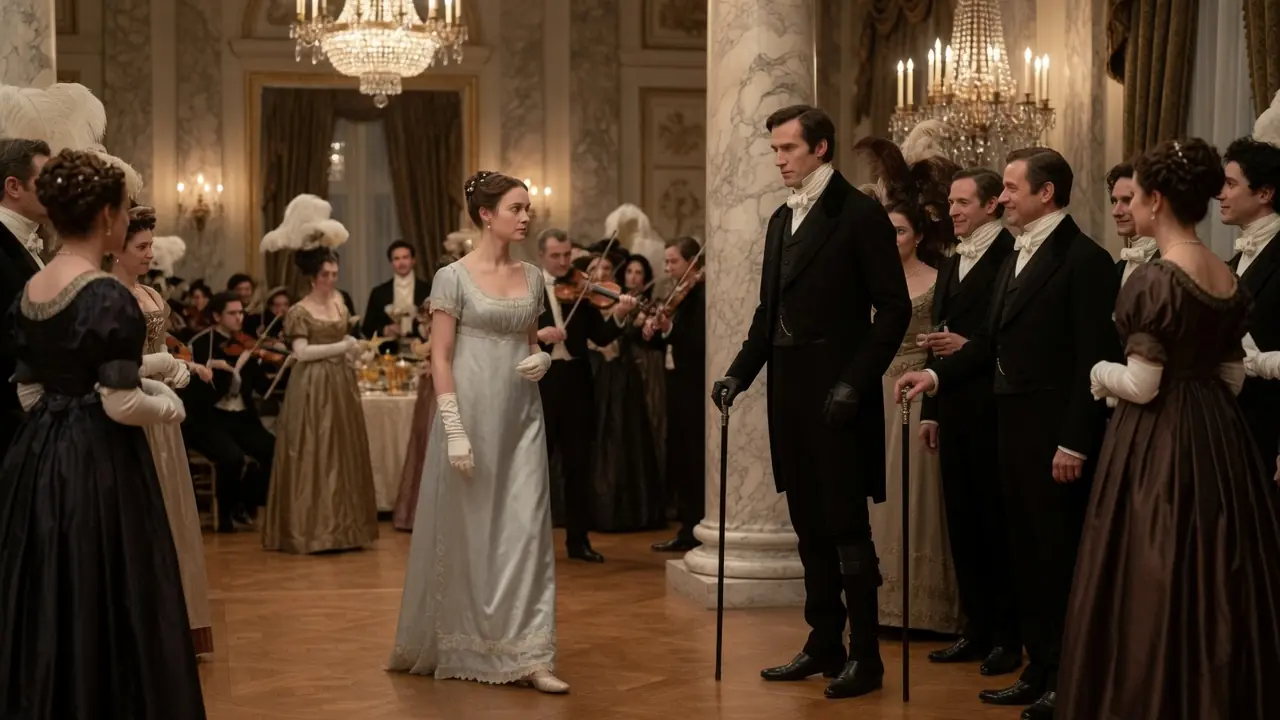
What the room gave him in return was worse than cruelty. It was theater. He stood near the east column, as he always did, close enough to the wall that no one could approach from his left without him seeing them first. A precaution so practiced it had become invisible even to himself.
Three gentlemen across the room were watching him with the smiles men wear when they have agreed on a joke they have not yet told. He recognized all three. Lord Farwell, 29, heir to a baronetcy with more ambition than estate. Grantley, 31, who owed money to two of Edmund's tenants and knew that Edmund knew it.
And a third man, younger, whose name Edmund had not yet bothered to learn, which was itself a form of assessment. He knew their debts, their fathers' failings, the precise dimensions of their social reach. He knew considerably more about them than they suspected. He also knew what they were waiting for.
They had been waiting for it at every ball this season. The moment he crossed the floor, the moment the cane caught on the edge of a rug, or his gait betrayed him in front of witnesses, or some well-meaning fool offered him an arm with loud, visible charity. He had not yet crossed the floor tonight. He did not know he was being watched from the other side of the room by a woman who was not laughing.
He did not know her name. He did not know why she stood alone near the orchestra without her chaperone, an elderly relation of Stanhope's who had been persuaded an hour ago to sit with Lady Grantham and had not moved since. He did not know what she had seen or how long she had been watching. He did not know why her expression, even at this distance, looked like a woman who had recognized something she had spent years trying to forget.
He would learn all of it, but not yet. Because at that moment, the three gentlemen began to move, and Edmund lifted his chin. Across the ballroom, the woman in the pale dress took one step forward before she had decided to. Her name was Lady Cecily Hale.
She was 24 years old, second daughter of the late Viscount Merton, and she had attended this ball because her cousin, Lord Stanhope, required a female relation to fill his carriage and she had no grounds to refuse him. She had stood near the orchestra for 40 minutes. She had not been asked to dance. This was not coincidence.
Lord Farwell reached Edmund first. He was a tall man, expensively dressed, with the confidence of someone who had never once been the subject of a room's careful attention and therefore genuinely could not conceive of the damage it did. He said something Edmund could not hear from across the room. She could not hear it either.
But she had seen the formation before, the half circle, the weight shifting to the balls of the feet, the particular angle of enjoyment that is not quite a smile because a smile would be too legible. She arrived at Edmund's right side as Farwell's hand came to rest on the silver handle of the cane, not grabbing it, not quite, just the two fingers of a man who had decided that another man's necessary things were available for his entertainment.
It was such a small gesture, the kind that left no mark you could point to in the morning. Cecily looked at Farwell's hand. Then she looked at Farwell. “Lord Farwell,” she said, in the pleasant tone of a woman resuming a conversation she found moderately interesting, “how unexpected. I had heard all three of you were expected at the Hathersage supper this evening.”
“Lady Hathersage mentioned your names specifically. She will be quite put out.” She glanced at Grantley and the younger man with the mild curiosity one might direct at unfamiliar furniture. “I do hope nothing has prevented you.”
There was no supper at Hathersage. There was, in fact, no Lady Hathersage currently in London. Farwell did not know this with certainty, and that uncertainty, that precise two-second window of social vertigo during which a man cannot be sure whether the two men beside him know something he does not, was all she needed. Farwell lifted his hand from the cane.
He laughed. It was not a comfortable laugh. “Lady Cecily,” he said, and made her name sound like a minor administrative error, and moved away with his companions in the direction of men who have concluded that a particular entertainment has become more trouble than it is worth. She had not looked at Edmund throughout any of this.
She looked at him now. He was watching her with an expression she did not immediately have a word for. Not gratitude, which men weaponized, which men made into debt. Something more careful than gratitude, something that looked, from a distance she was careful to maintain, almost like recognition.
“There is no supper at Hathersage,” he said. “No,” she agreed. “You invented it entirely.” “It took very little invention. The form is standard.”
He studied her for a moment. “Why?” She had not prepared an answer. She had not prepared anything beyond her first step, because preparation required anticipation, and anticipating an act like this meant she had planned it, and she had not planned it.
She had looked across a ballroom and seen three men arranging themselves around one in the choreography she knew by heart from a different room, a different year, a different person who had not had anyone step forward, and something in her had said, not again, with such complete finality that her feet had already moved. “Because it was easy,” she said, which was not the full truth, and they both understood it. “And because you were not going to.”
She was gone before he could respond. She had learned that, too. How to leave before a room decided what it thought of you. Edmund stood against the east column and watched her cross the floor and did not move for a full minute.
He was a man who counted things. He counted the number of steps it took her to reach the far side of the room. He counted the number of heads that turned to follow her passage and found the number smaller than it should have been for a woman who had just done what she had done, which told him something he filed carefully away. He did not pursue her that evening, but he found out her name before the carriage was called.
Lady Cecily Hale, 24, second daughter of Viscount Merton, who had died when she was 20, leaving an estate consumed entirely by debts no one in the family had known existed. She lived now at Stanhope House on Upper Brook Street at her cousin's convenience. She attended events when Stanhope required the appearance of a well-ordered household. She was, in the considered silence of people who knew the situation and had decided it was not their concern, entirely without resources of her own.
Edmund turned this over on the drive home. A woman with nothing who had walked directly into a situation designed to humiliate a man she had never met and invented a fiction on his behalf, and then left before he could make her pay for it with his gratitude. He wanted to understand what had taught her that particular kind of courage. He suspected it had not been cheap.
He found out six days later in the reading room of his club, and not in the way he had anticipated. He had gone on Tuesday because his solicitor kept rooms nearby and the walk afterward was useful for the leg, which needed movement and resented rest. He had not gone to listen for gossip. He was not, by temperament, a man who listened for gossip.
He was, by temperament, a man who read documents and balance sheets and the architectural plans of his four estates with the focused attention of someone who understood that most disasters are visible in the paperwork long before they arrive in person. Farwell's voice came through the half-closed reading room door. Then Grantley's laugh. Then Cecily's name delivered in the register men used when they had decided a woman was a story rather than a person.
Edmund stopped in the corridor. What Farwell had constructed over six days was not a lie, precisely. It was a shape, a familiar shape that London recognized and therefore did not question. The version of Lady Cecily Hale that came through the door was a woman who had positioned herself deliberately, who had inserted herself into the Earl of Carwell's acquaintance for reasons that were self-evident and uncharitable, who had perhaps arranged the encounter in advance.
It required no evidence. It required only the right tone and an audience already disposed to find it plausible. And Farwell was competent at both. Edmund pushed open the door.
What he said, he said quietly. He was always quiet when it mattered. He had discovered at 23, the year his father died and left him the earldom and a brother whose gambling debts required immediate and total management, that volume was the instrument of men who were not certain they were right. He was certain.
He said what was required. He used his title the way he rarely used it, not as armor, but as weight, and he placed it with precision. By the time he was done, Farwell's two companions had developed a sudden, absorbing interest in the bookshelves. Farwell himself had gone the particular color of a man who has just correctly estimated his own position and found it indefensible.
Edmund left the club. He went to his solicitor. He made three inquiries. The first regarding the Merton estate's creditors and the settlement of its debts.
The second regarding the terms of any trust established under the late Viscount's will. The third was not an inquiry he had planned to make, but something about the arithmetic of it, a woman of 24 with an educated manner and a borrowed invitation and no winter gloves on an evening cold enough to require them, had been sitting in his mind since the Pemberton ball like a number that did not resolve. He received the answers a fortnight later.
He read them at his desk on a Friday morning in late October, with the gray light coming through the window and the fire not yet built up, and he sat there for a long time without calling for the fire. The Merton estate had been insolvent. That was known. What was less known, what had apparently been made deliberately less known through the administration of a small discretionary trust the late Viscount had established for his younger daughter, was that Lady Cecily Hale had an income.
She had always had one, a modest one, sufficient for independent rooms and a reasonable life, established in her father's will and administered since his death four years ago by her cousin Lord Stanhope. The trust's existence had never been communicated to her. She had not known to ask. She had not known there was anything to ask about.
She had received none of it. Stanhope had told her within months of her father's death that the estate had been consumed by outstanding obligations, that he was sorry, that his house was available to her as long as she conducted herself appropriately, and that she should be grateful. She had been 20 years old. She had believed him.
She had been given every reason to believe him and no instrument to verify otherwise. Edmund set the papers down. He thought about two years of balls attended at a cousin's convenience. He thought about a woman who had learned to stand near orchestras without being seen and had stepped forward anyway, not because it was easy.
He understood now, with the particular clarity of a man who had been slow to understand something important, that she had done it because she had been in the position of the person against the wall for long enough that she could not watch it happen to someone else. He thought about her saying, “Because it was easy,” and he thought about the winter gloves she had not been wearing, and the old, careful form of her dress. And he thought about four years of an income collected by a man who had told a young woman of 20 to be grateful.
He went to find her on a Thursday morning. His secretary had established, carefully and without explanation, that she spent Thursday mornings at the lending library on Albemarle Street when the Stanhope house became insupportable. The secretary had also established, without being asked, that this was most Thursdays. She was standing between two shelves with a volume on botanical illustration open in her hands.
She looked up when the door opened, and her face did the thing he had first seen at the Pemberton ball. That instant practiced recalibration, the closing of something that had been briefly, inadvertently open. “Lord Carwell,” she said. “Lady Cecily.”
He did not approach. He stayed near the end of the shelf and looked at her directly because she deserved that, and he had not, he was increasingly understanding, given her enough of it. “I owe you an apology before I tell you what I came to tell you.”
She waited. “I looked into your situation,” he said. “I did it because the numbers did not resolve, and I am a man who cannot leave unresolved numbers alone, which is a habit and not a virtue, and I want you to know the distinction before you hear what I found.”
She closed the book in her hands, slowly, with the deliberate care of a woman doing something with her hands because her hands were the only part of her she could currently manage. He told her about the trust, all of it, the income, the four years, the collected interest sitting in an account under Stanhope's name while she attended his dinners and filled his carriage and wore dresses two seasons out of fashion in houses where everyone could see she did and no one said anything because no one was obligated to.
The library was quiet. Someone at the far end turned a page. Cecily did not move for a moment. Then she said, “How certain are you?”
“Entirely.”
She looked at the cover of the closed book. She looked at the shelves. She looked finally at him. And her expression was not grief, though there was grief in it, and not anger, though there was anger in it, and not the careful, practiced blankness she had worn at the Pemberton ball.
It was the expression of a woman who has been surviving something alone for four years and has just been told that the thing she survived was a crime, not a misfortune, and that there is a difference. And that the difference matters. “I have a brother,” she said. “He is 19.”
“Stanhope sent him to a school in Northumberland when I came to live at Stanhope House. He told me Thomas had been placed well, that the school was reputable, that I should not concern myself.” She looked at the shelf. “Thomas has written to me six times in two years. Only two reached me.”
“The letters that did come were short. The handwriting was careful in the way it is careful when someone knows they are being read.” She stopped. “I have not been permitted to write back directly. Stanhope said it would unsettle him.”
Edmund said nothing. He was listening, which was the thing she needed, and he had learned in the last two weeks, slowly and at the cost of several prior assumptions, that listening was not the passive act he had always treated it as. “I do not know if he is well,” she said. “I have not known for eight months.”
He left the library 20 minutes later. He made four more inquiries. He found Thomas Hale in three weeks. The young man, 19 years old, was at a school in Northumberland that was in every material sense adequate and in every human sense designed for the convenient storage of young people whose families found them complicated.
He was well. He was unhappy in the specific way of a young man who has been told repeatedly that his circumstances are his own fault. He had written to Cecily six times. Four letters had not been forwarded.
He had been asking the housemaster every week whether there was any news of his sister. Edmund told her on a Wednesday in the same library. He watched her face do something he had not yet seen it do. Not recalibration, not the practiced stillness.
Something that had no practice in it at all, open and unguarded and entirely unplanned, like a room that has been shuttered for years and someone has pushed the window. She pressed one hand to her mouth. “He is well. He has been asking after you every week.”
She stood very still. Then she said quietly, “That is the most important sentence anyone has said to me in four years.”
Stanhope received a visit from Edmund's solicitor the following Monday. The conversation was brief, legal, and structured around the precise terminology of misappropriation of a held trust, which carried consequences Stanhope found persuasive.
Cecily's income was restored and backdated by four years, less what could not be recovered, which was the time, and that could not be restored by any instrument Edmund possessed, and he was aware of it, and he did not pretend otherwise. Thomas came to London in December having completed his term. He was 19 and thin and had his sister's eyes and the particular weariness of a young man who had spent two years being told the world is indifferent to him and is not yet certain it is not.
He shook Edmund's hand in the entrance hall of the Carwell townhouse with a careful politeness that cost him something, and Edmund shook it back and did not make it into more than it was. He understood by then that the Hale family had been offered a great many things that were not what they appeared to be, and that trust of any kind would need to be built rather than announced.
Cecily sent him a letter that December. She did not observe the formal salutation, and she signed it only with her first name. Both of these were things a woman of her position did not do when writing to an unmarried earl who was not yet her relation. And she did them anyway, deliberately, as a woman who had decided that the forms were for other people now.
It said, “I find I do not have a form adequate to this. I know the correct formulas for gratitude, and I find I do not wish to use them because you did not do what you did in the form of a favor, and I do not wish to receive it as one.”
“You looked. That is the thing. You looked when you had no reason to, and you kept looking when most men would have stopped. I have been very angry for a very long time, and I am not finished with the anger, but I am glad of the looking.”
“That is the truest thing I can write.”
She signed it Cecily. He did not reply immediately. He sat with it for three days in the way he sat with things that mattered, turning them over, looking for the shape underneath. Then he wrote back four sentences.
He did not sign it with his title, either.
They were married the following October in the chapel at Carwell. Thomas stood beside his sister. The morning was cold, and the light came through the high chapel windows in clean, angled bars. Edmund stood at the altar with his cane and his imperfect leg, and did not look like a man apologizing for either.
He had attended 219 balls in his lifetime. He counted things. He thought about this without particularly meaning to during the ceremony. Two hundred eighteen had been rooms he stood in until they were over.
One had contained a woman in a pale dress who took one step forward before she had decided to, and changed the precise geometry of every room he would ever stand in afterward. He had spent three years against the wall by preference. Chin level, hands steady, offering the room no purchase on anything he actually felt. He had told himself this was composure.
He had told himself this was strength. He understood now, standing at an altar next to a woman who had crossed a ballroom floor with nothing to gain and everything to risk, that what he had called composure was the same thing she had been practicing near the orchestra. The careful management of a person who had learned, through cost, not to occupy more space than the room had agreed to give them.
She had been the one to step forward first. She had been the one to show him that the wall was choice and not a sentence. He thought he would spend a very long time being grateful for that. He thought it would not be difficult.
Outside the chapel, Thomas shook his hand again, this time without the careful politeness, and Edmund thought about walls and the people who build them. And the far rarer people who simply walk forward before they have decided to and let everything else arrange itself around that one true movement. They did not return to the Pemberton ballroom that season or the next.
When they did return, three years into the marriage, it was because Cecily had decided they should. Edmund had understood, without being told, that this was important in a way that had nothing to do with him. She wore new gloves. She had worn new gloves every winter since December of that first year, and she never mentioned it, and neither did he.
This small, unremarked thing was one of his favorite facts about their life together. Thomas, 22 by then and in possession of opinions about everything, stood near the orchestra and argued with a young woman about the merits of botanical illustration. Edmund watched him from across the room and thought about 19-year-olds who write six letters and do not stop. Cecily came to stand beside him near the east column.
“You are counting something,” she said.
“Heads turning,” he said, “when you crossed the room just now.”
She looked at him sideways.
“The number is much larger than it was the first time,” he said.
She was quiet for a moment.
“That the room has recalibrated,” he said. “Rooms do eventually for people who refuse to make it easy for them not to.”
She took his hand, which was not done, not here, not in this room, and he let her, and nobody who mattered looked away.