Imani Carter learned ballet in a garage that had no reason to feel holy.
It sat behind a narrow brick house on the east side of Cleveland, where the winters bit hard, the summers sat heavy on the pavement, and the streetlights flickered like they were tired of keeping watch. The block had corner stores with bars over the windows, old houses with missing porch rails, and empty lots where families used to live before the city forgot to come back for them. Nobody drove through that neighborhood looking for ballet.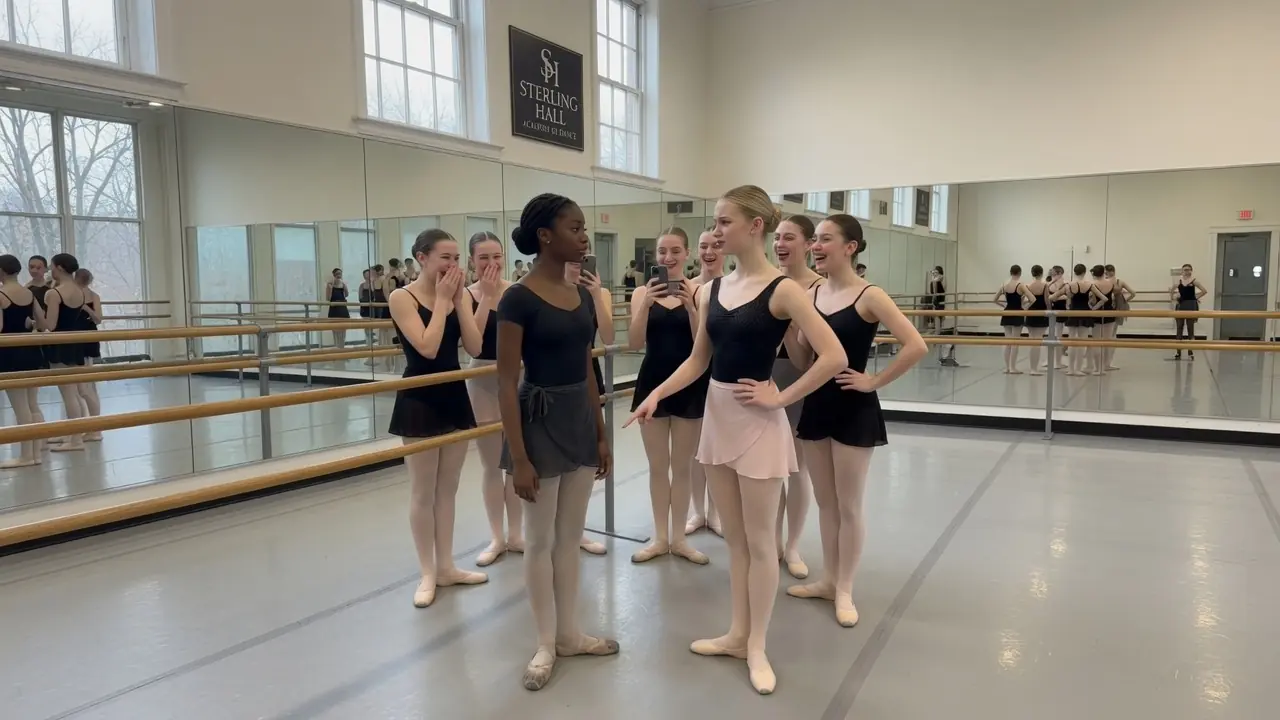
But every night after homework, dinner, and the last bus groaning past the corner, music came from the Carter garage.
Her grandmother, Mae Carter, had built that little studio out of stubbornness and memory. She laid the wood floor herself over cracked concrete, one board at a time, sanding until her palms blistered and sealing it with the care of someone blessing a church. The barre was a salvaged pipe from a demolished building, bolted into the wall with screws a neighbor gave her from an old toolbox.
The mirror was three broken panels from a beauty salon that closed on Euclid Avenue.
A long crack ran through the middle, cutting every reflection into pieces. Mae used to tell Imani not to hate that crack. “It tells the truth,” she would say. “A person can be split clean down the middle and still stand tall.”
Mae had once been the kind of dancer people remembered even when programs forgot her name.
In the old photographs, she looked almost impossible: long neck, strong legs, lifted chest, arms soft as smoke, body hanging in the air like gravity had loosened its grip just for her. She danced in regional companies before most directors wanted Black women near center stage unless the part required “something ethnic” and brief. They called her gifted. They called her expressive. They called her difficult to cast, which was the polite way of saying they did not know where to put a Black girl who danced like she belonged everywhere.
At twenty-eight, during a showcase that could have changed her life, Mae landed badly.
Her right ankle folded beneath her with a sound that still visited her in dreams. The company sent flowers with a white ribbon. The director sent a note about unfortunate timing. Two days later, another dancer stepped into the role, and the theater kept moving as if Mae had only been a loose thread cut from a costume.
She never danced professionally again.
But she never let the music leave the house.
When Imani was five, Mae stood her in front of the cracked mirror and taught her first position. When Imani was seven, she could hold an arabesque longer than children twice her age. When she was ten, she drilled turns in a garage so cold her breath fogged the broken mirror while Mae sat in an old kitchen chair, cane across her knees, tapping time against the floor.
“Again,” Mae would say.
That word raised Imani.
Again after a fall.
Again after tears.
Again after weak ankles, tired feet, sloppy arms, and days when hunger, embarrassment, or schoolyard cruelty tried to sneak into the music.
By sixteen, Imani had watched every ballet performance she could find online. Swan Lake, Giselle, The Firebird, Don Quixote, old grainy clips of dancers whose names she wrote in a notebook like scripture. But she also watched street dancers from Cleveland, Chicago, New York, and Atlanta. Breakers under bridges, krump crews in parking lots, poppers moving like electricity had found bones and decided to stay.
To Imani, ballet and street dance were not enemies.
They were cousins who had been told not to sit together.
Mae gave her discipline, turnout, line, patience, and the kind of control that makes a body obey before the mind starts complaining. The street gave her attack, pulse, release, and the sharp freedom of moving like survival had rhythm. Late at night, after Mae went to bed and the house settled into old pipes and refrigerator hum, Imani would return to the garage with her phone propped against a paint can.
She practiced what she never showed her grandmother.
A plié that snapped into a body hit.
A pirouette that broke into a freeze.
A grand jeté that landed low and slid across the floor like water finding a crack in concrete.
At first, it looked wrong.
Then it looked wild.
Then, slowly, it started looking like her.
She kept it secret because she wanted one day to bring Mae something finished. Not rebellion. Not disrespect. A gift. Ballet had been Mae’s language, and street dance had become Imani’s heartbeat. She wanted to prove both could live inside one body without either one apologizing.
The flyer appeared on a Thursday morning outside a coffee shop Imani could not afford.
Sterling Hall Performing Arts Invitational.
Open solo division.
Grand prize: full scholarship to the Whitmore Conservatory of Dance.
The photograph on the flyer showed the Sterling Hall main theater, all velvet seats, gold balconies, polished stage, and chandeliers bright enough to look like they belonged to another country. Imani stood on the sidewalk with her backpack strap tight in her fist, staring so long that a woman behind her asked if she planned on buying coffee or blocking the door all day.
That night, Imani showed Mae.
Her grandmother sat at the kitchen table, rubbing ointment into her ankle the way she did when rain was coming. The television played low in the living room, but neither of them heard it. Mae took the flyer, read it once, then read it again more slowly.
Imani waited.
Finally, Mae looked up. “You want that stage?”
Imani swallowed. “More than I can explain without sounding crazy.”
Mae folded the flyer carefully and slid it back across the table. “Then don’t explain it. Dance it.”
Sterling Hall Academy sat west of the city behind clean sidewalks, glass doors, trimmed hedges, and banners showing past champions with perfect smiles. Everything inside seemed designed to remind visitors that excellence had a price, and whatever price they imagined, it was probably still higher. The lobby smelled like fresh flowers, expensive floor polish, and parents who knew how to make donations sound like generosity instead of leverage.
Imani arrived wearing black jeans, a white T-shirt, and the best jacket she owned.
Her dance bag held thrift-store ballet shoes, a banana wrapped in a napkin, and the $65 registration fee Mae had pressed into her palm that morning. Imani had tried not to take it. Mae had closed her fingers around the money and said, “Don’t insult my sacrifice by acting like it’s too heavy for you.”
The receptionist looked up when Imani walked in.
“Can I help you?” the woman asked.
“I’m here to register for the Invitational.”
“The dance competition?”
“Yes, ma’am.”
Another pause.
Then the woman pointed down the hall. “Room 214.”
Imani kept walking.
Through the glass studio walls, she saw dancers moving in clean rows. Their leotards matched. Their hair was sleek. Their shoes looked soft, new, and perfectly fitted. In one studio, a teacher clapped twice, and twelve dancers stopped together like one body with twelve faces.
Imani found Room 214, filled out the form, paid the fee, and left with a contestant number.
On her way out, she passed Studio B.
The door was open.
A blonde girl was rehearsing alone in the center, turning with sharp, cold control while four others watched from the floor. Her technique was clean enough to make the room feel sharpened. Every landing had the certainty of someone who had never wondered whether the floor belonged to her.
The girl caught Imani’s reflection in the mirror and stopped.
“Can I help you?”
Same words as the receptionist.
Different blade.
“Just passing through,” Imani said.
The girl glanced at Imani’s bag, then at her shoes. Her smile came slowly, like she wanted everyone to see it being built.
“Service hallway is downstairs.”
The other girls laughed.
Imani did not answer.
She walked out under Sterling Hall’s bright ceiling lights and into the cold afternoon air, holding her face still until she reached the bus stop. Only then did she let her breath shake.
That was the first time Brielle Ashford made her feel small.
It would not be the last.
But it would be the last time Imani let Brielle know it worked.
The open rehearsal took place ten days before the championship.
All finalists were given access to Sterling Hall’s main studio, a huge room with sprung hardwood, high windows, clean mirrors, and a sound system that made every note feel rich. Imani arrived early, chose a corner near the side wall, and began stretching quietly.
The academy dancers claimed the center floor like it had been reserved by bloodline.
Brielle arrived last, and the room changed before she said a word. Her father’s name was carved into the donor wall downstairs. Her mother chaired one of the academy’s arts committees. Brielle had won the Invitational twice, been photographed for the academy brochure, and been introduced at fundraising dinners as “one of Sterling Hall’s brightest young stars.”
She wore a black leotard, pale tights, and a wrap skirt that moved like water.
Her friends followed behind her in loose formation.
Sienna, Harper, and Lacey, all long limbs, perfect buns, and smiles too sharp to be accidental.
For twenty minutes, rehearsal moved smoothly. Dancers warmed up, marked choreography, tested turns, and took space without asking. Imani waited until a strip of floor opened near the side barre. Then she stepped out and began the first phrase of her solo.
It started with ballet.
Slow port de bras.
A controlled développé.
A turn into arabesque, held long enough for her breath to settle into the line.
She was not performing yet. She was listening to the floor, learning the room, letting her feet understand what the stage might ask from her. The studio air felt colder than the garage, more polished, less forgiving. Still, the music entered her body the same way.
Brielle noticed.
At first, only with her eyes.
Then with her whole body.
She stopped mid-combination and turned toward Imani. “Everyone, wait.”
The music cut.
Imani froze with one arm lifted, weight carefully balanced over the ball of her foot. Twenty dancers turned toward her. Some looked curious. Some looked bored. Some had already begun smiling because Brielle’s voice often gave people permission to be cruel.
“No, keep going,” Brielle said sweetly. “I think we should all appreciate what Sterling Hall is allowing through the doors these days.”
A few girls laughed.
Imani lowered her arm. “I’m rehearsing.”
“Were you?” Brielle asked. “I thought maybe you were checking the floor for dust.”
Sienna covered her mouth.
Someone behind her whispered, “Maybe she works here after class.”
The laughter grew.
Brielle walked closer, eyes dropping to Imani’s shoes. “Where did you train?”
Imani did not answer right away.
“In a garage,” she said.
That was enough.
Brielle’s face lit with delight, the cruel kind that needs an audience to breathe. “A garage. That explains so much.”
The room shifted.
Harper pulled out her phone.
Imani saw it.
Brielle turned toward the others. “Honestly, I admire the confidence. Most people would know the difference between a dance studio and a driveway.”
More laughter.
Imani kept her chin level and shoulders down. Mae had taught her that dignity was posture before it was speech. If they wanted to make her small, they would have to do it without her help.
Brielle stepped closer until only two feet separated them. “Let me help you, since nobody in your garage apparently did. This competition is not about effort. It is not about struggle. It is not about showing up with sad eyes and hoping people clap for your story.”
Imani’s hands curled slightly at her sides.
Brielle smiled. “It’s about dance. Real dance. And you look like a lost girl trying to do ballet in a parking lot.”
Someone made a clumsy stomping sound.
Then another girl whispered, “Garage ballerina.”
The room laughed harder.
Imani looked at Brielle. “Are you finished?”
Brielle blinked.
“I need the floor,” Imani said.
The silence changed.
Brielle’s smile disappeared for half a second. Then she tilted her head, voice low enough to feel private while still carrying through the room. “You don’t belong here. You never did. And when you walk onto that stage, everyone will see exactly what I see.”
Imani stared back. “What do you see?”
Brielle’s eyes flashed. “A scholarship case with a little rhythm.”
The words landed.
The phones recorded.
Imani walked to the wall, unlaced her shoes, and sat down.
She did not leave.
That night, the clip went online.
Harper had edited it carefully, cutting out the ugliest lines and keeping only Imani’s stiff opening phrase, one awkward foot adjustment, and Brielle saying, “Garage ballerina.” The caption read: When the charity entry thinks she’s principal material.
By morning, the clip had almost a million views.
By lunch, it had crossed two million.
The comments came like stones thrown from passing cars.
She dances like a broken lawn chair.
Somebody close the garage door.
Why does every competition need a pity slot?
Put her back behind the mop bucket.
Imani sat on the edge of her bed and watched strangers turn her into a joke. They did not know the cracked mirror. They did not know Mae counting beats through pain. They did not know winter mornings, thrift-store shoes, or how a garage could become a cathedral when music filled it the right way.
They knew fifteen seconds.
For most people online, that was enough.
She turned off the phone and went downstairs.
Mae was already in the garage.
She sat in the old kitchen chair, cane across her lap, eyes fixed on the cracked mirror. She did not say she had seen the video. She did not ask whether Imani wanted to talk. Mae had lived long enough to know some wounds need quiet before they can accept language.
Imani stood in the doorway.
“Maybe I made this too big,” she said. “Maybe they’re right.”
Mae pushed herself up slowly.
Her bad ankle trembled beneath her weight, but she stood anyway. When Mae was angry, she did not yell. She rose.
She walked to the old cabinet by the back wall, opened the bottom drawer, and removed a faded blue cloth. Inside was a pair of ballet shoes. The satin had dulled with age, the toes softened by years, the ribbons folded with a care that looked almost religious.
Imani had seen them only once before.
Mae’s final shoes.
“Take the left one,” Mae said.
Imani lifted it carefully.
“Look inside.”
On the inner sole, written in faded ink, were seven words.
Dance until the room remembers you.
“I wrote that the night before the showcase that took my ankle,” Mae said. “I thought it was going to be the beginning of everything.”
Imani traced the words with one finger.
“They took my ending and called it destiny,” Mae said. “Don’t you let those girls take your beginning and call it truth.”
Imani looked up.
Mae placed the shoes in her hands. “Wear them.”
“They’re yours.”
“That is why.”
From that morning forward, Imani trained like someone had struck a match beneath her skin.
At five before school, she was in the garage with Mae’s old shoes tied around her feet. At night, she returned after dinner, then again after Mae went to sleep. She drilled ballet until the foundation did not shake: plié, relevé, pirouette, arabesque, jeté, fouetté.
Mae counted.
Corrected.
Tapped the cane.
“Again.”
Again until Imani’s calves trembled.
Again until sweat ran down her back.
Again until correction stopped feeling like criticism and started feeling like a map.
Then came the secret work.
When the house went quiet, Imani lowered the lights and practiced the other half. Popping. Locking. Floorwork. Power slides. Sharp shoulder hits that broke ballet’s softness without disrespecting it. She built transitions no academy teacher would have approved, then cleaned them until approval no longer mattered.
A fouetté became a freeze.
An arabesque folded into a sweep.
A classical port de bras stuttered into pop-and-lock precision so controlled it looked like music had entered her joints and rewired them.
On the fifth night, Mae caught her.
The side door opened while Imani was halfway through the fusion section. She did not hear it over the music. She turned, dropped low, spun across the floor, then rose into a final extension with one arm cutting through the dim garage light.
Then the overhead bulb came on.
Mae stood in the doorway, cane in hand, eyes wide.
Imani froze. “Grandma—”
“How long?”
Imani swallowed. “Since I was fourteen.”
Mae leaned on the cane. “You had a whole storm in here and didn’t tell me?”
“I wanted to finish it first.”
Mae stared at her.
For one terrible second, Imani thought she had hurt her.
Then Mae said, “Do it again.”
“What?”
“The whole thing. From the top.”
So Imani danced it.
This time with the lights on.
This time with Mae watching.
The ballet began like memory. The beat entered like challenge. The two styles met, argued, collided, and slowly became one body. Mae sat down halfway through, not because she was tired, but because the sight had taken something out from under her.
When Imani finished, the garage stayed silent.
Mae looked at the floor.
Then she reached behind the chair and pulled a rolled paper from an old shelf. It was yellowed at the edges, tied with a piece of ribbon. She unrolled it carefully on the floor.
Handwritten choreography notes.
Counts.
Stage directions.
Music marks.
“I wrote this forty years ago,” Mae said. “The solo I never got to perform.”
Imani knelt beside it.
The title was Open Window.
“It was supposed to mix ballet with jazz and church movement,” Mae said. “They told me it was too modern, too emotional, too much of myself. I kept revising it anyway. Then the ankle went.”
Imani studied the notes.
The structure was beautiful. Restrained at first, then widening, breaking open, becoming freer with each section. Mae had been building a bridge long before Imani knew she needed one.
“This is yours now,” Mae said.
Imani looked at her. “I can’t take your piece.”
“You are not taking it. You are finishing it.”
So they rebuilt the solo together.
Mae shaped the classical lines, corrected the phrasing, guarded the emotional arc. Imani added the street language, the attack, the floorwork, the sound of asphalt and bus stops and late-night practice under a buzzing bulb. The piece became a conversation across forty years.
What was denied.
What survived.
What came back louder.
Three days later, someone else saw it.
Sienna Cole, one of Brielle’s friends, appeared outside the garage just after sunset. She stood awkwardly near the side door with her arms folded, hair loose, face pale like she had cried before walking over. Imani saw her reflection in the cracked mirror and stopped the music.
Mae turned slowly. “You lost?”
“No, ma’am,” Sienna said. “I came to apologize.”
Imani did not speak.
“For the video,” Sienna continued. “For laughing. For letting Brielle make cruelty feel like safety.”
“Why now?” Imani asked.
Sienna looked at the floor. “Because I watched you through the window for five minutes, and I realized the clip we posted was a lie.”
Mae tapped her cane once. “You posted it?”
Sienna’s face crumpled. “I edited it.”
The truth sat in the garage like smoke.
Imani felt anger rise, clean and deserved.
Sienna held up both hands. “I know. I don’t expect forgiveness. I just wanted to say it to your face. And if they try anything else, I’ll tell the truth.”
Imani looked at her for a long moment.
“You can sit,” she said finally. “But your phone stays in your bag.”
Sienna sat on the floor near the door for two hours and did not move.
By the next morning, Brielle knew.
The rumors started before lunch. Imani had stolen choreography. Sienna had leaked academy routines. Mae was not a licensed instructor. The garage floor was unsafe. Imani’s online support was fake. Brielle spread rumors the way some girls spray perfume, lightly and everywhere, trusting the scent to do the work.
Then her father stepped in.
Preston Ashford owned half of Sterling Hall’s new east wing. His money paid for rehearsal rooms, scholarship plaques, reception flowers, and enough private influence to make teachers smile before disagreeing with his daughter. Brielle had been raised to believe winning was not an achievement, but an expectation her family had already prepaid.
The idea that a girl from the east side, trained in a garage by an old Black woman with a cane, might beat Brielle on the academy’s own stage was not something Preston planned to allow.
The letter arrived six days before finals.
Imani opened it at the kitchen table while Mae stood by the stove.
Dear Miss Carter,
After review of competition policy, the committee has determined that your participation violates Section 16.4, prohibiting unauthorized media publication involving registered competitors during the preparation period. Your registration is revoked effective immediately.
We wish you the best in future artistic endeavors.
Imani read it once.
Then again.
Her fingers went numb.
“They kicked me out,” she said.
Mae took the paper and read it slowly. Her face did not change, but her hand tightened until the corner of the page bent.
The phone rang before either of them could speak.
It was Sienna.
“Don’t accept it,” she said quickly. “Section 16.4 has never been enforced. Brielle posted rehearsal clips all month. I heard her father tell the committee chair to use that rule because it would look clean.”
Imani closed her eyes.
Mae leaned toward the phone. “Will you say that publicly?”
Sienna hesitated only one second.
“Yes.”
Then Jalen Price moved.
Jalen had been Imani’s friend since middle school, a street dancer who worked evenings at his uncle’s tire shop and filmed battles on weekends. He had been quietly recording Imani’s training for months because he always said history needed receipts. That night, he cut a three-minute video.
It showed the garage.
The cracked mirror.
Mae counting from the chair.
Imani falling, starting over, sweating, spinning, rising.
Then it showed the letter.
The final screen read:
They laughed when she stumbled. Now they’re afraid you’ll see her dance.
He posted it at midnight.
By breakfast, it had 500,000 views.
By noon, it had crossed two million.
#LetImaniDance began in Cleveland and spread fast. Former dancers commented. Parents commented. Black women who had been called too loud, too strong, too different, too emotional, too much, wrote their own stories beneath the video. A retired principal dancer reposted the clip and wrote, This is not pity. This is power.
Sterling Hall turned off comments by dinner.
That only made people louder.
The board called an emergency meeting.
The person who took control of that meeting was Vera Lang, seventy-four years old, former Broadway dancer, international judge, and one of the few people in American dance who could make wealthy parents go quiet by removing her glasses. She reviewed Imani’s file. She reviewed Section 16.4. She reviewed Brielle’s public rehearsal videos, Sienna’s statement, and the messages between Preston Ashford and the committee chair.
One message was especially short.
Handle the garage girl. Use policy. Keep it clean.
Vera placed the printed message on the table and looked at Preston.
“If Section 16.4 applies to Miss Carter,” she said, “then it applies to every finalist who posted rehearsal footage, including your daughter.”
Preston’s jaw tightened. “That is not the same.”
“Because she is yours?”
No one moved.
Vera turned to the committee chair. “Imani Carter is reinstated immediately. After this championship, we will discuss whether this board has confused donor influence with governance.”
The vote was unanimous.
Imani was back in.
She did not celebrate when the call came.
She laced Mae’s shoes and danced Open Window twice from start to finish.
The second time, Mae tapped her cane twice at the ending.
Tap. Tap.
That meant ready.
Then, two nights before the championship, Mae fell.
It happened in the bathroom just after midnight. Imani heard the crash and found her grandmother on the tile, one hand gripping the tub, face pale with pain. Her bad ankle had buckled, and her old knee injury had twisted under her.
“I’m fine,” Mae said immediately.
“You’re on the floor.”
“I’ve been on worse floors.”
“Grandma.”
The ambulance came because Imani refused to negotiate with stubbornness while fear roared in her ears.
At the hospital, Mae lay propped under thin blankets, leg braced, eyes furious at her own body. The doctor said nothing was broken, but she would not be walking safely for weeks. Mae listened with the patience of someone waiting for irrelevant people to finish talking.
When they were alone, Imani stood beside the bed.
“I can’t do it without you.”
Mae turned her head. “Do not insult my entire life by saying that again.”
Imani looked away.
Mae reached for her hand. “Listen to me. I have spent forty years teaching in rooms nobody came to photograph. I have watched girls quit because the world taught them talent without money is just a hobby. You have a stage now.”
Tears filled Imani’s eyes.
“You walk onto it,” Mae said. “And you dance like every locked door was only wood.”
Imani bent over Mae’s hand and pressed her forehead there.
At midnight, she returned to the garage alone.
The chair was empty.
The cane leaned against the wall.
The mirror reflected one body where there had always been two.
Imani placed Mae’s shoes on the floor, laced them slowly, and pressed play.
The music filled the garage.
She danced Open Window from the first breath to the last beat.
No counting.
No correction.
No cane tapping.
Just memory, muscle, grief, and love.
When the final note faded, Imani stood in the center of the floor, breathing hard.
“Ready,” she whispered.
The Sterling Hall Theater held nearly two thousand people, and every seat was filled.
Cameras lined the aisles. A livestream ran on the academy website, but the servers began struggling before the first finalist finished. Outside, people who could not get tickets gathered with phones and portable speakers, watching from the sidewalk like the night was a championship fight.
Brielle drew the eighth slot.
Imani drew the final one.
The first seven dancers were strong. Classical solos, contemporary pieces, lyrical routines built around carefully polished emotion. The audience clapped, judges wrote notes, and parents whispered scores under their breath like prayer or investment strategy.
Then Brielle took the stage.
She was flawless.
No honest person could say otherwise. Her ballet solo was elegant, disciplined, and expensive in every visible way. The choreography showed off her extensions, her turns, her control. She landed every sequence with the confidence of a girl who had been given every tool and had learned how to use them.
Her score appeared.
9.43.
The highest of the night.
Brielle smiled like the world had returned to order.
Three more dancers performed.
Then the theater darkened.
A single spotlight opened at center stage.
“Finalist number fifteen,” the announcer said. “Imani Carter.”
The sound in the room changed before she appeared.
Phones rose everywhere.
Imani stepped from the wings in a simple black leotard. No sequins. No jewels. No costume begging for attention. Her hair was braided back. Her face was calm. On her feet were Mae’s old ballet shoes, the satin dulled by time, the ribbons tied tight around her ankles.
She took center stage.
Head lowered.
Arms at her sides.
Three seconds passed.
The room forgot how to whisper.
A violin began.
Soft.
Lonely.
Almost fragile.
Imani lifted her arms through first position and opened into movement so controlled it felt like breath becoming visible. Her first arabesque stretched across the stage with quiet authority. Her footwork was clean, her line long, her transitions patient. This was ballet first, pure and respectful, the language Mae had given her.
Then the music shifted.
A beat entered beneath the strings.
Low.
Steady.
Like a heart under floorboards.
Imani’s body changed.
A pirouette snapped into a freeze. A développé folded into a sharp shoulder hit. A classical turn slid into floorwork so smooth the audience gasped before it could stop itself. She swept low, rose high, broke rhythm, found it again, and never once lost the ballet beneath it.
The two styles did not take turns.
They spoke together.
The violin climbed.
The beat deepened.
Imani moved faster now, not frantic, but free. A grand jeté landed into a power slide. Her arms opened in port de bras, then fractured into pop-and-lock precision so clean it looked mathematical. She spun through fouettés, one, two, three, then broke the fourth into a controlled drop that brought her to one knee before she rose like the floor itself had returned her.
The audience was silent.
Not bored.
Held.
At the side of the stage, Brielle watched with her arms folded too tightly across her chest. Her face was unreadable now. Not anger exactly. Not mockery. Something closer to the moment a person realizes the room they thought they owned had a door they never noticed.
In the hospital, Mae watched on a tablet propped against a water pitcher.
When Imani entered the final section, Mae gripped the bed rail with one hand. The nurse beside her did not tell her to calm down. She was crying too.
The music reached its peak.
Strings and beat together.
Imani began to spin.
One.
Two.
Three.
Each turn tighter.
Four.
Five.
The audience stopped breathing.
Six.
Seven.
Eight.
She opened out of the rotation, dropped into a floor sweep, rose into one final extension, and stopped dead center with both arms wide.
The last note disappeared.
For one heartbeat, nothing happened.
Then the theater rose.
Not gradually.
All at once.
Nearly two thousand people stood, shouting, clapping, crying, stomping so hard the stage seemed to vibrate under her feet. Outside, the crowd watching the livestream screamed through the speakers. Online, the stream froze under the weight of too many people trying to witness the same impossible thing at the same time.
Imani stood in the light, chest heaving, eyes searching.
She could not see Mae.
But she felt her.
The judges took longer than usual.
No one complained.
When the scores appeared, the theater erupted again.
9.88.
The highest score in Invitational history.
Vera Lang stood from the judges’ table and walked to the microphone.
“I have seen perfect technique,” she said. “I have seen discipline. I have seen ambition. Tonight, I saw inheritance become invention.”
She turned toward Imani.
“You did not choose between the studio and the street. You made the stage big enough to hold both. That is not a trick. That is art.”
Imani covered her mouth.
Vera continued. “On behalf of the Whitmore Conservatory of Dance, it is my honor to award Imani Carter the full scholarship.”
The applause became thunder.
Backstage, Brielle left before the ceremony ended.
Her father exited through a side door.
Within a week, Sterling Hall removed Preston Ashford from donor influence after the messages went public and former students began speaking about favoritism, quiet exclusions, and competitions that had been shaped long before anyone took the stage. The academy released a statement full of words like review, reform, and accountability.
Imani did not care much about the statement.
She cared about Mae.
At the hospital that night, Imani walked into the room carrying the trophy under one arm and Mae’s shoes in the other hand. Mae looked first at the trophy, then at Imani’s feet.
“You wore them right,” Mae said.
Imani laughed and cried at the same time.
Mae held out both arms.
Imani placed the trophy on the chair and climbed carefully onto the edge of the bed, folding herself against her grandmother like she had when she was little. Mae held her with one hand on her back and the other in her hair.
“You finished it,” Mae whispered.
“No,” Imani said. “We did.”
That summer, Imani used part of her scholarship stipend and donation money from supporters to rebuild the garage.
The cracked mirror came down, but she kept one piece and framed it. The old plywood floor was replaced with proper sprung hardwood. The salvaged metal barre stayed because Mae said new things needed old bones if they wanted to last.
They called it the Mae Carter Open Window Studio.
Free Saturday classes.
No auditions.
No dress code.
No one turned away because their shoes were wrong or their body did not look like a brochure.
Fifteen kids came the first week.
Thirty-two came the second.
By the end of summer, children were lining up outside the garage before Mae unlocked the door.
Some came in ballet slippers.
Some came in sneakers.
One came in socks with holes in both heels.
Imani taught them first position.
Then she taught them how to fall and get up without shame.
Mae sat in her old chair by the mirror, cane across her lap, calling corrections like she had never belonged anywhere else. Sometimes, when a child found the right movement, she tapped the cane twice.
Tap. Tap.
The whole room learned what that meant.
On the wall above the barre, Imani hung Mae’s old shoes in a glass case. Inside the left shoe, the faded words were still visible.
Dance until the room remembers you.
Below them, a brass plate read:
Mae Carter, unfinished solo, 1983.
Imani Carter, Invitational Champion, 2026.
Every Saturday, some new child would point up and ask, “Whose shoes are those?”
Imani always smiled before answering.
“They belong to every girl who was told the room was not built for her.”
Then she would press play, step onto the floor, and begin again.