Imani Carter learned ballet in a garage that had no reason to feel holy.
It sat behind a narrow brick house on the east side of Cleveland, where the winters bit hard, the summers sat heavy on the pavement, and the streetlights flickered like they were tired of keeping watch. The block had corner stores with bars over the windows, old houses with missing porch rails, and empty lots where families used to live before the city forgot to come back for them. Nobody drove through that neighborhood looking for ballet.
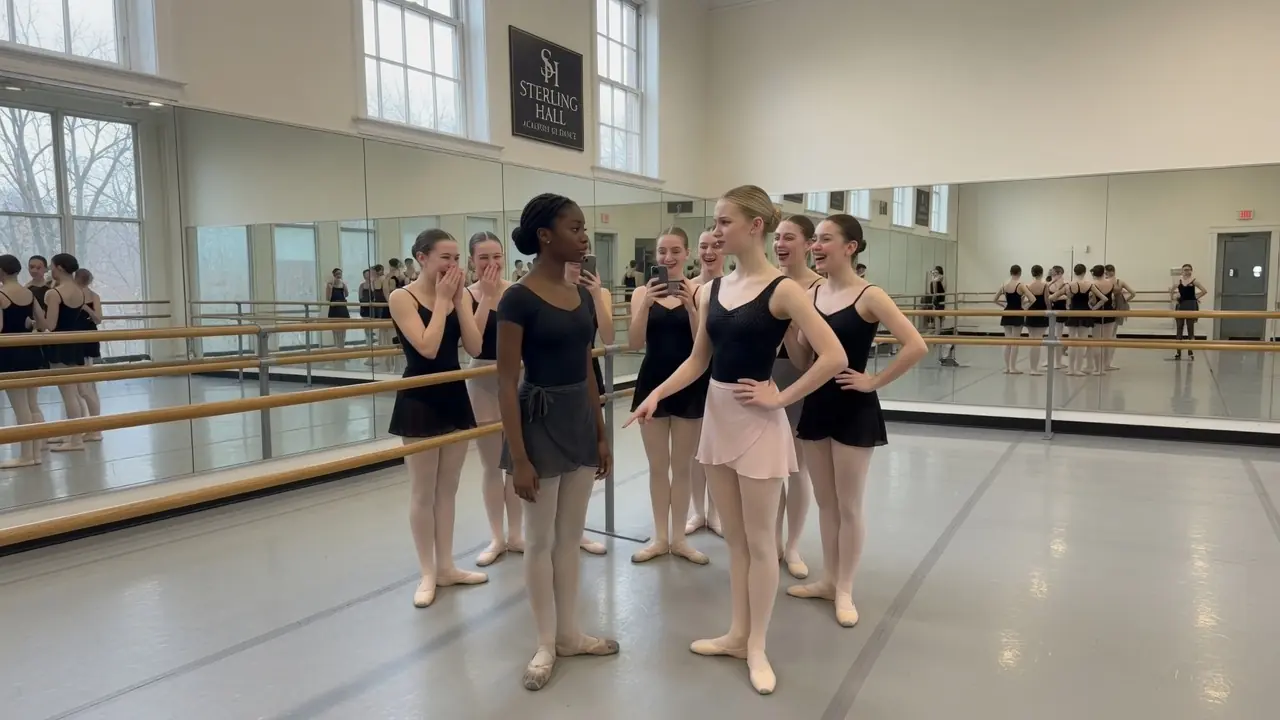
But every night after homework, dinner, and the last bus groaning past the corner, music came from the Carter garage.
Her grandmother, Mae Carter, had built that little studio out of stubbornness and memory. She laid the wood floor herself over cracked concrete, one board at a time, sanding until her palms blistered and sealing it with the care of someone blessing a church. The barre was a salvaged pipe from a demolished building, bolted into the wall with screws a neighbor gave her from an old toolbox.
The mirror was three broken panels from a beauty salon that closed on Euclid Avenue.
A long crack ran through the middle, cutting every reflection into pieces. Mae used to tell Imani not to hate that crack. “It tells the truth,” she would say. “A person can be split clean down the middle and still stand tall.”
Mae had once been the kind of dancer people remembered even when programs forgot her name.
In the old photographs, she looked almost impossible: long neck, strong legs, lifted chest, arms soft as smoke, body hanging in the air like gravity had loosened its grip just for her. She danced in regional companies before most directors wanted Black women near center stage unless the part required “something ethnic” and brief. They called her gifted. They called her expressive. They called her difficult to cast, which was the polite way of saying they did not know where to put a Black girl who danced like she belonged everywhere.
At twenty-eight, during a showcase that could have changed her life, Mae landed badly.
Her right ankle folded beneath her with a sound that still visited her in dreams. The company sent flowers with a white ribbon. The director sent a note about unfortunate timing. Two days later, another dancer stepped into the role, and the theater kept moving as if Mae had only been a loose thread cut from a costume.
She never danced professionally again.
But she never let the music leave the house.
When Imani was five, Mae stood her in front of the cracked mirror and taught her first position. When Imani was seven, she could hold an arabesque longer than children twice her age. When she was ten, she drilled turns in a garage so cold her breath fogged the broken mirror while Mae sat in an old kitchen chair, cane across her knees, tapping time against the floor.
“Again,” Mae would say.
That word raised Imani.
Again after a fall.
Again after tears.
Again after weak ankles, tired feet, sloppy arms, and days when hunger, embarrassment, or schoolyard cruelty tried to sneak into the music.
By sixteen, Imani had watched every ballet performance she could find online. Swan Lake, Giselle, The Firebird, Don Quixote, old grainy clips of dancers whose names she wrote in a notebook like scripture. But she also watched street dancers from Cleveland, Chicago, New York, and Atlanta. Breakers under bridges, krump crews in parking lots, poppers moving like electricity had found bones and decided to stay.