The candle burned down to nothing. That was the only light she had when she wrote it. No name. No return address. Just the raw, trembling truth she had carried inside her chest for over a year.
Finally bleeding onto paper at midnight. She did not mean to send it. She meant to burn it. But her younger sister had bundled the wrong letters that morning, rushing out the door before the post was collected.
And by the time Vivian realized what had happened, the letter was already gone. Sealed. Sent. Delivered to the one man in all of England she had no business writing to.
The Duke of Warwick. Cold. Powerful. Untouchable. A man who did not smile at garden parties.
A man who walked into a room and made every conversation stop. A man who had buried a wife, survived a scandal, and came out harder on the other side. They said he had no heart left. They said whatever warmth he once carried had been locked away somewhere even he could not find.
And now he had her letter. Her words. Her confession. Her most private, most foolish, most honest thoughts.
She had written about the way she noticed him when no one else was paying attention. Not the Duke with the title and the estate. But the man who stood alone near the window at the Whitmore ball, holding his glass without drinking from it, staring at something no one else could see. She had written that she thought he was the loneliest person in any room he entered.
And that it broke something open in her every time she saw it. She had written that she wished, just once, someone would stand beside him, not because of his name, but because of him. She never signed it. She never meant for anyone to read it.
But at 2:00 in the morning, three days after it was sent, her housekeeper came pounding on her bedroom door, voice low and frightened, telling her there was a carriage outside. A black one with the Warwick seal on the door. And the Duke himself was standing on her front steps. Waiting.
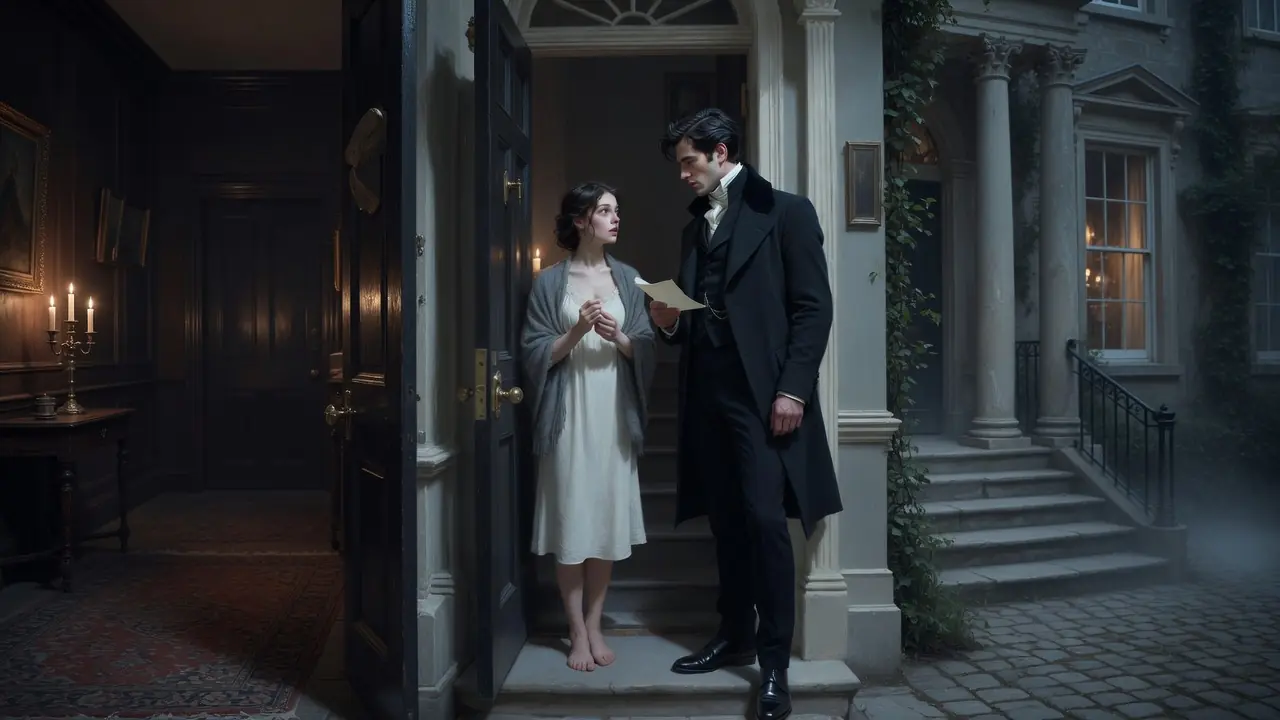
Vivian Calloway had exactly three minutes to decide whether to pretend she was not home. She stood in the middle of her bedroom, barefoot on the cold floor, her dark hair loose around her shoulders, her nightgown plain and unadorned. The candle on her writing desk had burned itself to a stub. The rest of the house was dark.
It was 10 minutes past 2:00 in the morning, and somewhere downstairs, the Duke of Warwick was standing at her front door. Her housekeeper, Mrs. Fenwick, had come upstairs with wide eyes and a voice pulled tight with alarm. She had whispered the words like they were dangerous. The Duke. Outside. Waiting.
And Vivian had stood very still, gripping the bedpost, trying to breathe normally. She had not managed it. She pulled a shawl around her shoulders, lit a second candle from the dying first one, and then moved toward the stairs. Her feet made no sound on the carpet.
The house felt different at this hour. Smaller. Closer. Like the walls had drawn in while she was sleeping. She could hear the wind outside, and beneath it, faintly, the restless shift of horses.
Mrs. Fenwick was at the bottom of the stairs, holding her own candle, her gray hair pinned hastily, and her face pale. She looked at Vivian with an expression that asked very clearly whether they should simply bolt the door and pretend the whole thing was a dream. Vivian shook her head once. She walked to the front door.
She opened it. He was taller than she remembered. That was her first thought, which was absurd, because she had seen him standing at various distances at various social events over the past two years. She knew how tall he was.
But standing in her doorway at 2:00 in the morning, with nothing but a thin shawl between her and the night air, he seemed to take up the entire airframe. The Duke of Warwick, Sebastian Greaves, looked at her without speaking. He was dressed for travel, his dark coat still carrying the cold of the night. His cravat loosened slightly at the throat.
His hair was darker than the sky behind him. His face was exactly as she had always seen it in public, composed, unreadable, giving nothing away. But his eyes were different. She had never been close enough before to notice his eyes properly.
They were gray, and they were not calm at all. He held something in his left hand. A letter. Her letter.
She recognized it immediately because she had written it herself on the pale ivory paper she kept in her writing desk, in her own hand. The ink had smeared slightly on the third line because she had been crying when she wrote it, and had not realized it until a tear hit the page. He did not hold it up to show her. He simply held it at his side as though he had been holding it for some time and had forgotten to put it down.
Neither of them spoke for a long moment. The wind moved between them. Then he said quietly, “May I come in?”
His voice was lower than she had expected. Not cold, not commanding. Just low and careful, like someone trying not to startle something. Vivian became very aware that she was in her nightgown, that her hair was unbound, that her feet were bare, that Mrs. Fenwick was standing eight feet behind her, holding a candle with the expression of a woman watching a carriage heading toward a cliff, and that she had absolutely no idea what to say.
She stepped aside. He came in. Mrs. Fenwick shut the door behind him, and the wind was gone. And the four of them, Vivian, the Duke, the housekeeper, and the silence, stood in the front hallway of the small townhouse that Vivian shared with her sister while their parents remained at the family estate in the country.
“Perhaps the sitting room,” Vivian said. Her voice came out steadier than she felt. He nodded. She let him in.
She set her candle on the mantel. She did not sit down because she did not trust her legs to keep working if she did. She stood near the fireplace, which had gone cold hours ago, and she faced him. And she waited.
He stood in the center of the room. He looked around once, briefly, not with curiosity, but with the careful attention of someone who was trying to get their bearings. Then he looked back at her. He held up the letter.
“This came to me three days ago,” he said. “It was bundled with correspondence addressed to my solicitor. I assumed at first it was misdirected. I set it aside.”
A pause. “Then I read it.”
Vivian said nothing. There was nothing to say that would make this better. “I read it several times,” he said.
She felt heat rise in her face and was grateful for the dark. “I spent two days trying to determine who sent it,” he continued. “The handwriting was unfamiliar. There was no name, no seal, nothing to identify the sender.”
Another pause. “I had almost decided to let it go.”
“But you didn’t,” she said.
“No.” He looked at her. “Your sister brought a bouquet of flowers to Lady Marrow’s afternoon gathering yesterday. She wrote a note to accompany them. Lady Marrow showed it to her daughter, who showed it to her companion, who is acquainted with my secretary.”
He stopped. “The handwriting matched.”
Vivian closed her eyes for exactly one second. Her sister. Her careless, warm, rushing sister who had grabbed the wrong bundle of letters on the way out the door and sent the most private thing Vivian had ever written directly to the most powerful man in London. And then had helpfully provided a sample of the family handwriting to complete the trail.
“Miss Calloway,” he said.
She opened her eyes. He was still holding the letter. He was still looking at her with those gray eyes that were not calm. And he said very quietly, “Why did you write it?”
She had prepared for many versions of this moment in the three days since she realized the letter was gone. She had prepared for anger. She had prepared for a cold dismissal. She had even, in her most dramatic imaginings, prepared for something like contempt.
For the way he was looking at her like the answer mattered. She said the only true thing she had left. “Because it was 2:00 in the morning and I did not think anyone would ever read it.”
Something shifted in his face. Just slightly. Just enough that she caught it before he could put it back where it belonged. He looked down at the letter in his hand.
He looked at it for a long moment. Then he folded it carefully along the same creases it had already been folded into. And he placed it inside his coat pocket. He said, “You wrote that you thought I was the loneliest person in any room I entered.”
She did not deny it. “You wrote that you wished someone would stand beside me not because of my name.”
She still did not speak. He looked at her. “No one has ever said that to me. Not once. Not in any letter or any conversation or any room I have entered in the last 15 years.”
The candle on the mantel burned between them. The house was perfectly silent. Outside, one of the horses shifted and went still again. Vivian felt something in her chest that she did not have a word for.
It was not quite hope. It was heavier than hope and older and more frightened. She said, “I am sorry for the intrusion. It was never meant to reach you.”
“I know,” he said. “That is why I believed it.”
He stayed for 11 more minutes. They did not sit. They did not move from opposite sides of the cold fireplace. They spoke in low voices about nothing that mattered.
The weather, the lateness of the season, the state of the roads from his estate to London. Ordinary things. Safe things. But when he left, he paused at the front door.
He looked back at her once. And he said, “Miss Calloway, would you be at home tomorrow afternoon?”
She looked at him. “Yes,” she said.
He nodded. He went out into the dark. Mrs. Fenwick shut the door. The sound of the carriage faded down the street.
Vivian stood alone in the hallway for a long time. Then she sat down on the bottom stair, pulled the shawl tight around her shoulders, and stared at the closed door. She had no idea what she had just agreed to. She was not entirely certain she cared.
The morning arrived with the particular cruelty of mornings that follow sleepless nights. Vivian had managed perhaps two hours before the household began to stir. She heard the cook downstairs, the rattle of the grate, the smell of coal smoke drifting under her bedroom door. She lay on her back and stared at the ceiling and went over every single word of the previous night until she had worn them smooth.
Her sister, Harriet, appeared in her doorway at half past 8:00 with a piece of toast and an expression of shining oblivious innocence. Harriet was 20, two years younger than Vivian, with fair hair that curled without effort and a temperament that found almost everything in life delightful. She was the kind of person who walked into a room and made it warmer. She had no idea what she had done.
“You look terrible,” Harriet said cheerfully, dropping onto the edge of the bed and offering the toast.
“Thank you,” Vivian said.
“Did you not sleep? I heard Mrs. Fenwick moving about quite late. Was something wrong?”
Vivian looked at her sister. She looked at the toast. She took a very deliberate breath. “Harriet,” she said.
“When you took the letters to the post three days ago, do you remember which bundle you took?”
Harriet thought about this. “The ones from your writing desk, I think. You had asked me to take care of them before I left.”
“I asked you to take the letters on the small tray beside the window.”
“Yes. That is what I took.”
“The tray beside the window had three letters on it,” Vivian said carefully. “Two were meant for the post. One was not.”
Harriet blinked. “Oh.” A pause. “Oh dear.”
“The one that was not meant for the post was written on ivory paper. It was folded twice. It had no seal.”
Harriet’s expression moved through several stages. Realization. Concern. A flicker of something that was almost, not quite, but almost amusing, which she quickly suppressed when she saw Vivian’s face.
“Who was it addressed to?”
Vivian told her. The toast fell off the plate. Harriet stared at her sister with her mouth slightly open.
“The Duke of Warwick.”
“Yes.”
“Sebastian Greaves.”
“The Duke.”
“Yes, Harriet.”
“The one who never smiles.”
Vivian pressed her fingers to her forehead. “He smiled last evening, actually. Briefly. Once.”
Harriet made a sound that was not quite a word. Then she sat up very straight. “Last evening? Vivian, what do you mean last evening? And did something happen last evening?”
Vivian told her about the carriage, the door, the gray eyes that were not calm, the letter in his hand already folded and refolded until the creases had gone soft. She told her sister all of it, including the last thing he had said before he left. By the time she finished, Harriet had forgotten entirely about the toast on the floor.
She was sitting cross-legged on the bed, both hands pressed over her mouth, watching Vivian with enormous eyes. “He’s coming here today,” Harriet said.
“This afternoon.”
“To this house.”
“Yes.”
“Because you wrote him a letter that said he was the loneliest man in London.”
“That is not precisely what I wrote.”
“That is precisely what you meant.”
Vivian did not argue with that. Harriet was quiet for a moment. Then softly, “Viv, you have been watching him for two years.”
“I have not been watching him.”
“You told me last winter that you had memorized the exact way he stands when he is bored at a dinner party versus when he is genuinely listening.”
Vivian looked at her. “That is watching someone, Viv.”
Vivian looked at the ceiling again. Harriet reached over and took her hand. “What are you going to say to him when he comes?”
“I have no idea.”
“Are you frightened?”
She thought about it honestly. “I was frightened last night,” she said. “Now I am something else. I am not sure what.”
“Curious,” Harriet said gently.
“Perhaps.”
“He came himself at 2:00 in the morning. He did not send a letter. He did not send a solicitor. He did not ignore it. He came by himself.”
“I know.”
“That means something, Vivian.”
Vivian sat up and pushed her hair out of her face. She had a great deal of thinking to do. And very little time to do it in.
By 1:00, she had dressed in her best day dress, brushed and pinned her hair, and positioned herself in the sitting room with a book she had absolutely no intention of reading. Mrs. Fenwick had straightened the room twice and rearranged the flowers in the vase on the side table once. Harriet had offered to disappear entirely or alternatively to sit in the corner and not say a word. And Vivian had chosen the former.
At half past one, the knock came. It was not the knock of a man who was uncertain about his welcome. It was quiet, unhurried, and precise. Three times, no more.
Mrs. Fenwick opened the door. The Duke came in. He was dressed differently from the night before. Still formal, still immaculate, but without the travel dust and the road-worn edges.
He looked like the man she had seen at parties, polished and contained, except that now she had seen the version of him that knocked on doors at 2:00 in the morning with crumpled letters in his hand, and she could not entirely unsee it. He was not alone. Behind him came a woman Vivian did not recognize. She was perhaps 50, with silver-streaked hair and a composure that matched the Duke’s almost exactly.
Her posture was perfect. Her gaze was sharp and intelligent and moved around the sitting room quickly before settling on Vivian with something that was not quite assessment but was close to it. “Miss Calloway,” the Duke said. “May I introduce Mrs. Alderton. She is my father’s sister. She accompanies me as a matter of propriety on social calls of this nature.”
Mrs. Alderton inclined her head. Her expression was careful and entirely unreadable. Vivian understood at once. He had brought a chaperone.
Not because society required it for a call of this kind exactly, but because he was the Duke of Harwick, and he was standing in the sitting room of an unmarried woman whose letter he had received, and he had been precise and deliberate about every detail of how he arrived. He had thought about how this would look. He had arranged it properly. She found that she respected him for it enormously.
“Please sit down,” she said. “Mrs. Fenwick will bring tea.”
They sat. Mrs. Alderton took the chair nearest the window and produced a small piece of needlework from her bag with the efficiency of a woman who had spent decades performing the role of chaperone and had learned to make herself simultaneously present and invisible. The Duke sat across from Vivian. In the daylight, with a full night between her and the shock of his arrival, she was able to look at him more steadily.
He was not handsome in the conventional way that young men at balls were handsome. He was older than that, 34 or 35, with a face that had been shaped by weather and thought and things that had not been easy. There was a small scar near his left jaw that she had never been close enough to notice before. “I hope I have not caused you distress,” he said.
“My arrival last night was irregular.”
“It was,” she agreed. “But I understand why you came.”
“Do you?”
“The letter required a response that a written reply could not give. You wanted to see if the person who wrote it would flinch.”
He looked at her for a moment. “And did you flinch?”
She met his eyes directly. “I almost didn’t open the door.”
“But you did.”
“Yes.”
Something in his expression shifted again, the way it had the night before, brief and quickly controlled. She was beginning to recognize it as the closest he came, in public at least, to showing what he actually felt. He said, “I would like to ask you something, and I would like you to answer honestly.”
“I will try.”
“In the letter,” he said carefully, “you wrote about observing me. Over what period of time?”
It was not a comfortable question, but she had already written him the most honest thing she had ever put on paper, and pretending otherwise now seemed absurd. “Two years,” she said. “Perhaps a little more.”
A pause. “Why?”
She thought about how to answer that. The simple version, the one that would not humiliate her further and would still be true. “Because you seemed real,” she said at last.
“At parties, at dinners, everyone performs. Everyone is careful and polished and says the right thing, but you were just there. You were not performing. You were simply enduring it, and I found that I kept looking for you in every room because it felt like proof that something real still existed in those spaces.”
The room was very quiet. Mrs. Alderton’s needlework needle paused for exactly one second. The Duke said nothing for a long moment. He looked at his hands.
Then he looked up at her. “Miss Calloway,” he said. “I buried my wife four years ago. I have spent the time since then being very careful not to want things.”
She did not speak. She let him finish.
“I read your letter 14 times,” he said. “And then I came here.”
The tea arrived. Mrs. Fenwick set it down with the focused attention of a woman pretending she had not heard a single word of the last three minutes. She poured and withdrew. Vivian handed the Duke his cup.
Their fingers did not touch, but they came very close. He stayed for precisely one hour. They talked about his estate in the north, her family’s home in the country, her work translating French correspondence for a publication that most people in their circle considered slightly unusual as an occupation for a woman of her background, and a small, peculiar argument about whether Keats was overrated, in which she held her ground, and he almost smiled twice.
When he stood to leave, he paused again, the way he had the night before. It seemed to be something he did naturally, pausing at exits, standing in doorways for one extra moment before committing to departure. “I have been invited to the Thurston musical next Thursday,” he said.
“As have I,” Vivian said.
“I expect it will be dull.”
“Almost certainly.”
“I expect,” he said in that low, careful voice, “that I will look for you when I arrive.”
He left before she could respond. Mrs. Alderton paused at the door, needlework tucked under her arm, and looked back at Vivian with those sharp, intelligent eyes. She did not say anything, but the look said a great deal. Vivian stood in the sitting room after the door closed and held her own hands together to keep them from shaking.
She had a week until the Thurston musical. She was already counting the days.
The Thurston musical was held in a townhouse on Grosvenor Square that was large enough to make Vivian’s feel like a cottage. Mrs. Thurston collected guests the way some women collected porcelain. She wanted variety, quantity, and the right names in the right chairs. The invitation list ran to 60 people, and by the time Vivian arrived with Harriet on Thursday evening, the front rooms were already warm with candlelight and conversation and the particular noises of a crowd that had dressed carefully and intended to be noticed.
Harriet had worn her best cream evening gown and had pinned her hair up with the pearl combs their mother had sent from the country. She looked lovely and knew it and was not embarrassed about her knowing it, which was one of the things Vivian admired most about her sister. Vivian had spent considerably longer than usual at the mirror. She had not admitted this to anyone, including herself, until she was already dressed and sitting in the carriage, and Harriet glanced at her sideways with a small, knowing smile and said nothing at all.
They were greeted at the door by Mrs. Thurston, a broad and energetic woman in her late 50s, who took both of Vivian’s hands as if they were old friends and said something warm and indistinct about being so pleased. Then they moved into the main reception room. Vivian did not look for him immediately. She greeted three acquaintances, accepted a glass of lemonade from a passing footman, commented to Harriet on the flower arrangements, and then, when she had given herself enough time to seem unhurried, she looked.
He was standing near the far window. Of course he was. And he was talking to a man she recognized as Lord Pemford, one of the older peers with a house in Yorkshire and an opinion about everything. The Duke was listening.
His expression was the one she had cataloged mentally over two years as his polite endurance face, attentive enough to be courteous, distant enough to be honest. Then he looked up. Across the entire length of the crowded room, through the candlelight and the movement of 60 people in evening clothes, he found her eyes in approximately four seconds. She did not look away.
Neither did he. Lord Pemford was apparently still talking. The Duke was no longer listening.
Harriet appeared at Vivian’s elbow. “He found you immediately,” she murmured. “That is promising.”
“He is simply looking around the room.”
“He is looking at you. There is a difference, Viv. Why don’t you know it?”
Vivian took a sip of her lemonade. The musical program began at 8:00. Mrs. Thurston had engaged a soprano from the Italian opera who performed three pieces with considerable drama and genuine talent, followed by a young pianist who played Schubert with more enthusiasm than precision. The guests arranged themselves in the long gallery, seated in rows of gilded chairs, and Vivian found herself four rows from the front with Harriet on her left and a woman she vaguely recognized on her right.
The Duke was seated two rows behind her and slightly to the left. She knew this because she had looked back once, pretending to glance at the room, and found him already watching her. During the intermission, guests stood and circulated, and Mrs. Thurston directed footmen with trays of champagne through the crowd with military precision. Vivian was speaking with Mrs. Golightly, a cheerful widow with a genuine interest in French literature, when she became aware of a shift in the immediate atmosphere that she had learned to associate with his presence.
She turned. He was three feet away. “Miss Calloway,” he said. His voice was perfectly level.
His eyes were not. “Your Grace,” she said.
Mrs. Golightly looked between them with bright, curious eyes and said something about needing to find her companion and disappeared with the smooth efficiency of a woman who understood social situations very well. They were not alone. They were in the middle of 60 people, but somehow the six feet of space around them felt private. “The soprano was excellent,” Vivian offered.
“She was,” he agreed. “The pianist needs more practice.”
“He is perhaps 16.”
“Sixteen-year-olds can practice.”
She almost laughed. She pressed her lips together and looked at the painting on the wall beside them, a large pastoral scene with improbable sheep. “You are harder on him than he deserves.”
“I am harder on most things than they deserve,” he said. A pause. “So I have been told.”
She looked back at him. He was watching her with that careful attention she had noticed at the door. Up close, in the warm candlelight, the gray of his eyes had more depth than she had first realized. There were lines at their corners that came from sun and wind more than age.
“I have been thinking,” he said quietly. “About what you said on Tuesday. About watching someone because they seem real.”
“I did not mean it as an intrusion,” she said.
“I know. That is not why I have been thinking about it.” He paused. He looked at the improbable sheep for a moment. “I have been thinking about it because I could not remember the last time someone described me as real.”
“I am usually described as formidable or cold or difficult. Occasionally impressive. Never real.”
“Those are all defenses,” she said. “Real is what is underneath them.”
He looked at her. She had not meant to say that quite so plainly.
“Yes,” he said very quietly. “It is.”
The second half of the program was about to begin. Mrs. Thurston was directing guests back toward the gallery. The crowd shifted around them. He said, “I am riding in the park on Saturday morning. Early, before the fashionable hour. The paths near the East Gate are quiet.”
She looked at him steadily. “Are you inviting me to ride in the park, Your Grace?”
“I am mentioning,” he said carefully, “that I will be there. What you do on Saturday morning is entirely your own affair.”
The smallest, most controlled smile she had ever seen crossed his face. It lasted perhaps two seconds. Then it was gone and he was the Duke again. Composed and contained.
But she had seen it. “I enjoy an early ride,” she said.
He inclined his head. He moved back toward his seat. She moved toward hers. Harriet, who had managed to position herself close enough to observe the entire conversation without appearing to, materialized at Vivian’s side as she sat down.
“Saturday morning,” Harriet breathed.
“Not a word,” Vivian said.
Harriet pressed her lips together. She lasted exactly 40 seconds before she whispered, “He smiled.”
Vivian did not answer. But she was looking straight ahead at the stage and she was not thinking about the pianist at all.
Saturday arrived with clean autumn air and a sky the color of pewter turning slowly to silver. Vivian was at the East Gate of the park at half past 7:00. She had brought her own horse, a calm gray mare named Delphi, and a groom who understood that his job this morning was to ride at a discreet distance and notice nothing. The Duke was already there.
He was mounted on a dark bay that moved with the controlled energy of a horse that wanted to run and was being asked to wait. He was in riding clothes, darker and less formal than his usual dress, and the difference made him look somehow less constructed, more like the man who knocked on doors at 2:00 in the morning. He saw her and brought his horse alongside hers without ceremony. They rode.
For the first several minutes they said almost nothing. The park was beautiful at this hour, the paths empty, the trees holding their last autumn color overhead. Their horses fell into an easy pace together and the silence was not uncomfortable. It was the kind of silence that exists between people who are paying close attention to each other and do not need to fill the space.
“You said eventually. You translate French correspondence.”
“I do.”
“For a quarterly journal.”
“Mostly political essays. Occasionally literary.”
“Do you enjoy it?”
“Very much. It gives me something to think about that is entirely my own.”
He glanced at her. “Your family disapproves?”
“My mother considers it eccentric. My father considers it harmless. Harriet considers it admirable.” A pause. “I consider it necessary.”
“Why necessary?”
She thought about how to answer. “Because I am 22 and unmarried and live in a townhouse in London with my younger sister and attend musicals. If I did not have work that required genuine thought, I think I would lose something important.”
He was quiet for a moment. “What would you lose?”
“Myself,” she said simply.
The path curved around a small pond. A family of ducks moved across the water with great dignity and no particular destination. “My wife,” he said carefully, in the way of someone stepping onto uncertain ground, “was 20 when we married. She was accomplished and kind. And we were reasonably well suited.”
“She died of a fever four years ago. It was sudden. Three days from the first symptom to the last.” He paused. “I say this not because I want your sympathy. But I say it because you have been honest with me. And I would like to be honest with you.”
Vivian listened. “I closed a great deal of myself afterward,” he said. “I was not conscious of doing it. But I stopped looking for things. I stopped expecting anything from social occasions or from people. I appeared where I was required to appear, and I endured it, and I went home.”
A pause. “And then I read a letter from a woman I had never spoken to, who said I looked like the loneliest person in the room.”
“I am sorry if it caused you pain,” she said.
“It did not cause pain,” he said. “It caused something else. Something I had not felt in quite some time.” He looked ahead down the path. “Something I was not entirely prepared for.”
She did not ask him to name it. She understood. They rode in silence for another few minutes. The silver sky was beginning to warm at the edges.
Somewhere behind them, her groom was riding at the required discreet distance, probably cold and wondering how long this was going to take. He said, “I am not a simple man to know. I want you to understand that. I am demanding, and I am private, and I’ve been told I am impossible to read.”
“I can read you,” she said.
He looked at her.
“Not always,” she added honestly. “But more than most people can, I think.”
“That,” he said quietly, “is either reassuring or very dangerous.”
“Perhaps both,” she said.
And something passed between them in the cool morning air. Something that had no name yet, but was already too large to ignore. It settled around them like the light settling across the water. Warm and patient and absolutely certain of itself.
He did not reach for her hand. He did not say anything that could not be repeated in polite company. He simply rode beside her until they reached the East Gate again. And when they parted, he held her gaze for one long moment.
“Miss Calloway,” he said.
“Your Grace.”
“Thank you for the ride.”
She rode home with her cheeks cold and her chest full of something she had no safe language for yet. Harriet was waiting at the door before Vivian had even dismounted. And one look at her sister’s face sent Harriet into a small, private, completely contained celebration that mostly expressed itself as a single sharp squeeze of both hands.
Vivian went inside. She sat at her writing desk. She did not write anything. She simply sat there with her hands flat on the surface where the letter had been written in the small hours of a night that felt like another lifetime.
And she breathed.
Three days after the ride in the park, a letter arrived for Vivian with the Harwick seal. She did not open it immediately. She held it for a moment, the way you hold something that might change things. Carefully, conscious of the weight of it.
Then she broke the seal. It was not a long letter. He was not the man who used 10 words when five would do. But what it said in those few sentences was precise and considered and entirely like him.
He wrote that he had enjoyed their conversation in the park. He wrote that he had a standing engagement at his club on Monday evenings, but that on Tuesday, he intended to attend the exhibition of watercolors at the Langley Gallery on Brook Street if she had any interest in art and happened to find herself in that part of the city. He had not asked her directly. He had simply mentioned where he would be.
But she smiled at the letter for a private moment. Then she folded it and placed it in the drawer of her writing desk alongside the other things she kept that mattered. On Tuesday afternoon, she arrived at the Langley Gallery at 2:00. She was not alone.
She had brought Harriet, which was both practical for propriety and inadvisable because Harriet was constitutionally incapable of subtlety when she was excited. She had also told Mrs. Fenwick where they were going, which meant that by evening, the cook would know as well, and probably the woman next door. But that was simply the nature of small households. The gallery was a long, narrow space with good light from the upper windows and a pleasant smell of beeswax and old paper.
The watercolors were landscapes, mostly, with a few portraits and one remarkable series of coastal scenes that had a quality of light Vivian found genuinely beautiful. She was standing in front of the third coastal scene when she heard footsteps she had, apparently, already learned to recognize. He appeared at her left side. “The cliffs are wrong,” he said by way of greeting.
She looked at the painting. “I beg your pardon.”
“The angle. He has painted them from a position that would require standing in the water, which is possible, but unlikely.”
“Perhaps he had very tall boots.”
He made a sound that was not quite a laugh, but was in the same family. “Perhaps.”
Harriet, who had been examining a landscape two paintings over, suddenly became very interested in something at the far end of the gallery. She did not look back. But Vivian owed her an enormous debt that she would be paying off in small installments for years. “The coastal series is the best of the collection,” Vivian said.
“The interior landscapes are competent, but they lack something.”
“Feeling,” he said.
She looked at him.
“The coastal work has a feeling in it,” he said. “The rest is technically correct. Technically correct and genuinely felt are not the same thing.”
“No,” she agreed. “They are not.”
They moved slowly through the gallery. Not quickly, not with any performance of purpose. They simply walked and looked and spoke in quiet voices about what they saw. And it was the most natural thing she had experienced with him so far.
Easier than the sitting room, easier than the park, because the paintings gave them somewhere to put their attention when the conversation required breathing space. And he knew considerably more about art than she had expected. He spoke about technique and composition with the precision of someone who had spent real time looking and thinking, not simply collecting. “You paint,” she said.
He glanced at her. “Why would you think that?”
“Because you describe it the way people describe things they do themselves, not as an observer, as a practitioner.”
A pause. “Poorly,” he said. “I paint poorly. But yes.”
“What do you paint?”
“Landscapes, mostly. Nothing worth showing anyone.”
“But you keep doing it.”
“Yes.”
“Because it requires genuine thought that is entirely your own,” she said.
He stopped walking. He looked at her. She had just used his own words back at him. The ones she had said in the park that she had not realized she was echoing until they came out.
Something in his face did the thing it did, the brief, unguarded shift, and this time, it lasted a little longer before he put it away. “Yes,” he said quietly. “Precisely because of that.”
They had reached the end of the gallery. Through the window, the street outside was busy with afternoon traffic and the indifferent noise of the city. He said, “I would like to call on you properly, with the correct formality. I would like to speak with your father.”
Vivian went very still. “My father is in the country,” she said carefully.
“I am aware. I am prepared to travel there if he will receive me.” A pause. “I want to do this correctly, not because I am required to, but because you deserve to have it done correctly.”
She turned to face him fully. He was looking at her with the steadiness she had come to associate with the moments when he was being most honest. No performance. No distance. Just the gray eyes and the careful words.
“You have known me for less than two weeks,” she said.
“I have known you considerably longer than that,” he said. “I simply had not spoken to you yet.”
She stared at him. “What do you mean?”
He was quiet for a moment. A very deliberate, measured moment. “You mentioned that you had been watching me for two years. Observing. Noticing things about me that most people do not.”
He paused. “I was not always unaware of you, Miss Calloway.”
She felt something cold and warm at the same time move through her chest. “You never spoke to me,” she said.
“No. I was being careful. I was not ready to stop being careful.” A pause. “Your letter made it impossible to continue.”
Harriet had appeared silently at the edge of the room, far enough away to be proper, but close enough to confirm that she was absolutely absorbing every word with the focused attention of someone who planned to replay this conversation for the rest of her life.
Vivian said, “If you speak to my father, he will ask you your intentions.”
“Yes. I expect he will.”
“What will you tell him?”
He looked at her for a long, unhurried moment. “I will tell him that I have read a letter that convinced me I had been wrong to stop wanting things. And that I would like, with his permission and yours, to explore whether the person who wrote it might be willing to tolerate me in a more permanent arrangement.”
She breathed once, slowly. “That,” she said, “is perhaps the most restrained proposal of intent I have ever heard.”
“I am a restrained man.”
“You knocked on my door at 2:00 in the morning.”
“I am,” he said, with the absolute ghost of that smile, “occasionally flexible.”
She looked at him for a long moment. The gallery was quiet around them. The coastal paintings with their improbable cliffs watched them from the walls. “Write to my father,” she said.
“His name is Mr. Edmund Calloway. The estate is Thornfield Park in Wiltshire.”
He nodded. “I will write tomorrow.”
“He will likely write back within a week.”
“Then I will wait a week.”
She held his gaze. “And if he says yes?”
“Then,” he said, “we will have a great deal more to talk about.”
He left the gallery first, after bidding farewell to Harriet with the formal courtesy of a man who had remembered she existed and felt appropriately apologetic about the fact that he had spent most of the afternoon forgetting. Harriet accepted this with gracious delight and immediately turned to Vivian the moment the door closed.
“He noticed you first,” Harriet said. “He noticed you before any of this. Vivian.”
“I know,” Vivian said.
“He is going to write to Father.”
“I know.”
“Father is going to say yes. You know Father is going to say yes.”
Vivian looked at the coastal paintings one more time. The cliffs with their improbable angles. The painter who had perhaps stood in the water to see what could not be seen from the safe dry shore. “Yes,” she said, “I know.”
She was smiling when she said it.
The letter from her father arrived on a Wednesday morning, eight days after Sebastian had written to Wiltshire. Vivian was at her writing desk translating a particularly dense French political essay when Mrs. Fenwick brought it up on a small tray with the morning post. She saw her father’s handwriting on the outside and set down her pen immediately. The letter was two pages long, which was unusual.
Her father was a man of few written words. He preferred conversation, preferred sitting across a table and reading a person’s face rather than their sentences. Two pages meant he had felt strongly enough to sit down and work through his thoughts in full. She read it slowly.
He had received the Duke’s letter. He had read it three times. He had then, characteristically, gone for a long walk around the estate before writing his reply, because her father made no significant decision without first consulting the open air. He wrote that he found the Duke’s letter direct and honest, which he respected.
He wrote that he had made inquiries discreetly about the Duke’s reputation and character, and that what he had learned had satisfied him on the important points. He wrote that he had some reservations, not about the Duke himself, but about the speed of things, and that he wanted to see Vivian in person before any formal understanding was reached. Then, on the second page, he wrote something that made her eyes fill without warning. He wrote that he had always known Vivian was the kind of person who felt things deeply and noticed things others missed.
He wrote that he had sometimes worried this made the world harder for her than it needed to be. But when he wrote that if there was a man who had read her words and come to her door at 2:00 in the morning because he could not stay away, then perhaps the world had finally caught up to what his daughter deserved. He asked her to come home to Wiltshire for a fortnight. Vivian folded the letter and held it against her chest for a moment.
Then she went downstairs and told Harriet to begin packing. Thornfield Park in Wiltshire was not a grand estate. It was comfortable and slightly worn at the edges in the way of houses that were genuinely lived in rather than maintained for appearance. The gardens were her mother’s territory and showed it, abundant and slightly overgrown in the most beautiful possible way.
The house smelled of wood smoke and old books and the particular combination of scents that Vivian associated entirely with safety. Her parents were both waiting in the front hall when the carriage arrived. Her mother, a small energetic woman named Frances, who had opinions about everything and expressed them freely, took one look at Vivian’s face and said, “Oh, it is serious.”
Her father, tall and gray-haired with her own dark eyes set in a kind face, simply put his arms around her and said nothing for a moment, which was, as always, exactly right. They had dinner that evening with the family gathered around the long table in the dining room. Present alongside her parents and Harriet were her older brother, Thomas, who had come up from his own house nearby with his wife, Clara, a sensible and warm woman who had been part of the family for four years and felt entirely like she had always been there.
Also present was Thomas’s close friend and nearest neighbor, Mr. Philip Daunt, who was spending a few days at the estate and had the good-natured sociability of someone who is always welcome precisely because he never imposes. Vivian had forgotten how noisy her family was when assembled together. There were always at least two conversations running simultaneously at the dinner table, and her mother had the gift of following both while conducting a third.
Her father waited until after dinner, when the table had cleared and the younger members of the party had moved to the drawing room, to sit with Vivian alone in his study. The fire was lit. Two cups of tea sat on the table between them. Her father’s study had not changed in 20 years.
Same books, same worn armchair, same painting of the river near the north field that had hung above the fireplace since before she was born. He said, “Tell me about him.”
She told him. Not the condensed version she had told other people, but the real one. Beginning from two years ago at the Whitmore ball, when she had first noticed a man standing alone near the window holding a glass he was not drinking from. Through the letter she had never meant to send.
Through the knock at 2:00 in the morning. Through the park and the gallery and everything he had said and not said and the way he looked at her when he thought she was looking away. Her father listened without interrupting, which was one of his finest qualities. When she finished, he was quiet for a moment.
He turned his teacup in his hands. “Are you frightened?” he asked.
“Not the way I was at first,” she said. “Not frightened of him. Perhaps a little frightened of how much I want this to be real.”
“Does it feel real?”
She thought about the way Sebastian had folded her letter along its existing creases before putting it in his pocket. The way he had brought Mrs. Alderton for propriety without being asked. The way he had said in the Langley Gallery that her letter had made it impossible to continue being careful. “Yes,” she said.
“More real than anything I have felt in a long time.”
Her father nodded slowly. He set down his cup. “He wrote to me with a great deal of care,” he said. “Most men in his position would have written something brief and confident. He wrote something considered.”
“He acknowledged the shortness of your acquaintance and said plainly that he was not asking for anything to be rushed. He said he would wait as long as was required to do this correctly.”
“That sounds like him,” she said quietly.
“I liked him for it,” her father said. “I want you to know that before I say what else I need to say.”
She looked at him. “He has had a difficult few years,” her father said carefully. “Grief does things to people. Sometimes it softens them. Sometimes it makes them very good at building walls.”
“I want you to be sure that you are seeing the man and not simply the idea of saving him from his own loneliness.”
She was quiet for a moment. She took it seriously as he intended. “I have thought about that,” she said. “And I do not think that is what this is.”
“I did not write that letter because I wanted to rescue him. I wrote it because I recognized something in him that I felt in myself. Not his loneliness. His realness. The fact that he did not perform.”
She paused. “I am not trying to save him, Papa. I am trying to get to know him.”
Her father looked at her for a long moment. Then he reached across and patted her hand once in the way he had done since she was small when he wanted her to know something was settled. “Then you have my blessing,” he said. “Both in the receiving and the giving.”
She squeezed his hand and could not speak for a moment.
Sebastian arrived at Thornfield Park on Friday. He came in a carriage with Mrs. Alderton and his secretary, a quiet young man named Mr. Graves, who carried papers and said very little. He arrived exactly at the time he had written ahead to confirm, which Vivian noticed and her mother noticed, and they exchanged a brief private glance about.
He was formal in the introduction. But he shook her father’s hand and spoke with the directness that her father valued. He was courteous to her mother, who assessed him within approximately 90 seconds and delivered her verdict to Vivian privately before dinner by saying simply, “He listens when other people speak. That is rare and I approve of it.”
Thomas watched him through dinner with the quiet measuring attention of an older brother who takes his responsibilities seriously. Afterward, while the ladies were in the drawing room, the men sat with their port and Vivian tried not to think too hard about what was being said. Harriet sat beside her on the settee and held her hand without comment, which was the most useful thing anyone could have done. When the men came back, Thomas met Vivian’s eyes from across the room and gave a single small nod.
She breathed. But later that evening, with the house settling into its nighttime quiet and only the drawing room fire still burning, Sebastian found a moment to stand beside her near the window. The others were occupied. The night outside was clear and cold and full of stars.
He said very quietly, “Your father has given his blessing.”
“I know,” she said. “He told me.”
“I have not yet asked you,” he said.
She turned to face him. He was not performing. He was not the composed public duke or the careful strategist of careful words. He was simply there in the firelight with his gray eyes steady and something in his face that was unguarded in a way she had only seen in pieces before.
“Vivian,” he said. Just her name. No title. For the first time, she felt it move through her like something warm and irreversible.
“I am not an easy man,” he said. “But I am asking you to take that on with full knowledge of it. I am asking you to let me try to be worth what you wrote about me. I am asking you to give me the chance to be the person you saw from across a room for two years before I was paying attention.”
She said, “You were paying attention.”
“Not enough,” he said. “I am paying attention now.”
A pause. The fire crackled. Outside, an owl called once from the garden.
“Then yes,” she said. “My answer is yes.”
He reached out and took her hand. His fingers were warm and the grip was certain and it felt like the most honest thing that had ever happened to her.
The engagement was announced in the first week of November. It appeared in the morning papers on a Tuesday, three lines in the social column between a notice about a new assembly room opening in Bath and an advertisement for imported wool. Three lines. Vivian Calloway, daughter of Mr. Edmund Calloway of Thornfield Park, Wiltshire, to Sebastian Greaves, Duke of Harwick.
Three lines for something that had started with a letter she never meant to send. She read those three lines at her breakfast table in London, where she and Harriet had returned to manage the practical business of the engagement, and she felt the precise, quiet weight of a thing becoming real in the world beyond herself. Harriet cut the notice out of the paper with small scissors and placed it carefully in the letterbox, where she kept important things. She did this without ceremony, but with the focused attention of someone preserving something worth keeping.
The weeks that followed were not quiet. Society had opinions, as society always did, and it expressed them freely through morning calls and whispered conversations at evening parties and letters with very thin pretenses of casualness. The Duke of Harwick had been considered thoroughly unavailable for four years. The woman he had chosen was not from the highest tier of society.
She translated French essays for a journal. She had sent him an anonymous letter. That last detail had somehow escaped into circulation in the blurred and embellished way that private things always do in London. By the time it had passed through enough hands, the story was that she had sent him a passionate declaration and he had appeared at her door in the dead of night to declare himself in return, which was, Vivian reflected, not entirely wrong.
She was called upon by women she barely knew who wanted to understand exactly how it had happened. She gave them the polite version and kept the real one close. Sebastian, when she told him about the visiting inquirers, said simply that people were curious about things they could not manufacture themselves and left it at that.
Mrs. Alderton called on Vivian alone one afternoon in November without the Duke and sat across the sitting room tea table with her sharp, intelligent eyes and her needlework tucked under her arm in its perpetual state of partial completion. “I want you to understand something,” Mrs. Alderton said.
“Yes?” Vivian said.
“I have known my nephew since he was 12 years old. I watched him grow up and marry and grieve and close himself away. I have watched many women try to reach him in the years since his wife died. Some were kind. Some were calculated. All of them failed because they approached him from the outside and could not find the way in.”
Vivian waited. “You wrote him a letter that found the door,” Mrs. Alderton said. “You did not even know you were doing it. That is either extraordinary luck or extraordinary perception, and having now spent some time with you, I believe it is the latter.”
She paused. She smoothed the needlework in her lap. “He is difficult,” she continued. “I will not soften that for you.”
“He holds things long past the point when he should let them go. He will sometimes go quiet for days and expect you to understand that it is not about you. He will work too hard and rest too little and argue passionately about things that most people consider not worth the energy.”
“I know,” Vivian said.
“You do not know yet, but you will.” A pause. “What I want you to know, before you walk into that church, is that he is also the most loyal person I have met in my life.”
“When he gives you his trust, it is complete. When he decides something matters, he does not waver. And he has decided that you matter.”
Vivian held her teacup in both hands. She was not going to cry in front of Mrs. Alderton. She was almost certain she was going to cry in front of Mrs. Alderton. “Thank you,” she said.
Her voice was steady. Mrs. Alderton nodded briskly in the manner of someone who has said the important thing and sees no reason to elaborate. She finished her tea. She tucked her needlework more firmly under her arm.
She left. Vivian sat alone in the sitting room for a long time.
The wedding was set for the 15th of December. Her mother came to London with her sister-in-law Clara two weeks before, and the townhouse became considerably louder and more full of fabric samples and opinions. Her mother had views about flowers. Clara had views about the breakfast.
Harriet had views about everything and expressed them with the cheerful authority of someone who knows they are right. Vivian let them manage most of it, which made everyone happy. She had one condition. She wanted the ceremony to be small.
Real small, though not the society version of small, which still meant 100 people and three courses. She wanted the people who mattered. Sebastian agreed without hesitation. They exchanged letters every few days during the weeks of preparation.
He was at Harwick House in Mayfair and she was in the townhouse, and they saw each other at three dinners and one evening at the theater with the full combined force of both families, which was considerably livelier than either of them had individually anticipated. At the theater, during the interval, they found themselves briefly alone in a side corridor while both their families occupied the box. He looked at her in the way he had, direct and unhurried, and said quietly, “Three weeks.”
“Fourteen days,” she said.
“You have been counting, have you not?”
A pause. “Every morning,” he said.
She had not thought it possible to love a sentence that much. The 15th of December arrived the way significant days always do, with the peculiar quality of feeling both enormously important and startlingly ordinary at the same time. She woke early. The house was already awake around her.
She could hear her mother somewhere downstairs and the sound of Harriet singing something private and tuneless in her room next door. Mrs. Fenwick brought her breakfast and sat on the edge of the chair by the window and cried quietly into a handkerchief, which she pretended she was not doing. Vivian dressed with Clara and Harriet helping and her mother appearing at intervals with adjustments and instructions and at one point simply standing in the doorway looking at her daughter with an expression that required no words.
The church was a small one in a quiet square, old stone and high windows that let in the pale December light in long clean angles. The pews held perhaps 40 people. Her father’s family, his. Mrs. Alderton in the front row with her needlework pointedly left behind for once.
Thomas and Clara. Harriet, who had cried already and was determined not to again and wasn’t succeeding. Mr. Daunt, who had somehow become part of the extended occasion without anyone quite arranging it. Mr. Graves, the secretary, sitting very straight with the expression of a man experiencing more emotion than he usually permitted.
A handful of close friends on each side. People who knew the real version of the story. Vivian walked in on her father’s arm. She had looked forward to this moment and thought about it carefully and planned exactly how she would feel, as composed and present and quietly joyful.
And then she saw him standing at the front of the church and all of that planning became completely irrelevant. He was watching her walk toward him with an expression she had never seen on him before. Not the public face. Not the guarded face. Not even the careful, honest face he gave her in private moments.
Something she had no name for. Something that was entirely for her. His gray eyes were bright. He had told her once in the park on a cold autumn morning that he had spent four years being very careful not to want things. Looking at his face now, she could see that carefulness was completely gone.
In its place was something open and certain and entirely undefended. Her father placed her hand in Sebastian’s. His fingers closed around hers. She looked up at him.
He said very quietly, but so that only she could hear, “You should have sent that letter years ago.”
She laughed. One soft, startled, completely real laugh right there in the church. And around them, she heard the gentle ripple of it reaching the people in the pews. Her mother’s small sound. Harriet’s undone attempt not to cry. Thomas clearing his throat.
The ceremony was simple and clear and full of the kind of meaning that does not need ornamentation. They made their promises in steady voices. She held his hand the entire time and he held hers and neither of them let go. When it was done, they walked back down the aisle together through the pale December light coming through the high windows, through the people who loved them, through the sound of the bells beginning above them in the old stone tower.
Outside, the December air was cold and clean. The square was quiet. Their breath rose in small clouds between them. He looked at her on the church steps with the light on his face and something in his expression that was so open and unguarded, it almost hurt to look at.
She thought about a woman sitting alone at 2:00 in the morning with a candle burned to nothing, writing the truest thing she had ever felt onto a piece of ivory paper she had meant to burn. She thought about the knock at her door in the dark. She thought about gray eyes that were not calm at all. And she understood, standing in the cold December light with his hand warm in hers, that the letter had not been a mistake.
It had been the most important thing she had ever done. He lifted her hand and pressed his lips to her fingers, unhurried, certain, real. And the bells rang on above them over the quiet square, over the small church, over the city that had been the backdrop to two years of watching from across rooms and one letter sent by accident and a knock at 2:00 in the morning that had changed everything.
She was home. Not in the house she had grown up in or the townhouse she had shared with her sister, but in the particular feeling of standing beside someone who saw you completely and stayed anyway. She was entirely, perfectly home.